No. 108
Rabbit Skull: Why It Has Lace-Like Holes and How to Identify One
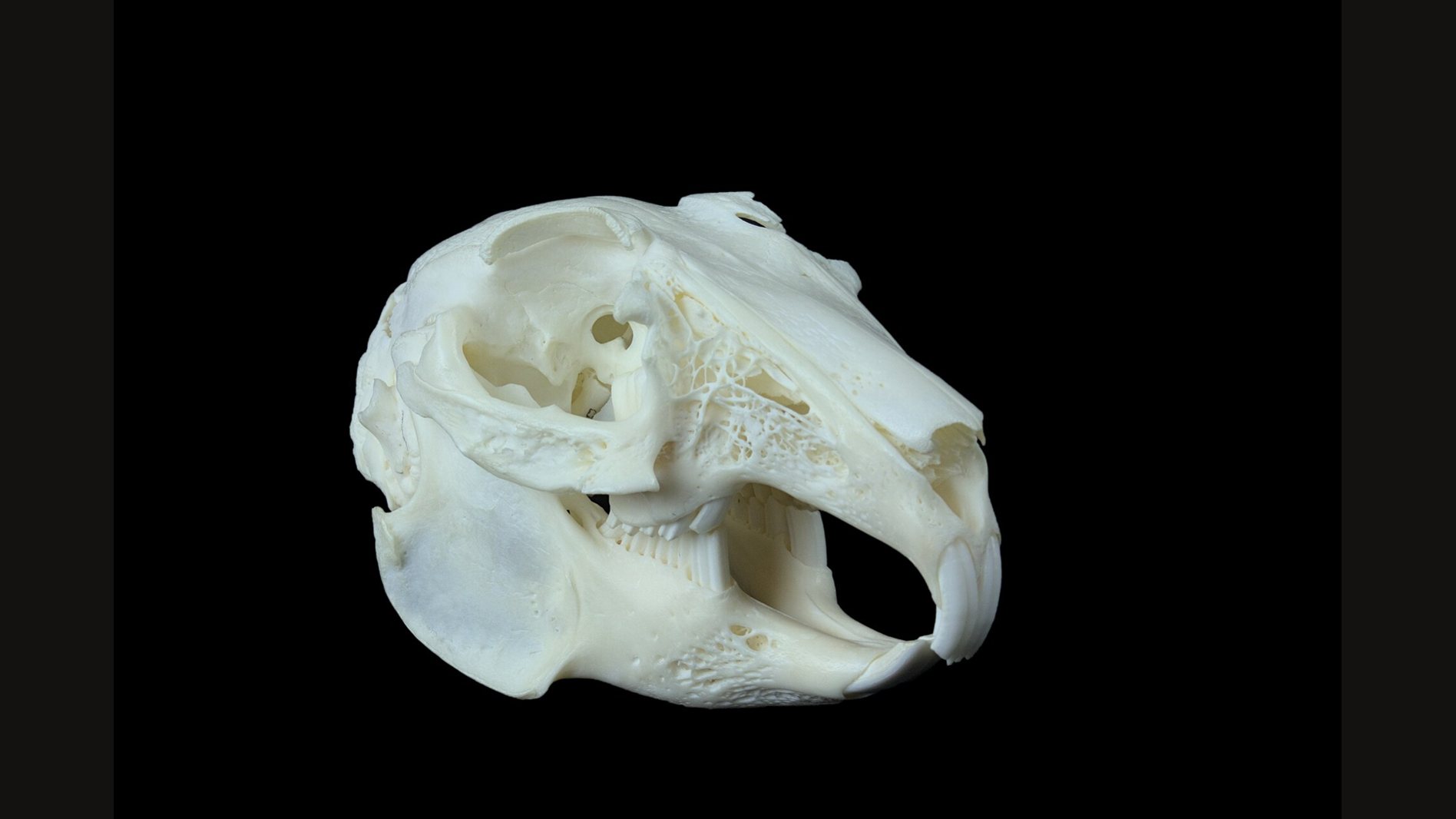
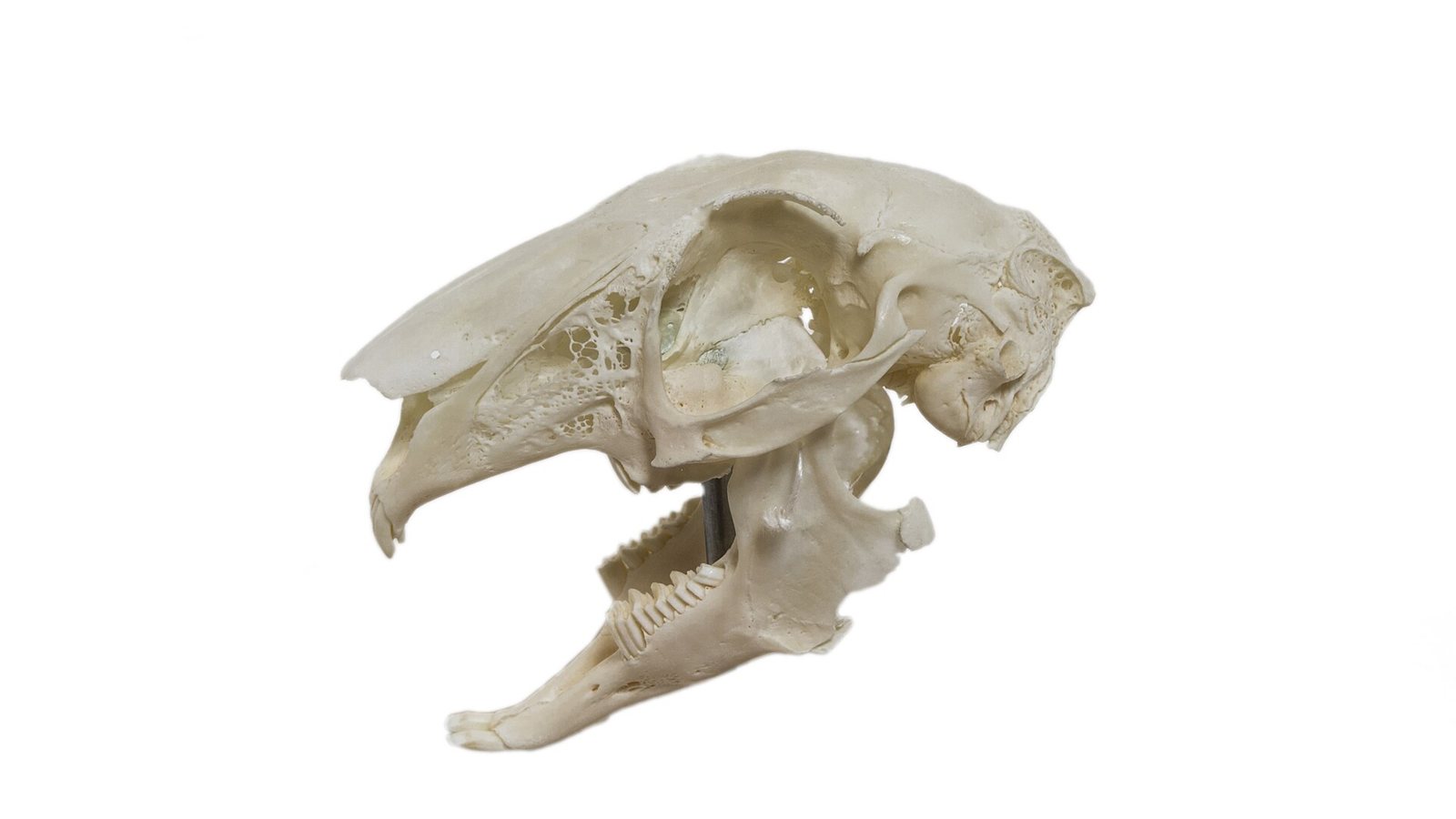
If the skull in your hand is small and light, with lace-like holes along the side of the snout, two big front teeth with two tiny peg teeth tucked right behind them, and a long toothless gap before the cheek teeth, you are holding a lagomorph skull. That is the group of rabbits, hares and pikas. The holes are not damage. They are normal openings called fenestrations, built into the bone of every rabbit and hare.
Telling a rabbit from a hare takes a closer look, at measurements and at one small bony process above the eye. Telling it from a squirrel or a rat is easier: count the upper front teeth.
What a rabbit skull looks like
Take the European rabbit, *Oryctolagus cuniculus*, as the model. Its skull is lightweight and elongated, with large incisors at the front and a long empty stretch of jaw, called the diastema, before the cheek teeth begin. Right behind the two big upper incisors sits a second, much smaller pair, the peg teeth. Along the side of the snout, the bone thins into a delicate web full of openings.
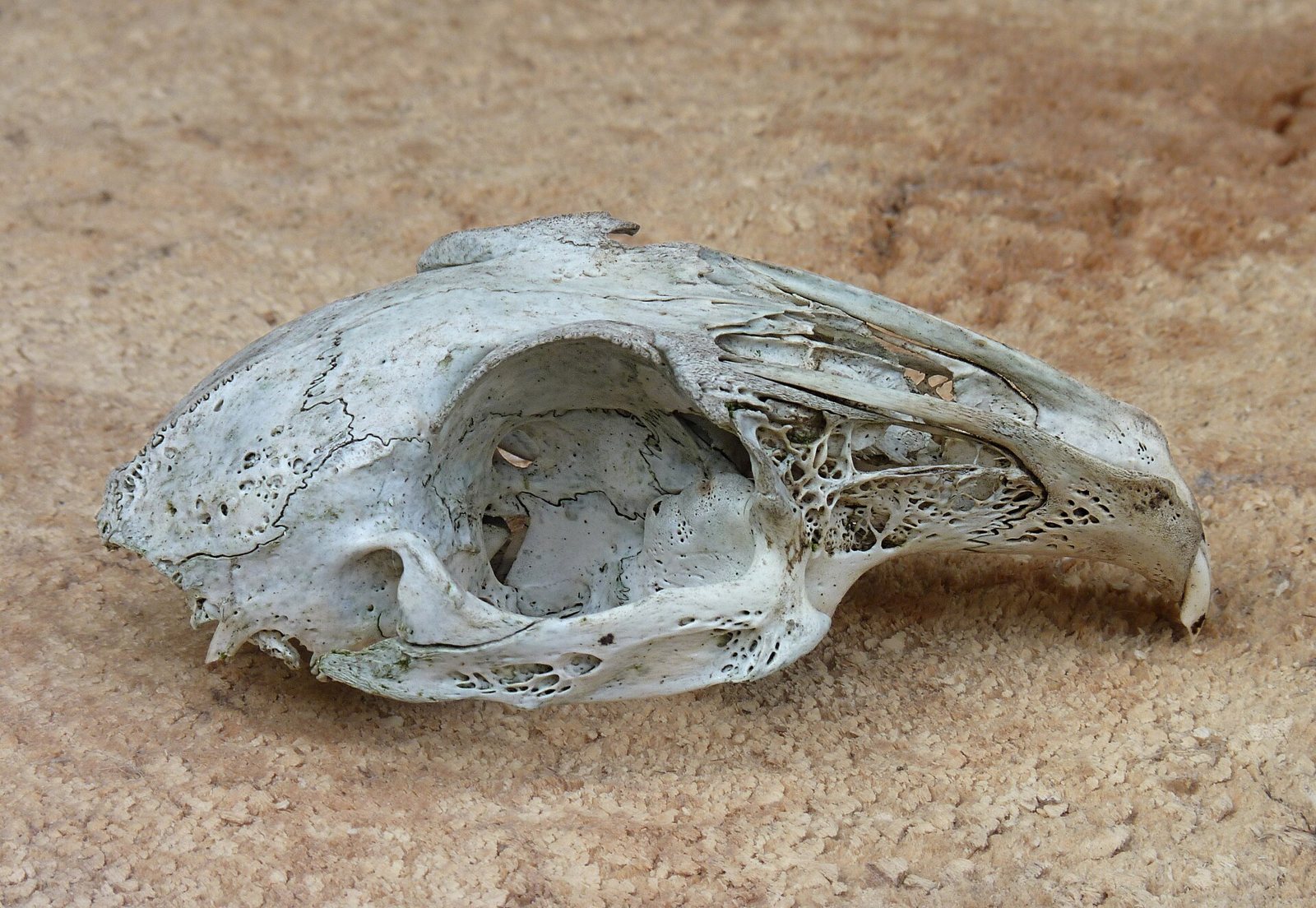
The University of Colorado Museum of Natural History uses one of its own specimens, a black-tailed jackrabbit, *Lepus californicus*, collected on November 28, 1965, to point out exactly those identification features: the diastema and the delicate webbing along the snout. Collections in Spain describe the skull the same way. The paleontology pages of IGME-CSIC on lagomorphs and a rabbit skull model at the Universidad de Granada present it as light and elongated, with a perforated front section, two pairs of upper incisors and a long space between the incisors and the back teeth.
That combination is what the University of Texas at El Paso's account of the Leporidae, the rabbit and hare family, also lists. Keep in mind that the fenestrations and peg teeth tell you "lagomorph", not "rabbit" on its own. A hare carries the same features.
Why the side of a rabbit skull is full of holes
The openings are a normal part of the skull, not a sign that it has been chewed, weathered or diseased. The Florida Museum of Natural History treats them as a standard feature of leporid skulls. In life, the maxilla, the main bone of the upper jaw, and several other skull bones form a light lattice rather than a solid wall.
Why build a skull like that? Amber P. Wood-Bailey and Alana C. Sharp of the University of Liverpool describe leporid skulls as uniquely fenestrated, and in their 2025 study in *The Anatomical Record* they report that the leading explanation is weight: the lattice cuts skull mass while keeping enough bone for the muscles to attach. They tested the idea with a biomechanical model. Filling in the fenestrations changed biting efficiency very little, which supports an explanation tied to how rabbits and hares move, rather than one based only on chewing.
The Natural History Museum of Los Angeles County puts it in terms of the animal's lifestyle, describing the lattice as helping to reduce the impact of hopping. The result is one of the loveliest skulls you can pick up, more filigree than bone along the snout, and also one of the most fragile.
Twenty-eight teeth, including two you might miss
The usual dental formula for rabbits and hares is 2/1, 0/0, 3/2, 3/3, for 28 teeth in all, according to the University of Texas at El Paso. Read it one side of the mouth at a time, upper over lower:
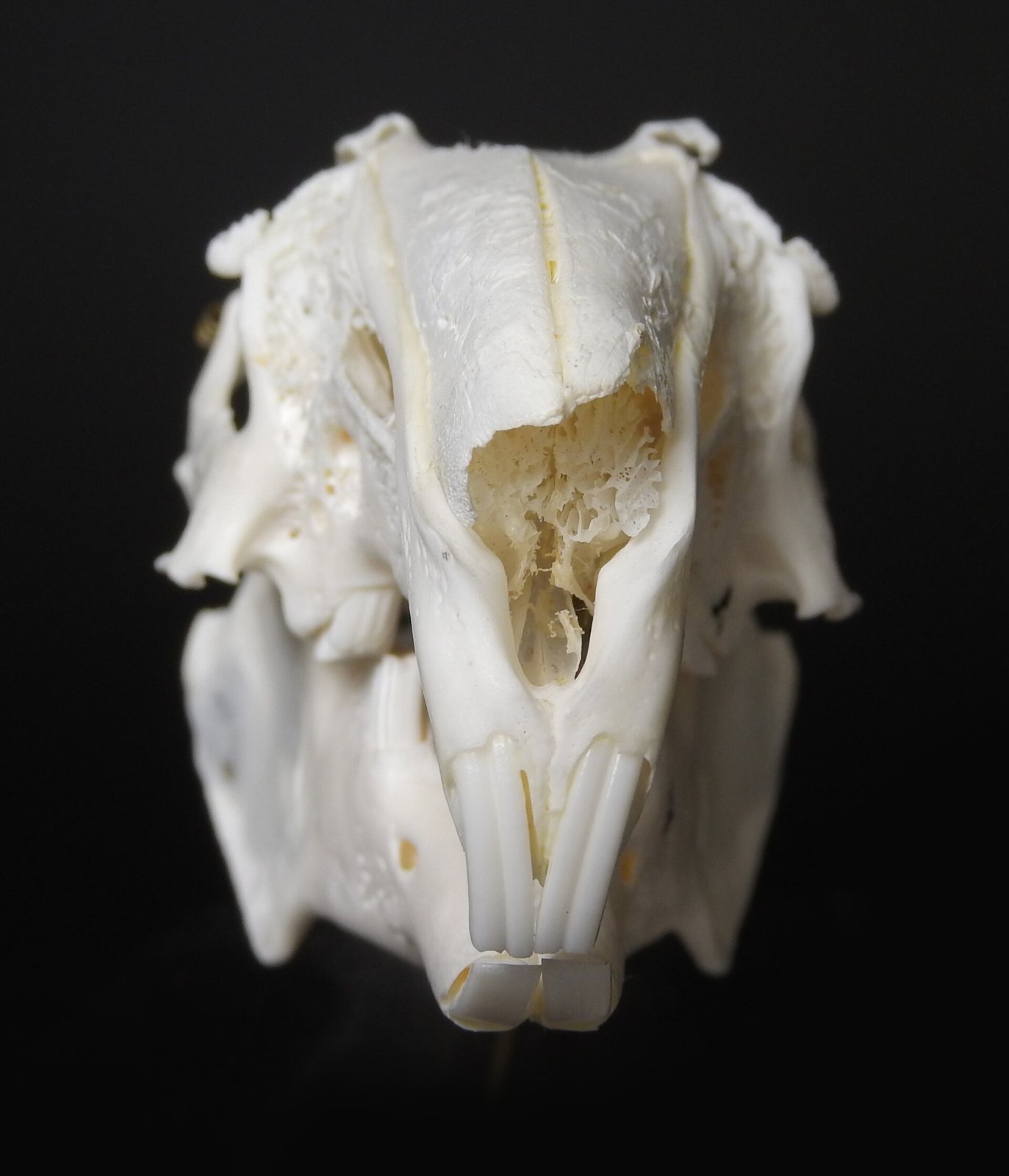
- 2/1 incisors: two upper incisors on each side (the big front tooth plus the peg tooth behind it) and one lower incisor.
- 0/0 canines: none at all, which is why the diastema is so long.
- 3/2 premolars: three above and two below.
- 3/3 molars: three above and three below.
The peg teeth are easy to overlook. They sit directly behind the large upper incisors and are much smaller, so a quick look from the front shows only two teeth. Turn the skull over and look at the roof of the mouth just behind the front teeth, and the second pair appears.
The Arizona-Sonora Desert Museum's skull guide adds a detail about the back of the mouth: a rabbit's cheek teeth are built for grinding plants.
Rabbit or hare?
Both rabbits and hares have the fenestrated snout, the peg teeth, the diastema and the 28-tooth set. So, the family features will not separate them. A species-level identification needs the place where the skull turned up, careful measurements and a look at specific skull characters.
The *Identification Manual to the Small Mammals of British Columbia* shows how that works in practice. It separates the European rabbit, *Oryctolagus cuniculus*, from several hares and cottontails using skull measurements and the shape of the supraorbital process, a small flange of bone that sticks out above the eye socket. In its key, a skull is a European rabbit when the rear extension of that process stands free of the braincase. The same manual identifies the snowshoe hare, *Lepus americanus*, and the cottontails by other measurements and by where the process touches the skull.
As a broad visual guide, hare skulls are often larger and have wider nasal passages than rabbit skulls, as Steve Harris explains in his guide to identifying mammal skulls. Size overlaps, though, so treat it as a hint rather than an answer. A regional key, written for the animals that live where you are, is what settles the question.
Rabbit, squirrel or rat?
Here the first check is quick and reliable: count the upper incisors. Rabbits and hares have two pairs, the big ones and the peg teeth behind them. Rodents such as rats and squirrels have only one pair. Rodents also have a gap behind the front teeth, so the diastema alone will not decide it, but a rodent skull will not have the lacy, windowed bone along the side of the snout.
If the skull turns out to be a rodent after all, rat and squirrel skulls can be told apart by further features, including the breadth of the snout, the size of the skull, the form of the molars and the shape of the infraorbital opening, the hole in front of the eye socket. A beaver skull is a good example of how big rodent incisors can get, and our beaver skull story goes through one in detail.
The short version holds well: a lacy snout plus peg teeth points to a lagomorph, not a rat or a squirrel.
Checking your skull, step by step
Set the skull on a soft cloth in good light; that lattice breaks easily, so lift it from underneath rather than by the snout. Then work through the features in order.
Is it a rabbit skull? A quick check
Tap a card to bring it forward.
- Side of the snout: Lacy or windowed bone points to a lagomorph, such as a rabbit or hare.
- Upper front teeth: Two small peg teeth behind the large incisors point to a rabbit, hare or other lagomorph, not a typical rat or squirrel.
- The gap: A long toothless stretch between the incisors and cheek teeth fits the lagomorph or rodent pattern.
- Tooth count: 28 teeth in the usual formula fits the rabbit and hare family.
- Size and nasal passages: A larger skull with wider nasal passages may suggest a hare, but this is not conclusive alone.
If you would like a firm name for it, take photographs from the side, top and underside with a ruler for scale, note where it turned up, and ask a natural history museum or a university mammal collection. Staff there can compare it with labeled specimens of the rabbits and hares that live in your area.
Rabbit skulls in art and on skin
That fine lattice has caught the eye of artists. The Metropolitan Museum of Art holds *Rabbit Skull* by the British artist Simon Costin, born in 1963. The work is dated 1987 and combines bone with silver, rock crystal, hematite, paper and silk. For more skulls that ended up in museum collections as art, see famous skull art.
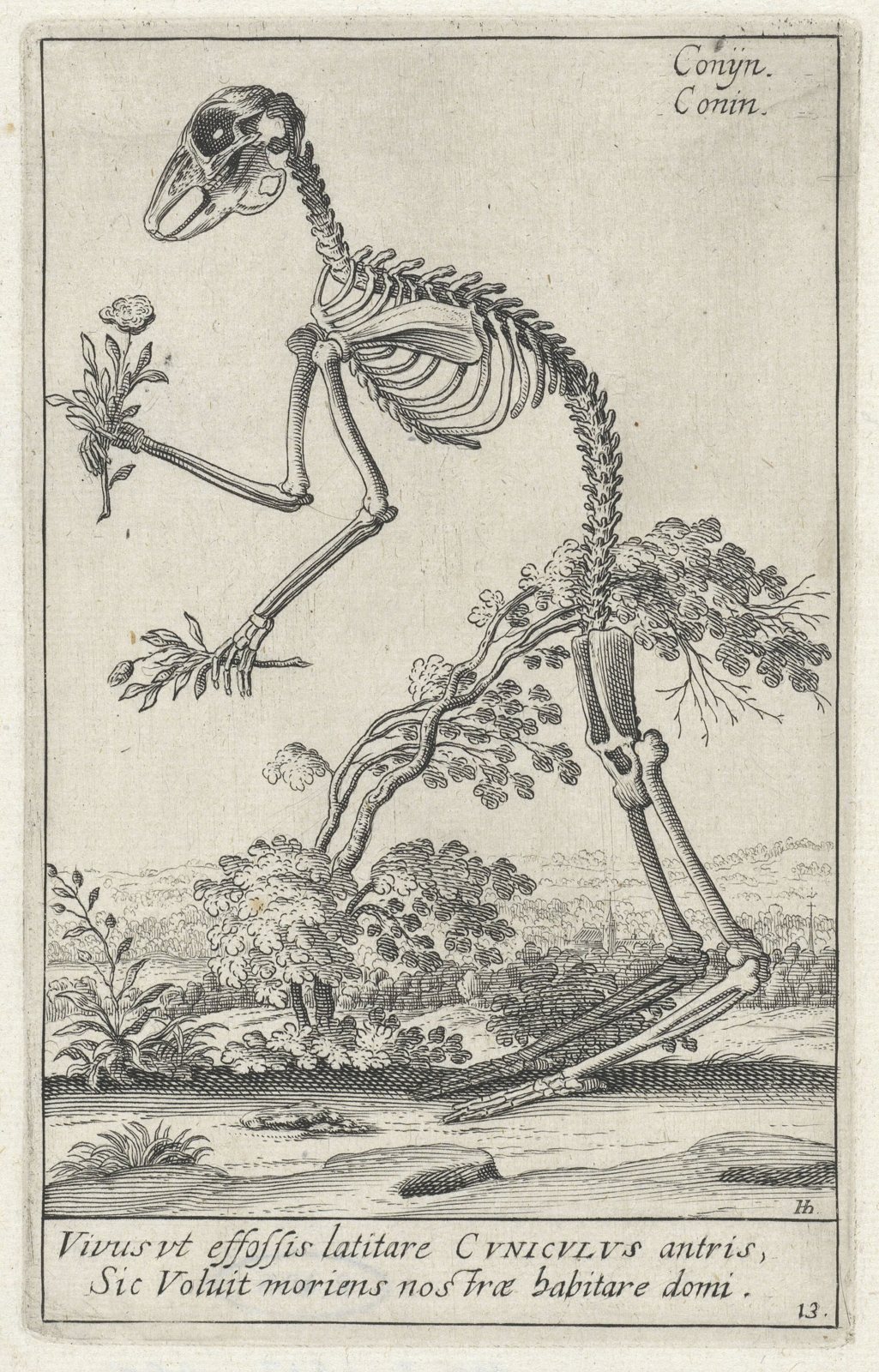
Much earlier, the Museo Nacional del Prado catalogues *Esqueleto de conejo*, a rabbit skeleton by Hendrik Hondius I, an etching and engraving dated 1626. Rabbit skulls have also served teaching. The Universidad de Granada keeps an anatomical rabbit skull model from around 1950 in its collection of medical models; it has a complete lower jaw and is catalogued as a possible rabbit.
Rabbit skulls turn up in tattoos, too. A rabbit-skull tattoo means what its artist and its wearer intend, so if a design catches your eye and you want to know its meaning, ask the tattoo artist who drew it. For the wider history of skulls in ink, see skull tattoo meaning.
Rabbit skulls in art, science and collections
Tap or hover a step to follow the order.
1626
Hendrik Hondius I's Esqueleto de conejo, an etching and engraving now catalogued by the Museo Nacional del Prado.
1916
J. Arthur Thomson's Outlines of Zoology includes a labelled rabbit skull illustration.
November 28, 1965
A black-tailed jackrabbit skull is collected for what is now the University of Colorado Museum of Natural History.
March 14, 1970
A European rabbit skull now in Museums Victoria is collected in Victoria, Australia.
1987
Simon Costin makes Rabbit Skull, now in The Metropolitan Museum of Art.
2025
Wood-Bailey and Sharp publish their biomechanical study of why rabbit and hare skulls are fenestrated.
Keeping a rabbit skull you came across
> A general note, not legal advice: rules on wildlife parts are set by each state and country, and they are revised from time to time.
A rabbit skull lying in a field feels like the simplest find in the world, but whether you may keep it depends on where you are, what the species is and who owns or manages the land. Before you take it home, check with your state wildlife agency and with the landowner or land manager. Our story on what to do when you find an animal skull sets out the federal and state rules that can apply and who to ask.
Once you know the skull is yours to handle, how to clean an animal skull covers the gentle methods that suit fragile bone. Real skulls are not something this site sells.
Rabbit skull questions
A few more answers about that small, fragile skull.
Do the holes in a rabbit skull mean it was damaged or sick?
No, they are normal fenestrations, part of the skull's design in every rabbit and hare. The Florida Museum of Natural History treats them as a standard feature of the family rather than a sign of damage, though a weathered skull can of course have breaks of its own as well.
How many teeth does a rabbit have?
An adult rabbit typically has 28 teeth. There are no canines at all, and two of the upper teeth are the small peg teeth hiding behind the front incisors, so a quick front-on count usually comes up short.
What are the small teeth behind a rabbit's front teeth?
They are peg teeth, a second and much smaller pair of upper incisors. The Arizona-Sonora Desert Museum points to this second set of upper incisors as a mark of rabbits, and it is the strongest first check against a rodent, which has only one pair.
Rabbit skull quiz
Answer every question to check.
Where to go next
If your small skull turns out not to be a rabbit, the skunk skull story looks at another small skull that turns up outdoors, this time with canines. For bigger finds, deer skull meaning covers the skull most often picked up on a woodland walk, and bird skull meaning looks at the light, beaked skulls that sometimes get mistaken for small mammals. And if there is ever any doubt about what you are holding, how to tell a human skull from an animal skull is the place to start.
Terms in this story
Tap a term to see what it means.
Lagomorph. The group that includes rabbits, hares and pikas. Lagomorph skulls have fenestrations and peg teeth.
---