

No. 105
Skunk Skull Identification: 34 Teeth and How to Tell It From a Raccoon or Cat
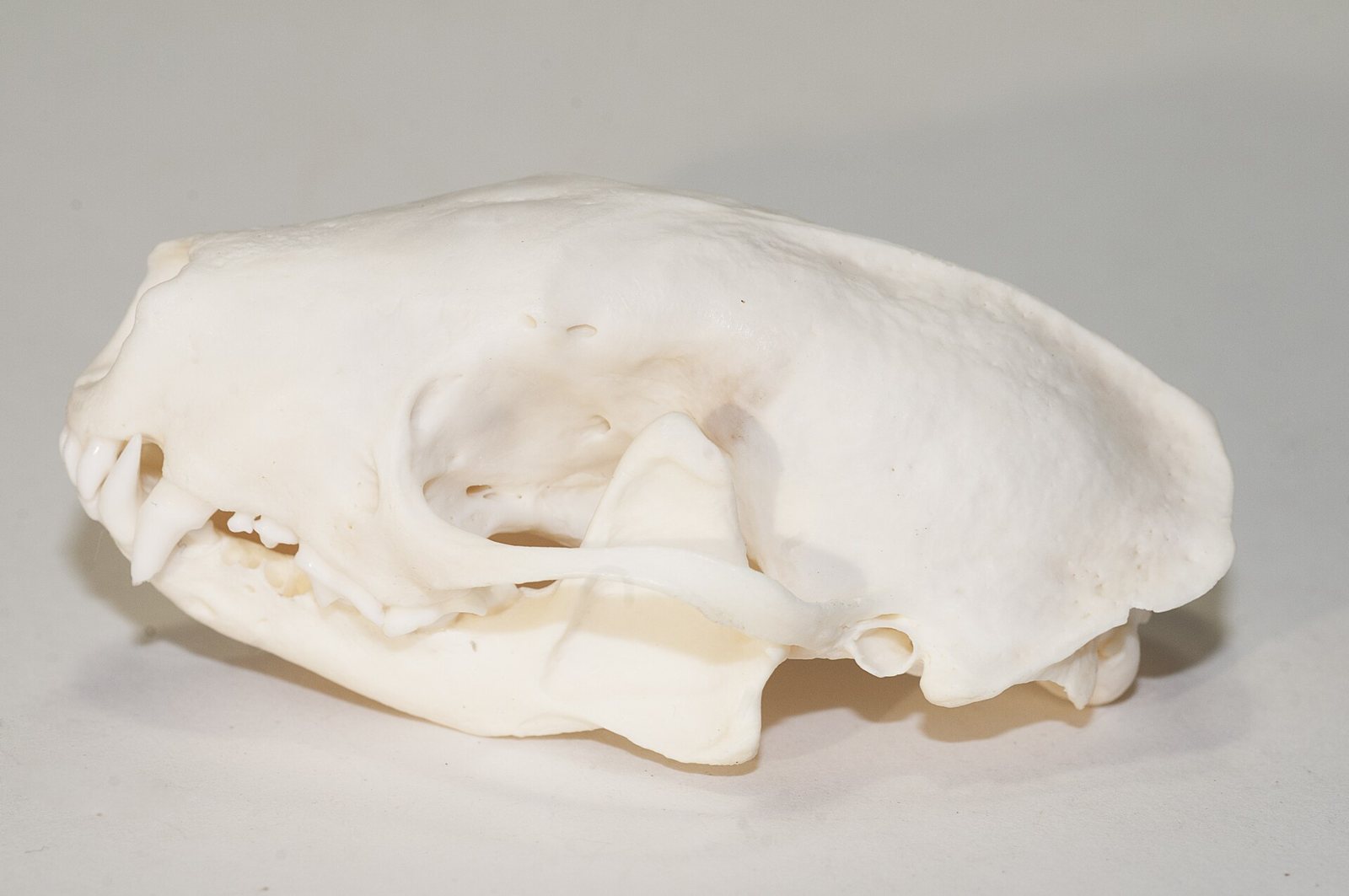
A striped skunk skull, *Mephitis mephitis*, usually has 34 teeth. On each side there are three incisors, one canine, three premolars, and one upper and two lower molars, a formula Texas Tech writes as I 3/3, C 1/1, P 3/3, M 1/2. Turn the skull over and the bony palate ends at or before the last molar. On top, the forehead is rounded and a sagittal crest runs along the midline.
A raccoon, *Procyon lotor*, has 40 teeth and a palate that runs on past the last molar. A house cat has a shorter row of cheek teeth built for slicing. So, count the teeth and look underneath before anything else; those two checks settle most small skulls.
The striped skunk skull, tooth by tooth
Thirty-four is the number to remember, and the Texas Tech Natural Science Research Laboratory's account of the striped skunk gives the formula behind it. Read I 3/3 as three incisors above and three below on each side, C 1/1 as one canine above and one below, P 3/3 as three premolars above and three below, and M 1/2 as one molar above and two below. Add up one side, double it, and you reach 34.
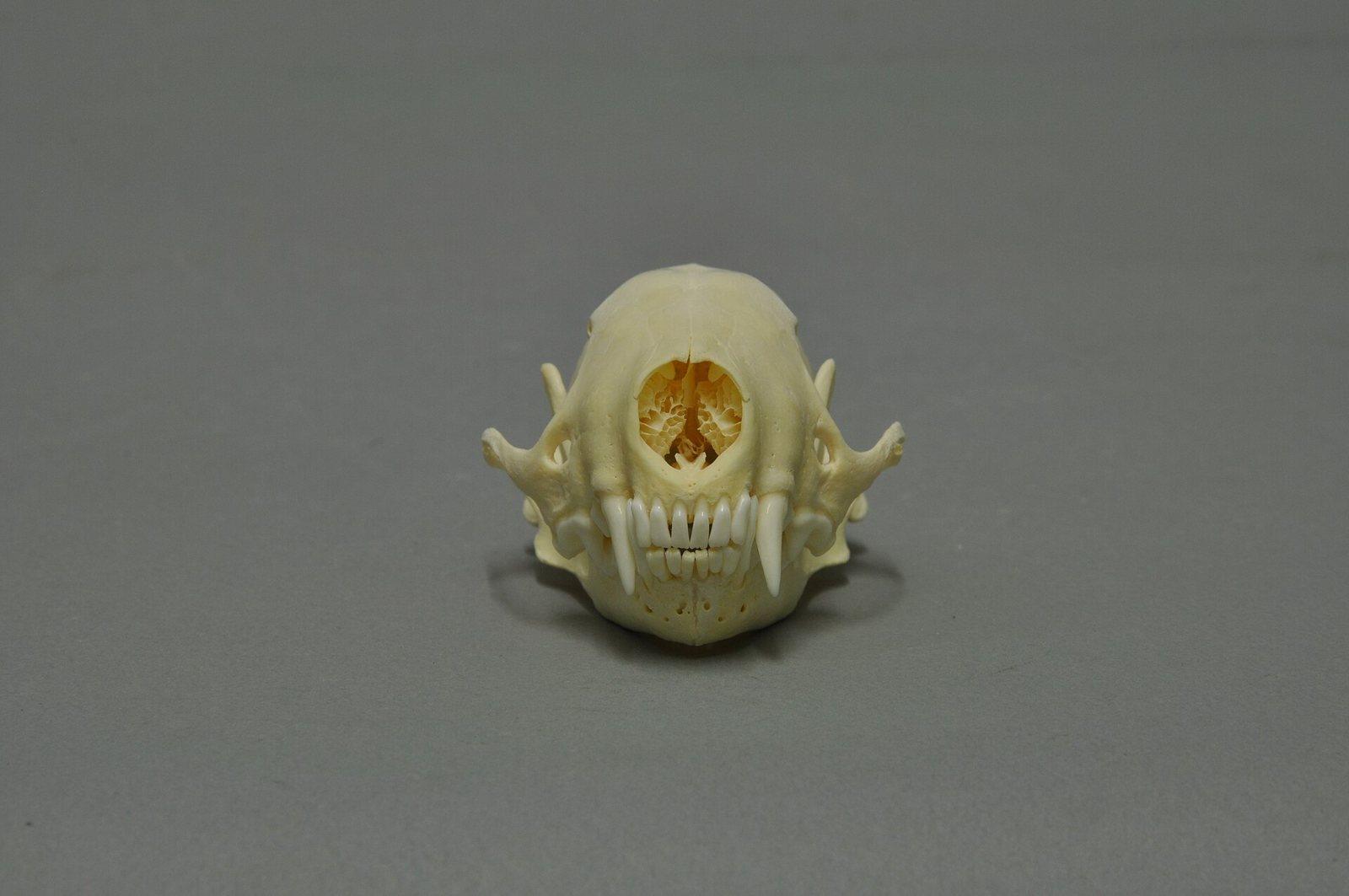
A university mammalogy skull key for *Mephitis mephitis* adds three features to look for beyond the count: a palate that ends at or before the last molar, a rounded frontal bone over the forehead, and a prominent sagittal crest, the ridge along the top of the skull where jaw muscles attach.
The Maryland Department of Natural Resources key to common mammal skulls, written by Kerry Wixted and published in 2022, picks out the striped skunk by two more details. The single upper molar on each side is rectangular, and the auditory bulla, the rounded bony capsule around the ear on the underside of the skull, is flat rather than elongated. The same key notes a piece of family history: skunks were once grouped with the weasels, but they now sit in a family of their own, the Mephitidae.
How big a skunk skull is
There is no single size for every skunk. Species, sex, age and the individual animal all make a difference, so a ruler is a guide rather than a verdict.
For a reference point, Texas Tech's published measurements include one adult male striped skunk with an occipitobasal length of 55.36 millimeters and a zygomatic breadth of 36.23 millimeters. The first is a length taken along the base of the skull. The second is the width across the cheekbone arches, the zygomatic arches that flare out on each side. In everyday terms, that adult male's skull was a little over two inches long and about an inch and a half wide.
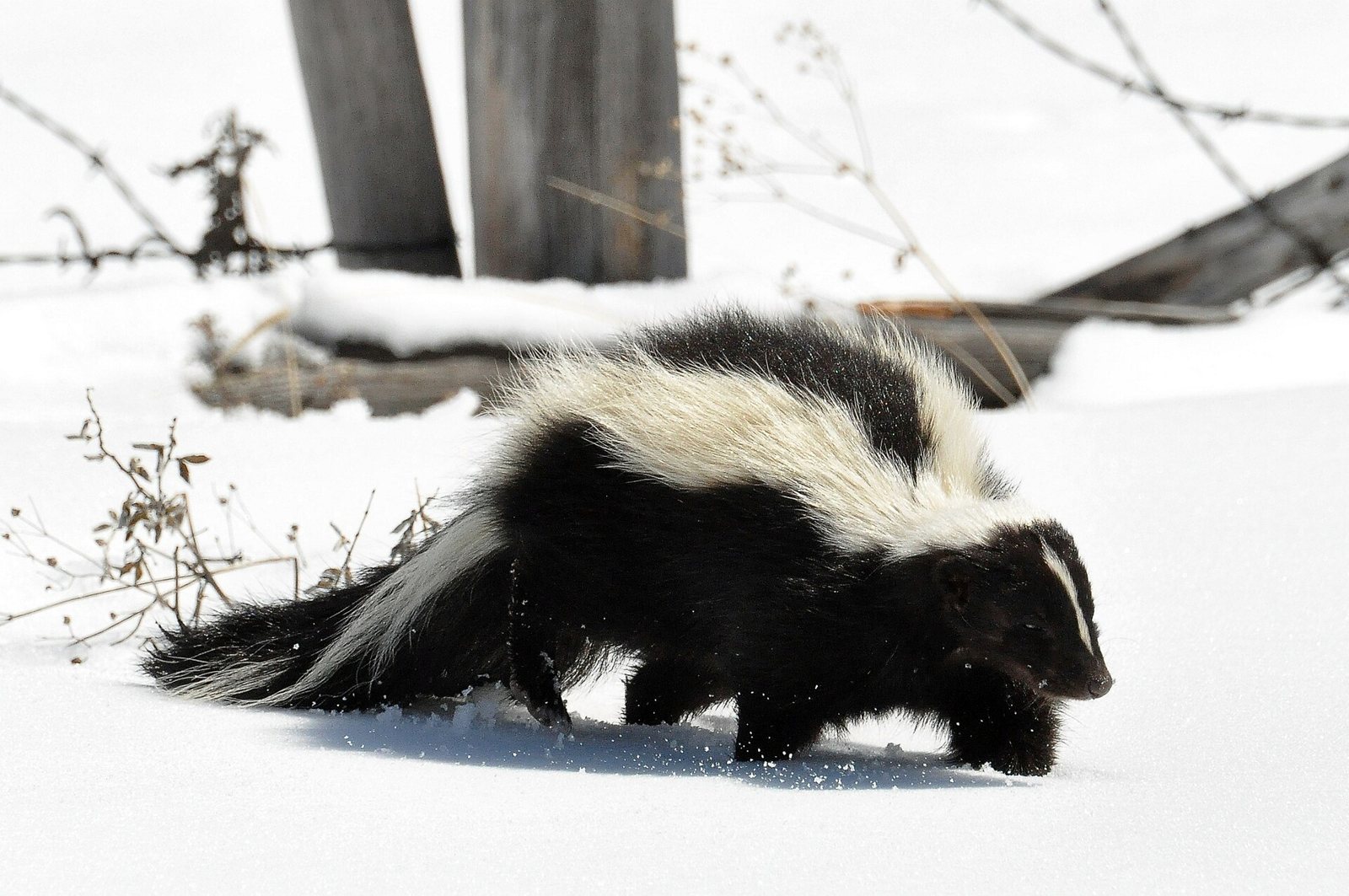
The animal itself is around the size of a house cat, according to the University of Wisconsin-Stevens Point Vertebrate Collection, which is one reason the skulls get mixed up. Measure yours directly rather than judging by eye. The Texas A&M AgriLife *Educator's Guide to Texas Mammals*, published for wildlife education in 2015 and 2016, photographs adult skulls against gridlines in six views, side, front, top, bottom and tooth views among them, which makes it handy for checking proportions against your own.
Striped skunk or spotted skunk?
The striped skunk is generally the larger of the two. A key to the adult terrestrial mammals of the Southeastern United States separates them by the shape of the skull roof. The striped skunk has a convex upper profile, curving up over the top, and a total body length over 500 millimeters. The eastern spotted skunk, *Spilogale putorius*, has a flat top-of-skull profile and a total length under 500 millimeters, along with broken white markings on its back. That flat profile belongs to the spotted skunk, so a flat-topped skull points that way, while a domed one points to the striped skunk.
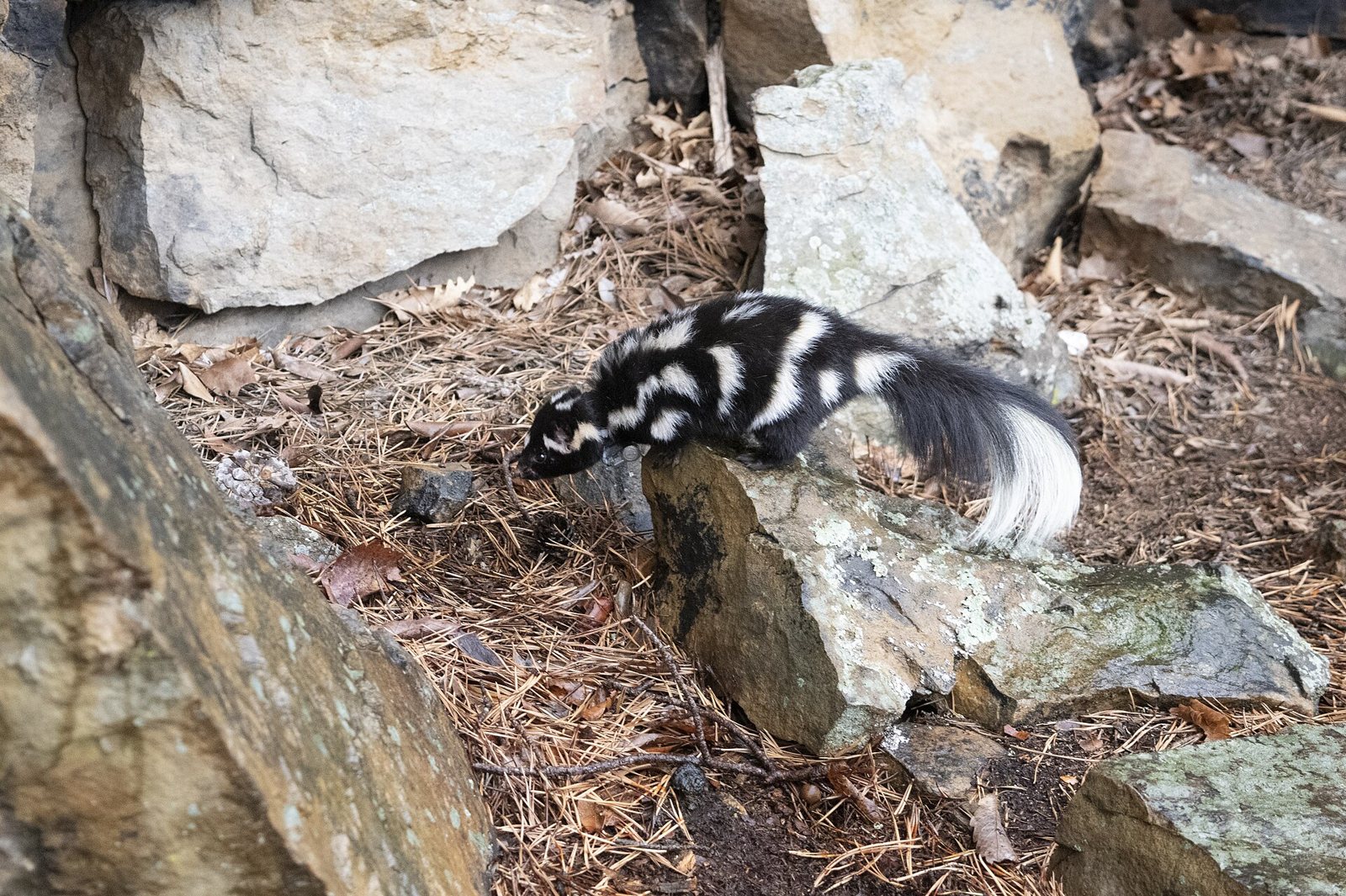
The Texas A&M guide places adult skull plates of the striped skunk and the spotted skunk side by side, which is the easiest way to see the difference. Museums lean on skulls for exactly this job. The University of Colorado Museum of Natural History holds an eastern spotted skunk collected on December 27, 1933, in Marysville, Cooke County, Texas, and explains that its accompanying skull was part of how the specimen was identified.
Two things can make this harder. A young striped skunk's skull may be small, and a damaged skull can lose the shape you need to read. Put species range, location and skull shape together before you settle on an answer.
Telling it from a raccoon
The count does most of the work. A skunk usually has 34 teeth, and a raccoon has 40, with four premolars and two molars on each side of each jaw. Maryland's Simplified Key to Furbearer Skulls separates raccoons by their six upper cheek teeth on each side and 40 teeth in all, and it sends skulls with 32 to 38 teeth to its section on mustelid-like animals, where a skunk skull would be keyed out.
Then turn the skull over. In a raccoon, the hard palate extends beyond the last molar and the skull generally lacks a sagittal crest, according to Washington University in St. Louis. A skunk's palate stops at or before the last molar, and a striped skunk carries that prominent crest. The raccoon's cheek teeth are also broader. If you think yours may be a raccoon after all, our raccoon skull story works through it from the raccoon's side.
Telling it from a cat
A domestic cat, *Felis catus*, has fewer cheek teeth than a raccoon, and the ones it has are highly specialized. Virginia Tech's guide to mammals in Virginia explains that cats have prominent canines and carnassial teeth, the blade-like cheek teeth adapted for piercing and slicing. A skunk's cheek teeth are more generalized, the teeth of an animal with an omnivore's menu.
So, on a suspected skunk skull, check five things: the tooth count, the shape of the cheek teeth, the palate, the sagittal crest and the overall profile. Old skulls lose teeth, which makes counting unreliable, so count the empty sockets along with the teeth that are still there. The cat skull story has the cat's own features in detail.
Tap or hover a row to highlight it.
| Feature | Striped skunk, Mephitis mephitis | Raccoon, Procyon lotor | Domestic cat, Felis catus |
|---|---|---|---|
| FeatureTotal teeth | Striped skunk, Mephitis mephitis34 | Raccoon, Procyon lotor40 | Domestic cat, Felis catusFewer cheek teeth than a raccoon |
| FeatureCheek teeth | Striped skunk, Mephitis mephitisMore generalized, omnivore-like | Raccoon, Procyon lotorBroad, generalized omnivore teeth | Domestic cat, Felis catusSpecialized piercing and slicing teeth |
| FeaturePalate | Striped skunk, Mephitis mephitisEnds at or before the last molar | Raccoon, Procyon lotorExtends beyond the last molar | Domestic cat, Felis catusNot the same combination as a skunk |
| FeatureSkull crest | Striped skunk, Mephitis mephitisProminent sagittal crest | Raccoon, Procyon lotorGenerally absent | Domestic cat, Felis catusA different carnivore profile |
| FeatureFirst check | Striped skunk, Mephitis mephitisCount teeth, inspect the upper molar and profile | Raccoon, Procyon lotorCount 40 teeth, look for the extended palate | Domestic cat, Felis catusLook for prominent canines and carnassials |
A step-by-step check for your skull
Lay the skull on a table in good light with a ruler nearby, and work through it in this order.
Is it a skunk skull? A quick check
Tap a card to bring it forward.
- Photograph it: Take views from the side, top, front and underside.
- Measure it: Record the greatest length and the width across the cheekbone arches.
- Count the teeth: Count every tooth that remains and every empty socket.
- Look under the palate: A palate ending at or before the last molar fits a skunk; one running past it fits a raccoon.
- Check the molar and ear capsule: A rectangular upper molar and a flat auditory bulla fit the striped skunk.
- Note the place: Write down where the skull turned up.
- Check the rules: Confirm local possession rules before collecting or moving it.
- Ask if it is fresh: Call animal control or public health if the remains are fresh or anyone touched them.
Handling a skunk skull safely
Skunks carry a particular health concern. The CDC's rabies prevention guidance, dated July 1, 2025, lists skunks among the common rabies-infected animals in the United States and advises never approaching animals that appear injured, sick or dead. If there is any chance of a bite, a scratch, or saliva getting into an open wound, the eyes or the mouth, the CDC says to wash the area with soap and water for 15 minutes and contact a healthcare or public-health professional right away.
State agencies say much the same. South Carolina's Department of Public Health advises never approaching or handling sick, injured or orphaned skunks and keeping children and pets away. The Ohio Department of Natural Resources says that if a dead animal must be moved, use gloves or a shovel, follow your local health department's instructions, and clean tools and surfaces with bleach and water afterward. North Dakota Health and Human Services tells people not to touch dead animals and to contact public health officials after any saliva exposure.
A skull that is already clean and dry is a different situation from a fresh carcass. Still, do not assume any remains are safe to handle. If the animal died recently, behaved strangely before it died, or someone has already touched it, call local animal control or the health department and follow their instructions.
Can you keep a skunk skull?
> This part is general information, not legal advice. Each state and country writes its own wildlife rules, and those rules change.
Whether a skunk skull can go on your shelf depends on the state, who owns the land, the species' status there and how the animal died. A skull lying on the ground is not automatically yours to keep.
Two states show how different the answers can be. In Wisconsin, the Department of Natural Resources guidance on possessing wild animals says clean skulls and bones of unprotected wild animals may be collected on private or public land without a DNR license, tag or permit, although private property needs the owner's permission. The same guidance says skunk parts may be possessed when the animal was legally obtained, and that wildlife parts brought into Wisconsin must comply with the law of the place they came from. In North Carolina, the Wildlife Resources Commission states that selling wildlife parts from animals found dead is generally prohibited, with limited exceptions for licensed trappers and hunters and for specified furbearers, skunks among them.
Those are two examples, not a rule for where you live. Before you collect, move or display a skunk skull, identify your state, the land and the species, then confirm the rule with your state wildlife agency or the land manager. Our story on what to do when you find an animal skull lays out the federal and state rules that can apply and who to contact. Once you know a skull is yours to handle, and the safety advice above is covered, how to clean an animal skull goes through the methods. Real skulls never pass through our shop.
Skunk skulls with a past
Skunk skulls have been sitting in museum drawers and scientific plates for a long time. A fossilized striped skunk skull from Rancho La Brea, California, about 27,000 years old, is on display at the Natural History Museum of Los Angeles County. In 1877, Elliott Coues published an illustration of an eastern spotted skunk skull in *Fur-bearing Animals: A Monograph of North American Mustelidae*, a book on the weasel family that included the skunks.
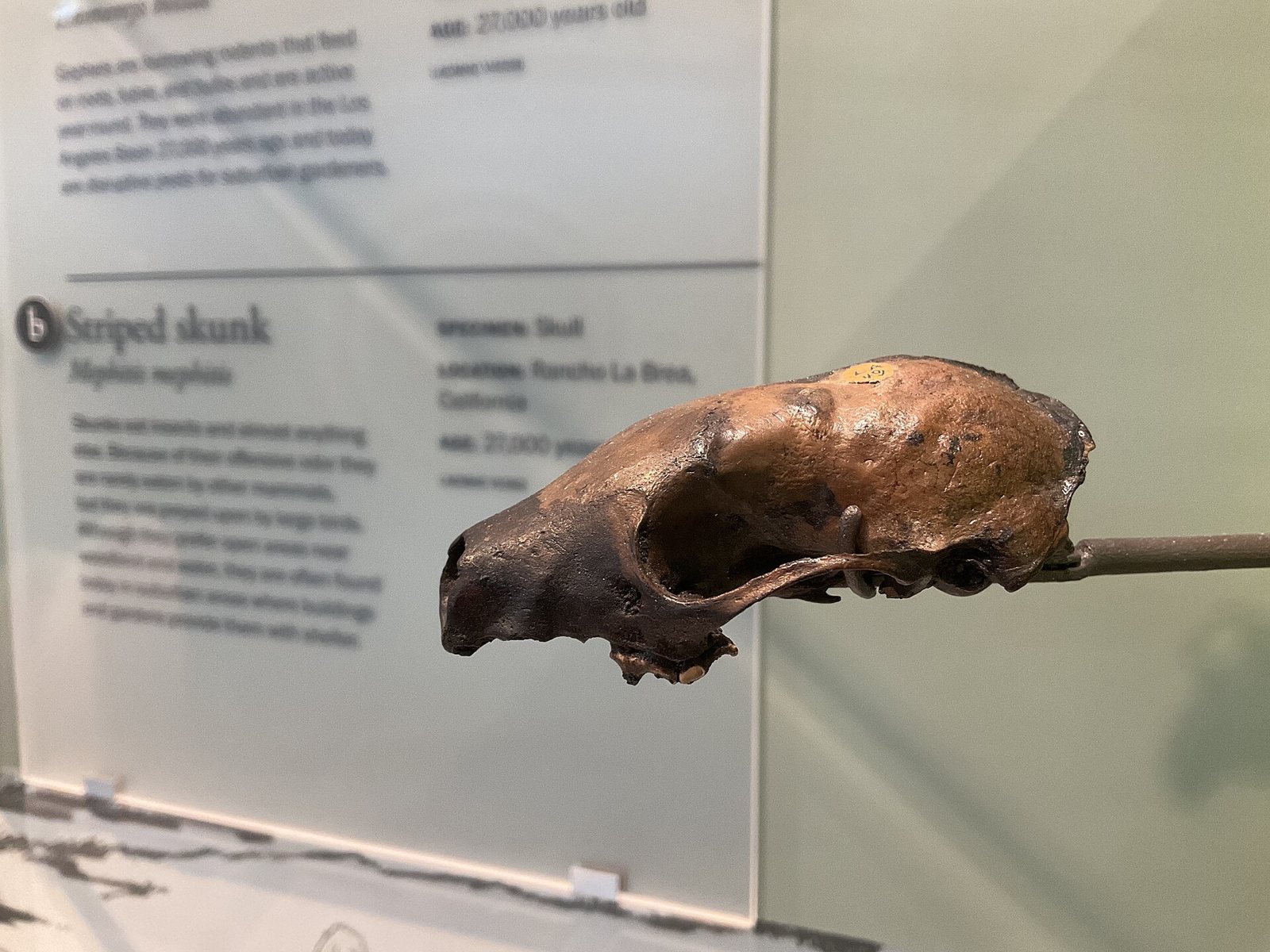
Skunk skulls in collections and keys
Tap or hover a step to follow the order.
1877
Elliott Coues publishes an eastern spotted skunk skull illustration in Fur-bearing Animals.
August 12, 1928
R. M. Bradley collects a striped skunk skull two miles northwest of Durand, Shiawassee County, Michigan, for the University of Michigan Museum of Zoology.
December 27, 1933
An eastern spotted skunk now in the University of Colorado Museum of Natural History is collected in Marysville, Cooke County, Texas.
2015 to 2016
Texas A&M AgriLife publishes a six-view adult skull guide that includes striped and spotted skunks.
2022
Kerry Wixted's Maryland skull key describes the striped skunk's rectangular upper molar and flat auditory bulla.
July 1, 2025
The CDC's rabies guidance names skunks among the common rabies-infected animals in the United States.
Skunk skull questions
A few more answers for the skull on your table.
What does a skunk skull look like?
A skunk skull is small and sturdy, with 34 teeth in the striped skunk and a mix of canines and generalized cheek teeth. The top of the skull curves upward in the striped skunk and is flatter in the eastern spotted skunk.
How many teeth does a skunk have?
A striped skunk has 34 teeth. Only one molar sits on each side of the upper jaw, against two on each side of the lower jaw, and Maryland's key describes that single upper molar as rectangular.
What is the fastest way to tell a skunk skull from a raccoon skull?
Count the teeth: 34 points to a skunk and 40 to a raccoon. If teeth are missing, turn the skull over, because a raccoon's palate runs past the last molar while a skunk's stops at or before it.
Are skunks related to weasels?
Skunks were once grouped with the weasels, but Maryland's 2022 skull key notes that they now have their own family, the Mephitidae. That older grouping is why Elliott Coues's 1877 monograph on North American Mustelidae includes the spotted skunk.
Skunk skull quiz
Answer every question to check.
Where to go next
If the count does not fit a skunk, the opossum skull story covers a long-snouted skull with 50 teeth, and the fox skull story covers a longer, narrower find with blade-like cheek teeth. For a skull that is catlike but bigger than a house cat's, the bobcat skull story takes it from there. And if there is ever any doubt about what you are holding, how to tell a human skull from an animal skull is the place to begin.
Terms in this story
Tap a term to see what it means.
Mephitis mephitis. The scientific name of the striped skunk, the larger of the two skunks in this story.
---