

No. 181
How to Identify a Cat Skull and Tell It From a Raccoon, Opossum or Fox
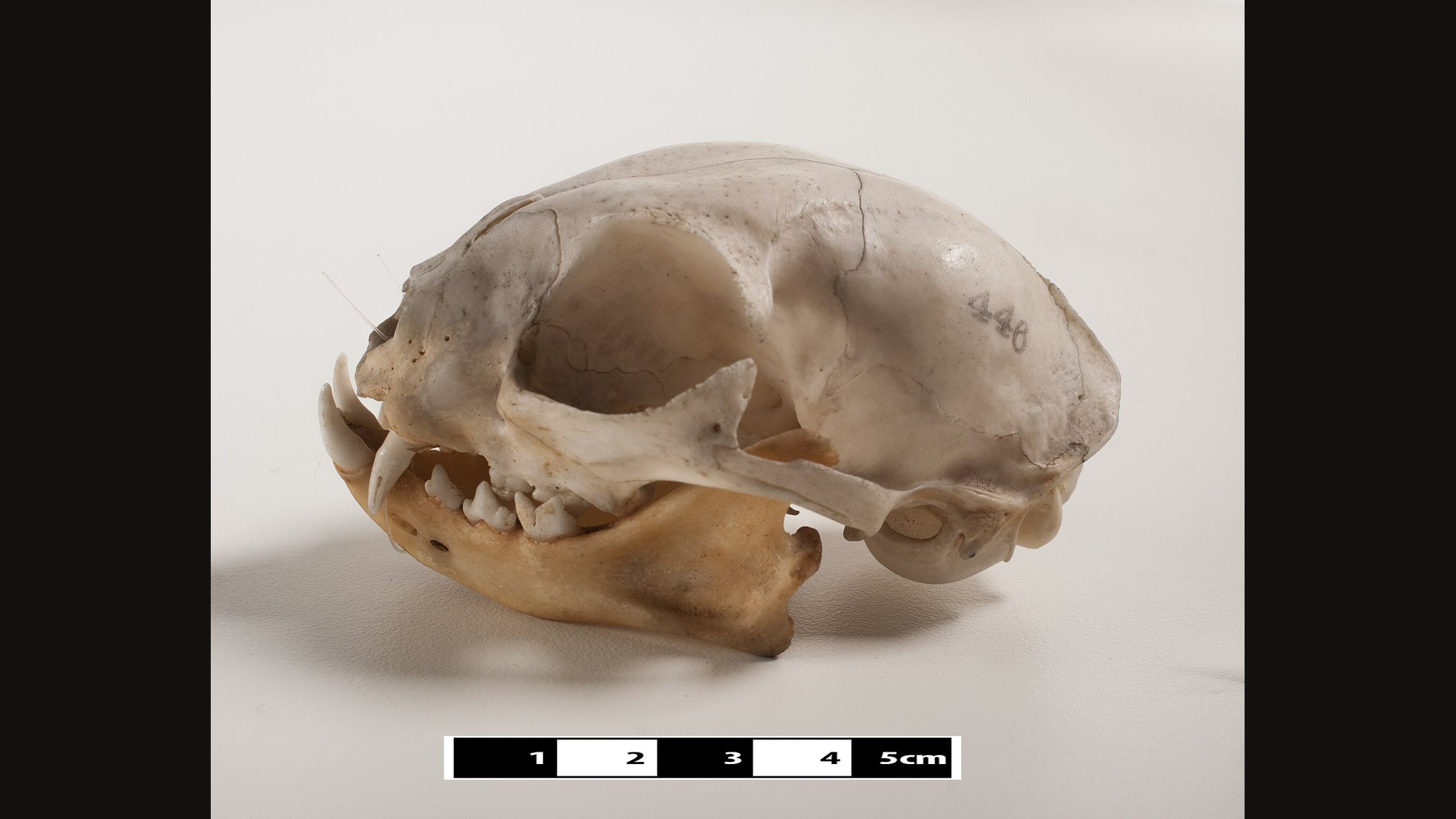
A domestic cat skull, *Felis catus*, is small and round, with a very short face, large eye sockets that face forward, long pointed canines and only about 30 adult teeth. The clue that settles it most often is tiny: a little upper premolar sitting just behind each upper canine, or the empty socket where it used to be.
The look-alikes part ways quickly once you count. A raccoon has about 40 teeth and broad, crushing cheek teeth. A Virginia opossum has 50, with five small upper incisors on each side. A red fox has 42 and a long, narrow snout. A bobcat looks like a bigger cat, but it usually lacks that tiny premolar.
If the skull in your hand passes those first tests, the next things to check are the exact tooth count, the length of the skull and the shape of the face from the side and the front. And if you think it may have been someone's pet, there are a few gentle, practical steps for that too.
The short face, big eyes and slicing teeth of a cat
Cats belong to the family Felidae, and Animal Diversity Web's account of the cat family describes a skull built for one job. The rostrum, the part of the skull in front of the eyes, is short. The row of teeth is short as well, with long, conical canines up front and large carnassials behind them. Carnassials are the scissor-like cheek teeth that meat-eaters use to slice, and in a cat they do most of the work that grinding molars do in other animals.
Then there are the eyes. A cat's orbits, the eye sockets, are relatively large and face forward. The Smithsonian National Museum of Natural History explains that forward-facing orbits give binocular vision and depth perception, the kind of overlapping sight a predator uses to judge a pounce. That is why a cat skull seems to stare straight back at you.
Put together, those features make the outline you probably noticed first: a rounded braincase, a blunt little face and two big openings for the eyes. Plenty of skulls are small; the short face is what makes a cat's stand out.
Counting the teeth, and when the count misleads
A complete adult domestic cat normally has 30 permanent teeth. Zoologists write that as a dental formula: I 3/3, C 1/1, P 3/2, M 1/1, multiplied by two. In plain words, each side of the upper jaw holds three incisors, one canine, three premolars and one molar, and each side of the lower jaw holds three incisors, one canine, two premolars and one molar. Fifteen on each side, 30 in all.
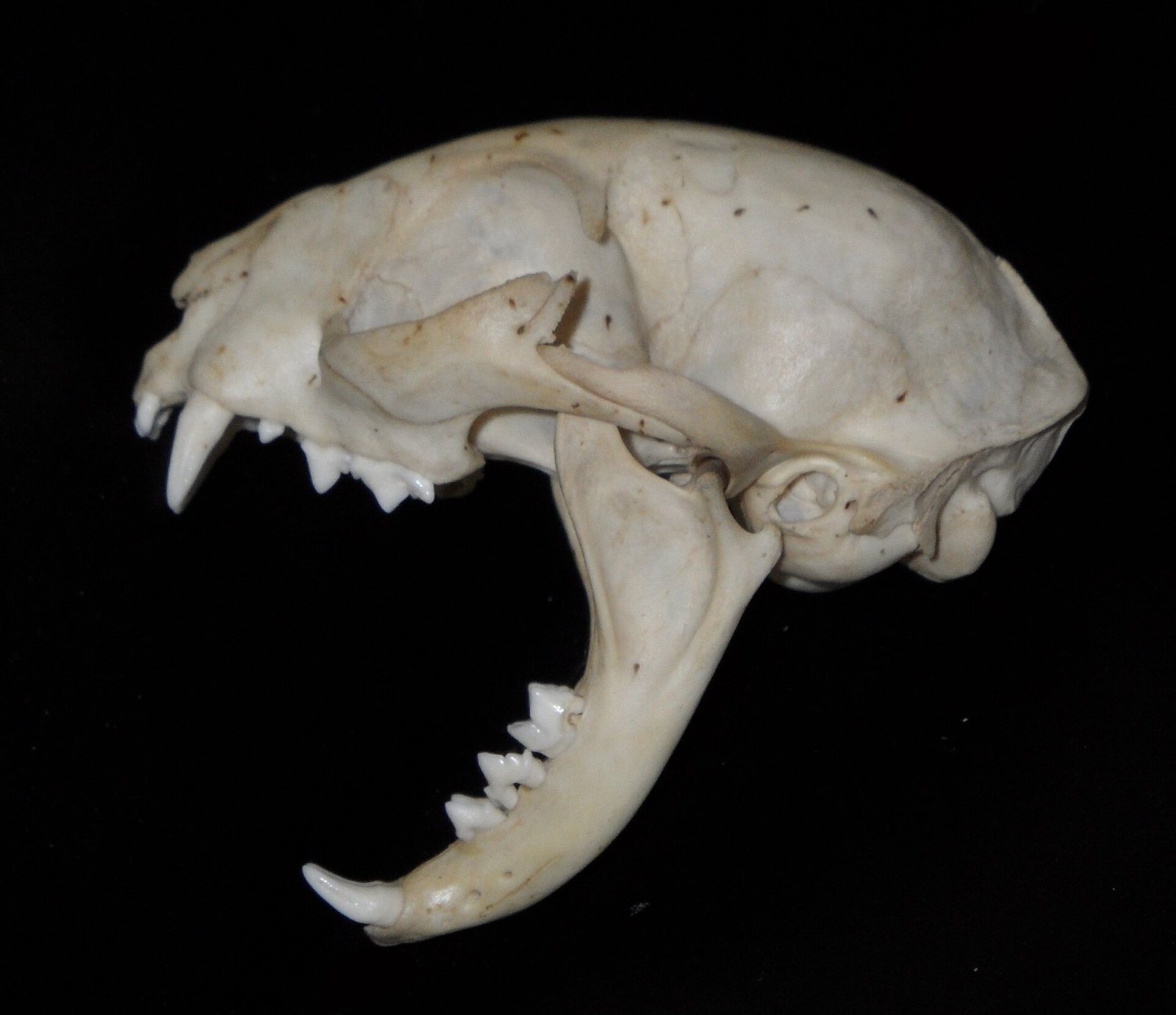
The tiny upper premolar is part of that count. It sits right behind the upper canine and is small enough to fall out after death. The Maryland Department of Natural Resources key to mammal skulls points out that even when the tooth is gone, its empty socket can remain, so look for a small hole as carefully as you look for a tooth.
A few things can throw the count off. Kittens have deciduous, or baby, teeth, so a young cat's skull will not match the adult numbers. Older skulls lose teeth, and weathered or chewed skulls lose pieces of bone. Count the sockets along with the teeth, and treat a count as a strong clue rather than a final verdict.
House cat or bobcat?
The bobcat, *Lynx rufus*, is the wild cat whose skull most often gets mistaken for a house cat's in North America. In 2022, Maryland wildlife specialist Kerry Wixted published the state's skull key, and it separates the two with two simple checks.
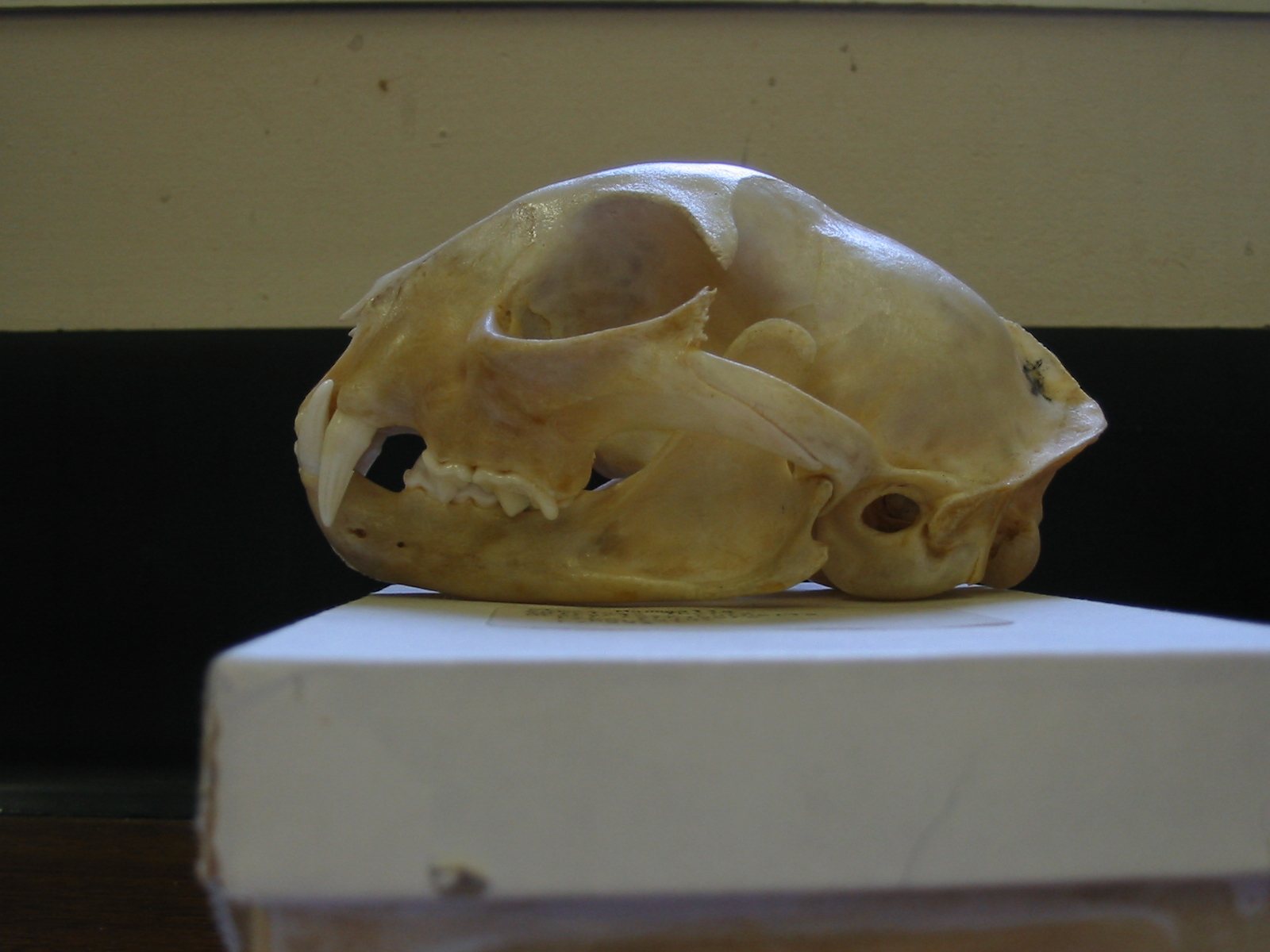
A house cat skull has a short rostrum, a tiny premolar behind each upper canine and a greatest length of about 77 to 101 millimeters, measured from the front of the skull to the back. A bobcat skull lacks that tiny upper premolar and is longer than 101 millimeters. A bobcat normally has 28 adult teeth, with the formula I 3/3, C 1/1, P 2/2, M 1/1, so it is missing one premolar on each side of the upper jaw compared with a house cat.
Size helps, but do not lean on it alone. Age, sex, damage and ordinary variation between animals all change how big a skull is, and a large house cat and a small bobcat can come close. The University of Texas at El Paso's key to regional carnivores takes the same approach, using tooth counts, muzzle shape and skull measurements together. Check the premolar, then measure.
Cat, raccoon, opossum or fox?
These are the skulls most often confused with a cat's, and the teeth and muzzle sort them out together. A complete skull with about 30 teeth and a very short face is much more consistent with a cat than with any of the others.
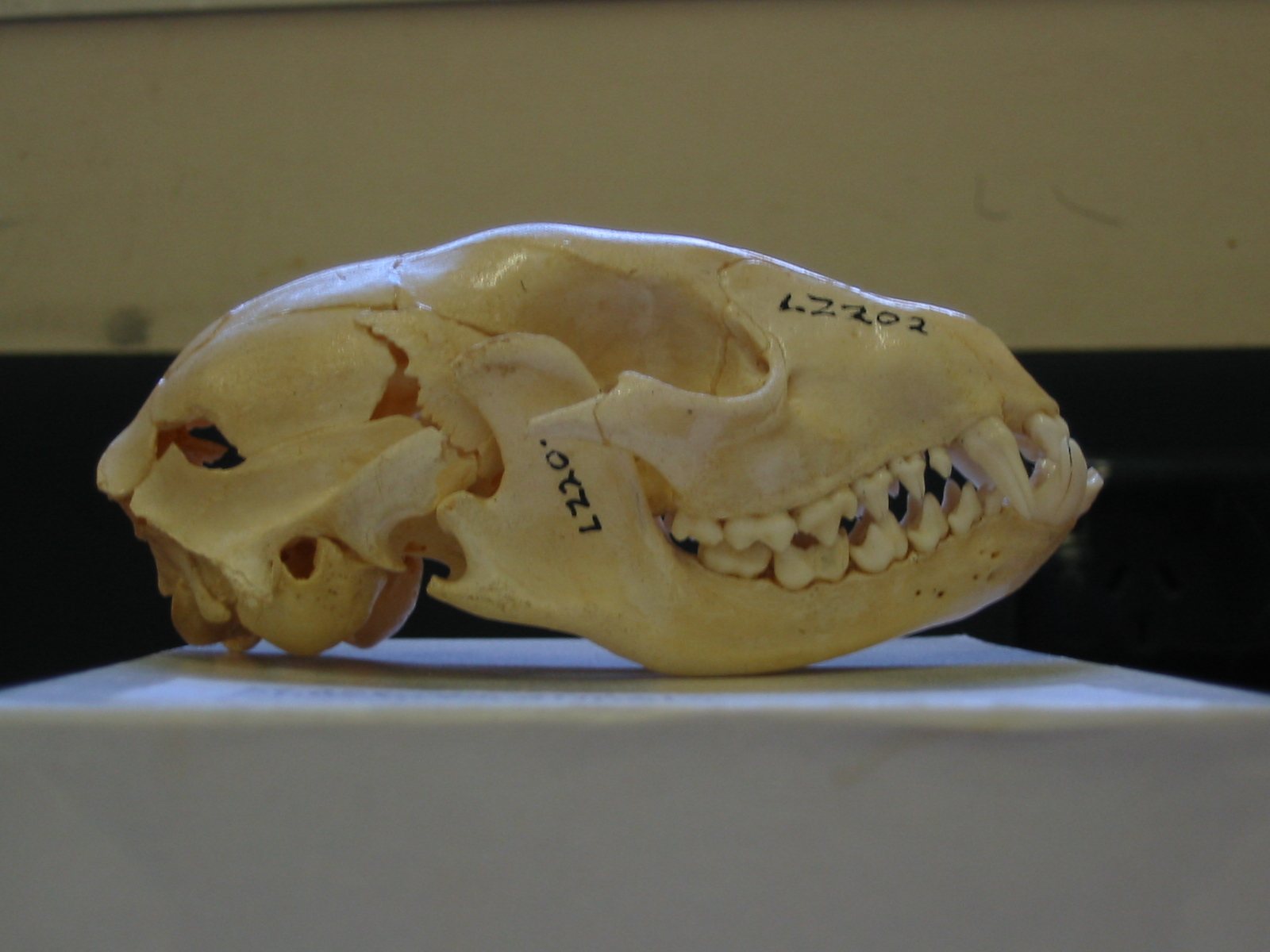
The raccoon, *Procyon lotor*, is the closest match, because it also has a fairly short face. It has 40 teeth, a larger braincase and broad grinding cheek teeth. The Smithsonian uses a raccoon skull to show how wide molars plus canines mark an omnivore, an animal that eats a bit of everything. Our full side-by-side of the two is in how to identify a raccoon skull, so if your skull has broad, rounded back teeth, start there.
The Virginia opossum, *Didelphis virginiana*, is easier. Five upper incisors on each side point strongly to opossum, and Maryland's key adds a small braincase, a long face and a prominent sagittal crest, the ridge of bone running along the top of the skull. Fifty teeth make a crowded grin no cat could match. Read more in the opossum skull story.
The red fox, *Vulpes vulpes*, has a long, narrow muzzle and 42 teeth, under the formula I 3/3, C 1/1, P 4/4, M 2/3 given in the Texas Tech University red fox account. Maryland's key notes temporal ridges on top of the skull forming a V. If your skull is long and slim rather than short and round, the fox skull story takes it from there.
Tap or hover a row to highlight it.
| Species | Scientific name | Adult teeth | Quick clue |
|---|---|---|---|
| SpeciesDomestic cat | Scientific nameFelis catus | Adult teeth30 | Quick clueShort rostrum, large orbits, tiny upper premolar |
| SpeciesBobcat | Scientific nameLynx rufus | Adult teeth28 | Quick clueFelid skull, usually larger and lacking the tiny house-cat premolar |
| SpeciesRaccoon | Scientific nameProcyon lotor | Adult teeth40 | Quick clueBroad cheek teeth and large braincase |
| SpeciesVirginia opossum | Scientific nameDidelphis virginiana | Adult teeth50 | Quick clueFive upper incisors per side and prominent sagittal crest |
| SpeciesRed fox | Scientific nameVulpes vulpes | Adult teeth42 | Quick clueLong narrow rostrum and sharp carnassial teeth |
Reading the skull from the side and the front
Skull keys and labeled museum photos use a handful of words that are worth knowing before you compare your skull with one. The views come first. A lateral view is the side, a frontal view is the front, a dorsal view looks down from above, and a ventral or basal view looks up from below.
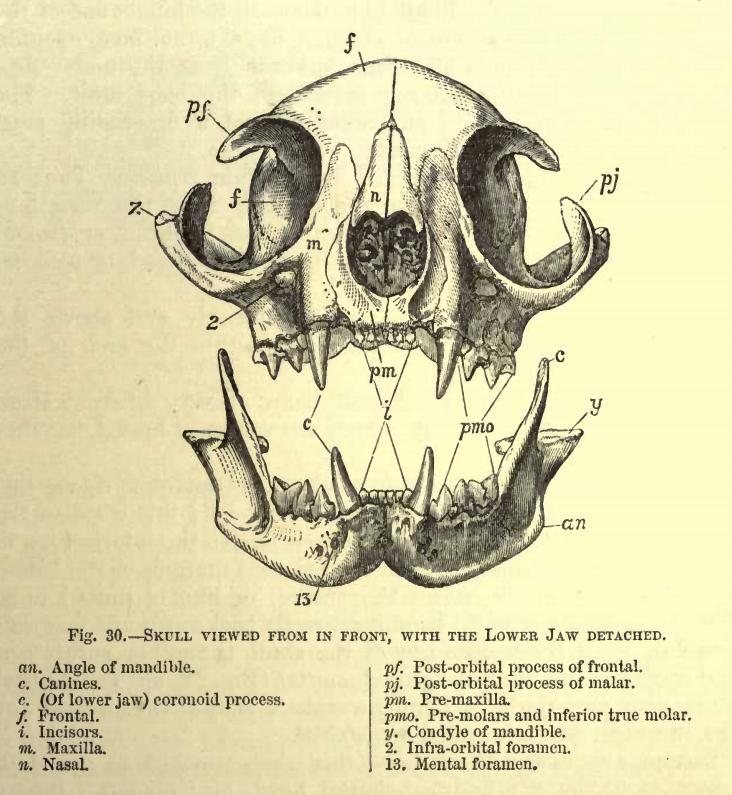
Then the parts. The rostrum runs from the nose to the eye sockets, and the orbit is the eye socket itself. The post-orbital process is the small bony point just behind the orbit. The zygomatic arch is the cheekbone, curving below and behind the eye. The infraorbital foramen is a small opening in the upper jaw below the orbit. The sagittal crest is a ridge along the top of the cranium, and the auditory bulla is the rounded bony capsule on the underside that surrounds the middle ear. The mandible is the lower jaw. The teeth run, from front to back, as incisors, canines, premolars and molars, with the carnassials among the cheek teeth. Central Michigan University's mammal skull and teeth guide labels these on side, top and underside views.
In a side view, compare the length of the rostrum, the size of the orbit, where the post-orbital process sits, the shape of the zygomatic arch and the length of the tooth row. A cat shows a short rostrum, a big orbit and a short row of teeth. In a front view, compare how wide the face is, how far apart the orbits sit and which way they face, the shape of the nasal opening and where the upper canines stand. A cat's front view is short-faced, with both orbits looking straight at you.
Can you name the skull?
Answer every question to check.
A step-by-step check at the table
Lay the skull on a table in good light, with a ruler and a phone camera close by. Gloves are a good idea if the skull is not fully clean. Then work through it in order.
Is it a cat skull? A seven-step check
Tap a card to bring it forward.
- Photograph it: Take photos from the side, front, top and underside before you handle it much.
- Count the teeth: If the skull is complete, count every tooth. About 30 suggests a cat.
- Check the upper incisors: Five on each side means opossum, not cat.
- Measure the length: In Maryland's key a house cat skull runs about 77 to 101 mm; longer than 101 mm points toward bobcat.
- Find the tiny premolar: Look just behind each upper canine for the small house-cat premolar or its empty socket.
- Compare the shape: Check rostrum length, orbit size, the cheek teeth and any sagittal crest.
- Check the rules: Confirm collection rules with the local land manager or wildlife agency.
If you are still unsure after all seven, compare the skull with a labeled specimen from a natural history museum or a university mammal collection. A side-by-side with a known cat skull is the surest way to settle it.
If the skull may have been someone's pet
A house cat skull can mean a cat that lived nearby, and some readers are holding one with exactly that worry. It deserves to be taken seriously, and a few calm steps help.
Photograph the skull where it lies before moving it, and note the place and the date. Do not handle a decomposing animal or a skull with bare hands. Then contact local animal services, a shelter, a veterinarian or the police nonemergency line, and ask whether deceased pets are reported in your area and what identification options they have. Orange County Animal Care, in California, recommends reporting found animals and using shelters or veterinarians for microchip scans when an animal is alive, so ask your local office what it does when only remains are left.
Rules about moving animal remains vary by state, county, park and landowner, so check locally before you take it anywhere. If a family is looking for their cat, your photographs and notes of the place and date can help them.
Keeping a cat skull
What follows is general information, not legal advice, and the rules for animal remains shift from place to place and year to year.
Collection rules for animal remains depend on the state, the county, the park and the landowner. Before you keep, move or display a skull, confirm the collection, possession and transport rules with the state wildlife agency, park office or land manager where it turned up. Our story on what to do when you find an animal skull covers the wider federal and state rules and who to ask, and how to clean an animal skull goes through cleaning once you know it is yours to handle. Our shop sells skull art, never real bones.
Quick answers about cat skulls
A few more points about the skull on your table.
What does a cat skull look like?
A cat skull has a short face, large forward-facing eye sockets, long canines and cheek teeth built for cutting meat. It is small and rounded, and an adult normally has 30 permanent teeth.
How many teeth does a cat skull have?
An adult domestic cat normally has 30 permanent teeth, under the formula I 3/3, C 1/1, P 3/2, M 1/1. A kitten's skull will not match, because kittens still have deciduous teeth.
What animal skull has big eye sockets?
Among small skulls, a cat's eye sockets stand out because they are large and face forward. That forward placement gives a predator binocular vision and depth perception, which is why cats, bobcats and other hunters share it.
Cat skull or raccoon skull: what is the fastest check?
Count the teeth and look at the back of the jaw. A cat has about 30 teeth and slicing cheek teeth, while a raccoon has about 40 teeth, a broader braincase and wide cheek teeth suited to a mixed diet.
Where to go next
If the skull turns out to belong to someone else, the raccoon skull, opossum skull and fox skull stories pick up each comparison. If you are not sure the skull is an animal's at all, read how to tell a human skull from an animal skull first. And if you are wondering how long it has been lying there, how old are these bones? is the place to start on that question.
Terms in this story
Tap a term to see what it means.
Felis catus. The scientific name of the domestic cat.
---