

No. 162
Who Was Cheddar Man? Britain's Oldest Complete Skeleton and His Face
Cheddar Man was a young man, probably 18 to 23 years old when he died, who lived in what is now Somerset, England, around 10,000 years ago. His nearly complete skeleton was found in December 1903 inside Gough's Cave in Cheddar Gorge, and the Natural History Museum in London describes him as a Mesolithic hunter-gatherer and Britain's oldest almost complete Homo sapiens skeleton (Natural History Museum). The face that made headlines in 2018 came from two lines of work: DNA read from his skull, which predicted dark or dark-to-black skin, dark hair and light eyes, and a model built by the reconstruction artists Adrie and Alfons Kennis.
That face is the reason most people come looking for him. Behind it is a real person whose bones have been studied for more than a century, and each round of study has added a little to what is known about his life, his age and his family line, while leaving some questions open. This is what the scientists who have worked on him say, and where you can see him today.
The find in Gough's Cave
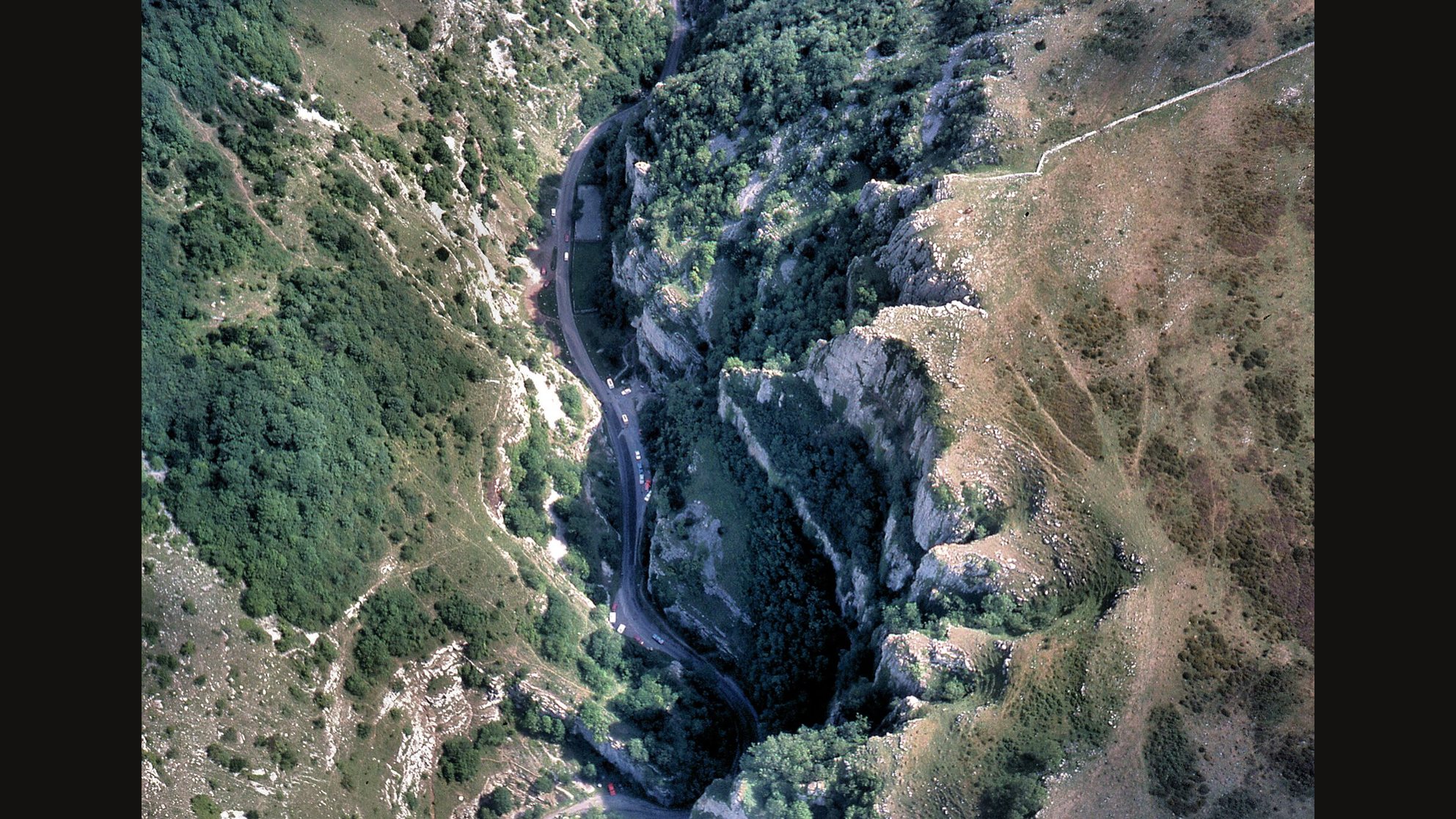
Gough's Cave is one of the caves in Cheddar Gorge in Somerset, in the southwest of England. In December 1903, workers digging a drainage channel inside the cave came upon a human skeleton. It turned out to be nearly complete, and in scientific papers he carries the formal name Gough's Cave 1 (Natural History Museum).
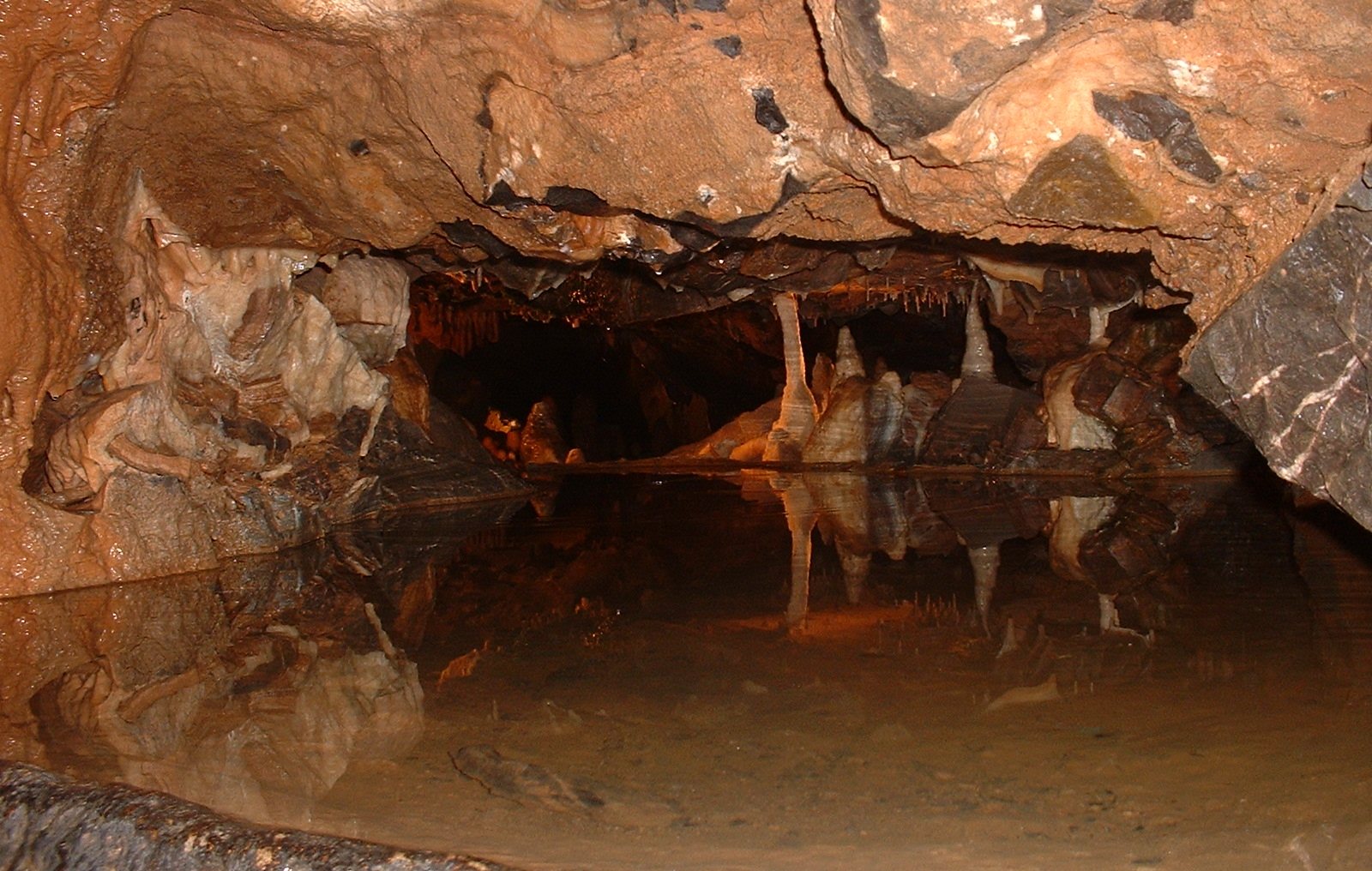
The popular name comes from the place. He was never "Cheddar Man" in his own lifetime, of course; whatever name his people used for him is long gone. What survives is his body, laid in a cave in a gorge that people still walk through today.
He belongs to the Mesolithic, the Middle Stone Age, when the people of Britain lived by hunting and gathering, before farming arrived. The Natural History Museum's description of him as Britain's oldest almost complete Homo sapiens skeleton is what puts him on so many lists of famous ancient people. For older skulls from around the world, our story on the oldest human skull follows the trail much further back.
How old is Cheddar Man, and how do we know?
The bones themselves have been dated by radiocarbon, a method that measures the carbon left in once-living material. His bones were dated directly, and the dating was carried out twice. Once calibrated, the results place him in the late ninth millennium BCE, approximately 10,000 years ago. Published ranges include 8540 to 7990 cal BCE and 8470 to 8230 cal BCE (Brace et al. supplementary material; Cotswold Archaeology).
"Cal BCE" is worth a sentence of explanation. A raw radiocarbon measurement is not a calendar year, because the amount of carbon-14 in the air has changed over time. Scientists convert the measurement into calendar years using calibration curves, and the result is a range rather than a single year. That is why the two published results are written as spans of a few centuries. Both point to the same answer in plain terms: Cheddar Man lived roughly 10,000 years ago. Radiocarbon work on the skeleton dates from the 1970s onward, so the "about 10,000 years" figure has stood for decades. Our story on how old these bones are covers the dating methods in more detail.
Tap or hover a row to highlight it.
| Field | Data |
|---|---|
| FieldName | DataCheddar Man, also designated Gough's Cave 1 |
| FieldSpecies | DataHomo sapiens |
| FieldFind place | DataGough's Cave, Cheddar Gorge, Somerset, England |
| FieldYear found | Data1903 |
| FieldPeriod | DataEarly Mesolithic |
| FieldDate | DataAround 10,000 years ago |
| FieldCalibrated ranges | Data8540 to 7990 cal BCE and 8470 to 8230 cal BCE |
| FieldEstimated age at death | DataAbout 18 to 23 years |
| FieldEstimated height | DataAbout 1.66 metres |
| FieldGenetic appearance prediction | DataDark or dark-to-black skin pigmentation, dark hair and light eyes |
| FieldMitochondrial haplogroup | DataU5b1 |
| FieldCurrent display | DataNatural History Museum, London |
| FieldOwnership | DataLongleat Estate, with the skeleton on loan to the Museum |
What his bones say about his life and death
The most detailed study of his age and sex was carried out by Erik Trinkaus, Louise Humphrey, Chris Stringer, Steven E. Churchill and Robert G. Tague. They place his age at death between about 18 and 23 years (Trinkaus and colleagues). They assess the skeleton as probably male, and they keep that "probably" on purpose: some features of the face and pelvis are unusual, so the authors left a qualification on the sex estimate rather than state it flatly.
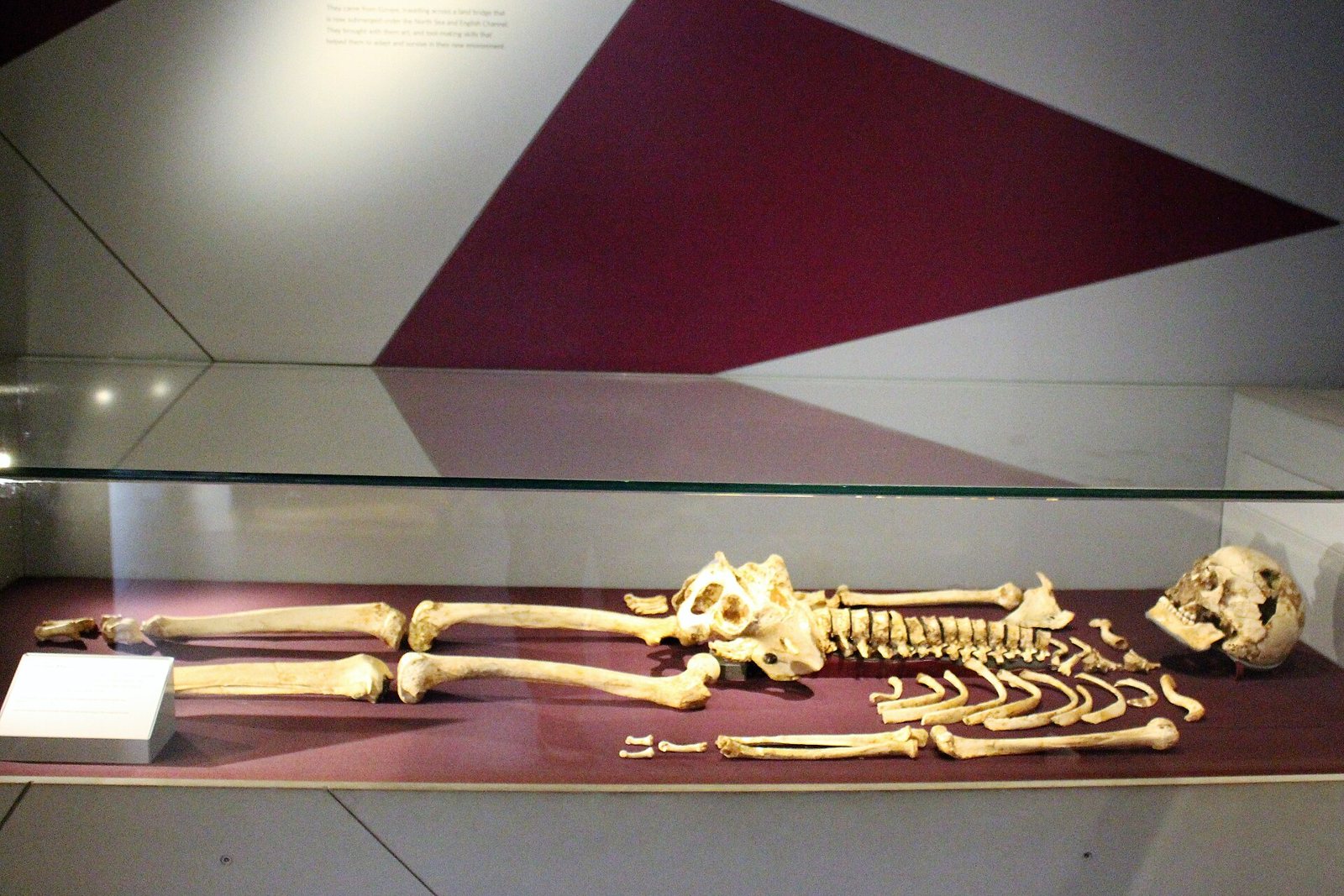
He stood about 1.66 metres tall, about five foot five, and his body mass has been estimated at about 66 kilograms (Bello et al.). As a young adult, he had not lived long enough to show the wear that age leaves on a skeleton. For how archaeologists read age and height from bones like his, see what bones tell archaeologists.
How he died is still an open question. Earlier writers took damage to his skull and upper jaw as the mark of a fatal blow. Later work by Louise Humphrey and Chris Stringer identified a lesion above his right eye that may have come from an infection, possibly osteomyelitis (an infection of the bone) or an infected sinus, or from an injury. Some of the other damage may have happened after death, or during the 1903 digging. The Natural History Museum therefore describes his cause of death as uncertain, and that is where the science rests (Natural History Museum).
The 2018 DNA study
In 2018, researchers at the Natural History Museum and University College London announced the first reading of Cheddar Man's whole genome. The DNA came from the petrous part of his skull, a very dense piece of bone around the inner ear. At the Museum, the genetic work was led by Selina Brace and Ian Barnes, with analysis by UCL geneticists including Mark Thomas and Yoan Diekmann. The peer-reviewed study, by Selina Brace and colleagues, was published in *Nature Ecology & Evolution* in 2019 (Natural History Museum; Brace et al. supplementary material).
The genetic markers predicted dark or dark-to-black skin pigmentation, dark brown or black hair and light eyes. Public material usually describes the eyes as blue or blue-green, and the Natural History Museum presents him with dark skin and blue eyes. His DNA also placed him in the population geneticists call Western European hunter-gatherers, the people living across western Europe in the Mesolithic. His mitochondrial lineage, the line of DNA passed down from mother to child, belongs to a group known as U5b1 (Natural History Museum FAQ).
One more result comes up often. Cheddar Man lacked the genetic adaptation that lets adults digest the sugar in milk, so he would have been lactose intolerant as an adult. That fits a man who lived before farming and dairy herds reached Britain. It is a trait of his time, not a sign that he was ill (Bello et al.).
What the scientists cautioned
The team was careful about how far the appearance prediction could go. The pigmentation markers are read through associations observed in people living today, and the known genetic variants do not explain every aspect of human skin, hair or eye colour (Natural History Museum FAQ). The prediction is a strong likelihood built on current genetics, not a photograph.
Mark Thomas also made a point about scale. The prediction describes one individual, and while it is indicative of the population he belonged to, it does not tell us how every Mesolithic person in Europe looked (Natural History Museum). Cheddar Man is one young man from one cave in Somerset, and the scientists who studied him describe their results with that in mind.
How his face was made
The face itself is the work of Adrie and Alfons Kennis. They built it from measurements of his skull, a three-dimensional scan and conventional estimates of how thick the soft tissue is at points across the face. The DNA results guided the colouring of skin, hair and eyes (Natural History Museum).
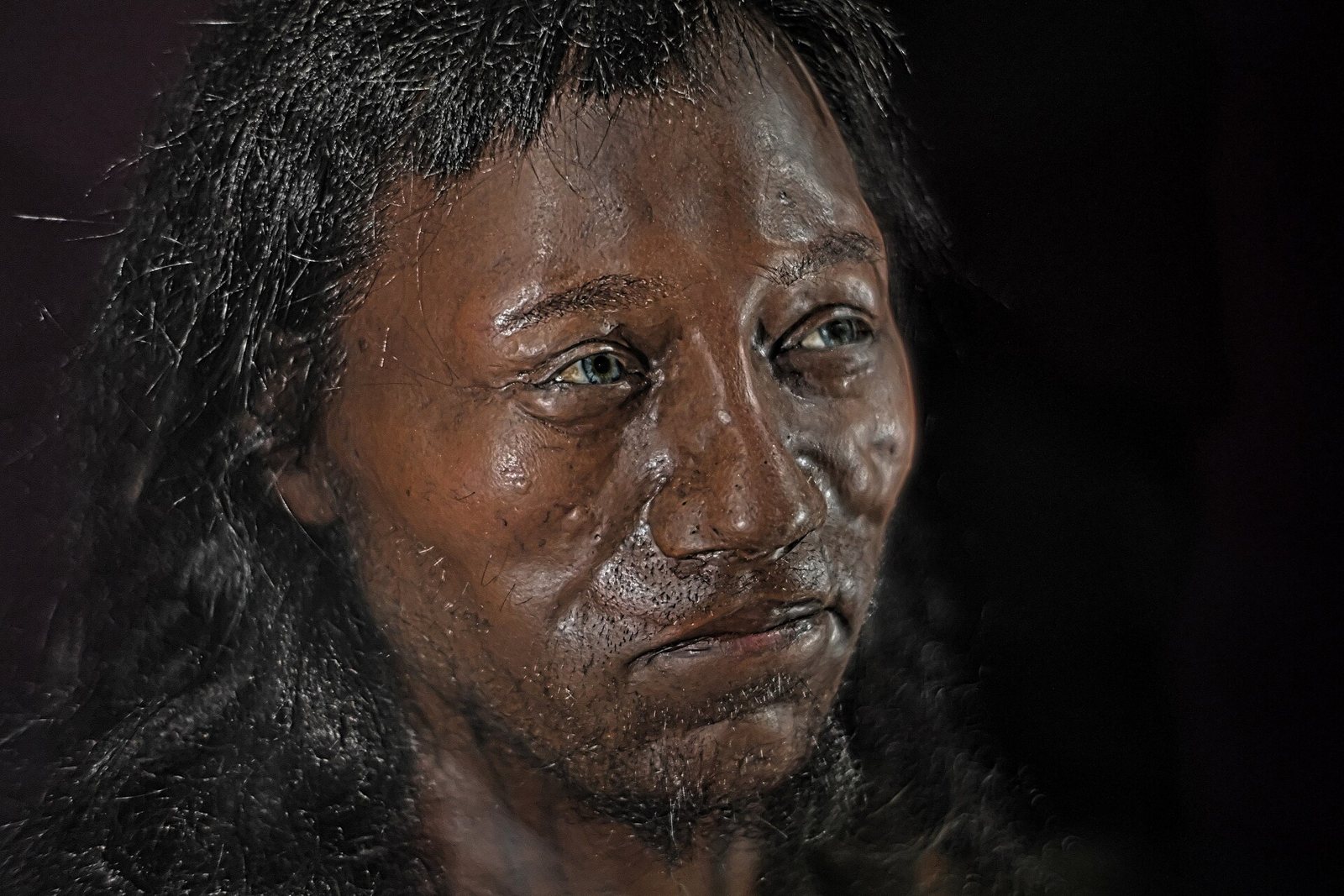
The Museum describes facial reconstruction as partly scientific and partly artistic. The skull sets the shape: the brow, the cheekbones, the jaw and the proportions of the face. What the skull cannot tell is every soft detail, such as the exact shape of the nose and lips, the hairstyle or the expression. So, the Kennis face is the best estimate of how he may have looked, built on his own bones and genes, with the artists' judgment filling what the evidence leaves open. Our story on facial reconstruction covers how these faces are built from skulls, and Naia of Hoyo Negro is another ancient young person whose remains have been studied closely.
Cheddar Man, from the cave to the gallery
Tap or hover a step to follow the order.
1903
Nearly complete skeleton found during drainage work in Gough's Cave.
1970s onward
Radiocarbon dating places the skeleton around 10,000 years old.
1997
Bryan Sykes's television-linked mitochondrial DNA comparison reports a close maternal-line match with Adrian Targett.
2018
Natural History Museum and UCL researchers announce the DNA-based appearance prediction and new facial reconstruction.
2019
The whole-genome study by Brace and colleagues appears in Nature Ecology & Evolution.
Today
Skeleton and facial reconstruction are displayed in the Natural History Museum's Human Evolution Gallery.
The 1997 match with a local teacher
Long before the genome, Cheddar Man had already made news through DNA. In 1997, the Oxford geneticist Bryan Sykes led a mitochondrial DNA comparison linked to a television programme, using a sample from one of Cheddar Man's molars. The sequence was compared with cheek-cell samples from pupils and staff at Kings of Wessex school and from adults belonging to long-established Cheddar families. The closest reported match was Adrian Targett, a history teacher who lived about half a mile from Gough's Cave (The Washington Post, 9 March 1997).
It is a lovely story, and it is worth knowing exactly what it showed. Mitochondrial DNA is inherited through the maternal line, from a mother to her children. A match means Targett and Cheddar Man shared an ancestor somewhere along that line. It does not mean Targett descends directly from Cheddar Man. Chris Stringer cautioned at the time that no one knows whether Cheddar Man had children at all; the shared line could run back through his mother, a sister or another maternal relative. The 1997 result was reported through television and the press, and it was a comparison of mitochondrial DNA, not a peer-reviewed whole-genome study (Natural History Museum FAQ).
Where to see Cheddar Man today
The original skeleton is owned by the Longleat Estate and is on loan to the Natural History Museum in London. The skeleton and the Kennis reconstruction are displayed together in the Museum's Human Evolution Gallery, so you can stand in front of both the bones and the face built from them (Natural History Museum Human Evolution Gallery).
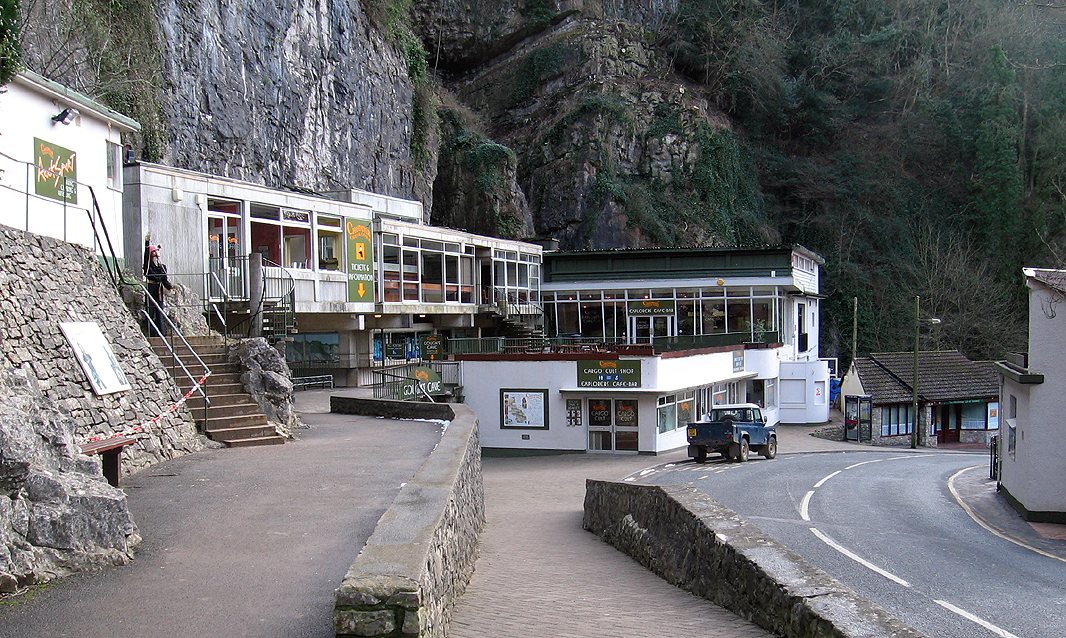
Cheddar Gorge itself is a visitor attraction. Its official attractions include Gough's Cave, the place where he was found, and the Museum of Prehistory, which presents Cheddar Man and other finds from the region. The cave, the museum and the gorge are run as separate visitor experiences (Official Cheddar Gorge attractions page). Opening times, admission, tour availability and photography rules can change, so confirm them with the Natural History Museum and with Cheddar Gorge before you travel.
If you like meeting ancient people through their remains, Ötzi the Iceman, the bog bodies of northern Europe and the Neanderthal skull story are good next reads.
Questions people ask about Cheddar Man
People ask a handful of things about him again and again. Each answer below starts with the short version.
Who was Cheddar Man?
Cheddar Man was a Mesolithic hunter-gatherer, a young man of about 18 to 23, whose nearly complete skeleton was found in Gough's Cave, Cheddar Gorge, in 1903. He lived around 10,000 years ago, when Britain's people lived by hunting and gathering. His DNA suggests dark or dark-to-black skin, dark hair and light eyes.
What does "el hombre de Cheddar" mean, and who was he?
"El hombre de Cheddar" is simply the Spanish name for Cheddar Man, the man from Cheddar. He is named after Cheddar Gorge in Somerset, where his skeleton lay in Gough's Cave, and he lived in the late ninth millennium BCE, thousands of years before farming reached Britain.
How old is Cheddar Man?
Cheddar Man is about 10,000 years old. Direct radiocarbon dating of his bones gave calibrated ranges of 8540 to 7990 cal BCE and 8470 to 8230 cal BCE. He himself died young, at an estimated 18 to 23 years of age.
Where was Cheddar Man found?
He was found in Gough's Cave in Cheddar Gorge, Somerset, in December 1903. Workers came upon the skeleton while digging a drainage channel inside the cave, and it is still known in scientific papers as Gough's Cave 1.
Where is Cheddar Man now?
His skeleton is on display in the Human Evolution Gallery at the Natural History Museum in London, alongside the 2018 Kennis reconstruction. The skeleton belongs to the Longleat Estate and is on loan to the Museum, while Gough's Cave and the Museum of Prehistory tell his story at Cheddar Gorge.
Did Cheddar Man have dark skin and blue eyes?
The DNA predicts that he did: dark or dark-to-black skin, dark brown or black hair and light eyes, usually described as blue or blue-green. The scientists add that the prediction rests on genetic variants studied in people today, which do not explain every aspect of skin, hair or eye colour.
Was Cheddar Man related to a modern teacher?
A 1997 comparison reported that the history teacher Adrian Targett shared a close mitochondrial DNA sequence with him, which points to a shared ancestor on the maternal line. It does not show direct descent, and no one knows whether Cheddar Man had children.
Was Cheddar Man lactose intolerant?
Yes, his DNA lacks the adaptation that lets adults digest milk, so he would have been lactose intolerant as an adult. That fits his life as a hunter-gatherer before dairy farming reached Britain.
Cheddar Man quiz
Answer every question to check.
A young man from Somerset, still being studied
Cheddar Man has been a skeleton in a cave, a radiocarbon date, a television DNA story and, since 2018, a face. Through all of it he has stayed what he always was: a young man who lived and died near Cheddar Gorge about 10,000 years ago, whose people laid him in Gough's Cave. The scientists who have studied him keep their answers as careful as the evidence, and the open questions, such as how he died, are part of his story too. If you visit him in London, you will find the bones and the face side by side, which is the best way to see how much a skull can say, and where it stops.
Terms in this story
Tap a term to see what it means.
Mesolithic. The Middle Stone Age; in Britain, the time when people lived by hunting and gathering, before farming arrived. Cheddar Man lived in the early Mesolithic.
---