

No. 173
Black Death Mass Graves: What They Did With the Bodies, and What the Bones Tell Us
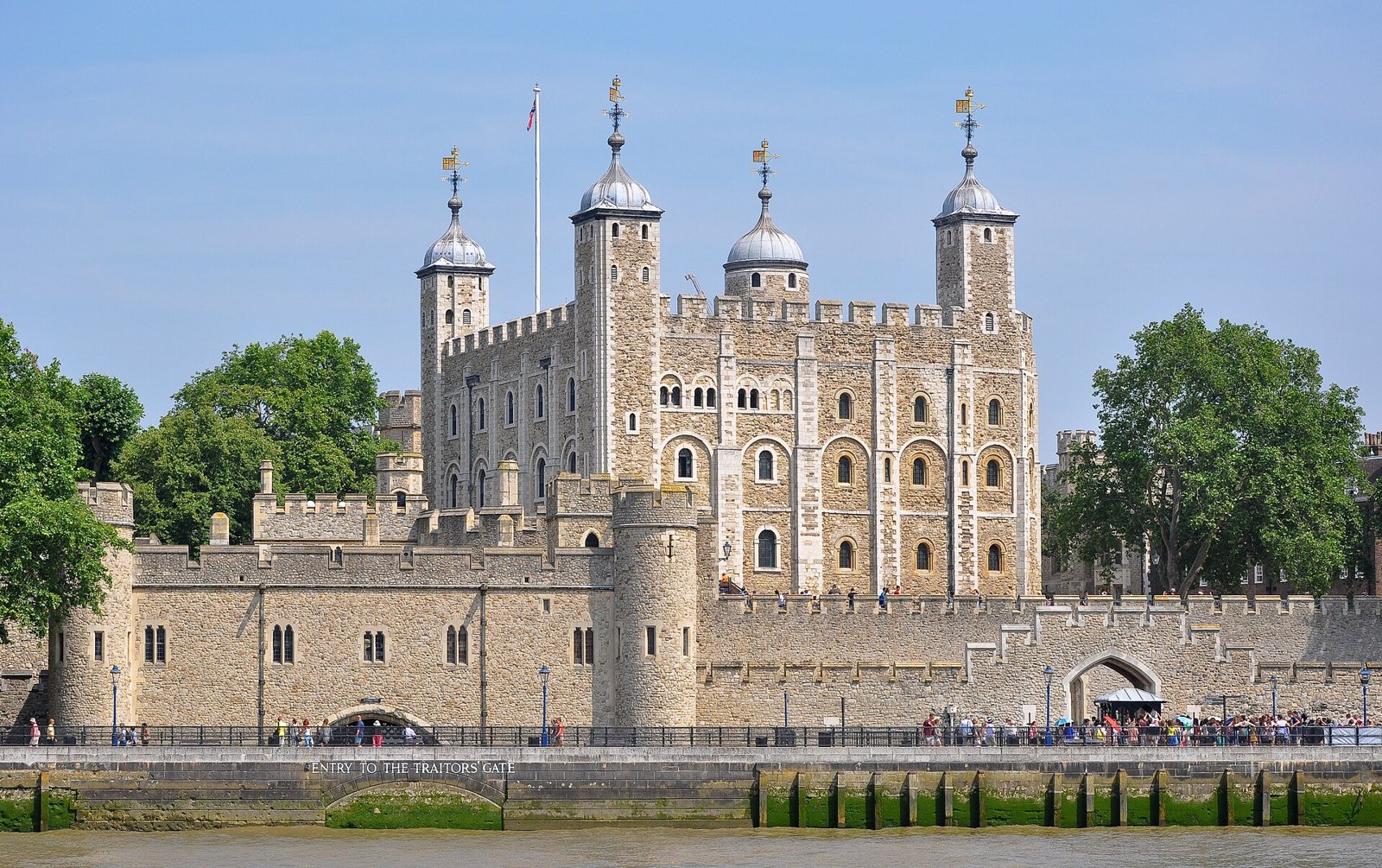
When the Black Death reached London in 1348, people kept burying their dead in parish churchyards for as long as there was room. When those filled, the city opened emergency cemeteries and dug long trenches, laying the dead side by side in rows and in layers, sometimes five deep. At East Smithfield, near the Tower of London, one of those burial grounds was in use from 1348 or early 1349 until 1350 (London Museum). The bones excavated from these graves give back a great deal: the ages and health of the people buried there, where many of them grew up, and the DNA of the plague bacterium, Yersinia pestis, still held inside their teeth.
So, if the plague pit in the news made you wonder whether bodies were simply tipped into a hole, the evidence from London and Lincolnshire tells a gentler story. Overwhelmed communities did dig mass graves, and they still laid people out with care.
How London buried its dead in 1348 to 1350
Ordinary burial did not stop when the plague arrived. Parish cemeteries went on taking the dead, and London added two emergency burial grounds when existing churchyards could not cope. One was East Smithfield, close to the Tower. The other was West Smithfield, part of which now lies beneath Charterhouse Square (London Museum).
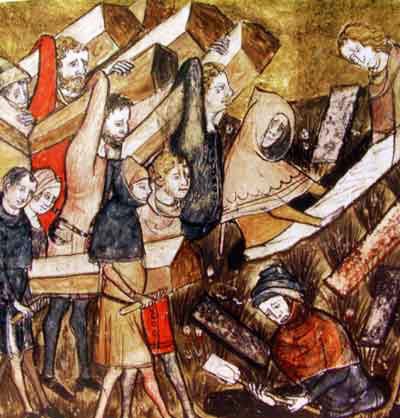
The London Museum and MOLA (Museum of London Archaeology) describe both as carefully managed emergency cemeteries. The graves at East Smithfield held several layers of burials, sometimes five deep, and the bodies were laid in rows rather than thrown in at random (London Museum). Excavation there exposed mass trenches and several hundred articulated skeletons, meaning bodies that were still lying whole, the way they were placed (Antoine, The Archaeology of "Plague").
Outside the big cities, mass graves seem to have been unusual. Hugh Willmott of the University of Sheffield notes that rural mass graves are rare, which suggests many communities still managed to bury people in the usual way, one grave at a time, even during the worst months (University of Sheffield).
East Smithfield and the people buried there
East Smithfield was used for only about two years, yet it became one of the most studied medieval cemeteries anywhere. The London Museum now cares for more than 600 individuals excavated from the site (London Museum). Those people are not a faceless crowd to the specialists who study them. Each skeleton carries its own record of age, health and childhood.
Some of the most striking results concern where these people came from. Dental chemistry, bone traits and mitochondrial DNA indicate that many of those buried at East Smithfield had family or childhood connections outside London (London Museum). Fourteenth-century London drew people in from far and wide, and the plague cemetery reflects that mixed city.
The scale of loss in London was enormous. The London Museum estimates that about 35,000 people died in the city by 1352, more than half of the population inside the city and its suburbs (London Museum). Many of them remain where they were laid, in burial grounds that later disappeared under streets, warehouses and offices. That is why construction work in London still meets medieval graves, and why a plague burial ground can turn up in the news centuries after the last mourner left it.
Charterhouse Square and the Crossrail burials
In 2013, engineers building the Crossrail line dug a shaft at Charterhouse Square, and archaeologists exposed 25 shallow burials there. Historical records identify this ground as part of the West Smithfield emergency cemetery. Dating and ancient DNA linked at least some of the individuals to the Black Death and to Yersinia pestis (MOLA).
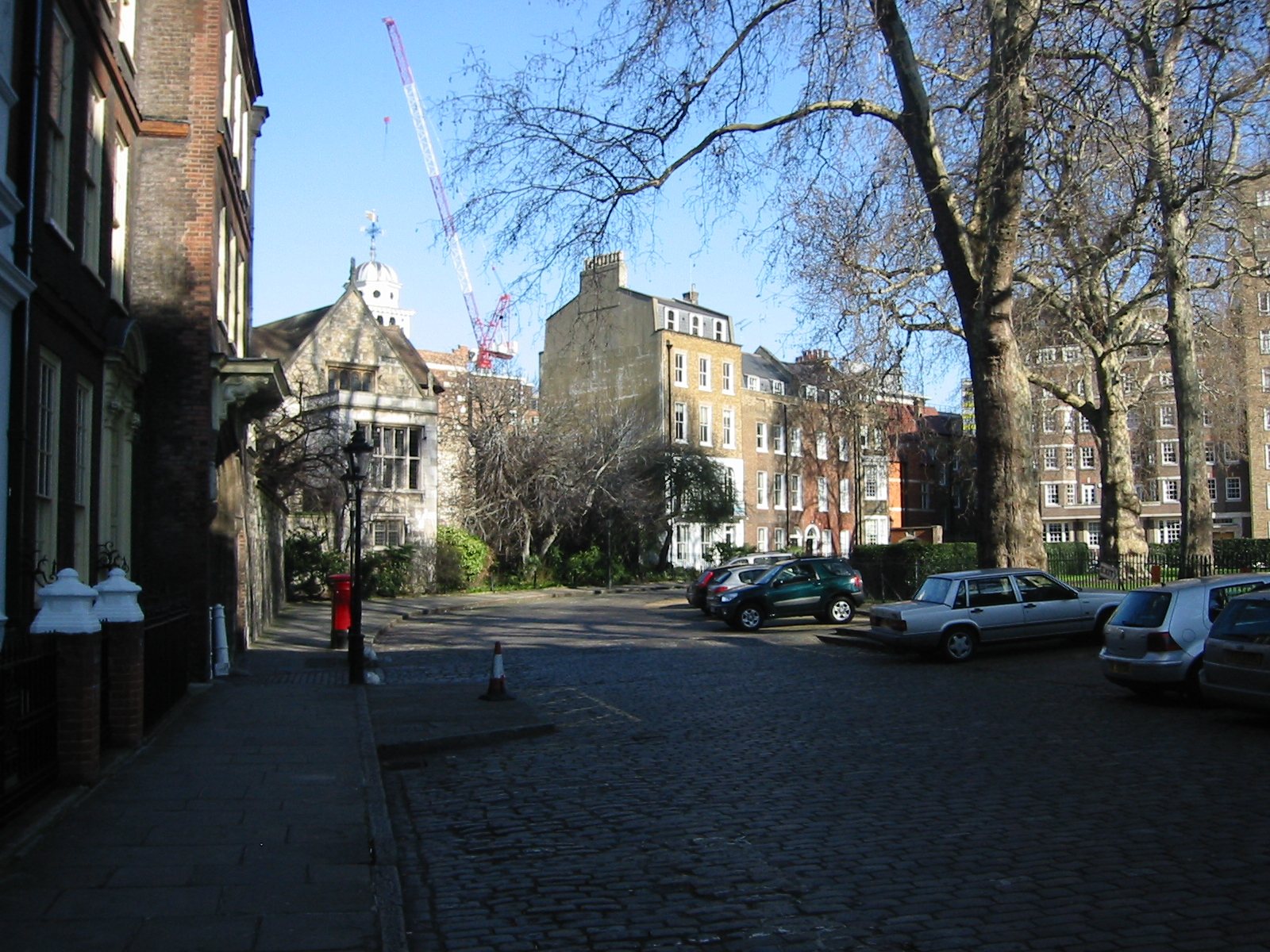
As at East Smithfield, the people at Charterhouse Square were placed carefully in rows, not left as a heap of scattered bones (MOLA). Even with a city in crisis, someone took the time to lay each body down.
Thornton Abbey, a village's grave
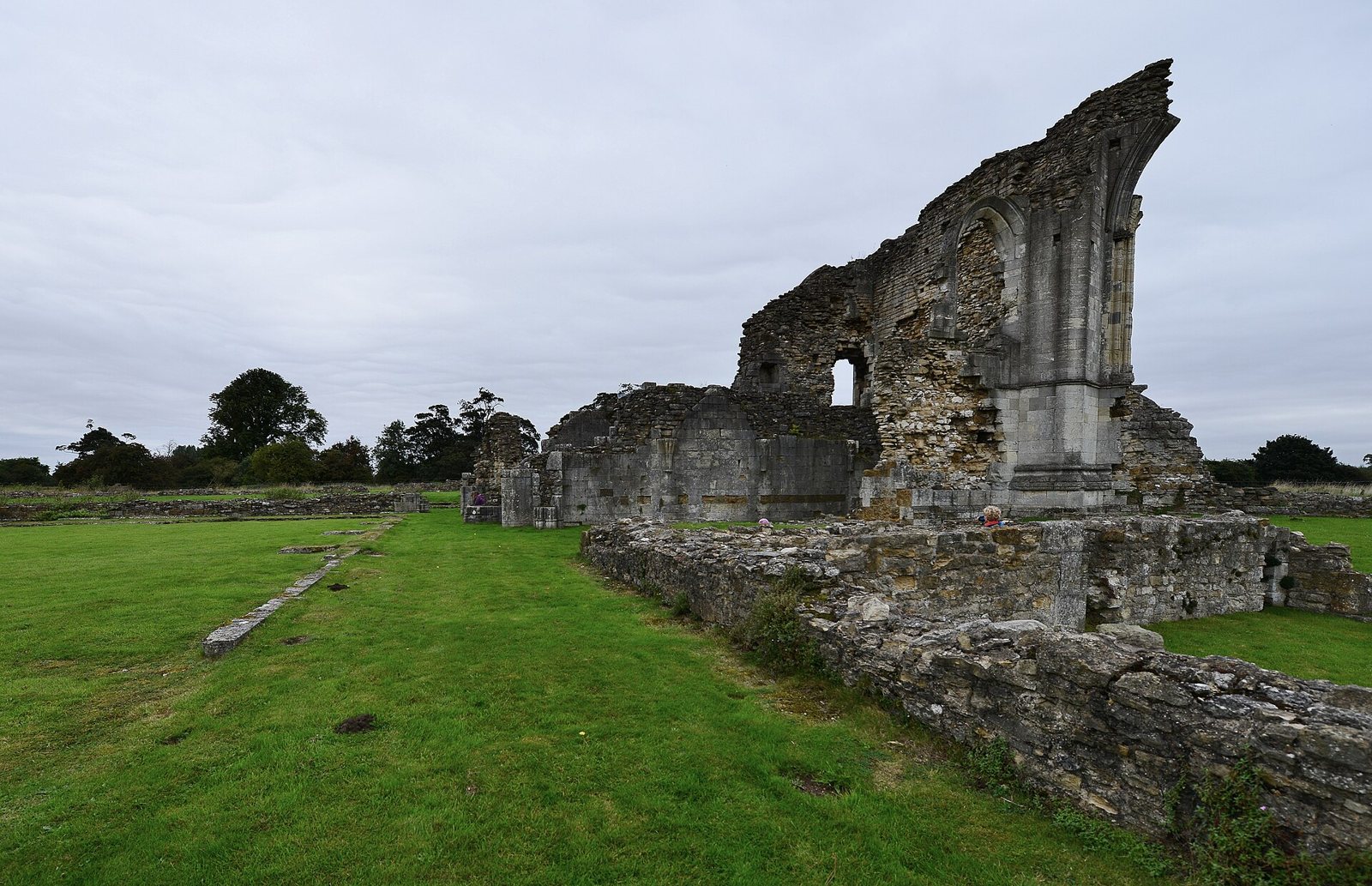
The rarest kind of plague burial is a rural one, which is what makes Thornton Abbey in Lincolnshire so important. Excavations by the University of Sheffield between 2013 and 2016, led by Hugh Willmott, uncovered at least 48 people buried together near the abbey's hospital. Twenty-seven of them were children (University of Sheffield).
Radiocarbon dating placed the burial in the fourteenth century, and Yersinia pestis DNA was identified in sampled remains. The team, writing in the journal Antiquity, describes it as Britain's first confirmed rural Black Death mass grave (Willmott et al., Antiquity).
The number of children is what stays with most people who read about Thornton Abbey. A small community lost so many of its young at once that its usual way of burying people, one grave at a time, could no longer keep up.
Tap or hover a row to highlight it.
| Place | Date | What archaeologists recorded |
|---|---|---|
| PlaceEast Smithfield, London | DateEmergency cemetery used 1348 to 1350 | What archaeologists recordedMore than 600 individuals now cared for by the London Museum; rows and layers up to five deep |
| PlaceCharterhouse Square, London | Date2013, during Crossrail works | What archaeologists recorded25 shallow burials in part of the West Smithfield emergency cemetery; Yersinia pestis DNA in some |
| PlaceThornton Abbey, Lincolnshire | Date2013 to 2016, University of Sheffield | What archaeologists recordedAt least 48 people, including 27 children; radiocarbon dated to the fourteenth century |
What teeth tell scientists about the plague
For centuries, historians could only infer what disease caused the Black Death. Teeth settled much of the question. Ancient DNA is often recovered from dental pulp, the soft inner part of a tooth, because the tooth can protect DNA from germs that once circulated in the blood. Studies of London and other medieval burials identified Yersinia pestis, confirming that plague caused at least some of the deaths linked to the Black Death (Spyrou et al., Nature; MOLA).

Teeth also pointed back toward where the pandemic began. In 2022, Maria Spyrou, Philip Slavin, Johannes Krause and colleagues published a study in Nature of human remains from the Kara-Djigach cemetery in the Chüy Valley of present-day Kyrgyzstan. Tombstones there date the deaths to 1338 and 1339, several years before the plague reached Europe. The Yersinia pestis genomes from those graves belonged to a lineage close to the ancestor of the strains that spread during the Black Death, and the authors argued that the wider Tian Shan region of Central Asia was the most likely source area (Spyrou et al., Nature).
That result narrowed the search, but it did not end the debate. The paper identifies a source region and an ancestral lineage, not one proven starting point for the whole pandemic. Other scientists and historians have proposed different starting regions, including areas farther east and around the Black Sea (Nature news).
Not every skeleton under London is a plague victim
Bones tell scientists far more than how someone died. In 2018, Historic Royal Palaces excavated two skeletons outside the chapel of St Peter ad Vincula at the Tower of London. Alfred Hawkins reported an adult woman aged about 35 to 45 and a child aged about seven. Both showed signs of illness or physical stress, and the woman had evidence of chronic back pain. There were no signs of violent death (Historic Royal Palaces).
These two people were not identified as Black Death victims, and they were reburied in a ceremony in 2019 (Historic Royal Palaces). Their story shows what else bones can hold: a sore back, a hard childhood, a life lived before any epidemic. If you want to know how specialists read that kind of evidence, our story on what bones tell archaeologists walks through it, and how old are these bones covers how dates like the ones above are worked out.
London's plague-pit stories
London is full of places said to sit on plague pits, and some of those stories hold up better than others. Many of them also mix two different epidemics: the Black Death of 1348 and the Great Plague of London in 1665, more than three centuries later.
Islington Green is one well-known example. The site was also known as Jones' Burial Ground, Little Bunhill Fields and New Bunhill Fields, and the local history publication Streets with a Story records the plague-pit claim as a tradition connected mainly with the Great Plague of the seventeenth century (Islington History). It is best understood as a traditional or later-plague story, not a confirmed Black Death cemetery.
Vinegar Alley in Walthamstow is said to be named after vinegar used to disinfect a nearby plague burial site in 1665. Local historian Lissa Chapman records that the name appears to date from the late eighteenth century, that the vinegar explanation is unproven, and that the alleged mass grave has not been securely shown by archaeology (Lissa Chapman). The vinegar story is local tradition, and a good one, but tradition all the same.
Then there is the Underground. Stories that Tube stations were built directly over plague pits belong largely to urban folklore (University of Westminster). Transport works really have met medieval and early modern burials, including at Charterhouse Square and in the Liverpool Street area, but each of those has its own site and date (MOLA). A blanket claim about the whole network goes further than the evidence.
How many died, and who was blamed
The Black Death cannot be reduced to one precise death toll. The University of Sheffield gives an estimated 75 to 200 million deaths worldwide for the pandemic of 1346 to 1353 (University of Sheffield). Historians commonly describe Europe's loss as roughly a quarter to a half of the population, depending on the region, the period and the evidence used (London Museum).
People at the time did not know about bacteria or fleas. Some saw the plague as divine punishment; others blamed corrupted air. In many parts of Europe, Jewish communities were falsely accused of poisoning wells. Those accusations led to torture, forced confessions, expulsions and mass killings. Pope Clement VI condemned the accusations in 1348, but the violence continued (Jewish Encyclopedia; Jewish History Sourcebook). Jews were victims of persecution, not the cause of the disease.
The fear and grief of those years also shaped how Europeans imagined death itself, in images such as the danse macabre, where skeletons lead people of every rank away together.
The Black Death, from Kyrgyzstan to the excavation trench
Tap or hover a step to follow the order.
1338 to 1339
People die at Kara-Djigach in present-day Kyrgyzstan; their graves later yield Yersinia pestis DNA.
1348
The Black Death reaches London and the city creates emergency burial grounds.
1348 to 1350
East Smithfield operates as an emergency cemetery near the Tower of London.
2013
Crossrail works expose 25 burials at Charterhouse Square, part of the West Smithfield cemetery.
2013 to 2016
University of Sheffield excavations at Thornton Abbey uncover a mass grave of at least 48 people.
2022
Spyrou, Slavin, Krause and colleagues publish the Kara-Djigach DNA study in Nature.
Questions people ask about Black Death mass graves
Short answers to the questions that come up most.
What did they do with all the bodies during the Black Death?
They buried them, in ordinary churchyards for as long as possible and then in emergency cemeteries with large multi-body graves. In London, East Smithfield and West Smithfield were organized burial grounds where bodies were generally laid in rows and layers (London Museum).
Were there mass graves caused by the Black Plague?
Yes, archaeologists have identified Black Death mass graves at East Smithfield and Charterhouse Square in London and at Thornton Abbey in Lincolnshire. A shared grave alone does not prove plague, which is why dating, context and Yersinia pestis DNA matter when a site is identified (Willmott et al., Antiquity).
Where are the bones of plague victims buried?
Many still lie in their original cemeteries beneath later cities, including parts of West Smithfield under Charterhouse Square. Excavated remains are curated, studied and reburied according to archaeological and legal requirements; the London Museum cares for more than 600 people from East Smithfield (London Museum).
Did they burn bodies during the Black Plague?
No, burial was the normal treatment for the dead in medieval England, including in London's emergency cemeteries. Burning did happen in some places, but as part of the violence against Jewish communities falsely accused of poisoning wells, not as the standard way of handling plague victims (Jewish Encyclopedia).
Who was blamed for the Black Death plague?
Jewish communities were falsely blamed in many European towns for poisoning wells, and others explained the plague as divine punishment or bad air. The accusations were baseless and led to persecution and mass killings (Jewish History Sourcebook).
Where did they bury the dead of the Black Death?
In parish cemeteries while there was room, and in emergency cemeteries and multi-body graves once towns were overwhelmed. London's East Smithfield and West Smithfield served that purpose during the epidemic of 1348 to 1350 (London Museum).
What were the Black Death's mass graves?
They were shared burials opened when normal cemeteries could not take everyone who had died. Archaeology shows that some were carefully organized, with bodies placed in rows and layers (Willmott et al., Antiquity).
Is the Black Death the same as the Great Plague of London?
No, the Black Death reached London in 1348, while the Great Plague struck the city in 1665. Many London plague-pit stories, such as those about Islington Green and Vinegar Alley, are tied to the later outbreak (Islington History).
Black Death mass graves quiz
Answer every question to check.
The people beneath the city
The plague pit in the headlines is, in the end, a burial ground: a place where a frightened city still found the time to lay its neighbours in rows. Archaeologists at MOLA, the London Museum and the University of Sheffield treat the people they excavate as individuals, with ages, injuries, childhood homes and, in their teeth, the trace of the disease that killed them. Their work has turned the Black Death from a number into thousands of particular lives. If the care people have taken over their dead interests you, our story on ossuaries around the world follows other communities who kept their ancestors' bones close, and repatriation of human remains looks at how museums decide where the dead should rest.
Terms in this story
Tap a term to see what it means.
Black Death. The plague pandemic of 1346 to 1353, which reached London in 1348 and killed an estimated 75 to 200 million people worldwide.
---