

No. 174
Skeletons Found Hugging: The Couples Buried Together
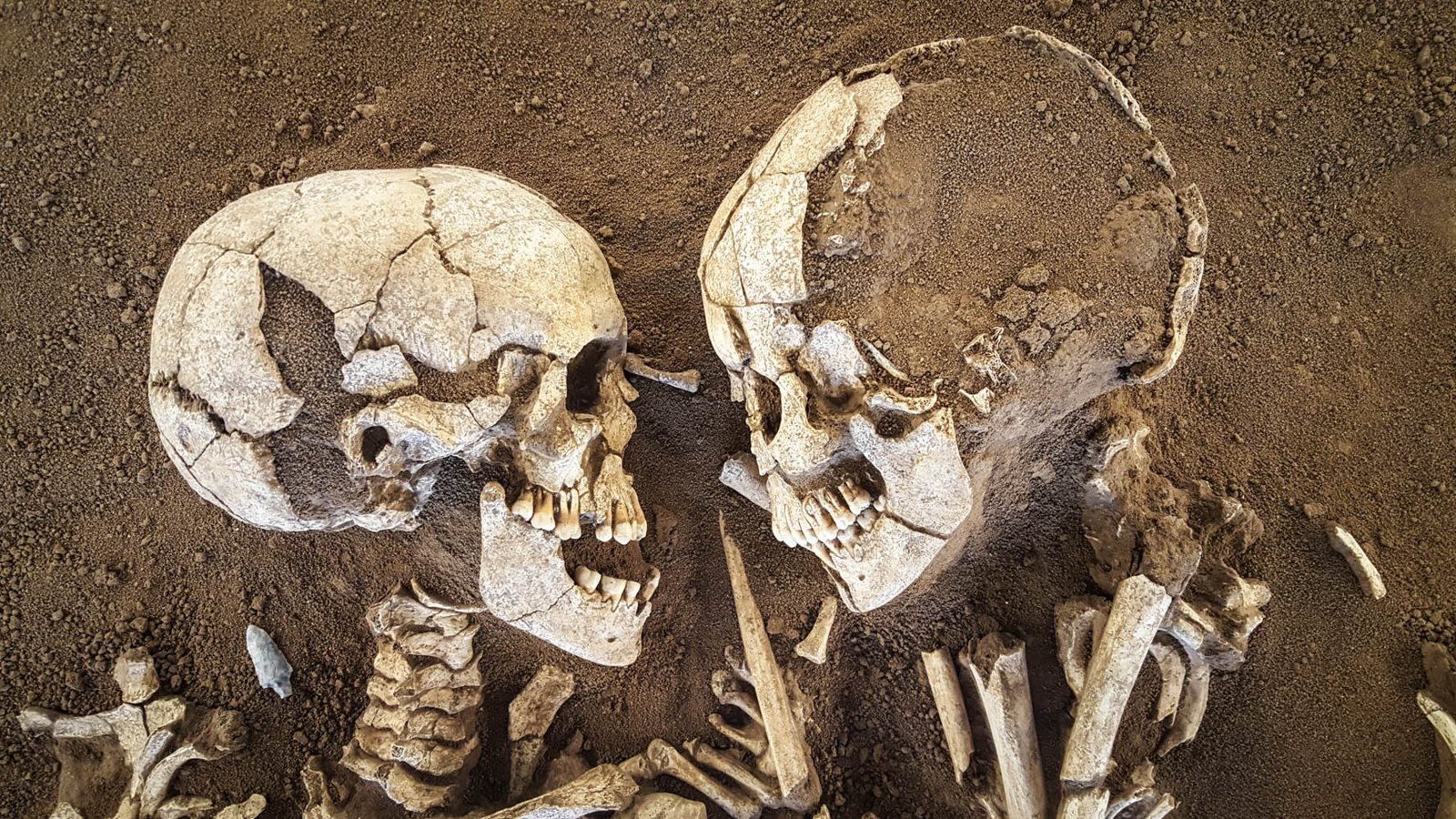
The photo of two skeletons hugging that travels most widely online is usually the Lovers of Valdaro: a young woman and a young man buried together near Mantua, Italy, about 5,500 to 5,100 years ago, found in 2007 and now on permanent display at the Museo Archeologico di Mantova (Museo Archeologico di Mantova). The other famous pair is the Hasanlu Lovers of northwestern Iran, who died when their town was destroyed around 800 BCE and whom later ancient DNA showed to be both male (Penn Museum). A handful of other hugging burials are known, in Greece, China and Italy. Archaeologists read each one from its own evidence, because a pose alone cannot say whether two people were partners, relatives, friends or strangers.
What follows is who each pair was, how old the burials are, and what the people who study them think the closeness means.
The Lovers of Valdaro, Mantua
The Lovers of Valdaro were found in 2007 at Valdaro, on the edge of Mantua in northern Italy, in a late Neolithic double grave. The Mantua archaeological museum dates the burial to about 5,500 to 5,100 years ago (Museo Archeologico di Mantova).
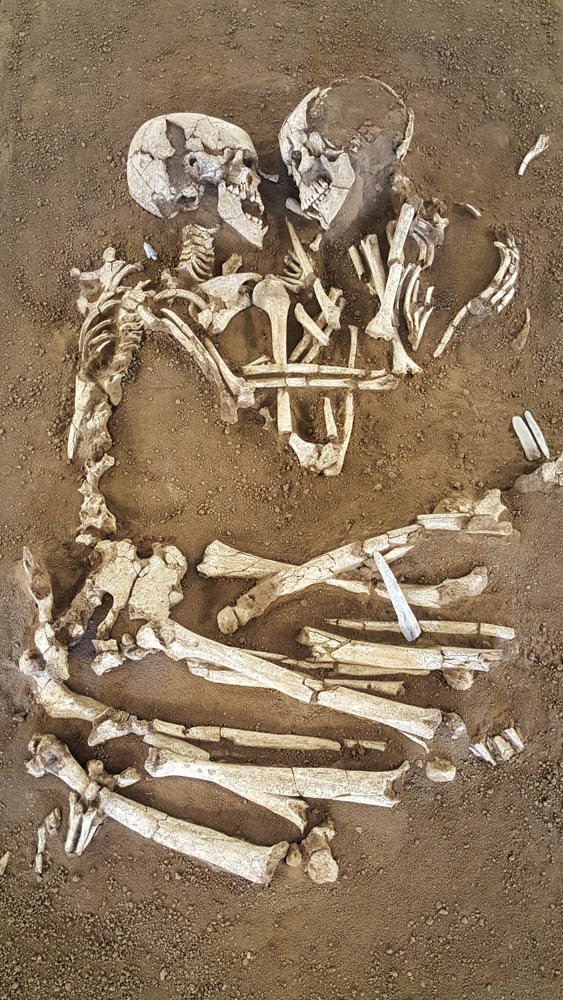
According to the regional museums of Lombardy, the skeleton on the left is a woman aged 16 to 20 and the one on the right is a man aged 18 to 22 (Direzione regionale Musei Lombardia). They were buried in a crouched position, with flint tools beside them.
How they came to look so close is part of the story. The two bodies were wrapped in textiles when they were buried. As the cloth decayed over the centuries, the skeletons shifted toward each other, and that movement helped create the hug seen today (Direzione regionale Musei Lombardia). They were buried together, and the final closeness of the pose is partly the work of time.
Were they a couple? Nobody knows. They are real people, two young adults of the same generation buried in one grave, and the museum is careful not to claim more about their relationship than the grave can tell. The Spanish-language web often calls them "el abrazo que duró 6000 años," the hug that lasted 6,000 years. That is a rounded figure for a burial the museum dates to about 5,500 to 5,100 years ago.
If you want to see them, they are on permanent display at the Museo Archeologico di Mantova, according to the museum's own page. Check the museum's current hours before you travel.
The Hasanlu Lovers, Iran
The Hasanlu Lovers were found in 1972 during the Penn Museum's excavations at Hasanlu, a settlement in northwestern Iran, and their remains came into the Penn Museum's collection in 1973. Page Selinsky, an archaeologist with the Penn Museum, dates the destruction of Hasanlu to around 800 BCE (Penn Museum). The two people died during that violent destruction and were found lying face to face in a bin made of mudbrick and plaster.
From the bones, one was a young adult aged 19 to 22 and identified as male. The other was estimated at 30 to 35 years old and assessed as probably male, although the skeletal signs were less clear. Later ancient-DNA work, published by Lazaridis and colleagues in "The genetic history of the Southern Arc," identified both as genetically male (Lazaridis et al.).
How did they die? The exact cause is unknown. The Penn Museum reports injuries around the time of death but no wounds on the skeletons that were clearly fatal. Suffocation from smoke or from collapsing debris has been proposed, but that is an interpretation, not something the bones prove (Penn Museum).
Their relationship is also unknown. Selinsky's article on the pair is titled "Lovers, Friends, or Strangers?", and that title sums up the question well. They may have been partners, relatives or friends, or two people who reached for each other as their town was destroyed.
The pair was displayed at the Penn Museum from the mid-1970s until the mid-1980s and remains in the museum's care. If you hope to see them, ask the Penn Museum whether they are currently on view.
The hug at Alepotrypa Cave, Greece
In southern Greece, at a spot called Xagounaki beside Alepotrypa Cave at Diros, archaeologists uncovered an undisturbed double burial of a young adult man and woman lying in each other's arms. The Greek Ministry of Culture reports that carbon-14 dating places the burial at about 3800 BCE, which is roughly 5,800 years ago, and that DNA analysis identified one male and one female (Greek Ministry of Culture).
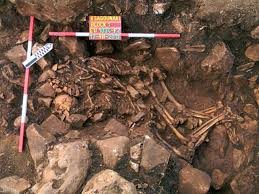
The burial is close to, though technically just outside, the main entrance of Alepotrypa Cave. The wider cave and Diros complex was used for living and for burying the dead from about 6000 to 3200 BCE. The Diros Project was directed by Giorgos Papathanassopoulos, working with Anastasia Papathanasiou and other Greek and international archaeologists (Field Museum).
The ministry describes the burial as an unusually rare double grave, and it does not say what the two people were to each other. Carbon-14 dating, the method used here, is explained in our story on how old are these bones.
The Northern Wei couple of Shanxi, China
In 2021, Quanchao Zhang, Xiaogang Hou and colleagues published a burial from Shanxi Province in northern China dating to the Northern Wei period, 386 to 534 CE, about 1,500 years ago (Zhang et al., Wiley). It held an adult man and an adult woman with their arms around each other. The woman wore a ring on the ring finger of her left hand.
The authors read the arrangement as an expression of the wish for lasting love, while noting that other explanations cannot be ruled out. They also suggest that the woman may have died, or chosen to die, so she could be buried with her husband. That is their interpretation, and they present it as one.
The Lovers of Modena, Italy
The Lovers of Modena were found in 2009 in a Late Antique cemetery in Modena, Italy, dating to the fourth to sixth centuries CE. They were buried side by side, holding hands. A 2019 study in Scientific Reports, led by Federico Lugli, used proteins in their tooth enamel to estimate sex and found that both were male (University of Bologna).
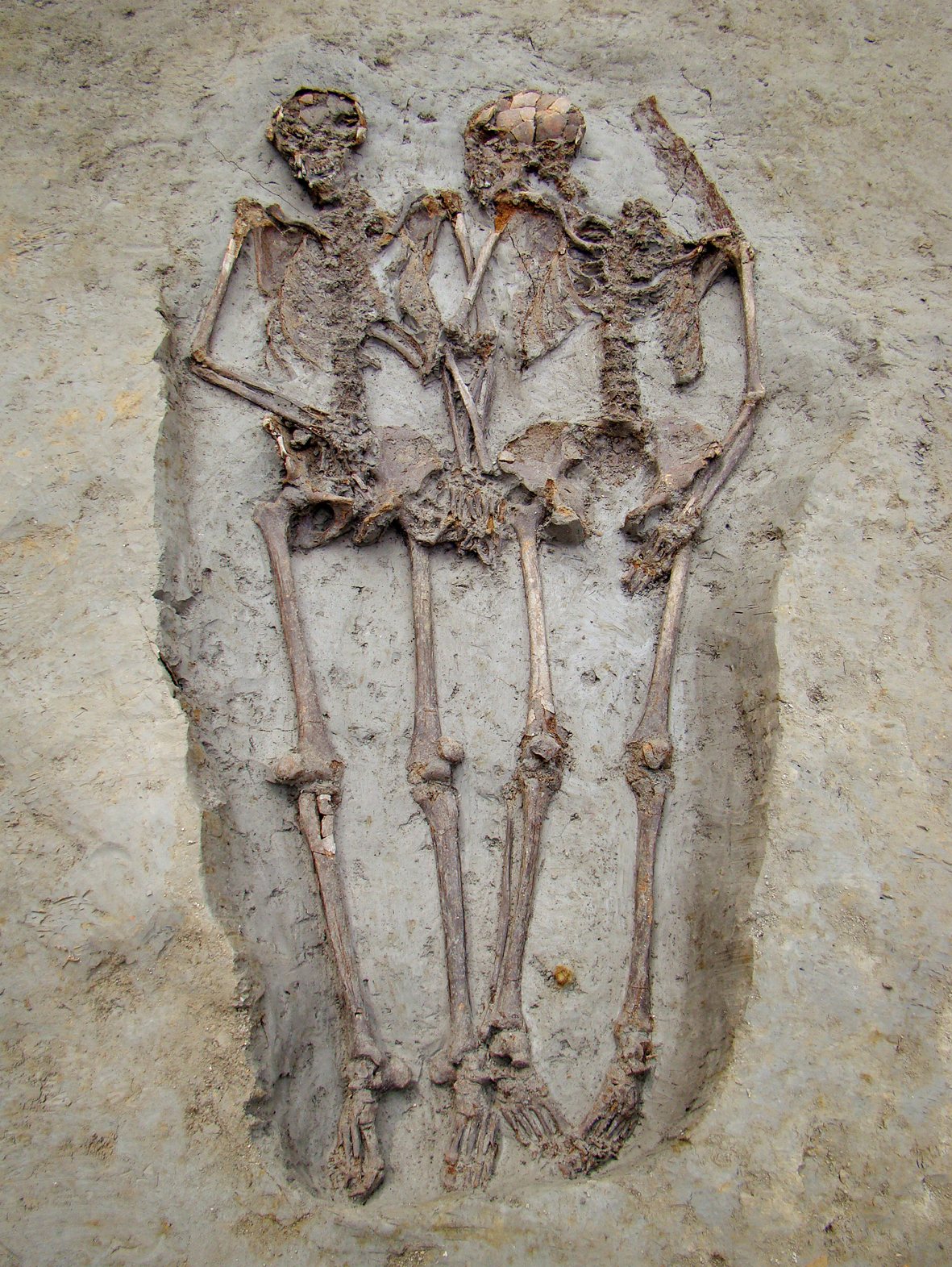
Both the study and the University of Bologna say their relationship remains unknown. Possible explanations include relatives, companions, or soldiers who died together. The study sees the hand-in-hand position as a sign of a significant bond, without claiming to know whether it was romantic. Since 2014 the pair has been on view at the Museo Civico Archeologico Etnologico di Modena.
What archaeologists think the hug means
It is natural to look at these photos and feel tenderness. That feeling is part of why they are shared so widely, and archaeologists understand it. What they add is a sense of how many stories a single pose can hold.
Page Selinsky says the Hasanlu pair could show comfort between lovers, relatives, friends or strangers facing extreme danger, and she points out that the nickname "lovers" invites assumptions (Penn Museum). The Northern Wei study reads its couple as an expression of marriage and continuing attachment, but leaves the door open. The Modena study sees a meaningful relationship without being sure it was a romantic one. The Greek ministry describes the Alepotrypa pair as rare and leaves their relationship unnamed.
Put together, a hugging or face-to-face burial may reflect affection, family ties, protection, ritual, the circumstances of a death, or simply the way bodies shift as wrappings decay, as at Valdaro. Each grave is read through its own setting: who was buried, when, with what objects, and how the bodies were placed. The word "lovers" is a modern label that people gave these pairs, not a finding.
The sex of each person comes from careful work too. Bones give one kind of evidence, and newer methods such as ancient DNA and enamel proteins give another; at Hasanlu, DNA confirmed what the bones of the older individual could only suggest. For how archaeologists estimate age and sex from a skeleton, see our story on what bones tell archaeologists.
The five pairs side by side
Here is how the best-known hugging burials compare, as the museums and studies describe them.
Tap or hover a row to highlight it.
| Pair | Place | Date | Who they were | Where they are now |
|---|---|---|---|---|
| PairLovers of Valdaro | PlaceValdaro, Mantua, Italy | DateAbout 5,500 to 5,100 years ago | Who they wereA woman aged 16 to 20 and a man aged 18 to 22 | Where they are nowOn permanent display, Museo Archeologico di Mantova |
| PairXagounaki pair | PlaceBeside Alepotrypa Cave, Diros, Greece | DateAbout 3800 BCE, by carbon-14 | Who they wereA young adult man and woman, by DNA | Where they are nowAsk the museum |
| PairHasanlu Lovers | PlaceHasanlu, northwestern Iran | DateDied around 800 BCE | Who they wereTwo males, aged 19 to 22 and 30 to 35 | Where they are nowIn the Penn Museum's care |
| PairNorthern Wei couple | PlaceShanxi Province, China | Date386 to 534 CE | Who they wereAn adult man and an adult woman | Where they are nowNot stated |
| PairLovers of Modena | PlaceModena, Italy | DateFourth to sixth centuries CE | Who they wereTwo males, by enamel proteins | Where they are nowOn view at the Museo Civico Archeologico Etnologico di Modena since 2014 |
Hugging burials through time
Tap or hover a step to follow the order.
About 5,500 to 5,100 years ago
The Lovers of Valdaro are buried near Mantua, Italy.
About 3800 BCE
A man and woman are buried together at Xagounaki beside Alepotrypa Cave, Greece.
Around 800 BCE
Hasanlu is destroyed; the two Hasanlu Lovers die together.
386 to 534 CE
A Northern Wei couple is buried together in Shanxi, China.
Fourth to sixth centuries CE
The Lovers of Modena are buried hand in hand in Italy.
1972
The Hasanlu pair is excavated by the Penn Museum.
2007
The Valdaro burial is found.
2009
The Modena burial is found.
Questions people ask about skeletons found hugging
Short answers to the questions people ask most.
Were the Hasanlu Lovers both men?
Yes, according to later ancient-DNA work, which identified both individuals as genetically male. From the bones alone, the Penn Museum had assessed one as male and the other as probably male. What they were to each other is not known (Lazaridis et al.).
Are the Lovers of Valdaro real?
Yes. They are the real remains of two young people from a Neolithic double grave found near Mantua, Italy, in 2007, and the museum identifies them as a young woman and a young man buried about 5,500 to 5,100 years ago (Museo Archeologico di Mantova).
Where do the Hasanlu Lovers rest now, and how did they die?
They are in the care of the Penn Museum, which displayed them from the mid-1970s to the mid-1980s; ask the museum whether they are on view today. Their exact cause of death is unknown: they died when Hasanlu was destroyed around 800 BCE, and suffocation from smoke or debris has been proposed but not proven (Penn Museum).
What does it mean when two skeletons are found kissing or hugging?
There is no single meaning. A close pose may reflect affection, family, protection, ritual, how the people died, or movement of the bodies after burial, and archaeologists read each case from its own evidence (Penn Museum).
What is the 6,000-year-old hug?
It usually refers to the Lovers of Valdaro, the Neolithic pair found near Mantua in 2007. The Mantua museum dates their burial to about 5,500 to 5,100 years ago, so "6,000 years" is a popular rounding (Museo Archeologico di Mantova).
Hugging skeletons quiz
Answer every question to check.
Why these photos stay with us
Two people lying close after thousands of years speak to something everyone understands, whether they were partners, family, friends or strangers sharing a terrible moment. The facts, kept as the museums and scientists give them, make the stories richer rather than smaller: two young people wrapped in cloth at Valdaro, two men who died together when Hasanlu was destroyed, a ring on a woman's finger in Shanxi. They were real people, and the care archaeologists take in describing them is a kind of respect. If stories of people found together in moments of disaster interest you, read about the Pompeii skeletons.
Terms in this story
Tap a term to see what it means.
Neolithic. The late Stone Age period of early farming communities; the Lovers of Valdaro were buried in the late Neolithic, about 5,500 to 5,100 years ago.
---