

No. 171
Opossum Skull: 50 Teeth and How to Tell It From a Raccoon or Cat
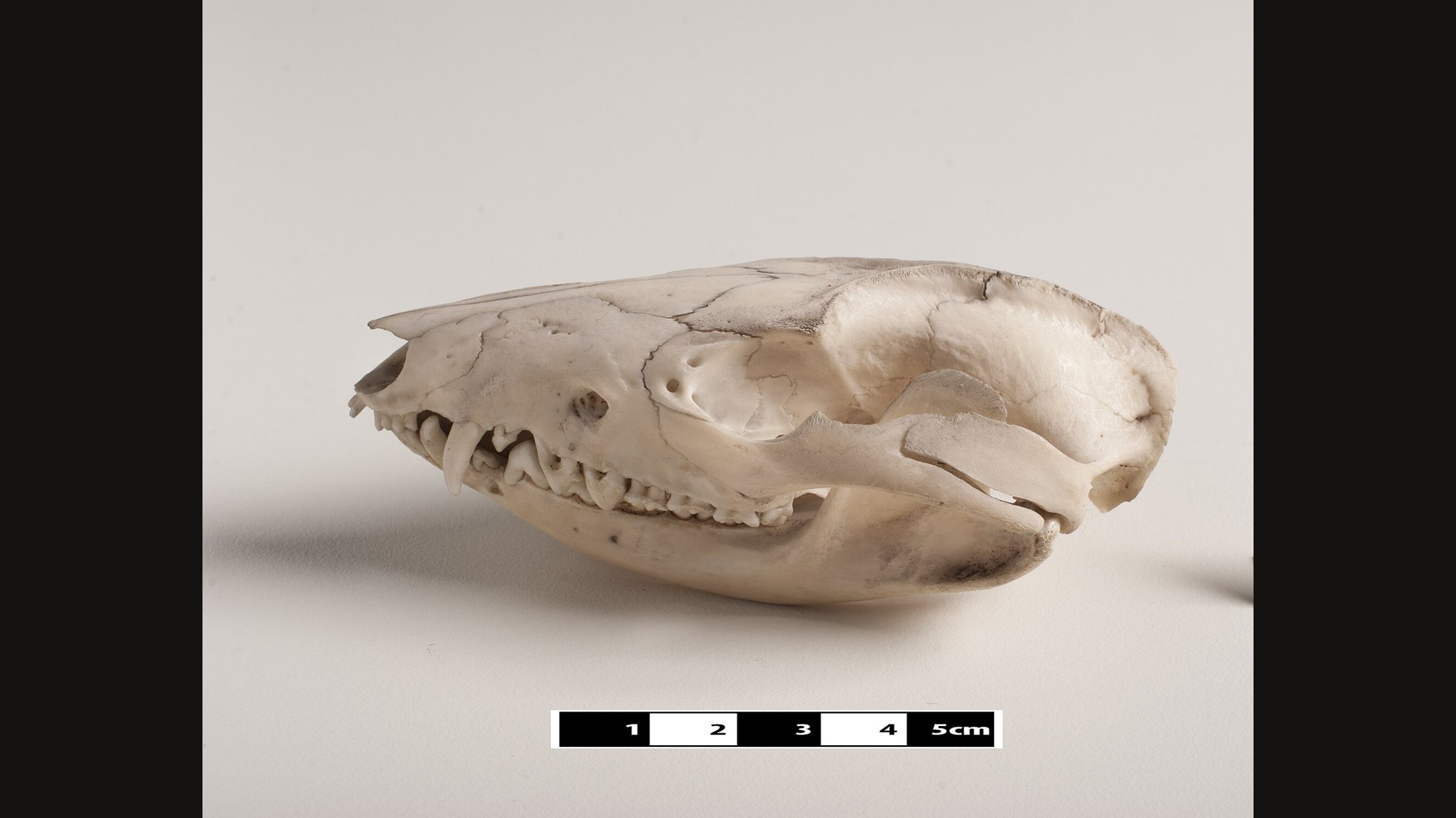
If the skull in your hand has 50 teeth, five small upper incisors on each side, a long snout, a small braincase and a tall bony crest running along the top, it is very likely a Virginia opossum, *Didelphis virginiana*. The National Park Service says the Virginia opossum has more teeth than any other North American land mammal, and the dental formula is I 5/4, C 1/1, P 3/3, M 4/4.
The two skulls most often mistaken for it are easy to separate once you start counting. A raccoon has about 40 to 42 teeth and a shorter, broader face. A house cat has about 30 teeth and a very short face.
That crowded grin is the opossum's signature, and it is worth a closer look, from how to count it to why the animal has so many teeth in the first place, and to the tlacuache of Mexican stories, who is said to have brought fire to people.
The long snout, small braincase and tall crest
The University of Texas DigiMorph project, based at the Texas Memorial Museum, describes the Virginia opossum skull as having a long snout, a small braincase and a pronounced sagittal crest along the top. The sagittal crest is a ridge of bone running from front to back over the skull, where the jaw muscles attach. In an opossum it stands out clearly, a raised line you can feel with a fingertip.
The Maryland Department of Natural Resources key to mammal skulls, published in 2022 by wildlife specialist Kerry Wixted, picks out the opossum by the same combination: 50 teeth, a large sagittal crest and a small braincase. Check all three, because together they make a far stronger case than any one of them alone.
Size is less help than you might think. The Virginia opossum is about the size of a small cat, and the Santa Barbara Museum of Natural History gives adult skull lengths of roughly 77.9 to 145.8 millimeters. That is a wide range, and its lower end overlaps with a house cat's, so the teeth and the crest tell you more than the ruler does.
Counting fifty teeth
The formula I 5/4, C 1/1, P 3/3, M 4/4 reads like this. On each side of the upper jaw there are five incisors, one canine, three premolars and four molars. On each side of the lower jaw there are four incisors, one canine, three premolars and four molars. That makes 13 above and 12 below on each side, 25 per side and 50 in all.
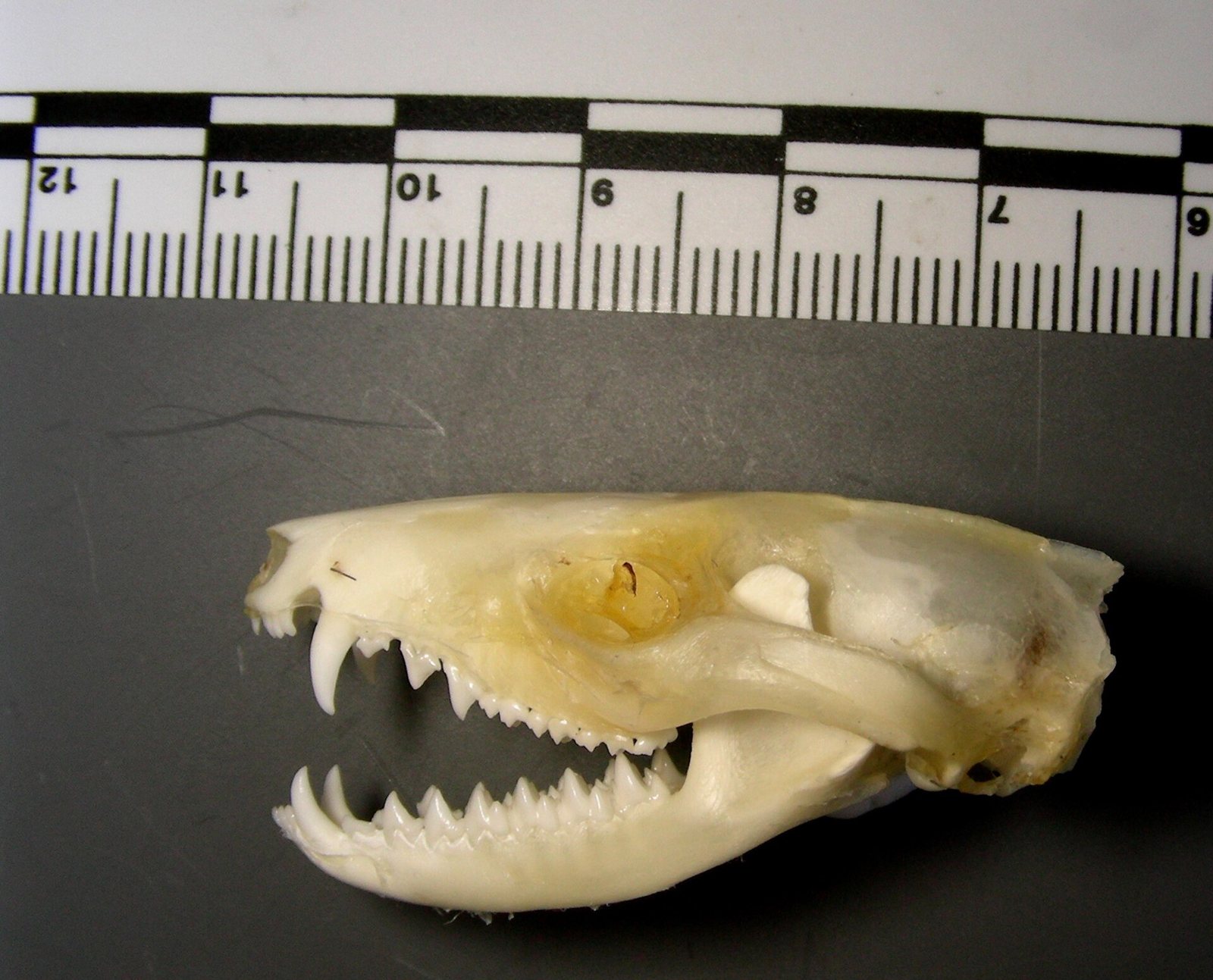
The quickest single clue is at the very front. Five small upper incisors on each side, ten across the top of the mouth, is something no raccoon, cat or fox has. If you count only one thing, count those.
Old skulls lose teeth, so count the empty sockets along with the teeth that remain. A young opossum's skull may not show the full adult set yet, so a low count on a small skull is not enough on its own to rule out an opossum. The crest and the shape of the snout still help.
Tap or hover a row to highlight it.
| Feature | Virginia opossum, Didelphis virginiana | Raccoon, Procyon lotor | Domestic cat, Felis catus |
|---|---|---|---|
| FeatureAdult tooth count | Virginia opossum, Didelphis virginiana50 | Raccoon, Procyon lotorAbout 40 to 42 | Domestic cat, Felis catusAbout 30 |
| FeatureSnout | Virginia opossum, Didelphis virginianaLong and pointed | Raccoon, Procyon lotorShort and broad | Domestic cat, Felis catusVery short |
| FeatureBraincase | Virginia opossum, Didelphis virginianaSmall | Raccoon, Procyon lotorLarge | Domestic cat, Felis catusRelatively large |
| FeatureCrest | Virginia opossum, Didelphis virginianaStrong sagittal crest | Raccoon, Procyon lotorSkull form varies with age | Domestic cat, Felis catusNot the same prominent opossum crest |
| FeatureKey tooth clue | Virginia opossum, Didelphis virginianaFive upper incisors per side | Raccoon, Procyon lotorFewer incisors and broad molars | Domestic cat, Felis catusSmall peg-like upper premolar behind canine |
Why an opossum has so many teeth
Opossums are marsupials, and the National Park Service calls the Virginia opossum North America's only marsupial. The 50 teeth come with the family. The University of Michigan Museum of Zoology's account of the Didelphidae, the family of American opossums, gives the same formula, five over four incisors, one over one canines, three over three premolars and four over four molars, for 50 teeth across the family.
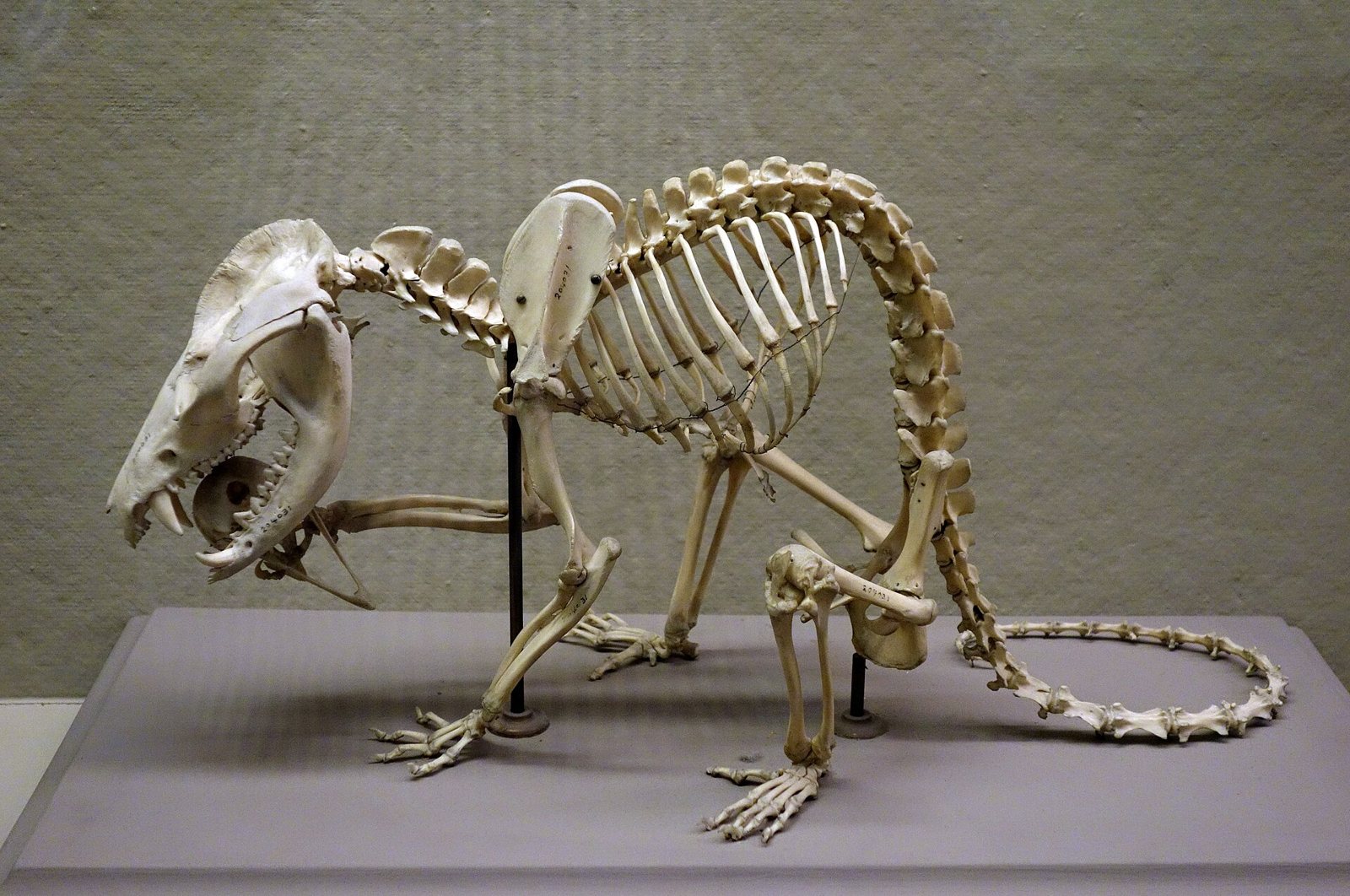
That pattern is a generalized one, shared by didelphid opossums and associated with early mammals. It is not a set of tools built for one particular food. Opossums are omnivores that eat insects, carrion, fruits and seeds, and their mouths carry small conical incisors, large canines and a long run of cheek teeth that can handle all of it.
What is known, then, is the pattern and the diet. Exactly why the Virginia opossum has kept all 50 is a question the tooth count alone does not answer.
Opossum or raccoon?
The raccoon is the usual look-alike, and the count settles it fast. A raccoon, *Procyon lotor*, has about 40 to 42 teeth in Maryland's key, along with a short nose, a larger braincase and broad molars made for crushing. The Smithsonian National Museum of Natural History notes that raccoon molars are wide and suited to both crushing and shearing, and the University of Florida IFAS account of the northern raccoon shows the raccoon skull for comparison.
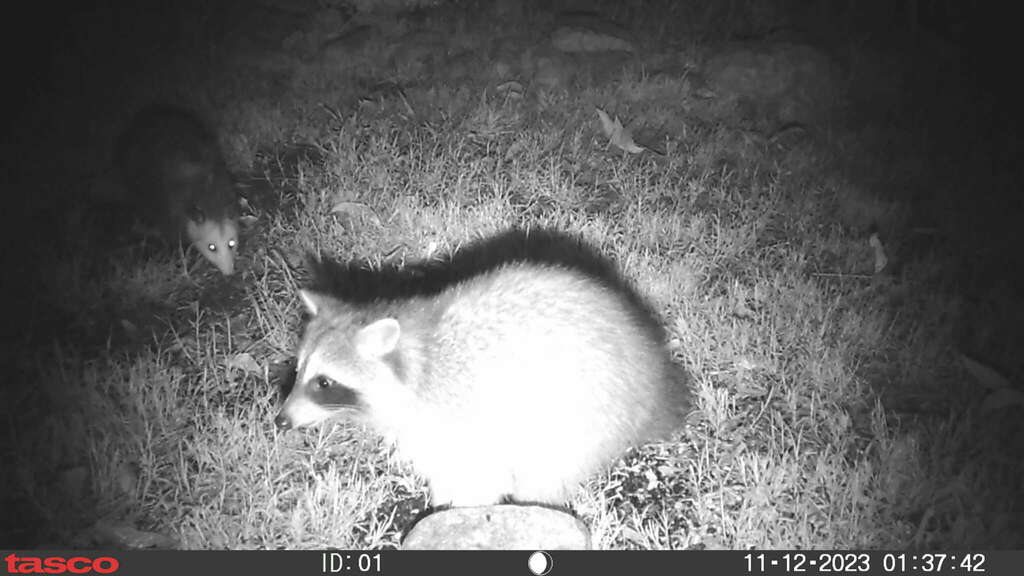
Count the teeth first, then compare the snout and the cheek teeth. A long, narrow snout with a small braincase and a tall crest points to opossum; a shorter, broader face with a roomy braincase and wide molars points to raccoon. Our raccoon skull story has the full side-by-side from the raccoon's end.
Opossum or cat?
A domestic cat, *Felis catus*, has about 30 adult teeth and a much shorter face. Maryland's key adds a small, peg-like upper premolar behind each canine, a tooth that can fall out of a cleaned skull and leave a visible socket. The same key gives an adult house cat skull a length of 77 to 101 millimeters, which overlaps with a small opossum, so here too the teeth decide. Twenty extra teeth and a long snout are hard to miss. The cat skull story goes through the cat in detail.
And if your skull is long and narrow but has only 42 teeth and sharp, blade-like cheek teeth, you may be holding a fox. How to identify a fox skull takes it from there.
Is it an opossum skull? A quick check
Tap a card to bring it forward.
- Count the teeth: About 50 points to opossum, about 40 to 42 to raccoon and about 30 to cat.
- Check the upper incisors: Five on each side means opossum.
- Look for the crest: A tall sagittal crest along the top fits an opossum.
- Compare snout and braincase: A long snout with a small braincase suggests opossum; a short face with a larger braincase suggests raccoon or cat.
- Look for the cat's premolar: A small peg-like upper premolar behind each canine, or its empty socket, points to a cat.
The tlacuache who brought fire
In Mexico, tlacuache is a common name for the opossum, and zarigüeya is another. The animal is also a hero of old stories, and the Museo Nacional de Antropología, run by INAH, Mexico's National Institute of Anthropology and History, keeps one in its collection. It presents a Pame figure from Santa María Acapulco, Santa Catarina, San Luis Potosí, as the tlacuache who first found and created fire. In that story the animal's tail catches fire from friction between rocks, and the tlacuache shows how fire is made with flint.
INAH's publication *El Tlacuache* describes related Mesoamerican versions in which the tlacuache steals fire from the beings who guard it and carries it to people. In those tellings, the opossum's bare tail is the mark it earned by carrying the flame.
These are traditional narratives with several versions, told by particular peoples, the Pame among them, and they are not a single story for all of Mexico. They are also not zoology. They are a good reason to look at that long, hairless tail a little differently.
Opossum skull quiz
Answer every question to check.
Opossum skulls in art and tattoos
Opossum skulls turn up in contemporary decor, artwork and tattoos. Their meaning is the one the artist, tattooist or wearer gives them, so if a design speaks to you, ask its maker what it stands for. For more on skulls as decoration, see skull home decor, and for skulls in ink, skull tattoo meaning.
Keeping an opossum skull
None of this is legal advice. Opossum rules depend on where you are, and wildlife agencies change them from time to time.
Before you keep, transport, sell or display an opossum skull, check the wildlife agency rules for the state or country where it turned up, and ask the owner or manager of the land. Our story on what to do when you find an animal skull covers the federal and state rules that can apply and who to ask, and how to clean an animal skull goes through cleaning once you know it is yours to handle. Real skulls are not something we buy or sell.
Opossum skull questions, answered
A few more points about the skull on your table.
What does an opossum skull look like?
An opossum skull is long, with a narrow snout, a small braincase, a tall sagittal crest along the top and a mouth full of small teeth. An adult Virginia opossum has 50 of them.
How many teeth does an opossum have?
An adult Virginia opossum has 50 teeth, under the formula I 5/4, C 1/1, P 3/3, M 4/4. The National Park Service says that is more than any other North American land mammal.
What is the ridge on top of an opossum skull?
It is the sagittal crest, a ridge of bone where the jaw muscles attach. Maryland's skull key treats a large sagittal crest, together with 50 teeth and a small braincase, as the mark of an opossum.
Opossum skull or raccoon skull: what is the fastest check?
Count the teeth, starting with the upper incisors. Fifty teeth with five upper incisors on each side means opossum, while about 40 to 42 teeth and broad crushing molars mean raccoon.
Where to go next
If your skull turns out to be a raccoon, a cat or a fox, the raccoon skull, cat skull and fox skull stories each pick up the comparison. Before any skull goes on a shelf, what to do when you find an animal skull is the place to start.
Terms in this story
Tap a term to see what it means.
Didelphis virginiana. The scientific name of the Virginia opossum.
---