

No. 118
Bobcat Skull vs House Cat Skull: How to Tell Them Apart
To tell a bobcat skull from a house cat skull, start just behind each upper canine. A domestic cat, *Felis catus*, normally has a tiny extra premolar there, or the small empty socket where it sat, and 30 adult teeth in all. A bobcat, *Lynx rufus*, normally has no tooth in that spot and 28 adult teeth.
Then get out a ruler. The Maryland Department of Natural Resources skull key, published in 2022, puts a house cat skull at about 77 to 101 millimeters in greatest length and a bobcat skull at more than 101 millimeters. Read the tooth and the length together. The little premolar can drop out after death, and sizes overlap near the line, so either clue on its own can lead you astray.
If the skull on your table is short-faced, big-eyed and cat-shaped, those two checks settle most cases. The rest of this story covers what a bobcat skull looks like, how to measure it, how a lynx, a raccoon or a fox compares, and what to know before you keep it.
What a bobcat skull looks like
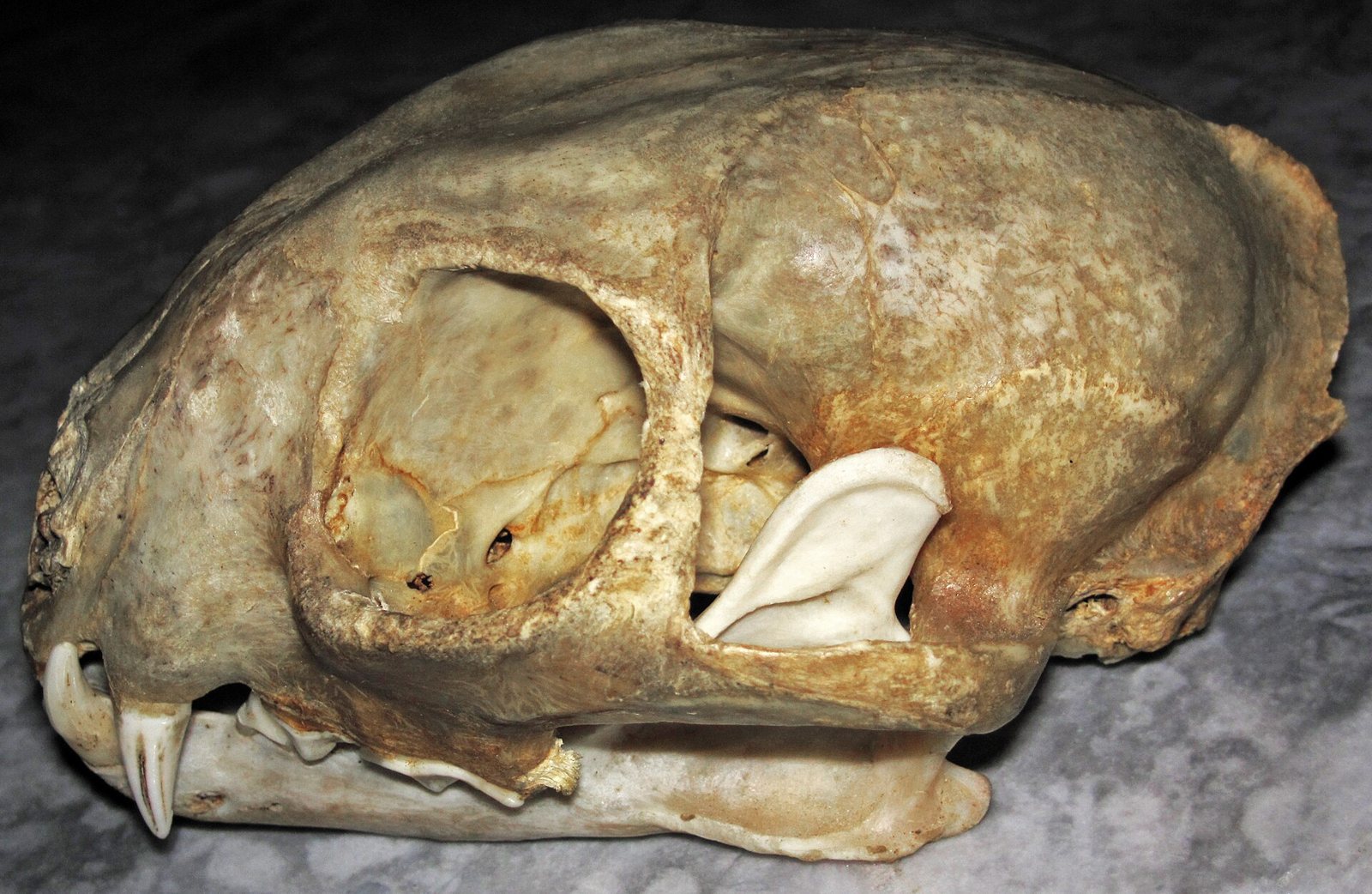
A bobcat skull reads as a house cat skull scaled up and built a little heavier. The Arizona-Sonora Desert Museum's skull guide describes it as short-snouted and wide across the cheekbones, with a braincase that is rounded to slightly peaked, eye sockets that face forward, a curved jaw and specialized carnassial teeth. Carnassials are the blade-like cheek teeth of meat-eaters, and the museum notes that a bobcat's jaw has little or no side-to-side movement. It opens and closes like a pair of shears, which is exactly what slicing teeth need.
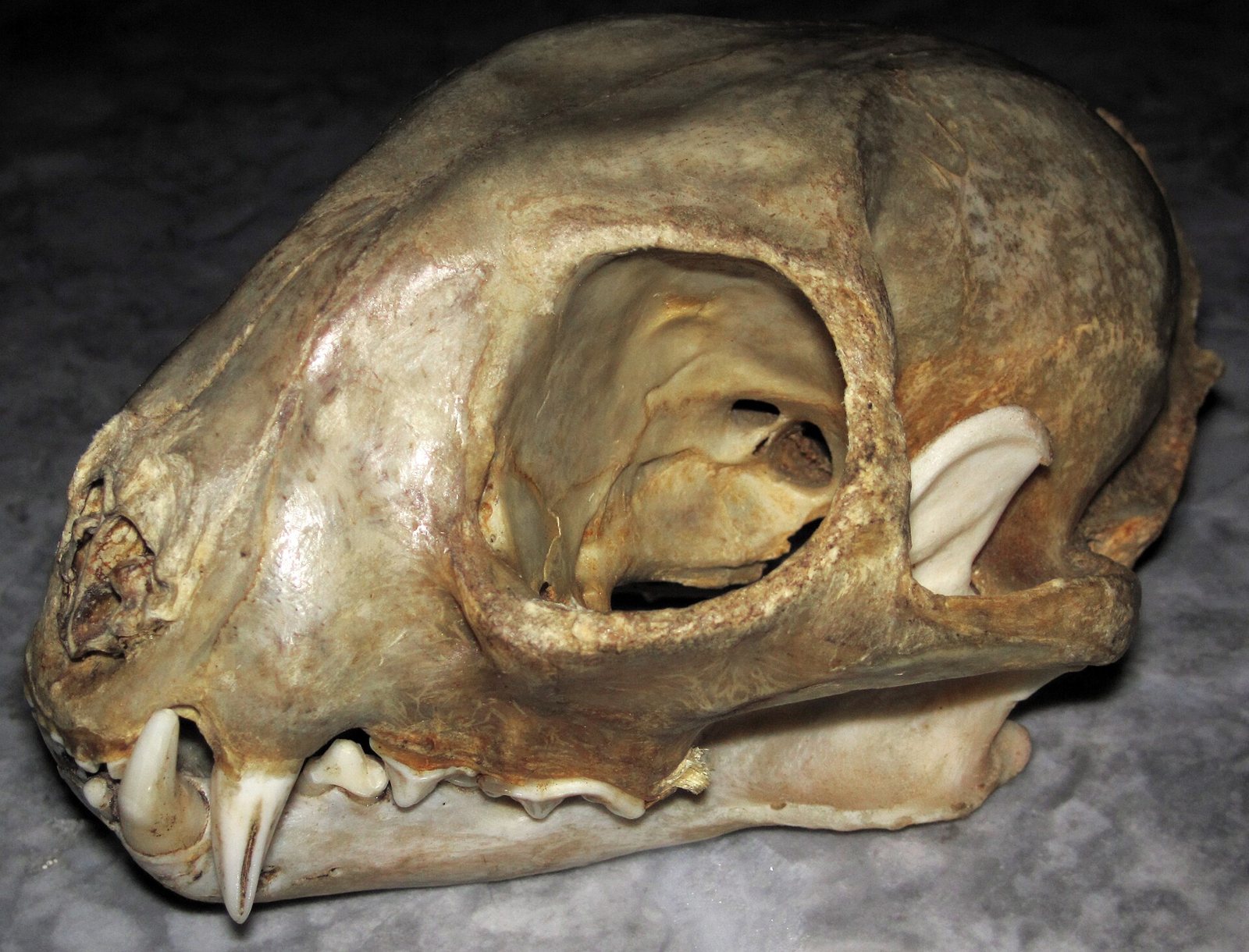
The teeth follow a set pattern. Texas Tech University's bobcat species account gives the adult dental formula as I 3/3, C 1/1, P 2/2, M 1/1. Read across, that means each side of the upper jaw carries three incisors, one canine, two premolars and one molar, and each side of the lower jaw carries the same. Fourteen per side, 28 in total.
The animal behind the skull is not huge. Texas Tech gives adult weights of 5 to 9 kilograms, occasionally up to 16, and an average total length of 870 millimeters for males, tail included. For a sense of the skull itself, the Smithsonian's bobcat education specimen measures roughly 12 by 8 by 5.5 centimeters. That is not far beyond house cat territory, which is part of why a bobcat skull gets mistaken for a big house cat's.
The tiny tooth that separates the two cats
One small tooth does most of the work. A house cat has three premolars on each side of the upper jaw, and the first one is tiny, sitting right behind the canine like an afterthought. A bobcat has only two upper premolars on each side and normally skips that little one, so the gap behind its canine is clean bone.
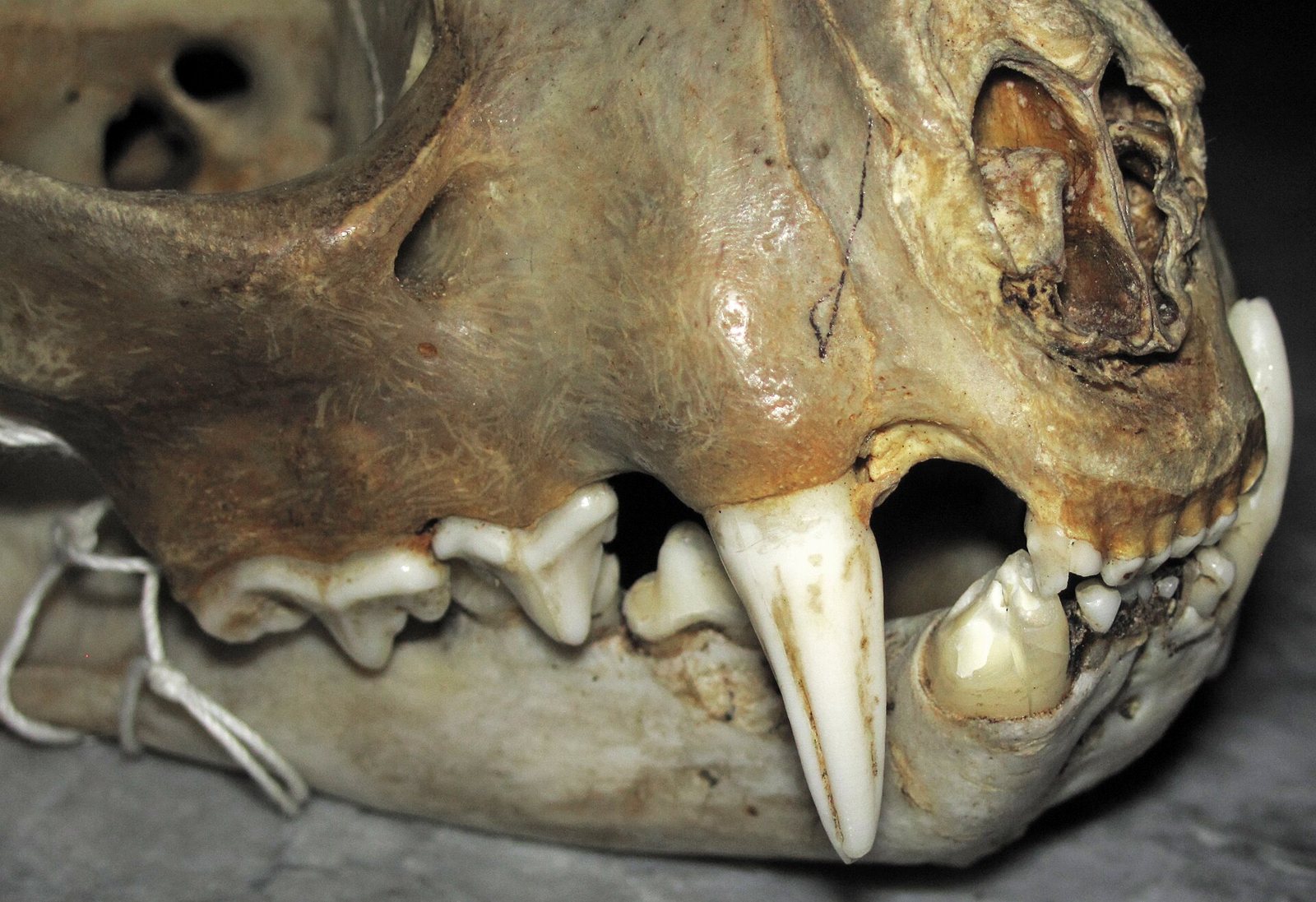
Texas Tech's domestic cat account and the Maryland key both rely on this tooth. Because it is so small, it often falls out once the skull has been lying outdoors for a while. When that happens, look for its socket instead: a small hole in the bone directly behind the canine still points to a house cat. Tilt the skull toward a window or use a phone flashlight, since a socket that size is easy to miss in flat light.
Check both sides. Damage or wear can leave one side unclear, and a match on both sides is a stronger result than one. If you want the whole story of a house cat skull, including the side and front views and what to do if it may have been a neighbor's pet, our cat skull identification story covers it.
Measuring the skull
The measurement skull keys use is greatest length: the straight distance from the tip of the rostrum, the front of the face, to the farthest point at the back of the skull. A flat ruler laid alongside works, though a caliper or two books pushed against each end gives a cleaner number.
On the Maryland scale, about 77 to 101 millimeters points to a house cat and anything over 101 millimeters points to a bobcat. The trouble lives near that boundary. Age, sex, damage and plain individual variation all shift skull size, so a large tomcat and a young bobcat can land close together. A number like 99 or 104 millimeters is a reason to look harder at the premolar, not a verdict.
Age matters for the teeth too. Kittens of both species carry deciduous teeth, the baby set, so a young skull will not match the adult counts. Weathered skulls lose teeth and sometimes chips of bone. Count sockets as well as teeth, and treat each number as one piece of evidence.
Bobcat or Canada lynx?
Where Canada lynx live, a bobcat skull has a closer cousin to sort out. The bobcat and the Canada lynx, *Lynx canadensis*, share the genus *Lynx*, and both normally have 28 adult teeth, so counting will not separate them.
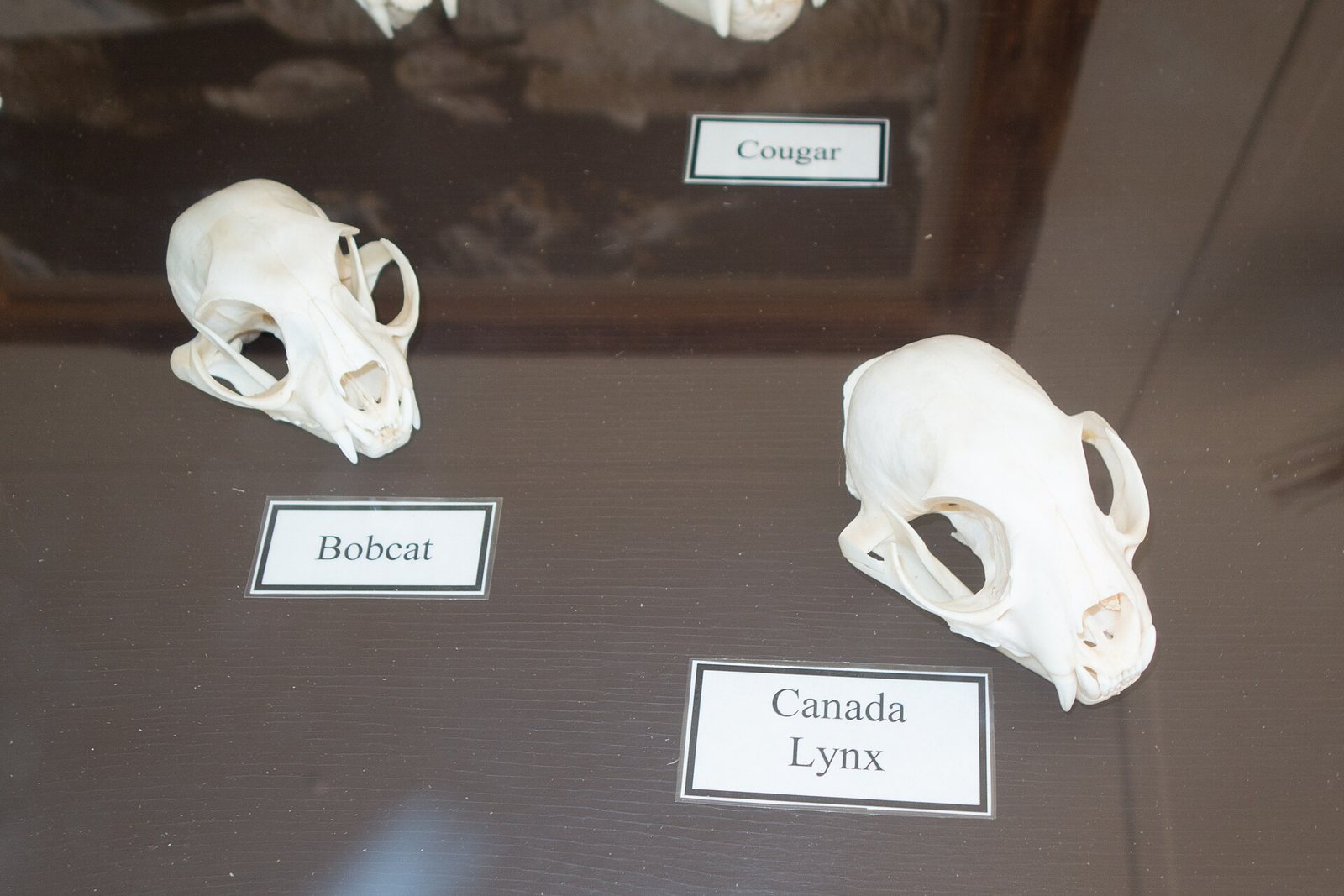
Specialists use finer characters. The Pennsylvania Bobcat Management Plan cites two that wildlife researchers use to support a bobcat identification: a narrow presphenoid bone, under 6 millimeters, on the underside of the skull, and a connection between two small openings at the base, the hypoglossal foramen and the posterior lacerate foramen. Both take a good specimen, a sharp eye and usually a labeled comparison to read.
The living animals are easier to tell apart. The National Park Service describes the Canada lynx as having larger feet, longer ear tufts, less prominent spotting and a completely black tail, while the bobcat has smaller feet, shorter tufts, stronger spotting and a tail that is black at the tip and white underneath. None of that survives on a bare skull, which is why the place it lay matters so much. Without the locality, a scale and a specialist comparison, the safest label for an uncertain skull is *Lynx* sp., meaning a lynx-genus cat of unconfirmed species.
In Europe, the lynx in question can be a different animal again. Spain's Museo Nacional de Ciencias Naturales, part of the CSIC, includes a 3D skull of the Iberian lynx, *Lynx pardinus*, at a touch station in its biodiversity exhibition. That skull follows the same family plan: short and wide, with large orbits, cutting teeth and 28 teeth in all.
Bobcat, raccoon or fox?
Outside the cat family, the usual look-alikes are the raccoon and the foxes, and the teeth and the face shape sort them out quickly.
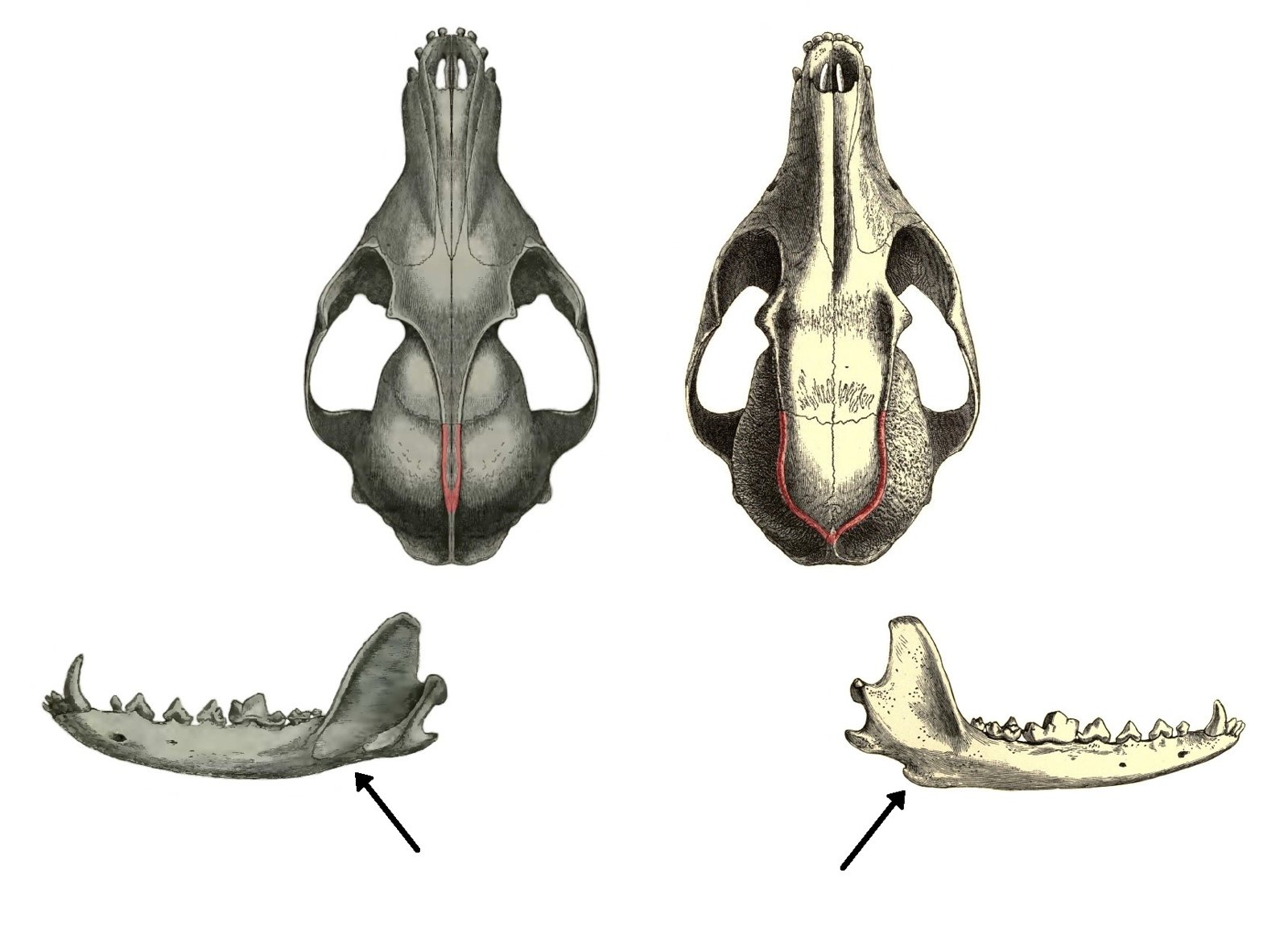
A raccoon, *Procyon lotor*, normally has 40 teeth. Its cheek teeth are broad and lumpy, made for crushing a mixed diet, its braincase is larger and its palate runs back past the last molar. The Maryland key groups raccoons with skulls that have six or more upper cheek teeth and 40 to 42 teeth in total, usually under 200 millimeters long, and the University of Puget Sound's skull and teeth guide and University of Florida IFAS cover the same animal. A bobcat has far fewer cheek teeth, and they are thin and sharp rather than broad. Our raccoon skull story has the full comparison.
Foxes have longer faces. A red fox, *Vulpes vulpes*, has a long, narrow muzzle and 42 teeth. The gray fox, *Urocyon cinereoargenteus*, also has 42 and, according to the Texas Tech gray fox account, carries distinctive U-shaped temporal ridges on top of the skull. If your skull has a snout you could call pointed, it is very unlikely to be a cat, and the fox skull and coyote skull stories pick it up from there.
What unites the cats is the short face, the big forward orbits and the slicing cheek teeth. If a skull has all three and is clearly bigger than a house cat's, you may be holding something larger than a bobcat; our mountain lion skull story covers that much bigger wild cat.
Tap or hover a row to highlight it.
| Animal | Scientific name | Usual adult teeth | What to look for |
|---|---|---|---|
| AnimalHouse cat | Scientific nameFelis catus | Usual adult teeth30 | What to look forA tiny premolar or its socket right behind each upper canine; short face; big forward orbits |
| AnimalBobcat | Scientific nameLynx rufus | Usual adult teeth28 | What to look forNo tiny premolar behind the canine; Maryland's key puts the skull over 101 mm long |
| AnimalCanada lynx | Scientific nameLynx canadensis | Usual adult teeth28 | What to look forSame count as a bobcat; separating them takes locality, specialist skull characters and measurements |
| AnimalRaccoon | Scientific nameProcyon lotor | Usual adult teeth40 | What to look forBroad crushing cheek teeth, a larger braincase and a palate that runs behind the last molar |
| AnimalRed or gray fox | Scientific nameVulpes vulpes or Urocyon cinereoargenteus | Usual adult teeth42 | What to look forA long, narrow snout; the temporal ridges on top differ between the two foxes |
Six checks with a ruler and a good light
With the skull in good light, a ruler and a phone nearby, work through it in this order. Gloves make sense if any tissue remains.
Bobcat or house cat? Six steps
Tap a card to bring it forward.
- Take four photos: Shoot the side, the front, the top and the underside, so you have a record before you handle it much.
- Count teeth and sockets: Count every tooth and every empty socket; an adult bobcat normally has 28 and a house cat 30.
- Look behind the upper canines: A tiny premolar, or the hole it left, points to a house cat.
- Measure the greatest length: From the tip of the face to the back of the skull; Maryland's key puts bobcats over 101 mm.
- Compare with a labeled skull: Line up the face, eye sockets, cheek teeth and braincase against a museum or university specimen.
- Check the rules first: Confirm possession and transport rules for that place before you move or keep it.
If something about the skull makes you wonder whether it is an animal's at all, stop and read how to tell a human skull from an animal skull before you go further.
Test your cat skull eye
Answer every question to check.
Keeping a bobcat skull
A word before you find it a spot on the shelf: what follows is general information only, not legal advice. Wildlife rules vary from one state and country to the next, and they get revised.
Bobcats are regulated furbearers, which means rules govern how they are taken and what may be done with their parts. Those rules often depend on whether the animal was legally harvested, found dead or salvaged after a road collision. A few examples show how much states differ. The Wisconsin Department of Natural Resources places bobcat harvest and raw fur under tagging, reporting and certification requirements, while allowing other bobcat parts to be possessed under conditions it spells out. Michigan's 2026 furbearer regulations require a kill tag for a harvested bobcat, plus registration and presentation of the pelt and skull. New York's Department of Environmental Conservation requires a possession tag and pelt sealing for bobcats, including certain road-killed animals picked up during an open season.
None of that tells you whether your particular skull may stay with you. Before you keep, move or display it, ask the state wildlife agency, the park office or the land manager for the place where it lay. Our story on what to do after you find an animal skull goes through the wider federal and state rules and who to contact, and how to clean an animal skull is the next stop once the rules are settled.
Quick answers about bobcat skulls
These cover the questions that come up once the main checks are done.
How many teeth does a bobcat have?
An adult bobcat normally has 28 permanent teeth, under the formula I 3/3, C 1/1, P 2/2, M 1/1. That is two fewer than a house cat, because the bobcat lacks the tiny first upper premolar on each side.
What does a lynx skull look like?
A lynx skull is short and wide, with large orbits, cutting cheek teeth and 28 teeth, whether it belongs to a Canada lynx, an Iberian lynx or a bobcat. Telling the species apart from a skull takes the place it came from, careful measurements and a specialist's comparison.
Can a big house cat skull be mistaken for a bobcat?
Yes, because skull sizes overlap near Maryland's 101-millimeter line, and a large adult house cat can come close to a small bobcat. The tiny premolar behind the upper canine, or its socket, is the better tiebreaker.
How do you identify a wild cat skull?
A wild cat skull has the cat family's short face, forward-facing eye sockets and slicing cheek teeth, and lynx-genus cats such as the bobcat have about 28 teeth. From there, the skull's length and where it lay narrow the species, and a labeled museum or university specimen confirms it.
Where to go next
If your skull turns out to be a house cat after all, the cat skull story picks up the details, including the gentle steps for a skull that might have been someone's pet. If you are wondering how long it has been outdoors, how old are these bones? is the place to start, and the raccoon and fox stories cover the two look-alikes that most often turn up beside cats.
Terms in this story
Tap a term to see what it means.
Lynx rufus. The bobcat, a North American wild cat in the genus Lynx. An adult normally has 28 teeth.
---