

No. 113
Snake Skull: What It Looks Like and Why the Jaw Opens So Wide
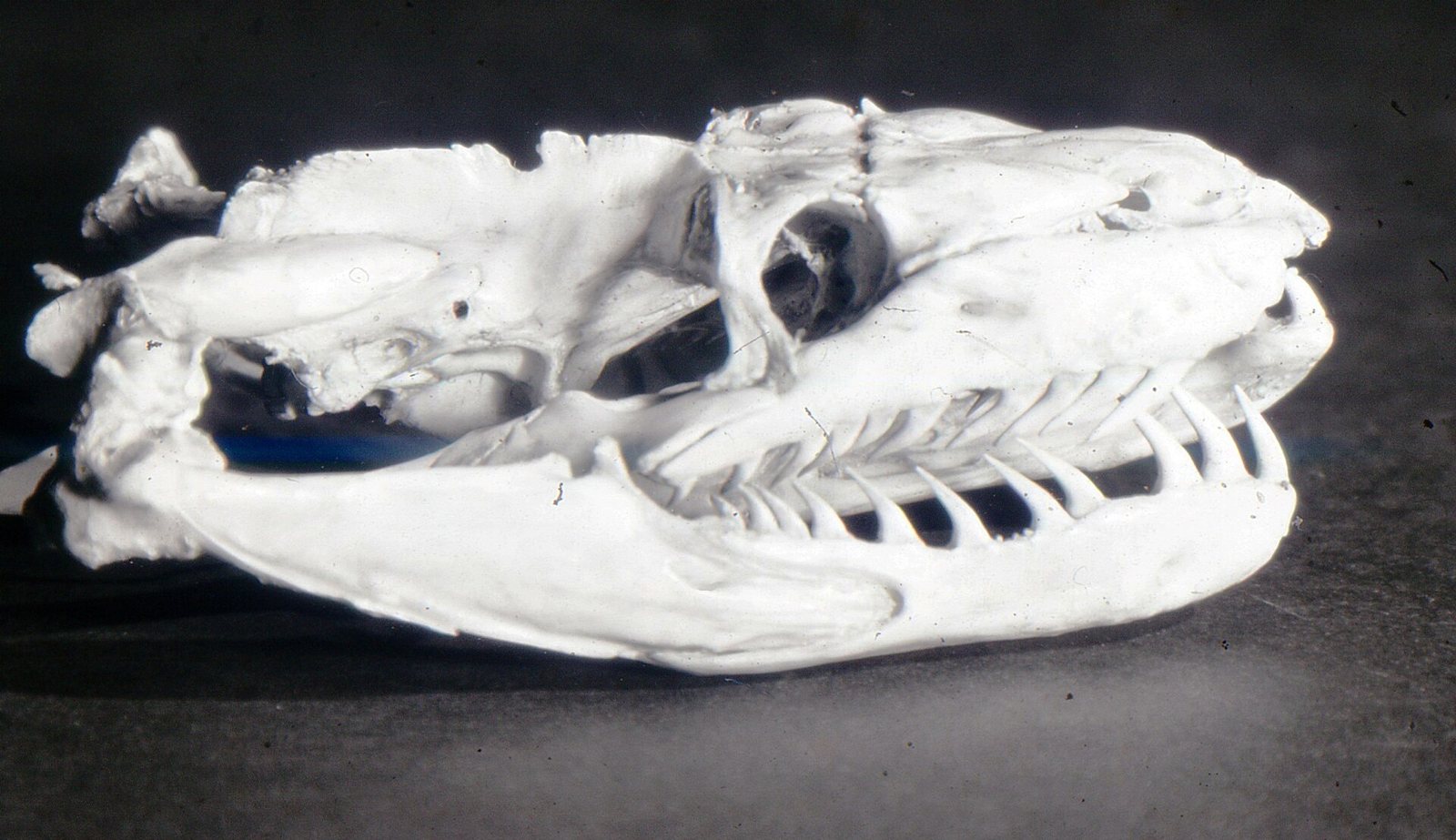
A snake skull is a light, delicate frame of about 30 bones, and many of them are only loosely joined, so they can move on their own. That is why it looks more like lacework than a solid skull. The Natural History Museum in London describes it as a skull built to flex.
The mouth opens so wide because the two halves of the lower jaw are not fused at the chin. An elastic ligament joins them, so they can spread apart. At the back, each half hinges on a long, movable bone called the quadrate, which swings downward to widen the gape. The jaw stretches and stays connected the whole time.
The teeth hold clues about venom. Vipers carry long, hollow front fangs, cobras and their relatives have fixed front fangs, snakes such as the boomslang have grooved fangs toward the back, and many snakes have no specialized fangs at all. Those clues help you read a skull, but they are not a safe way to decide whether an unknown snake was venomous. That takes the whole specimen and an expert.
The parts of a snake skull
Most land animals with backbones have a rigid skull, its bones locked together. A snake's is different. Many of its bones are loosely joined and move independently, and that design is the key to everything else in this story. Marion Segall, Alessandro Palci, Phillip Skipwith and Anthony Herrel set out how this works across snakes in their 2023 review, “The evolution of the form and function of the head of snakes.”
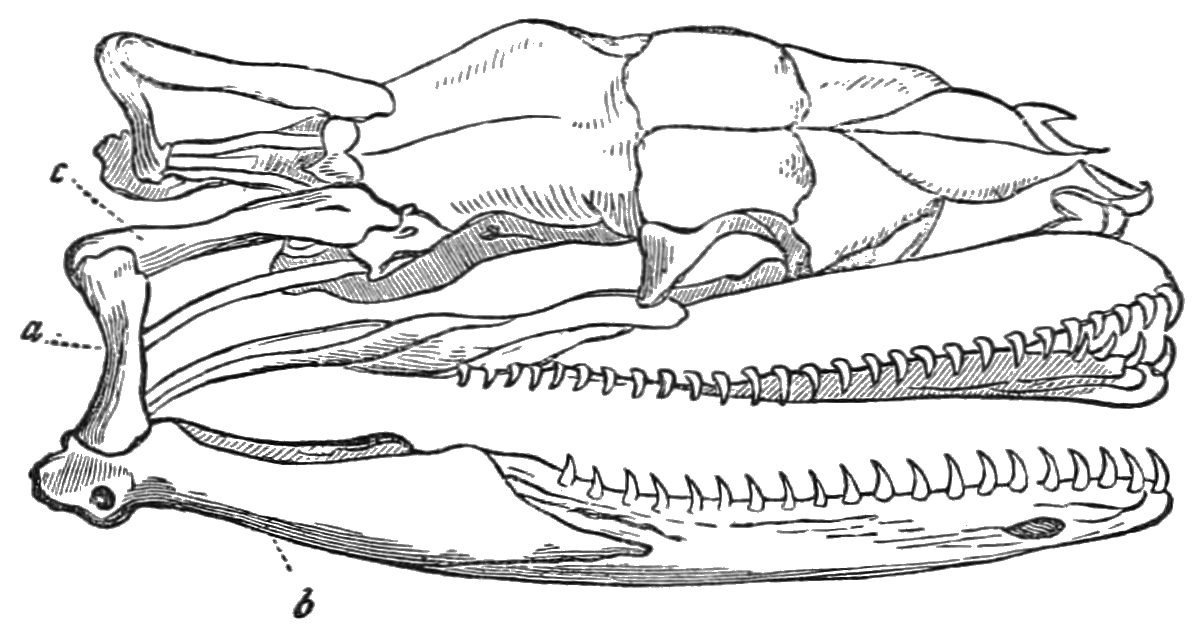
The names are worth knowing, because museum labels and diagrams use them. The braincase is the part that holds the brain. The maxilla is the upper jaw's main tooth-bearing bone, and its shape changes a great deal from one kind of snake to another, as the fang section below shows. Behind and around it sit the palatine, the pterygoid and the ectopterygoid, then the supratemporal and the quadrate toward the back of the skull. The quadrate is the one to remember, because it forms the hinge for the lower jaw. Below all of these come the two separate halves of the lower jaw, each including a bone called the dentary.
Even large snakes keep this flexible build. The Burmese python, *Python bivittatus*, handles big prey with a skull made on the same loose plan.
Why it is so light, and so rarely fossilized
A skull made of small, loosely joined bones is light, and it is also fragile. That delicacy is the reason snake skulls are rarely preserved as fossils.
It makes the exceptions special. The Smithsonian reports that its scientists recovered fragments of three skulls of *Titanoboa*, the extinct giant snake, an unusually lucky set of finds for reconstructing what that animal looked like. A complete snake skull, even a modern one, is a small marvel of survival.
How the jaw opens so wide
The wide gape comes from several moving parts working together, and the lower jaw is the place to start. Its two halves are joined at the front by an elastic ligament rather than fused bone, so they can spread apart sideways. At the back, each half connects to the skull through the quadrate, which David Futuyma's textbook *Evolution* describes as long and movable. When the quadrate rotates downward, the hinge point drops and the mouth opens farther still.
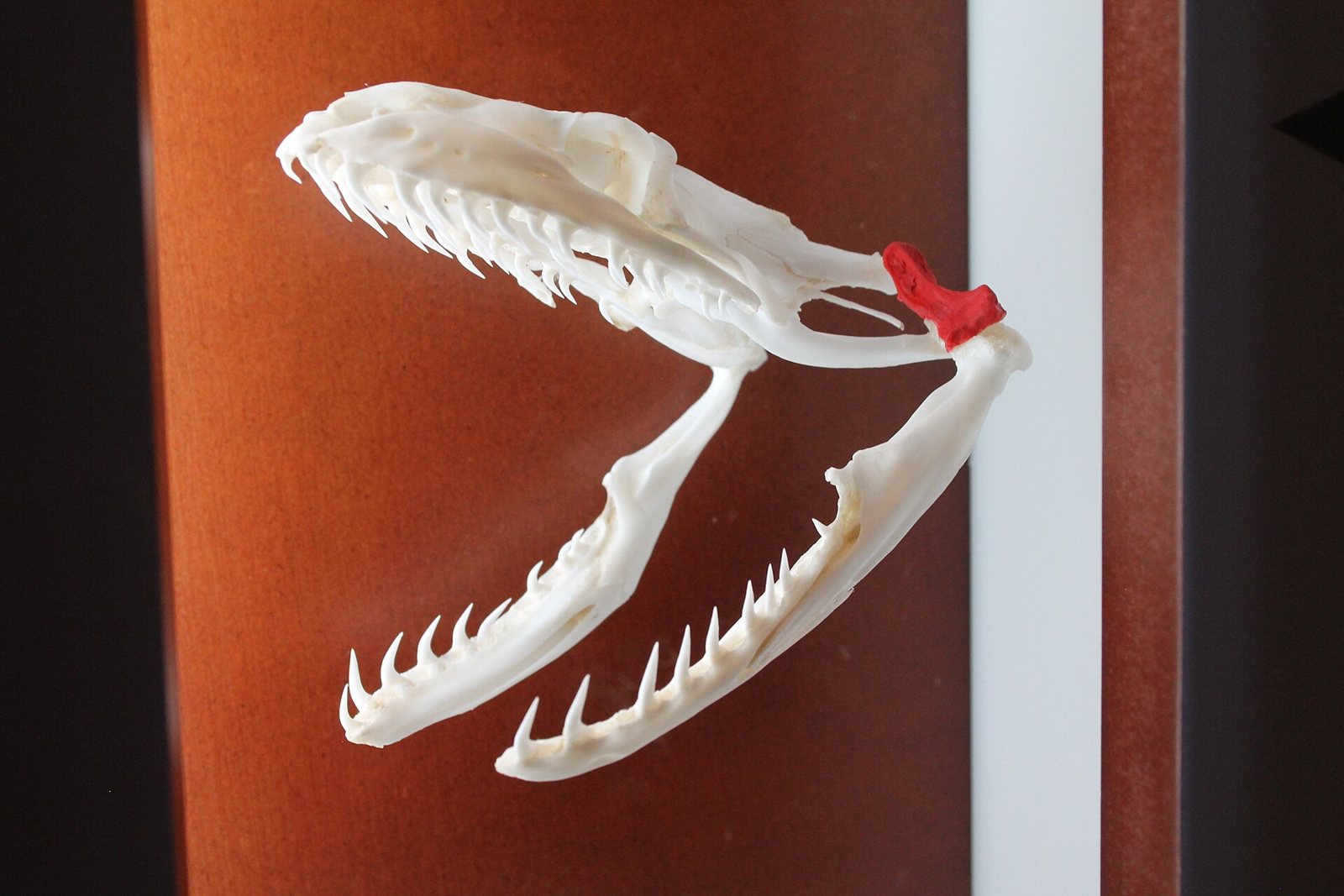
The upper jaw bones move too, each on its own. The American Museum of Natural History sums it up as specially jointed skulls and jaws. During feeding, the left and right sides can work in turn, one side gripping while the other reaches forward, so the snake pulls itself over its meal a step at a time. Teeth that curve backward keep the prey from sliding out between steps.
Put together, that is how a snake swallows an animal wider than its own head. No joint pops out of place; the stretch comes from the ligament, the swinging quadrates and bones that were built to move.
How does a snake's jaw work?
Answer every question to check.
Front fangs, rear fangs and no fangs
Snake teeth come in a few broad patterns, and a skull shows them plainly. The American Museum of Natural History's fang exhibit compares five forms side by side, including a snake without fangs, a rear-fanged snake, an elapid and a viperid.
Many snakes have no specialized fangs. These are generally called aglyphous snakes, and their teeth all look much alike.
Rear-fanged snakes have one or more enlarged teeth toward the back of the upper jaw, often grooved to channel venom. The boomslang, *Dispholidus typus*, is a documented rear-fanged venomous snake, and the Natural History Museum's venom page places its venom teeth toward the rear of the mouth.
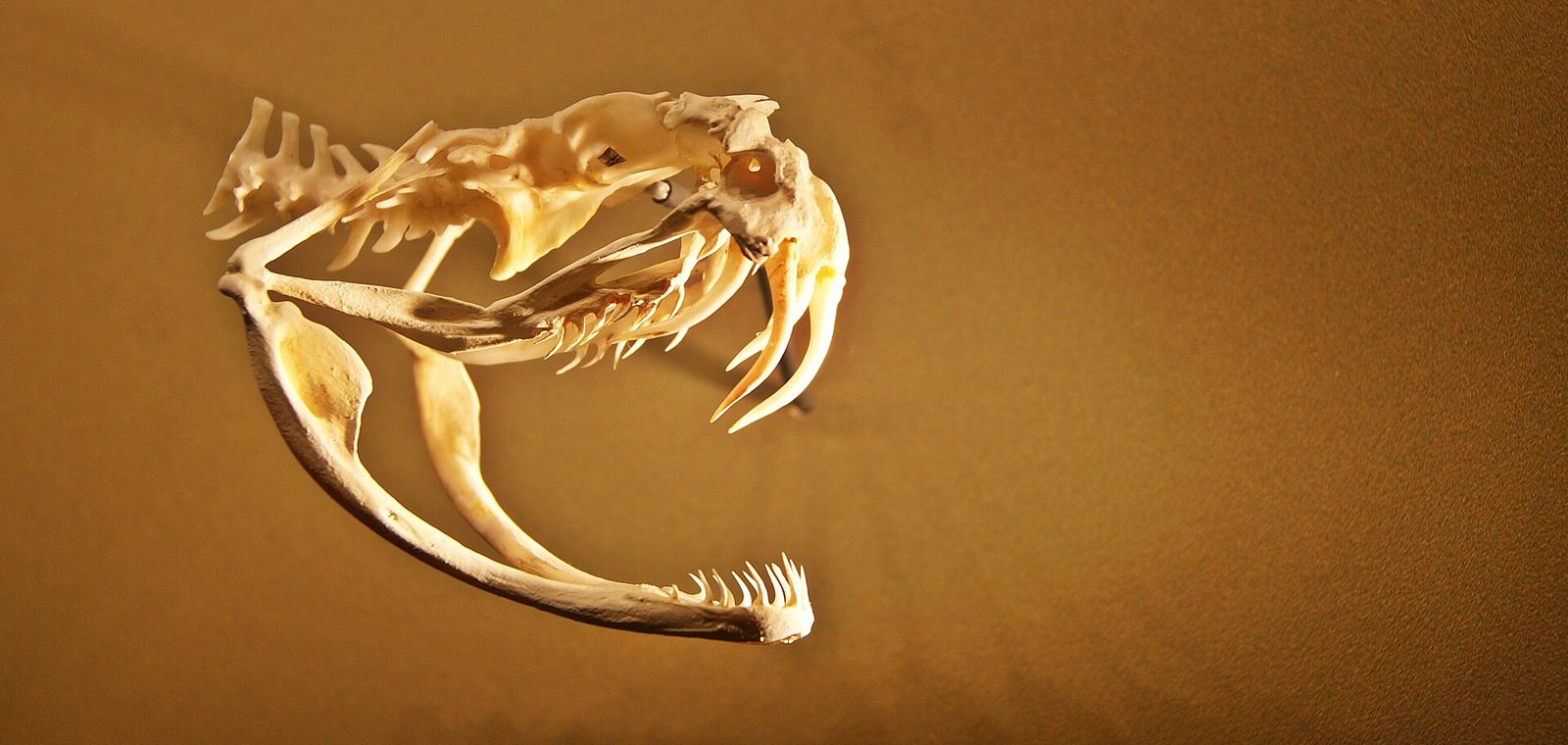
Elapids, the group that includes cobras, have fixed fangs at the front of the upper jaw. Vipers go a step further. Their long, hollow front fangs sit on a short, highly mobile maxilla, and when the mouth opens the maxilla rotates and swings the fangs upright. The Gaboon viper, *Bitis gabonica*, holds the record in the Natural History Museum's account of the longest fangs of any snake, reaching 55 millimeters.
Four ways a snake skull carries its teeth
Tap a card to bring it forward.
- No specialized fangs: Aglyphous snakes have similar-looking teeth along the jaws.
- Rear fangs: Enlarged teeth toward the back of the upper jaw, often grooved to channel venom, as in the boomslang.
- Fixed front fangs: Elapids such as cobras carry fangs at the front of the upper jaw that stay in place.
- Folding front fangs: Vipers carry long, hollow fangs on a short maxilla that rotates to swing them upright.
What the skull can tell you about venom
A skull can tell you a good deal. It shows where the fangs sit, whether they are long and hollow, grooved or absent, and how mobile the maxilla is. Those are the same details the American Museum of Natural History's fang exhibit uses to set the snake groups side by side.
What the skull cannot do is serve as a safe identification of an unknown snake. Naming a species, and so knowing whether it was venomous, takes the whole specimen and confirmation by a qualified herpetologist or a museum specialist. Read the teeth in a skull as general information about how snakes are built, not as a verdict on the one in front of you.
A python skull next to a viper skull
Set a python skull beside a viper skull and the two feeding systems are easy to tell apart. Both skulls are kinetic, meaning their bones move against one another, but they use that movement differently.
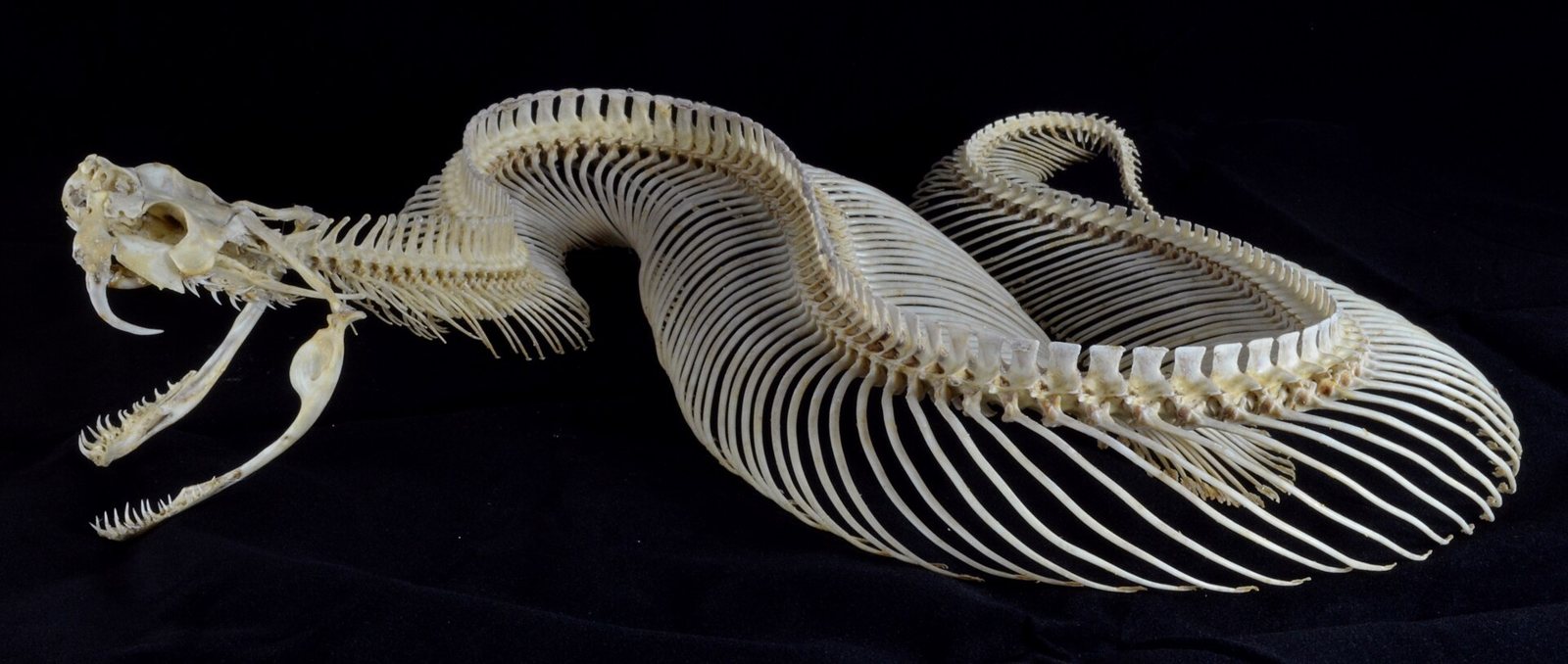
The Burmese python, *Python bivittatus*, has a long, tooth-bearing maxilla and a large set of mobile bones that let it walk its jaws over big prey. Its teeth are many, curved backward and all much the same, with no fangs among them.
A viper skull, such as that of the Gaboon viper or the red diamondback rattlesnake, *Crotalus ruber*, has a shortened, highly mobile maxilla carrying a large front fang. At rest the fang folds back against the roof of the mouth, and during a strike it swings forward into an upright position. The viper's skull is still flexible, but it has been reshaped around swinging that fang into place.
Tap or hover a row to highlight it.
| Feature | Burmese python, Python bivittatus | Gaboon viper, Bitis gabonica |
|---|---|---|
| FeatureTeeth for feeding | Burmese python, Python bivittatusMany recurved teeth | Gaboon viper, Bitis gabonicaLarge, hollow front fangs |
| FeatureMain upper-jaw feature | Burmese python, Python bivittatusLong, mobile tooth-bearing jaw bones | Gaboon viper, Bitis gabonicaShort, highly mobile maxilla |
| FeatureWhere the fang sits | Burmese python, Python bivittatusNo viper-style front fang | Gaboon viper, Bitis gabonicaFront fang that folds against the roof of the mouth |
| FeatureHow it feeds | Burmese python, Python bivittatusWalking the jaws over prey with a flexible skull | Gaboon viper, Bitis gabonicaA flexible skull plus fang rotation |
| FeatureWhat the skull says about venom | Burmese python, Python bivittatusNo viper-style fang system | Gaboon viper, Bitis gabonicaA specialized front-fang system |
Snake skulls in art and on skin
The snake's meaning in art depends on where you are and which tradition you are standing in. In 2025, the Art Museum of The Chinese University of Hong Kong presented “Celebrating the Year of the Snake,” which connected snake imagery in Chinese history with creation myths, shamanic figures, the dragon, Xuanwu, the guardian of the north, and the danger of venom. Those meanings belong to their own Chinese historical settings, not to snakes everywhere.
In tattooing, a skull with a snake has no single fixed meaning. It can pair mortality with ideas people attach to snakes, such as danger, change, renewal, healing or temptation, and what it says depends on the wearer, the artist's style and the culture it comes from. If you want a design to carry a particular meaning, the wearer and the artist are the ones who decide it. Our story on skull and snake meaning follows the pairing through European art and tattoo flash, and skull tattoo meaning covers skull designs more widely.
If you came across a snake skull
First, a note on what follows: it is general information, not legal advice. Rules on keeping animal remains vary by state and by country, they change, and some species are protected.
A skull you came across outdoors should not be assumed legal to keep. Before you take it home or move it, ask your state wildlife agency or the U.S. Fish and Wildlife Service what applies to that species and that place. Our story on what to do after you find an animal skull covers the wider federal and state rules and safe handling, and once you know where you stand, how to clean an animal skull goes through the cleaning. If you are curious about the insects museums put to work on skeletons, the story of dermestid beetles covers them.
Quick answers about snake skulls
These pick up a few questions the sections above leave open.
Do snakes unhinge their jaws?
They do not dislocate them. The two halves of the lower jaw are joined by an elastic ligament and each hinges on a movable quadrate bone, so the mouth stretches open while every joint stays connected.
How does a snake swallow something bigger than its head?
It stretches the ligament between its lower jaw halves, swings its quadrates downward and moves each side of the jaw forward in turn, pulling itself over the prey. Backward-curving teeth keep the meal from slipping out between each step.
Do all snakes have fangs?
No, many snakes have rows of similar-looking teeth and no specialized fangs, and they are called aglyphous. Fangs, where they exist, sit either at the front of the upper jaw, as in cobras and vipers, or toward the back, as in rear-fanged snakes.
What is a rear-fanged snake?
A rear-fanged snake has one or more enlarged teeth toward the back of the upper jaw, often grooved to channel venom. The boomslang, *Dispholidus typus*, is a well-documented example.
Where to go next
If you like the way reptile skulls are built, our alligator skull story shows a broad, pitted skull with teeth that are replaced all through life, and the turtle skull story covers another reptile skull built its own way. For the symbolism side, skull and snake meaning is the place to go next.
Terms in this story
Tap a term to see what it means.
Quadrate. A long, movable bone at the back of a snake's skull that forms the hinge for each half of the lower jaw and swings down to widen the gape.
---