No. 017
Skull and Snake Meaning: Death, Temptation and Renewal in Art and Tattoos
A skull and snake together usually pair death with one of the snake's many meanings. The skull is the steady part: mortality, the fact that every life ends. The snake changes with the tradition it comes from. In Christian art it is the serpent of Eden, temptation and sin. In medical symbolism it is the serpent of Asclepius, healing and renewal, partly because a snake sheds its skin and comes out new. In tattoos it can also suggest danger. Modern tattoo writers read the pairing as a tension between change and the finality of death. There is no single fixed code, so the way the design is drawn, what surrounds it and what the wearer intends all shape what it means.
If you have the design on your arm, your finger or your shirt, that is good news. You get to know where the pieces come from and decide which story is yours.
Where the pairing comes from in European art
Skulls and serpents were sharing space in European prints and paintings centuries before anyone put them in tattoo flash. Three works in public collections show the main threads.
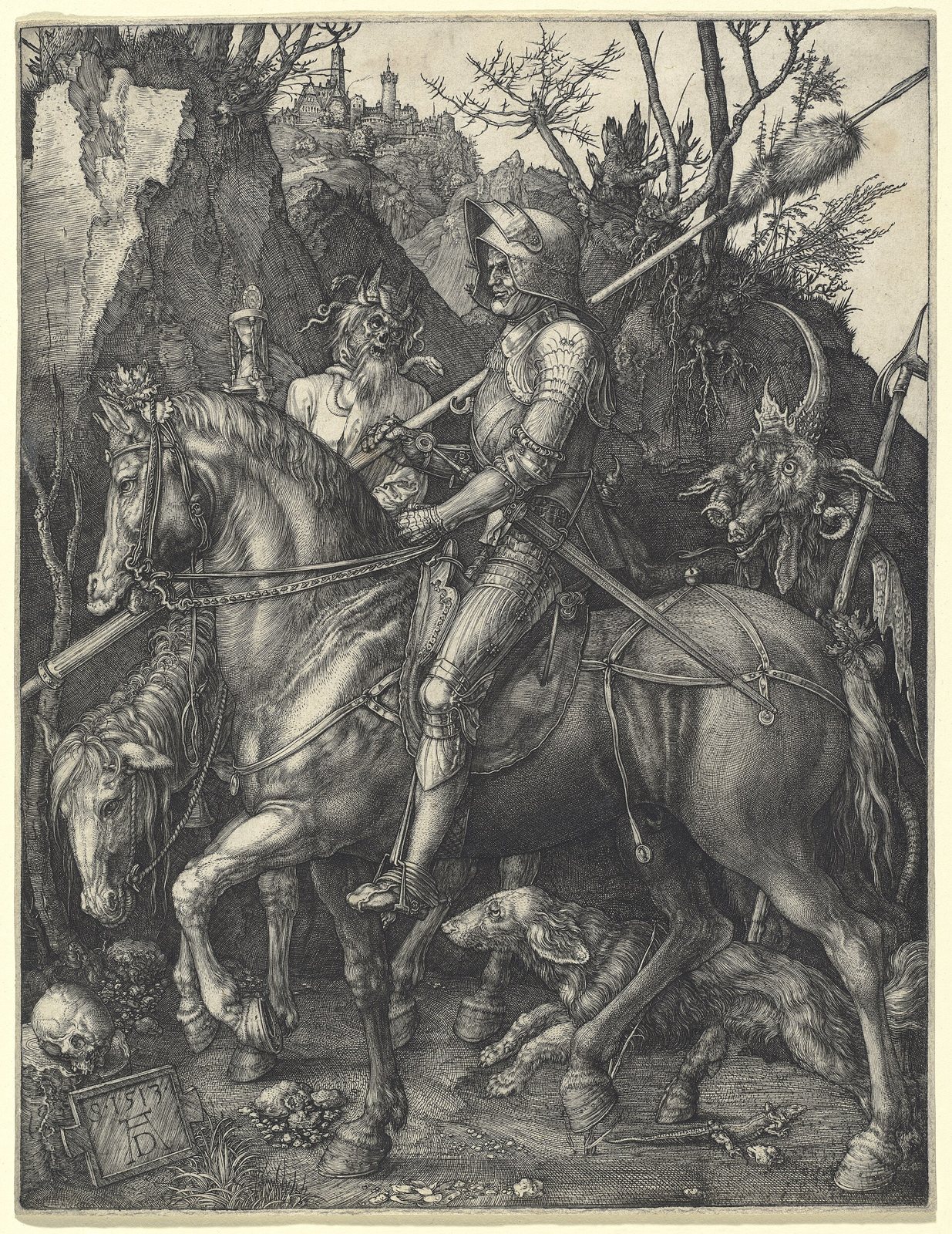
The oldest of the three is Albrecht Dürer's engraving *Knight, Death and the Devil*, dated 1513 and held by the National Gallery of Art. A skull lies at the lower left, and serpents coil around the skeletal figure of Death. Death here is wrapped in snakes, which is about as direct a skull-and-snake pairing as the sixteenth century offers.
A few decades later the French engraver Étienne Delaune made *Adam and Eve*, dated before 1573 and now at The Metropolitan Museum of Art. The serpent coils around the Tree of Knowledge, and two skulls hang below Adam and Eve. The Met reads those skulls as the death that results from sin. The snake brings the temptation, the skulls show the cost.
Then, around 1800 to 1803, William Blake made *Illustration 11 to Milton's Paradise Lost*, now at The Huntington. The serpent lies beneath the cross, and the nail through Christ's feet pierces its head. The Huntington identifies the serpent with Sin and Death, defeated by Christ. In that image the snake is not winning; it is the thing being overcome.
For the wider story of skulls in church art, see our piece on skulls in Christianity.
Skulls and serpents in art, 1500 to 2017
Tap or hover a step to follow the order.
About 1500 to 1525
A North French or South Netherlandish rosary bead joins lovers to a death's head as a memento mori
1513
Albrecht Dürer engraves Knight, Death and the Devil, with a skull at lower left and serpents around Death
Before 1573
Étienne Delaune engraves Adam and Eve, with the serpent on the Tree of Knowledge and skulls below
About 1800 to 1803
William Blake makes Illustration 11 to Milton's Paradise Lost, with the serpent beneath the cross
2016 to 2017
The Field Museum's TATTOO exhibition in Chicago shows six signed and dated flash sheets by Norman "Sailor Jerry" Collins
The memento mori thread
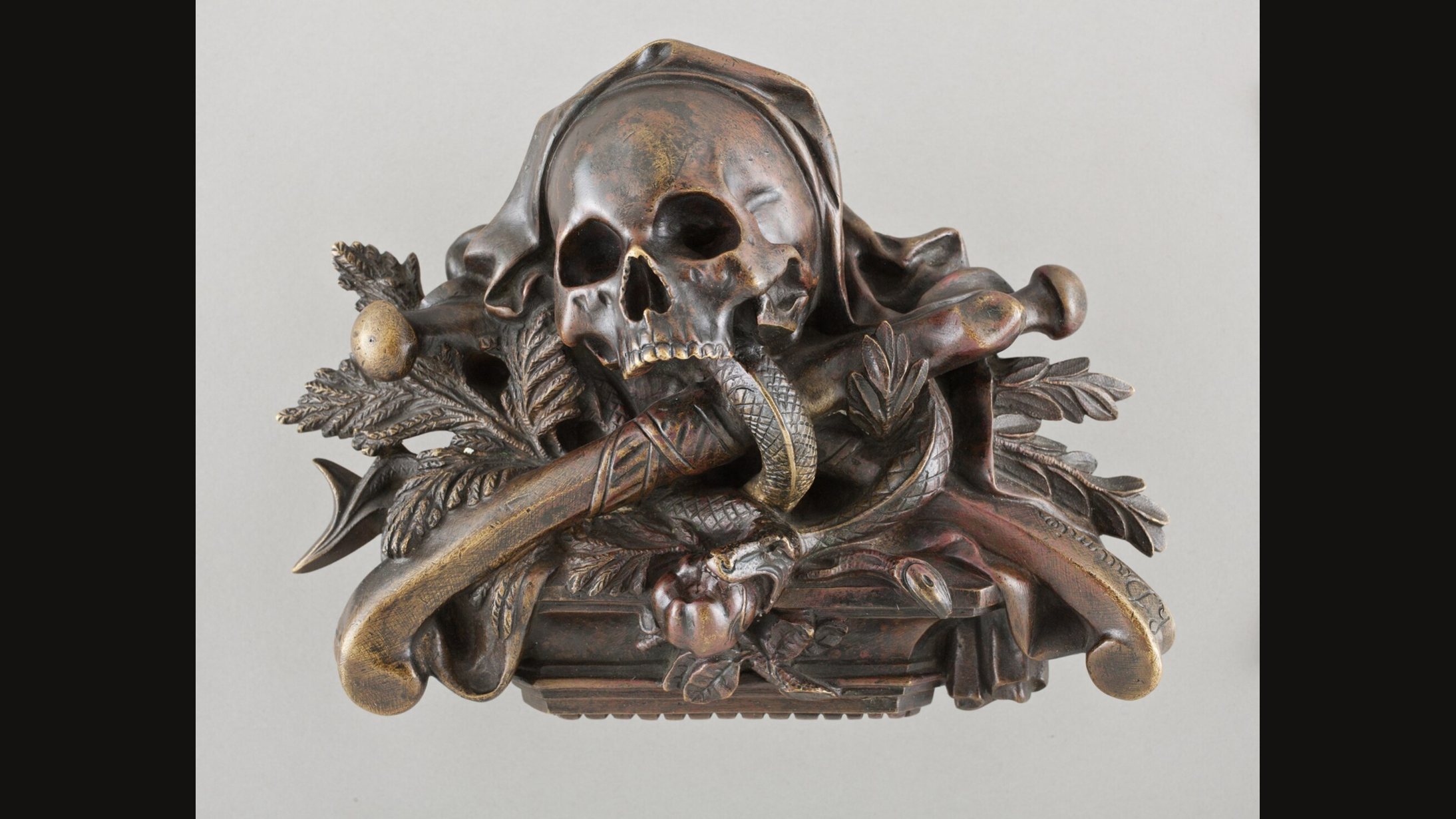
The skull in these works does a familiar job. It is a memento mori, Latin for "remember that you will die," a call to keep death in mind. A small object in the Met's collection shows how personal that idea could get: a rosary terminal bead from northern France or the southern Netherlands, made around 1500 to 1525, that joins a pair of lovers with a death's head. Someone praying with it would hold love and death in the same hand.
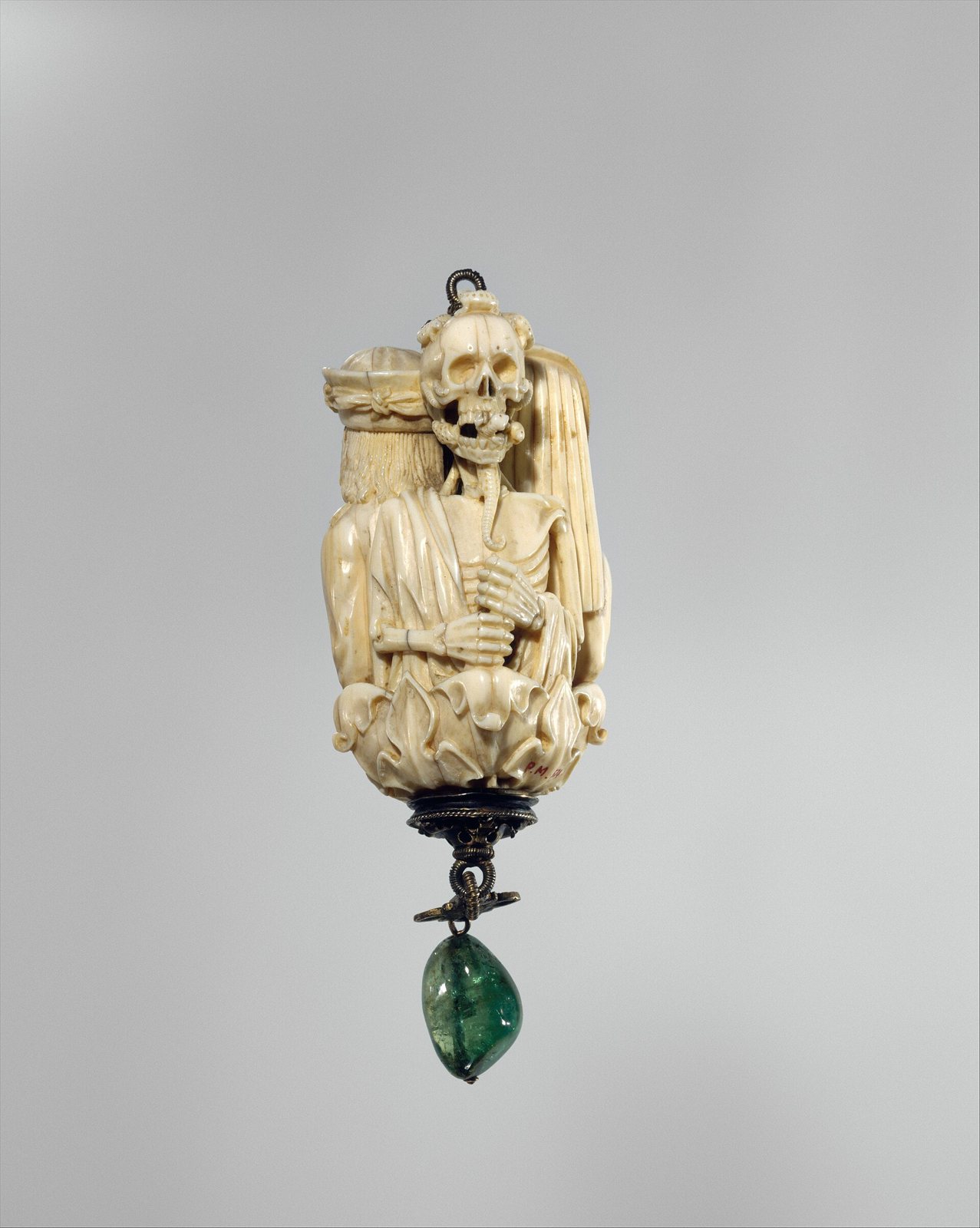
That is the skull's role in a skull-and-snake design too. Whatever the snake is doing, the skull is the part that says time is short. If that idea is what draws you in, our piece on what memento mori means follows it further.
What the snake means, tradition by tradition
The snake is the half that changes meaning, so it helps to know which snake you are looking at.
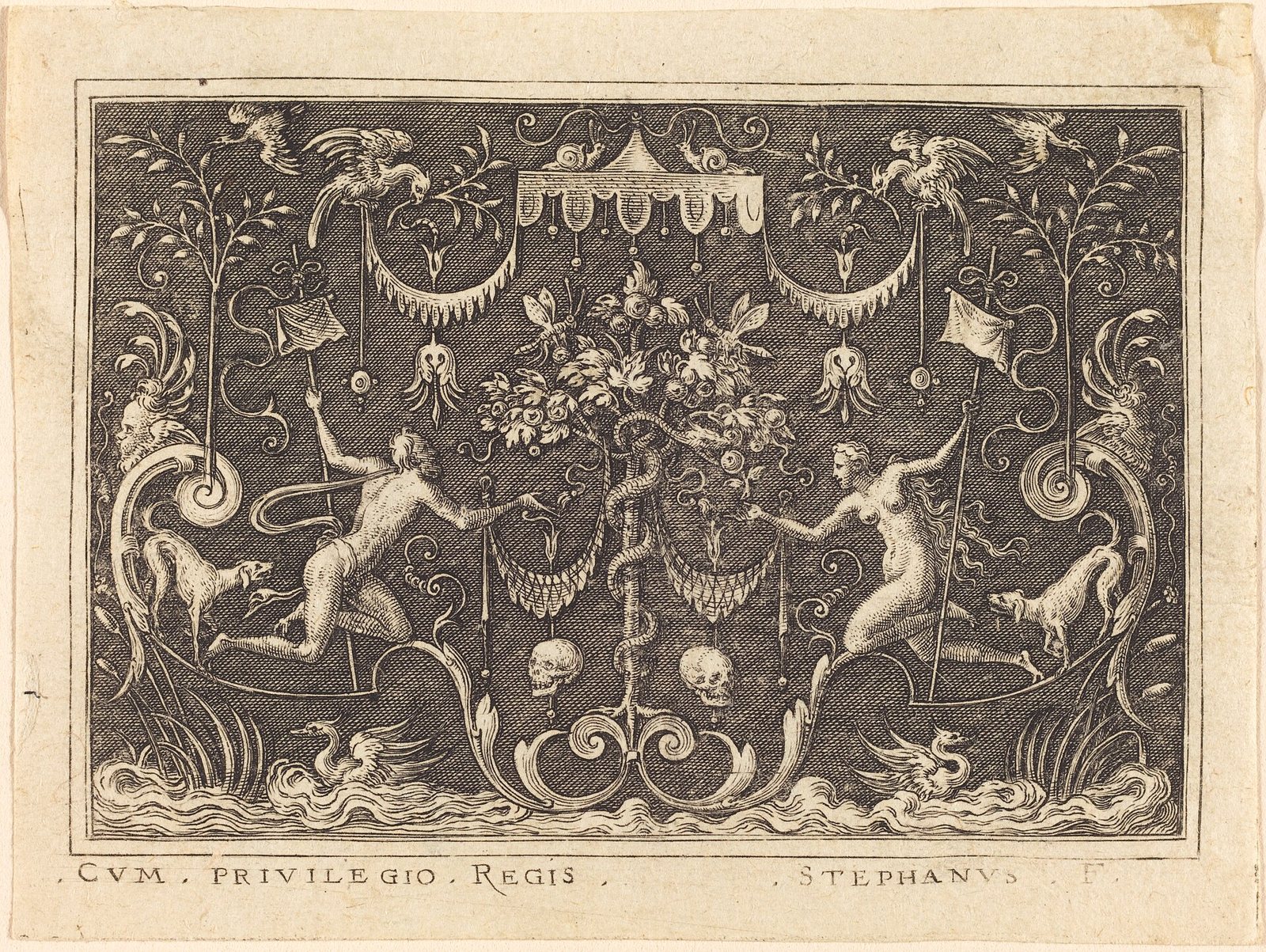
In Christian imagery drawn from Genesis, the serpent stands for temptation, the Fall and sin. That is the serpent of Delaune's engraving and of Blake's illustration.
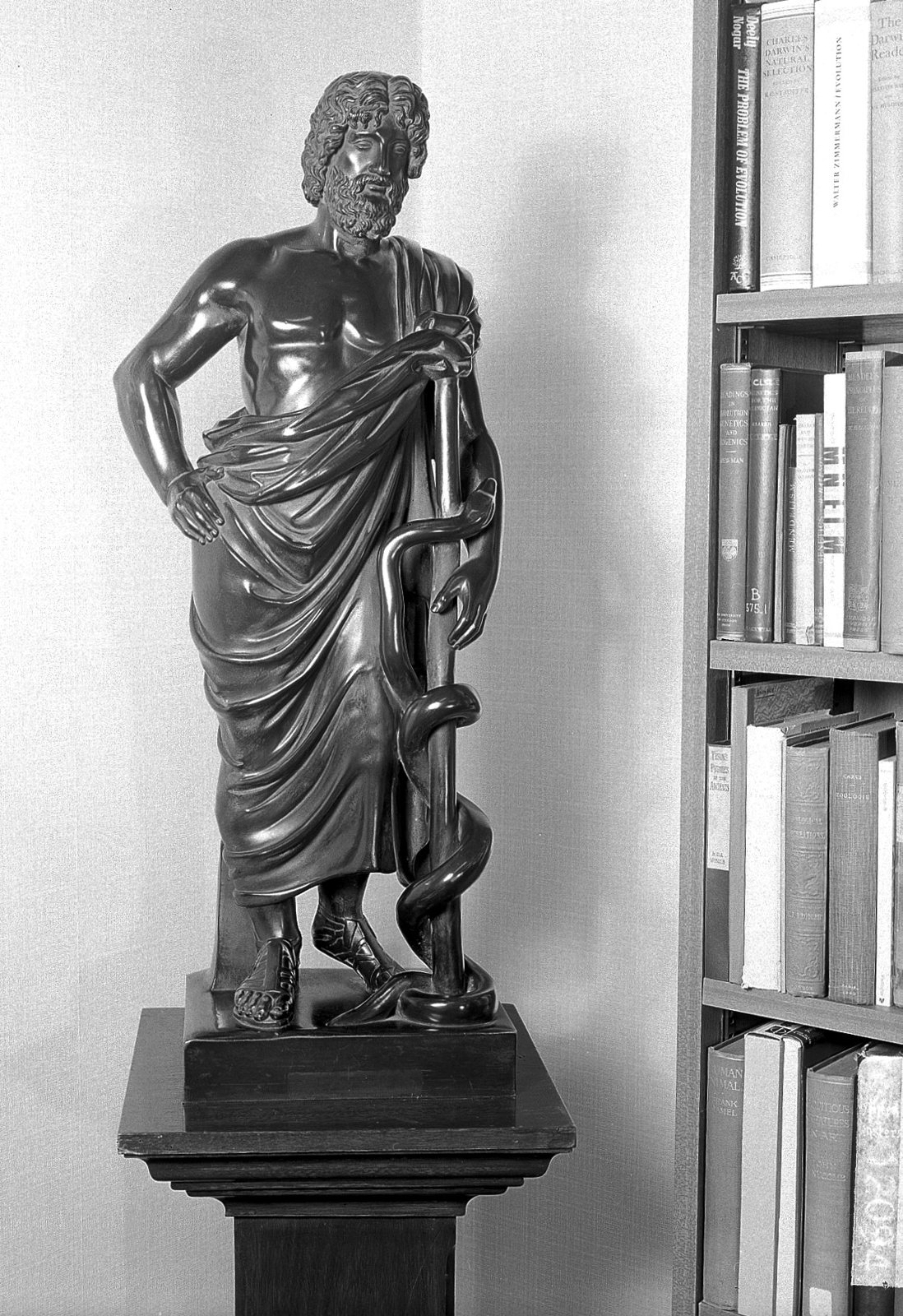
In Greek medicine, the snake means something almost opposite. The single serpent on the rod of Asclepius belongs to Asclepius, the god of medicine and healing. The Karolinska Institutet in Sweden notes that over time the snake came to be shown coiled around his staff. The Royal College of Physicians of Edinburgh links the snake's shedding of its skin to renewed strength and health, and it points out a common mix-up: the rod of Asclepius has one snake, while the caduceus of Hermes has two snakes and wings.
These meanings sit side by side rather than blending into one. A snake beside a skull in a church engraving and a snake on a doctor's emblem are telling different stories.
What the snake can mean, and where
Tap a card to bring it forward.
- Christian art from Genesis: Temptation, the Fall and sin, as in Delaune's Adam and Eve
- Christian redemption imagery: Sin and Death defeated, as in Blake's serpent beneath the cross
- Greek medicine: Healing, through the single serpent on the rod of Asclepius
- Shedding skin: Renewed strength and health, as the Royal College of Physicians of Edinburgh describes
- Modern tattoo reading: Change set against the finality of death, as tattoo writers describe it today
Skull and snake in American traditional tattooing
In tattooing, the skull and the snake are both staples of American traditional flash, the sheets of ready-to-pick designs that hung on shop walls. Norman "Sailor Jerry" Collins, who lived from 1911 to 1973, drew in that style. Six sheets of his flash, signed and dated by him, were shown in the Field Museum's *TATTOO* exhibition in Chicago in 2016 and 2017, according to the Sailor Jerry brand's account of the show. That account sets his work among sailor superstition, his Hawaiian experience and postwar Western themes.
Neither Collins nor American tattooers as a group are known for fixing one official meaning for a skull with a snake. The pairing earned its place as part of a shared visual vocabulary: bold, readable and easy to recognize.
Today's tattoo writers do offer a reading, and it is worth hearing as exactly that, a modern interpretation. The tattoo magazine iNKPPL describes the skull-and-snake pairing as a tension between change and permanence, and between renewal and the finality of death. It also makes the practical point that a skull tattoo's meaning depends on how the skull is drawn, what surrounds it and the wearer's intention.
What wearers say
Not every skull-and-snake tattoo comes with a philosophy, and that is fine. In a 2010 post on the Bowhunting.com forum, one wearer wrote, "My snake/skull tat on my upper arm was an entire spur of the moment thing," and explained that he simply asked a tattooer for a "snake in a skull." Plenty of people choose the design for the look: the classic traditional style, the strong lines and the way a snake winds through an eye socket. A design can be a favorite without being a manifesto.
If you want your own piece to carry a specific meaning, the simplest route is to tell your tattoo artist what you want each part to stand for, and to ask how they would draw it.
Skull, knife and snake
Add a dagger and the design gets busier, and so does the reading. There is no single established meaning for the skull, knife and snake together. Each part brings its own range. The skull suggests mortality or remembrance. The snake can suggest temptation, healing, change or danger. A knife can suggest risk, conflict, violence or personal resolve. How they combine depends on the wearer, the style of the artwork and the community it comes from, so the person wearing it is the one to ask.
When a group adopts the design
Like any strong image, the skull and snake can be taken up by a particular group and given a meaning inside that group. A U.S. Department of Justice filing records an unofficial skull-and-snake symbol used by some Los Angeles County Sheriff's Department deputies in the Antelope Valley as a marker of affiliation. The filing says people disagreed about what it meant and describes the symbol as divisive. That is one group's use in one place, and it does not define the design for everyone else who wears it.
Is it satanic or demonic?
This question comes up often enough to answer plainly. In Christian art drawn from Genesis, the serpent can stand for temptation, sin or Satan, and Blake's illustration ties it to Sin and Death. But the snake is not satanic across traditions. The single serpent on the rod of Asclepius stands for healing, and you will find it on medical emblems to this day.
A skull tattoo is not automatically demonic either. European memento mori art used skulls to prompt reflection on mortality, even on prayer objects like the Met's rosary bead. Modern wearers choose skulls for remembrance, rebellion, hard times survived, style or no special reason at all. A design that includes explicit demonic imagery can carry that theme, but a skull on its own does not. For more on what skull tattoos carry in general, see our skull tattoo meaning piece.
Skull and snake quiz
Answer every question to check.
Quick answers about the skull and snake
What does a skull with a snake mean?
A skull with a snake usually pairs mortality with the snake's meaning in that design: temptation and sin in Christian art, healing and renewal in medical symbolism, or change and danger in tattoos. Modern tattoo writers describe the combination as a tension between renewal and the finality of death.
Is the snake a satanic symbol?
The snake is not satanic in every tradition, though in Christian Genesis imagery the serpent can stand for temptation, sin or Satan. In Greek medicine the single serpent on the rod of Asclepius stands for healing, and the Royal College of Physicians of Edinburgh links its shed skin to renewed health.
Is a skull tattoo demonic?
A skull tattoo is not demonic by itself. For centuries European memento mori art used skulls as a call to reflect on mortality, and many people wear skulls today for remembrance or style. Only a design with explicit demonic imagery carries that theme.
What does a skull, knife and snake tattoo symbolize?
A skull, knife and snake tattoo has no single established meaning; it combines mortality from the skull, temptation, healing, change or danger from the snake, and risk, conflict or resolve from the knife. The wearer's intention and the style of the piece decide which reading fits.
Where to go next
Skull-and-snake designs share a lot with other classic pairings. Compare the life-and-death contrast in skull and roses meaning, the many ways a skull reads on a band in skull rings and what they mean, and the see-no-evil and memento mori readings in three skulls tattoo meaning. And if the memento mori half of the design is the part you like best, our Memento Mori skull tee puts that thought on a shirt.