
No. 001
Skull Ring Meaning: What a Skull Ring Says and Why People Wear Them
A skull ring says whatever its design and its wearer say, and that has been true for about four hundred years. Over that time the same shape has stood for remembrance of a person who died, a prayer about the shortness of life, regiment loyalty, biker identity, punk defiance and, for plenty of wearers today, a liking for a well-made bit of sculpture. The oldest skull rings on record are memento mori and mourning rings from sixteenth- to nineteenth-century Britain and Europe. If you are wearing one, wanting one or buying one as a gift, the useful questions are what the design includes, what the inscription says, who is wearing it and from which period it comes.
Memento mori rings, the oldest skull rings
"Memento mori" means "remember you must die." In sixteenth- and seventeenth-century Europe, rings used skulls, skeletons, coffins, hourglasses and inscriptions to nudge the wearer toward thoughts of mortality. These were not always mourning rings. A memento mori ring could be for a living owner who wanted to keep death in mind, while a mourning ring marked a particular person who had died.
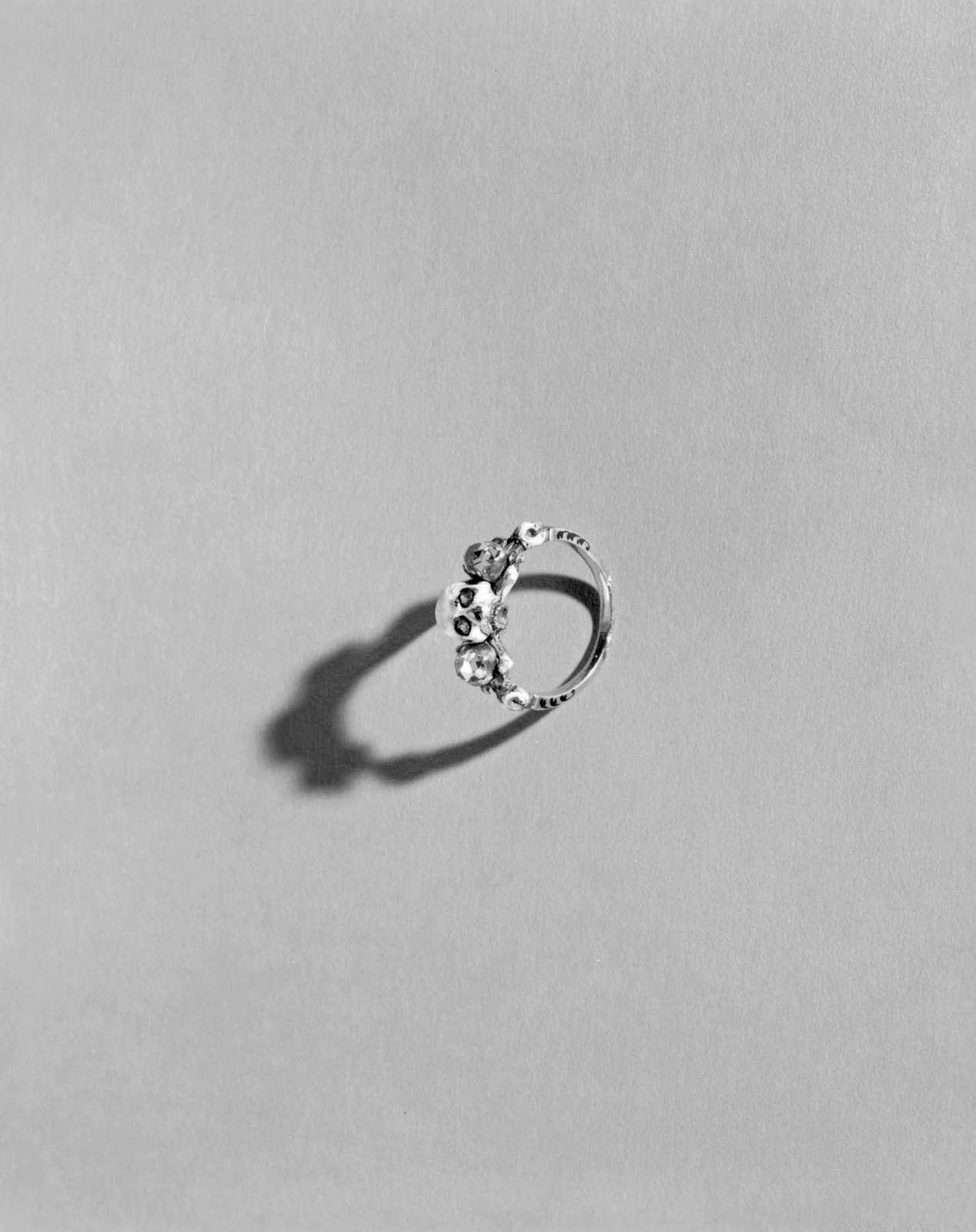
Museum collections hold a surprising range. The V&A has an English gold-and-enamel betrothal ring from 1550 to 1600 that pairs marriage symbols with a skull and the inscription "BE HOLD THE ENDE." The British Museum records an early seventeenth-century northern European gold ring with an enamelled, three-dimensional skull inside the bezel, and another sixteenth-century ring that opens like a small book, with a skull, an hourglass, a skeleton, scenes of the Fall of Man and clasped hands holding a heart. The Walters Art Museum has a European enamel-on-gold ring from about 1600 set with diamonds.
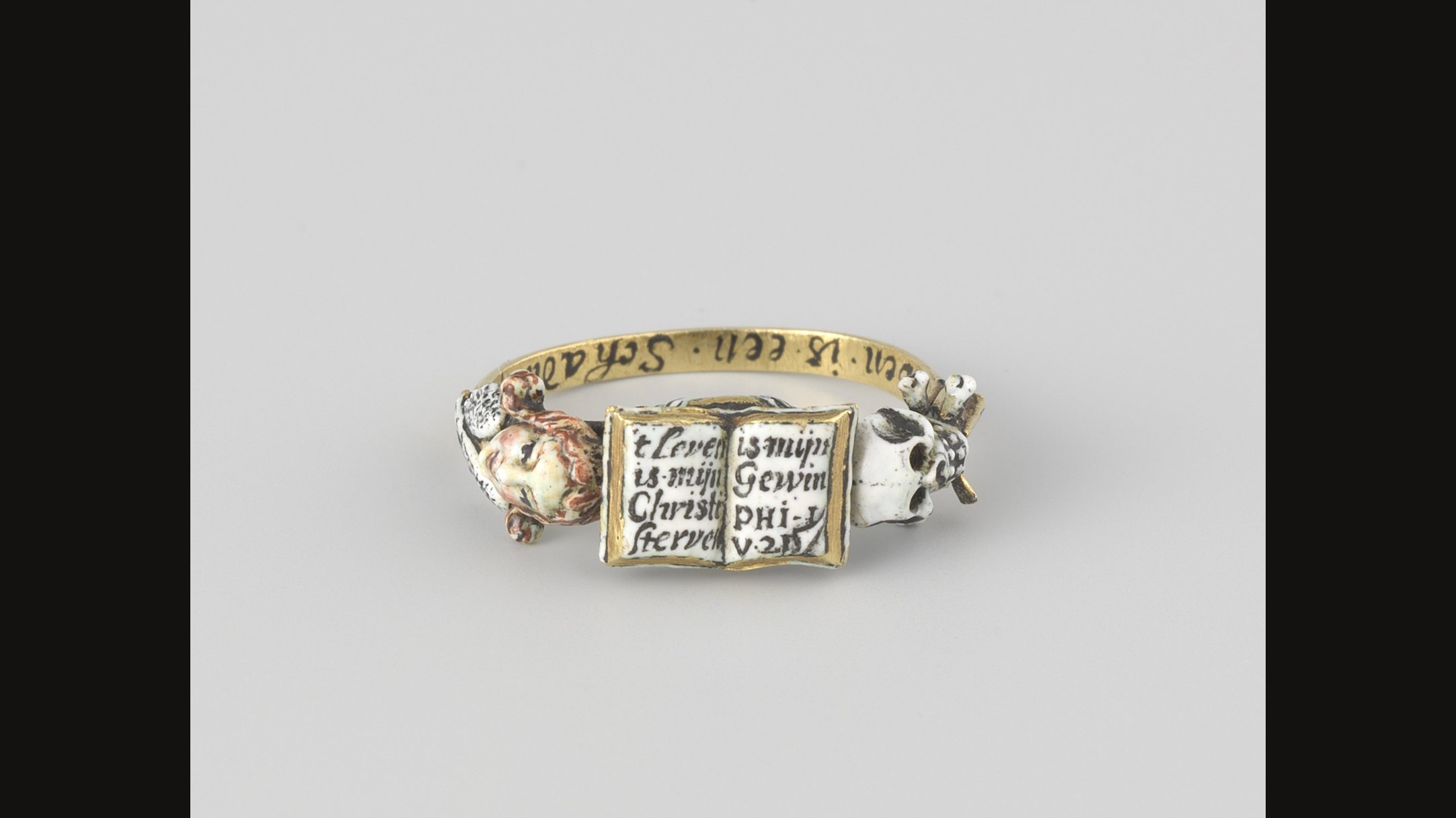
A ring in the Rijksmuseum from the northern Netherlands, of the mid seventeenth century, joins a skull, crossbones, an hourglass and an angel to a line from Philippians that translates as "For me to live is Christ, to die is gain." Inside, an inscription describes life on earth as a shadow. The Metropolitan Museum of Art holds a seventeenth-century British skull locket ring with diamonds and white enamel that hides a ruby chamber in the skull, so love and death share one object. The Met also describes a Renaissance gimmel ring with a tiny baby in one chamber and a skeleton in the other, which served as both a memento mori and a wedding ring.
Skull rings from 1550 to 1988
Tap or hover a step to follow the order.
1550 to 1600
V&A betrothal ring with a skull and "BE HOLD THE ENDE," England
About 1600
Walters Art Museum enamel and diamond memento mori ring, Europe
Mid seventeenth century
Rijksmuseum ring with skull, crossbones, hourglass, angel and Philippians text, northern Netherlands
1665
Alice Walter's will leaves a "deaths head Ring" to her daughter, London
1670
London Museum gold and black enamel mourning ring for "R.H."
1734
English mourning ring with name, age, death date and hair beneath crystal
1757
Sarah Rawson's ring at the Met, with a coffin-shaped crystal bezel and a skeleton
1972
The Great Frog begins making silver skull rings on request, London
1977
Alchemy begins related pewter jewellery, Leicester
1988
Keith Richards explains his skull-and-crossbones ring to the Washington Post
Mourning rings: a ring for one person
Mourning rings were often arranged ahead of time. In seventeenth- to nineteenth-century Britain, people left money or instructions in wills for rings to be made for relatives, friends or funeral guests. A will from 1665 shows the difference. Alice Walter left a "deaths head Ring" to her daughter Mary Long, and the University of Exeter's Material Culture of Wills project, which tells her story, treats it as an inherited memento mori object, not a mourning ring made after a death.
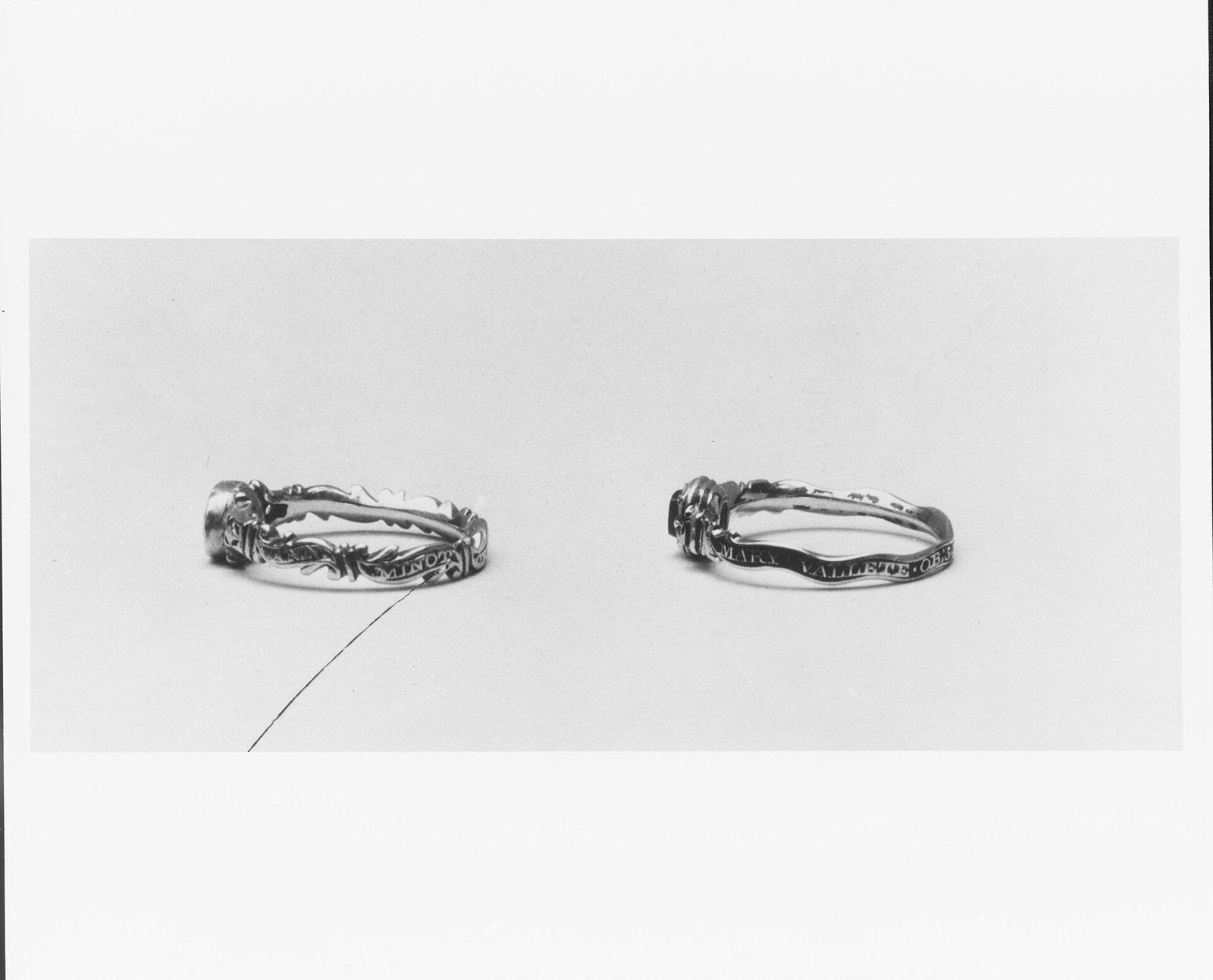
The rings that did commemorate someone carried names and dates. A London Museum ring from 1670, black enamel on gold, is inscribed "Oh my sister, my sister, R.H. Jan 22. 1670," and the museum notes that mourning rings were handed out with black scarves and hatbands. The Swiss National Museum describes an English mourning ring from 1734 with the person's name, age and date of death, plus hair beneath crystal behind a small skull. At the Met, a ring dated 1757 for Sarah Rawson has a coffin-shaped crystal bezel with a skeleton and an inscription naming her. The Science Museum Group holds a gold ring remembering Augusta Bruce, dated 1701 to 1800, with an inscription under glass.
By the later eighteenth and nineteenth centuries, mourning jewellery usually grew gentler. The Met notes that skulls, coffins and skeletons were especially popular until the middle of the eighteenth century, before black enamel, hairwork, weeping willows, urns and initials took over. The story of that later style is in our guide to Victorian mourning jewelry, and the habit behind all of it is covered in what memento mori means.
Tap or hover a row to highlight it.
| Type | Who it speaks about | What it usually carries |
|---|---|---|
| TypeMemento mori ring | Who it speaks aboutThe living wearer's own mortality | What it usually carriesA skull or skeleton, an hourglass, a motto, and it may be made with no death in mind |
| TypeMourning ring | Who it speaks aboutOne named person who has died | What it usually carriesA name, age or death date, often with black enamel or hair beneath crystal |
Skull rings, faith and ritual
A skull ring is not one official symbol of any church or lodge. In Catholic memento mori tradition, a skull can point to mortality, repentance, devotion and the hope of resurrection. The Met describes Renaissance memento mori jewellery as moral imagery that set youth and beauty against death and decay, meant to encourage devotion. A ring that pairs a skull with a cross, a saint, a prayer or a Christian inscription says something more specific than a plain skull, and the wider history of that imagery is in the story of skulls in Christianity.
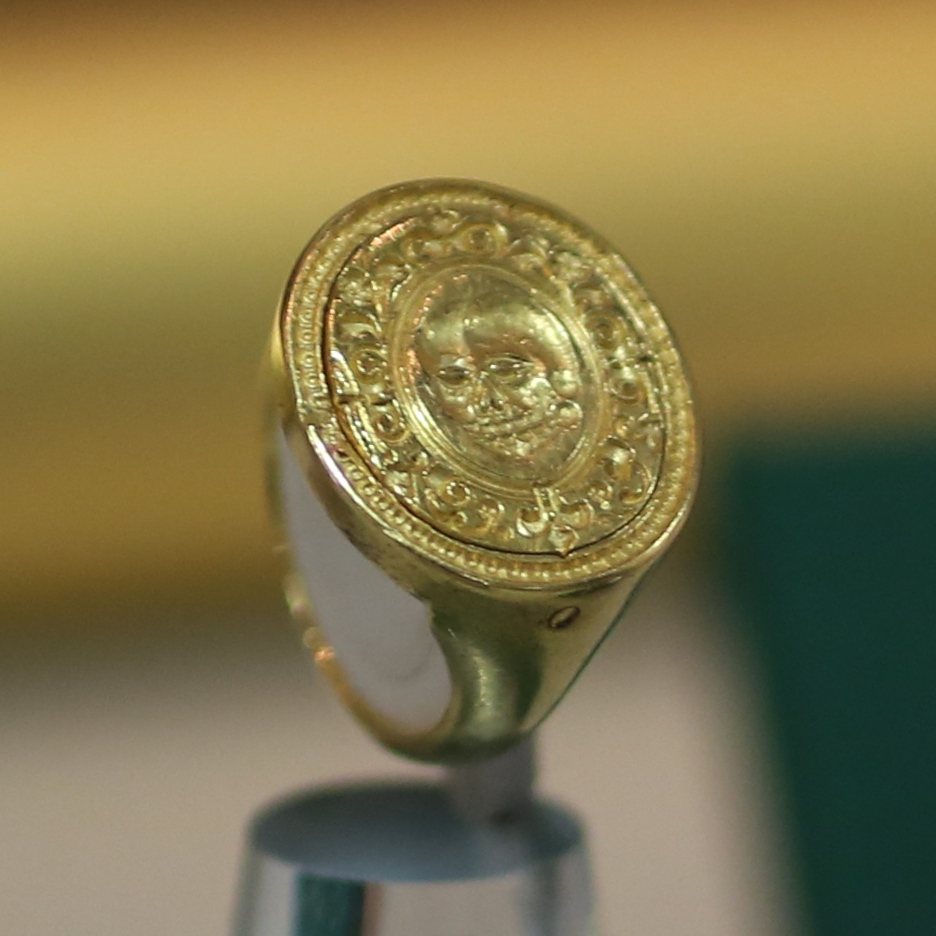
Freemasonry works the same way. The Grand Lodge of British Columbia and Yukon explains that, inside Masonic ritual, a skull stands for memento mori during the third-degree initiation and in some other rituals. A standalone skull-and-crossbones ring is not automatically Masonic, and a ring that pairs a skull with the square and compasses does not by itself prove membership, rank or authorization. The same Grand Lodge describes the popular story that the Knights Templar flew a skull-and-crossbones flag as an undocumented legend.
The modern skull ring: soldiers, bikers, punks and Keith Richards
The skull was used by several different military communities, so a skull on a ring cannot be tied to just one of them. Claire Barratt, in her chapter "Death Symbolism in Metal Jewelry", notes that the British 17th/21st Lancers used a skull, crossed bones and the words "Or Glory," meaning "Death or Glory." She also traces a route into subculture jewellery through postwar biker culture: in the 1950s, British and American bikers reused military surplus and metal skull and skull-and-crossbones badges on their jackets. Some of those badges came from Nazi military regalia, and others from British military imagery.
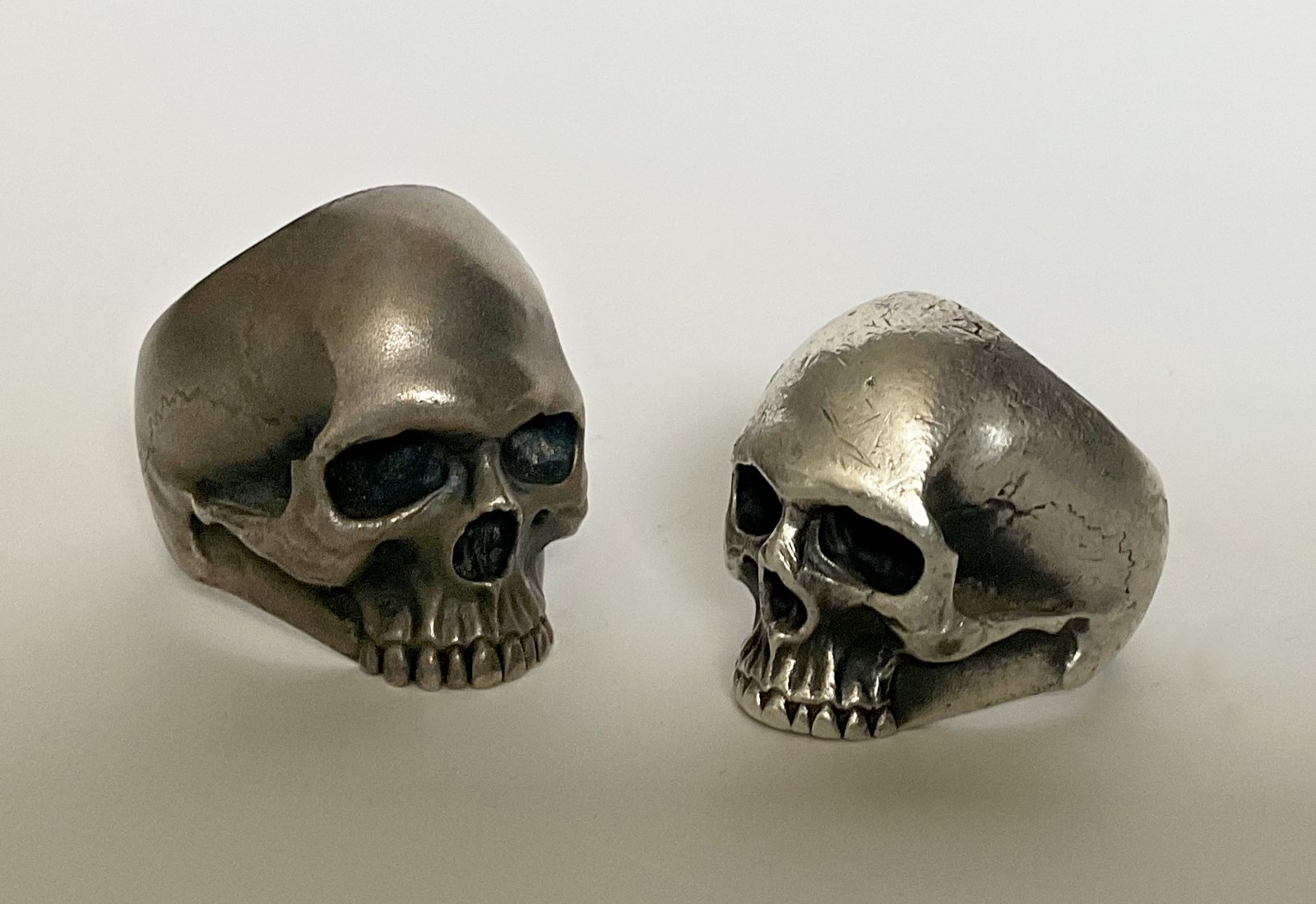
The ring itself arrives a little later. Barratt records that The Great Frog in London began making silver skull rings on request in 1972, and that Alchemy in Leicester began making related pewter jewellery in 1977, in the first wave of punk. Rock culture then loosened the link to any one group. In a 1988 interview with the Washington Post, Keith Richards of the Rolling Stones looked at his skull-and-crossbones ring and said it showed what people "really look like" beneath the flesh. He said he wore it because people around the world are basically alike, not because he was a pirate.
So, the evidence supports a chain of overlapping uses, from military insignia to biker style to punk and metal jewellery to rock-star personal style. It does not support one origin story for every modern skull ring.
One ring that carries a specific history
One skull ring has a history that anyone buying, inheriting or gifting should know. The SS Totenkopfring, also called the SS Honour Ring or Death's Head Ring, was a personal award from Heinrich Himmler to selected members of the SS in Nazi Germany. It was not a wedding ring. A surviving 1936 award text, held in the Westfälische Geschichte archive, says the ring stood for loyalty, obedience and SS comradeship, that it could not be bought, and that it had to be returned when the holder left the SS or died.
The design combined a skull and crossed bones with SS victory runes, the Hagall rune and oak-leaf decoration. The SS also ran the SS-Totenkopfverbände, the concentration-camp guard formations, so a ring that closely copies the Totenkopfring, especially one with runes, SS insignia, swastikas or Nazi-era inscriptions, carries an explicit extremist and genocidal association. It is not a "biker ring" or a generic memento mori.
A skull on its own does not equal the SS symbol, as the 17th/21st Lancers show. Identification depends on the complete design, any inscriptions or runes and the ring's provenance. If you are unsure about a ring you own or are thinking of buying, a museum or a specialist in militaria can help identify it.
What wearers and makers say today
People who wear skull rings today describe four overlapping meanings. Some wear one as a personal sign of remembrance or of how short life is. Some link it to the defiance of punk, biker and rock styles. Some read it as protection or strength, especially when a ring adds helmets, armour or wings, and that is a modern personal reading, not a historical rule. Others simply like the object, with its weight, detail and sculpted form. A ring may carry one meaning, several, or none beyond visual taste.
The jeweller Stephen Einhorn, who makes skull rings, presents them as a modern memento mori, tied to mortality, sculpture and history. That is one maker's reading, and the wearers above show how many others there are.
As for who wears them, people from many backgrounds do: mourners and devotional owners in early modern Europe, people in gothic, rock, biker or alternative fashion today, and people who just like skulls. The ring alone does not prove membership of any group. The safest way to read one is to ask the wearer, then look at the surrounding symbols, any inscription, the community and the period.
Materials, styles and what to look at when you buy
Historical examples were made in gold, silver, enamel, glass and crystal, and some mourning pieces included hairwork or ivory. Styles on record include gold bands with engraved or enamelled skulls, black-and-white enamel, coffin-shaped bezels with skeletons or miniatures, skulls beneath rock crystal, rings with names, initials, ages and death dates, gem-set skulls and crossbones, and Victorian sculptural rings that combine skulls with owls, butterflies, angels and building shapes.
Current makers commonly use sterling silver, 9-carat and 18-carat gold, platinum, titanium, enamel and gemstones. For a clear description of any ring, tell solid metal, plating, enamel, stones and cast or carved construction apart. Weight, colour or finish do not prove age or historical authenticity.
Test your skull ring knowledge
Answer every question to check.
Quick answers about skull rings
Why would someone wear a skull ring?
Reasons include remembrance of a person, reflection on mortality, religious devotion, group identity, rebellion or simply liking the design. The meaning is not universal, and a historical ring is best read through its own inscription and period.
Who wears skull rings?
People from many backgrounds do, including mourners and devotional owners in early modern Europe and wearers of gothic, rock, biker or alternative styles today. A ring alone does not prove membership in any group, so ask the wearer.
What does a skull ring mean in Catholic tradition?
A skull can stand for mortality, repentance, devotion and the hope of resurrection, but a skull ring is not one official Catholic symbol with a required meaning. A ring that adds a cross, a saint, a prayer or a Christian inscription points to a more specific devotional intention.
What do Masonic skull rings mean?
In Masonic ritual, as the Grand Lodge of British Columbia and Yukon describes it, the skull is a memento mori within the third-degree initiation and some other rituals. A skull-and-crossbones ring alone is not automatically Masonic, and a ring with the square and compasses does not prove membership.
Is my skull ring an SS Totenkopf ring?
Only the full design can answer that. The SS Totenkopfring combined a skull and crossed bones with SS runes, the Hagall rune and oak leaves, and it was awarded personally and never sold in shops. A plain skull, or a skull used by a regiment such as the 17th/21st Lancers, is a different thing, so ask a museum or a militaria specialist to identify a ring you are unsure about.
Where to go next
The skull on a ring is part of a much longer habit of keeping death in sight. Start with what memento mori means, read about Victorian mourning jewelry, and follow the symbol to its other famous partner in the story of the skull and crossbones. For the wider range of meanings, there is also the guide to skull symbolism. We do not make rings, but if you lift for a living or a hobby, our Iron Crew skull tee has an engraved skull set in a barbell plate.