

No. 079
Homo erectus Skull: What It Looks Like and How It Differs From Ours
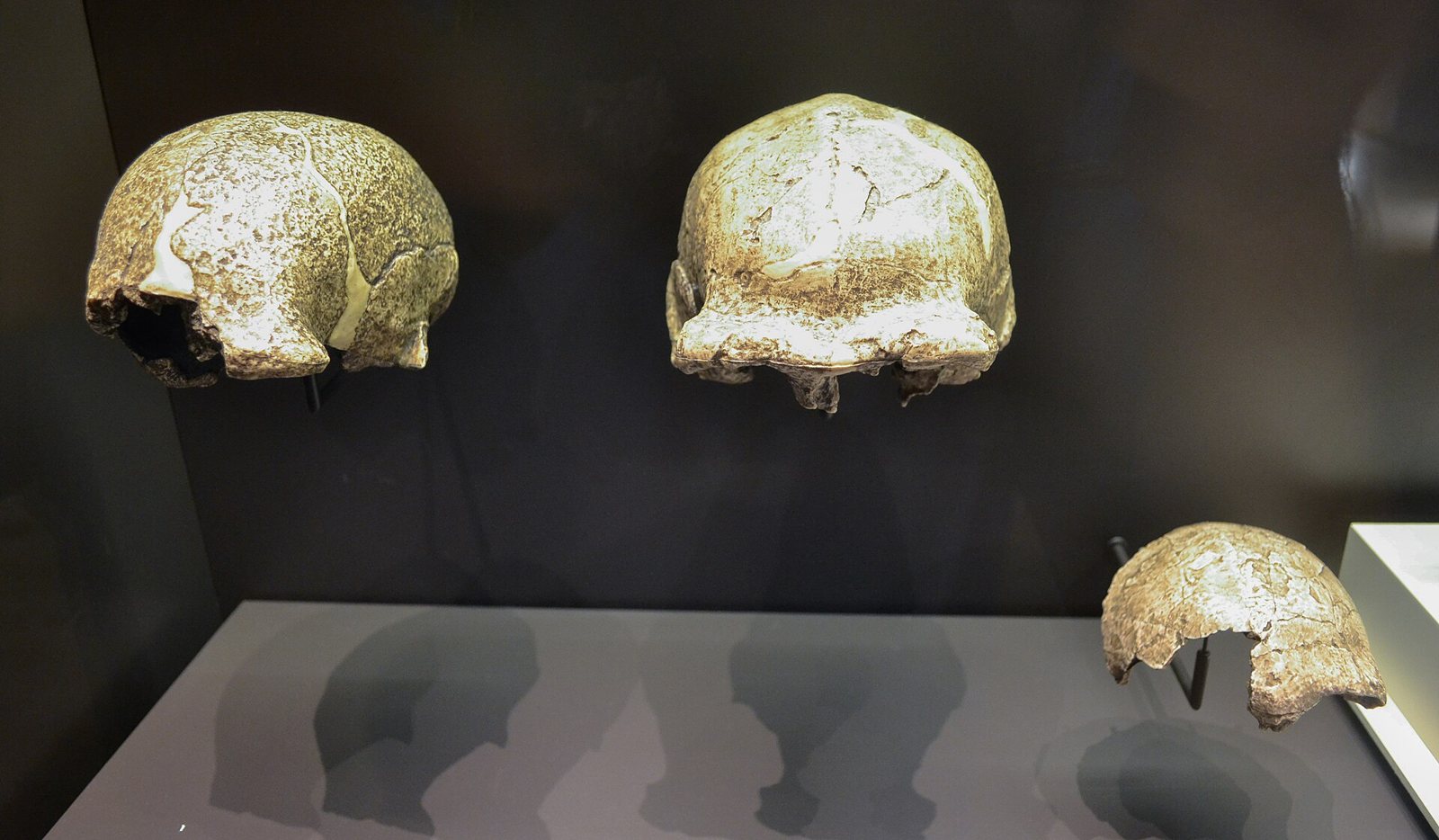
A typical *Homo erectus* skull is long and low. The forehead slopes back, a strong brow ridge runs above the eyes, the face is relatively large, and the cranial bone is thick. Many skulls have a keel, a low ridge, running along the top, and a pronounced bar of bone across the back called the occipital torus. The lower jaw has no chin. Set a modern human skull beside it and ours is higher, shorter and rounder, with a taller forehead, smaller brow ridges and a chin that juts forward.
That description fits a species that lived for a very long time over a very wide area. The Smithsonian Human Origins Program gives *Homo erectus* a range of about 1.89 million to 110,000 years ago, with fossils from Africa, Georgia, China and Indonesia. Individual skulls vary, and brain size grew over that long stretch of time, so the features below are a pattern to look for rather than a stamp every fossil carries.
Reading the skull from the brow to the back
Start with the overall shape. The braincase is long and low, and the Natural History Museum, London notes that from above or in profile it often looks football-shaped. Ours, by comparison, rises into a tall dome.
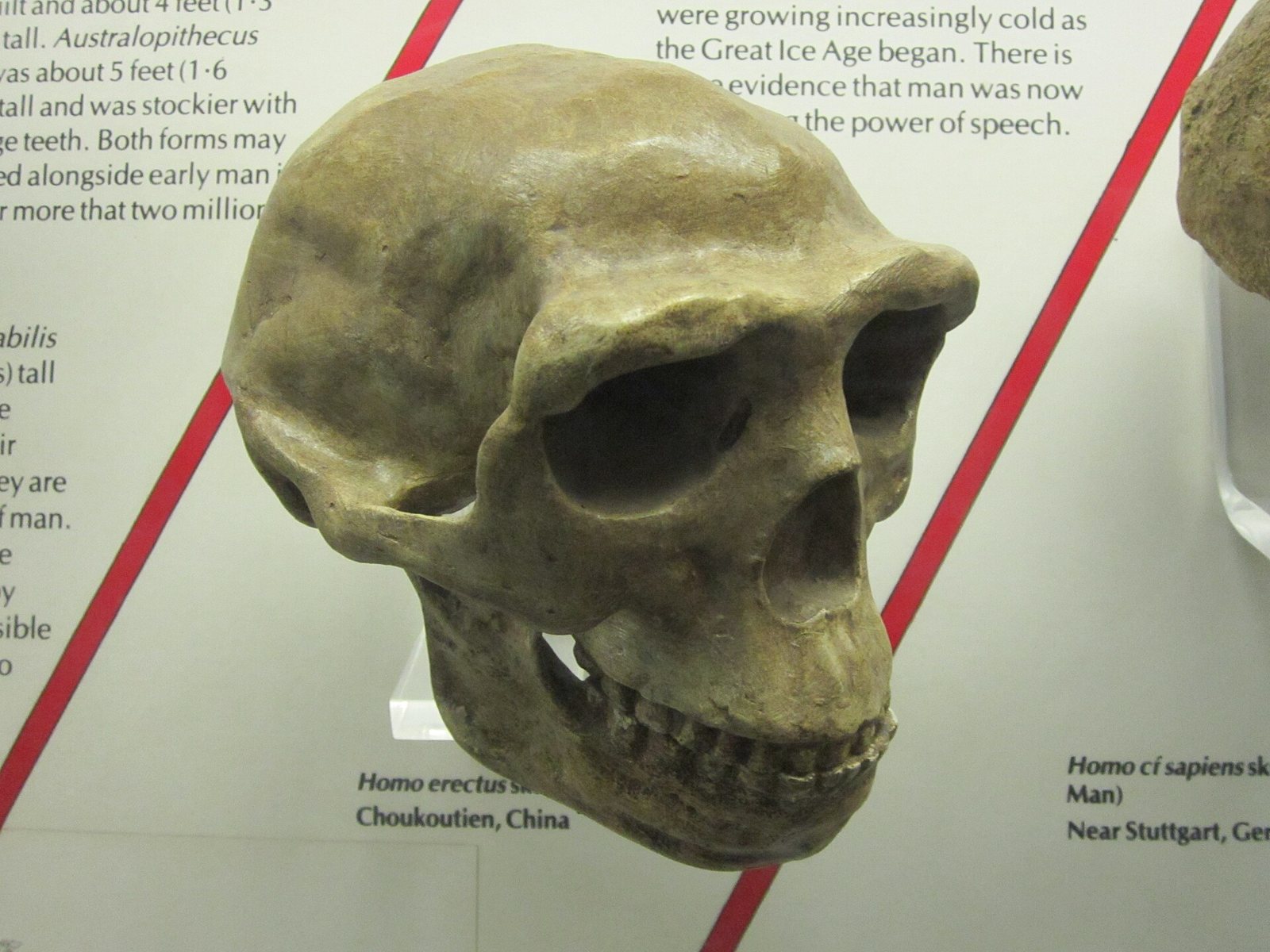
The forehead slopes back from the brow instead of standing up. Right above the eye sockets sits the brow ridge, also called the supraorbital torus, usually large and continuous across both eyes. It is the feature most people notice first on a cast, and it is still something of a puzzle. The Natural History Museum describes its function as debated, with structural reinforcement and facial or social signalling both proposed.
The bone itself is often thick. Antón's review, *Natural history of Homo erectus*, lists thick vault bone and keeling among the species' characteristic features, though a study by Balzeau on thickened cranial vaults and parasagittal keeling disputes the idea that the bone was uniquely thick in *Homo erectus* alone. Along the midline of some skulls runs the sagittal keel, a gentle ridge like the roof line of a tent. At the back, the occipital torus forms a shelf of bone. Below the large, projecting face, the jaw lacks the chin our own jaws have.
What to look for on a Homo erectus skull
Tap a card to bring it forward.
- Braincase: Long and low, often football-shaped from above or in profile.
- Forehead: Low and sloping back from the brow.
- Brow ridge: A large, usually continuous supraorbital torus above the eyes.
- Cranial bone: Often thick, though how thick varies from skull to skull.
- Sagittal keel: A low ridge along the midline on some specimens.
- Occipital torus: A pronounced bar of bone across the back of the skull.
- Face: Relatively large and projecting.
- Jaw: No modern chin.
Brain size, specimen by specimen
The tempting question is how big the brain was, and the honest answer comes one fossil at a time. Turkana Boy, the young skeleton from Kenya, had a cranial capacity of 880 cubic centimetres at death, and the Smithsonian estimates he would have reached about 909 cubic centimetres as an adult. OH 9, found at Olduvai Gorge in Tanzania in 1960, is described by the Smithsonian as the oldest known early human fossil with a brain size above 1,000 cubic centimetres.
For scale, the modern human average is commonly given as about 1,300 to 1,400 cubic centimetres, and individual people vary a great deal around that figure. Brain size in *Homo erectus* increased over time and varied widely between individuals and regions, so the best way to talk about it is with a named fossil, its place and its date, rather than a single number for the whole species.
Side by side with a modern human skull
*Homo erectus* and *Homo sapiens* have a good deal in common. Both walked upright, both had human-like body proportions, and both had large brains compared with earlier hominins. The differences show up mostly in the shape of the head.
Tap or hover a row to highlight it.
| Feature | Homo erectus | Homo sapiens |
|---|---|---|
| FeatureBraincase shape | Homo erectusLong, low and often angular | Homo sapiensHigher, shorter and more rounded |
| FeatureForehead | Homo erectusLow and receding | Homo sapiensTaller and more vertical |
| FeatureBrow ridge | Homo erectusUsually large and continuous | Homo sapiensUsually smaller and broken into two arches |
| FeatureCranial bone | Homo erectusOften thick, although the degree is variable | Homo sapiensGenerally thinner |
| FeatureBack of skull | Homo erectusOften marked by an occipital torus | Homo sapiensUsually lacks the strong Homo erectus torus |
| FeatureMidline | Homo erectusSome specimens have a sagittal keel | Homo sapiensUsually lacks a sagittal keel |
| FeatureFace | Homo erectusRelatively large and projecting | Homo sapiensSmaller and tucked beneath the braincase |
| FeatureJaw | Homo erectusNo modern chin | Homo sapiensA projecting chin is typical |
| FeatureBrain-size examples | Homo erectus880 cc in Turkana Boy; over 1,000 cc in OH 9 | Homo sapiensCommonly about 1,300 to 1,400 cc, with substantial variation |
Treat the table as a set of population patterns, not a checklist that can identify every fossil. Researchers disagree about how much variation belongs inside *Homo erectus*, and about whether some early African fossils should be placed in a separate species, *Homo ergaster*. If you want the modern skull's 22 bones named one by one, our human skull facts story lays them out.
Java Man and Sangiran 17
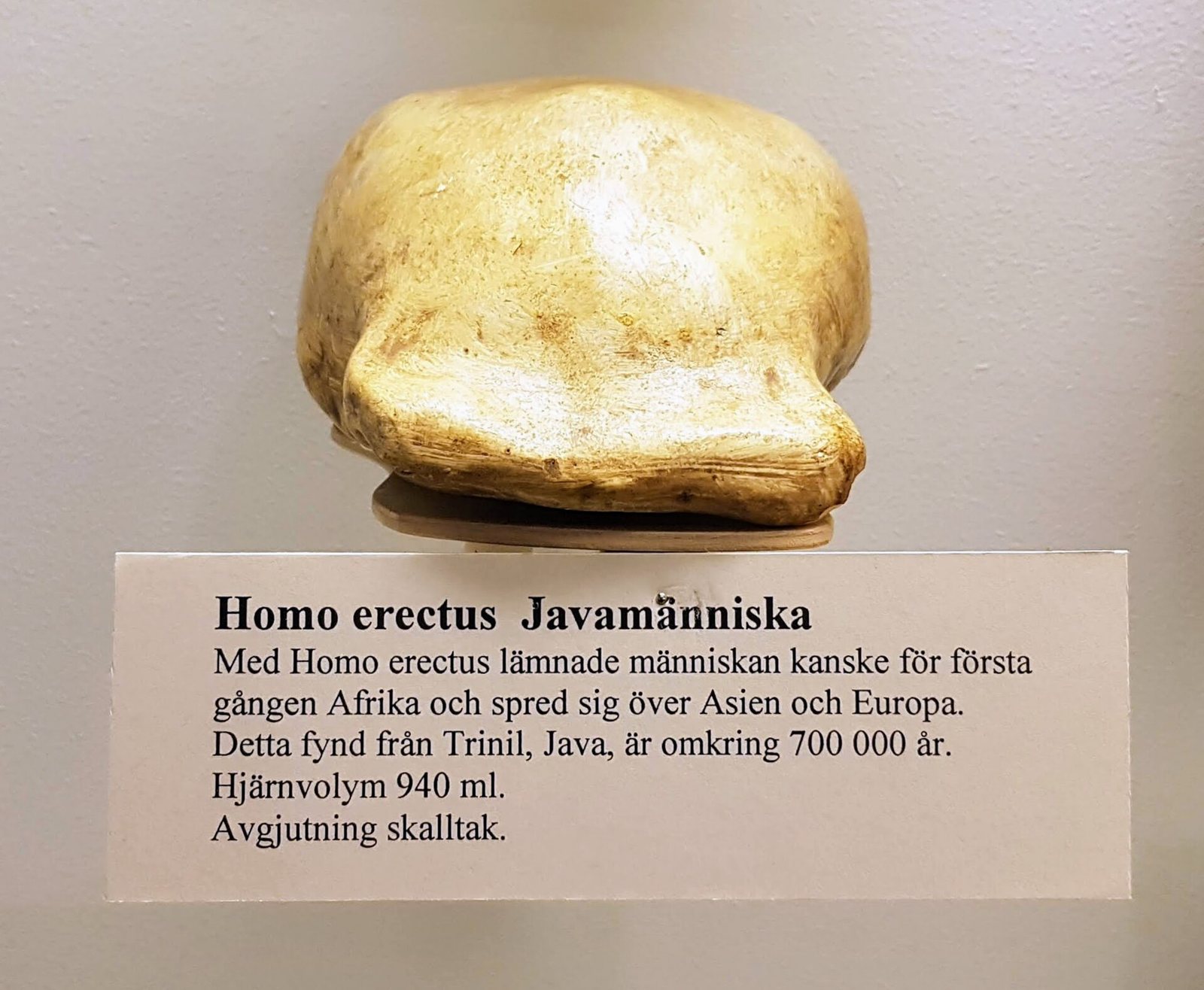
The first *Homo erectus* skull to become famous came from Java. In 1891 the Dutch surgeon Eugène Dubois found a skullcap at Trinil, on the Indonesian island of Java. Known today as Trinil 2, or Java Man, it was first named *Pithecanthropus erectus*, and it became the first widely recognized early human fossil found outside Europe. Java also produced one of the most complete *Homo erectus* skulls. Sangiran 17 was found at Pucung, in the Sangiran area of Java, in 1969 by Towikromo and Tukimin. The Indonesian heritage catalogue for Sangiran 17 describes it as an adult male skull that preserves the vault, the base and the face, which makes it an important reference for reconstructing what a *Homo erectus* face looked like.
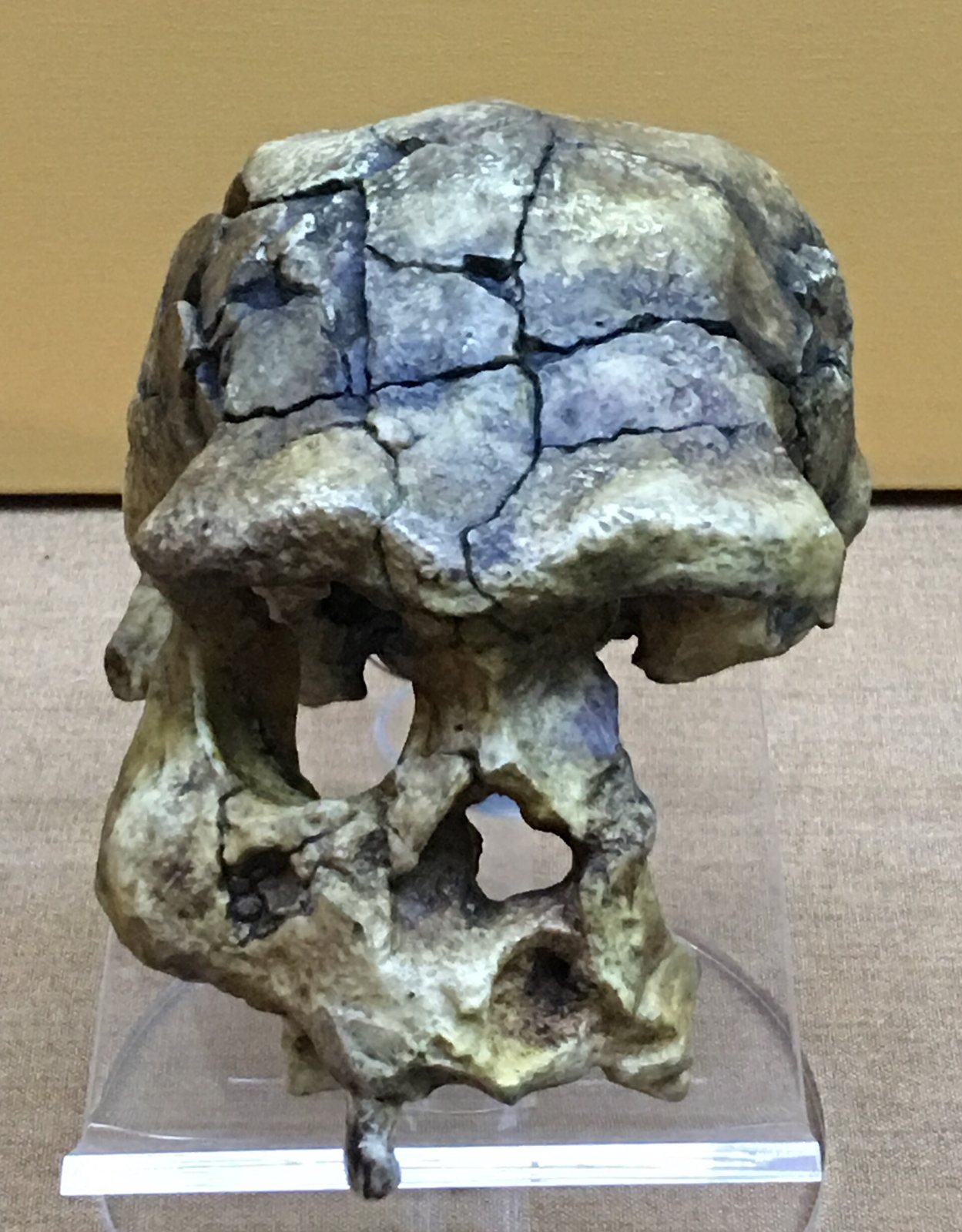
Its age depends on who you ask. The Smithsonian dates Sangiran 17 broadly to between 1.3 and 1.0 million years ago. The Indonesian catalogue gives the surrounding rock formation an age of about 800,000 to 700,000 years, and the Natural History Museum, London, gives about 700,000 years. Those figures do not agree, and each rests on its institution's reading of the site.
Peking Man and Turkana Boy
China's best-known *Homo erectus* fossils came from Zhoukoudian, near Beijing, excavated mainly in the 1920s and 1930s. The finds included several skulls and skull fragments that the Smithsonian dates to about 780,000 to 400,000 years ago. The original fossils disappeared during World War II, so casts and written descriptions now carry the record; the whole story of their loss is in our piece on Peking Man.
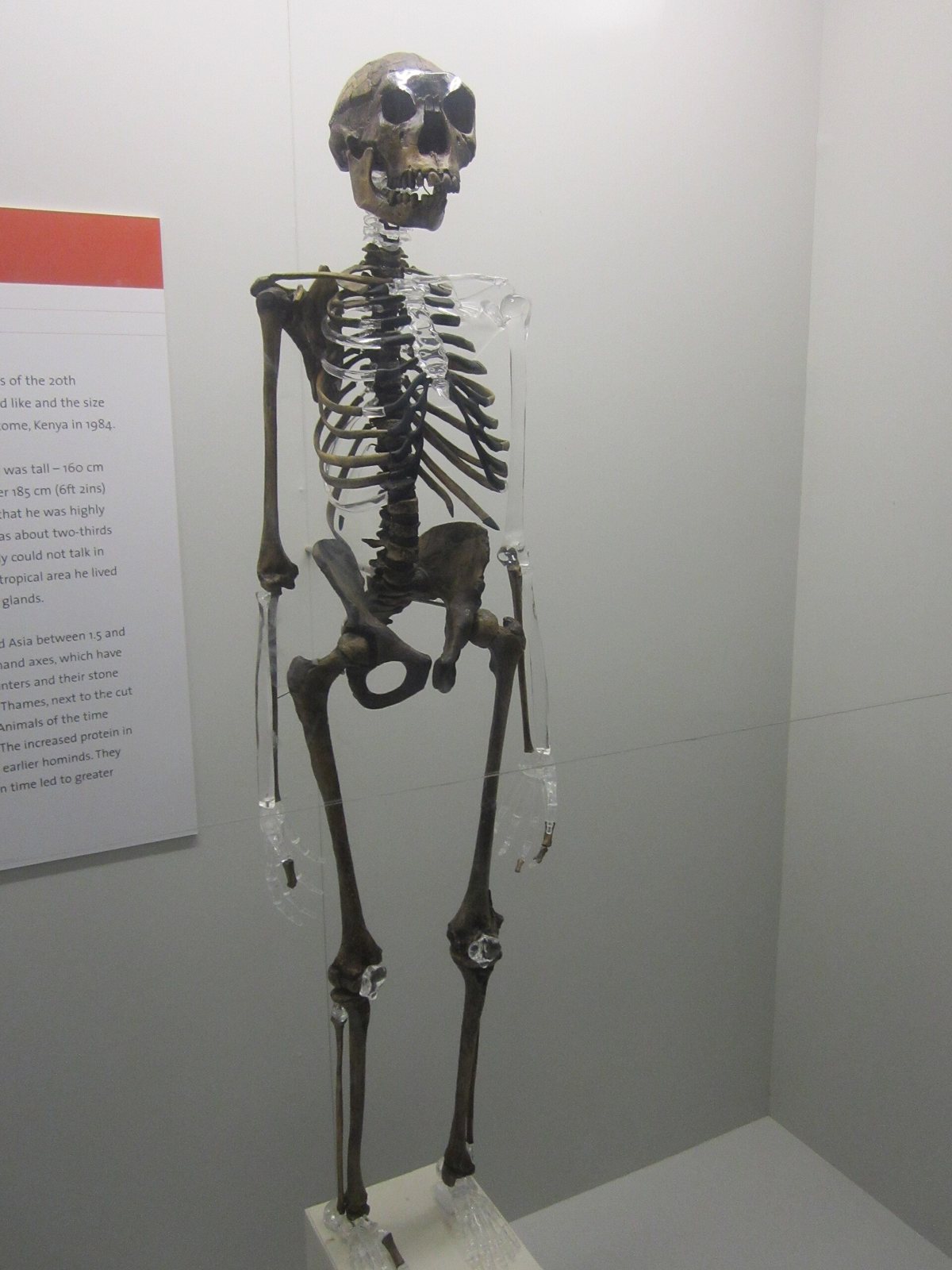
One of the best-known African skulls belongs to a child. Turkana Boy, catalogued as KNM-WT 15000, was found by Kamoya Kimeu at Nariokotome, West Turkana, Kenya, in 1984. He lived about 1.6 million years ago and was eight or nine years old when he died, yet he already stood about 1.6 metres tall. His skull held a brain of 880 cubic centimetres, and the estimate of about 909 cubic centimetres as an adult is a size he never reached.
How long Homo erectus lasted
The youngest widely cited *Homo erectus* population lived at Ngandong, on Java. In 2020, Rizal and colleagues published a study in *Nature*, *Last appearance of Homo erectus at Ngandong, Java, 117,000 to 108,000 years ago*. They combined uranium-series dating, uranium-series electron spin resonance dating, luminescence dating, argon-argon dating and geological correlation to place the Ngandong bonebed at about 117,000 to 108,000 years ago.
That is the study's conclusion, and it is not the only date ever proposed. Earlier studies suggested much younger ages, roughly 53,000 to 27,000 years ago, while other work argued for older ones, and Huffman and colleagues' reassessment of the 1931 to 1933 Ngandong finds revisits where in the ground those early fossils came from. The Natural History Museum notes that late Java fossils have produced conflicting results, with some methods giving ages older than 200,000 years and others less than 50,000. Our story on how archaeologists know how old bones are explains what each of those dating methods actually measures.
Homo erectus skulls through time
Tap or hover a step to follow the order.
1891
Eugène Dubois finds Trinil 2 on Java.
1920s to 1930s
Major Peking Man finds at Zhoukoudian, China.
1960
OH 9 is found at Olduvai Gorge, Tanzania.
1969
Sangiran 17 is found at Sangiran, Java.
1984
Turkana Boy is found at Nariokotome, Kenya.
2020
A Nature study dates the Ngandong bonebed to 117,000 to 108,000 years ago.
Where to see a Homo erectus skull, original or cast
Museum displays mix original fossils, casts and reconstructions, so it helps to know which one you are looking at. A few places to start:
- Museum Manusia Purba Sangiran, Sragen, Central Java, Indonesia. The Indonesian Heritage Agency says visitors can see Sangiran 17 there, while the Sangiran catalogue lists Museum Geologi Bandung, in West Java, as the skull's storage location.
- Natural History Museum, London. Its palaeoanthropology collection holds *Homo erectus* material with scientific-quality replicas and a cast of a skull from Dmanisi in Georgia, the site of our story on Dmanisi Skull 5. The museum's Human Evolution Gallery shows a cast of a Chinese *Homo erectus* skullcap.
- Field Museum, Chicago. The Natural History Museum identifies a replica of the Turkana Boy skeleton on display there.
- Zhoukoudian Site Museum, Fangshan District, Beijing. The site museum presents the Peking Man site, and because the originals vanished, its displays rely heavily on casts and reconstructions.
- Online. The Smithsonian's fossil collection pages offer photographs and 3D scans of Sangiran 17, Turkana Boy, Trinil 2, OH 9 and the Zhoukoudian fossils.
Before you travel, confirm with the museum what is on display, including whether an object is an original fossil, a cast or a reconstruction. That goes for Trinil 2 as well: ask the holding museum where the skullcap is currently shown or stored.
Homo erectus skull quiz
Answer every question to check.
Questions about the Homo erectus skull
A few more questions tend to follow a first look at a cast.
What are the features of a Homo erectus skull?
A *Homo erectus* skull is usually long and low, with a receding forehead, a prominent brow ridge, thick cranial bone, a large face and no chin. Some have a sagittal keel along the top and a strong occipital torus at the back. Because the species spans Africa, Georgia, China and Indonesia over nearly two million years, a single fossil may show some of these features more strongly than others.
Did Homo erectus have a thicker skull than modern humans?
Usually, yes: the vault bone is often thick, while ours is generally thinner. How thick it is varies from fossil to fossil, and Balzeau's study disputes the idea that the thickness was unique to *Homo erectus*.
Is the Homo erectus skull in a museum the real fossil?
Often it is a cast or a reconstruction. The Peking Man displays, for example, are based on casts and reconstructions because the original Zhoukoudian fossils were lost during World War II, so ask the museum which kind of object you are looking at.
Is Homo ergaster the same as Homo erectus?
It depends on the researcher. Some classify early African fossils separately as *Homo ergaster*, while others keep them within *Homo erectus*, and the debate is part of a wider disagreement about how much variation one species can hold.
Where to go next
The *Homo erectus* skull sits in the middle of a long family story. To see where our own species begins, read about the oldest human skulls, and for another heavy brow ridge, the Neanderthal skull. Indonesia has another surprising early human in Homo floresiensis, and South Africa's Rising Star Cave holds Homo naledi. China's Dragon Man skull has a strange modern history of its own, and if you want to know how specialists read so much from a single skull, see what bones tell archaeologists.
Terms in this story
Tap a term to see what it means.
Homo erectus. An early human species that lived from about 1.89 million to 110,000 years ago in Africa, Georgia, China and Indonesia, according to the Smithsonian.
---