

No. 115
Alligator Skull: How to Tell It From a Crocodile, and the Rules on Owning One
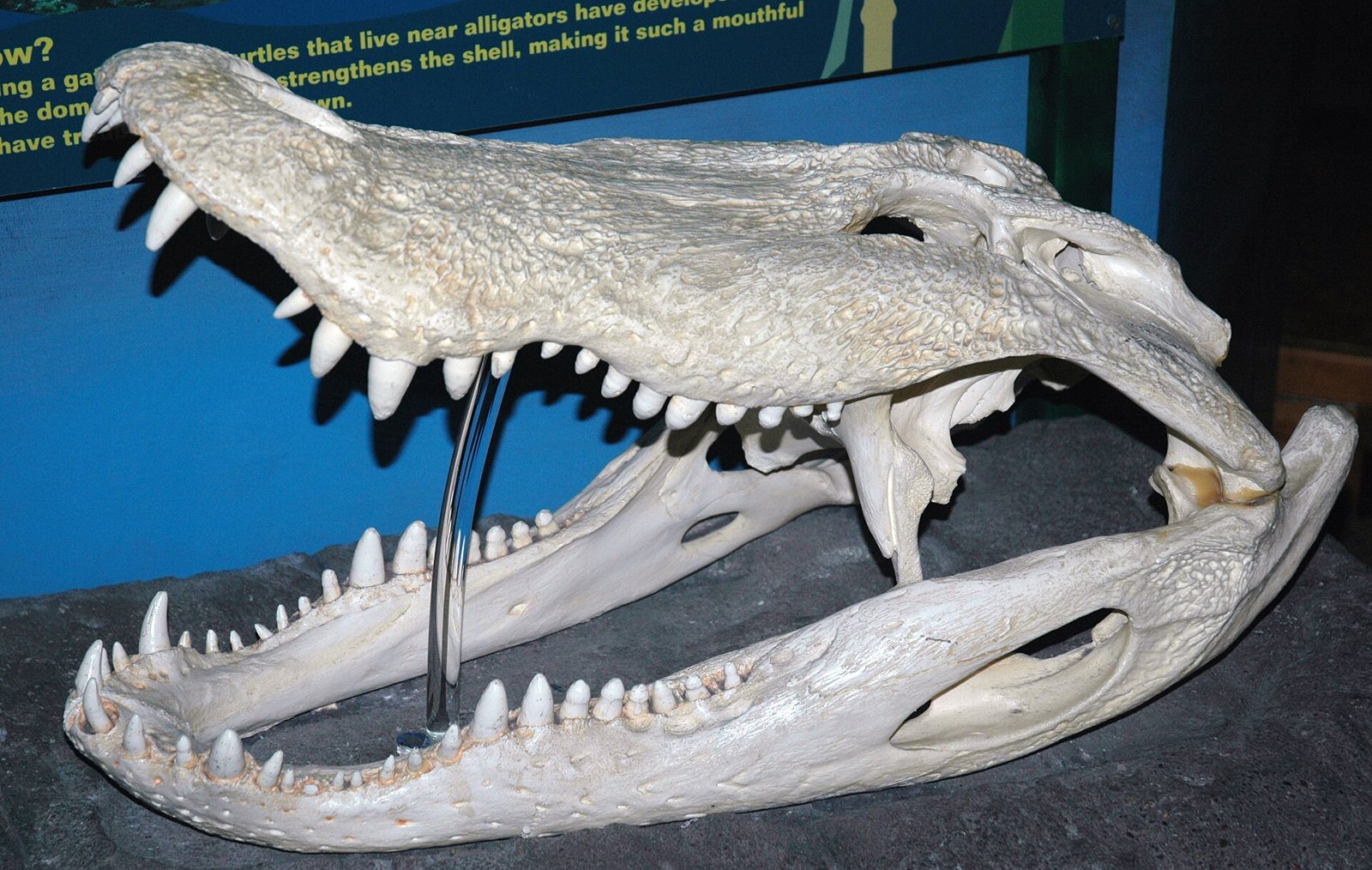
An American alligator skull, from *Alligator mississippiensis*, has a broad, rounded snout shaped like a U or a shovel. To confirm it is an alligator and not a crocodile, look at the big fourth tooth in the lower jaw. In an alligator that tooth fits into a socket in the upper jaw and disappears when the jaws close. In a true crocodile it sits in a notch at the side of the upper jaw and stays visible, according to the Smithsonian's National Zoo and the IUCN Crocodile Specialist Group.
Owning one can be lawful when the skull came from a legally acquired animal and carries the paperwork its state, federal and international rules call for. Those rules vary by state and by the kind of transaction. A skull for sale should come with its records, and a skull lying on a riverbank is a question for the state wildlife agency before it goes anywhere.
Whether you are looking at one through museum glass, scrolling a listing or standing over one at the edge of a marsh, the checks below cover the snout, the teeth, what the skull says about the animal's size, a pair of giant fossil relatives, and the rules.
What an alligator skull looks like
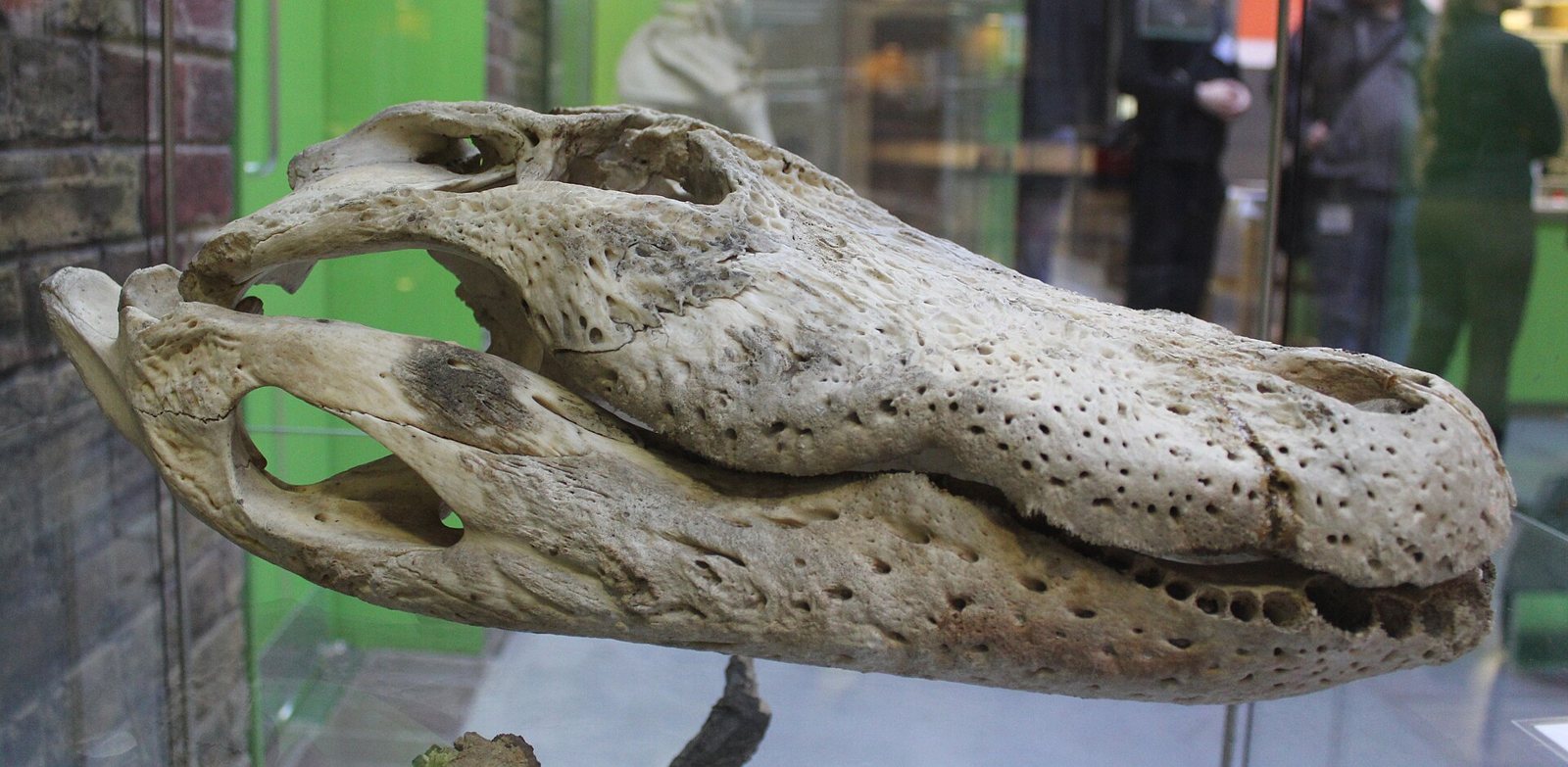
The first thing most people notice is the width. The Florida Museum of Natural History describes the American alligator's snout as broad and rounded, U-shaped or shovel-shaped, and its outer skull bones as marked with irregular pits, which give the top of the skull its rough, dimpled look.
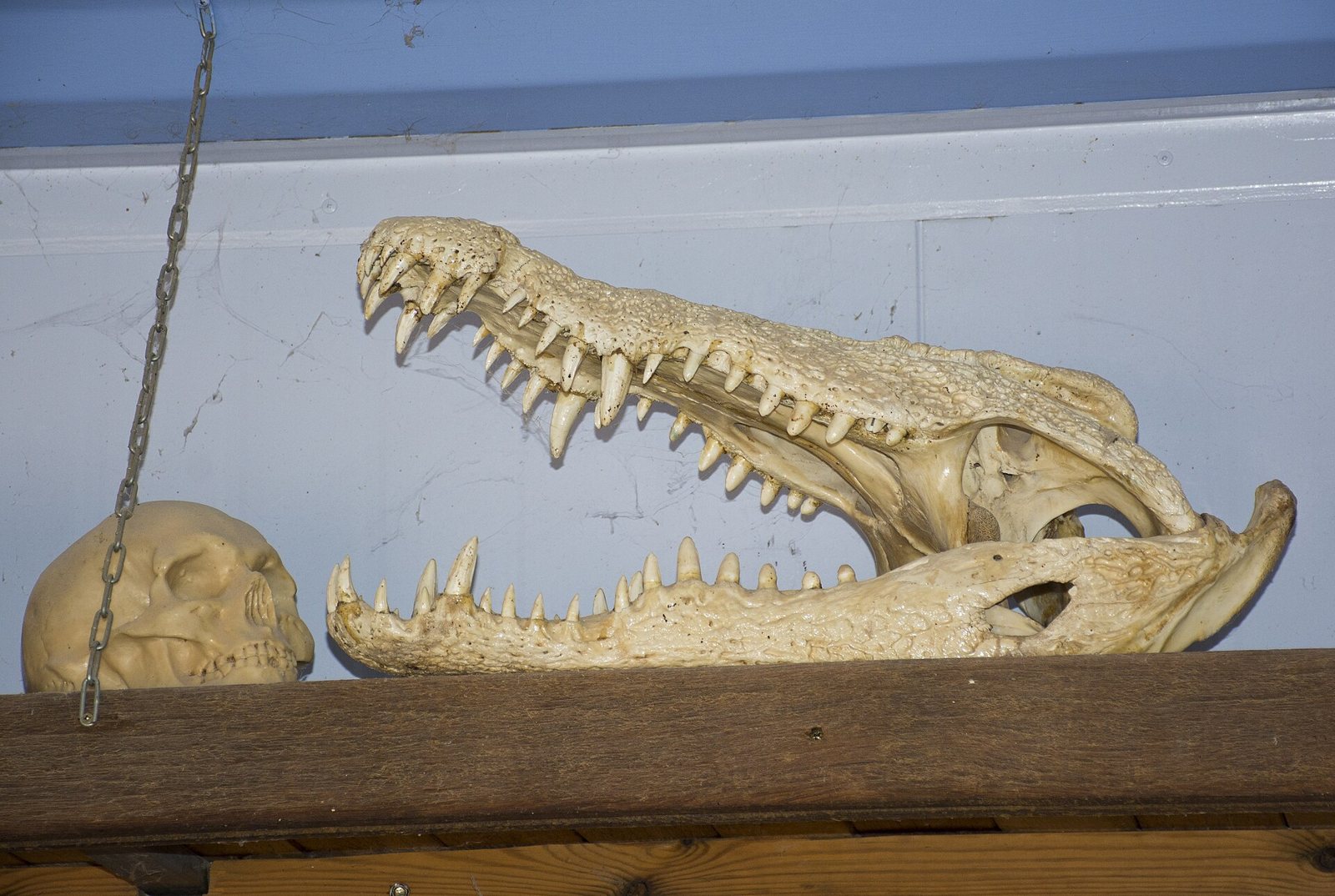
The teeth change as they go back. Those at the front are sharper, built for grabbing and holding, while the ones toward the back are blunter and better suited to crushing.
Then there is the replacement system. Alligators are polyphyodont, a word for animals that keep replacing their teeth all their lives. The National Zoo says an alligator has about 74 to 80 teeth in its mouth at any one time and may go through roughly 3,000 over its lifetime. The Florida Museum lists the American alligator as polyphyodont too, so the teeth in any skull are simply the set that happened to be in place when the animal died.
Alligator or crocodile: the snout and the fourth tooth
Most people start with the snout, and it is a fair first look. Skulls in the alligator family, the alligatorids, generally have a broader, blunter U-shaped snout. True crocodiles often have a narrower, more tapered one.
The catch is that snout shape varies more than its reputation suggests. The University of Texas Digimorph collection includes a broad-skulled Morelet's crocodile and a relatively narrow-skulled caiman, which would fool anyone going by width alone. So, treat the snout as a hint and move to the teeth.
The enlarged fourth tooth of the lower jaw is the most useful skull clue. Close the jaws, or line them up if the skull and jaw are separate, and look from the side. In an alligator, that tooth slots up into a socket in the upper jaw and is hidden. In a true crocodile, it fits into a notch on the outside of the upper jaw and stays in view, which is why a crocodile with its mouth shut still shows a tooth poking up.
There is a third clue inside the nose. The Field Museum's publication *The American Alligator* describes a bony bridge dividing the nasal opening in alligators, a feature it notes is absent in crocodiles and caimans. Look into the front opening of the snout to see whether bone splits it in two.
Use the features together. A damaged, juvenile, partial or unusually shaped skull may need a specialist at a natural history museum to settle it.
Tap or hover a row to highlight it.
| Feature | Alligator | True crocodile |
|---|---|---|
| FeatureSnout | AlligatorUsually broad, rounded and U-shaped | True crocodileOften narrower and more tapered, though it varies |
| FeatureFourth lower tooth | AlligatorSlots into a socket in the upper jaw and is hidden when the mouth closes | True crocodileSits in a notch at the side and stays visible with the mouth closed |
| FeatureNasal opening | AlligatorDivided by a bony bridge | True crocodileThe Field Museum describes the bridge as absent in crocodiles and caimans |
| FeatureHow sure you can be | AlligatorStrongest when several features agree | True crocodileNever decide from snout shape alone |
What the skull tells you about the animal's size
A skull is also a measuring tool, and scientists have used it that way. The U.S. Geological Survey species profile gives a usual total length for adult American alligators of about 1.8 to 5 meters, and records a reported length of 5.84 meters, while cautioning that exceptionally large historical reports need care.
The key study is “Maximum Size of the Alligator”, published in 1995 by Woodward, Linda and colleagues. They measured head length, from the tip of the snout to the rear of the skull, and built regression equations to estimate total body length from it. The team examined 366 alligators from Florida as well as museum skulls. The longest male officially measured in Florida between 1977 and 1993 was 426.9 centimeters, and the longest female 309.9 centimeters. The longest alligator whose total length could be backed up from skull measurements was estimated at 454 centimeters.
That works because head and body grow in step. Peter Dodson's 1975 growth study showed that skull length and body length show a roughly isometric relationship, meaning they keep about the same proportion, across a broad range of sizes in *A. mississippiensis*.
A skull gives an estimate, though, not a tape-measure reading. Sex, population, growth stage, damage and the exact measuring method all shift the result. If you are looking at a skull in a shop or a collection, its length gives you a reasonable sense of the animal, with that margin built in.
Tap or hover a row to highlight it.
| Animal | Size detail |
|---|---|
| AnimalAmerican alligator, Alligator mississippiensis | Size detailUSGS: usually about 1.8 to 5 m long; a reported 5.84 m |
| AnimalLongest Florida male, Woodward et al. | Size detail426.9 cm, officially measured between 1977 and 1993 |
| AnimalLongest Florida female, Woodward et al. | Size detail309.9 cm, officially measured between 1977 and 1993 |
| AnimalDeinosuchus | Size detailWestern Australian Museum estimate: about 11 m and 6 to 7 tonnes |
| AnimalSarcosuchus imperator | Size detailMuséum national d'Histoire naturelle estimate: up to 10 m and about 4 tonnes |
Giant relatives in museum collections
If you have seen an enormous crocodilian skull in a museum, it may belong to one of two famous fossils.
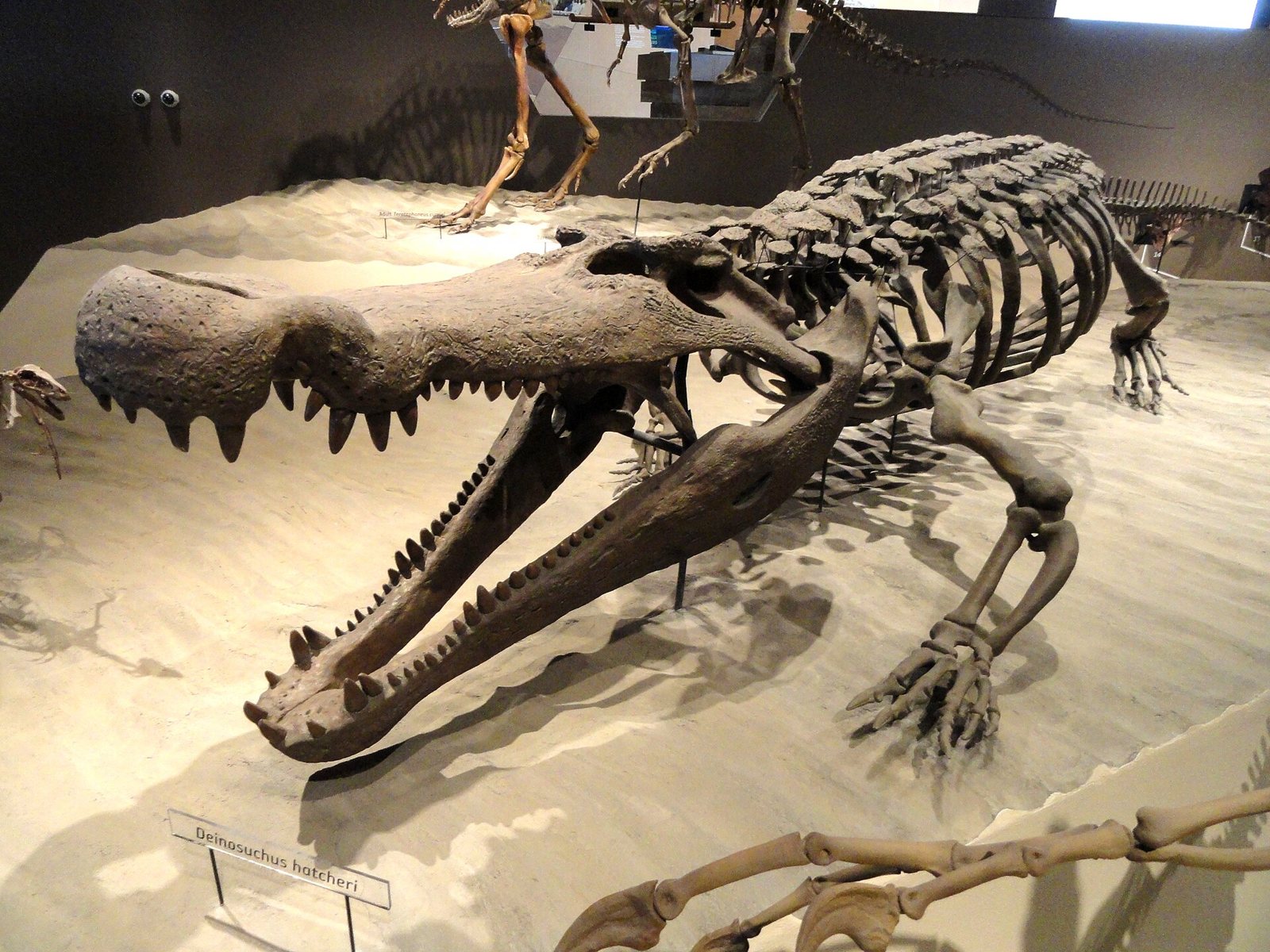
*Deinosuchus* was a giant alligatoroid, a relative on the alligator side of the family tree, that lived in North America during the Late Cretaceous, roughly 83 to 72 million years ago. The Western Australian Museum summarizes estimates of about 11 meters long and 6 to 7 tonnes. Growth rings in its bony scutes, the armored plates in its skin, suggest it reached that size by living a long time rather than by growing unusually fast. Dinosaur and turtle bones carry bite marks attributed to it, which says a good deal about its menu. For a sense of the dinosaurs sharing that world, see the story of Sue the T. rex skull.
Complete *Deinosuchus* skulls are rare, and most cranial remains are fragments. The Charleston Museum holds a *Deinosuchus* skull fragment from Florence County, South Carolina, catalogued as PV6776. A published study of *Deinosuchus* cranial material by Rivera-Sylva and Frey notes that the well-known American Museum of Natural History reconstruction was based partly on modern crocodilian anatomy, because so little complete skull material exists.
*Sarcosuchus imperator* lived in Africa about 110 million years ago. The Muséum national d'Histoire naturelle in Paris records Philippe Taquet's 1965 find of important remains at Gadoufaoua in Niger and the naming of the species in 1966. The museum estimates a length of up to 10 meters and a mass of about 4 tonnes, and its skull had a very long snout. A record from the Museum of Natural History of Venice describes a skull about 160 centimeters long and an estimated body length of about 12 meters, which shows how much estimates shift with the specimen and the method.
Fossil alligator skulls share the problem. The Florida Museum notes that the individual skull bones often separate after death, so isolated bones turn up more often than complete fossil skulls, which matters because a complete skull is what identifying an alligator species depends on. A whole one is a real prize for a collection.
Alligator skull quiz
Answer every question to check.
Buying or selling an alligator skull
There is no single nationwide rule. Whether a sale or purchase is lawful depends on how the skull was obtained, whether it came from a legally harvested animal, the state involved, whether it crosses state lines or borders, and the paperwork attached to it. Rules change, so confirm the current version with the agency before you buy, sell or ship.
Florida shows how detailed this gets. The Florida Fish and Wildlife Conservation Commission's alligator regulations require documentation for alligator parts transferred through permitted processing channels, and state that skeletal parts, including skulls, may be sold when they come from legally acquired alligators and the required transfer records are kept. Its after-harvest rules cover CITES tags and harvest-transfer records. Florida also requires permits to import or export live alligators or alligator parts, and its taxidermy guidance says skeletal-part sales by authorized people must record the type and quantity of items sold and the buyer's name and address.
South Carolina takes a different approach for its private-lands program. The Department of Natural Resources' permit conditions require a retained skull to be permanently marked "SC Alligator" with the matching harvest-tag number, and under those conditions possessing an unmarked skull, or one without the tag number, is prohibited.
Above the states sit federal and international rules. Interstate and international trade can involve CITES, the treaty that governs international trade in listed wildlife, along with federal law. The U.S. Fish and Wildlife Service warns that other federal, state, Tribal, local and foreign laws may apply, and advises contacting the appropriate state agency before any activity involving regulated wildlife.
In practice, a skull offered for sale should come with its provenance: seller details, a harvest-tag number, CITES documents or other records of lawful origin. Keep whatever paperwork comes with it alongside the skull.
If you came across one outdoors
Before anything else, a plain note: this section is general information, not legal advice. Wildlife rules differ from state to state and country to country, and they are revised over time.
A skull on a creek bank or at the edge of a marsh is not automatically yours to take. Before you keep, move, buy or sell it, contact the wildlife agency in the state where it lay. Send photographs and the location, and ask what proof of lawful origin, tagging or permits apply. Our story on what to do after finding an animal skull covers the wider federal and state rules and who to ask, and if you have any doubt about what kind of skull it is, how to tell a human skull from an animal skull comes first. Once the rules are settled, how to clean an animal skull takes it from there.
Quick answers about alligator skulls
These pick up the questions that come after the main checks.
Is it legal to own an alligator skull?
It can be, when the skull came from a legally acquired animal and has the state, federal or international documentation its origin requires, but rules vary by state and by transaction. Before buying one or keeping one you came across, ask the state wildlife agency what proof of lawful origin, tagging or permits it expects.
How many teeth does an alligator have?
An American alligator has about 74 to 80 teeth in its mouth at any one time, and it replaces them throughout life, going through roughly 3,000 in all. The front teeth are the sharper grasping ones, and the blunter teeth farther back do the crushing.
What does a crocodile skull look like?
A crocodile skull usually has a narrower, longer snout than an alligator's, and the big fourth tooth of the lower jaw stays visible from the side when the mouth is closed. Snout shape alone is not enough, so check the tooth and the nasal opening as well, and keep the animal's size, age and the skull's condition in mind.
How can you tell a caiman skull from a crocodile skull?
Caimans belong to the alligator family, and the Field Museum notes that, like crocodiles, they lack the bony bridge that divides an alligator's nasal opening. Snout width varies in both groups, so a caiman or crocodile skull often needs a museum specialist to confirm it.
Where to go next
If alligators have you curious about other reptiles, our snake skull story shows a skull built in an entirely different way, and the turtle skull story covers the animals whose bones *Deinosuchus* bit. If you are wondering how long a skull has been lying out, how old are these bones? is a good next read.
Terms in this story
Tap a term to see what it means.
Alligator mississippiensis. The scientific name of the American alligator.
---