

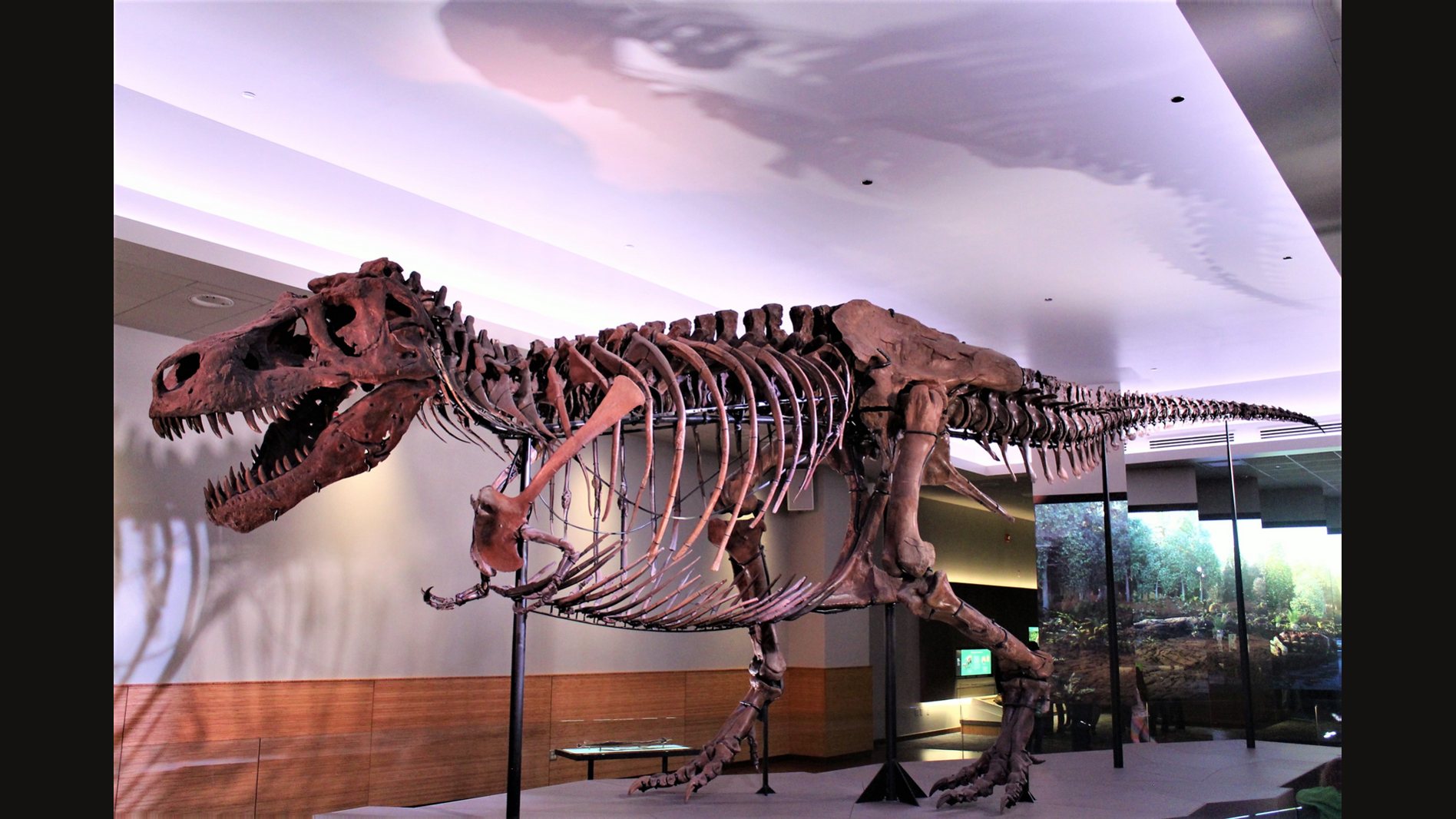
No. 090
Sue the T. rex: The Skull in Chicago, the Find and the Sale
If you have stood in front of Sue at the Field Museum in Chicago and wondered why the head is sitting in a glass case off to the side, the answer is weight. Sue's real fossil skull weighs about 600 pounds, far too much to bolt onto a standing skeleton, so the mounted dinosaur wears a lighter cast while the original rests in its own case, where visitors can see it up close and scientists can study it. And if it is the money you heard about, Sue sold at Sotheby's in New York on October 4, 1997, for a winning bid of $7.6 million. With the buyer's premium, the Field Museum paid $8,362,500, after years of court fights over who owned the bones in the first place.
The find in South Dakota
The story starts on August 12, 1990, near the small town of Faith, South Dakota. Sue Hendrickson, working on a commercial fossil dig run by the Black Hills Institute, spotted vertebrae weathering out of an eroded bluff. According to the Field Museum, six people then spent 17 days extracting the skeleton from the rock.

The bluff stood on the ranch of Maurice Williams, inside the Cheyenne River Sioux Reservation. That detail, which might sound like a footnote, turned into the whole second act. The dinosaur that came out of the ground shares its name with the woman who spotted it, and it was about to land at the center of a long court fight.
The fight over who owned Sue
The Black Hills Institute excavated and prepared the fossil after paying Williams $5,000, a payment the Institute said had bought the skeleton. Federal authorities did not see it that way. In May 1992 they seized Sue, according to the National Park Service.
The question went to the federal appeals court for the Eighth Circuit. In December 1993 the court held that the United States held the fossil in trust for Williams. His land was held in federal trust, and he had not obtained the Department of the Interior approval that a sale from that land required, so the $5,000 deal could not transfer ownership. A later 1996 ruling rejected the Institute's claim to a $209,000 lien for its excavation work.
So, by the time Sue went to auction, the legal owner was Maurice Williams, with the United States holding title in trust for him. This is history, not legal guidance on fossils; who owns a find depends on the land, the country and the laws that apply there.
The 1997 auction at Sotheby's
Sotheby's put Sue up for sale in New York on October 4, 1997. The Washington Post reported the next day that the winning bid came in at $7.6 million, and that with the buyer's premium the Field Museum paid $8,362,500. The museum bought Sue for public display in Chicago, which is where the skeleton has stood ever since. The mounted skeleton went on show in 2000.
Sue the T. rex, from the bluff to the museum
Tap or hover a step to follow the order.
August 1990
Sue Hendrickson spots the fossil near Faith, South Dakota.
May 1992
Federal authorities seize Sue.
December 1993
The Eighth Circuit upholds federal trust title for landowner Maurice Williams.
October 4, 1997
Sotheby's sells Sue to the Field Museum for a $7.6 million bid, $8,362,500 with the buyer's premium.
2000
Sue's mounted skeleton goes on show at the Field Museum.
2018
Sue moves to a new gallery at the Field Museum.
2022
A peer-reviewed study rules out a protozoan infection as the cause of the holes in Sue's jaw.
Why the skull sits apart from the skeleton
Sue's skull is about five feet long and weighs about 600 pounds. The Field Museum explains that the mounted skeleton therefore carries a lighter cast of the skull, while the real one is displayed on its own. That arrangement does two jobs. It spares the mount from holding up a head that heavy, and it puts the original fossil at eye level, in a case where scientists can get to it more easily.
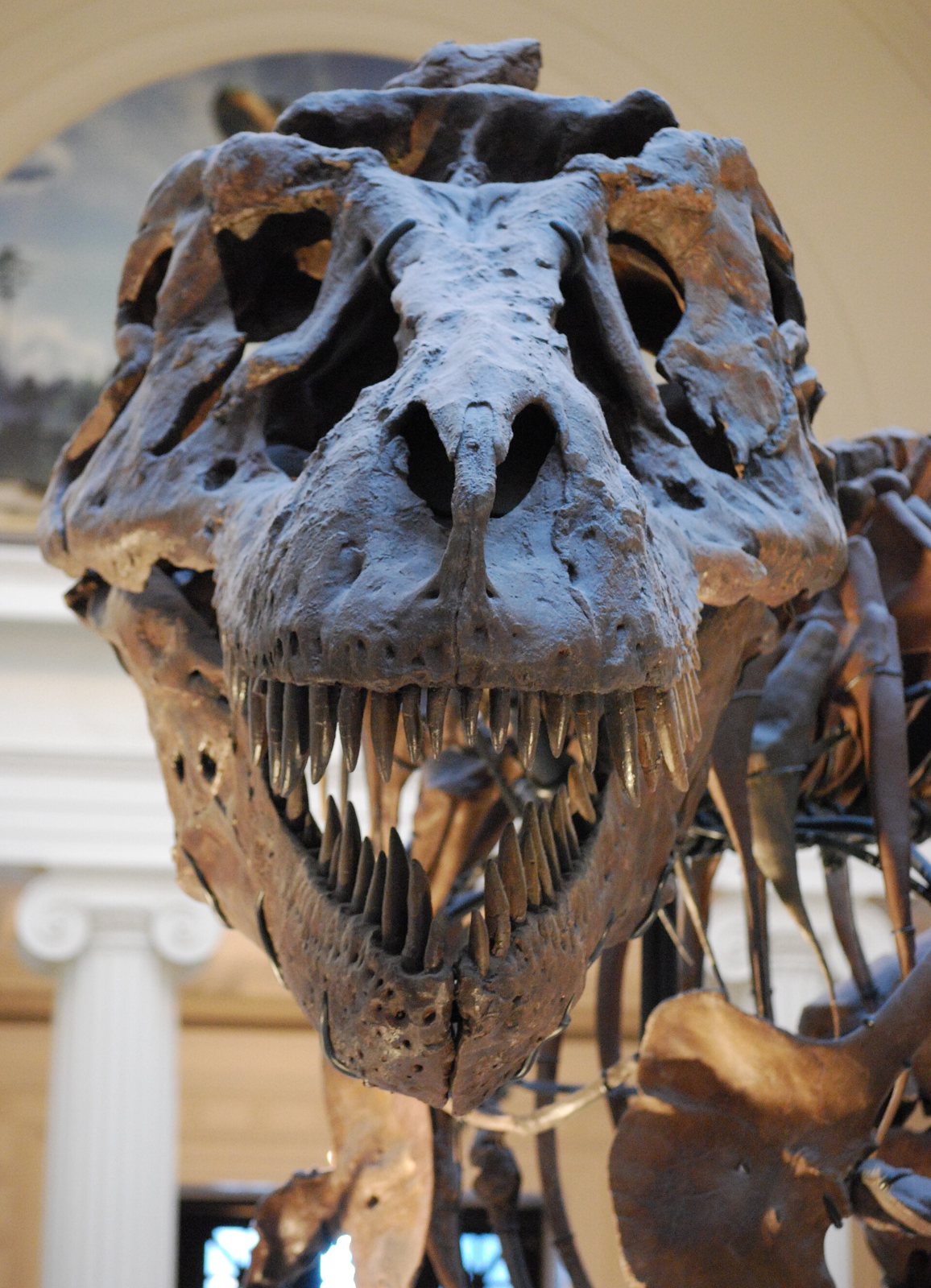
There is another reason the cast on the skeleton looks a little tidier than the real thing. The original skull is distorted and damaged on its left side, and the skull on the mount is a corrected cast. When people ask whether the skull on the skeleton is real, that is the answer: the head on the body is a cast, and the real one is the battered, heavy fossil in the case nearby.
Sue moved into a new gallery at the Field Museum, the Griffin Halls of Evolving Planet, in 2018.
The holes in Sue's jaw
Look closely at the back half of the left lower jaw and you will see several holes, some about the diameter of a golf ball. An earlier explanation pointed to infection. In 2022, a peer-reviewed study in Cretaceous Research by Bruce Rothschild, Jingmai O'Connor and María Cecilia Lozada examined the holes and saw signs that the bone had healed, but no evidence that a protozoan parasite infection caused them.
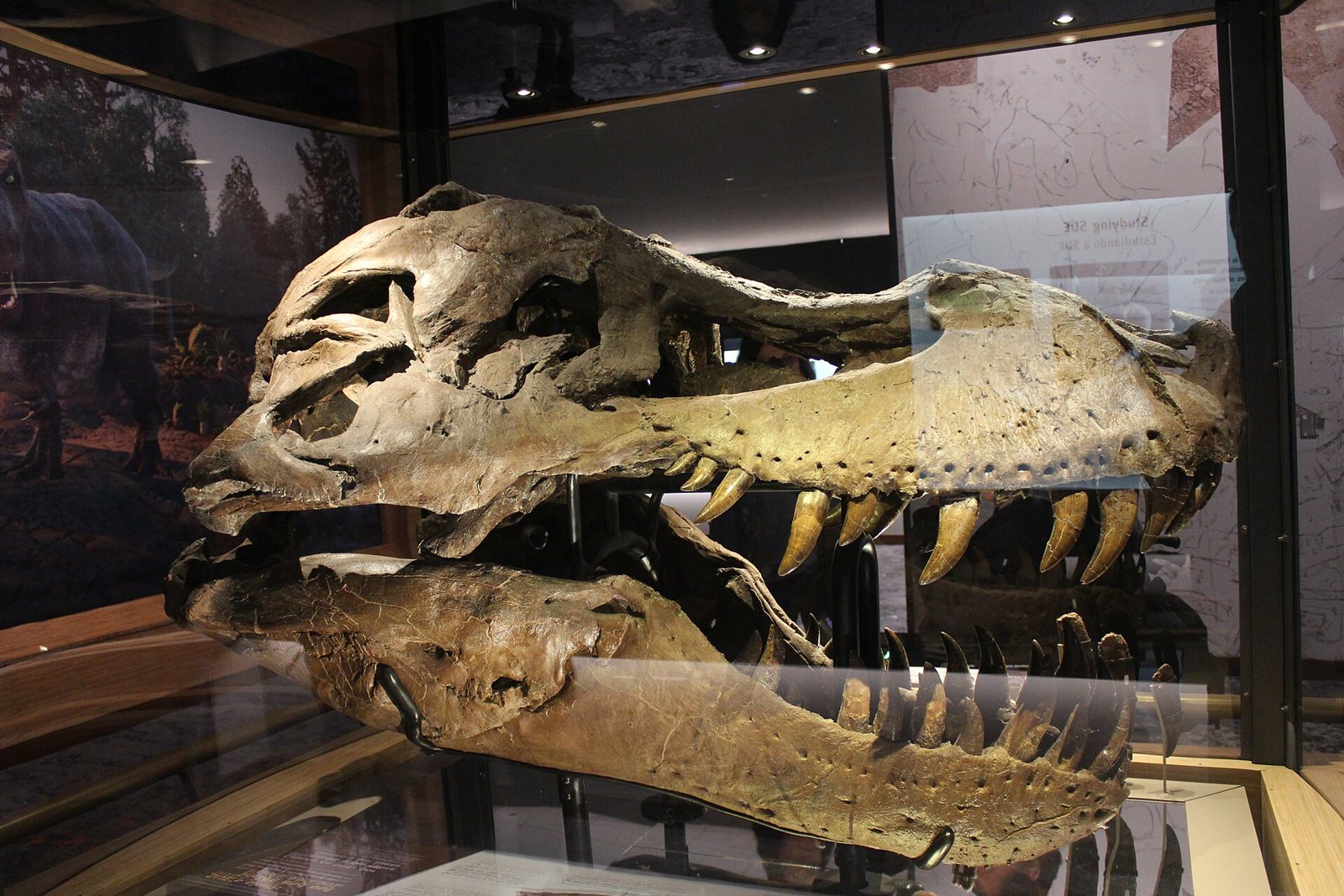
That still leaves the question open, and the scientists do not agree on the answer. As the Field Museum reported, Rothschild favored wounds from bites or claws, while O'Connor considered that explanation unconvincing. What can be said is that the bone shows healing and the exact cause is still unresolved. So, if you have heard that the holes came from a fight, that is one scientist's leading idea, not a settled fact.
How big, and how old
The Field Museum describes Sue as 40.5 feet long and 13 feet tall at the hip. The skeleton is about 90 percent complete by bone volume, with about 250 of the roughly 380 bones in a T. rex skeleton, as the museum's page on which dinosaur bones are real explains. Some of those bones are rarely preserved at all: Sue has a furcula, or wishbone, a stapes, the tiny bone of the ear, and almost all of the gastralia, the belly ribs.
Age is a little harder to pin down, because it depends on who is counting and how. The Field Museum's educational page How well do you know SUE? gives 28 years at death, read from growth rings in the bones. A later Field Museum account says about 33 years. A peer-reviewed growth study gives a range of 27 to 33 years, depending on the model the scientists used. However you slice it, Sue was an unusually old adult T. rex.
Tap or hover a row to highlight it.
| Measure | Figure | Given by |
|---|---|---|
| MeasureLength | Figure40.5 feet | Given byField Museum |
| MeasureHeight at the hip | Figure13 feet | Given byField Museum |
| MeasureSkull weight | FigureAbout 600 pounds | Given byField Museum |
| MeasureSkull length | FigureAbout five feet | Given byWashington Post, 1997 |
| MeasureBones preserved | FigureAbout 250 of roughly 380 | Given byField Museum |
| MeasureCompleteness | FigureAbout 90 percent by bone volume | Given byField Museum |
| MeasureAge at death | Figure28 years; later about 33; a study gives 27 to 33 | Given byField Museum; peer-reviewed growth study |
| MeasureWinning bid, 1997 | Figure$7.6 million | Given byWashington Post |
| MeasurePrice paid with premium | Figure$8,362,500 | Given byWashington Post |
Visiting Sue in Chicago
Sue is on permanent display at the Field Museum, 1400 S. DuSable Lake Shore Drive, Chicago. As of October 2026, the museum's visiting page lists daily hours of 9 a.m. to 5 p.m., with last entry at 4 p.m., and the museum is closed on Thanksgiving and Christmas Day. The Sue gallery is bilingual, with its text in English alongside Spanish, and photography is allowed for personal, non-commercial use. Admission, timed entry and special exhibitions change, so confirm them with the Field Museum before you go.
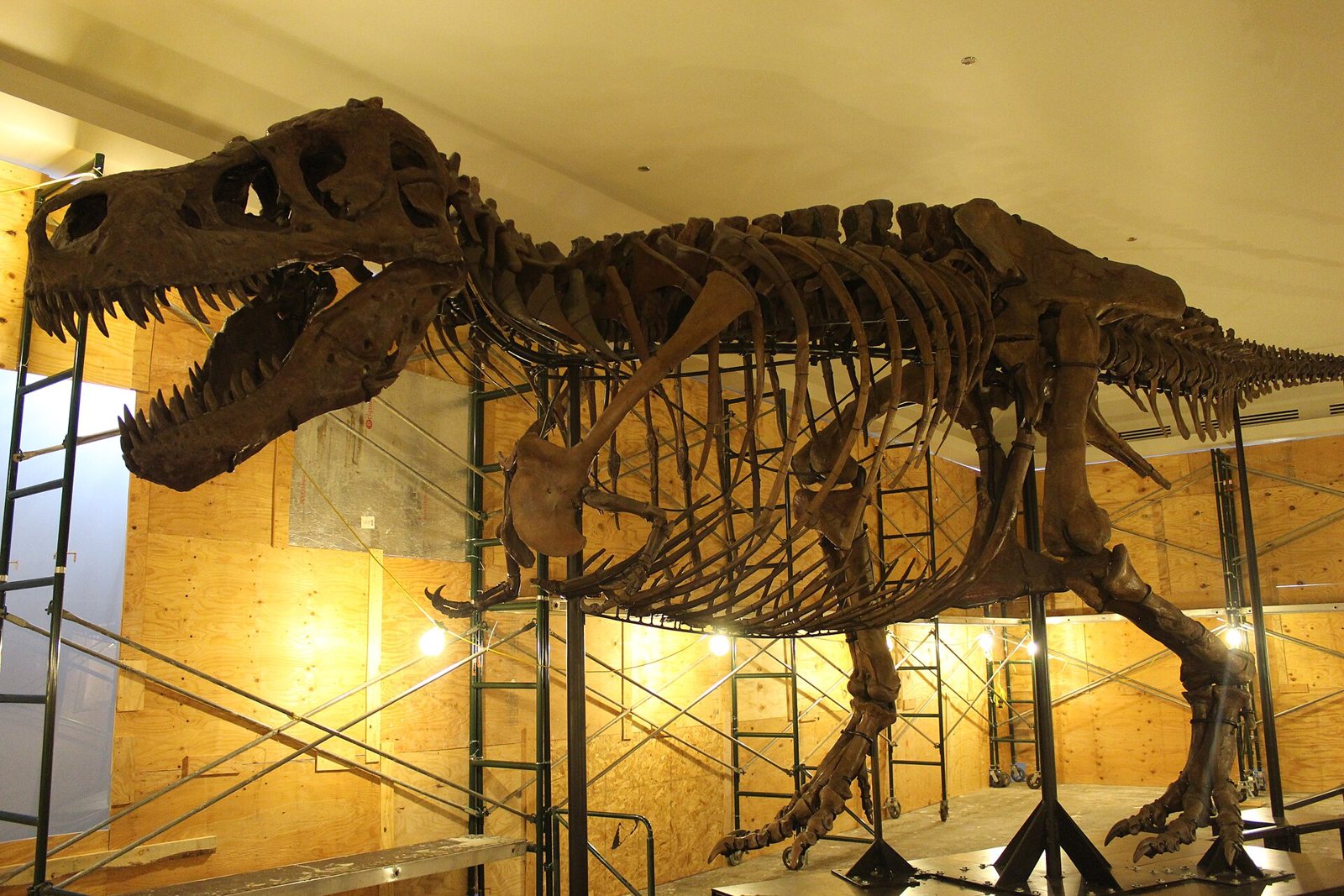
When you get there, find the skeleton first, then walk over to the case and look at the real skull. The cast tells you what Sue looked like. The fossil, with its crushed left side and its healed holes, tells you what Sue went through.
Questions people ask about Sue the T. rex
Where is Sue the T. rex?
Sue is in Chicago, on permanent display at the Field Museum, with the original skull shown separately in its own case. The gallery's text is bilingual, English alongside Spanish.
How much did Sue the T. rex sell for?
Sue sold for a winning bid of $7.6 million at Sotheby's in New York on October 4, 1997. With the buyer's premium, the Field Museum paid $8,362,500.
How big was Sue's skull?
Sue's original skull is about five feet long and weighs about 600 pounds. It is distorted on the left side, which is why the skeleton carries a corrected, lighter cast instead.
Is the skull on Sue's skeleton real?
No, the skull on the mounted skeleton is a cast. The real fossil skull is in its own case nearby, because it is too heavy for the mount and easier for scientists to study there.
Were the holes in Sue's jaw caused by fighting?
Maybe, but nobody knows for sure. A 2022 study showed the bone had healed and ruled out the parasite infection proposed earlier; Bruce Rothschild favored bites or claws, while Jingmai O'Connor considered that explanation unconvincing.
How well do you know Sue?
Answer every question to check.
A skull with a story in every crack
Most famous fossils are famous for being big. Sue is famous for being big, nearly complete, old, injured, fought over in court and sold for millions, and the skull carries a share of all of it. If you want to see how much a skull leaves out of a living face, the hippo skull makes the point beautifully, and our pieces on what bones tell archaeologists and how old these bones are look at how scientists read age and injury from bone.
Terms in this story
Tap a term to see what it means.
Cast. A copy of a bone or skull made from a mold. Sue's mounted skeleton carries a lighter, corrected cast of the skull.
---