

No. 122
Mountain Lion Skull: How to Identify One and the Rules on Keeping It
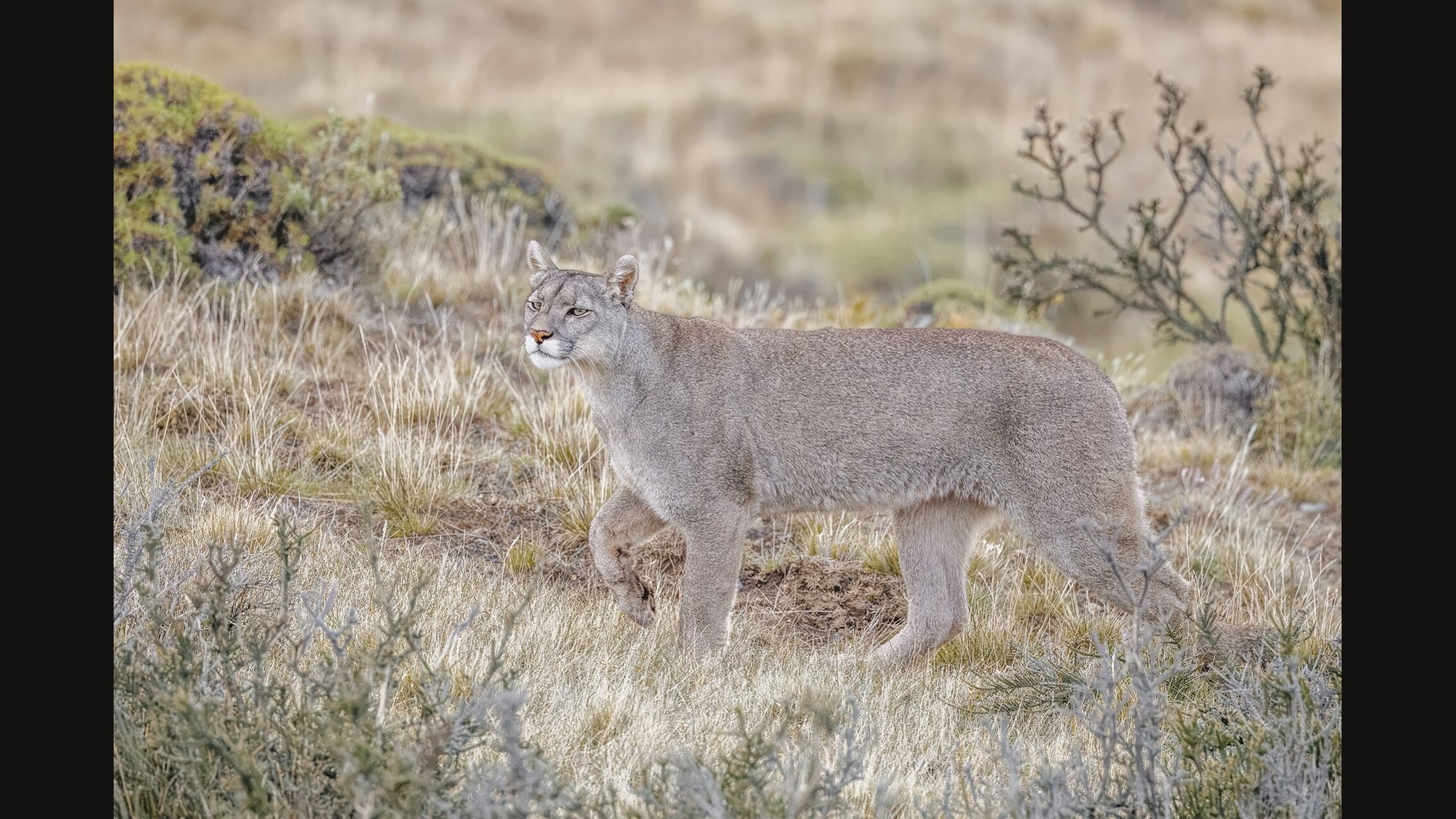
A mountain lion skull is a big cat's skull: short in the face, broad across the cheeks, with large canines, sharp blade-like carnassials and 30 permanent teeth. The animal goes by many names, mountain lion, cougar and puma among them, but the scientific name is one, *Puma concolor*. A Panthera identification guide puts the skull at roughly 16 to 24 cm long, and Oregon State University's mammal collection notes the temporal ridges meeting in a V at the front of the braincase to form a large sagittal crest.
Two quick checks rule out the usual look-alikes. A bobcat usually has 28 teeth instead of 30. A wolf has 42 teeth and a long, dog-like muzzle.
Before it goes on a shelf, know that mountain lion parts are regulated. In California the mountain lion is a specially protected mammal, so a skull picked up on a trail or a ranch is never assumed legal to keep. The state rules come later in the story.
Reading a mountain lion skull
Hold a mountain lion skull and the first thing you notice is how little snout there is. Cats have short, compact faces, and the teeth follow suit. Texas Tech University's Natural Science Research Laboratory gives the dental formula as I 3/3, C 1/1, P 3/2, M 1/1. On each side, the upper jaw holds three incisors, one canine, three premolars and one molar, and the lower jaw holds three incisors, one canine, two premolars and one molar. Both sides together make 30.
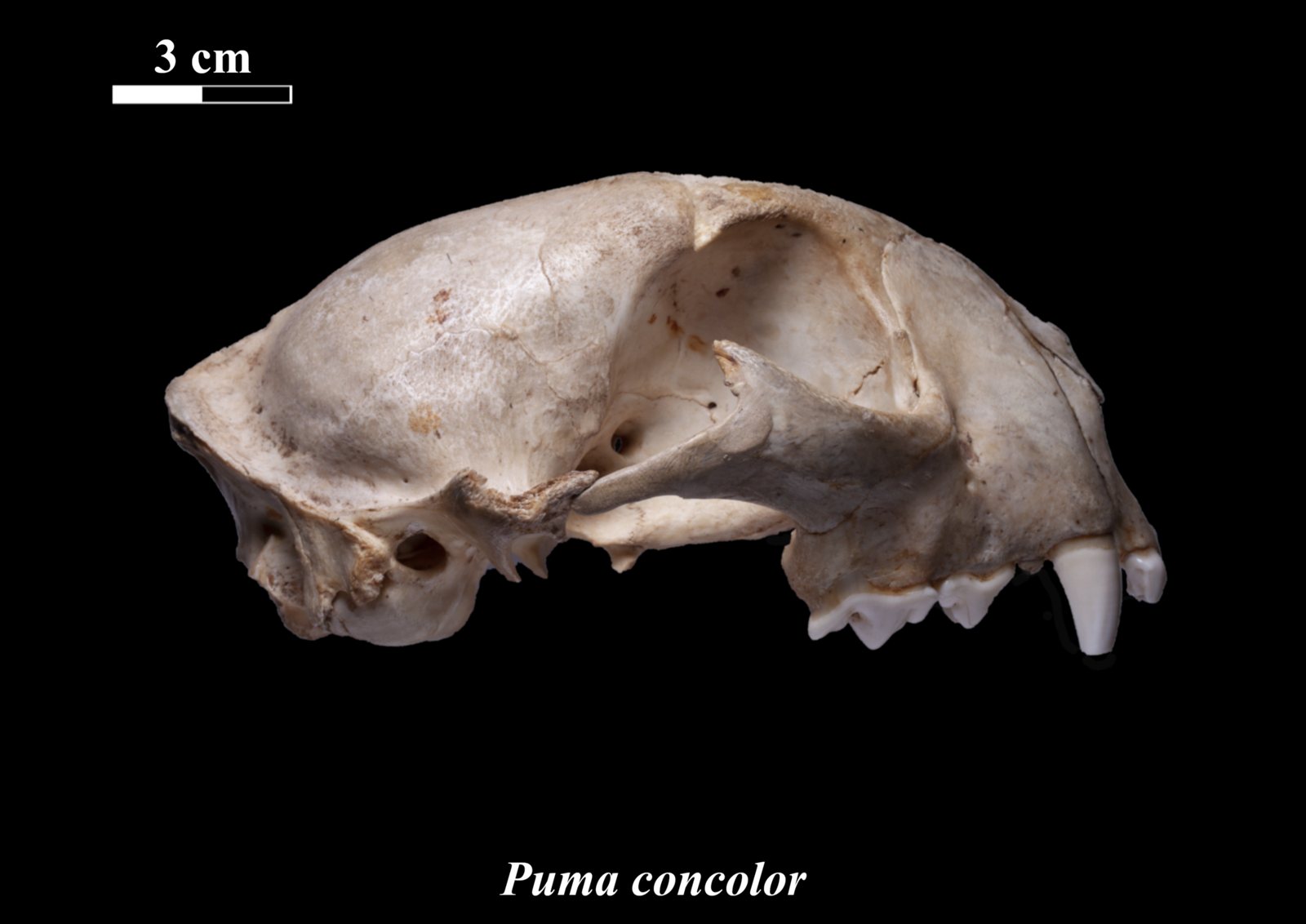
One detail trips up careful counters. The upper molar is very small and may be missing altogether, so a skull with 28 sockets is not automatically something else. Look closely at the back of each upper tooth row before you settle on a number.
The top of the skull carries a strong clue. Oregon State University describes the temporal ridges, the lines where the jaw muscles attach, running together in a V at the front of the braincase and continuing back as a large sagittal crest. Panthera's guide adds a convex nasal profile, a gently arched line along the top of the nose, and a palate shaped like a U on the underside.
Size is useful but not decisive. Panthera gives about 16 to 24 cm for the skull, and it cautions that small skulls are hard to identify by size alone. Age, sex and region all move the number, so read it alongside the teeth and the shape.
Mountain lion, bobcat or house cat?
All three are cats, so all three have the short face. The difference is in the size and in the upper cheek teeth.
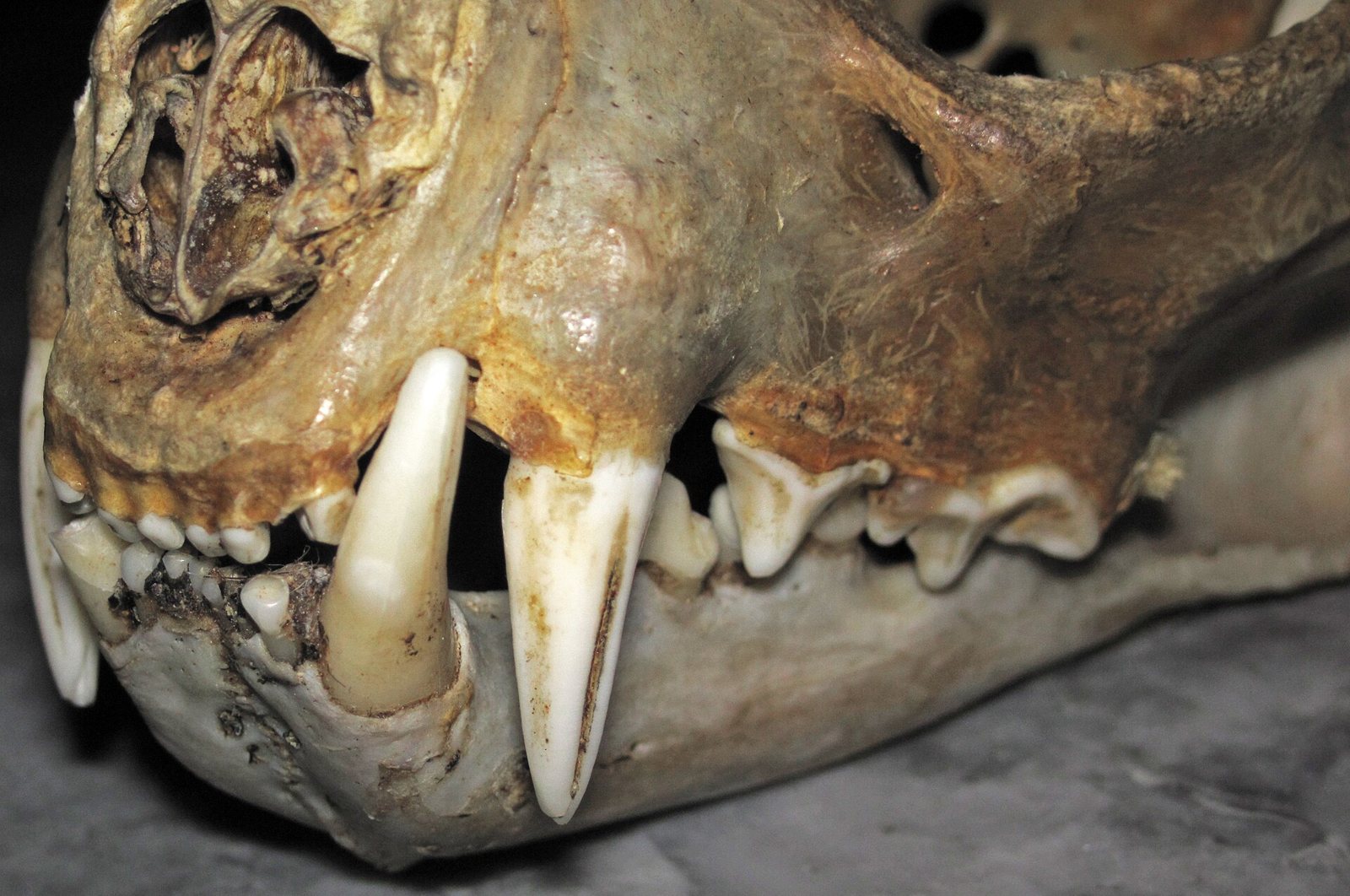
The bobcat, *Lynx rufus*, normally has 28 teeth, two fewer than the mountain lion, according to the University of Georgia Mammal Skull Key. The key places the difference in an extra upper premolar in the mountain lion. Counted per side, that gives a mountain lion four upper cheek teeth, three premolars and a molar, and a bobcat three, two premolars and a molar. A Texas A&M AgriLife Extension guide shows adult mountain lion skulls beside bobcat skulls from the side, the front and below, and the mountain lion is visibly the bigger animal in every view. For the bobcat's own features, read the bobcat skull story.
The house cat, *Felis catus*, is the odd case. Oregon State University describes it as smaller than a bobcat, with 30 teeth and a small first upper premolar, and Colorado State University's dental anatomy pages note that the mountain lion shares the domestic cat's dental formula. So, between those two, counting teeth will not help. Size and proportion do the work, and the gap is large. If your skull fits comfortably in one hand, cat skull identification is the place to go.
Tap or hover a row to highlight it.
| Feature | Mountain lion, Puma concolor | Bobcat, Lynx rufus | House cat, Felis catus |
|---|---|---|---|
| FeaturePermanent teeth | Mountain lion, Puma concolor30 | Bobcat, Lynx rufus28 | House cat, Felis catus30 |
| FeatureFace | Mountain lion, Puma concolorShort feline rostrum | Bobcat, Lynx rufusShort feline rostrum | House cat, Felis catusShort feline rostrum |
| FeatureRelative size | Mountain lion, Puma concolorLargest of the three | Bobcat, Lynx rufusSmaller than a mountain lion | House cat, Felis catusSmaller than a bobcat |
| FeatureUpper cheek teeth per side | Mountain lion, Puma concolorFour: three premolars and a molar | Bobcat, Lynx rufusThree: two premolars and a molar | House cat, Felis catusFeline pattern with a small first upper premolar |
| FeatureWatch out for | Mountain lion, Puma concolorSize overlaps with some other large cats | Bobcat, Lynx rufusYoung animals complicate size comparisons | House cat, Felis catusThe tooth count alone cannot separate it from a mountain lion |
Mountain lion, wolf or bear?
A big skull from the mountains could also be a wolf or a bear, and both look quite different from a cat once you know where to look.
A wolf, *Canis lupus*, has a longer, narrower rostrum, the muzzle in front of the eyes, plus 42 teeth, prominent carnassials and a pronounced sagittal crest. The University of Arizona Extension guide to the skulls of Alaskan mammals gives an average adult wolf skull length of about 23 to 29 cm. That overlaps the top of the mountain lion's range, so size will not separate them. The muzzle and the tooth count will: a long dog-like snout with a long row of cheek teeth points to a wolf, and how to identify a wolf skull takes it from there. A smaller skull with that long-snouted shape is more likely a coyote.
Bears are built differently again. Their skulls are broad and heavy, with large canines and teeth that carry more grinding surface for a varied diet. The Smithsonian National Museum of Natural History's guide to reading a mammal skull uses a polar bear to point out the long nasal cavity, the complex structures inside the nose and the large canines. A broad, massive skull with grinding teeth suggests a bear, and the bear skull story has the details. A short face with sharp, blade-like cheek teeth suggests a cat.
Six checks for a big cat skull
Tap a card to bring it forward.
- Look at the face: A short, compact face points to a cat; a long muzzle points to a wolf or coyote.
- Count the upper cheek teeth: Four per side fits a mountain lion; three fits a bobcat. Check for the tiny upper molar.
- Count all the teeth: A complete adult mountain lion has 30; a bobcat usually 28; a wolf 42.
- Measure the greatest length: About 16 to 24 cm fits a mountain lion, but young animals and big males vary.
- Look along the top: Temporal ridges meeting in a V and a large sagittal crest fit a mountain lion.
- Compare: Set the skull beside an identified specimen in a museum or a university skull key.
How Boone and Crockett scores a cougar skull
Hunters' record books have measured cougar skulls for more than a century, and the method is simple enough to try with calipers. The Boone and Crockett Club's score chart takes two measurements, A for greatest length and B for greatest width, and adds them together.
The club's record cougar came from Tatlayoko Lake, British Columbia, in 1979. Douglas E. Schuk took it, and it was later owned by Charles M. Travers. The skull measured 9 9/16 inches long and 6 11/16 inches wide, for a final score of 16 4/16.
The records go back further. Theodore Roosevelt took a cougar near Meeker, Colorado, in 1901, and the club records that skull at 15 12/16. In 1964 Garth Roberts took a cougar in Garfield County, Utah, that scored 16 and became the club's long-standing record before the British Columbia skull.
Famous cougars, from the record books to Los Angeles
Tap or hover a step to follow the order.
1901
Theodore Roosevelt takes a cougar near Meeker, Colorado; Boone and Crockett records the skull at 15 12/16.
1964
Garth Roberts takes a cougar in Garfield County, Utah, scoring 16, a long-standing record.
1979
Douglas E. Schuk takes the current record cougar at Tatlayoko Lake, British Columbia, scoring 16 4/16.
2012
A wildlife biologist photographs P-22 in Griffith Park, Los Angeles, after the mountain lion crossed two freeways.
2023
Tribal leaders, scientists and conservation advocates bury P-22 in the Santa Monica Mountains.
P-22, the Los Angeles mountain lion
Not every famous mountain lion is famous for its skull. P-22 crossed two major freeways to reach Griffith Park in the middle of Los Angeles, where a wildlife biologist photographed him in 2012. His story helped inspire a wildlife crossing project in Southern California.
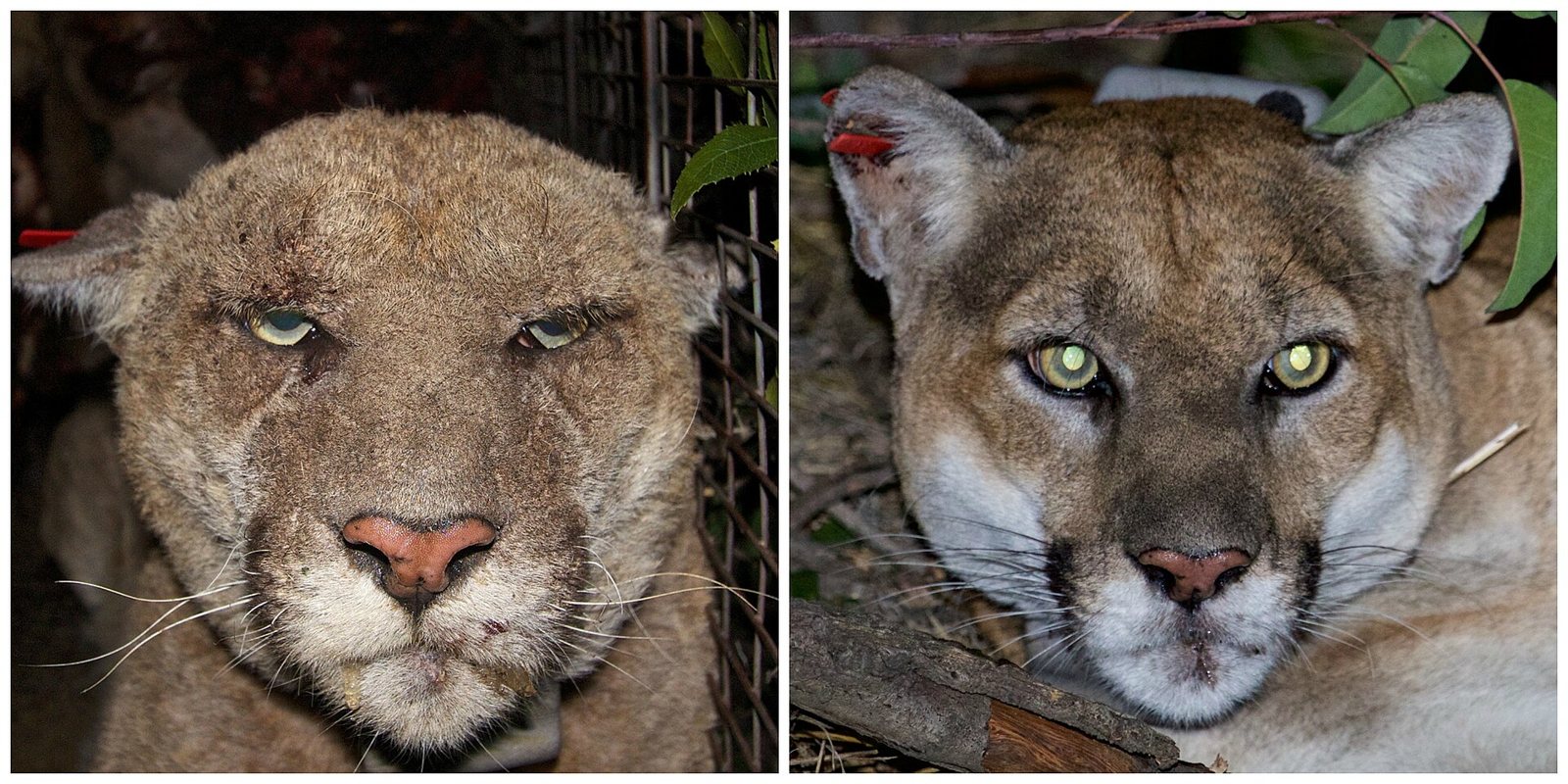
When P-22 died, his remains raised questions of their own. The Associated Press reported in 2023 that tribal leaders, scientists and conservation advocates buried him in the Santa Monica Mountains after discussions about cultural respect, his remains and scientific samples. A mountain lion's bones, it turned out, could matter to many people at once.
Keeping a mountain lion skull
> Not legal advice. What follows is general information. Wildlife laws are written state by state and country by country and are updated, so the wildlife agency for the place where a skull came from is the one to ask about yours.
Mountain lion rules depend on the state and on how the animal came to be dead, and a skull picked up in the field is not automatically legal to keep. Four western states show how much the rules vary.
California. Fish and Game Code section 4800, current law as of October 2026, classifies the mountain lion as a specially protected mammal. It generally prohibits taking, possessing, transporting, importing or selling a mountain lion or any product of one. The exceptions are narrow: documented possession from before June 6, 1990, and museum or educational possession of a lawfully taken carcass or product with the department's authorization.
Colorado. Colorado Parks and Wildlife regulations, as of October 2026, require a legally taken mountain lion to be reported within 48 hours and presented for inspection and sealing within five days, with the head and hide unfrozen. A premolar may be pulled to age the animal. The possession seal is what allows the skull or hide to be possessed, transported, tanned or mounted, and the state's wildlife possession guidance requires that wildlife parts were legally possessed in the first place.
Oregon. The Oregon Department of Fish and Wildlife, as of October 2026, requires a cougar taken under hunting rules to be presented at an ODFW office within 10 days, with the hide and skull unfrozen, inspected and marked and proof of sex attached. Cougars taken because of livestock damage follow separate department procedures for what happens to the animal.
Wyoming. The Wyoming Game and Fish Department's 2025 brochure requires hunters to keep the pelt and skull and present them for registration. The skull must arrive unfrozen so the department can collect premolars for aging.
Those are four states, not a rule for yours, and the same caution applies to a skull you are thinking of buying. Before you move, keep, transport or sell a mountain lion skull from the field, contact the wildlife agency for the state and the place where it lay. The agency may ask to inspect it, ask for documentation, or require you to surrender it. Found an animal skull sets out the federal laws that can apply, and how to clean an animal skull comes only after the agency confirms the skull is yours to handle. We Dig Skulls puts skulls on shirts and prints; we never deal in real ones.
Mountain lion skull quiz
Answer every question to check.
Mountain lion skull questions, answered
The size, the teeth and the law, in short form.
How big is a mountain lion skull?
A mountain lion skull is commonly about 16 to 24 cm long, though age, sex and the individual animal all shift it. For a sense of the top end, the Boone and Crockett record skull measured 9 9/16 inches long and 6 11/16 inches wide.
How many teeth does a mountain lion have?
An adult mountain lion has 30 permanent teeth, written as I 3/3, C 1/1, P 3/2, M 1/1. The tiny upper molar can be missing in a real skull, so count the sockets too.
Can a young cougar skull be mistaken for a bobcat?
Yes, because a small skull is hard to identify by size alone, as Panthera's guide warns. Count the upper cheek teeth instead: four per side points to a mountain lion and three to a bobcat.
Is it legal to own a mountain lion skull?
It depends on the state, how the animal was taken and whether the required inspection or seal exists. California generally prohibits possessing mountain lion products, so ask the state wildlife agency before keeping one.
Where to go next
If your skull has fewer teeth and a smaller frame, the bobcat skull story is the next stop, and a small, round one belongs with the cat skull. A long muzzle points to the wolf skull, and a broad, heavy skull to the bear skull. If you are not sure the skull is an animal's at all, read how to tell a human skull from an animal skull before anything else.
Terms in this story
Tap a term to see what it means.
Puma concolor. The single scientific name for the animal called the mountain lion, cougar or puma.
---