

No. 132
Wolf Skull: How to Identify One and Tell It From a Coyote or Dog
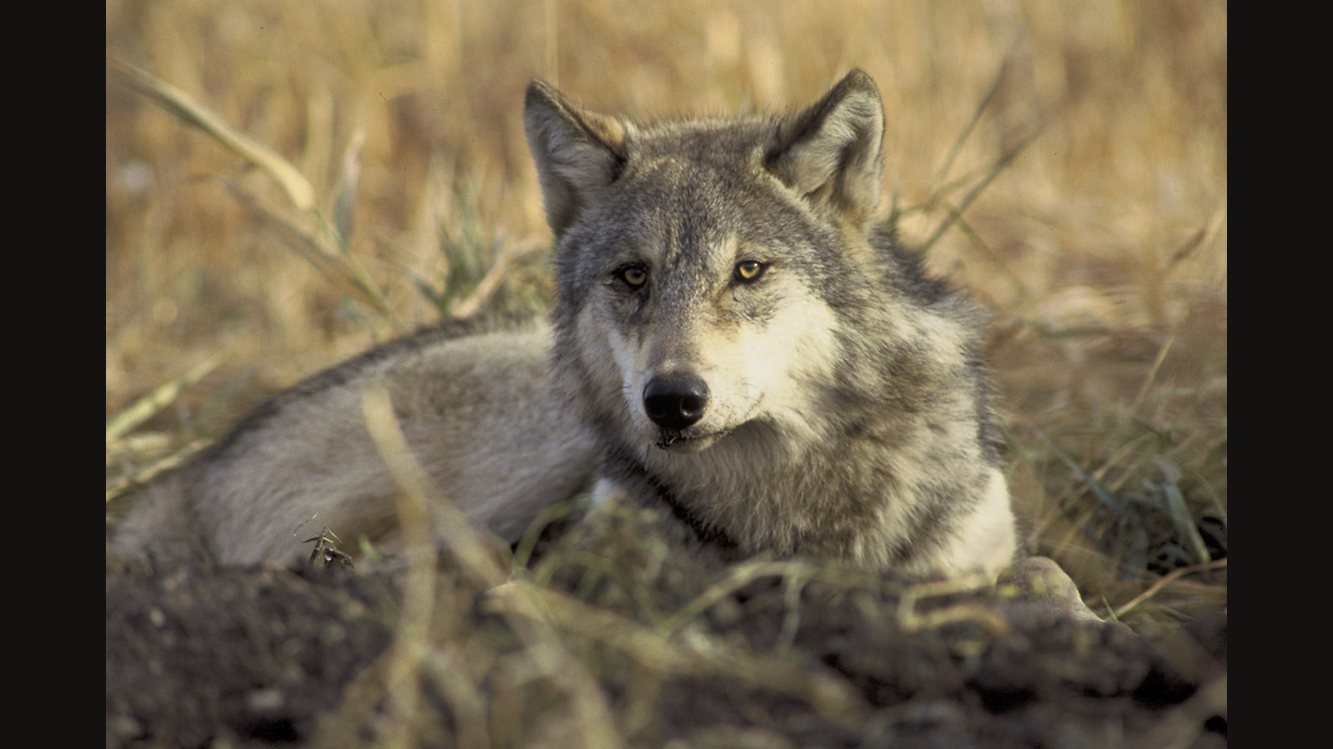
A gray wolf skull, *Canis lupus*, is a big, heavy canid skull with a long snout, broad, powerful jaws, 42 adult teeth, a pair of blade-like shearing teeth on each side and a bony crest along the top that can stand tall, especially in males. Start with a ruler. The San Diego Natural History Museum, known as The Nat, reports that wolf skulls usually measure more than 225 mm from end to end, while coyote skulls rarely pass 200 mm.
Length gets you close, but it does not finish the job. Large dogs overlap wolves in size, so the jaws, the teeth and the area around the eye sockets have to agree with the measurement before anyone can call a skull a wolf.
There is also the question of keeping it. Wolves are federally protected across much of the United States, so a wolf skull, found or bought, should never be assumed legal to own. The rules are laid out further down.
Reading a wolf skull: size, teeth and crest
The teeth follow a fixed pattern. Animal Diversity Web gives the adult gray wolf a dental formula of I3/3, C1/1, P4/4, M2/3. On each side, the upper jaw holds three incisors, one canine, four premolars and two molars, and the lower jaw holds three incisors, one canine, four premolars and three molars. Both sides together come to 42 permanent teeth.
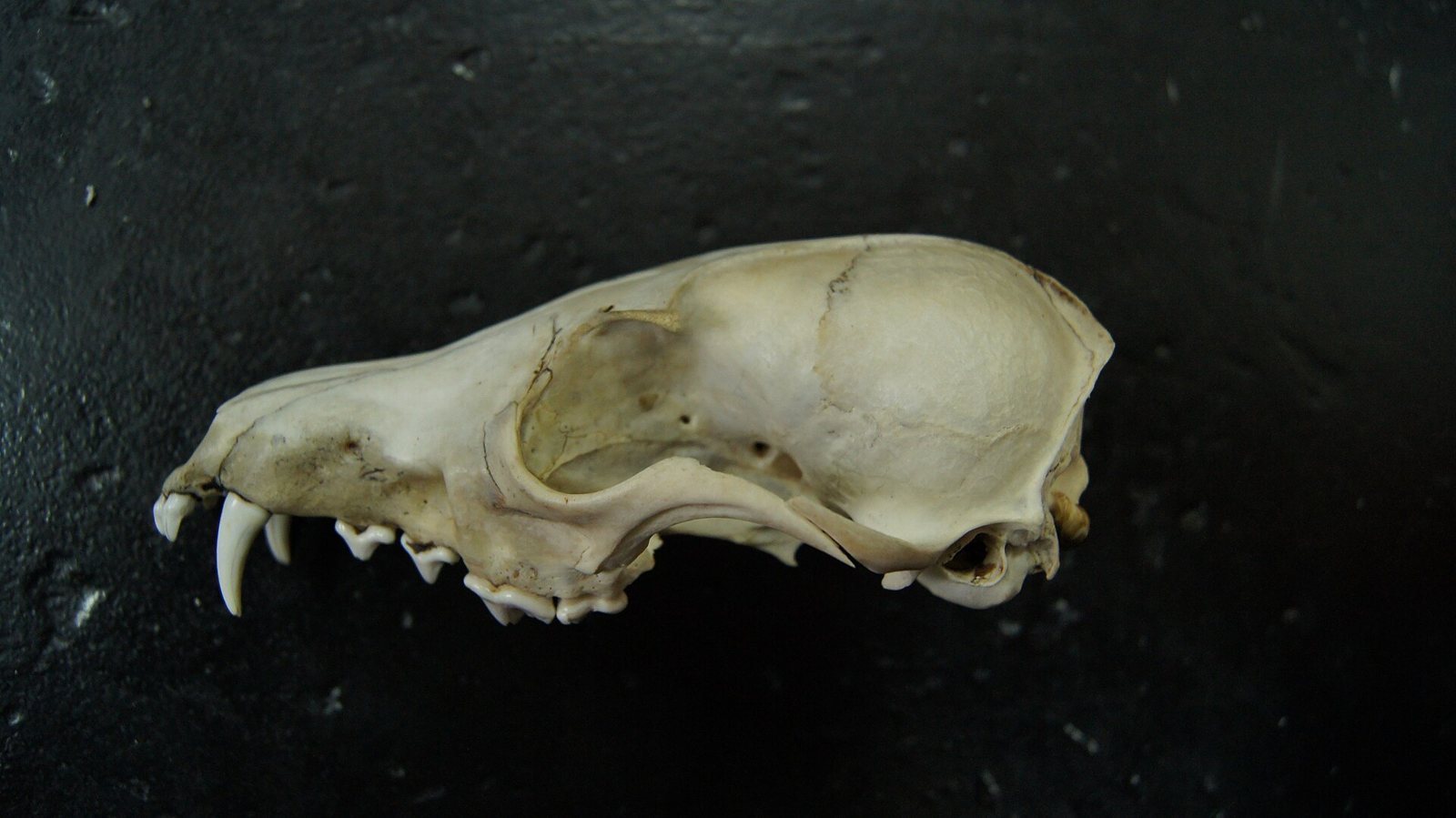
Two of those teeth do the heavy cutting. The carnassial pair is the upper fourth premolar and the lower first molar, and they slide past each other like the blades of a pair of shears. The Maryland Department of Natural Resources skull key uses them as one of its landmarks for canid skulls.
Above the braincase runs the sagittal crest, the ridge where the temporalis muscles, the big muscles that close the jaw, attach. In a wolf it can be pronounced, particularly in males, but its height changes from one animal to the next.
For size, The Nat's canid skull comparison shows two Oregon wolves: a male skull of 252 mm and a female of 227 mm. That 25 mm gap between two adults of the same species is a useful warning. Sex and individual build move the numbers, which is why no single measurement can prove a wolf.
Checking a skull step by step
A tape measure, a notebook and a bright window are all the kit you need, plus gloves if any tissue is left on the bone. Take the clues in order and write each one down as you go.
Is it a wolf skull? A step-by-step check
Tap a card to bring it forward.
- Measure the greatest length: From the tip of the snout to the very back of the skull. Wolves at The Nat usually run over 225 mm; coyotes rarely pass 200 mm.
- Judge the jaws: A wolf's are broad and heavy. A coyote's are narrower and lighter.
- Count teeth and sockets: A complete adult wolf has 42. Empty sockets count as teeth that were there.
- Find the carnassials: The upper fourth premolar and lower first molar form the shearing pair.
- Look along the top: The sagittal crest can be tall in a wolf, especially a male, but it varies.
- Compare: Hold your notes against identified wolf, coyote and dog specimens in a museum collection or a state skull key.
That last step matters more than it sounds. Identified museum specimens are the yardstick every key is built from, and a skull that sits near a boundary on one feature often settles once you see it beside the real thing.
Wolf or coyote?
Most of the time, size sorts these two. The coyote, *Canis latrans*, is much smaller than the gray wolf, and Colorado Parks and Wildlife describes gray wolves as about twice the size of coyotes overall. The Nat's figures put it in skull terms: both species measure over 160 mm, coyotes are rarely over 200 mm and wolves are usually over 225 mm.
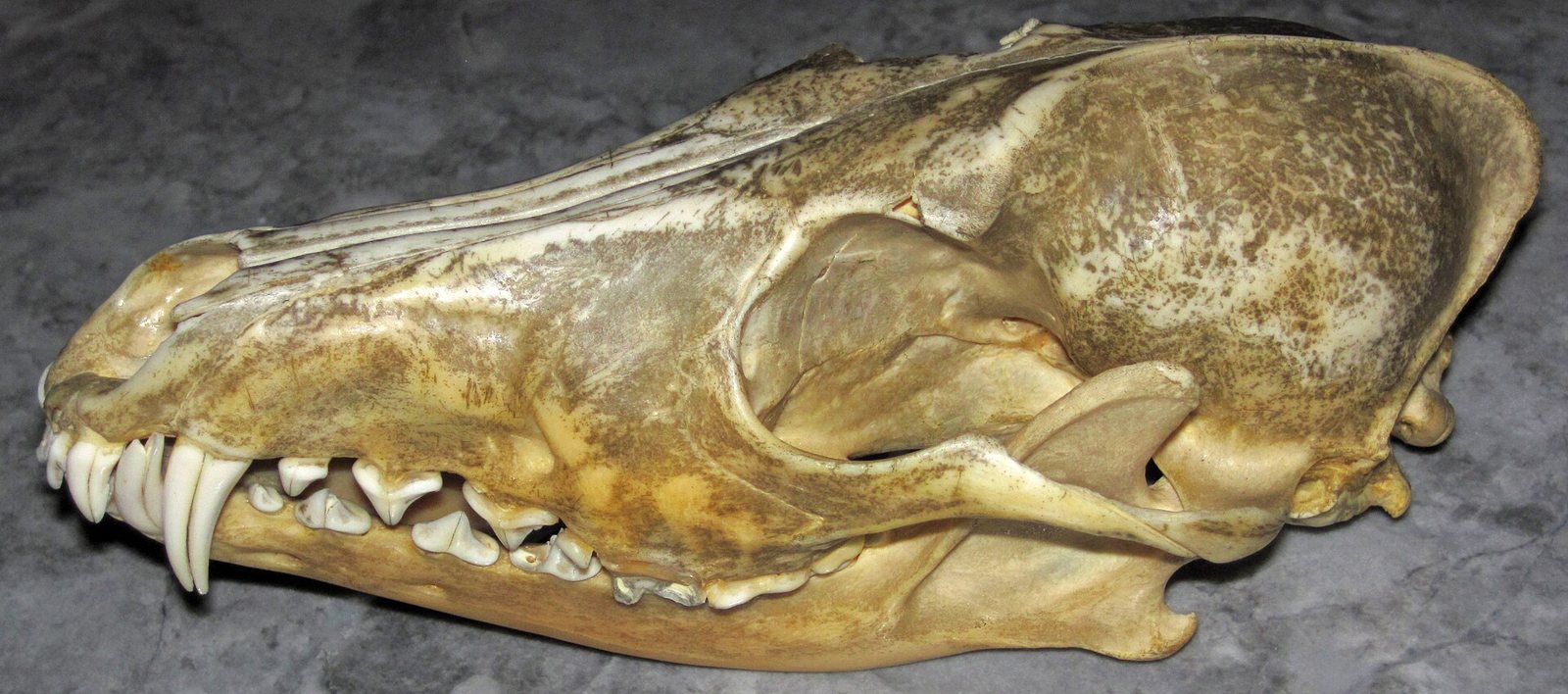
Shape backs the numbers up. A coyote skull is narrower and lighter, with less massive jaws. A wolf skull is broader and heavier throughout. Maryland's 2016 skull key starts its canid section with greatest skull length for exactly this reason: it is the quickest first split.
The trouble lives in the gap between 200 and 225 mm. Eastern coyotes, coyote and wolf hybrids, young wolves and unusually small or large animals can all land there. When yours does, compare the tooth proportions and the heft of the jaws, and think about where the skull turned up. For the coyote's own features in detail, read how to identify a coyote skull. If your skull comes in well under 200 mm with a slim, pointed snout, the fox skull story is the better match.
Wolf or a big dog?
This is the harder pair, and it has its own scientific papers. Studies comparing wolves and dogs measure total skull length, skull height, the width of the snout and palate, the size of the premolars and molars, the proportions of the braincase and the orbital angle, which is the angle formed by landmarks around the eye socket.
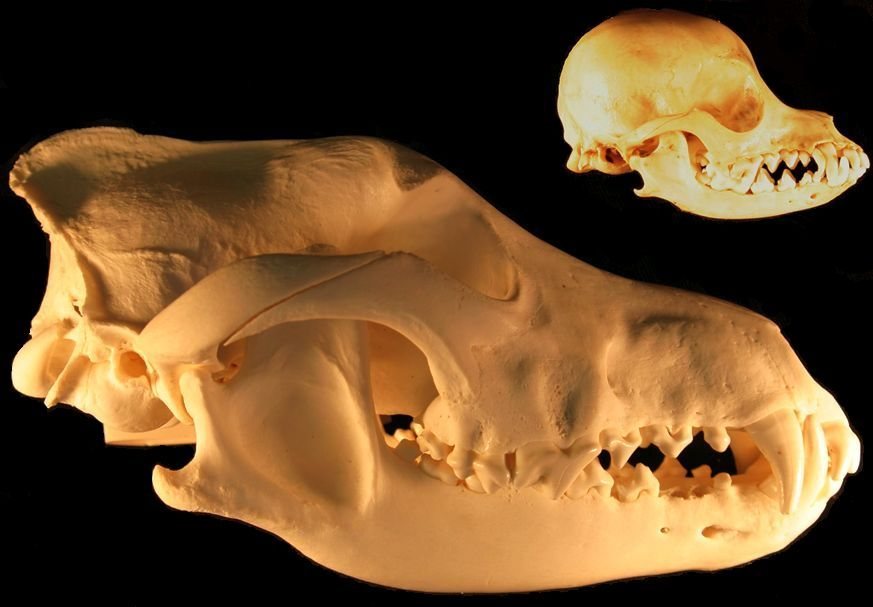
The best-known orbital angle study is Janssens and colleagues' paper *Can orbital angle morphology distinguish dogs from wolves?*, published in *Zoomorphology* in 2016. Their wolves averaged about 42 degrees, archaeological dogs about 47 and modern dogs about 55. The averages look tidy. The ranges do not: wolves ran from 28 to 52 degrees, archaeological dogs from 35 to 60 and modern dogs from 41 to 72. The authors reported that 43 percent of the modern dog measurements fell inside the wolf range of 41 to 52 degrees.
Coli and colleagues compared Italian wolves with German Shepherds in 2022 and used orbital angle along with skull length, the dimensions of the cranial cavity, the shape of the jaw and the position of the coronoid process on the lower jaw.
Why so much overlap? Breeding. People have shaped dogs into long, narrow-headed dolichocephalic breeds and short, broad-headed brachycephalic ones, and everything between. A big long-headed dog can match a wolf in size, and a wolf can fall inside a measurement range that looks like a dog's. Orbital angle helps when it is set against a reference sample, but on its own it cannot name the animal. Wolves do tend to have larger, heavier skulls, broader muzzles, stronger jaws and a more pronounced crest than many dogs, and that combination is what to look for. For the dog side of the comparison, including why dog skulls vary so much, see how to identify a dog skull.
Tap or hover a row to highlight it.
| Feature | Gray wolf, Canis lupus | Coyote, Canis latrans | Domestic dog, Canis lupus familiaris |
|---|---|---|---|
| FeatureTypical skull size | Gray wolf, Canis lupusThe Nat's examples: 227 to 252 mm | Coyote, Canis latransUsually under 200 mm at The Nat | Domestic dog, Canis lupus familiarisExtremely variable among breeds |
| FeatureJaw and muzzle | Gray wolf, Canis lupusBroad, heavy and suited to large prey | Coyote, Canis latransNarrower and lighter | Domestic dog, Canis lupus familiarisAnything from very narrow to very broad |
| FeatureTeeth | Gray wolf, Canis lupus42 in a complete adult | Coyote, Canis latransCanid dental pattern, with individual variation | Domestic dog, Canis lupus familiarisUsually 42 adult teeth, with breed and dental variation |
| FeatureCarnassials | Gray wolf, Canis lupusUpper fourth premolar and lower first molar | Coyote, Canis latransSame basic canid arrangement | Domestic dog, Canis lupus familiarisSame basic canid arrangement |
| FeatureSagittal crest | Gray wolf, Canis lupusCan be prominent; varies with sex and individual | Coyote, Canis latransGenerally less massive | Domestic dog, Canis lupus familiarisVaries strongly by breed |
| FeatureOrbital angle | Gray wolf, Canis lupusStudy mean about 42 degrees | Coyote, Canis latransNot a reliable separator from wolf on its own | Domestic dog, Canis lupus familiarisStudy mean about 55 degrees, with overlap |
Wolf skulls and the first dogs
The same puzzle you face at the kitchen table sits at the center of one of archaeology's long arguments: when, and where, did wolves become dogs? The answer depends on telling an ancient wolf skull from an early dog's, and that has turned out to be slippery.
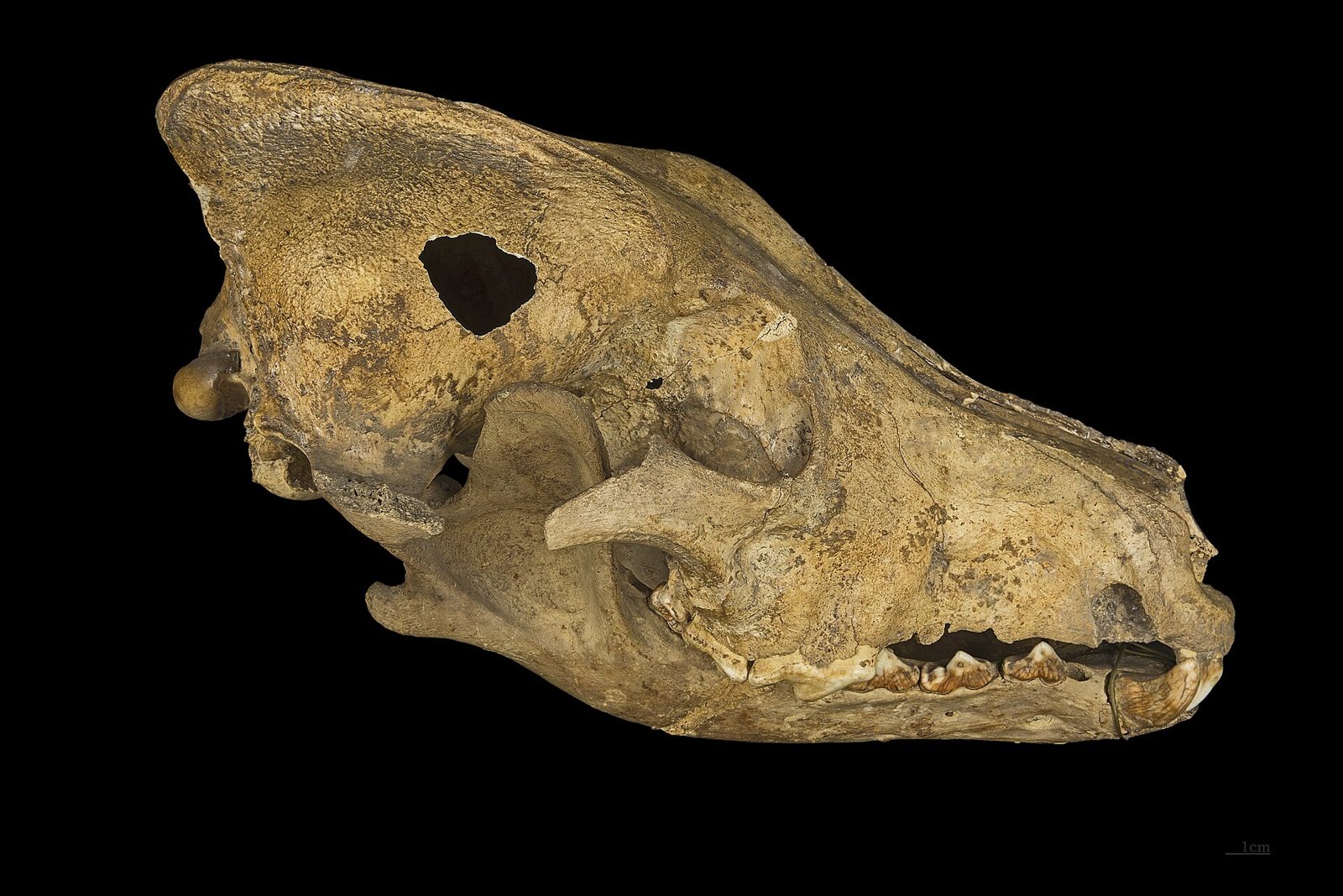
In 2016, Perri's paper *A wolf in dog's clothing* argued that any proposed Paleolithic dog has to be compared with a much larger sample of Pleistocene wolves, because early wolf skulls can fall within dog-like ranges. Boudadi-Maligne and colleagues put the question to two ancient canids with three-dimensional shape analysis: one from Goyet in Belgium, dated to about 31,680 years before present, and one from Eliseevichi in Russia, about 13,905 years before present. Both had been proposed as early dogs. Both came out as wolves in their shape.
Genetics added another layer. Frantz and colleagues, writing in *Science* in 2016, analyzed genetic sequences from 59 ancient dogs and a high-coverage genome from a late Neolithic Irish dog that lived about 4,800 years before present. Their results suggested dogs may have been domesticated separately from different wolf populations in eastern and western Eurasia. It is a suggestion, and the origins of the dog are still debated.
Museum drawers hold the reference skulls this work depends on. The University of Michigan Museum of Zoology has a male timber wolf skull, *Canis lupus lycaon*, collected in Houghton County, Michigan, on May 19, 1922. Specimens like it are why specialists treat "wolf or dog" as a question of many measurements, plus date, place and sometimes ancient DNA, rather than one glance. For more on how bones carry that kind of evidence, read what bones tell archaeologists.
Wolf skulls in science and law, 1922 to 2026
Tap or hover a step to follow the order.
1922
A male timber wolf skull is collected in Houghton County, Michigan, now in the University of Michigan Museum of Zoology collection.
2015
Three-dimensional shape studies question earlier identifications of the Goyet and Eliseevichi canids as dogs.
2016
Janssens and colleagues publish a large orbital angle comparison of wolves, archaeological dogs and modern dogs.
2016
Frantz and colleagues publish genomic and archaeological evidence for a possible dual origin of domestic dogs.
2021
A U.S. Fish and Wildlife Service delisting rule for gray wolves takes effect; court action later restores Endangered Species Act protections across much of the lower 48.
2023
The Service publishes the rule putting the restored protections in place, with the Northern Rocky Mountain population still delisted.
2026
The Service lists gray wolves outside the Northern Rocky Mountain population as endangered, with Minnesota wolves threatened.
Keeping a wolf skull
> General information only, not legal advice. Wildlife law is written state by state and country by country, and it gets revised. Only the agency responsible for the place where a skull came from can tell you whether you may keep it.
Wolves carry more legal weight than most skulls people bring home. According to the U.S. Fish and Wildlife Service update of September 21, 2026, gray wolves in the contiguous United States and Mexico are listed as endangered across their listed range, with two exceptions. Minnesota's wolves are listed as threatened, and the Northern Rocky Mountain population remains delisted. That delisted area covers Idaho, Montana, Wyoming, the eastern third of Washington and Oregon, and north-central Utah.
A few more pieces complete the federal rules. Alaska's wolves have never been listed under the Endangered Species Act. The Mexican gray wolf, *Canis lupus baileyi*, is listed separately as endangered. Colorado has a federally designated nonessential experimental population that runs under its own special rules.
The Endangered Species Act prohibits possessing, selling, transporting or otherwise handling protected wildlife or its parts when the animal or part was taken unlawfully. Under the experimental-population regulations, a wolf or wolf part generally has to be turned over to the Service unless the rule says otherwise. On top of the federal layer, state, Tribal, CITES, public-land and import and export rules can add their own restrictions.
So, the practical path is short. Write down where and how you came by the skull, keep any paperwork from a purchase, and contact your state wildlife agency or a U.S. Fish and Wildlife Service office before you keep, sell, move or import it. Our story on what to do when you find an animal skull covers the wider federal laws, and how to clean an animal skull is the next step only once the agency has confirmed the skull is yours to handle. We Dig Skulls makes skull art and designs; we never buy, sell or trade real skulls.
Wolf skull quiz
Answer every question to check.
Wolf skull questions, answered
A few more points come up once the ruler is out.
What does a wolf skull look like?
A wolf skull is large, long and heavily built, with strong jaws, specialized shearing carnassials and a sagittal crest where the temporal muscles anchor. Because size and shape vary from wolf to wolf, the surest comparison is against identified specimens in a museum collection, such as the gray wolf accounts at Animal Diversity Web.
Is skull size enough to identify a wolf?
No, size alone cannot settle it. Large dogs, small wolves, large coyotes and hybrids all overlap, and an evaluation of the classic wolf and dog measurements cautions that size also shifts with geography. Use length as the first clue, then check the jaws, teeth and orbit region.
Can a large coyote skull pass for a wolf's?
Near the boundary, yes. A big eastern coyote or a coyote and wolf hybrid can approach the 225 mm that The Nat gives as usual for wolves, so a skull between about 200 and 225 mm needs its jaws and tooth proportions compared as well as its length.
Is it legal to own a wolf skull?
It depends on the species, where and when the wolf died, how it was taken and the federal, state, Tribal and international rules that apply. Most wolves in the lower 48 are federally endangered as of September 2026, and possessing a part from an unlawfully taken wolf is prohibited, so ask your state wildlife agency before keeping or moving one.
Where to go next
If your skull turns out to be a coyote, the coyote skull story picks up from here, and a smaller, slimmer canid points to the fox skull. If it looks like a dog after all, how to identify a dog skull explains the many shapes dogs come in. A big skull with a short, rounded face belongs with the mountain lion skull, and a massive, broad one with heavy grinding teeth with the bear skull. And if there is any chance the bone in front of you is not an animal's at all, read how to tell a human skull from an animal skull first.
Terms in this story
Tap a term to see what it means.
Canis lupus. The gray wolf. The Mexican gray wolf, Canis lupus baileyi, and the timber wolf, Canis lupus lycaon, are named forms of it.
---