

No. 127
How to Identify a Dog Skull, and Why Dog Skulls Come in So Many Shapes
A dog skull is a meat-eater's skull: prominent canine teeth at the front, blade-like carnassial teeth along the cheeks and, in a complete adult, 42 permanent teeth, made up of 12 incisors, 4 canines, 16 premolars and 10 molars, according to the MSD Veterinary Manual. From there, compare the muzzle, the palate, the tooth rows, the length and the eye sockets with a museum specimen or a state skull key, because a dog and a coyote can be hard to tell apart.
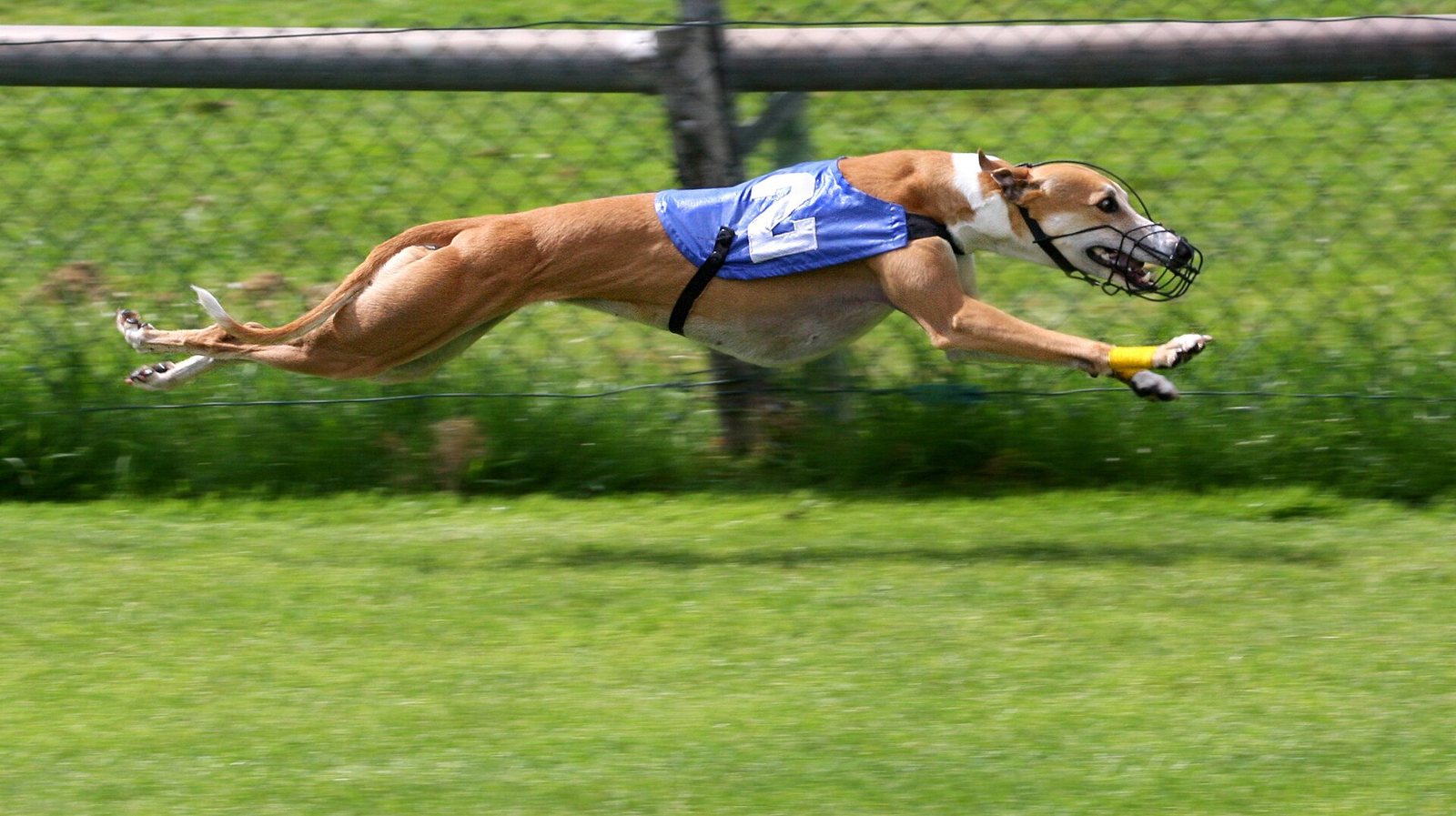
The second question has a tidy answer too. A pug skull and a greyhound skull look like different animals because people bred dogs for very different faces, short and broad at one end, long and narrow at the other. A 2010 study of 106 breeds measured more variation in skull shape among dogs than among the wild members of the dog family it compared.
And if you are wondering whether the skull in your hands was someone's pet, local animal services can often help. That has its own section below.
What makes a dog skull
The domestic dog is *Canis lupus familiaris*, and its teeth follow a fixed plan. Veterinary texts, including the Ohio State University College of Veterinary Medicine handbook, write it as 2 × (I 3/3, C 1/1, P 4/4, M 2/3) = 42. In plain terms, each side of the upper jaw has three incisors, one canine, four premolars and two molars. Each side of the lower jaw has three incisors, one canine, four premolars and three molars. Double it for both sides and you reach 42.
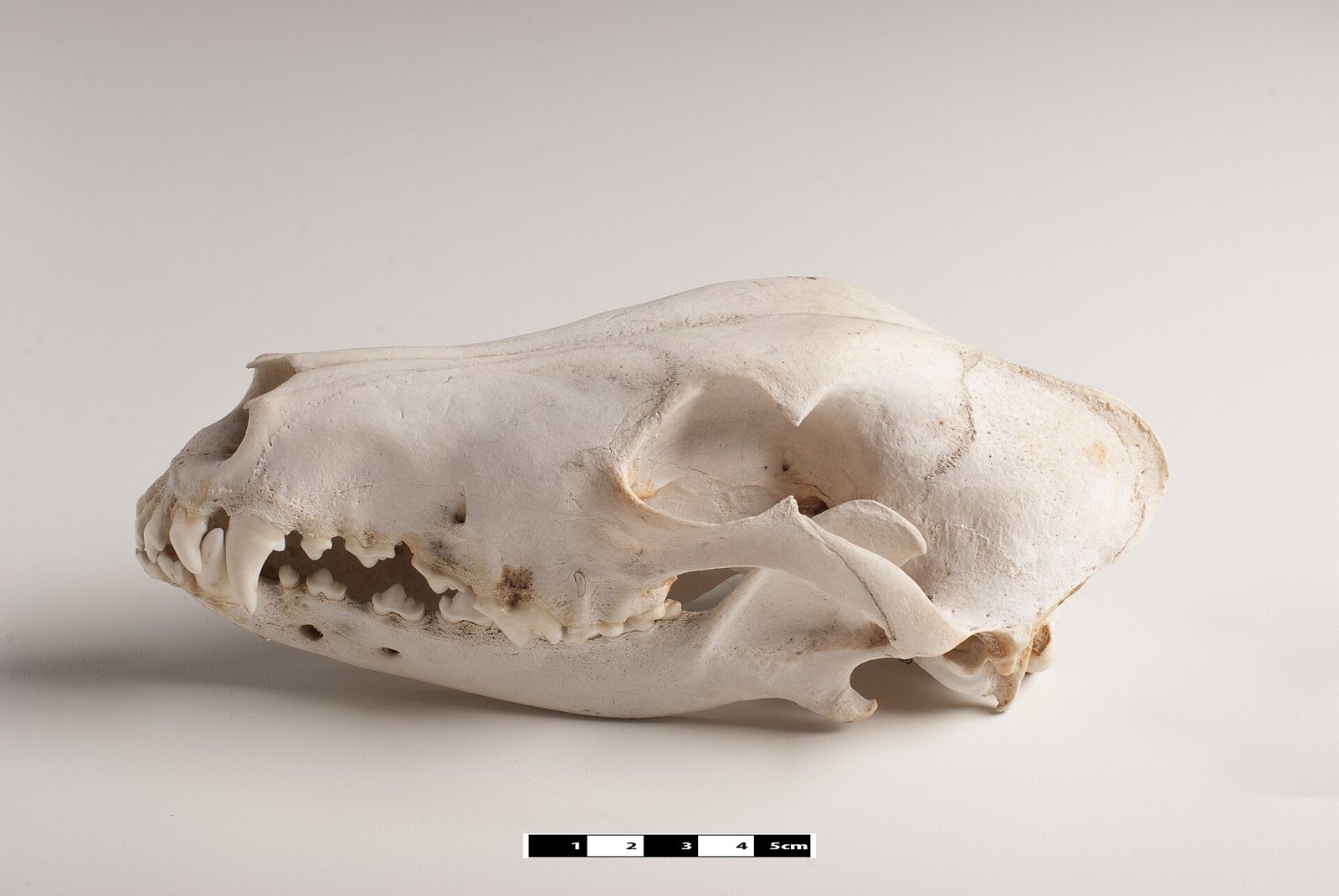
Beyond the teeth, a few parts of the skull carry most of the clues. Look at the muzzle, the braincase behind the eyes, the eye sockets, the zygomatic arches that form the cheekbones, the palate on the underside, the two tooth rows, the carnassials and the sagittal crest, the ridge of bone that can run along the top of the skull.
Expect the count to come up short now and then. Lost teeth, wear, age, an old injury and plain breed variation all complicate a dog skull. Count the empty sockets along with the teeth that are still there, and let the shape of the skull carry more weight when the count is incomplete.
Three skull shapes, short, medium and long
Anatomists sort dog skulls into three broad groups, and once you know them you will start seeing them on every walk.
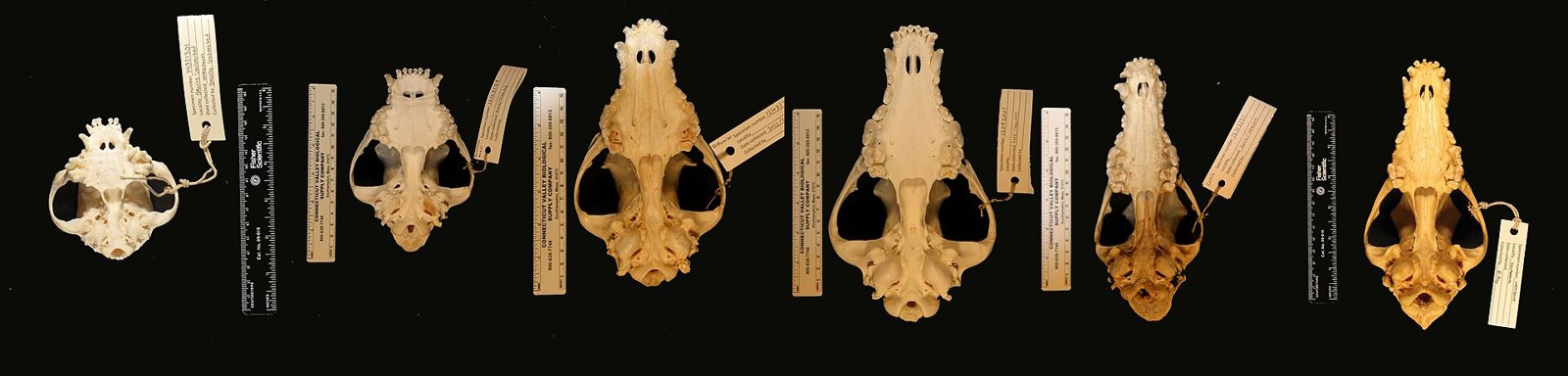
Brachycephalic means broad-headed, with a shortened muzzle. The Pug, the Bulldog, the French Bulldog and the Boxer belong here.
Mesaticephalic, also written mesocephalic, means the middle of the road: neither short nor especially long. The Labrador Retriever, the Beagle and the German Shepherd are examples.
Dolichocephalic means a long, narrow skull and muzzle. Think Greyhound, Collie, Saluki, Borzoi and Italian Greyhound.
The NHGRI Dog Genome Project uses one breed for each group in its skull studies: the Pug as brachycephalic, the Labrador Retriever as mesaticephalic and the Italian Greyhound as dolichocephalic. Line those three skulls up and it is hard to believe they belong to one species. They do.
Why a pug and a greyhound look nothing alike
The short answer is people. Breeders chose dogs for particular faces, and the skulls followed. The NHGRI project links this range of shapes to artificial selection, breeding by human choice rather than by nature alone.
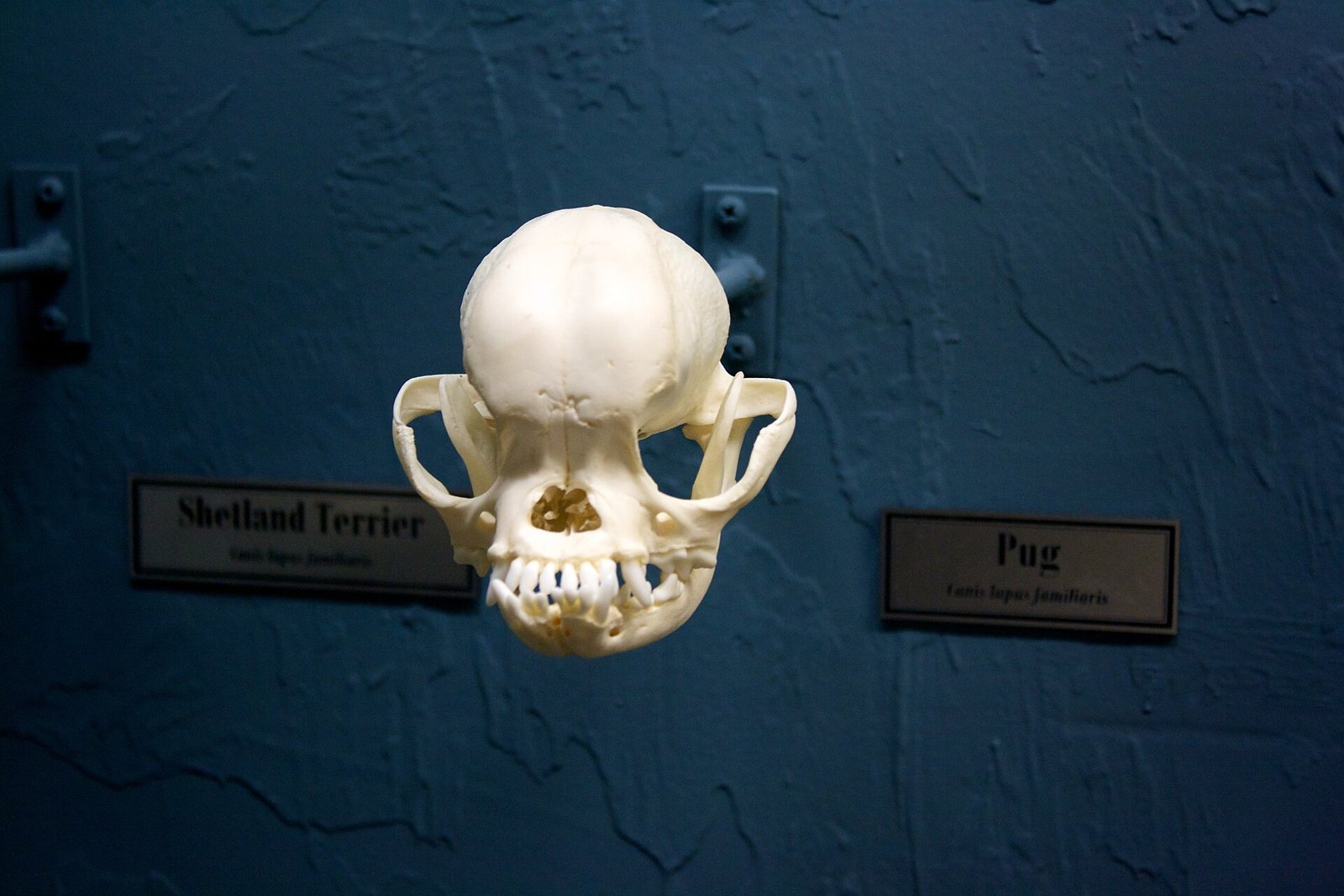
The numbers behind that are striking. In 2010, Abby Grace Drake and Christian Peter Klingenberg compared skull shape across 106 dog breeds in *The American Naturalist*. The variation among domestic dogs was greater than the skull-shape variation among the wild canids in their study. One species of dog, in other words, covers more ground in skull shape than the wild relatives they measured.
Genetics has followed the same trail. A 2012 study in *PLOS Genetics* tied canine skull diversity to human-directed selection and looked at variation in a gene called BMP3. And Eötvös Loránd University's 2024 digital database of dog and cat skulls holds 431 skulls in all, with CT scans representing 152 dog breeds as well as wild relatives including wolves, jackals and coyotes.
What a short face means for the dog
The squashed face that makes a pug a pug comes with a cost, and the veterinary schools describe it plainly. Brachycephalic obstructive airway syndrome, or BOAS, is linked to a shortened face and narrowed airways. The UC Davis School of Veterinary Medicine lists noisy or difficult breathing, trouble with exercise, overheating, vomiting and regurgitation among the signs. Short-faced dogs also face higher risks under anesthesia and during recovery, along with crowded teeth, rotated or overlapping teeth, underbites, eye injuries and skin-fold problems.
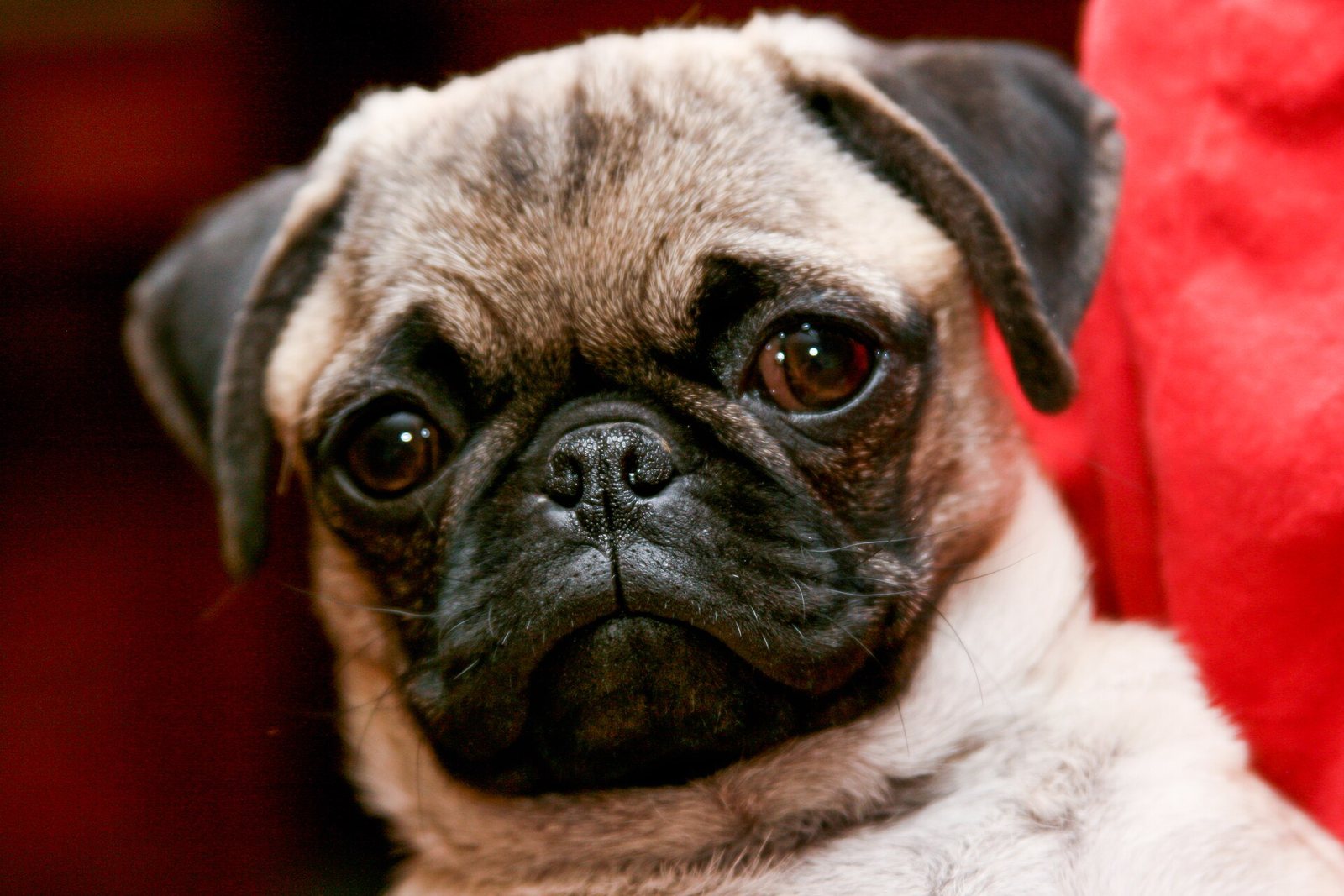
Not every short-faced dog is affected to the same degree. UC Davis and the Tufts Cummings School of Veterinary Medicine both point owners toward a veterinarian when breathing is noisy, exercise tolerance is poor or a dog overheats.
Dog, coyote, wolf, fox or pig?
A dog's wild relatives are the usual look-alikes, and the coyote is the hardest of them. The Maryland Department of Natural Resources Simplified Key to Furbearer Skulls warns that coyote and domestic dog skulls can be difficult to separate, especially when the skull is damaged or comes from a dog of middling size.
Grover Krantz's study *Distinctions Between the Skulls of Coyotes and Dogs* lists what coyotes tend to have: a longer, narrower muzzle, thinner bones, sharper crests, longer and sharper teeth, a straighter lower tooth row, larger auditory bullae and a smaller frontal sinus. No one of those settles it. Several together start to. The coyote skull story goes through the coyote in detail, including a measured test on the palate.
Size helps with the other canids. The San Diego Natural History Museum's canid comparison puts most coyote skulls at 160 to 200 mm long and most wolf skulls at more than 225 mm. Its two Oregon wolves, collected in 1925, measured 252 mm for the male and 227 mm for the female. A big dog can reach wolf size, though, so a large skull needs its jaws and teeth compared too, and how to identify a wolf skull takes that comparison further.
Foxes are smaller again and have a giveaway on top. In Maryland's key, the temporal ridges that run back from the eyes form a V in a red fox and a U in a gray fox. The San Diego museum also compares gray fox and kit fox skulls the same way, with the gray fox's U-shaped ridges against the kit fox's V. For more, read the fox skull story.
A pig skull is a different animal altogether, quite literally. Pig teeth and jaws are built differently from a dog's, and the MSD Veterinary Manual shows the distinctive porcine canines and cheek teeth. How to identify a pig skull walks through those differences. And if the skull is small, round and very short-faced, it may be a cat's, which cat skull identification covers. A damaged or puzzling skull is best compared with a museum specimen or taken to a university mammal collection. If there is any chance it is not an animal's at all, stop and read how to tell a human skull from an animal skull first.
Dog skull checklist
Tap a card to bring it forward.
- Count teeth and sockets: A complete adult dog has 42. Count empty sockets too, since teeth are often lost.
- Find the carnassials: Blade-like cheek teeth for shearing point to a meat-eater such as a dog.
- Read the muzzle: Short and broad, medium, or long and narrow suggests the shape group.
- Measure the length: Coyotes usually run 160 to 200 mm at the San Diego museum; wolves usually top 225 mm.
- Look along the top: Check the sagittal crest, and look for the V or U ridges of a fox.
- Compare: Set your notes against a state skull key or an identified museum specimen.
Can a skull tell you the breed?
A skull will usually show which of the three shape groups it belongs to. A short, broad, flat-faced skull reads as brachycephalic, and a long, slim one as dolichocephalic, without much argument.
Naming the exact breed is a harder question. Breeds within one group can be similar, many dogs are mixed, and individual dogs vary in size and build. That is the kind of question scientists tackle with large measured collections such as the Eötvös Loránd University database, where hundreds of scanned skulls can be compared side by side. For a single skull from a backyard, the shape group is the surest place to start.
Tap or hover a row to highlight it.
| Skull type or clue | What to expect |
|---|---|
| Skull type or clueAdult dog teeth | What to expect42 permanent teeth: 12 incisors, 4 canines, 16 premolars and 10 molars |
| Skull type or clueBrachycephalic | What to expectBroad skull and short muzzle, as in the Pug, Bulldog and Boxer |
| Skull type or clueMesocephalic or mesaticephalic | What to expectMiddle proportions, as in the Labrador Retriever and Beagle |
| Skull type or clueDolichocephalic | What to expectLong, narrow skull and muzzle, as in the Greyhound, Collie and Saluki |
| Skull type or clueCoyote versus wolf | What to expectCoyote skulls rarely over 200 mm; wolf skulls usually over 225 mm at the San Diego museum |
| Skull type or clueRed fox versus gray fox | What to expectV-shaped ridges for red fox and U-shaped for gray fox in Maryland's key |
If it may have been someone's pet
Sometimes the question behind a dog skull is a gentler one. If you think the remains may have belonged to a family's dog, it is worth treating that possibility seriously and letting the people whose job it is help.
Contact your local animal services, animal control office or shelter and tell them where the remains are. Some agencies can check a dog or cat for a microchip or help reach a possible owner; Champaign County Animal Control in Illinois is one office that describes doing so. Cities also publish their own steps, as New York City's Department of Sanitation does for reporting a dead animal. If the skull is on public land, or may turn out to be wildlife, ask the land manager or the state wildlife agency before you move it.
For anyone who has lost a dog and wants a way to remember one, our story on Day of the Dead for pets is a gentle place to start.
Keeping a dog skull you came across
> A note on the rules. This section is general information and not legal advice. What you may keep depends on where you are and what the animal was, and the rules change, so the local agency has the final word on your skull.
A skull that looks like a dog's may belong to a wild canid, and wild animals carry their own rules. The Wisconsin Department of Natural Resources, as one example, sets conditions for keeping wild skulls that depend on the species, the land and the circumstances. Do not assume a skull is yours to keep; confirm it with the wildlife agency or land manager first.
For the federal laws, and how other states treat skulls picked up outdoors, read what to do when you find an animal skull. Once it is clear the skull is yours to handle, how to clean an animal skull explains safe methods. We Dig Skulls makes skull designs for people who love skulls; we do not handle, buy or sell real ones.
Dog skull quiz
Answer every question to check.
Dog skull questions, answered
Three questions that tend to follow once the teeth are counted.
What does a dog skull look like?
A dog skull has a braincase, a muzzle, eye sockets, a palate, a lower jaw and the sharp teeth of a meat-eater. Its overall shape changes a great deal from breed to breed: short and wide, medium, or long and slender.
What are the parts of a dog skull?
The main visible parts are the neurocranium, or braincase, the muzzle, the nasal bones, the eye sockets, the zygomatic arches, the hard palate, the mandible or lower jaw, the mandibular condyle, the teeth and the sagittal crest. When you hold a skull against a museum or state wildlife key, the muzzle, the palate, the tooth rows, the length and the eye sockets are the parts to compare.
Is a skull with fewer than 42 teeth still a dog?
It can be. Tooth loss, wear, age and injury all lower the count in real skulls, so look for empty sockets and judge the skull by its shape and its carnassials as well as the number of teeth.
Where to go next
If the skull turns out to be wild, the coyote skull, the wolf skull and the fox skull stories pick up from here, and the pig skull covers the long-snouted farm find. And whatever it turns out to be, check found an animal skull before you decide to keep it.
Terms in this story
Tap a term to see what it means.
Canis lupus familiaris. The scientific name of the domestic dog.
---