

No. 003
What Was a Tzompantli? The Skull Racks of Tenochtitlan and What Archaeologists Found
A tzompantli was a rack, palisade or platform where the Mexica of Tenochtitlan displayed human skulls beside their temples. The word is Classical Nahuatl, and the UNAM Gran Diccionario Náhuatl translates it as "place of skulls" or "row of heads." The best-documented example is the Huei Tzompantli, the "great" skull rack that INAH archaeologists uncovered next to the Templo Mayor in Mexico City between 2015 and 2017. "Aztec" is the broader label most English readers know; "Mexica" names the people of Tenochtitlan itself, and it is the word scholars use here. Behind the headlines is a careful piece of archaeology about a building, the people whose remains it held, and what it meant to those who built it.
What the word means, and how to say it
*Tzompantli* is usually pronounced something like "tsom-PANT-lee," with three syllables and the stress on the middle one. Spanish and Nahuatl speakers vary the opening *tz*, so you may hear it closer to "s" or "ts" depending on the speaker and region. Spelling matters here, because the similar word *tzompāmitl*, which means "coral tree," is a different thing entirely.
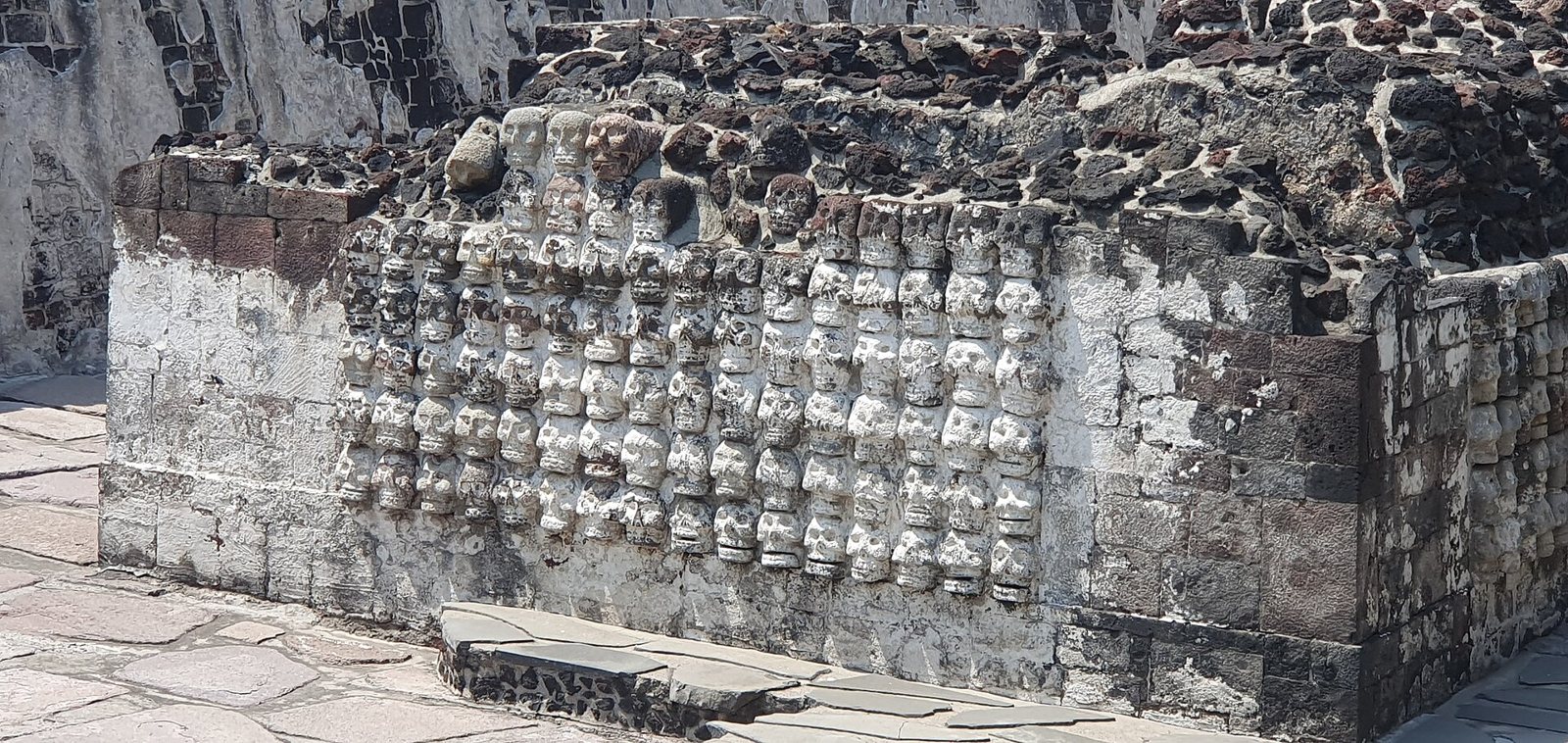
In archaeology, the term covers a structure used to display crania, usually after ritual decapitation. The form varied. Wooden posts and crossbeams are documented in Mexica contexts, while stone versions and stone carvings survive at other sites. INAH describes the Templo Mayor's stone example as an altar decorated with rows of carved skulls, and describes the Huei Tzompantli of Tenochtitlan as a far larger structure in which crania formed part of the building itself. You can read INAH's own account on its Templo Mayor page and its Huei Tzompantli page.
The dig under República de Guatemala 24
The dig began in 2015, when remains turned up during foundation work at República de Guatemala 24 in Mexico City's Historic Center. INAH's Urban Archaeology Program took over, and two field seasons from 2015 to 2017 identified part of the Huei Tzompantli. Archaeologists uncovered a rectangular platform about 35 by 12 metres, according to the 2025 Secretaría de Cultura report. They also found a low platform about 70 centimetres high, with post holes set in lines, where wooden supports once stood. INAH estimates that the complete structure may have measured 36 to 40 metres long and 12 to 14 metres wide, though only part of it has been excavated.
The building has a timeline. Its construction phases are tied to phases VI and VII of the Templo Mayor, roughly 1486 to 1502 and 1502 to 1521. Two ritual deposits were recorded as well. One dates to 1502 to 1521. The other, linked to the earlier phase, held 21 copper bells, skull fragments and two greenstone beads.
The Huei Tzompantli from 1486 to 2025
Tap or hover a step to follow the order.
1486 to 1502
One Huei Tzompantli construction phase, tied to Templo Mayor phase VI
1502 to 1521
A later phase, tied to phase VII
1521
End of Mexica Tenochtitlan and start of Spanish colonial rule
2015
Remains identified during work at República de Guatemala 24
2015 to 2017
Two field seasons document the northeast section and 655 crania
2020 to 2021
Conservation exposes the tower's outer facade
2025
INAH reports analysis of a conserved sample of 214 crania
A building made partly of skulls
What surprised many people was not a rack of loose skulls but a built structure. During later conservation work, archaeologists exposed a circular tower about 4.7 metres across and 1.8 metres high. Its skulls were joined with lime and clay, laid in concentric rows, with some faces turned inward and others outward. INAH stresses that the crania were part of the building's construction system, not decoration attached afterward.
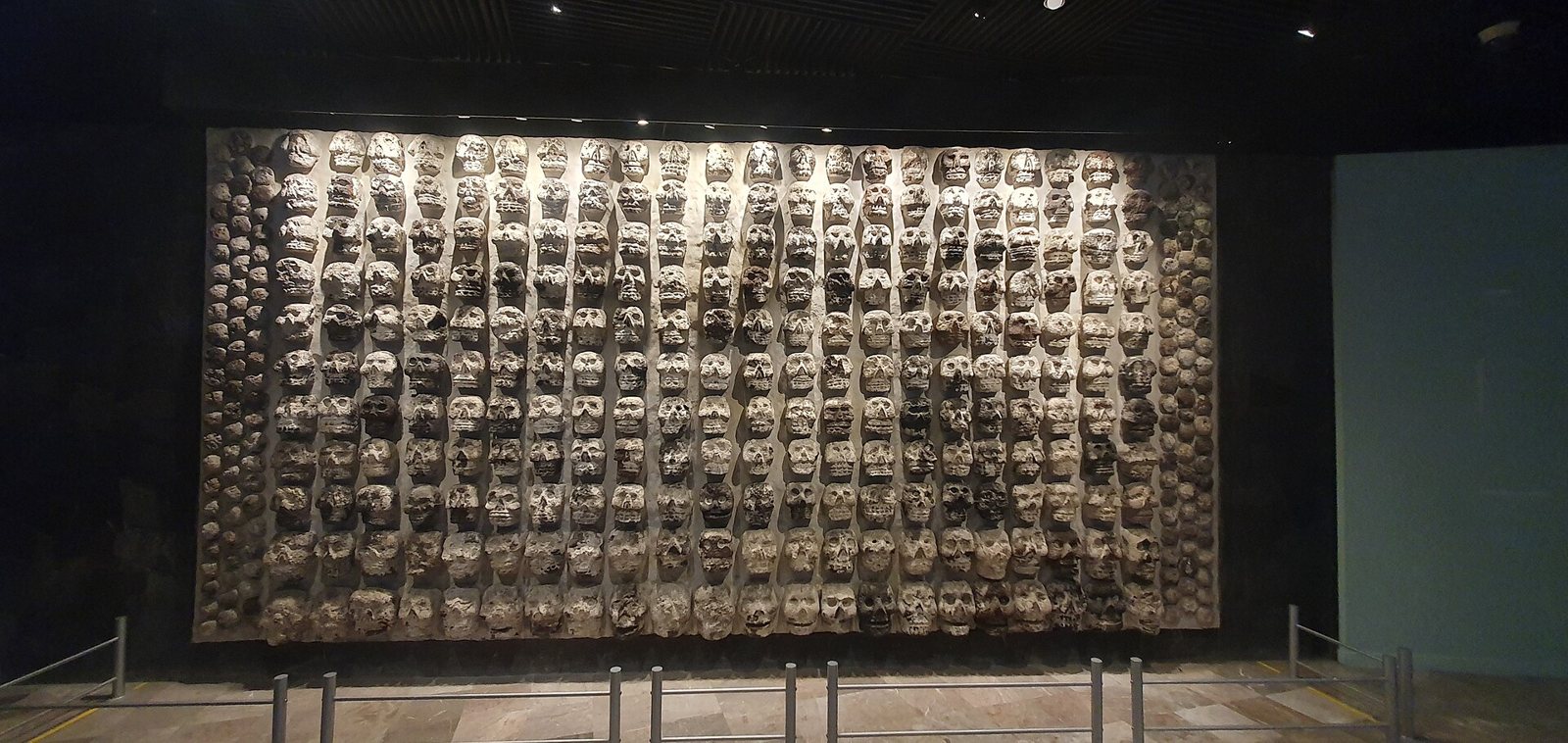
The numbers are large, so they are given here as INAH and the Secretaría de Cultura report them. The excavation recorded more than 11,000 skull fragments and at least 650 complete or substantially identifiable crania, and INAH registered 655 crania in the excavated tower section. Many of the skulls had been pierced through the temporal and parietal bones, the bones at the sides of the head, so that they could be threaded onto wooden poles. That detail is also why the archaeologists in the field are careful: a hole in a skull does not by itself prove a tzompantli. The structure, the post holes and the ritual setting have to be there too.
Tap or hover a row to highlight it.
| Find | Figure |
|---|---|
| FindPlatform | FigureAbout 35 by 12 metres |
| FindLow platform | FigureAbout 70 centimetres high |
| FindCircular tower | FigureAbout 4.7 metres across and 1.8 metres high |
| FindSkull fragments | FigureMore than 11,000 |
| FindComplete or substantially identifiable crania | FigureAt least 650 (655 registered in the tower section) |
| FindCrania conserved and analyzed by 2025 | Figure214 |
| FindPreliminary profile of that sample | Figure46.3 percent male and 37.4 percent female, the rest incomplete or not sexed, including infants |
Whose skulls these were
For a long time, popular accounts assumed that every individual on a skull rack was an adult male war captive. The Huei Tzompantli complicates that assumption. By INAH's 2025 update, a sample of 214 crania had been cleaned, stabilized and conserved. The preliminary profile was 46.3 percent male and 37.4 percent female, with the remainder incomplete or not sexed, a group that includes infants. INAH also noted that children's crania generally lacked the perforations used to mount adult ones.
Work on these remains is still going. DNA, isotope and bioanthropological studies are continuing, and the reasons individuals were chosen remain under study. Until the final results are published, the careful way to put it is the way INAH puts it: adults, women and children are all represented, and more will be learned. These are the remains of people, and the archaeologists, conservators and museums who keep them describe them that way.
What it meant to the Mexica
The tzompantli belonged to the sacred precinct of Tenochtitlan, and it was tied to gifts made to the gods, above all Huitzilopochtli in the case of the Huei Tzompantli. Its position along the southern axis of the Templo Mayor connected it, in its placement, with Huitzilopochtli's shrine and with the mythic hill of Coatepec. INAH describes the structure as part of Mexica ideas about death, renewal and the relationship between people and the gods.
Scholars read it in more than one way, and the readings fit together. Raúl Barrera Rodríguez, director of the Urban Archaeology Program, has interpreted the structure as a sacred monument connected to regeneration and cosmic balance. Eduardo Matos Moctezuma has described it as a public display of Mexica military power, a structure in the middle of the ceremonial precinct that made war, sacrifice and state ritual visible to residents and visitors. That political meaning is best understood as the sacralization and public presentation of power, rather than as a modern idea of a "terror device." The Museo del Templo Mayor, for its part, places Mexica ritual death within a wider set of ideas about death, fertility, renewal and communication with the gods.
It also helps to know who first described these structures to Europeans. Spanish chroniclers wrote through their own categories of punishment, warfare and spectacle, and a modern "trophy wall" comparison would impose a category the Mexica did not use. The Mexica view, as scholars reconstruct it, is religious and political at once.
The 136,000 figure
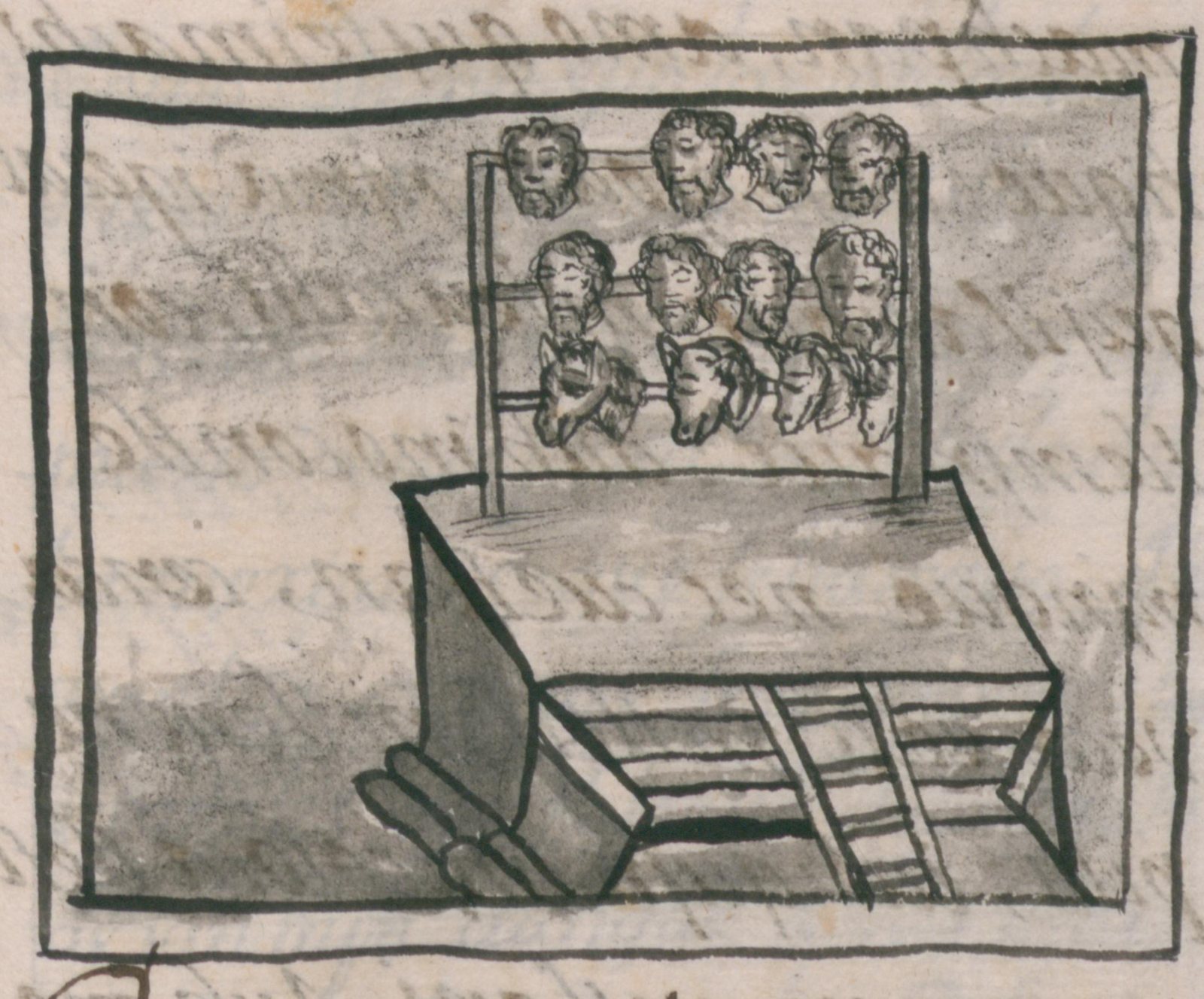
Almost every article on this subject quotes a huge number, so it deserves a plain answer. Andrés de Tapia, a conquest-era writer, reported more than 136,000 heads on the main Tenochtitlan structure, not counting skulls on the towers. Fray Diego Durán gave 80,000. Motolinía gave roughly 500 to 1,000 in one account. Other writers, among them José de Acosta, the Códice Ramírez tradition and Hernando Alvarado Tezozómoc, described arrangements such as 20 heads per pole, or gave different totals.
That spread is the point. These are sixteenth-century estimates written for particular audiences, sometimes years after the events, by authors with their own religious and political positions. Scholars treat them as evidence to be compared with the excavated structures, osteology, stratigraphy and Indigenous pictorial sources, and an analysis in SciELO takes that approach. So, how accurate is the 136,000 figure? It is Tapia's reported estimate, and it is not an archaeological count. The count from the ground at the Huei Tzompantli is 655 registered crania in one excavated section.
One sixteenth-century work helps. The Florentine Codex, compiled by Bernardino de Sahagún with Nahua authors and artists and completed in 1577, describes several named racks. Book 2 includes the Mixcoapan Tzompantli, and Book 12 shows a rack tied to the conquest. You can browse the Digital Florentine Codex at the Getty Research Institute.
Beyond Tenochtitlan
Skull racks were not unique to Mexico City, and the surviving examples look quite different from one another.
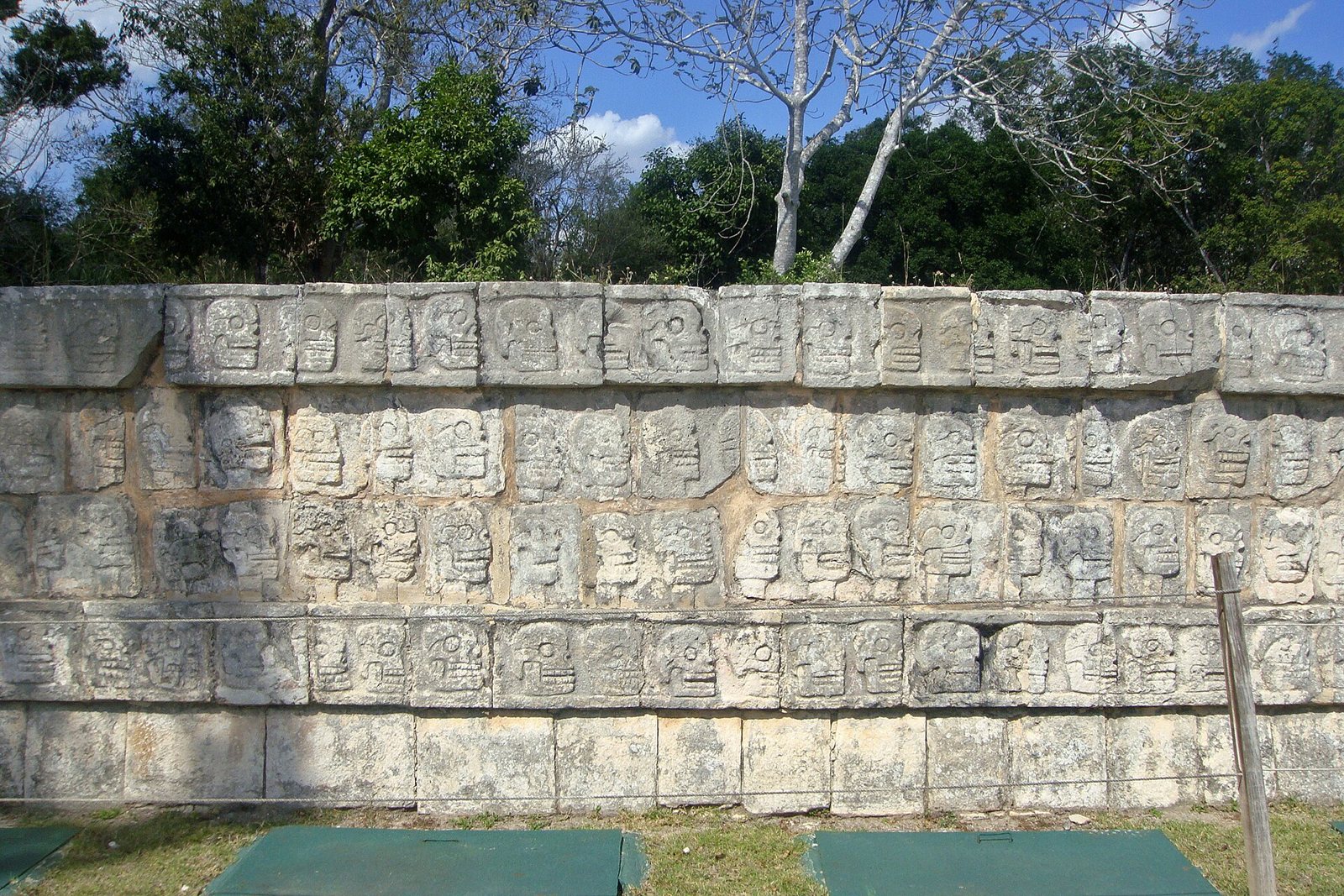
- Chichén Itzá, Yucatán. INAH identifies a carved stone Platform of the Skulls, the Tzompantli, near the Great Ball Court. It is a stone platform with carved skulls, not a preserved wooden rack with original crania. Since *tzompantli* is a Nahuatl word, using it for this Maya-Toltec monument is a scholarly comparison and not proof that the Maya used the same term. See INAH's Chichén Itzá page.
- Tula, Hidalgo. A structure officially labeled "Tzompantli, Lugar de Calaveras" stands near Ball Court 2. INAH reports that many teeth and cranial bones were recovered during its exploration, supporting the reading that it held heads, and says the Mexica may have built or reused it after the Toltec city's main period. See INAH's Tula page.
- Zultépec-Tecoaque, Tlaxcala. Archaeologists identified perforated crania linked to a tzompantli from the conquest period, about 1520 to 1521.
- Calixtlahuaca, State of Mexico. A tzompantli is associated with the Temple of Ehécatl-Quetzalcóatl.
Where you can see it today
Yes, tzompantli remains survive, though not all of them are open to visitors. The clearest place to start is the Museo del Templo Mayor in Mexico City. The archaeological zone includes the stone Altar Tzompantli, with its façade carved in rows of skulls. In the museum's vestibule, a display of skull-headed stones, original pieces recovered during excavations beginning in 1978, evokes the form of a tzompantli. The museum also shows a reconstruction, and its own page describes it as a museographic presentation, not the original Huei Tzompantli.
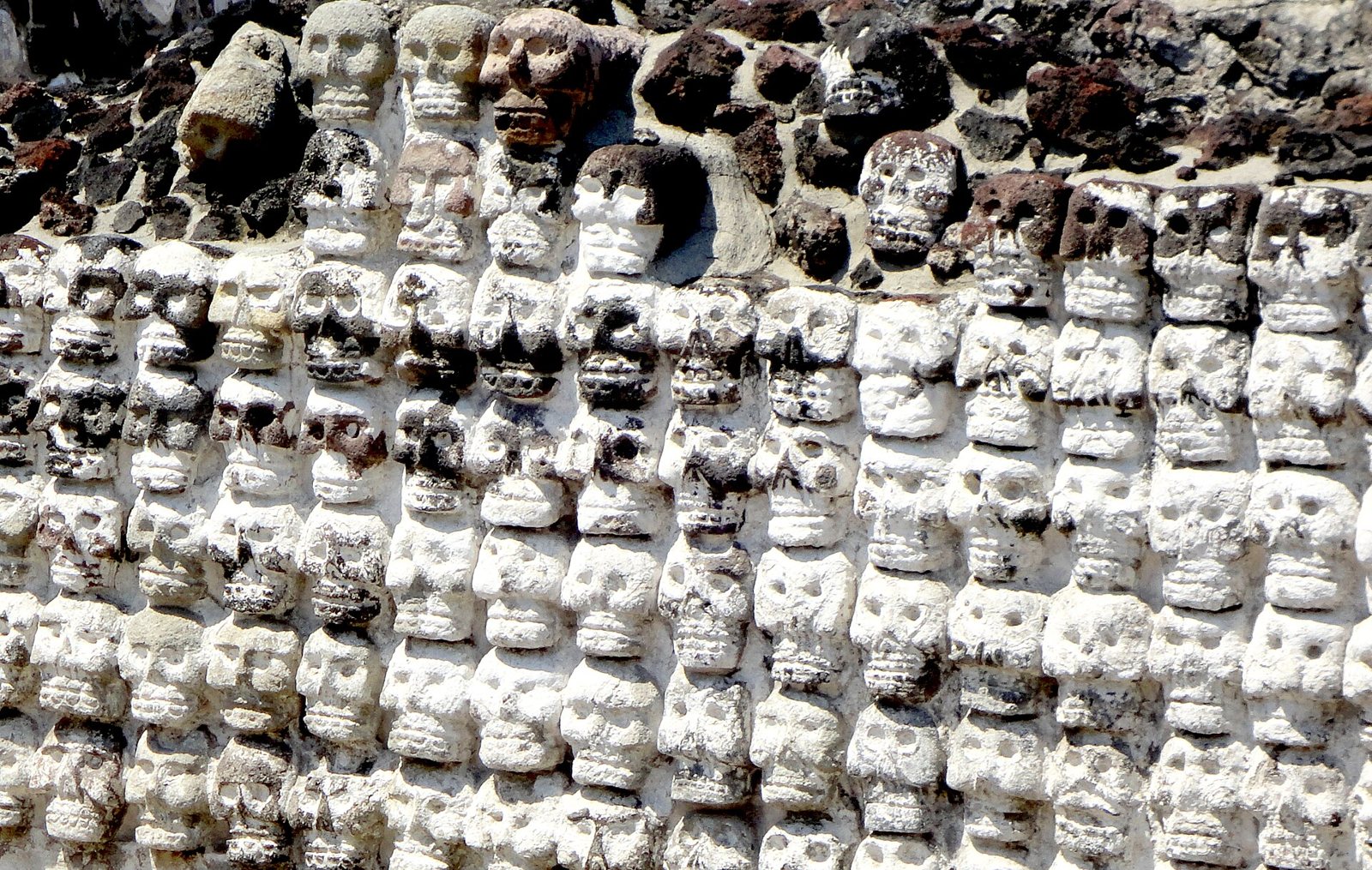
The excavated Huei Tzompantli itself remains in place beneath República de Guatemala 24 and is not an ordinary exhibit, so confirm access with INAH before planning a visit. The Museo del Templo Mayor lists Tuesday through Sunday, 9:00 a.m. to 5:00 p.m., and its vestibule page permits photographs without flash. Admission prices differ between official pages, so confirm the current fee with the museum. These are archaeological heritage and human remains, so follow the museum's rules and keep your voice and your camera respectful.
Tzompantli quiz
Answer every question to check.
Quick answers about the tzompantli
What is an Aztec tzompantli?
It is a Mexica ritual skull rack or platform where human skulls were displayed publicly near temples, and the Nahuatl word names both the structure and, in some uses, the skulls on it. At Tenochtitlan, the Huei Tzompantli belonged to the Templo Mayor precinct and had construction phases dated 1486 to 1502 and 1502 to 1521.
What does tzompantli mean?
It means "place of skulls" or "row of heads" in Classical Nahuatl, according to the UNAM Gran Diccionario Náhuatl. It is pronounced roughly "tsom-PANT-lee," and it is a different word from *tzompāmitl*, "coral tree."
How many skulls were found in the Aztec skull tower?
INAH registered 655 crania in the excavated tower section of the Huei Tzompantli, and the excavation recorded more than 11,000 skull fragments. The 136,000 figure often quoted online is a sixteenth-century estimate by Andrés de Tapia, and archaeologists do not treat it as a count.
Were women and children found in the Huei Tzompantli?
Yes. INAH's preliminary profile of a 214-cranium sample was 46.3 percent male and 37.4 percent female, with the rest incomplete or not sexed, including infants. Children's crania generally lacked the perforations used to mount adult ones.
Are there any tzompantli remains today, and what did the Mexica do with skulls?
Yes, remains survive at the Huei Tzompantli excavation, the Templo Mayor zone and Chichén Itzá, among other sites. The Mexica displayed skulls of sacrificed people on wooden poles and in a tower built of skulls, within a religious and political world that tied death to renewal, and some skulls were also placed in other ritual contexts. For a visit, the Museo del Templo Mayor in Mexico City is the place to start.
Where to go next
A tzompantli is one chapter in how people around the world have read the skull. For the wider story, start with skull symbolism. A very different ritual use of the skull appears in the story of the kapala skull cup, and the guide to ossuaries around the world looks at other places where human remains are kept and displayed. Mexico's living traditions of remembrance, from altars to marigolds, are covered in the guide to Día de Muertos.