No. 098
The Douaumont Ossuary at Verdun: Whose Remains Rest There and What a Visit Is Like
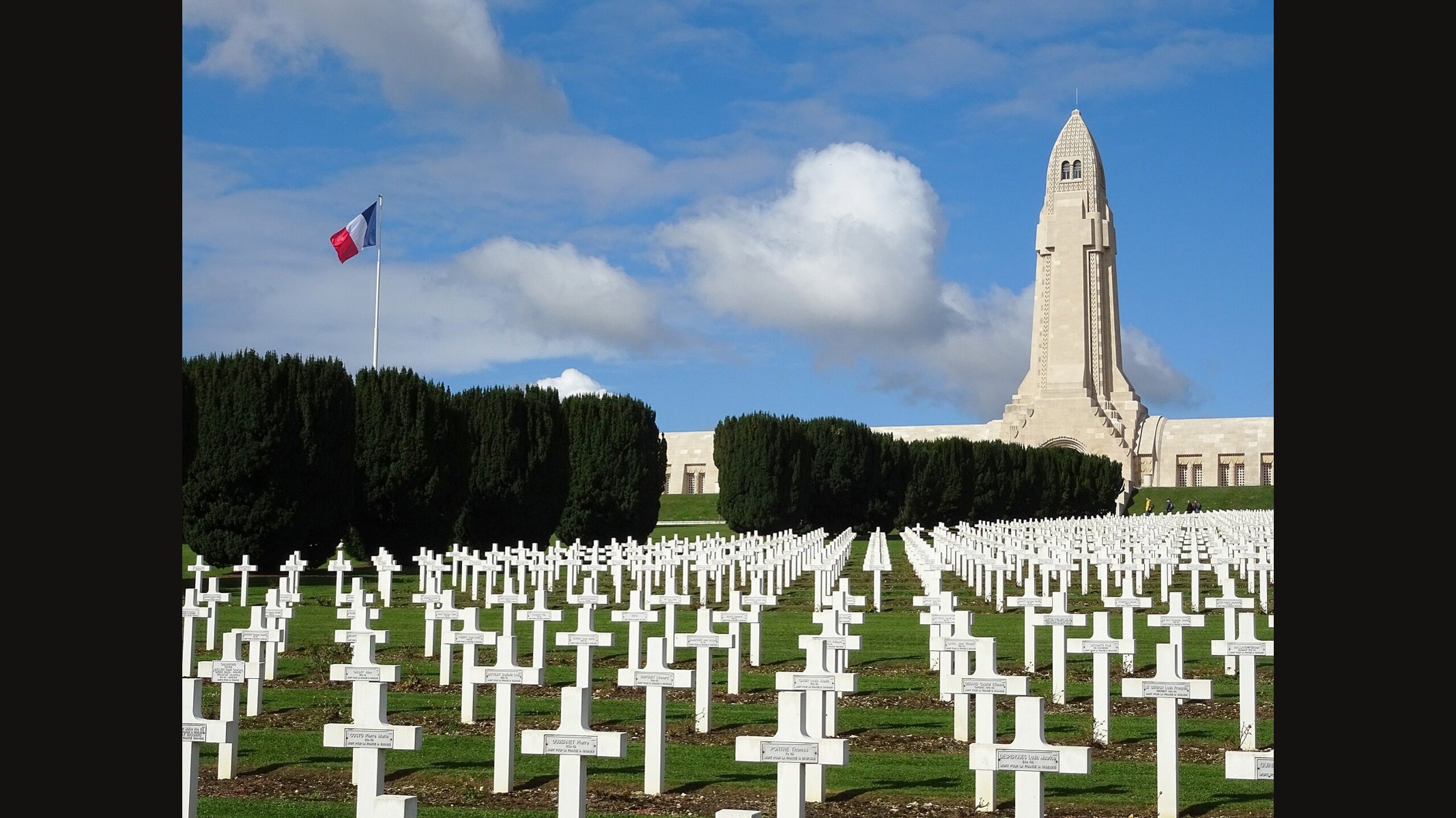
The Douaumont ossuary, on the battlefield of Verdun in northeastern France, holds the remains of about 130,000 French and German soldiers who could not be identified. According to the ossuary's own history, their bones were gathered from the battlefield after the fighting of 1916 and the Armistice, and they rest beneath the tombs of its long cloister.
The small windows at the base of the building are the ones in so many photos: through them you can see bones in the vaults, from outside. In front of the ossuary lies the National Necropolis of Fleury-devant-Douaumont, with 16,142 individual graves.
A visit to the cloister, chapel, tower, small museum and film takes about an hour, and in the 2026 season an adult ticket costs €7.
The Battle of Verdun and its dead
The men in the ossuary died in one of the longest battles of the First World War. The Battle of Verdun lasted from 21 February to 18 December 1916. The Mémorial de Verdun records about 163,000 French dead and 143,000 German dead, and about 700,000 French and German soldiers dead or injured.
You will often see that 700,000 figure quoted as if it were the number of dead. Historian Antoine Prost, discussing how First World War deaths are counted in Le Monde in 2018, explains that it counts total losses, which include the wounded, the missing and prisoners as well as the killed. Prost and fellow historian Gerd Krumeich, in an interview with the CNRS, put the deaths at roughly 300,000 French and German soldiers. Totals also shift with the dates and areas a historian counts as part of the battle.
So, who lies in the ossuary? Ordinary soldiers of two armies, each of them someone's son, whose bodies were never matched to a name. The ossuary presents them that way, as soldiers who could not be identified, kept together rather than as a collection of individuals.
Tap or hover a row to highlight it.
| Figure | What it counts | Who gives it |
|---|---|---|
| Figure21 February to 18 December 1916 | What it countsDates of the Battle of Verdun | Who gives itMémorial de Verdun |
| FigureAbout 163,000 and 143,000 | What it countsFrench dead and German dead | Who gives itMémorial de Verdun |
| FigureAbout 300,000 | What it countsFrench and German deaths | Who gives itHistorians Antoine Prost and Gerd Krumeich |
| FigureAbout 700,000 | What it countsFrench and German dead or injured | Who gives itMémorial de Verdun |
| FigureAbout 130,000 | What it countsUnidentified French and German soldiers in the ossuary | Who gives itOssuaire de Douaumont |
| Figure16,142 | What it countsBodies in the National Necropolis of Fleury-devant-Douaumont | Who gives itMémorial de Verdun |
| Figure137 metres, 22 compartments, 46 sectors | What it countsThe cloister and the battlefield sectors it represents | Who gives itOssuaire de Douaumont |
| Figure46 metres | What it countsHeight of the lantern tower | Who gives itMémorial de Verdun |
A bishop's answer to the battlefield
The ossuary began with one man's visit. In late 1918, Charles Ginisty, Bishop of Verdun, went over the ruined battlefield and saw human remains that no one could identify. He proposed a memorial sanctuary and ossuary for the soldiers whose identities could not be recovered, so that they would have a resting place even without a name.
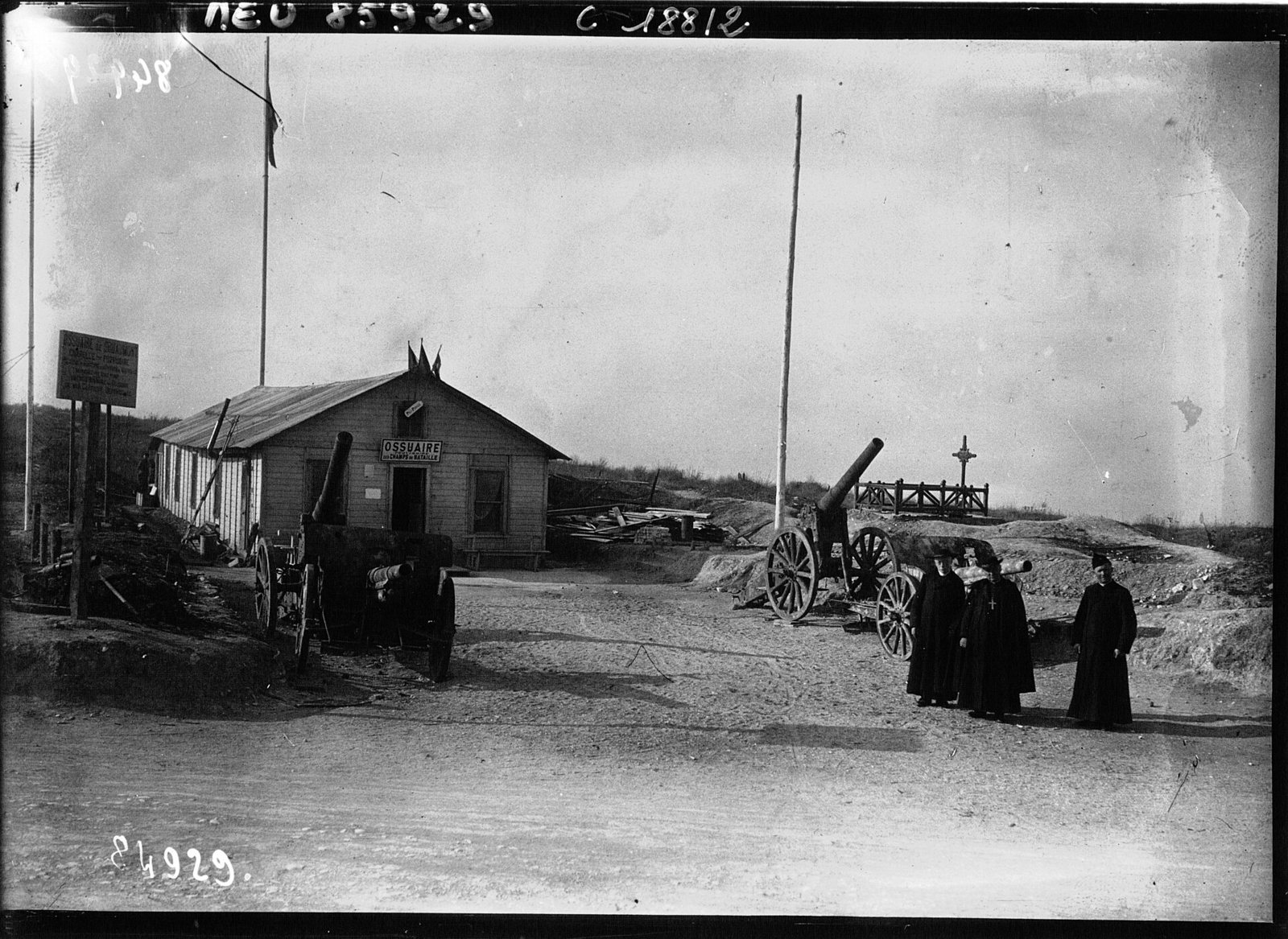
Historians quoted by the Mémorial de Verdun in Verdun, d'hier à aujourd'hui describe his idea as a "cathedral of the dead," and place it in the religious setting of the time. While the permanent building was planned and raised, the remains collected from the battlefield were kept in a temporary ossuary.
Building the ossuary, 1920 to 1932
It took twelve years to finish. According to the Mémorial de Verdun's teaching materials on the memory of the battles, the foundation stone was laid near Thiaumont in August 1920 and construction began in 1924. In 1927 the remains were moved from the temporary ossuary into the new building. The lantern tower, 46 metres high, was inaugurated in 1930, two years before the rest, and the completed monument was inaugurated in August 1932.
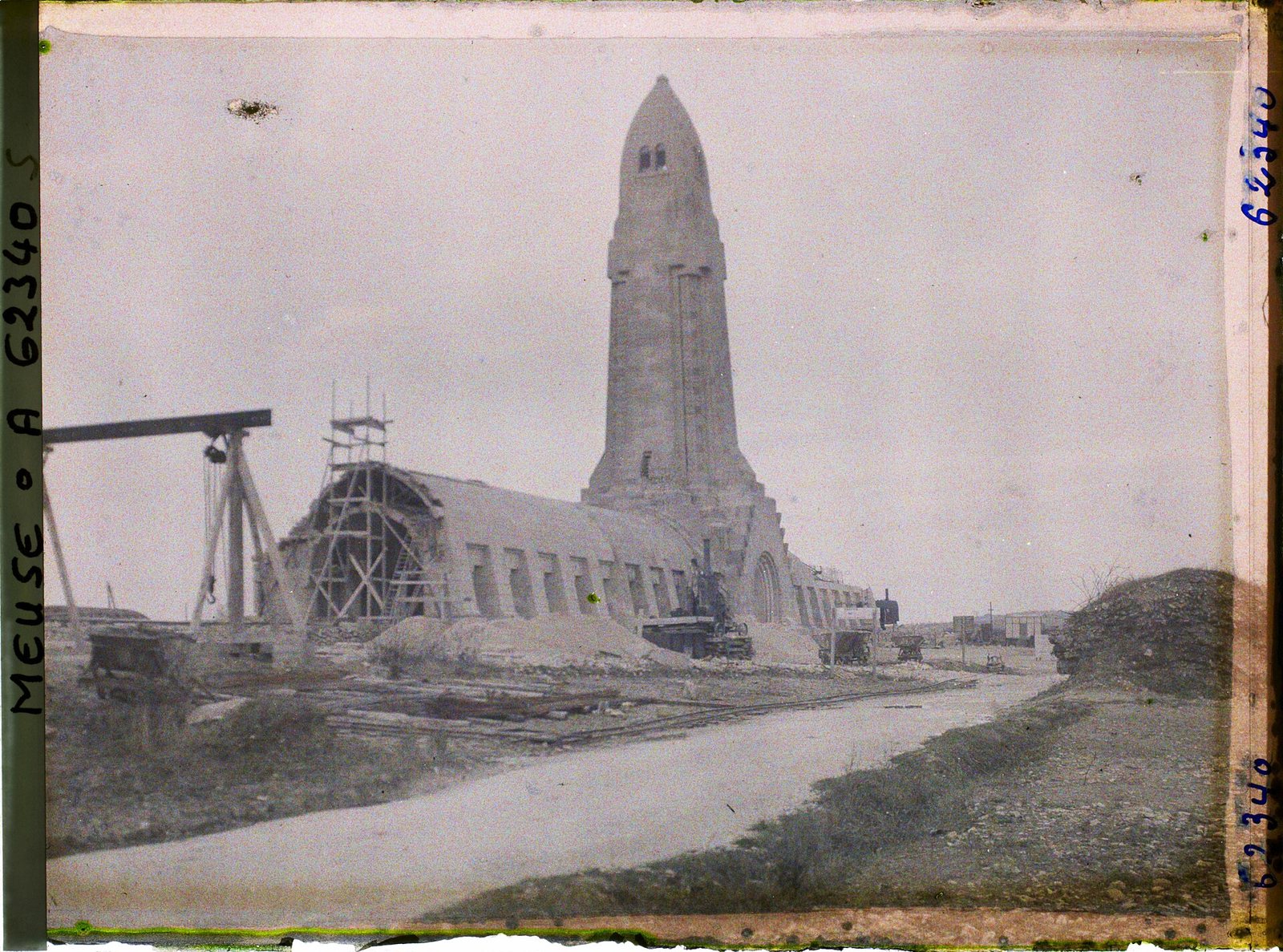
The Douaumont ossuary from 1918 to 2006
Tap or hover a step to follow the order.
Late 1918
Bishop Charles Ginisty visits the battlefield and proposes an ossuary for unidentified soldiers.
August 1920
The foundation stone is laid near Thiaumont.
1924
Construction begins.
1927
Remains are transferred from the temporary ossuary to the new building.
1930
The 46 metre lantern tower is inaugurated.
August 1932
The completed ossuary is inaugurated.
1938
The Jewish memorial is erected nearby.
2006
The Muslim memorial is inaugurated nearby.
The cloister and the windows of bones
Inside, the building is arranged by place rather than by person. The ossuary describes its cloister as 137 metres long, with 22 compartments that stand for 46 sectors of the Verdun battlefield. The unidentified remains gathered after the Armistice rest in those compartments according to the part of the battlefield they came from. Names of French soldiers are engraved on the ossuary's vault.
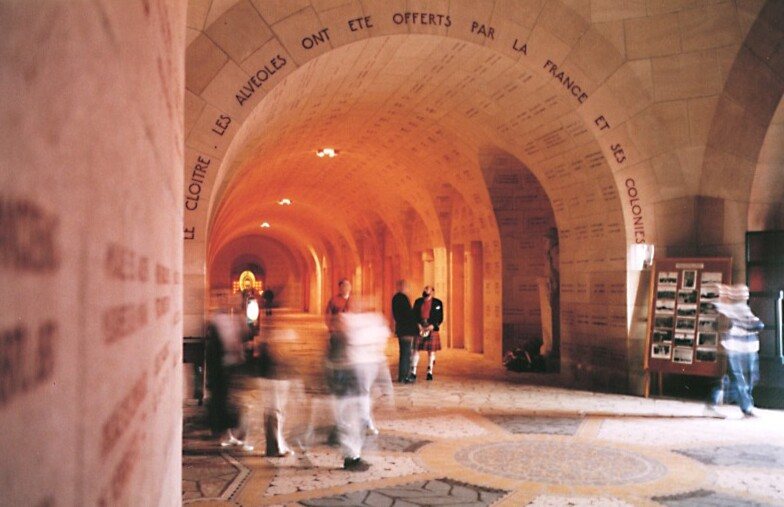
The bones themselves can be seen from outside. Small windows at the base of the monument look into the vaults, and through them visitors see the remains. The interior is a place of remembrance and prayer, and the windows show plainly what the building is for: a resting place for men gathered from the battlefield who could not be named.
The cemetery and the memorials beside it
The graves in front of the ossuary belong to the National Necropolis of Fleury-devant-Douaumont. The Mémorial de Verdun lists 16,142 bodies buried there, each in an individual military grave. That is a different kind of burial from the ossuary: here, a soldier has his own grave, while in the vaults behind, the unidentified rest together.
Two more memorials stand nearby. The Jewish memorial, erected in 1938, honors Jewish soldiers who died for France in the First World War. The Muslim memorial, inaugurated in 2006, honors Muslim soldiers who died in the war. UNESCO's 2023 nomination document lists the ossuary, the national necropolis, the Jewish memorial and the Muslim memorial together as the Douaumont memorial site.
Names still being recovered
The ossuary describes its contents as the remains of unidentified soldiers, and that is still how it presents them. Around it, though, the work of naming the dead of Verdun goes on, in individual graves and in the ground of the battlefield.
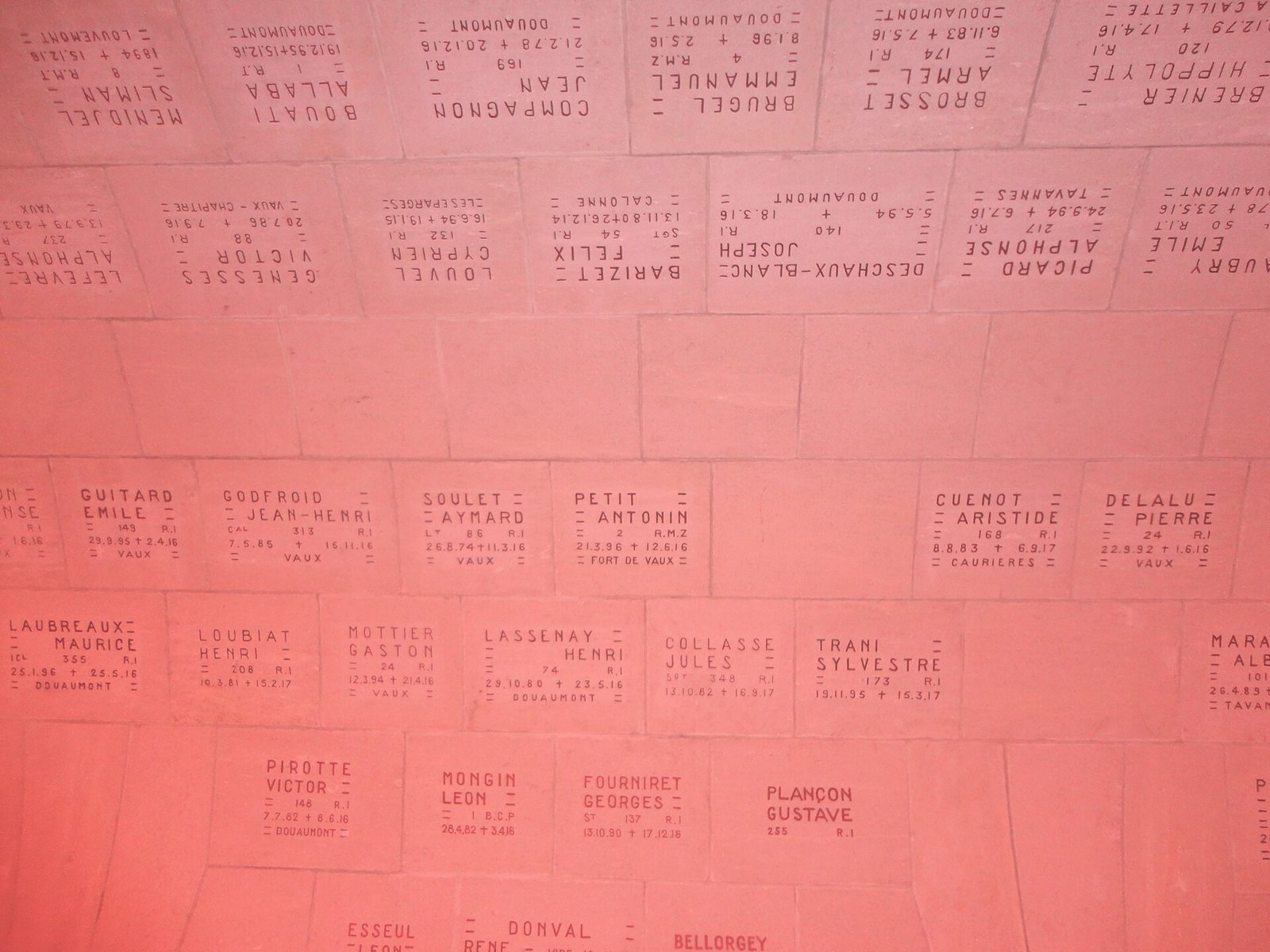
One soldier's story shows how. A 2023 account from the town of Plozévet tells how the soldier Pierre Marie Strullu was matched to his remains, which had been buried under an incorrect name in the Douaumont national necropolis. That was an individual grave in the cemetery, not the ossuary's collective vaults.
Remains also still come to light on the battlefield. In October 2024, L'Est Républicain reported that several First World War skeletons had come to light during utility work near the Jewish memorial; no identification had been announced at the time of the report. If you are looking for a relative who fought at Verdun, the ossuary's English-language page links to a search for ancestors.
Visiting in 2026: tickets, hours and rules
The ossuary's visitor information page for the 2026 season sets out the essentials. The complete visit, including the film and the tower, costs €7 for adults, €3 for children aged 8 to 16 and €4.50 for students. Individual visitors do not need to book.
Hours change with the season. From April to June 2026, the ossuary opened from 9:00 to 18:00 on weekdays and from 10:00 to 18:00 on weekends and public holidays; in July and August it opened from 9:00 to 18:30 every day. Last entry is one hour before closing. For any other month, check the official page before you travel, since hours and prices can change.
Tap or hover a row to highlight it.
| Visitor | Full visit with film and tower |
|---|---|
| VisitorAdult | Full visit with film and tower€7 |
| VisitorChild aged 8 to 16 | Full visit with film and tower€3 |
| VisitorStudent | Full visit with film and tower€4.50 |
The visit includes a small museum, the cloister, the chapel, the tower and a film about Verdun. According to the Grand Verdun tourism office, the film lasts about 20 minutes and runs every half hour, with translation headsets in English, German, Dutch, Russian and Chinese. From the top of the 46 metre tower you look out over the battlefield. The ossuary suggests allowing about an hour in all.
This is a memorial, and the house rules follow from that. Photography and filming are not allowed inside the monument, and neither are mobile phones, eating, drinking, smoking, shouting or running.
Visiting the Douaumont ossuary: the house rules
Tap a card to bring it forward.
- Photos: No photography or filming inside the monument.
- Phones: Mobile phone use is not allowed inside.
- Food and drink: No eating or drinking.
- Smoking: No smoking.
- Quiet: No shouting or running.
- Timing: Last entry is one hour before closing.
How well do you know the Douaumont ossuary?
Answer every question to check.
Questions about visiting the Douaumont ossuary
A few practical answers before you plan a day at Verdun.
Can you see the bones at Douaumont?
Yes, through the small exterior windows at the base of the ossuary, which look into the vaults. Remember that photography and filming are not allowed inside the monument, and that the bones belong to soldiers whose descendants still visit.
Is the Douaumont ossuary worth visiting?
For anyone interested in Verdun, the First World War or remembrance, yes: in about an hour you see the ossuary, chapel, cloister, tower view and film, with the national cemetery right outside. It is a solemn memorial rather than an attraction, so whether it suits you depends on how comfortable you are at a place of mourning.
Can you visit the destroyed village of Fleury-devant-Douaumont?
Ask the Grand Verdun tourism office or the Mémorial de Verdun about visiting it. The national cemetery in front of the ossuary carries the village's name, and the Mémorial de Verdun tells the story of the villages destroyed in the battle.
Can you combine the ossuary with other Verdun sites?
Yes, many visitors pair it with Fort Douaumont, Fort Vaux and the Mémorial de Verdun on the same trip. Each site keeps its own hours and tickets, so check their official pages when you plan the day.
More places where the dead are kept together
Douaumont is one of many places where human bones were gathered and kept together. To see how others compare, read about ossuaries around the world, and for two of Europe's best known, the Sedlec Ossuary and the Paris Catacombs. The Czermna skull chapel in Poland includes remains linked to wars, and in Serbia the Skull Tower of Niš is another monument tied to the dead of war.
If the work of naming the dead interests you, see what bones tell archaeologists. Across the ocean, the catacombs of Lima keep thousands of mostly unnamed people from colonial Peru, and the old idea behind all these places is in what memento mori means.
Terms in this story
Tap a term to see what it means.
Ossuary. A building or chamber where human bones are gathered and kept. At Douaumont it holds the remains of about 130,000 unidentified French and German soldiers.
---