

No. 007
The Skull Chapel in Czermna, Poland: Who Built It and Why
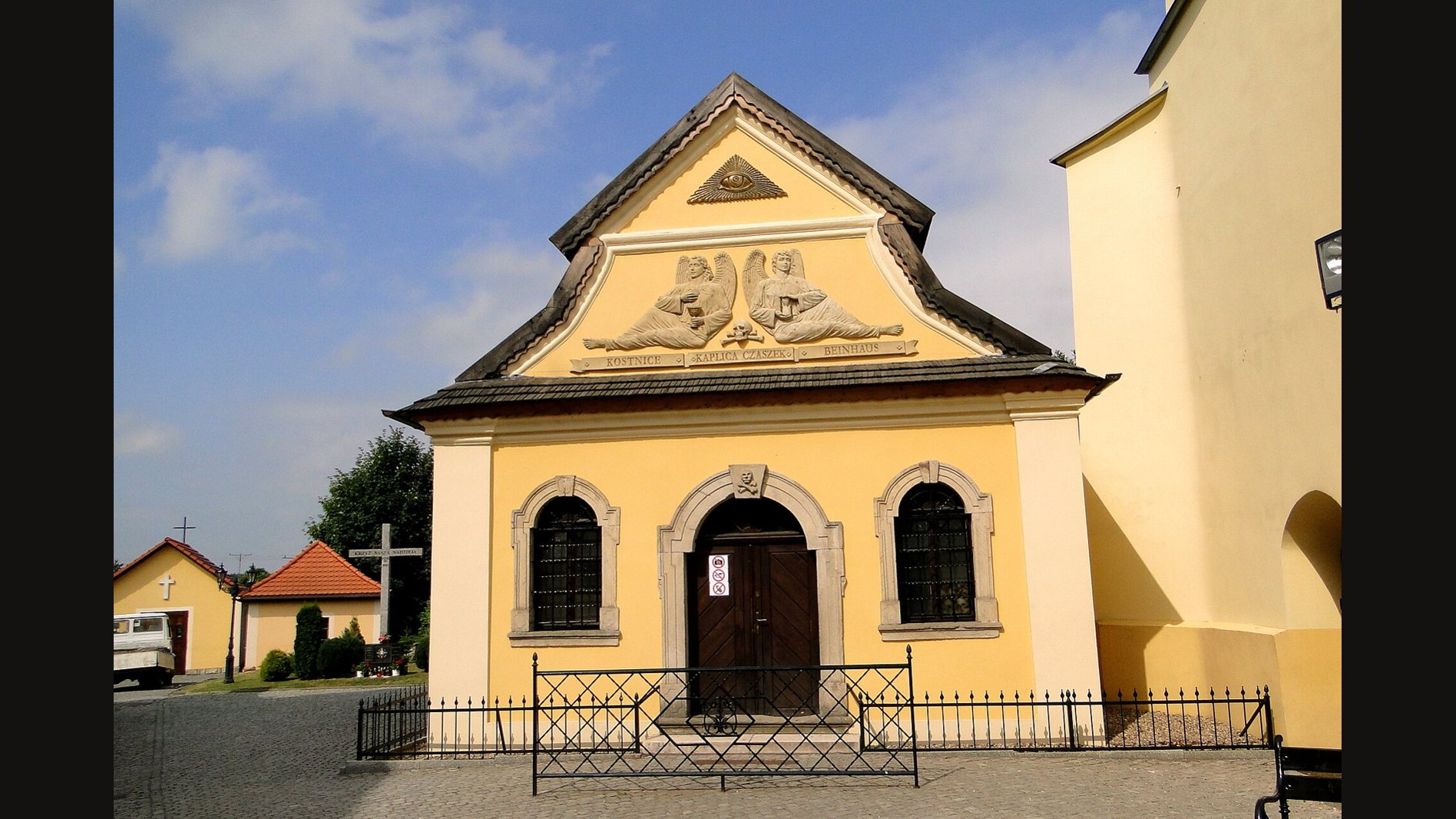
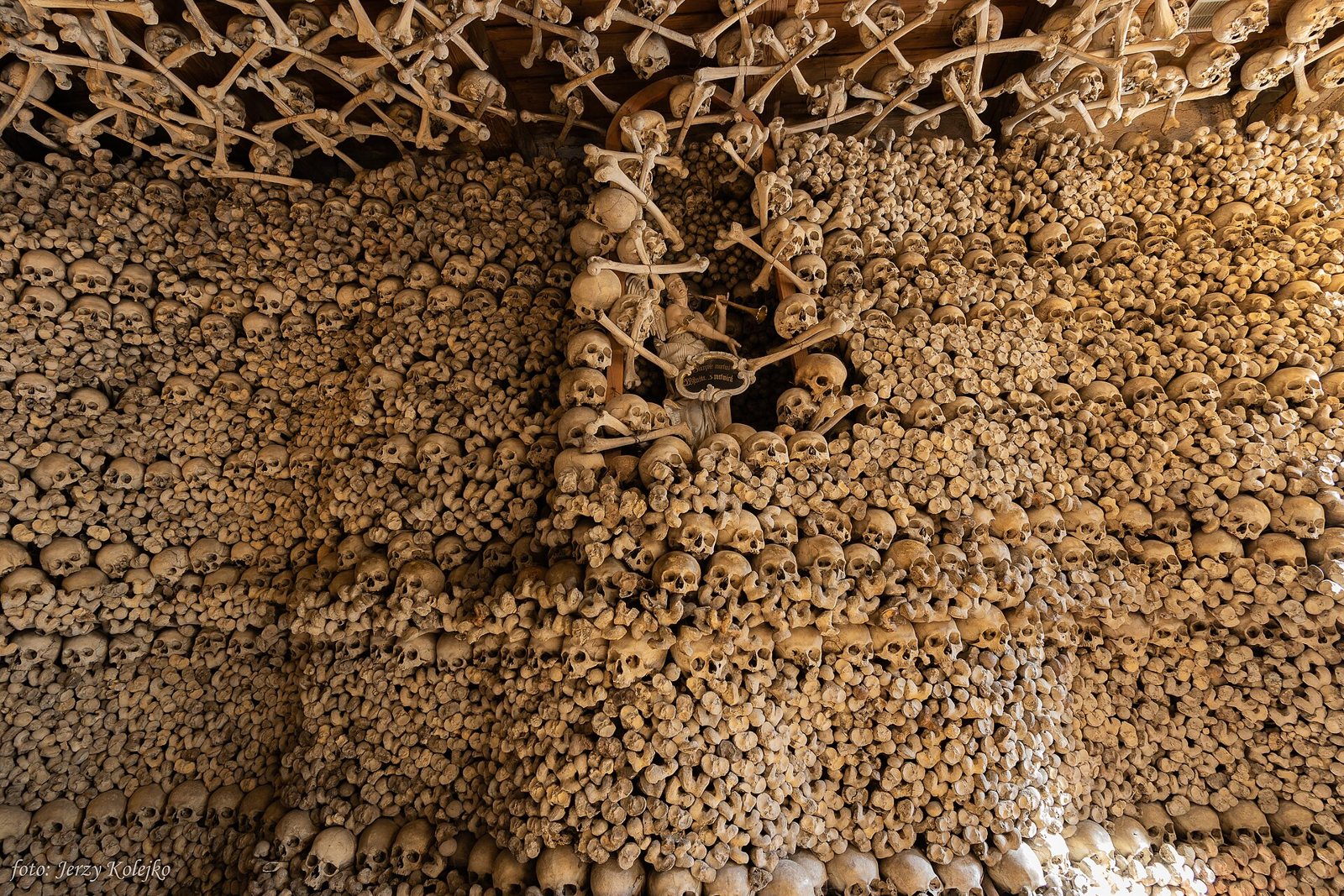
Yes, there is a chapel in Poland lined with skulls. The Kaplica Czaszek, or Skull Chapel (in Spanish, the Capilla de las Calaveras), is a small Catholic ossuary beside St. Bartholomew's Church in Czermna, now part of the town of Kudowa-Zdrój in Lower Silesia. About 3,000 human skulls and bones cover its walls and ceiling, and thousands more remains rest in the crypt below. It was built by the parish priest, Father Wacław Tomaszek, who began in 1776 and kept working until his death in 1804. He gathered the bones of people who had died in the region's wars and epidemics so they could rest together in a sacred place, and he arranged them as a Christian meditation on death and resurrection.
It is a chapel that keeps the dead, rather than a building made of bones. Here is who built it, whose remains are there and what visitors see today.
Father Tomaszek and the bones by the bell tower
The chapel's builder was a Czech-born priest whose name appears in several spellings: Wacław Tomaszek in Polish, Václav or Wentzel Tomaschek in Czech and German records. He served as the parish priest of Czermna in the eighteenth century, in the Kłodzko region.
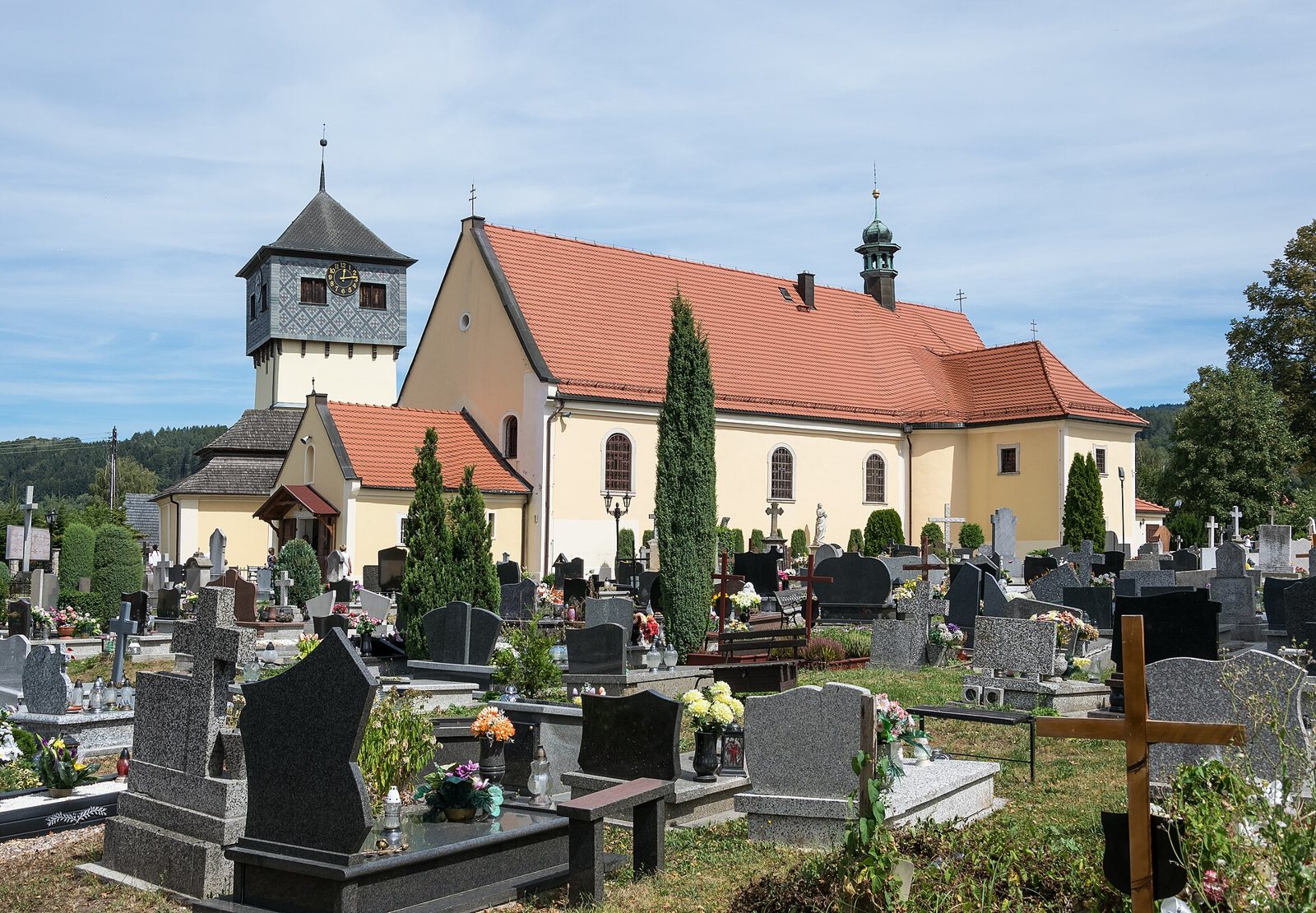
According to the Silesia e-ncyklopedia, the project began in 1776, when human remains came to light near the church bell tower. Tomaszek did not leave them where they lay. With the help of the gravedigger J. Langer and the sacristan J. Schmidt, he collected bones exposed near the church and from burial grounds around the Kłodzko region. The three men cleaned them and began arranging them in a small chapel beside the church.
The work took nearly three decades. Tomaszek kept gathering and placing remains until 1804, the year he died. The Polish Tourism Organization records that he took his inspiration from the Capuchin cemetery in Rome, the bone-decorated crypt now known to visitors as the Capuchin Crypt.
Why he built it
Tomaszek's chapel had more than one purpose, and they fit together. It was an ossuary, a place where bones exposed near the church and gathered from burial grounds could be laid to rest again with dignity. It was a memorial to the people of the region who had died in war and disease. And it was a sermon in bone.
The historian Tadeusz Fitych, writing in the journal *Studia Redemptorystowskie* in 2008, describes the chapel as a catechesis about resurrection: a lesson in Christian faith told through the remains themselves. The bones say that every life ends; the altar and its figures say what the faith believes comes after. Seen that way, the skulls are not decoration for its own sake. They are the dead of the parish and the region, kept close to the church and the living who pray there.
That idea, the skull as a call to remember death and hope for resurrection, runs through a great deal of Christian art. Our story on skulls in Christianity follows it further.
Whose remains are in the chapel, and how many?
The remains in the Skull Chapel are attributed to people who died in regional wars and epidemics, but the historical accounts differ on which ones.
- The Silesia e-ncyklopedia names victims of the Silesian Wars of 1740 to 1742 and 1744 to 1745, together with victims of eighteenth century cholera epidemics.
- The National Museum in Wrocław connects the remains with the Thirty Years' War, the Seven Years' War and a cholera epidemic in 1680.
The individual people are not named. They are remembered together, as the chapel presents them: people of the region whose bones were gathered and brought to rest together beside their parish church.
The numbers also come as estimates, and each one belongs to the account that gives it. About 3,000 skulls and bones line the walls and ceiling of the chapel itself, according to the Polish Tourism Organization. The crypt beneath is estimated to hold another 20,000 to 30,000 remains, according to the Silesia e-ncyklopedia. The National Museum in Wrocław records an older total of 24,000 skulls and tibias used in the chapel. These figures come from different accounts, so they are best read side by side.
Tap or hover a row to highlight it.
| Fact | Detail | Given by |
|---|---|---|
| FactLocation | DetailCzermna district of Kudowa-Zdrój, Lower Silesia, Poland | Given byPolish Tourism Organization |
| FactBegun | Detail1776, by Father Wacław Tomaszek | Given bySilesia e-ncyklopedia |
| FactWork period | Detail1776 to 1804 | Given bySilesia e-ncyklopedia |
| FactRemains on the walls and ceiling | DetailAbout 3,000 skulls and bones | Given byPolish Tourism Organization |
| FactRemains in the crypt | DetailAbout 20,000 to 30,000 | Given bySilesia e-ncyklopedia |
| FactOlder recorded total | Detail24,000 skulls and tibias | Given byNational Museum in Wrocław |
| FactComparable site | DetailSedlec Ossuary, Czechia, reorganized by 1870 | Given bySedlec Ossuary |
Inside the chapel: the altar, the angels and the crypt
The Kaplica Czaszek is small. Inside, its Baroque interior is covered with skulls and bones across the walls and ceiling.
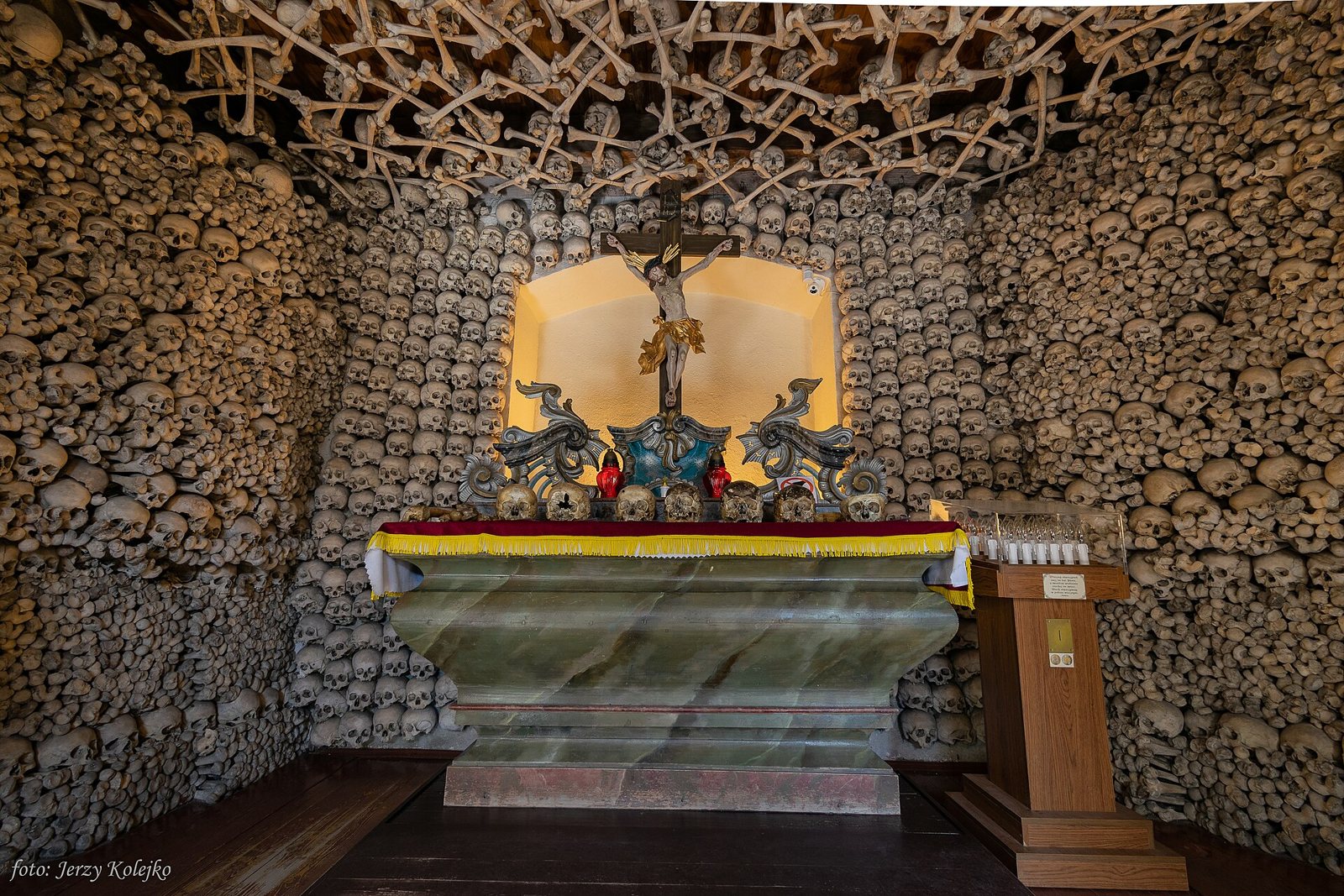
The altar holds a Baroque crucifix. Two angel figures stand among the remains, one carrying a trumpet and the other holding scales, the trumpet of the resurrection and the scales of judgment. Their Latin inscriptions are commonly translated as "Arise from the dead" and "Go before judgment." Together with the crucifix, they turn the room into the lesson Fitych describes: death, then judgment, then the hope of rising again.
A 1994 article in the Polish newspaper *Gazeta Jarocińska* reported that a display case near the altar held the skull attributed to Father Tomaszek and the skull of the gravedigger Langer, alongside some anatomical specimens. If that is part of what draws you, the chapel's guides can tell you what is displayed today and how the attributions are understood.
Beneath the chapel lies the crypt, with the larger number of remains, the estimated 20,000 to 30,000 people whose bones were gathered but not placed on the walls above.
The Skull Chapel in Czermna through time
Tap or hover a step to follow the order.
1776
Father Wacław Tomaszek begins the chapel after human remains come to light near the church bell tower
1776 to 1804
Tomaszek, gravedigger J. Langer and sacristan J. Schmidt collect, clean and arrange the remains
1804
The founding period ends with Tomaszek's death
1870
In Czechia, František Rint completes the reorganization of the Sedlec Ossuary
About 1910
A postcard, now in the National Museum in Wrocław, records the chapel interior
1994
Gazeta Jarocińska reports skulls attributed to Tomaszek and Langer displayed near the altar
October 2026
The official visitor site lists daily guided visits from 9:30 to 17:00
How Czermna compares with Sedlec and other bone chapels
Czermna is often mentioned in the same breath as the Sedlec Ossuary in Kutná Hora, Czechia, and the two have a lot in common. Both are Catholic ossuaries that keep human remains inside a chapel. Their histories, though, are quite different.
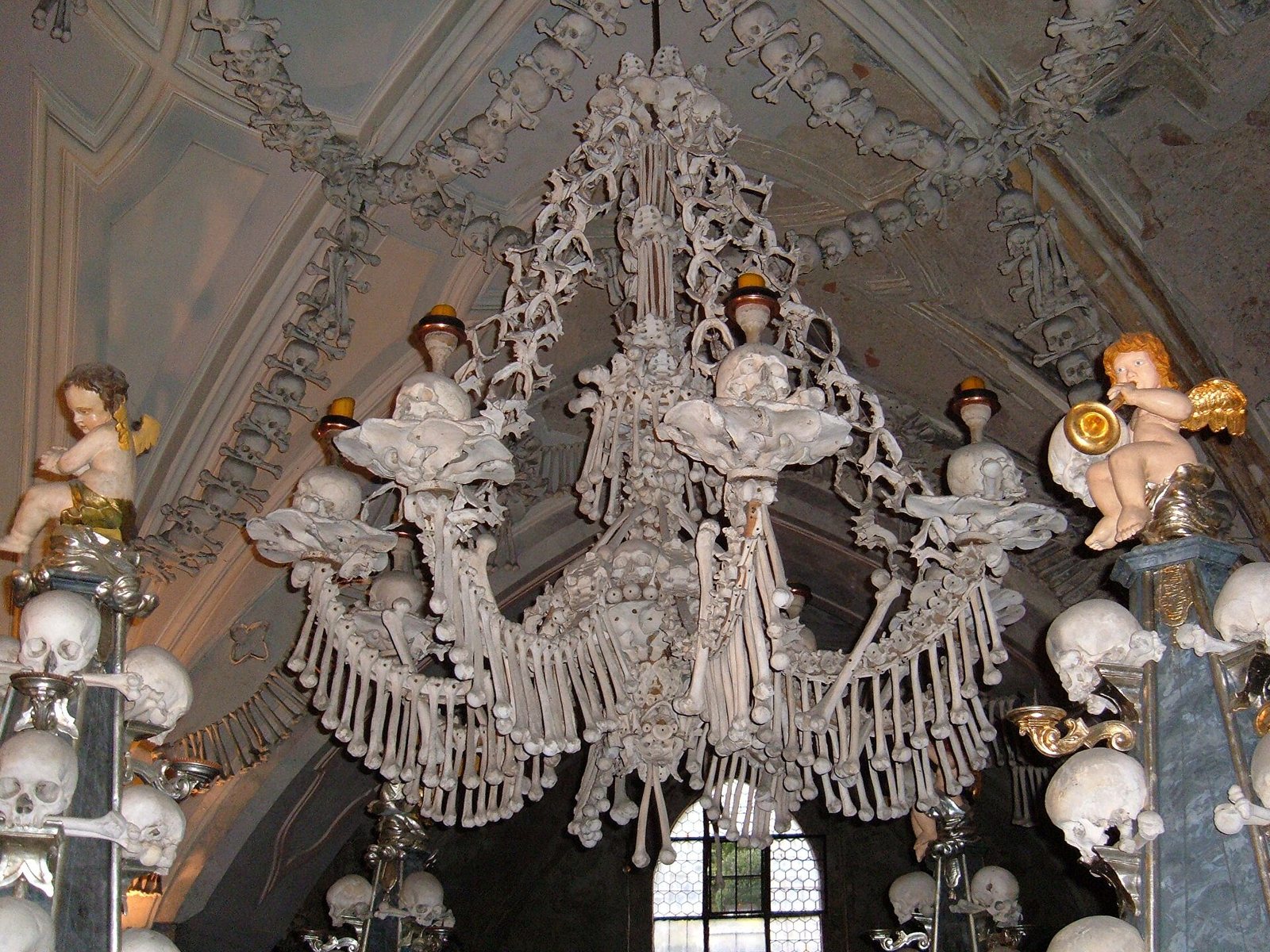
At Czermna, a parish priest began the work in 1776, responding to remains exposed from the region's wars and epidemics, and he finished his part within his own lifetime. Sedlec is older and grew in layers. The official Sedlec history explains that it began as part of a medieval Cistercian cemetery complex, and that its bones came from exhumed medieval graves associated with famine, plague and the Hussite wars. Jan Santini-Aichel is associated with its early Baroque arrangement, and František Rint completed a major reorganization in 1870 for the Schwarzenberg family. Sedlec holds the remains of tens of thousands of people and is known for bone decorations such as a chandelier and a coat of arms.
Two other bone chapels often come up alongside them: the Capuchin crypt at Santa Maria della Concezione in Rome, which inspired Tomaszek, and the Chapel of Bones in Évora, the Capela dos Ossos in Portugal. All of them belong to the long Catholic practice of keeping and honoring the bones of the dead, and all of them invite visitors to think about mortality. They were not built for one shared reason, and each has its own community and story. Our tour of ossuaries around the world gathers more of them.
Visiting the Skull Chapel
The Skull Chapel is still a place of prayer and remembrance in a working parish, and visits are arranged with that in mind. The details below are as the official Kaplica Czaszek site stated them on October 6, 2026:
- Address: Stanisława Moniuszki 8a, 57-350 Kudowa-Zdrój, Poland.
- Opening: daily, 9:30 to 17:00.
- Visits are guided.
- Prices: 20 zł for adults, 15 zł for seniors aged 65 and over, 12 zł for children and young people aged 6 to 18, and free for children under 6.
- Photography is not allowed inside.
The parish's own price sheet from 2024 lists a different, lower set of prices, says payment is cash only, and explains that admission income supports the repair, conservation and upkeep of the parish's religious buildings. Because these details change, confirm current hours, prices, guide arrangements and photography rules with the official site or the parish before you travel.
Inside, the guidance is simple: these are the remains of real people, gathered by their own parish so they would be cared for. Visitors who treat the chapel as they would any church, quietly and respectfully, are seeing it as it was meant to be seen.
Skull Chapel in Czermna quiz
Answer every question to check.
Questions about the Skull Chapel in Czermna
These short answers cover what people most often ask about the chapel.
Is there a church in Poland made of skulls?
Yes, the Kaplica Czaszek in Czermna, part of Kudowa-Zdrój in Lower Silesia, is a chapel whose walls and ceiling are lined with about 3,000 human skulls and bones. It stands beside St. Bartholomew's Church and keeps thousands more remains in its crypt, so it is a chapel that holds the dead rather than a church built of bone.
Who built the Skull Chapel in Czermna?
Father Wacław Tomaszek, the Czech-born parish priest of Czermna, built the Skull Chapel between 1776 and 1804. The gravedigger J. Langer and the sacristan J. Schmidt helped him collect, clean and arrange the remains from burial grounds around the Kłodzko region.
How many skulls are in the Czermna chapel?
The chapel holds about 3,000 skulls and bones on its walls and ceiling, with an estimated 20,000 to 30,000 more remains in the crypt. The National Museum in Wrocław records an older total of 24,000 skulls and tibias, so the figures are estimates from different accounts.
Whose bones are in the Skull Chapel?
The bones belong to people of the region who died in wars and epidemics, and the accounts name different events: the Silesian Wars of the 1740s and eighteenth century cholera in one, the Thirty Years' War, the Seven Years' War and a 1680 cholera epidemic in another. Individual people are not identified.
Is the Czermna Skull Chapel like the Sedlec Ossuary?
The Czermna Skull Chapel is like the Sedlec Ossuary in being a Catholic chapel that keeps and displays human remains, but the two have different histories. Czermna was the work of one parish priest from 1776 to 1804, while Sedlec grew from a medieval Cistercian cemetery and took its present form with František Rint's reorganization in 1870.
Where to go next
If the Skull Chapel moved you, the Sedlec Ossuary and the Capuchin Crypt are the two bone chapels most closely tied to its story. For more places where communities have kept their dead in view, read about the Hallstatt bone house and our wider guide to ossuaries around the world.
Terms in this story
Tap a term to see what it means.
Kaplica Czaszek. Polish for Skull Chapel, the name of the ossuary chapel in Czermna built by Father Wacław Tomaszek from 1776 to 1804.