

No. 008
Hallstatt Bone House: Why an Austrian Village Painted Its Skulls
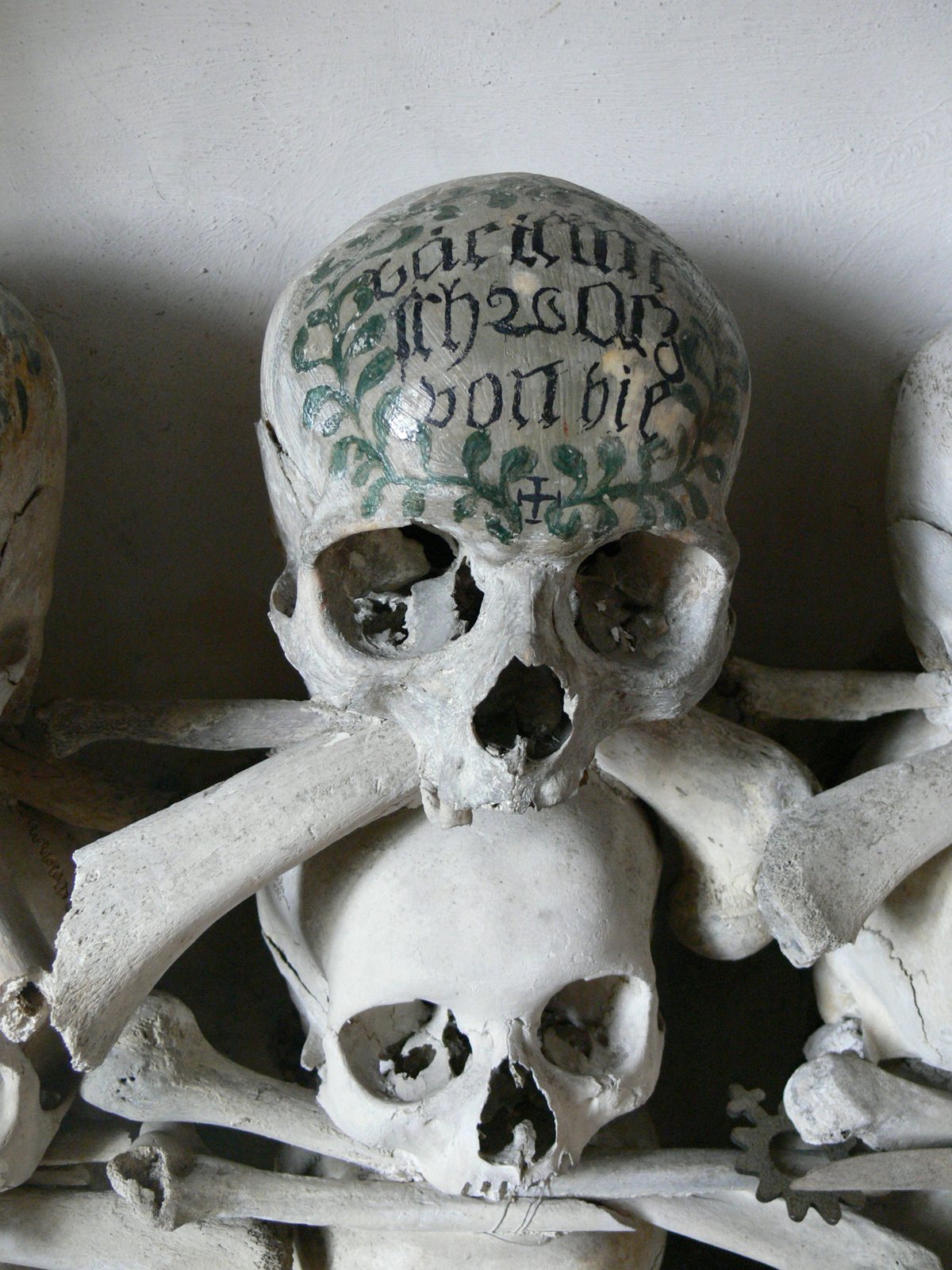
Hallstatt painted its dead because it had almost nowhere to bury them. The village churchyard sits on a narrow ledge between the mountain and Lake Hallstatt, and it could not grow. So, after roughly 10 to 15 years, graves were reopened, and the skull and long bones were cleaned and carried into the Beinhaus, the Bone House under St. Michael's Chapel, to make room for the next burial. From around 1720, families had those skulls painted with names, dates, crosses, leaves and flowers so that each person stayed recognizable and remembered. Today the Bone House holds about 1,200 skulls, and 610 of them are painted.
That is the short answer. The longer one involves a gravedigger who painted skulls himself in the 1980s, a woman who asked to be the last, and a custom that once stretched across a good part of the Alps.
What the Bone House is
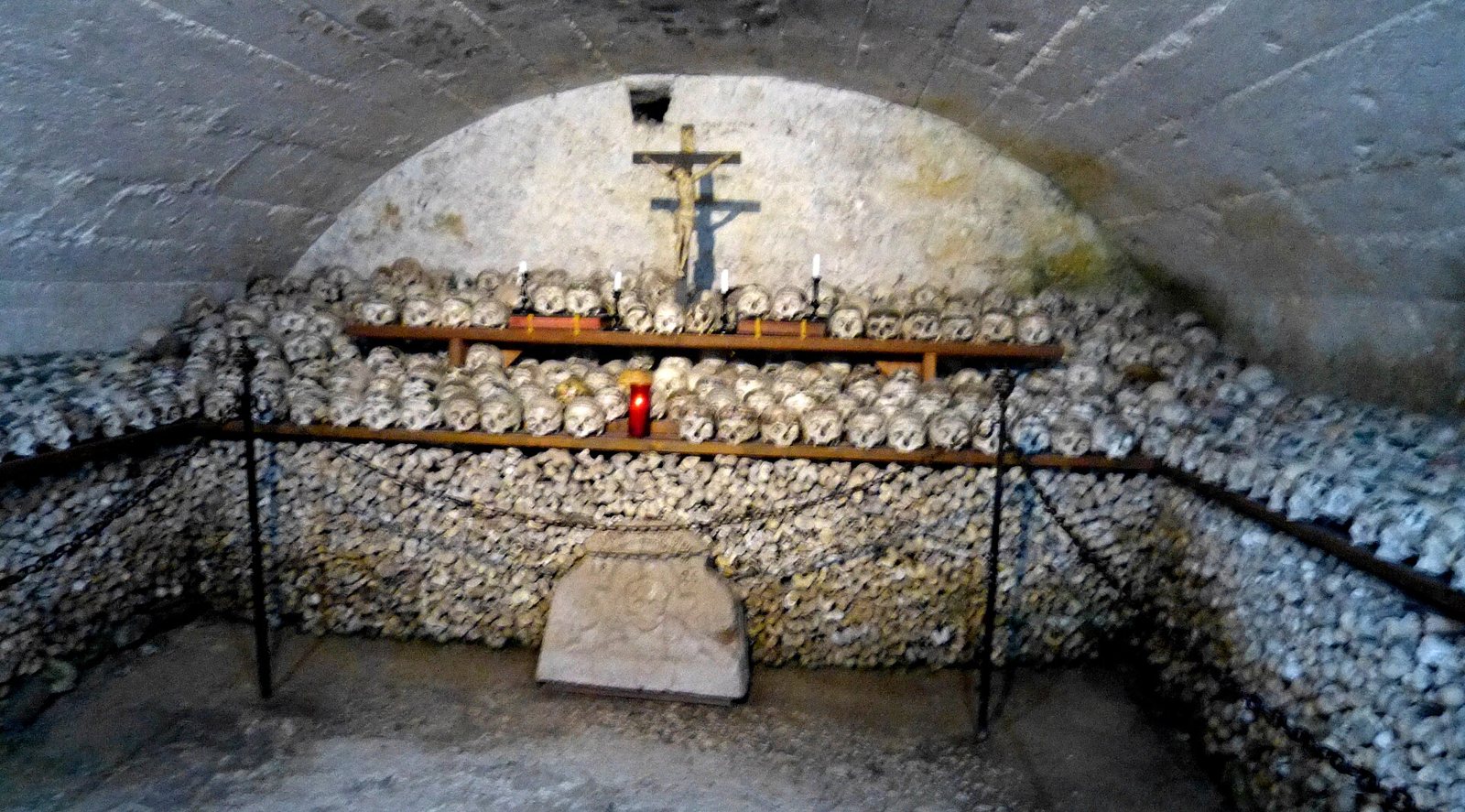
The Beinhaus is an ossuary, a place that keeps human bones after the body has decomposed. In Hallstatt it sits in the basement of St. Michael's Chapel, right beside the village's Catholic parish church. The chapel dates to the 12th century, according to Salzkammergut tourism, so the building is far older than the painting custom it later housed.
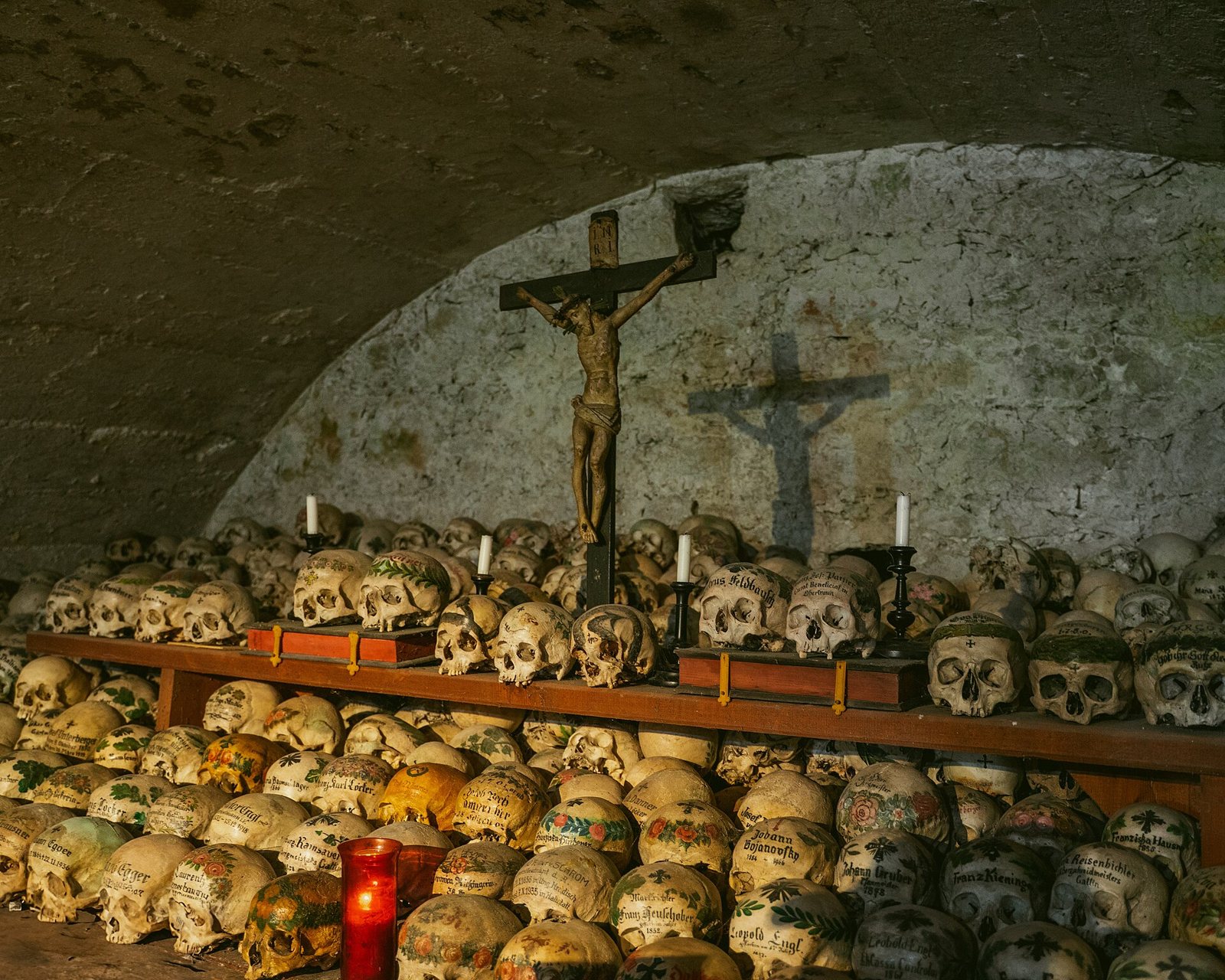
Inside, the skulls are stacked on shelves with long bones beneath them. The Hallstatt parish of the Diocese of Linz and regional tourism give the collection as about 1,200 skulls, with 610 painted. They are arranged by family and marked with names and death dates, so the room holds named people, many of them beside their relatives.
If you have only seen the close-up photographs, the scale can be surprising. It is a small room, and the effect comes less from size than from the faces of the skulls lined up row after row, each carrying a name.
A churchyard with nowhere to grow
Hallstatt is squeezed between steep slopes and deep water. The UNESCO World Heritage documentation for the area describes that restricted geography and the practical problem it created for the cemetery. There was simply no flat ground to add.
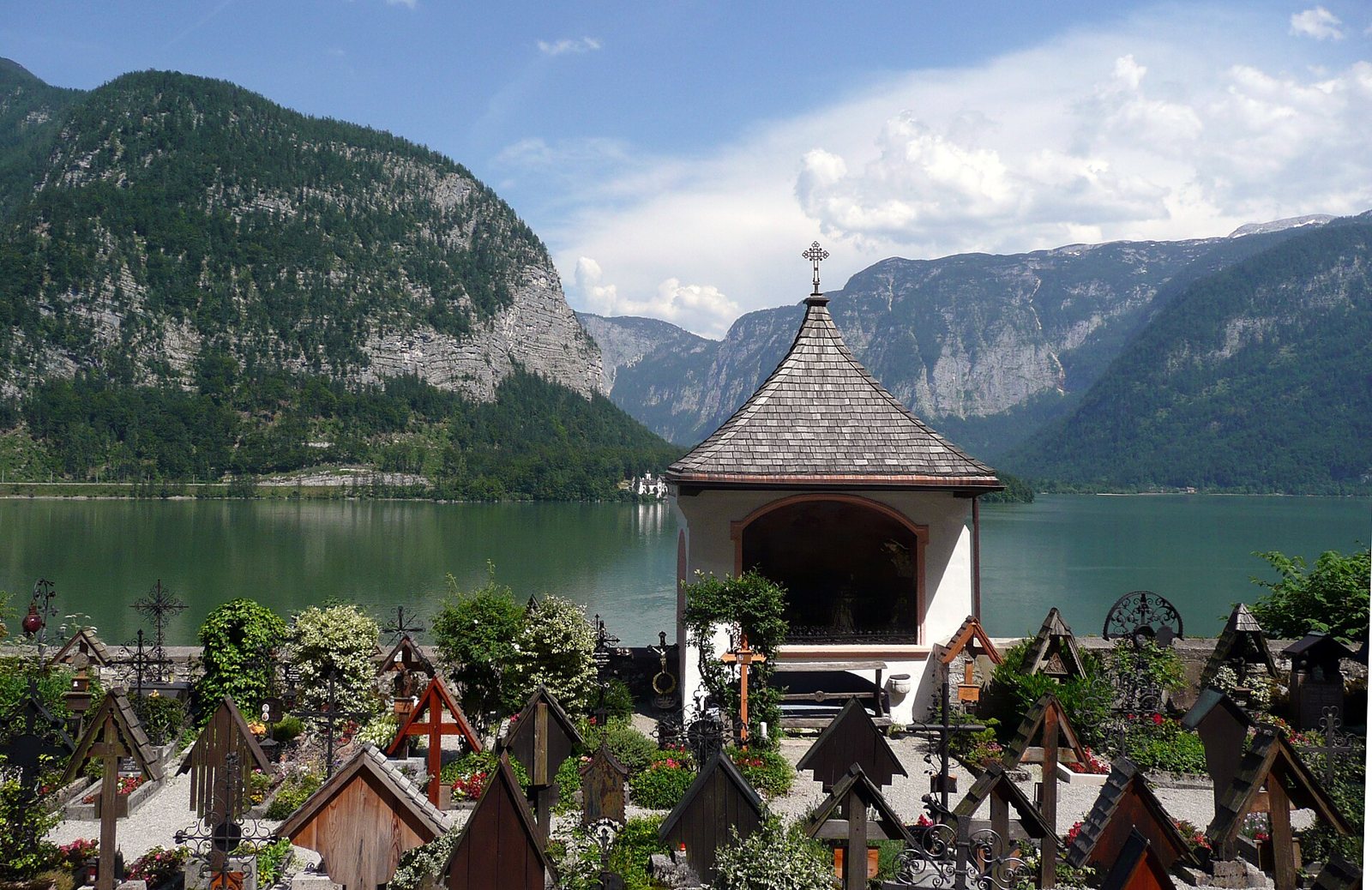
The answer was a second burial. A person was first buried in the churchyard in the usual way. After roughly 10 to 15 years, once the body had decomposed, the grave was opened again, and the skull and long bones were lifted out, cleaned and moved to the ossuary. The grave could then receive someone new. The parish says skulls had been kept in the Beinhaus as a second burial since the early 17th century, about a hundred years before anyone started painting them.
Second burial was not a Hallstatt invention. Communities in many places have moved bones into ossuaries when burial ground ran short, and you can read about several of them in our guide to ossuaries around the world. What Hallstatt added was the paint.
The Hallstatt Bone House through the centuries
Tap or hover a step to follow the order.
12th century
St. Michael's Chapel and its ossuary are built
Early 17th century
Skulls and bones are kept in the Beinhaus as a second burial
Around 1720
Families begin having skulls painted and dated
19th century
Skull painting is widespread across the eastern Alpine region
1981 to 1987
Friedrich Idam works as Hallstatt's gravedigger and paints exhumed skulls
1995
The last skull is added to the ossuary
How a skull was prepared and painted
The best first-hand account comes from Friedrich Idam, who worked as Hallstatt's gravedigger from 1981 to 1987 and later wrote about the custom in an essay titled "Bemalte Totenköpfe" (painted skulls). He describes cleaning the exhumed skulls and then leaving them out in the sun and moonlight for weeks until they turned a pale ivory color. Only then were they ready to be painted.
According to the parish, the dating and painting of skulls began around 1720. Idam records that regular exhumation continued in Hallstatt into the mid-1980s, which means the custom was still part of village life within living memory. He was not describing an old practice he had read about; he was describing his own job.
The painting itself was done on the bleached bone: a name or initials, the year of death and sometimes the year of birth, often a cross, and a band of leaves or flowers. The result is something between a grave marker and a portrait. A relative could walk into the Beinhaus and find a grandmother by her name and her flowers.
Reading the paintings
Most Hallstatt skulls carry the same core information you would find on a headstone: names or initials, birth and death years, and a cross. What catches the eye in photographs is the decoration around them.
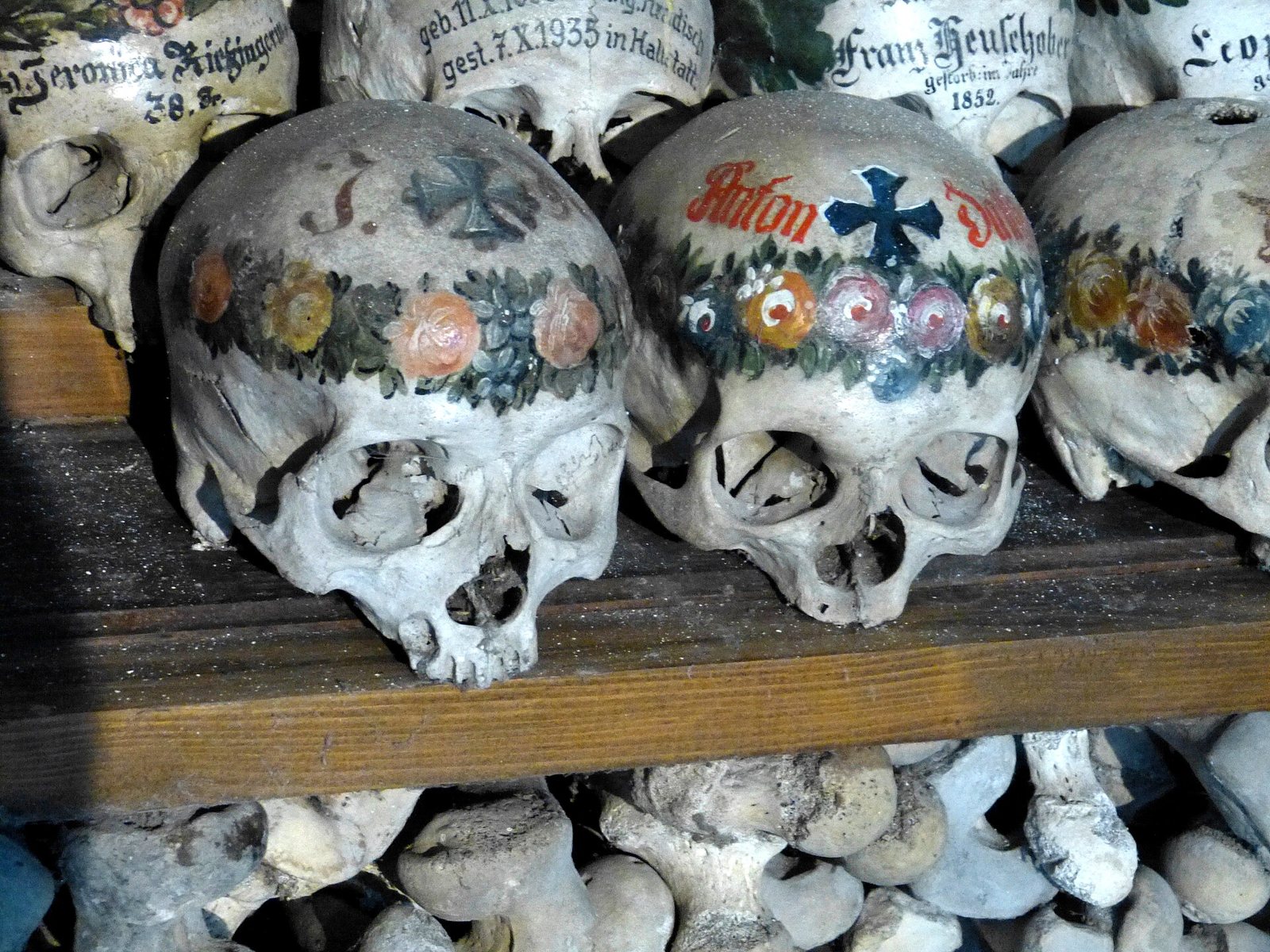
Idam describes ivy and oak leaves painted in dark green on many of the men's skulls and flower patterns on many of the women's. He also notes that painting styles changed over the years and that some meanings are uncertain. Some skulls carry occupational symbols, such as the crossed hammer and pick associated with miners, which makes sense in a place whose history is bound up with salt mining.
Historian Paul Koudounaris, speaking to Smithsonian Magazine, gave a set of traditional meanings for the plants: oak for glory, laurel for victory, ivy for life and roses for love. Those meanings are a helpful guide, but they are interpretations, not a code that every painter followed for every skull. There is even one rare skull painted with a snake, and its meaning remains uncertain.
What the painted skulls of Hallstatt carry
Tap a card to bring it forward.
- Names and initials: Who the person was, so relatives could find them after second burial
- Birth and death years: The same dates a headstone would give
- Crosses: A Christian burial mark on a skull kept in a church ossuary
- Ivy and oak leaves: Painted in dark green on many men's skulls, according to gravedigger Friedrich Idam
- Flowers: Painted on many women's skulls, according to Idam
- Oak, laurel, ivy, roses: Glory, victory, life and love, in historian Paul Koudounaris's reading
- Crossed hammer and pick: An occupational symbol associated with miners
- A snake: Painted on one rare skull; its meaning is uncertain
The painting did two jobs at once. It kept identity attached to bones that had left their own graves, and it gave families a way to honor them. The Hallstatt tourism office describes the inscriptions in just those terms, as a way of preserving who each person was.
The last skull, added in 1995
The most asked-about skull in the room is also the newest. According to Salzkammergut tourism, the last skull entered the ossuary in 1995. It belonged to a woman who died in 1983 and had asked to be laid to rest in the Bone House.
Her request says a lot about how the village saw the place. By then, exhumation was ending, and she could have stayed in the churchyard. She chose to join her community's dead on the shelves, painted and named like the generations before her. Smithsonian Magazine tells the same 1995 story.
Part of a wider Alpine custom
Hallstatt is the most photographed example, but painted skulls belonged to a much larger region. The Hallstatt tourism office describes skull painting as primarily a 19th-century practice across the eastern Alps, and records of it come from Upper Austria, Salzburg, the Austrian Innviertel, Tyrol, Bavaria and parts of Switzerland.
Museums hold examples from outside Hallstatt. The Museum of Ethnology Hamburg has a 19th-century painted skull from Tyrol whose green wreath and white blossoms indicated that the person had died unmarried, according to the museum's description. The same museum notes that from the late 18th to the early 20th century, families in Austria and parts of Bavaria and Switzerland could have skulls painted before secondary burial.
In Tyrol, the Tiroler Bildungsservice describes an ossuary at Elbigenalp, built for the same reason Hallstatt's was: too little churchyard space. The Anatomical Collections in Innsbruck hold painted ossuary skulls from several Austrian mountain areas, particularly Hallstatt and the Paznaun Valley in Tyrol. If you want to see another site, treat Hallstatt as one part of this wider custom and confirm each place with its local church, museum or heritage office before you go.
The idea behind all of them sits close to the Christian habit of keeping death in view, the theme behind memento mori and the long story of skulls in Christianity. Hallstatt's version simply adds a name and a sprig of ivy.
Visiting the Bone House
The Bone House is open to visitors. The official Hallstatt tourism page, as of October 2026, lists it at the Catholic Church in central Hallstatt with seasonal opening hours: daily through spring, summer and October, with the longest hours in summer, and Wednesday to Sunday only from November through March. It lists admission at 2 euros for adults and 0.50 euros for children and says both cards and cash are accepted.
The same page warns that details may change, so confirm the current hours and fee with the parish before you travel. The parish address is Kirchenweg 40, 4830 Hallstatt, Austria, and its phone number is +43 6134 8279. Ask the parish about photography rules too, before you visit.
It is worth remembering that this is a working parish and a burial place, kept by the parish as a resting place for named members of the community.
Hallstatt Bone House quiz
Answer every question to check.
Frequently asked questions
What is famous about Hallstatt?
Hallstatt is famous for its lakeside Alpine setting, its prehistoric salt-mining history, its place within a UNESCO World Heritage site and its historic churches. It is also known for the Beinhaus in St. Michael's Chapel, which holds about 1,200 skulls, 610 of them painted.
Why are the skulls in Hallstatt painted?
The skulls were painted to keep each person's identity and memory after their remains left an individual grave. Because the churchyard could not expand, graves were reopened after about 10 to 15 years and the bones moved to the ossuary, and names, dates, crosses, leaves and flowers kept every skull recognizable to the family.
How many skulls are in the Hallstatt Bone House?
The Bone House holds about 1,200 skulls, according to the parish and regional tourism. Of those, 610 are painted, and they are arranged by family with death dates.
What do the flowers and leaves on the skulls mean?
They are traditional symbols, read differently by different experts. Gravedigger Friedrich Idam describes ivy and oak on many men's skulls and flowers on many women's, while historian Paul Koudounaris links oak to glory, laurel to victory, ivy to life and roses to love.
Can you visit the Hallstatt Bone House?
Yes, the Bone House at St. Michael's Chapel is open to visitors during seasonal hours listed by Hallstatt tourism. The listed admission in October 2026 was 2 euros for adults and 0.50 euros for children; confirm hours, fees and photography rules with the parish before you go.
Where to go next
Hallstatt's painted skulls belong to a family of places where communities kept their dead close. The bone-built chapel at Sedlec, the friars' arrangements in Rome's Capuchin Crypt and the vast Paris Catacombs each answered the same shortage of burial space in a different way. Portugal's Chapel of Bones in Évora speaks to its visitors with a sign over the door. For the meanings people have read into skulls more broadly, start with skull symbolism.