No. 009
The Capuchin Crypt in Rome: Whose Bones They Are and What the Message Says
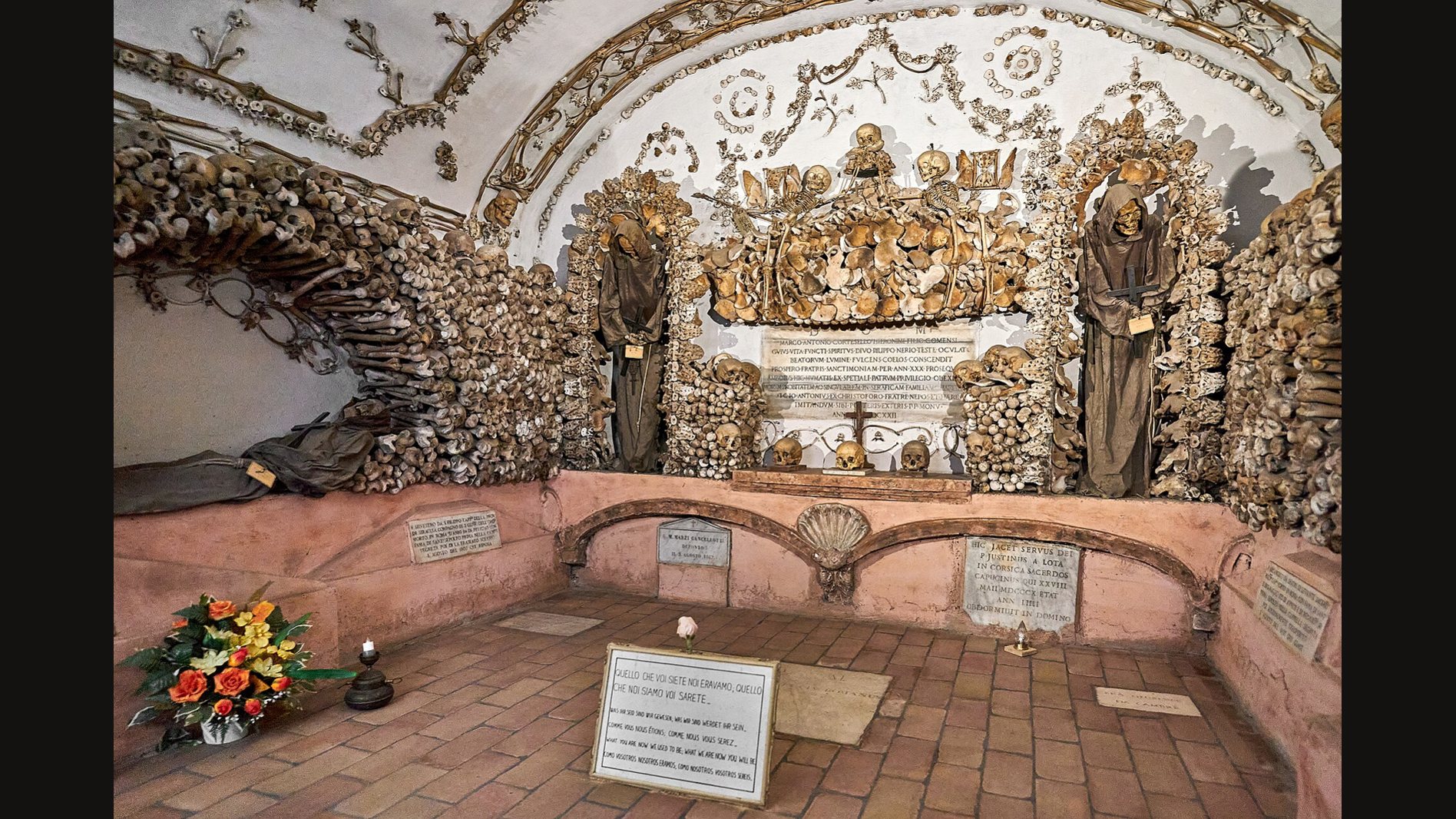
The Capuchin Crypt is the ossuary beneath the church of Santa Maria della Concezione dei Cappuccini on Via Vittorio Veneto in Rome. It holds the remains of about 3,700 people, most of them Capuchin friars, arranged into six small chapels and decorated with rosettes, stars, arches and chandeliers made of bone. The message it offers to visitors is a memento mori. In the wording quoted by Italy's Ministry of Culture, it reads *"Noi eravamo come voi e voi sarete come noi"*, which means "We were as you are, and you will be as we are." The crypt belongs to a religious community, and the friars who built it meant it as a place to think about death, not as a curiosity.
That answers the first questions. The rest of the story involves a new convent, an old cemetery, a decoration of uncertain date, and a long line of travelers who wrote about it.
What the crypt is, and how it came to be
The crypt is part of the Museo e Cripta dei Cappuccini, and you reach it by walking through the museum's exhibition rooms. The convent and church were begun in 1626 under Pope Urban VIII Barberini and Cardinal Antonio Barberini, and the plans came from a Capuchin friar, Michele da Bergamo. The friars moved into the new convent on April 16, 1631, and they brought the remains of their dead with them from the cemetery of the former San Bonaventura convent. The museum itself opened in 2012.
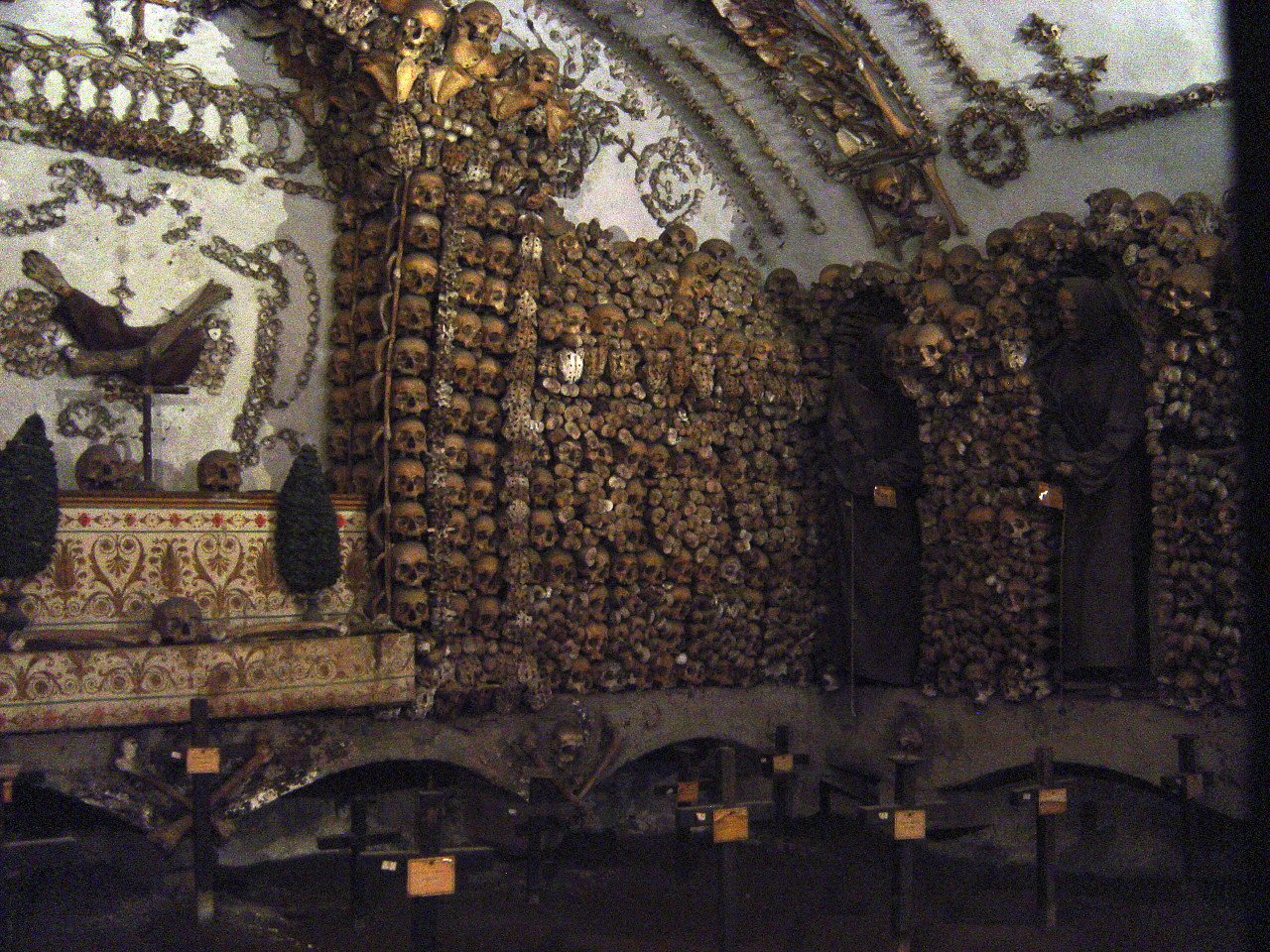
The museum describes the crypt as a religious burial site and a *memento mori*, a deliberate prompt to reflect on mortality, spiritual life and eternity.
The Capuchin Crypt from 1626 to 2012
Tap or hover a step to follow the order.
1626
Construction of the convent and church begins under the Barberini family
April 16, 1631
The Capuchins move into the Via Veneto convent and the remains from San Bonaventura are transferred
1656
The heart of Maria Felice Peretti is placed in the Mass Chapel
1660
Giuseppe Matteo Orsini is buried in the Mass Chapel
1775
The Marquis de Sade visits and describes the bone monument
1860
Hawthorne's The Marble Faun includes a fictionalized Capuchin cemetery scene
1869
Mark Twain publishes The Innocents Abroad
2012
The Museo e Cripta dei Cappuccini opens
Whose bones, and how many
The museum gives the figure as about 3,700 deceased people, mostly Capuchin friars who died in Rome. Other descriptions round upward. Rome's tourism office says nearly 4,000, Italy's Ministry of Culture describes about 4,000 friars who died between the sixteenth century and 1870, and an architectural guide offers a range of 3,500 to 4,000. For a number to repeat, "about 3,700" is the museum's own.
The collection is not a list of named monks. Many of the remains are unidentified, and the museum's own wording is "mostly Capuchin friars." A few burials are named. The Mass Chapel holds the heart of Maria Felice Peretti, who died in 1656, and the burial of Giuseppe Matteo Orsini, who died in 1660. Some complete skeletons are displayed in Capuchin habits, and the rest of the bones form the decoration.
The six spaces
The museum describes six connected spaces, one of them the chapel used for Mass. Their Italian names are worth knowing, because they appear on signs and in guides.
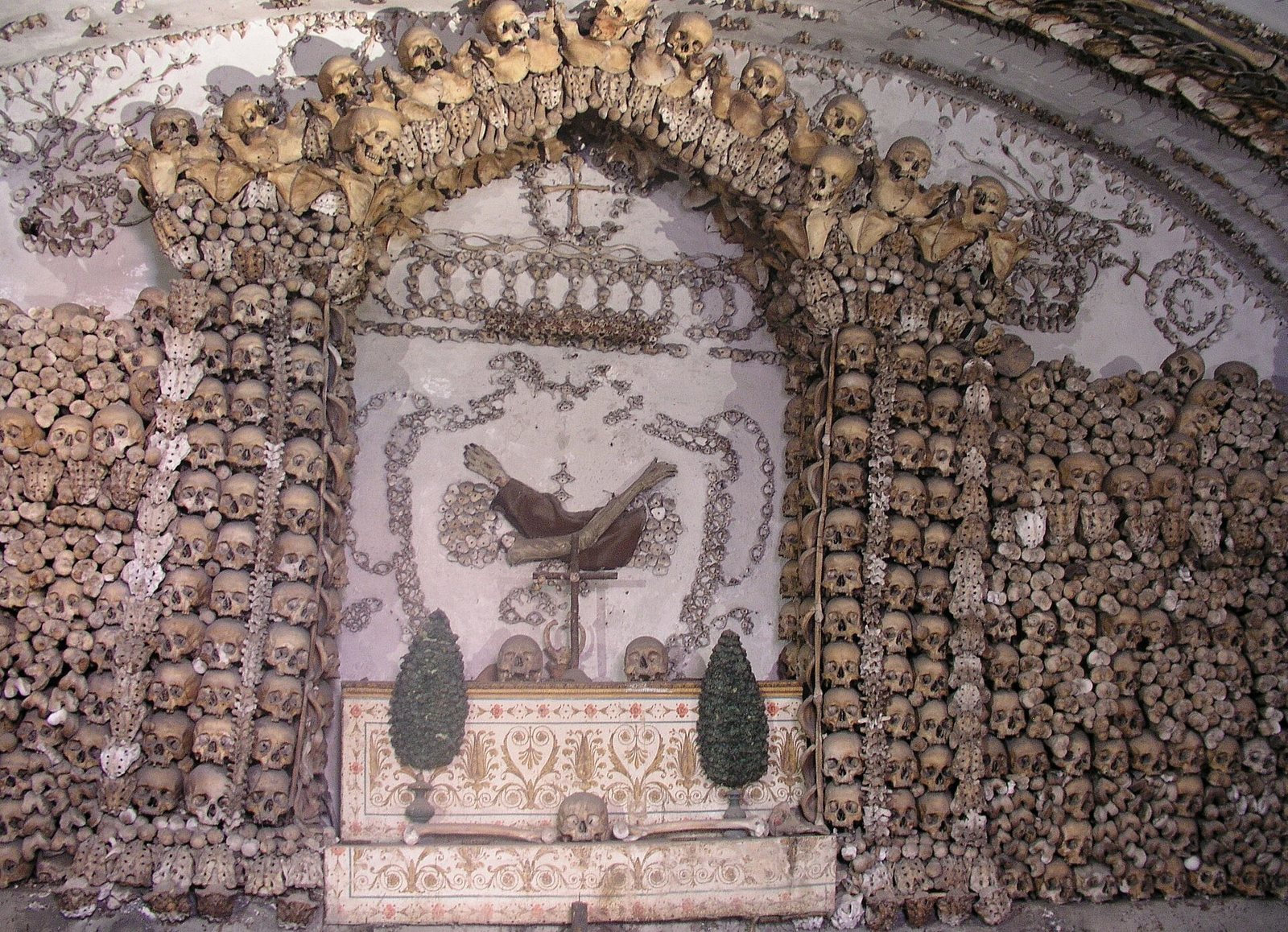
- Crypt of the Three Skeletons (*Cripta dei tre scheletri*): three young skeletons, floral bone decoration, a central figure associated with a scythe and scales, and memorial inscriptions.
- Crypt of the Tibias and Femurs (*Cripta delle tibie e dei femori*): arrangements dominated by leg bones, with skulls, arches, capitals, floral motifs and crosses made of vertebrae.
- Crypt of the Pelvises (*Cripta dei bacini*): pelvises, vertebrae and long bones forming bands, stars, a central rosette and crosses.
- Crypt of the Skulls (*Cripta dei teschi*): skull decoration, standing and reclining friar skeletons, and a winged hourglass that stands for time.
- Mass Chapel (*Cappella per la messa*): the chapel used for Masses for the dead, with an altarpiece of Mary and the Child with souls in purgatory.
- Crypt of the Resurrection (*Cripta della resurrezione*): bone-framed arrangements around a painting of the Resurrection of Lazarus, which stands for resurrection and eternal life.
Some older descriptions use "Crypt of the Leg Bones" or reverse the order of the rooms, so a guidebook may not match the museum's current labels.
Tap or hover a row to highlight it.
| Space | What it holds |
|---|---|
| SpaceCrypt of the Three Skeletons | What it holdsThree young skeletons, floral bone decoration, a central figure associated with a scythe and scales, and memorial inscriptions |
| SpaceCrypt of the Tibias and Femurs | What it holdsArrangements dominated by leg bones, with skulls, arches, capitals, floral motifs and crosses made of vertebrae |
| SpaceCrypt of the Pelvises | What it holdsPelvises, vertebrae and long bones forming bands, stars, a central rosette and crosses |
| SpaceCrypt of the Skulls | What it holdsSkull decoration, standing and reclining friar skeletons, and a winged hourglass that stands for time |
| SpaceMass Chapel | What it holdsAn altarpiece of Mary and the Child with souls in purgatory, the heart of Maria Felice Peretti and the burial of Giuseppe Matteo Orsini |
| SpaceCrypt of the Resurrection | What it holdsBone-framed arrangements around a painting of the Resurrection of Lazarus |
What the message says
The inscription is the line most visitors remember. Italy's Ministry of Culture quotes it as *"Noi eravamo come voi e voi sarete come noi"*, "We were as you are, and you will be as we are." Other named Italian descriptions of the church give a closely related wording:
> *"Quello che voi siete noi eravamo; quello che noi siamo voi sarete."* > "What you are, we once were; what we are, you will be."
Both say the same thing. Human life is temporary, and the living and the dead share the same mortality. The museum describes the crypt as a place to reflect on the transience of earthly life and the eternity of the spirit, and the Crypt of the Resurrection, with its painting of Lazarus rising, sets the message inside a Christian frame of death, judgment and hoped-for resurrection. The friars are speaking to the visitor as people who were once alive in the same way.
Who arranged it, and what is not known
Nobody can say exactly when the bone decorations were made or who made them. The museum records several hypotheses and says documentary certainty is lacking, so it is best to describe the arrangements as Capuchin decoration associated with the seventeenth and eighteenth centuries and to leave out any named designer. What is known is that the decoration already existed when the Marquis de Sade visited in 1775.
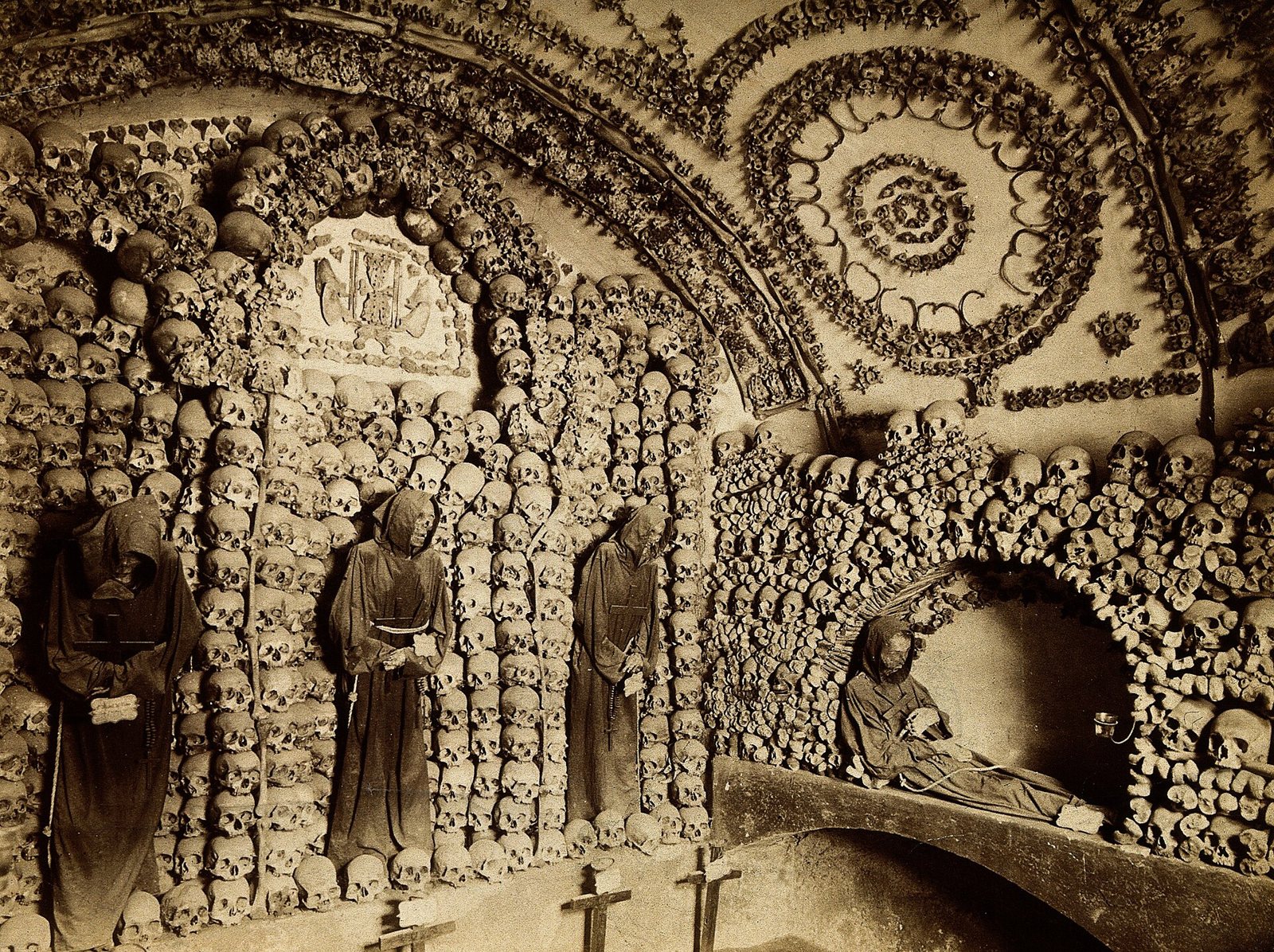
De Sade's account, as quoted by the museum, credits *"un sacerdote tedesco di questa casa"*, "a German priest of this house," with creating *"un monumento funebre degno di un ingegno inglese"*, "a funerary monument worthy of an English genius." That is how one visitor described the maker in 1775, and it is a description, not a record.
What travelers wrote
Mark Twain visited Rome on the trip he published in 1869 as *The Innocents Abroad*. In Chapter 28 he wrote that the Capuchin convent had "six divisions" decorated with human bones, and he described arches made from thigh bones, pyramids of skulls and designs made of vertebrae. A friar in his account told him the remains were those of "four thousand" monks. That is a nineteenth-century traveler's report, and the museum's modern figure is lower.
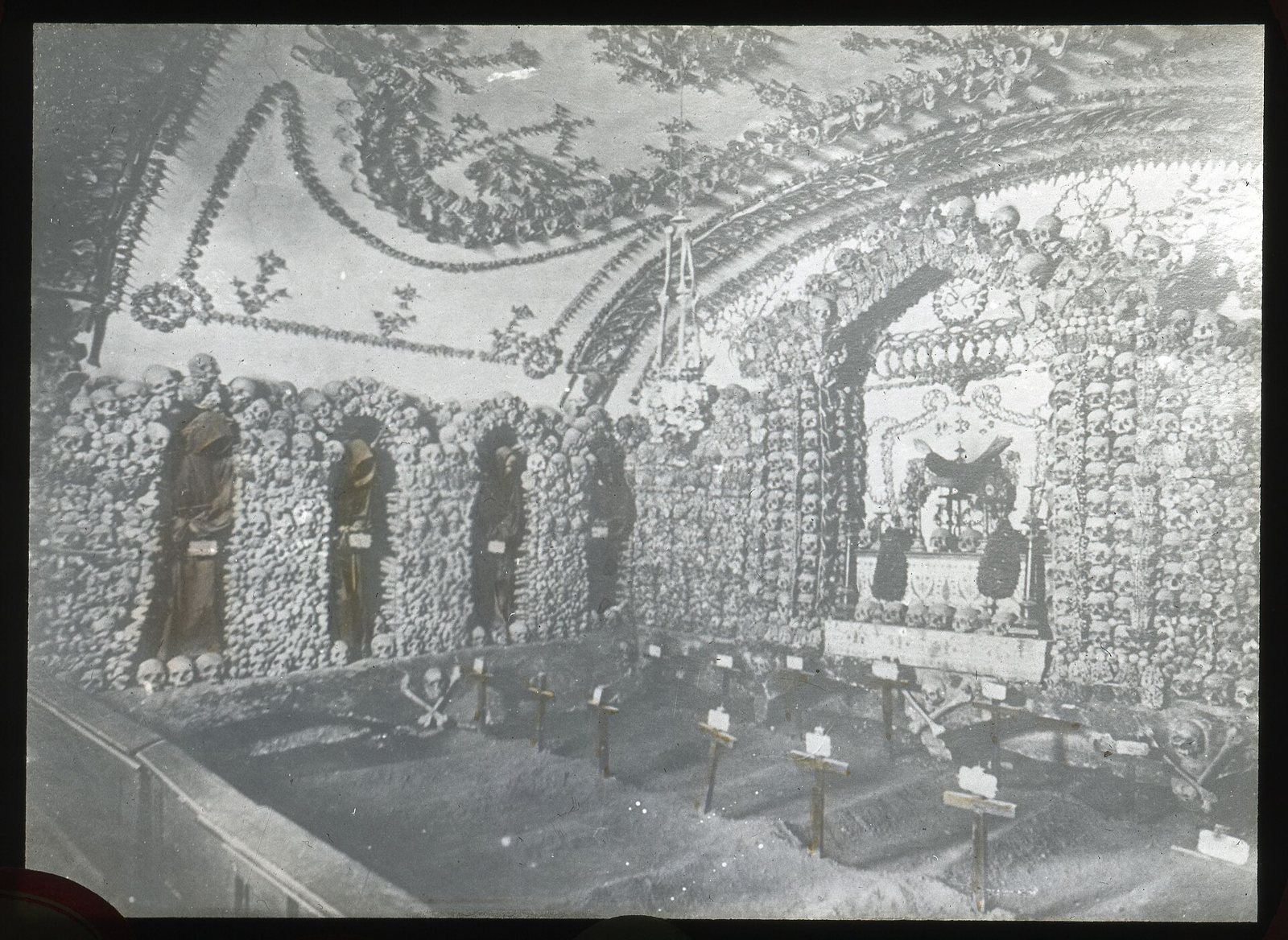
Nathaniel Hawthorne's *The Marble Faun* (1860) has a fictionalized Capuchin cemetery in Chapter 21, "The Dead Capuchin," with a friar laid out in his habit and bone-built arches beneath the church. It is a novel, not a travel report.
Visiting the crypt
As listed on the museum's official ticket page on October 5, 2026, the address is Via Vittorio Veneto 27, 00187 Rome. The crypt is visited only as part of the combined museum and crypt admission, with no crypt-only ticket. The museum is open daily from 09:30 to 13:30 and from 14:30 to 18:30, with last entry at 12:30 and 17:30, and it estimates about 60 minutes for the full visit. A full ticket was €10 and a reduced ticket €6.50, both with an audio guide, and a group ticket for ten or more was €7.50. Online tickets added a €1.50 fee, children aged six and under and qualifying disabled visitors entered free, and the museum did not accept the Roma Pass, MiC Card, ICOM Card or Turbo Pass. A ticket permits one entry.
The crypt is a sacred place, so shoulders and legs must be covered to the knees. Large bags and suitcases go in the free lockers. Under the museum's current rules, private non-commercial photography and video are permitted, while anything meant for publication or commercial use needs authorization from the Fondo Edifici di Culto. Prices and rules change, so confirm them on the museum's own page before you go.
Frequently asked questions
What is special about the Capuchin Crypt?
It is a sacred ossuary where the bones of about 3,700 people, mostly Capuchin friars, form six small chapels and symbolic designs. The museum presents it as a Baroque *memento mori*, meant to prompt reflection on mortality.
Do you need tickets for the Capuchin Crypt?
Yes, because the crypt is visited through the combined Museo e Cripta dei Cappuccini admission, and the museum does not sell a crypt-only ticket. A full ticket was €10 on October 5, 2026, with an additional €1.50 fee online.
How long does it take to see the Capuchin Crypt?
The museum says a complete visit to the museum and crypt takes about 60 minutes. That estimate covers the whole route, since the ticket includes both.
Who is buried in the Capuchin Crypt?
About 3,700 people, mostly Capuchin friars, rest there. The Ministry of Culture describes about 4,000 friars who died between the sixteenth century and 1870, and many of the remains are unidentified, so museum staff and the audio guide are the places to ask about any named burial.
What does the inscription in the Capuchin Crypt say?
Italy's Ministry of Culture quotes it as "We were as you are, and you will be as we are." A closely related Italian wording is translated "What you are, we once were; what we are, you will be."
Capuchin Crypt quiz
Answer every question to check.
Where to go next
The Capuchins are one of several communities that keep their dead in plain view. The skull chapel of Sedlec in Czechia, the quarry ossuary of the Paris Catacombs and the places on the list of ossuaries around the world each tell that story in a different way. The idea they share is memento mori, and its roots in the Christian tradition are covered in skulls in Christianity. The same thought sits behind our Memento Mori skull tee.