No. 008
What Does a Skull Mean in Heraldry? Blazons, Arms and Flags
A skull has no single fixed meaning in heraldry. The Heraldry Society says that heraldic charges have no fixed meanings, and that any intended meaning belongs to the person who first bore or designed the arms. Real skulls on real arms prove the point. On seventeenth-century Scottish funeral banners they meant mortality and memento mori. On the arms Charles V granted to Tlaxcala, Mexico, in 1535, skulls and crossed bones are read as military trophies. On a Canadian grant of 2007, a skull sprouting rye means "new life coming from death." To know what a particular skull means, find out whose arms they are and what the record says.
The short answer: the meaning belongs to the arms
Heraldry is a language of images with precise rules for how things are drawn and described, but it has no dictionary of fixed meanings. The Heraldry Society is clear on this, and the American Heraldry Society likewise says that most charges and colors have no set meanings. A lion is not automatically courage, and a skull is not automatically death.
What a skull does have, in every documented case, is a reason. Someone chose it for their arms, a regiment earned it, a town was granted it, or a designer used it to make a point about mortality. That reason is recorded, sometimes in a royal grant, sometimes in a modern public register, sometimes in a scholar's reading of a five-hundred-year-old document. Modern claims that a skull "means courage" or "means rebellion," the kind you see in tattoo and merch descriptions, do not establish a heraldic meaning.
So, the best way to read a skull on a coat of arms is to treat it like a name on a page. It means what its owner and its records say it means.
How heralds describe a skull
Heraldry describes arms in words, a formal description called a blazon. The National Records of Scotland explains that the blazon, not any artist's drawing of it, is what defines the arms. Two painters can draw the same skull very differently, and both are correct as long as they follow the blazon.
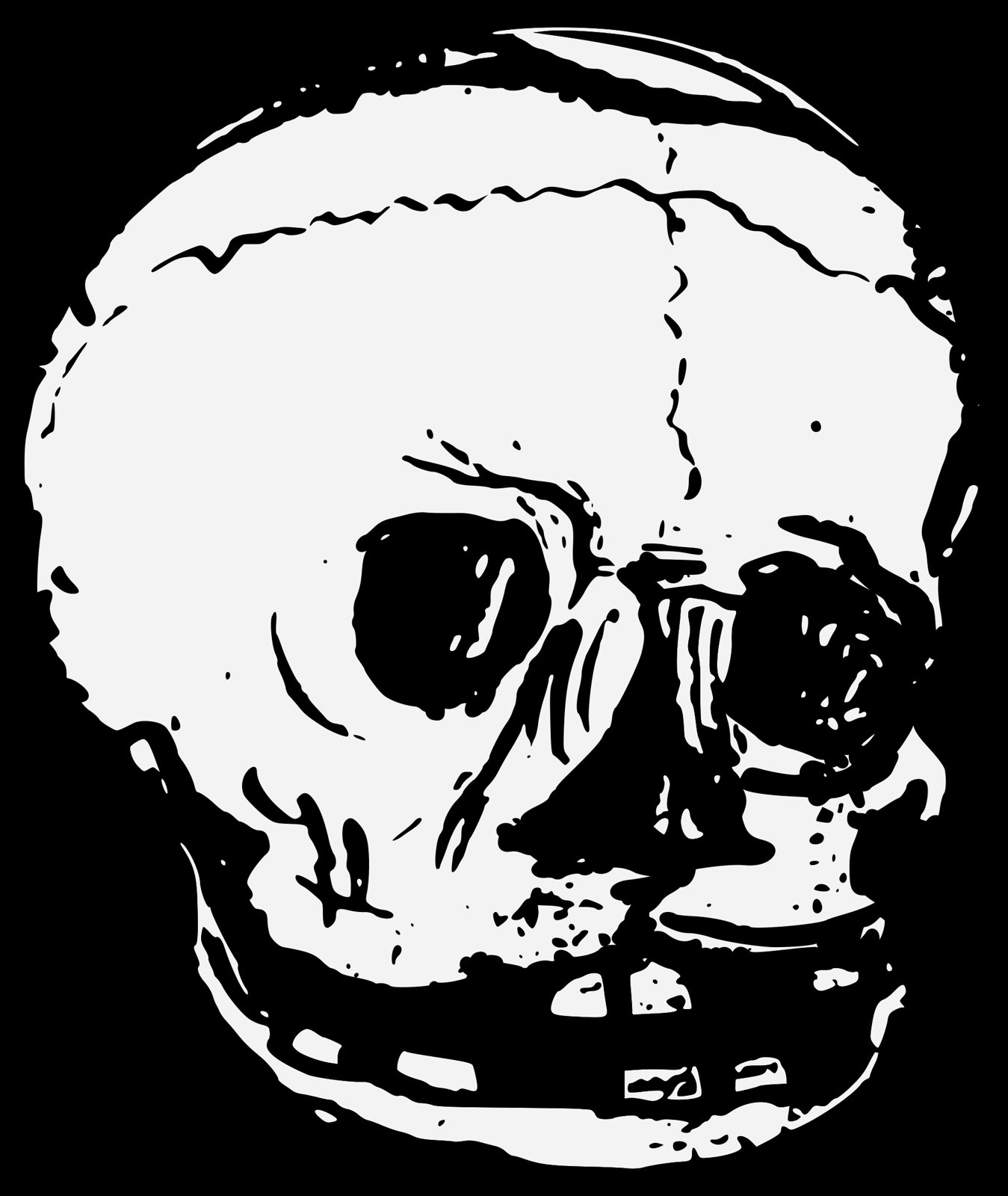
A skull is a charge, the heraldic word for an object placed on the shield, and it is usually shown facing the viewer. Small details change its name. In the Society for Creative Anachronism College of Arms glossary, a "skull" includes the lower jaw, while a skull without the jaw is a "death's head." A complete skeleton is blazoned separately. Two crossed bones are described as bones "in saltire," meaning crossed diagonally like the letter X. Heralds also distinguish a human skull from a bovine skull, the skull of a cow or ox, so "skull," "death's head," "human skull," "bovine skull" and "bones in saltire" are all different things in a blazon.
Here is how that sounds in a real, official blazon. The Spanish Army describes the emblem of its Lusitania Regiment in Spanish: "En campo de sable … una calavera contornada y en lo bajo dos tibias pasantes en aspa." In plain terms: on a black field, a skull, and below it two shinbones crossed in saltire. "Sable" is the heraldic word for black, and it is the same word in English blazon.
One note for anyone searching the phrase "death's head": in heraldry it simply means a skull without its lower jaw. The German military Totenkopf is a separate emblem with its own history, covered in our story on the Totenkopf.
Early skulls in armorials and prints
Skulls turn up in heraldic art well before the modern era. The Wernigerode Armorial, a book of painted arms made around 1490 in South Germany, includes a skull image that is now in the public domain.
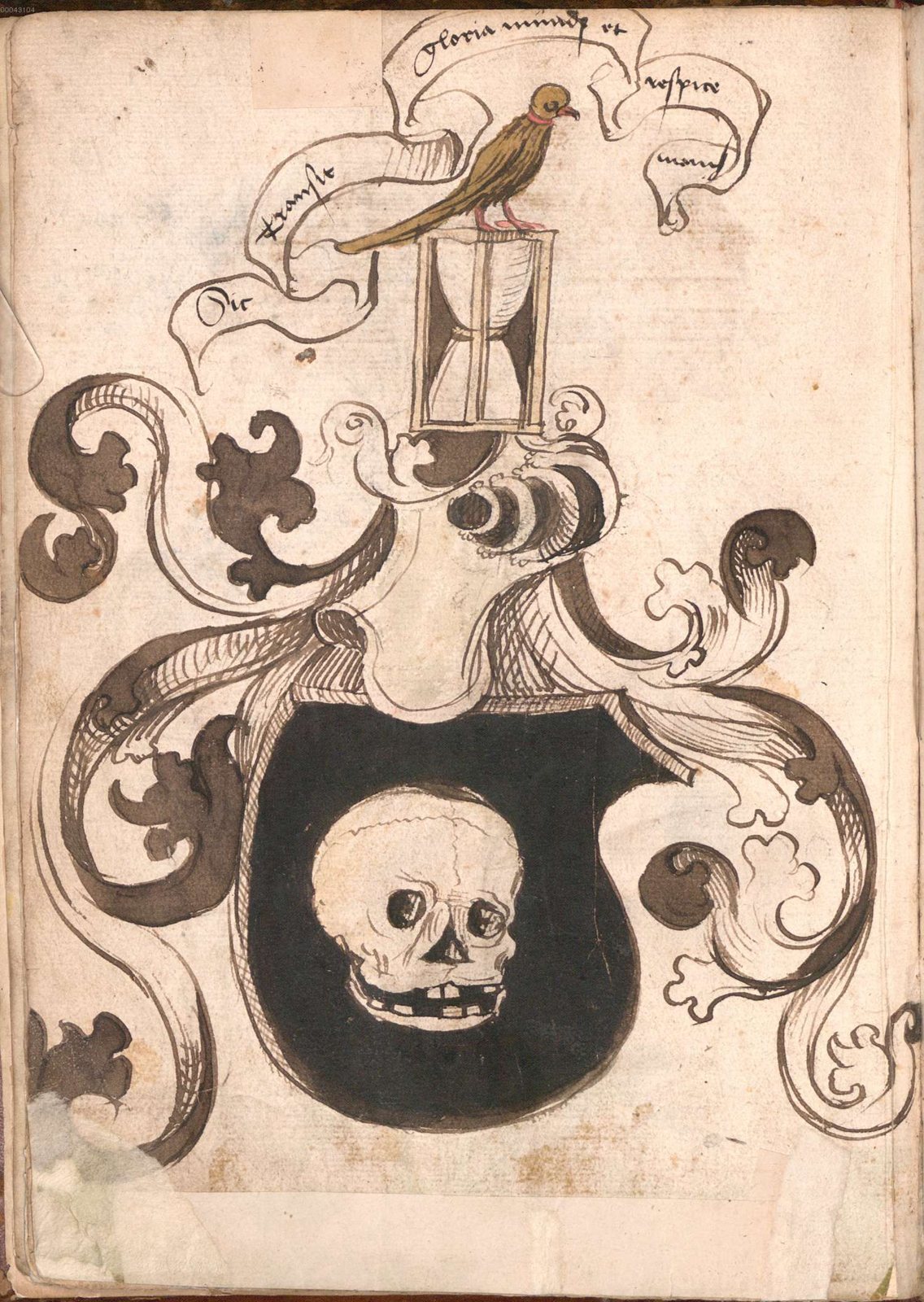
Another period example is the death's head shown for Francesco Carosio, Bishop of Melfi, in an armorial illustration associated with the Council of Constance. The Caerlaverock Roll cites the earliest version of that illustration as dated 1483, and it cautions that the image may not show the bishop's actual arms.
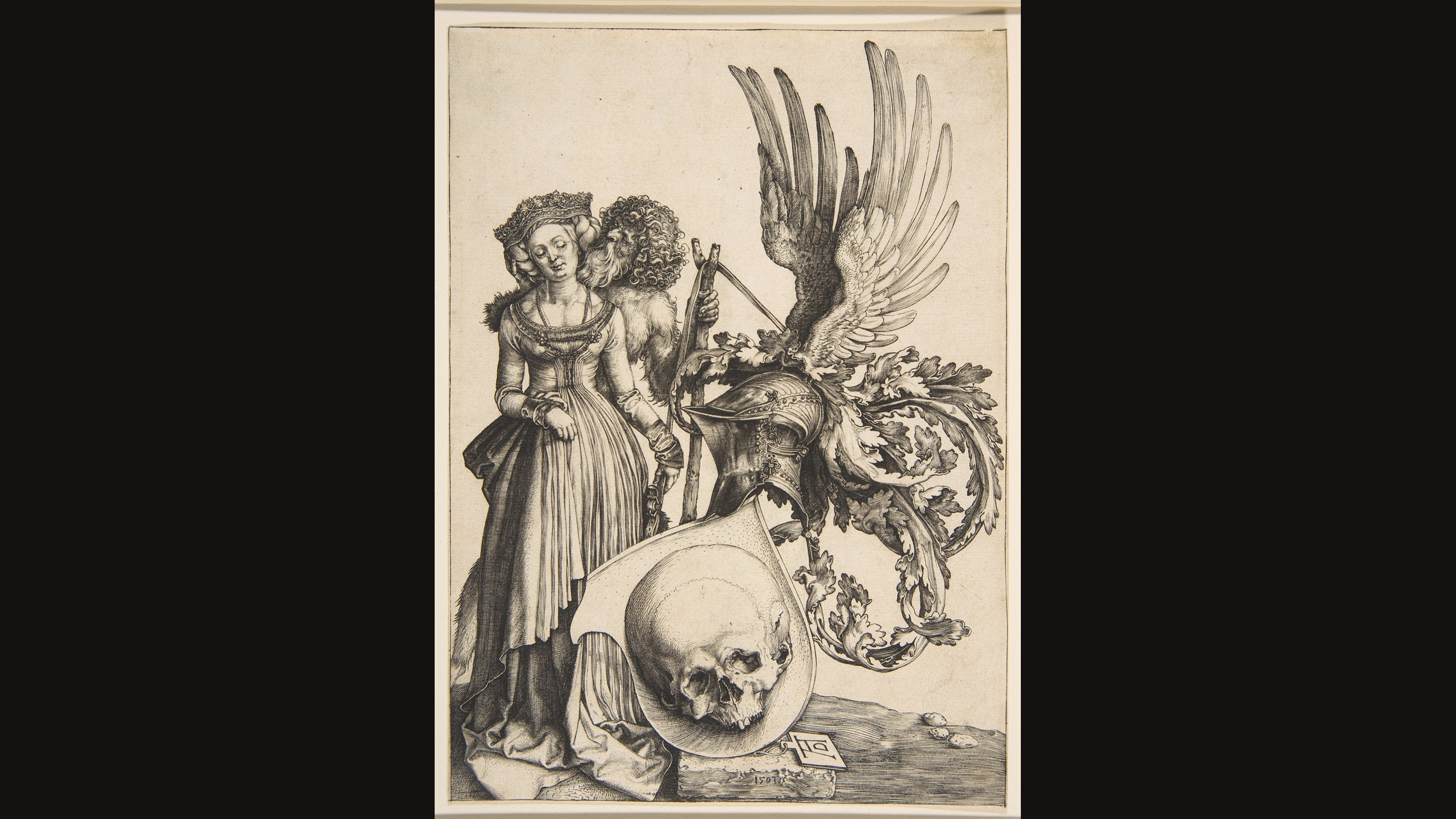
The most famous skull on a shield is not a real family's coat at all. Albrecht Dürer's engraving *Coat of Arms with a Skull*, made in 1503 and recorded by the Metropolitan Museum of Art, is an armorial composition: Dürer borrowed the form of a coat of arms to make an image about death. Our story on the skull with a crown looks at that print and its crowned bride in detail.
Tlaxcala, 1535: skulls as trophies
The clearest documented civic example of skulls in heraldry comes from Mexico. In 1535, the emperor Charles V granted arms to Tlaxcala. The arms include a silver bordure, the band around the edge of the shield, with palms, bones and skulls.
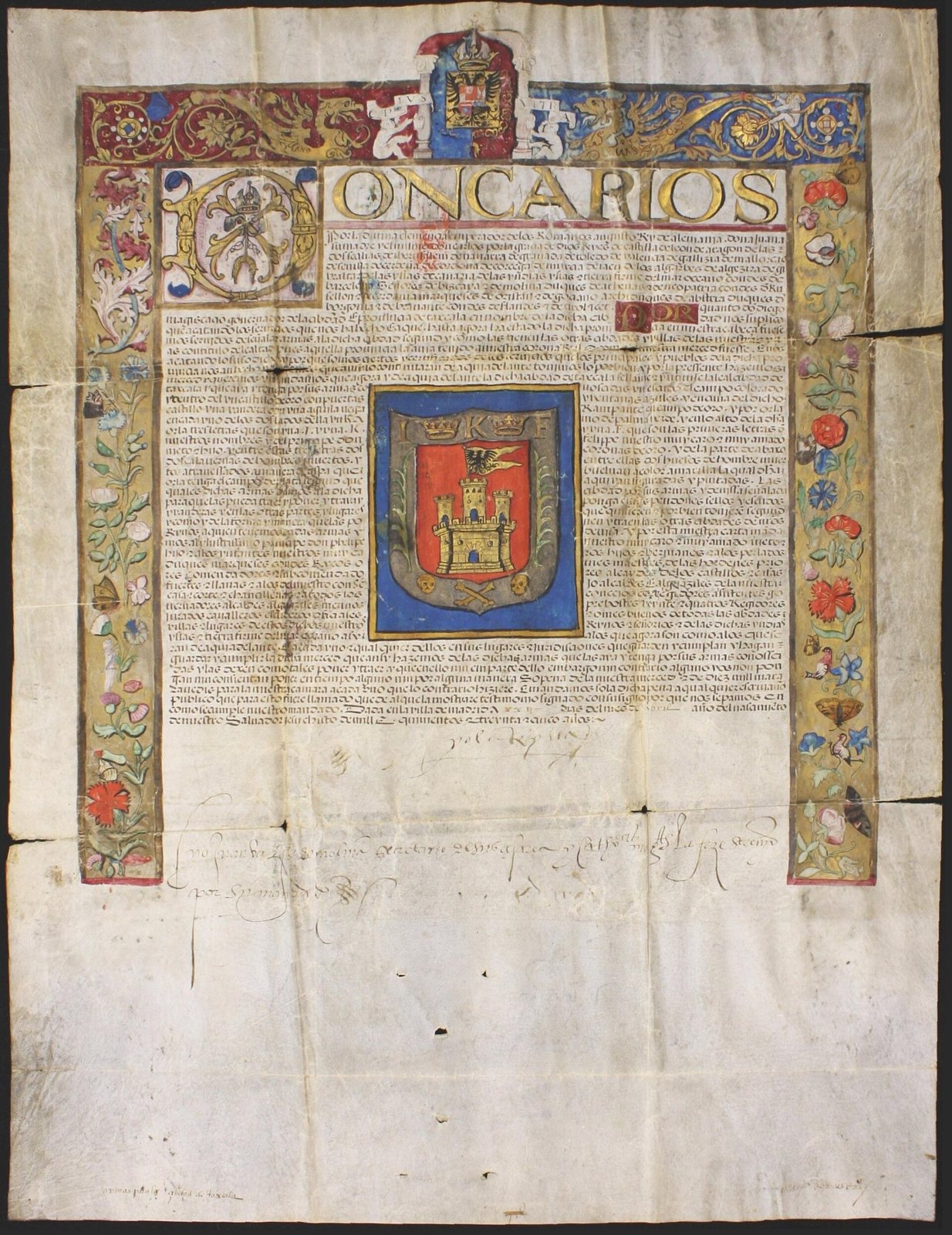
UNAM researcher María del Carmen Vázquez Mantecón, in a study of the Tlaxcala arms, interprets the skulls and crossed bones as trophy images representing the deaths of Mexica and allied opponents during the conquest, especially at Tepeaca and Tenochtitlan. Her study links them to the military history and victories of the Tlaxcalan polity during the conquest, and also places them within the Christian and imperial composition of a Spanish royal grant.
That reading belongs to this grant, this place and this century. The skulls on Tlaxcala's arms are about military victory in a specific war, not about mortality in general, and they show how far a heraldic skull can sit from the memento mori meaning many people expect.
Memento mori in Scotland
The meaning most people expect does exist, and Scotland has a strong example. Funeral banners made for John Leslie, Duke of Rothes, in 1681 show skulls and crossbones with the words "Memento Mori," as the National Galleries of Scotland describes. Here the skull does exactly what it does in European still-life painting: it asks the viewer to remember death and the passing of time.
Funeral heraldry like this was made for a specific occasion, the death and burial of a specific person. So, is a skull a symbol of death in heraldry? In settings like the Rothes banners, yes, very directly. On other arms, as Tlaxcala shows, it can mean something else entirely. For the wider idea, see what is memento mori.
Tap or hover a row to highlight it.
| Example | Date | Skull form | Documented interpretation |
|---|---|---|---|
| ExampleTlaxcala, Mexico | Date1535 grant | Skull formSkulls and crossed bones on the bordure | Documented interpretationMilitary trophies and victory in a sixteenth-century civic and imperial setting |
| ExampleLusitania Regiment, Spain | Date1744 origin; emblem approved 1995 | Skull formSkull and crossed shinbones | Documented interpretationTrophy awarded after Madonna del Olmo |
| ExampleKarl Heinrich Kopke, Canada | Date2007 | Skull formSkull above crossed leg bones with rye | Documented interpretationNew life coming from death |
| ExamplePenhold Air Cadet Centre, Canada | Date2001 | Skull formBovine skull caboshed | Documented interpretationThe site's former cattle range |
| ExampleBrendan L'Heureux, Canada | Date2019 | Skull formHuman skull in the crest | Documented interpretationMortality and Hussar service |
Skulls in modern grants
Heraldry is still alive, and skulls still appear in new arms. The Canadian Heraldic Authority publishes its grants in a public register, with the official blazon and an explanation of the symbolism, which makes its records some of the clearest evidence of what a skull means on a particular coat of arms.
The arms of Karl Heinrich Kopke, granted on 15 August 2007, are blazoned "Sable on a mount Or two leg bones in saltire surmounted by a skull Argent issuant therefrom three heads of rye Or…" In plain terms, on black, two crossed leg bones and a silver skull on a gold mound, with three gold heads of rye growing out of the skull. The Canadian Heraldic Authority explains the rye growing from death as "new life coming from death." It is one of the most hopeful skulls in heraldry.
In 2001 the Authority approved a badge for the Air Cadet Summer Training Centre at Penhold, Alberta: "Azure a vol, in chief a maple leaf Or, overall in base a bovine skull caboshed Argent…" "Caboshed" means an animal's head shown face-on with no neck. The official explanation says the bovine skull refers to the former cattle range at CFB Penhold. Here the skull is about local history, not death at all, and readers interested in cattle skulls as symbols will find more in cow skull meaning.
Christian Cardell Avery Aaron Belmont received arms on 20 July 2012 with this crest: "A human skull jessant of a Guernsey lily proper its roots entwining a paintbrush and a sculptor's chisel…" "Jessant" means something growing or issuing from the charge, here a lily through the skull. The Authority's record ties the skull to Belmont's forensic reconstruction work, rebuilding faces from skeletal remains, including the reconstruction of Sir Isaac Brock.
Brendan L'Heureux's crest, granted on 15 October 2019, reads "A Steller's jay holding a perpendiculum and perched on a human skull proper." "Proper" means shown in its natural colors. The Authority gives the skull a dual meaning: the transience of life, and L'Heureux's Hussar training.
Skulls on flags
A skull-and-crossbones flag is not automatically a pirate flag. Military units, navies and individuals have all flown skulls, each for its own reason.
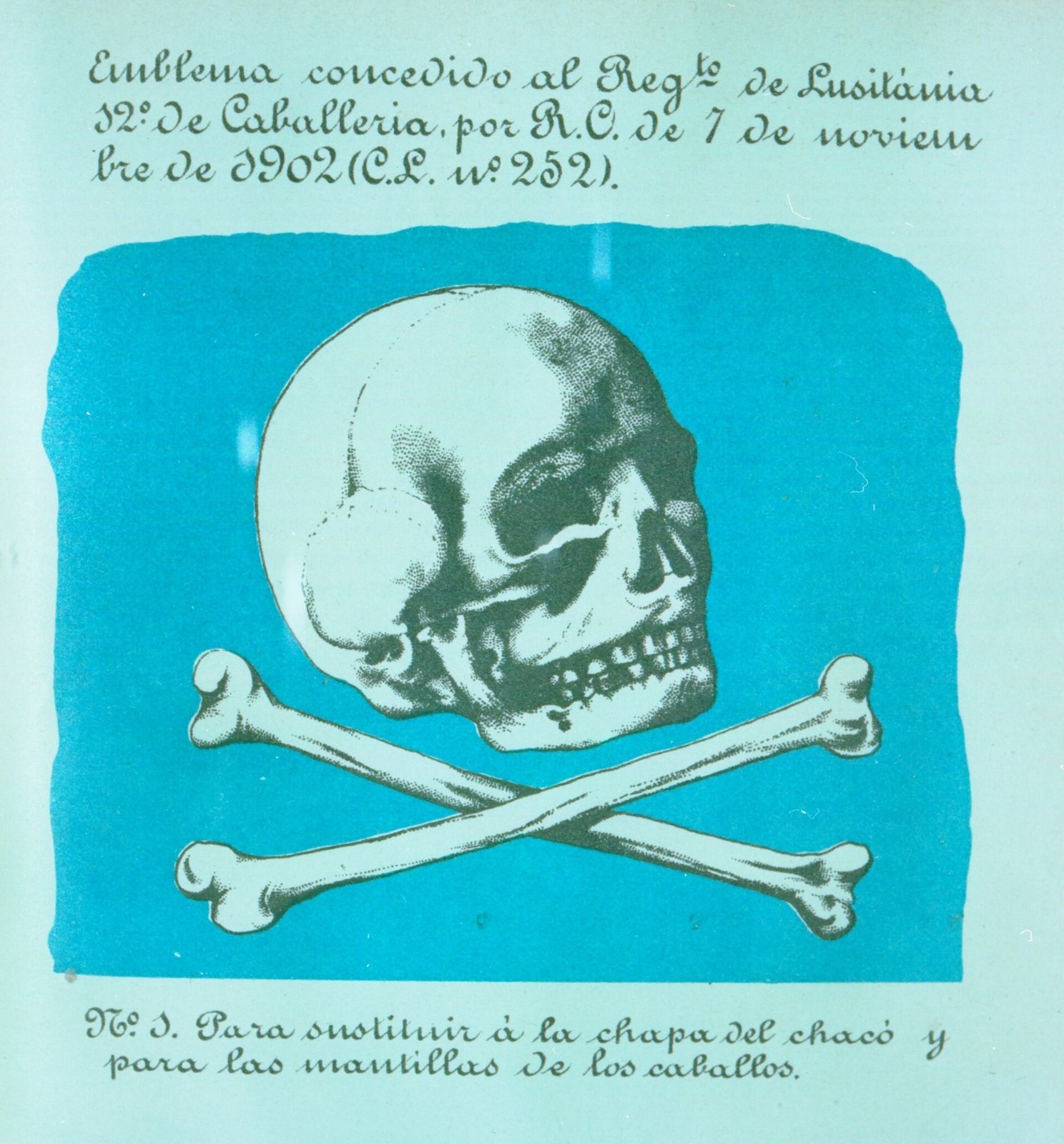
The Spanish Army's Lusitania Regiment carries a skull and crossed bones because, as the Army explains, Philip V awarded those trophies after the regiment's conduct at the Battle of Madonna del Olmo in Italy in 1744. The emblem was approved in 1995.
In the U.S. Navy, Mobile Construction Battalion THREE took the self-chosen identity "Ghost Battalion" during the Vietnam War, and the Seabees' history of the unit records its "Skull and Crossbones" identity during its 1965 deployment to Vietnam.
The USS Augusta flew a black Jolly Roger with a white skull and crossbones during its 1935 equator-crossing ceremony on the way to Borneo. The Augusta Museum of History holds the surviving flag.
The Australian War Memorial holds a Japanese flag captured in New Guinea on 17 December 1944. It is a hinomaru, the red-disc national flag, with a white skull and crossbones appliquéd onto it, apparently as a unit or personal flag.
Each of these flags means something different: a battle honor, a unit nickname, a shipboard ceremony, a soldier's or unit's own emblem. For the pirate version and its history, read the Jolly Roger pirate flag and skull and crossbones.
Skulls in heraldry and on flags, about 1490 to 2019
Tap or hover a step to follow the order.
About 1490
A skull image is painted in the Wernigerode Armorial in South Germany.
1503
Albrecht Dürer creates the engraving Coat of Arms with a Skull.
1535
Charles V grants arms to Tlaxcala, with skulls and bones on the bordure.
1681
Funeral banners for John Leslie, Duke of Rothes, show skulls, crossbones and Memento Mori.
1744
The Lusitania Regiment's skull-and-bones tradition is linked to the Battle of Madonna del Olmo.
1935
The USS Augusta flies a Jolly Roger at its equator-crossing ceremony.
1944
A Japanese hinomaru with a skull and crossbones is captured in New Guinea.
1965
The Navy's Ghost Battalion deploys to Vietnam under its Skull and Crossbones identity.
2001
The Penhold Air Cadet badge with a bovine skull is approved.
2007
Karl Heinrich Kopke's arms with a skull and rye are granted.
2012
Christian Belmont's skull crest is granted.
2019
Brendan L'Heureux's skull crest is granted.
Reading a skull you have seen, or using one in a design
If you saw a skull on a coat of arms or a flag and want to know what it means, start with whose it is. Look for the blazon or the official record: a royal grant, a public register such as Canada's, or a military unit's own explanation. Check whether the skull has a lower jaw, since a jawless one is a death's head in blazon. Look at what surrounds it: rye or a lily growing from it, crossed bones beneath it, a motto like Memento Mori nearby. Each detail narrows the meaning. And when people ask who exactly "wears" the skull, the answer in real heraldry is simple: whoever bears the arms, as the record names them.
If you want a skull in a design of your own that looks historically plausible, period examples like the Wernigerode Armorial, the Carosio illustration and the Rothes banners show how skulls were actually drawn and used. Before quoting an exact historical blazon, consult the armorial itself or a specialist edition, because many old examples survive only in copies. Modern grants show the other path: a skull can carry your own story, whether that is a profession, a military tradition or a reminder of life's limits, as long as you say what it means.
How well do you know skulls in heraldry?
Answer every question to check.
Questions people ask about skulls in heraldry
What does a skull mean in heraldry?
A skull has no single universal meaning in heraldry; its meaning depends on the named arms and their history. Documented skulls stand for mortality and memento mori, military trophies, a profession, a military tradition or a local history. Brendan L'Heureux's Canadian crest uses one for mortality and Hussar service, while Tlaxcala's 1535 arms use skulls as trophies of war.
Which coats of arms have a skull?
Coats of arms with a skull include the arms of Tlaxcala, Mexico, granted in 1535, and three Canadian grants: Karl Heinrich Kopke's arms of 2007, Christian Belmont's crest of 2012 and Brendan L'Heureux's crest of 2019. The 2001 badge of the Air Cadet Summer Training Centre at Penhold, Alberta, carries a bovine skull. The Spanish Army's Lusitania Regiment uses a skull and crossed shinbones in its approved emblem.
What is a death's head in heraldry?
A death's head in heraldry is a skull shown without its lower jaw, according to the SCA College of Arms glossary. A skull with the jaw is blazoned simply as a skull, and a full skeleton has its own term. The heraldic death's head is a different thing from the German military Totenkopf emblem.
How do you blazon a skull?
You blazon a skull by naming it as a charge with its color and position, for example "a skull Argent," meaning a silver skull, as in Karl Heinrich Kopke's 2007 arms. Crossed bones are blazoned "in saltire," and a skull without its jaw is a death's head. The blazon, not the drawing, is what defines the arms.
Is a skull a symbol of death in heraldry?
A skull is a symbol of death in some heraldry, such as the 1681 funeral banners for John Leslie, Duke of Rothes, marked Memento Mori. On other arms it means military victory, a profession or even a cattle range. The record for each coat of arms tells you which.
Terms in this story
Tap a term to see what it means.
Blazon. The formal written description of a coat of arms. The National Records of Scotland explains that the blazon, not the drawing, defines the arms.