No. 027
What Does a Skull With a Crown Mean? Art, Tattoos and History
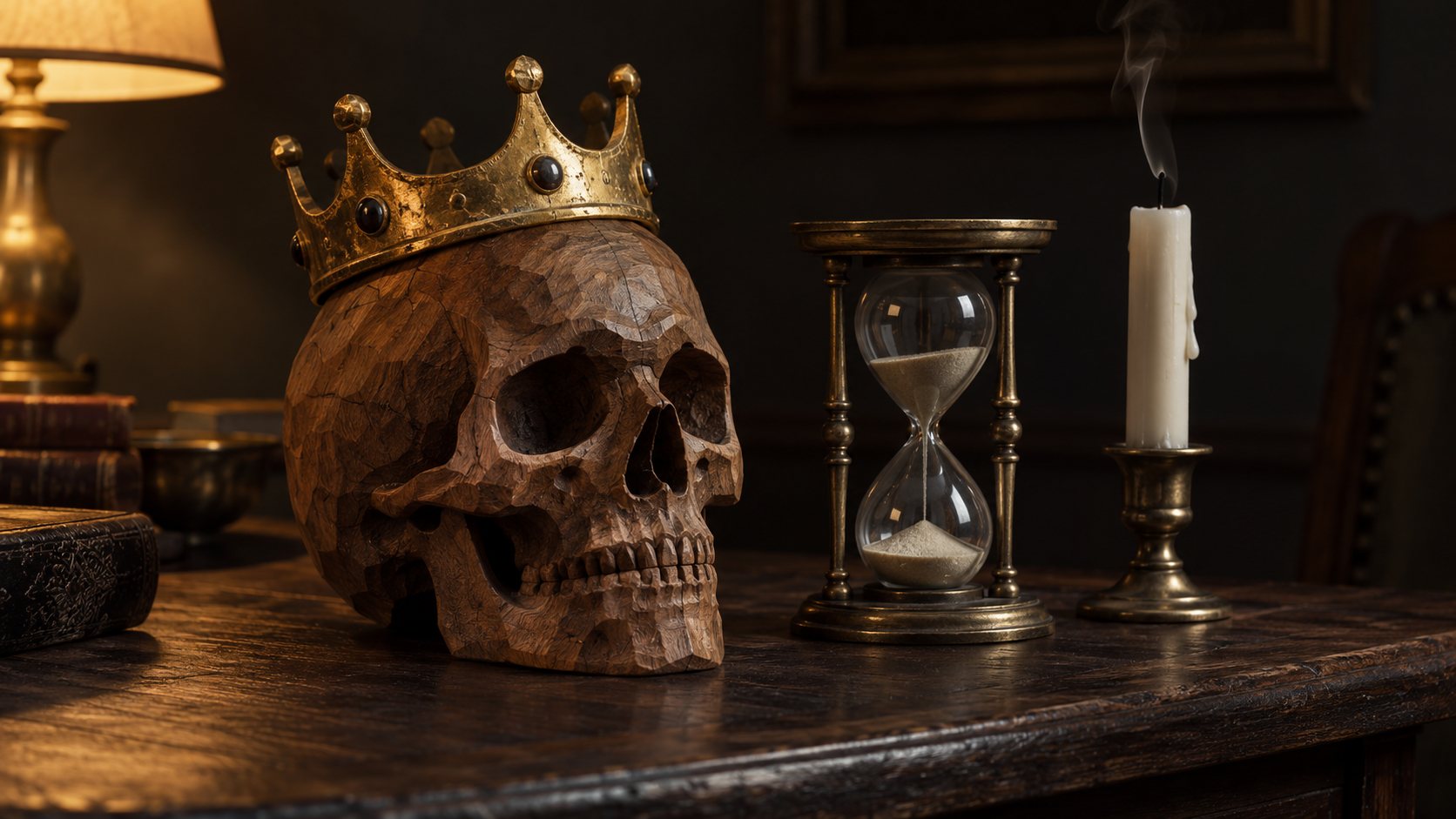
A skull with a crown most often means that death outlasts power. The crown stands for rank, wealth and rule; the skull stands for the end that comes to a king as surely as to anyone else. That reading comes from European memento mori and vanitas art of the 1500s and 1600s, and the Rijksmuseum explains that crowns and sceptres in seventeenth-century Dutch vanitas paintings could signal how short-lived military power and glory are. On a modern tattoo, ring or shirt, the same pairing usually reads as power facing mortality: authority, legacy, self-rule, or the plain fact that status does not last. The symbols around it, and the story of the person wearing it, settle the rest.
What the crown adds to the skull
A bare skull already says one thing clearly: every life ends. Put a crown on it and the message gets more pointed. Now the skull belongs to someone who had everything a person could want, rank, money, armies, a throne, and it made no difference at the end.
European painters said this out loud. Evert Collier's *Vanitas Still Life with Crown, Skull and Snuffed Candle*, painted in the late seventeenth century in oil on panel and now in the Princely Collections, Vaduz-Vienna, pairs a crown and a skull with the inscription *Sic transit gloria mundi*, "Thus passes the glory of the world." The snuffed candle in the title makes the same point a third time. Collier was not being subtle, and he did not need to be.
That is the core of the motif, and almost everything later builds on it. The crown can stand for a real monarch, for worldly success in general, or for the viewer's own ambitions. The skull answers all three the same way. If you like the idea behind memento mori, "remember that you will die," a crowned skull is that idea with the stakes raised.
Dürer's crowned bride and the skull on the shield
A well-known early image that puts a crown and a skull side by side is Albrecht Dürer's engraving *Coat of Arms with a Skull*, made in Germany in 1503 and held by the Metropolitan Museum of Art in New York. Here the crown is not on the skull. A crowned bride stands beside a wild man, and the wild man acts as a stand-in for Death. Between them sits a heraldic shield, and on the shield, where a family's emblem ought to be, is a skull.
The Met identifies the image as a memento mori. The Städel Museum describes the skull as referring to the transience and vanity of worldly things. Read together, the print takes the trappings of a good marriage and a proud lineage, a crown, a coat of arms, a wedding, and shows what waits under all of it. The fictive coat of arms exposes the vanity of social ambition and illicit desire.
For a reader holding a crowned skull design today, Dürer's print is a useful anchor. It shows that the crown and the skull were already being set side by side more than five hundred years ago, and that the pairing was about the limits of status, not about celebrating it.
Death gets its own coat of arms
Hans Holbein the Younger took the joke one step further. His woodcut *Dance of Death: The Coat of Arms of Death*, made around 1526 and held by the Cleveland Museum of Art, gives Death a coat of arms of its own. A skull sits on the shield, and above it skeletal arms hold up an hourglass. There is no real family behind this heraldry. The noble house is Death itself, and the hourglass says plainly that time is running out.
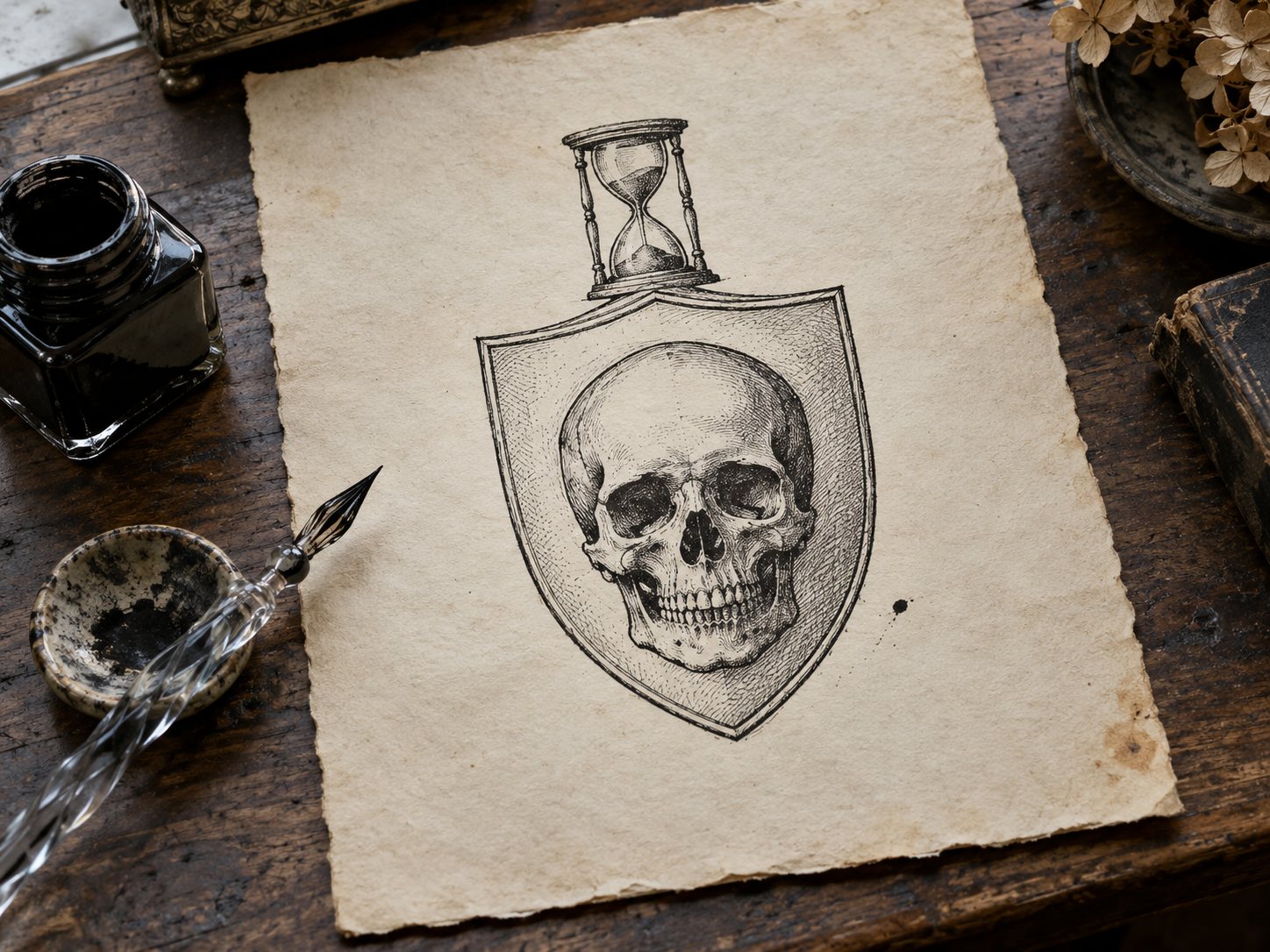
The print belongs to the wider danse macabre, the late medieval and early modern European image of skeletons or Death confronting people of every rank. In these series, death sits above every social distinction. Nobody gets out of the dance because of a title.
The idea lasted for centuries. A much later French danse macabre by Foujita, dated 1965 and held by the Musées de Reims, shows Death as a crowned skeleton. By then the crown had moved from the victim to the victor: Death wears it.
Crowns, laurel and wheat in vanitas still lifes
In the seventeenth century, European painters, especially in the Netherlands, turned the same idea into still lifes. A vanitas painting gathers objects tied to status, wealth, beauty and time, then places a skull among them so the viewer gets the point.
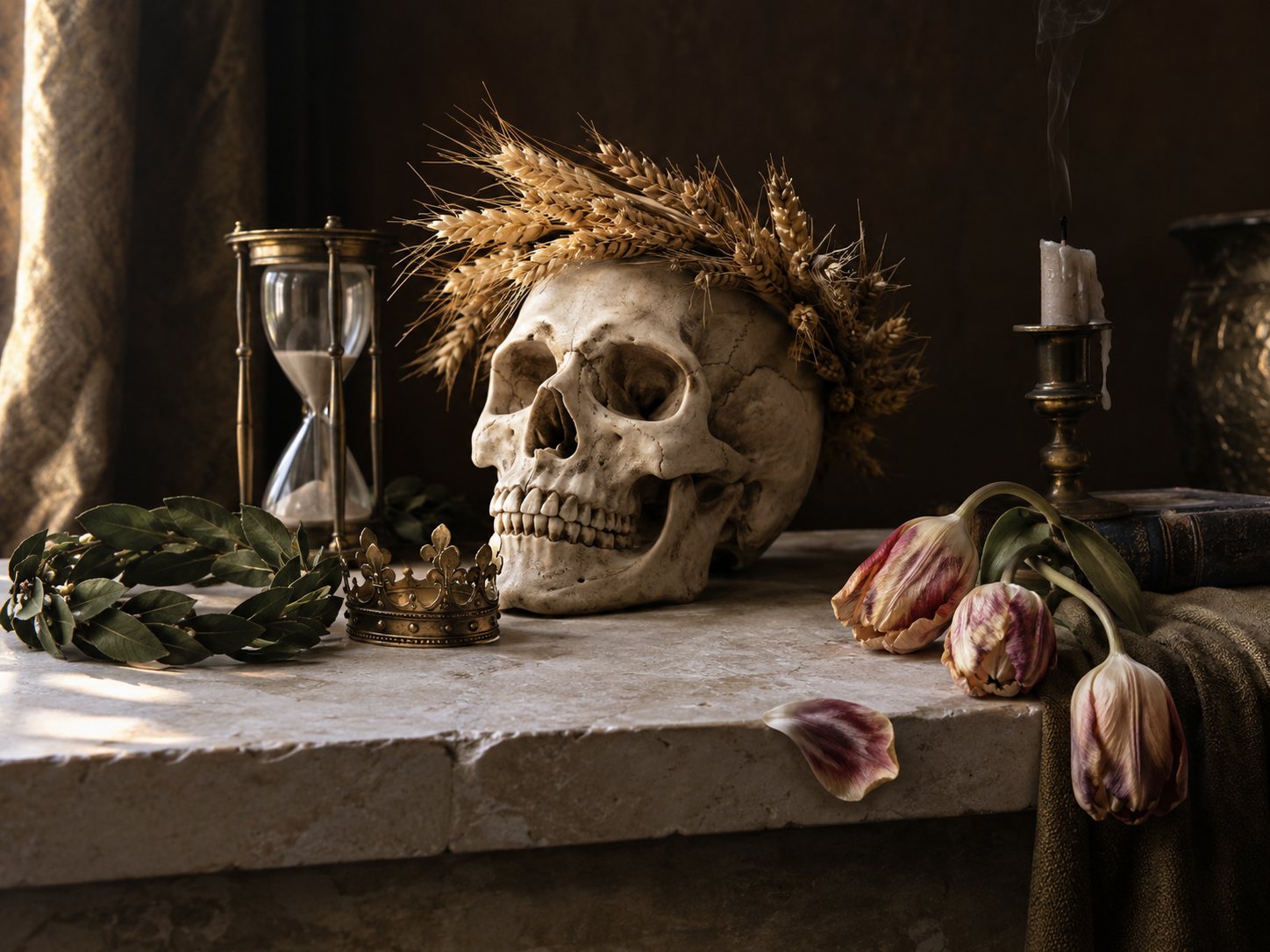
Jan van Kessel the Elder's *Vanitas Still Life*, painted around the 1650s in oil on panel and held by the National Gallery of Art in Washington, crowns its skull with wheat. Around it are flowers, an hourglass, insects and soap bubbles, each one a small, quick thing. The bubbles will pop, the flowers will wilt, the sand will run out.
Jacob van Campen's *Vanitas Still Life with Skull with Laurel Wreath, Book and Two Burning Candles*, painted between 1645 and 1650 in oil on panel, is in the Rijksmuseum in Amsterdam. The museum identifies it as both a vanitas still life and a representation of Death. A laurel wreath is the crown of a victor or a poet, so here it is fame and learning that the skull outlasts.
The Rijksmuseum also explains, in its notes on a still life with implements of war, that imperial crowns and sceptres in Dutch vanitas paintings could signify the impermanence of military power and glory. Put those pieces together and you have the historical meaning in its clearest form: in this art, a crown near a skull is a warning about how long power lasts.
The crowned skull, 1503 to 2018
Tap or hover a step to follow the order.
1503
Albrecht Dürer engraves Coat of Arms with a Skull, now at the Metropolitan Museum of Art; a heraldic skull turns status and marriage imagery into a memento mori.
c. 1526
Hans Holbein the Younger makes the woodcut Dance of Death: The Coat of Arms of Death, now at the Cleveland Museum of Art, with a skull, a shield and an hourglass.
1645 to 1650
Jacob van Campen paints Vanitas Still Life with Skull with Laurel Wreath, Book and Two Burning Candles, now at the Rijksmuseum.
Seventeenth century
Dutch vanitas still lifes use crowns and sceptres to stand for the temporary nature of power and glory.
1948 to 1981
Danzig Baldaev documents tattoos in Leningrad prisons as records of status and criminal biography.
2018
Kristina Sundberg and Ulrika Kjellman publish "The tattoo as a document", reading tattoo meanings through their social setting.
The crowned skull as a tattoo, ring or shirt today
In a contemporary tattoo or a piece of merchandise, a skull with a crown is usually a visual mix of mortality and authority. Modern tattoo writing, such as Kings Road Tattoo Parlor's page on the design, describes it as power, ambition, self-rule, legacy, rebellion or the temporary nature of status. Those are present-day readings. They are real, in the sense that plenty of people choose the design for exactly those reasons, but they are not one fixed historical meaning handed down from the vanitas painters.
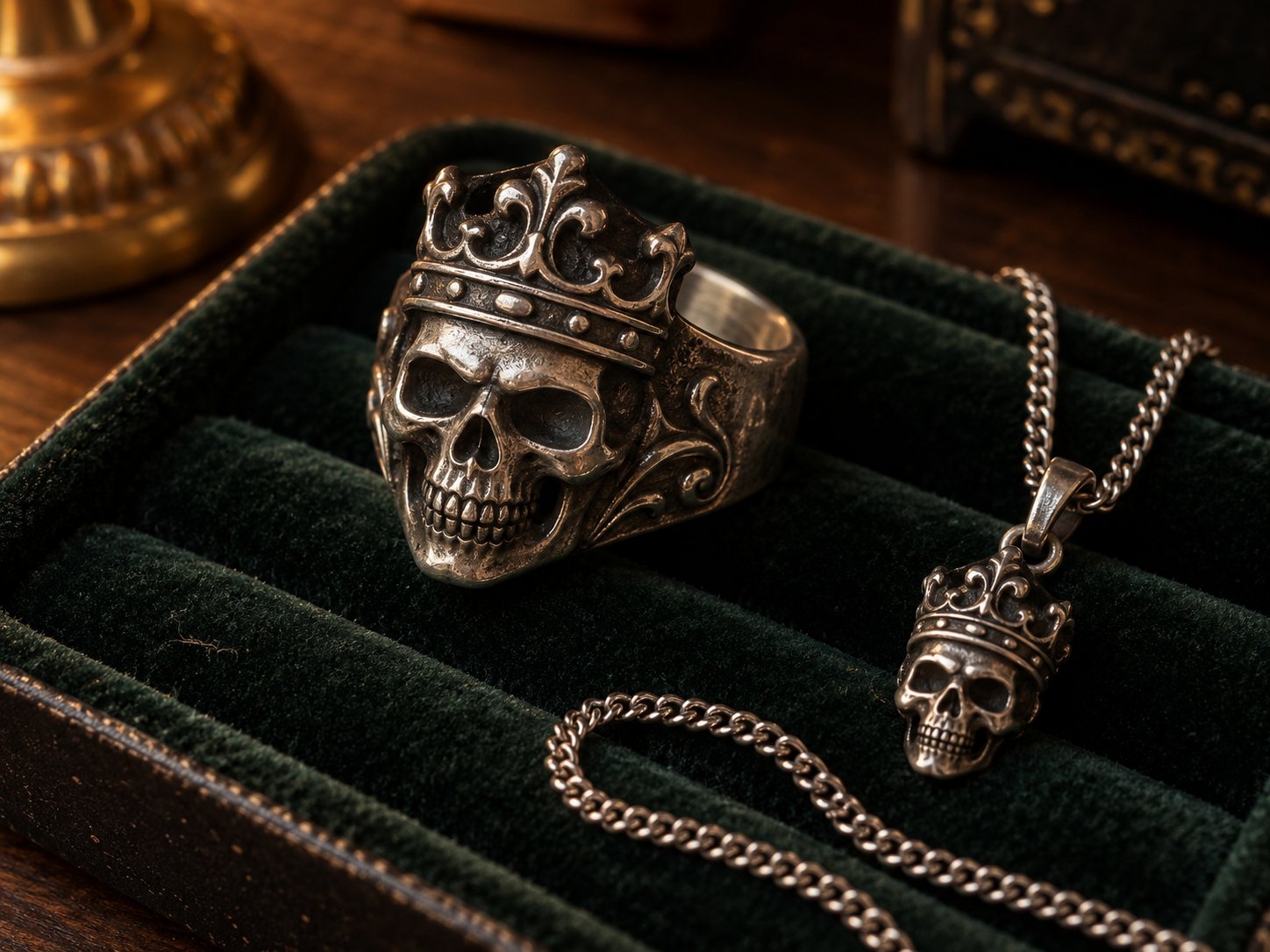
So, what does a crowned skull tattoo mean on a particular person? Usually something close to "I know my time is limited, and I am in charge of what I do with it," or "nobody stays on top forever." Some people wear it as a statement of personal sovereignty, some as a nod to the old memento mori warning, some because it simply looks great. All of those are honest answers.
Tattoo artists tend to talk about the skull as a shape before they talk about it as a message. In a 2010 interview with Pulp Metal Magazine, tattoo artist Gerry Carnelly discussed skulls as strong tattoo subjects because their form translates so well into a design. He did not assign a fixed meaning to the crowned skull, and that is a fair way to see it. The design is a good one; the meaning is what the wearer brings to it.
The same goes for jewelry. A crowned skull on a ring sits in the same family as other skull rings: mortality worn every day on the hand, with the crown adding a note of rule or rank.
One specific context: Russian and Soviet prison tattoos
There is one setting where a skull and crown could carry a coded meaning, and it is worth knowing before you choose a design. In Russian and Soviet prison tattoo culture, tattoos worked as records of rank, criminal history and status.
Danzig Baldaev documented these tattoos from his work in Leningrad prisons from 1948 to 1981. The Guardian's 2010 account of his archive reports that his drawings recorded tattoos as signs of hierarchy, criminal history and status, and that skull imagery could denote criminal authority. A 2018 study by Kristina Sundberg and Ulrika Kjellman, "The tattoo as a document", treats prison tattoos as documents of identity, memory and experience within that particular social setting.
The key point is that this coded reading belongs to that subculture. It does not apply to an ordinary crowned skull tattoo, ring or shirt unless there is real evidence of that world, such as a design copied directly from that tradition. If a design you are considering closely resembles Russian or Soviet criminal tattoo imagery, ask your artist about it before it goes on your skin, because in that tradition the images were not decoration.
Variations: roses, wreaths and the "king skull"
Crowned skulls rarely travel alone. The most common partner is the rose. A skull with roses combines mortality with beauty, love, remembrance or the short life of physical beauty, and our story on skull and roses meaning covers that pairing on its own. Add a crown and you get all three ideas at once: rank, beauty and the end of both. Van Kessel's painting is a good historical cousin, with its crowned skull among flowers, but there the flowers belong to a larger meditation on time and death rather than to any tattoo code.
The "king skull" is a modern design label for a skull wearing a royal crown. People read it as "king of the dead," "authority made temporary" or "personal sovereignty." Those are later interpretations, not a single documented historical category, so the best way to learn what a particular king skull means is to ask the wearer, the artist or the maker what they intend. Foujita's 1965 crowned Death is the closest thing in the art covered here to a literal "king of death," and it comes from a French danse macabre, not from tattoo history.
Other details shift the meaning in useful ways. An hourglass points back to Holbein and the passing of time. A laurel wreath points to fame and achievement, as in van Campen's painting. An inscription like *Sic transit gloria mundi* spells out the vanitas message in words.
How to read a crowned skull design
Tap a card to bring it forward.
- The crown: Rank, rule, success or ambition, the thing the skull outlasts in vanitas art.
- The skull: Mortality, the end shared by a king and everyone else.
- The symbols around it: Roses add beauty and remembrance, an hourglass adds time, a laurel wreath adds fame.
- Any words: An inscription such as Sic transit gloria mundi states the vanitas meaning directly.
- The setting: A design copied from Russian or Soviet prison tattoos belongs to that tradition; an ordinary design does not.
- The maker's intent: Ask the wearer, artist or maker what they meant; for a modern design that is the final word.
Choosing or decoding a crowned skull design
If you are choosing one, start with which half of the meaning you want louder. A design built around the old vanitas idea, with an hourglass, a candle or a Latin line, leans toward "power does not last." A bold skull with a heavy crown and no other symbols reads more like self-rule and defiance. Roses soften it toward love and remembrance. A tattoo artist can help you balance these, and can tell you if a reference image you found online comes from a tradition you would rather not borrow.
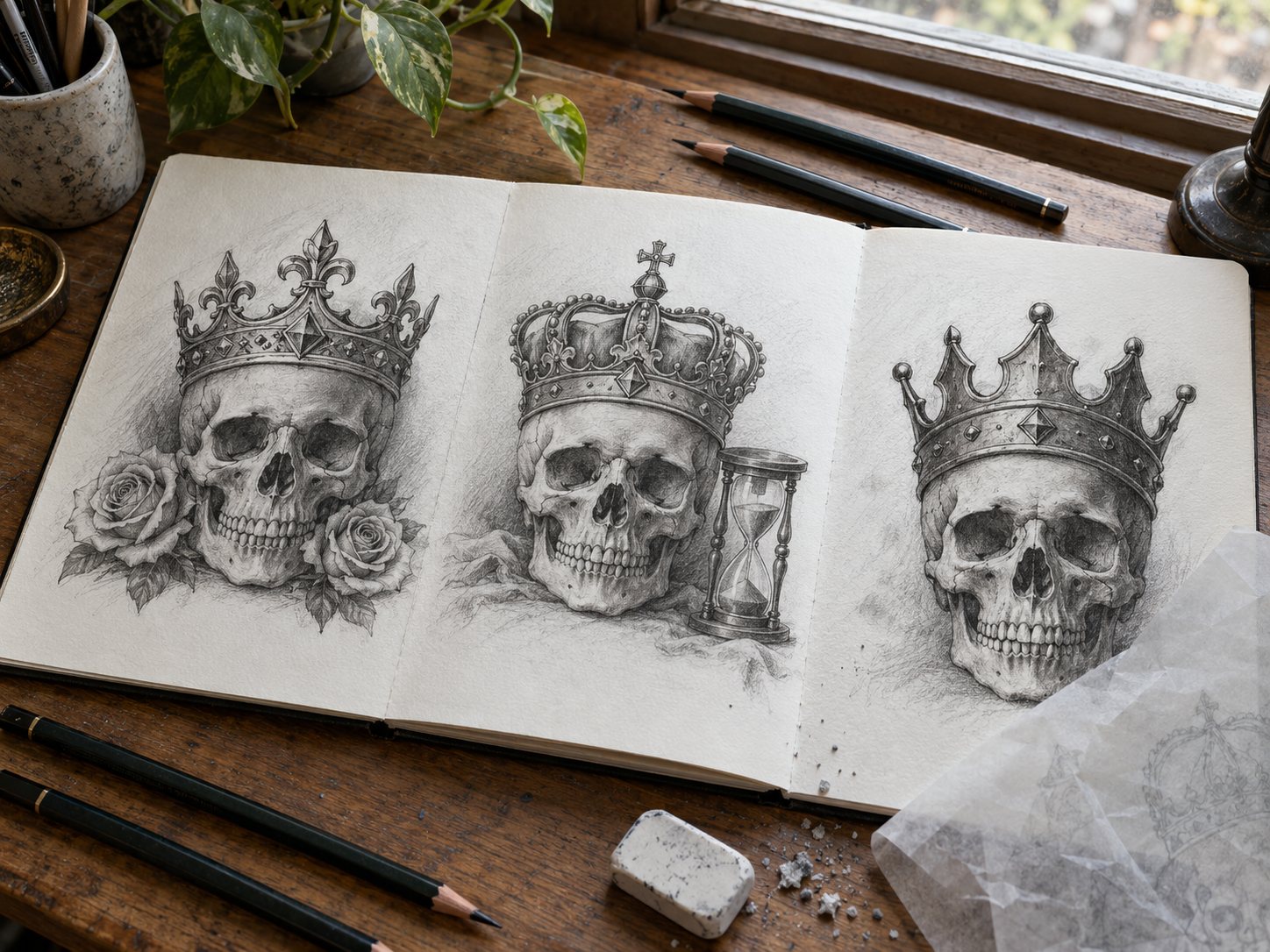
If you are decoding someone else's, the honest answer is that you will learn more from asking than from guessing. A crowned skull on a friend's arm might be a memento mori, a family joke or a favorite album cover. The art history gives you the background; the person gives you the meaning.
If the "death outranks every crown" idea is what draws you in, our Memento Mori skull tee takes the vanitas route: a calm skull beside an hourglass in the manner of a seventeenth-century print, with MEMENTO MORI above and USE THE DAY WELL below. No crown, but the same old message. For more about skulls as tattoos in general, see skull tattoo meaning and memento mori tattoo meaning, and for skulls on real shields and family arms, read skulls in heraldry.
How well do you know the crowned skull?
Answer every question to check.
Questions people ask about the skull with a crown
What does a skull with a crown mean?
A skull with a crown means that death outlasts earthly power and social rank, at least in the European memento mori and vanitas art where the pairing became famous. In a modern object it can also suggest authority, legacy, rebellion or power facing mortality. The specific image, its period and the symbols around it decide which reading fits.
What does a skull with a crown tattoo mean?
A skull with a crown tattoo is most often a personal symbol that joins mortality with authority, self-rule, resilience or the temporary nature of status. Whether it leans toward power, rebellion or legacy depends on the design and the wearer. The tattoo artist or the person wearing it can tell you what an individual piece is meant to say.
What does a king skull mean?
A king skull is a modern design label for a skull in a royal crown, often read as "king of the dead," authority made temporary, or personal sovereignty. It is not a single historical symbol with a fixed meaning. Treat it as a design description and ask the wearer, artist or maker what they intend.
What does a skull with a crown and roses mean?
A skull with a crown and roses joins mortality, rank and beauty, so it often reads as love or beauty that outlasts status, or as remembrance of someone who mattered. Roses alone with a skull usually point to beauty, love or the short life of physical beauty. The crown adds the idea that even the highest place in life ends.
Is a crowned skull a prison tattoo?
A crowned skull is not a prison tattoo by default; for most people it is a memento mori or a statement of personal power. In Russian and Soviet prison tattoo culture, which Danzig Baldaev documented in Leningrad from 1948 to 1981, skull imagery could denote criminal authority. That coded meaning belongs to that setting and should not be read into an ordinary design.
Terms in this story
Tap a term to see what it means.
Memento mori. Latin for "remember that you will die." In European art it names images and objects, often with a skull, made to keep mortality in mind.