

No. 009
Skull Cups: A History From Ice Age Britain to Lord Byron
Yes, people really did make human skulls into cups, and they did it in several separate times and places rather than as one tradition passed down the ages. The oldest directly dated examples are three skull-cups from Gough's Cave in Somerset, England, made about 14,700 years ago. Ancient writers described skull cups among the Scythians and the Celtic Boii. In Tibetan Vajrayana Buddhism the skull cup, or kapala, is a ritual vessel. Lord Byron drank wine from one at Newstead Abbey. The most famous version of all, the Viking warrior drinking from an enemy's skull, has the weakest footing: it rests largely on a seventeenth century mistranslation of a poem.
Here is how each of those stories is known, and how much weight each one can carry.
Gough's Cave: the oldest dated skull-cups
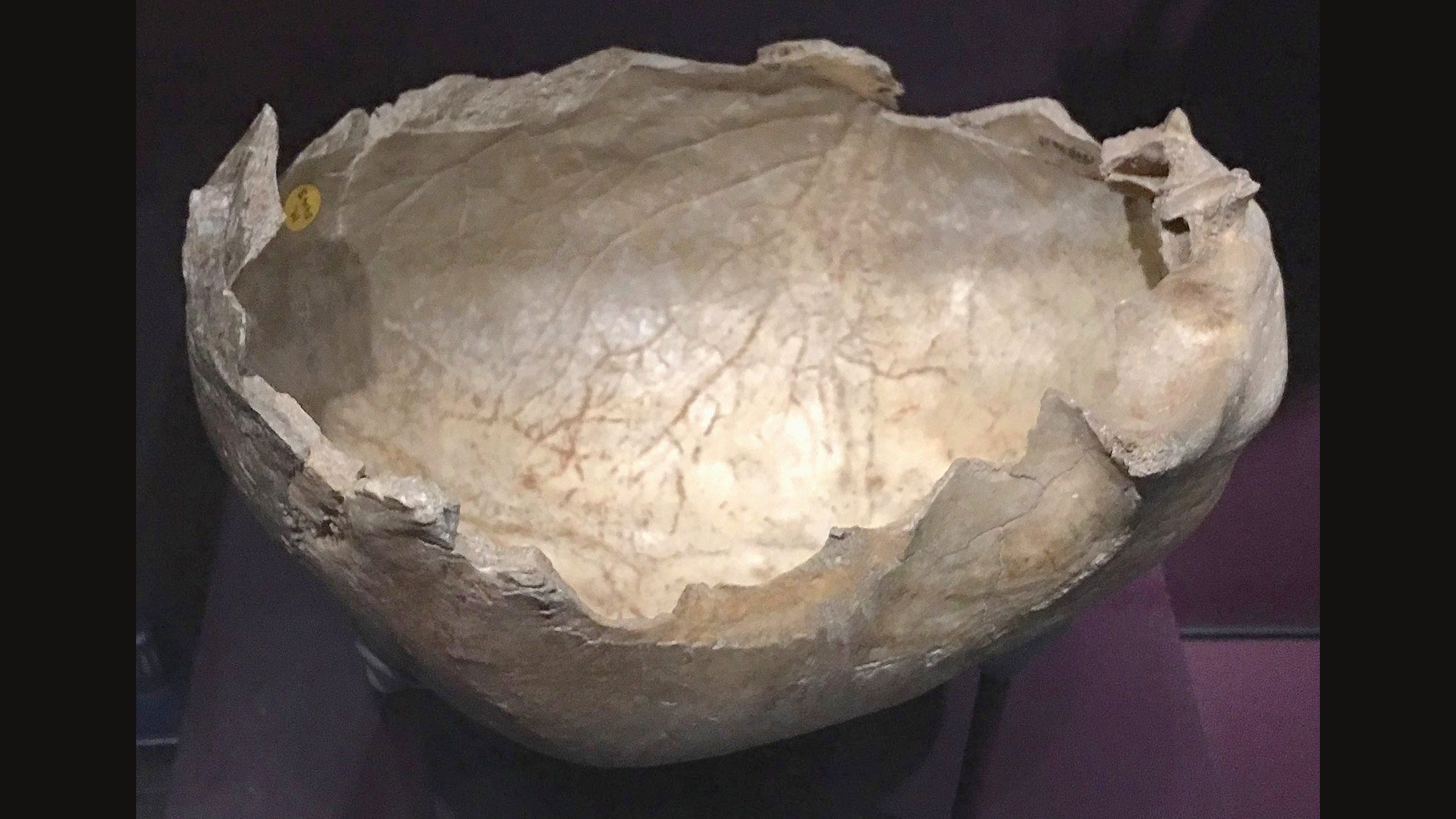
The story starts in a cave in Somerset, in the southwest of England. Gough's Cave held human remains from the Magdalenian period, the late part of the last Ice Age, and among them were three skull-cups.

In 2011, Bello, Parfitt and Stringer published a study in *PLOS One* titled "Earliest directly-dated human skull-cups". They dated two of the cups directly to about 14,700 calibrated years before present. That makes them the oldest directly dated skull-cups known, and at the time they were the only directly dated examples from Britain.
The work on them was careful and deliberate. According to the study and the Natural History Museum in London, the skulls were cleaned of soft tissue, the face and the base of the skull were removed, and the remaining cranial vaults were shaped into cups. The bones also carry evidence of marrow extraction. The researchers read the whole pattern as probable ritual treatment, not simple survival cannibalism, and the museum points out that the people of Gough's Cave had plenty of animal meat to eat.
The people of Gough's Cave left no writing, so what the ritual meant to them is a matter of careful interpretation. The Natural History Museum also notes comparable skull-cup evidence at two sites in France, Isturitz and Le Placard, so Gough's Cave was not alone.
Herodotus and the Scythian skull cups
The first written descriptions come thousands of years later. Herodotus, the Greek historian writing in the fifth century BCE, described the customs of the Scythians in Book 4 of his *Histories*.
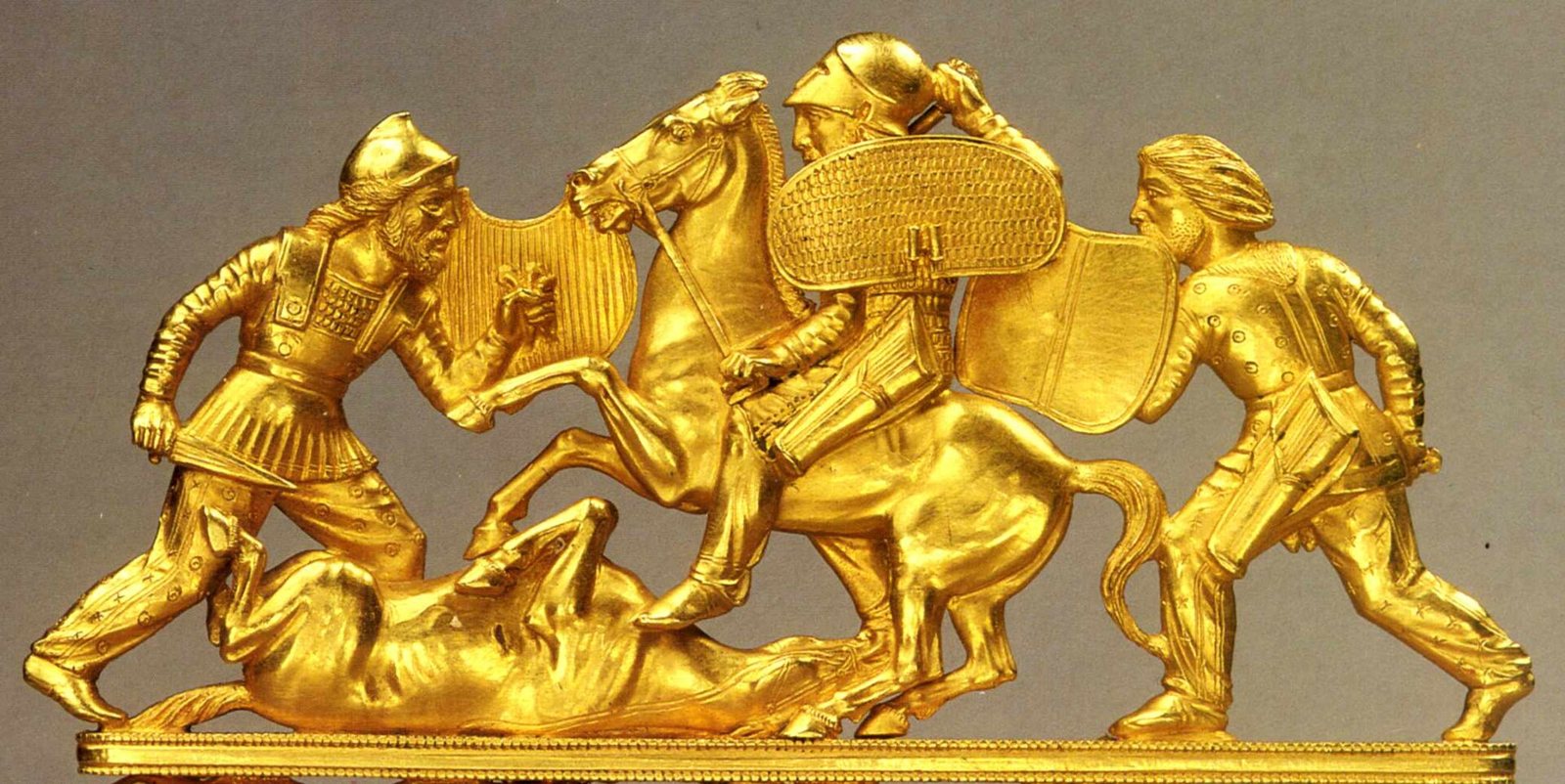
In passage 4.65, as rendered in Godley's translation on the Perseus Digital Library, a Scythian cut away the skull of an enemy below the eyebrows and cleaned it. A poorer man covered the outside with raw hide. A wealthy one also gilded the inside "and uses it for a drinking-cup." Herodotus adds that a man might make such a cup from a kinsman he had defeated in a feud, and bring it out to show honored guests.
It is a vivid passage, and it should be read for what it is: a Greek writer describing another people as an outside observer. It tells us what Herodotus believed and wanted his readers to know. It is not an excavation report.
Livy and the Boii: a skull cup for a temple
Rome has its own skull-cup story, told by the historian Livy in his *History of Rome*, Book 23, section 24. The people involved are the Boii, a Celtic people of Cisalpine Gaul. At the Battle of Silva Litana, usually dated to 216 BCE, they killed the Roman consul Lucius Postumius Albinus.
In the translation by Spillan and Edmonds, the Boii cleaned his skull and "covered the skull with chased gold." It served them "as a cup for libations" and as a drinking cup for the priests and ministers of their temple.
Like Herodotus, Livy was an outsider writing about a people Rome fought. Both accounts show that skull cups were part of how ancient writers imagined and described these peoples. Neither one proves that every detail happened exactly as written.
Skull cups through history
Tap or hover a step to follow the order.
About 14,700 years ago
Three skull-cups are made at Gough's Cave in Somerset, England, the oldest directly dated examples known
Fifth century BCE
Herodotus describes Scythian skull drinking cups in Histories 4.65
About 216 BCE
Livy records the Boii covering a Roman consul's skull in gold for temple libations
1600s
Ole Worm's Latin rendering of the poem Krákumál turns a poetic image into Viking skull cups
1600s to 1800s
Tibetan kapalas are used as ritual offering vessels and symbols of impermanence
Early 1800s
Lord Byron drinks from a polished skull cup at Newstead Abbey
The kapala: ritual skull cups in Tibetan Buddhism
The skull cup with the longest living history is the kapala. The word comes from Sanskrit, and the object belongs to tantric traditions in India and, above all, to Tibetan Vajrayana Buddhism. In that practice a kapala can serve as an offering vessel and as a symbol of impermanence, death, wisdom and emptiness.
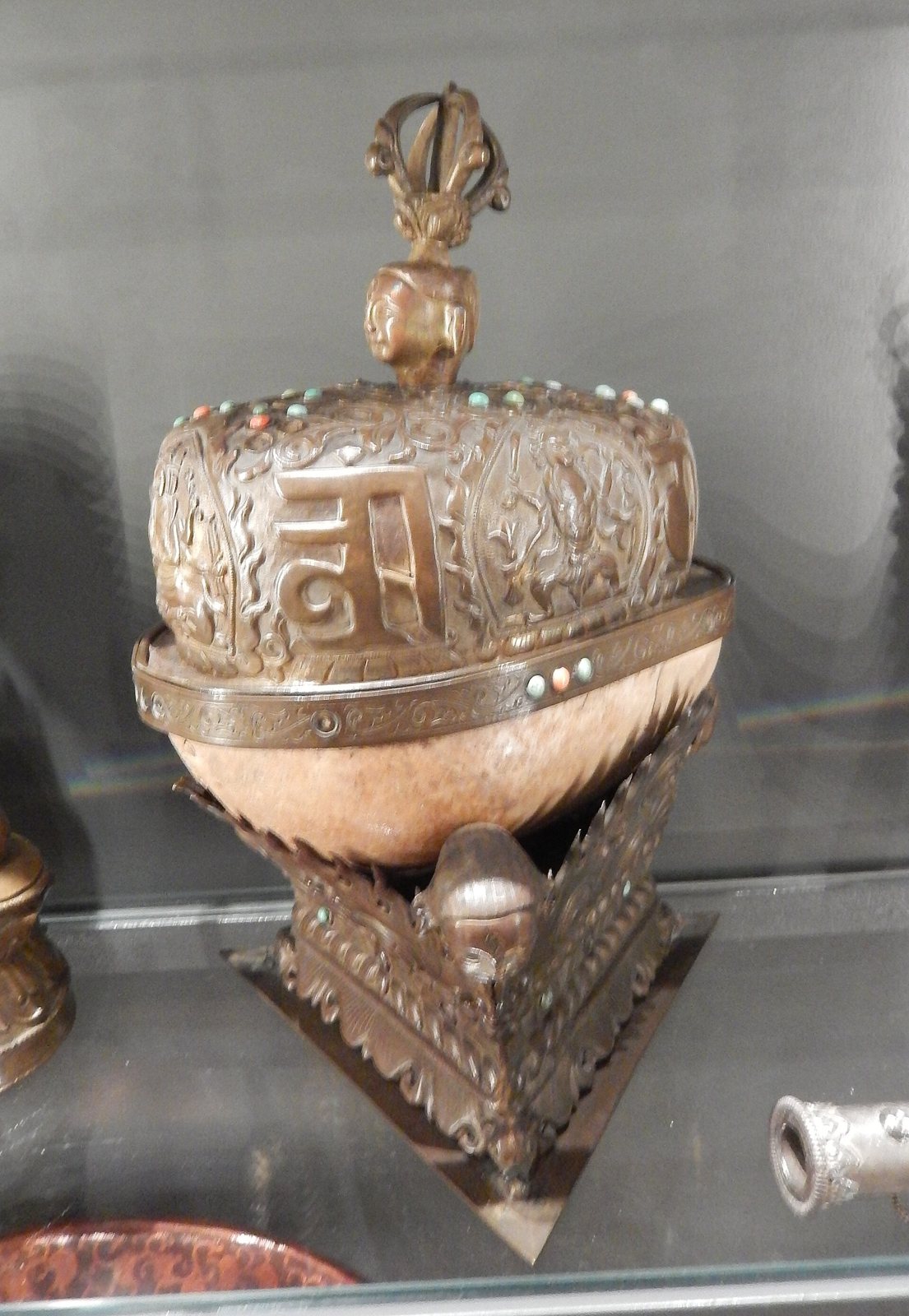
Museums hold many examples. The Walters Art Museum has a Tibetan skull cup from the eighteenth or nineteenth century, made from the upper part of a human skull and set on a covered stand decorated with turquoise, coral and glass. The Metropolitan Museum of Art has a seventeenth century work titled *Ascetic Master, probably a Mahasiddha*. The figure, probably the mahasiddha Kapalapa, holds a skull cup and links the object to Indian tantric and Tibetan Vajrayana traditions. The National Palace Museum in Taipei holds Qing-period kapala bowls, and the British Museum has nineteenth century Tibetan or Nepalese examples.
So, are Tibetan skull cups real? Yes. They are real ritual objects with a documented place in Vajrayana practice. They were not everyday tableware, and their forms, materials and meanings vary by lineage and region, which is why each museum record is the best guide to its own object. Our story on the kapala skull cup goes further into the object itself, and skull symbolism in Buddhism explains why skulls appear in Buddhist art at all.
Lord Byron's skull cup at Newstead Abbey
The most famous skull cup in English literature belonged to a poet. At Newstead Abbey, Lord Byron's home in England, a gardener dug up a human skull. Byron later described having it polished and mounted as a drinking vessel. His friends remembered wine, sometimes burgundy, being served from it at gatherings at Newstead.

He also wrote it a poem, "Lines Inscribed upon a Cup Formed from a Skull." The whole episode fits the Romantic fascination with medieval ruins, death and the memento mori, the old reminder that every life ends.
Whose skull it was is another matter. Byron believed it may have belonged to a monk, but the surviving accounts do not settle who the person was. If you hope to see the cup, ask Newstead Abbey or the collection responsible for it about where it is kept and whether it is on display.
Did Vikings drink from skulls?
There is no archaeological evidence that Vikings routinely drank from human skulls. The image of a Norse warrior raising an enemy's skull comes largely from a translation of the skaldic poem *Krákumál* made in the seventeenth century.
The scholar Ole Worm rendered the poem into Latin and read a phrase meaning "curved trees of skulls" as skull drinking cups. The phrase is a kenning, the kind of poetic riddle skaldic verse loves, and Rory McTurk's modern translation identifies it as drinking horns. The Skaldic Project and the scholars in the Retrospective Methods Network volume record both readings.
Then there is the toast. Many people assume that the Scandinavian toast *skål* comes from "skull." Linguists say otherwise. The Old Norse Dictionary gives *skál* as a bowl, with examples of bowls filled with water or mead, and the University of Texas Indo-European Lexicon lists Old Norse *skāl* as "bowl." The English word skull is associated with a different Old Norse word, *skalli*, meaning "bald head" or "skull." The American Swedish Historical Museum likewise treats *skål* as a bowl and the skull story as a later tale.
Tap or hover a row to highlight it.
| Old Norse word | Meaning | Modern descendant |
|---|---|---|
| Old Norse wordSkál | MeaningBowl or drinking vessel | Modern descendantThe Scandinavian toast skål |
| Old Norse wordSkalli | MeaningBald head or skull | Modern descendantAssociated with the English word skull |
The careful answer has one more layer. The Retrospective Methods Network volume notes that Norse literature contains a few exceptional skull-cup stories, so a one-off case cannot be ruled out in every tale. What the evidence does not support is the idea of skull cups as a normal part of Viking life. When you raise a glass and say *skål*, you are naming the bowl, not a skull.
Skull cups history quiz
Answer every question to check.
Questions about skull cups
These short answers cover what people most often ask about skull cups and their history.
What is the history of skull cups?
The history of skull cups is a set of separate episodes rather than one continuous tradition. The earliest directly dated examples come from Gough's Cave in England, about 14,700 years ago; later, Herodotus and Livy described Scythian and Boii skull cups, Tibetan Vajrayana Buddhism made the kapala a ritual vessel, and Lord Byron revived the idea as a Romantic gesture in the early 1800s.
Did Vikings really drink from skulls?
Vikings are not known to have drunk from skulls as a normal practice; no archaeological evidence shows it. The idea spread from Ole Worm's seventeenth century Latin translation of *Krákumál*, and Norse literature has only a few exceptional skull-cup stories. A 2023 article from National Geographic in Spanish, "Realidad o ficción", also traces the story to Worm's translation.
Is skål related to skull?
No, *skål* and skull come from two different Old Norse words. *Skál* meant a bowl or drinking vessel, while skull is associated with *skalli*, a bald head or skull, according to the Old Norse Dictionary and the University of Texas Indo-European Lexicon.
What is a kapala?
A kapala is a ritual skull cup used in tantric traditions and especially in Tibetan Vajrayana Buddhism, where it can serve as an offering vessel and a symbol of impermanence, wisdom and emptiness. Museum examples, such as the Walters Art Museum's eighteenth or nineteenth century cup, can sit on a covered stand decorated with turquoise, coral and glass.
Are Tibetan skull cups real?
Yes, Tibetan skull cups are real ritual objects, and museums including the Walters Art Museum, the British Museum and the National Palace Museum in Taipei hold documented examples. They belong to ritual practice and were not ordinary drinking cups.
Where to go next
The skull cup sits at the meeting point of several of our stories. Start with the kapala skull cup for the ritual object in depth, then read skull symbolism in Buddhism for the art around it. Byron's cup belongs with memento mori, and the wider story of what skulls have meant around the world is in our guide to skull symbolism.
Terms in this story
Tap a term to see what it means.
Skull-cup. A drinking or ritual vessel made from the upper part of a human skull, documented from Ice Age Britain to Tibetan Buddhist practice.