

No. 005
What Does the Skull Mean in Buddhism? Skull Symbolism in Buddhist Art
In Buddhism, a skull most often points to impermanence: the body changes, ages and comes apart, and seeing that clearly helps a person loosen their grip on it. In Vajrayana Buddhism, the tradition of Tibet and the Himalaya, skulls also belong to the visual language of tantric deities and charnel grounds, the places where the dead were cremated or left to the elements. There, as the scholar David B. Gray puts it, skull imagery evokes both death and awakening. So, the skull crown on a Tibetan painting and the skull in an old meditation text are related, but they are not saying exactly the same thing. The meaning depends on the tradition, the image and the ritual it belongs to.
That is the short answer. The longer one runs from early meditation instructions on the body to fourteenth century Tibetan sculpture and a fifteenth century Japanese Zen poet who wrote about a procession of skeletons.
The skull as a meditation on impermanence
The oldest layer of the story is a meditation, not a painting. In the *Mahā Satipaṭṭhāna Sutta*, the long discourse on the foundations of mindfulness known as DN 22, the practitioner is asked to call to mind a body left in a charnel ground and to follow it through decay. In Thanissaro Bhikkhu's translation, the stages run from a corpse to a skeleton, to scattered bones, a skull, whitened bones, a heap of bones and finally bones crumbled to powder.
Each stage ends the same way. The meditator turns the reflection back on their own body: "This body, too: Such is its nature, such is its future, such its unavoidable fate."
The point of the exercise is not to frighten anyone. It is meant to bring a clear view of impermanence and to weaken attachment to a body that will not last. A skull, in this setting, is a teacher. It shows plainly what every living face is resting on.
The same theme runs through other Buddhist texts. The 84000 translation of *The Transcendent Perfection of Wisdom in Ten Thousand Lines*, a Prajñāpāramitā scripture, lists nine contemplations of impurity, and the skeleton and the cremated corpse are among them. Readers who know European art will notice a family resemblance to memento mori, the Latin phrase for "remember that you will die," though the Buddhist practice grew from its own teachings and its own goals.
Charnel grounds: where the imagery comes from
To understand the skulls in Tibetan art, it helps to know where they come from. In India and Tibet, a charnel ground was a place where bodies were cremated or exposed to animals. Early Buddhist practitioners went to such places on purpose, to meditate on death and impermanence among the dead themselves.
In Vajrayana Buddhism, the charnel ground grew into much more than a meditation site. It became the setting associated with yogins, tantric practice, deity visualization and the imagery of wrathful deities and accomplished practitioners. David B. Gray, in his study "Skull Imagery and Skull Magic in the Yoginī Tantras", dates the beginnings of Yoginī Tantra composition to the late seventh or early eighth century in India, and skull and charnel-ground imagery is prominent in that literature.
In Tibet, the practice called *gcod* (often written chöd in English) drew directly on charnel-ground imagery, and its practitioners historically used ritual objects made from human bone. The Aro Encyclopaedia, a Tibetan lineage publication, describes air-burial rites in southern Tibet in the 1930s. Bodies were offered to vultures, and skulls and thighbones could become ritual objects. These were real people, and their remains were treated within a religious practice that saw the gift of the body as meaningful.
Skull crowns, garlands and skull cups in Vajrayana art
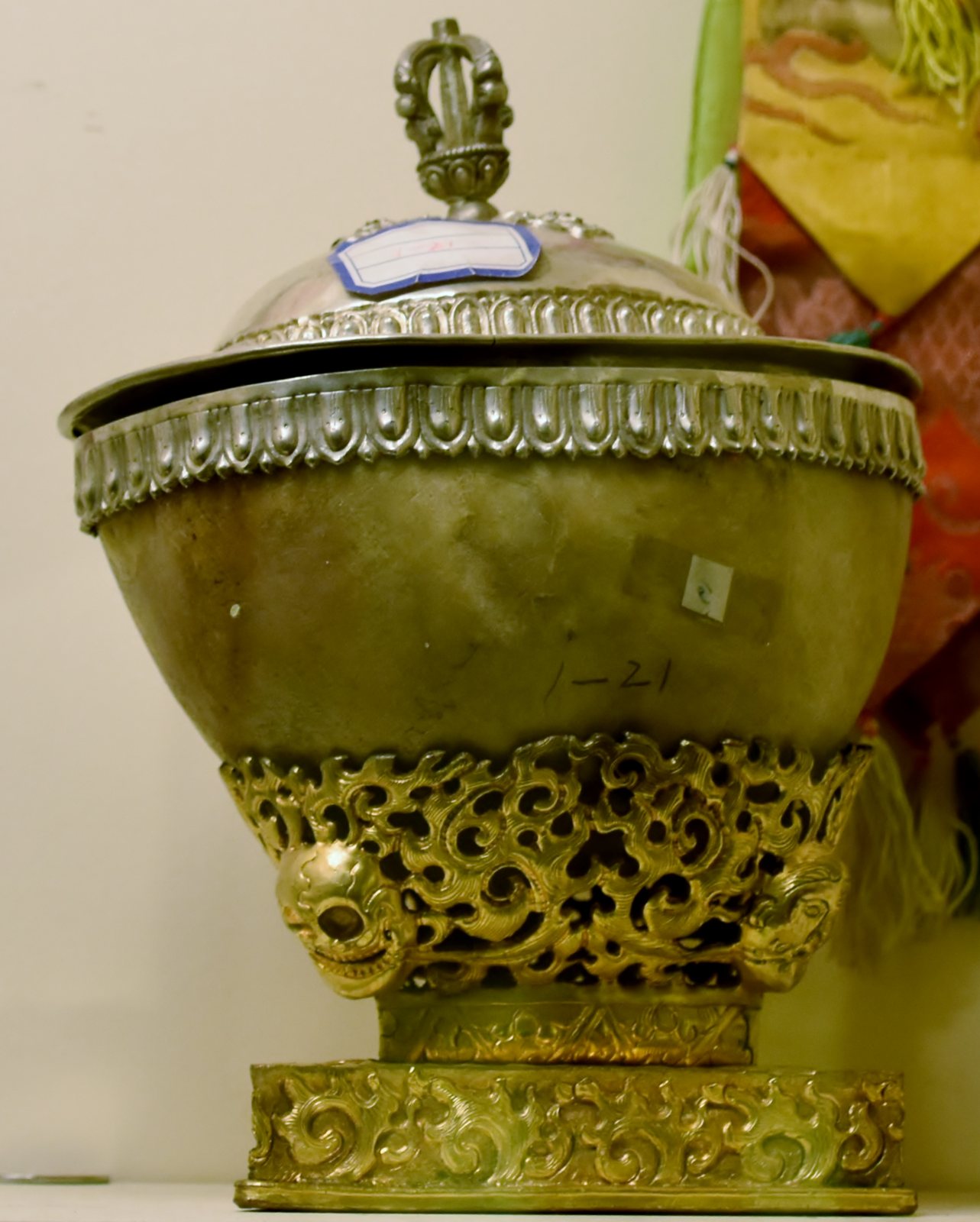
Once you know about the charnel ground, the skulls in Tibetan and Himalayan art start to make sense as a vocabulary. Tantric deities carry and wear attributes drawn from that setting: skull crowns, garlands of severed heads, skull cups called *kapāla*, bone ornaments and flaying knives. Gray describes skulls in the Yoginī Tantras as symbols that evoke death and awakening at once.
Museum collections give dated examples:
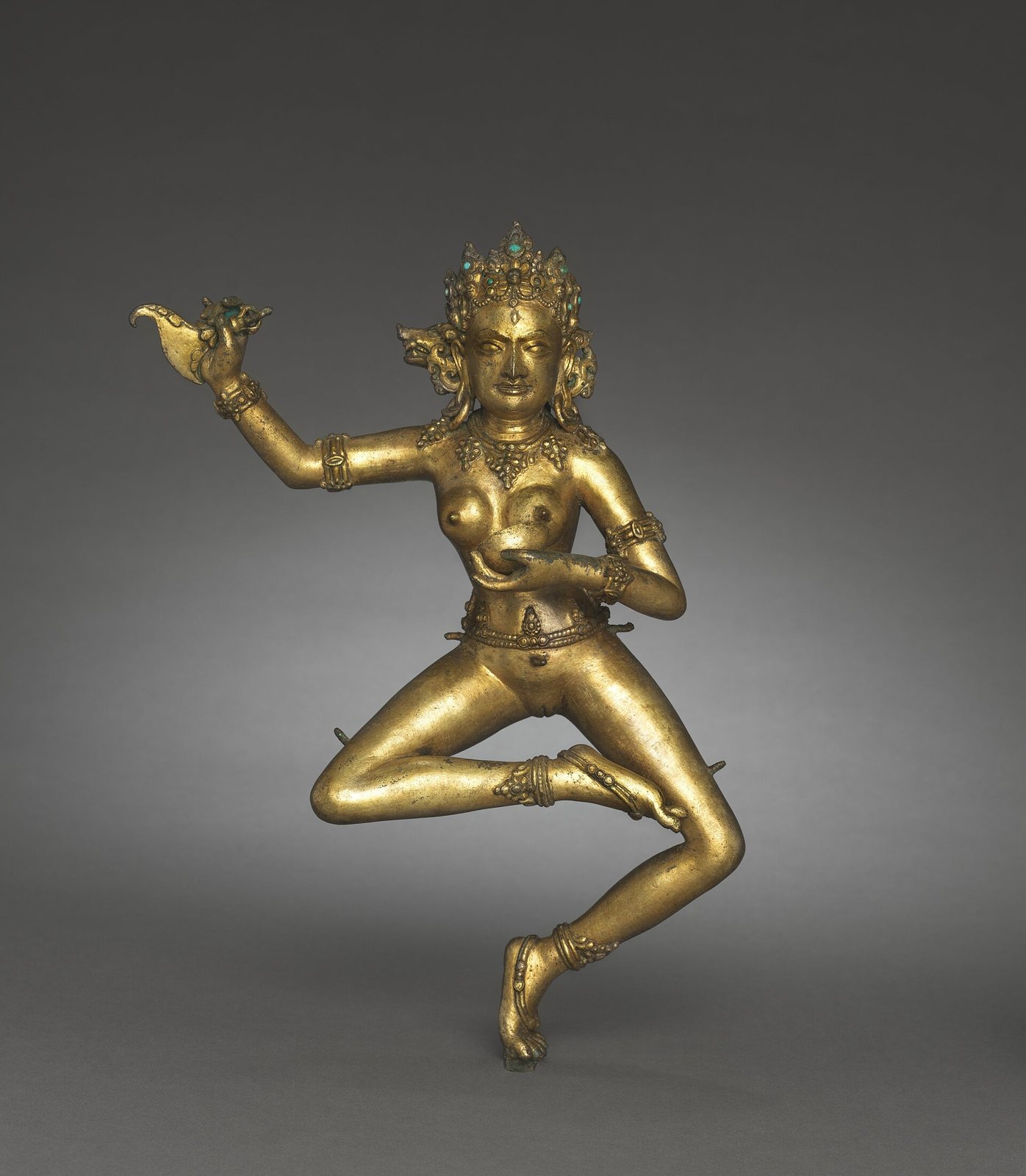
- The Cleveland Museum of Art holds a *Vajravarahi* from Tibet, made in the 1300s of gilt bronze with turquoise inlay (accession 1982.50). The museum identifies Vajravarahi as an enlightened Buddhist being, shown carrying a skull cup and a flaying knife.
- The National Museum of Asian Art in Washington holds a *Vajrayogini* from India or Nepal, made in the second half of the twentieth century of gilt copper alloy and other materials (accession S2013.22a-j). She wears a skull garland and raises a skull cup.
- The Rubin Museum of Himalayan Art holds a *Panjarnatha Mahakala* from Central Tibet, painted about 1720 in pigments on cloth. The protector wears a skull crown and a garland of severed heads, and the Rubin notes that the black background contains ashes from a funeral pyre.
Tap or hover a row to highlight it.
| Work | Place | Date | Medium | Collection | Skull attribute |
|---|---|---|---|---|---|
| WorkVajravarahi | PlaceTibet | Date1300s | MediumGilt bronze with turquoise inlay | CollectionCleveland Museum of Art | Skull attributeSkull cup, with a flaying knife |
| WorkPanjarnatha Mahakala | PlaceCentral Tibet | DateAbout 1720 | MediumPigments on cloth | CollectionRubin Museum of Himalayan Art | Skull attributeSkull crown and garland of severed heads |
| WorkVajrayogini | PlaceIndia or Nepal | DateSecond half of the twentieth century | MediumGilt copper alloy and other materials | CollectionNational Museum of Asian Art | Skull attributeSkull garland and raised skull cup |
The skull cup has a long history of its own, in ritual and in art. Our story on the kapala skull cup follows it in more detail.
Skulls are not the only sign of tantric ritual in Himalayan art. The Metropolitan Museum of Art describes the crowns of Newar Vajrācārya priests in Nepal as ritual objects worn by priests authorized to perform tantric and esoteric Buddhist ceremonies. The deity in a painting and the person performing a rite each have their own regalia.
Why do Tibetan deities wear skulls?
Tibetan deities wear skull crowns, skull garlands and bone ornaments because these refer to the charnel ground, to death and impermanence, and to the tantric idea that facing death can turn fear and attachment into awakening. The skulls also help identify wrathful or protective forms of enlightened beings and signal their power to overcome obstacles.
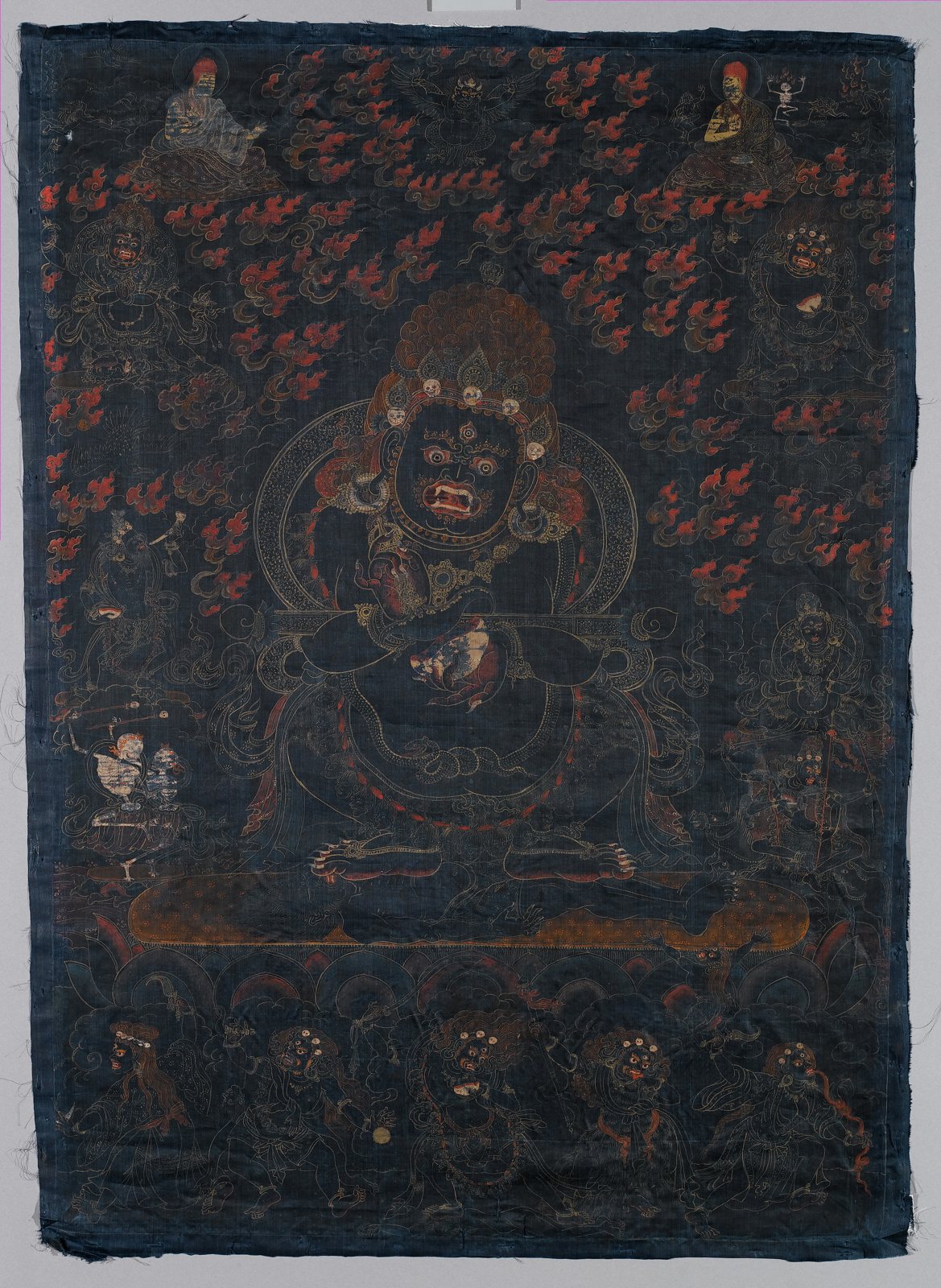
That is why a skull-crowned figure in a Tibetan painting is not a demon or a sign of evil. The Cleveland Museum's Vajravarahi carries a skull cup and a flaying knife, and the museum still describes her as an enlightened being. The fierce appearance is part of the teaching. In a protector like Mahakala, the skulls mark a wrathful form whose power is turned against obstacles.
It also helps to remember that these images belong to deity visualization and tantric ritual. Read in that setting, the skull crown points the viewer toward death, impermanence and awakening rather than toward fear.
How practitioners explain the images
Practitioners and the scholars who study their traditions tend to describe these images in terms of impermanence, letting go of attachment and turning fear into practice.
The Aro lineage teaching describes air burial as a final act of generosity: the body is given to feed other living beings. The same teaching says that *gcodpa* and *gcodma*, male and female practitioners of *gcod*, acquaint themselves with death in order to sever attachment to bodily form. The charnel ground is not a stage set for them; it is where that work happens.
The Rubin Museum presents the scholar David DiValerio's reading of a double-sided skull drum, a ritual instrument, as bringing together three ideas: impermanence, the norm-transcending power of wrathful deities and Buddhist cosmology. The Huntington Archive's essay on the skull cup, by Brian Zaharack, places the object in its ritual setting rather than treating it as a curiosity.
These explanations belong to particular Vajrayana lineages and practices, and they should not be stretched to cover every Buddhist community. Buddhism is practiced in many countries and schools, and each reads its images through its own teachings.
Skeletons in Japanese Zen: Ikkyū's Skeletons
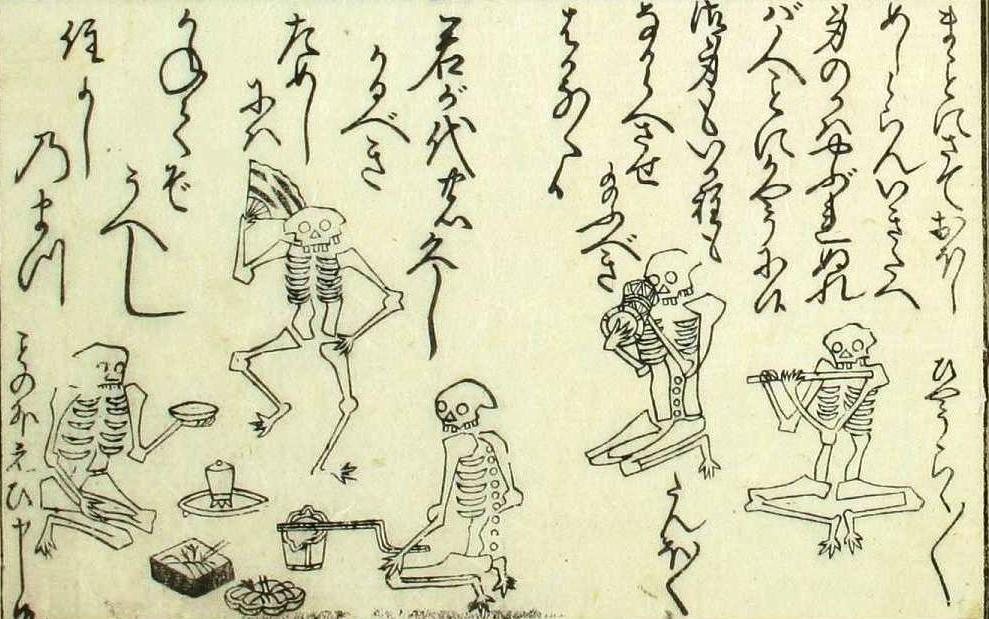
Japan has its own skull-and-skeleton story, and it is a literary one. Ikkyū Sōjun (1394 to 1481) was a Zen monk and poet, and he is associated with *Ikkyū Gaikotsu*, known in English as *Ikkyū's Skeletons*. The work presents a dreamlike procession of skeletons and uses them to express how unstable identity, memory and worldly life really are.
Waseda University Library records an illustrated printed edition from 1692, based on a work established in 1457. An English translation titled "Ikkyū's Skeletons" appeared in the journal *The Eastern Buddhist* in 1973, and the Ōtani University repository lists it today.
It is best read as one Zen poet's meditation on mortality. It does not mean skulls carry a single meaning across all of Japanese Buddhism, any more than one Tibetan painting speaks for every Buddhist country.
Skulls and skeletons in Buddhist texts and art
Tap or hover a step to follow the order.
Late seventh or early eighth century
Yoginī Tantra composition begins in India, according to David B. Gray; skull and charnel-ground imagery is prominent in this literature
1300s
A gilt bronze Vajravarahi carrying a skull cup is made in Tibet, now at the Cleveland Museum of Art
1394 to 1481
Life of the Zen monk and poet Ikkyū Sōjun
1457
Ikkyū Gaikotsu (Ikkyū's Skeletons) is established
1692
An illustrated printed edition of Ikkyū Gaikotsu is published in Japan
About 1720
Panjarnatha Mahakala with skull crown and garland of severed heads is painted in Central Tibet, now at the Rubin Museum
1930s
Air-burial rites associated with gcod practitioners take place in southern Tibet, as the Aro lineage records
1973
An English translation, Ikkyū's Skeletons, appears in The Eastern Buddhist
Dancing skeletons, and where to see these works
Many readers arrive here after seeing a pair of dancing skeletons in Tibetan art and searching for "Citipati" or "dancing skeletons in Tibetan Buddhism." Those figures have their own story, and we tell it separately in our article on Citipati. For any detail you plan to rely on, a museum with Himalayan collections or a Tibetan Buddhist institution is the best place to confirm it.
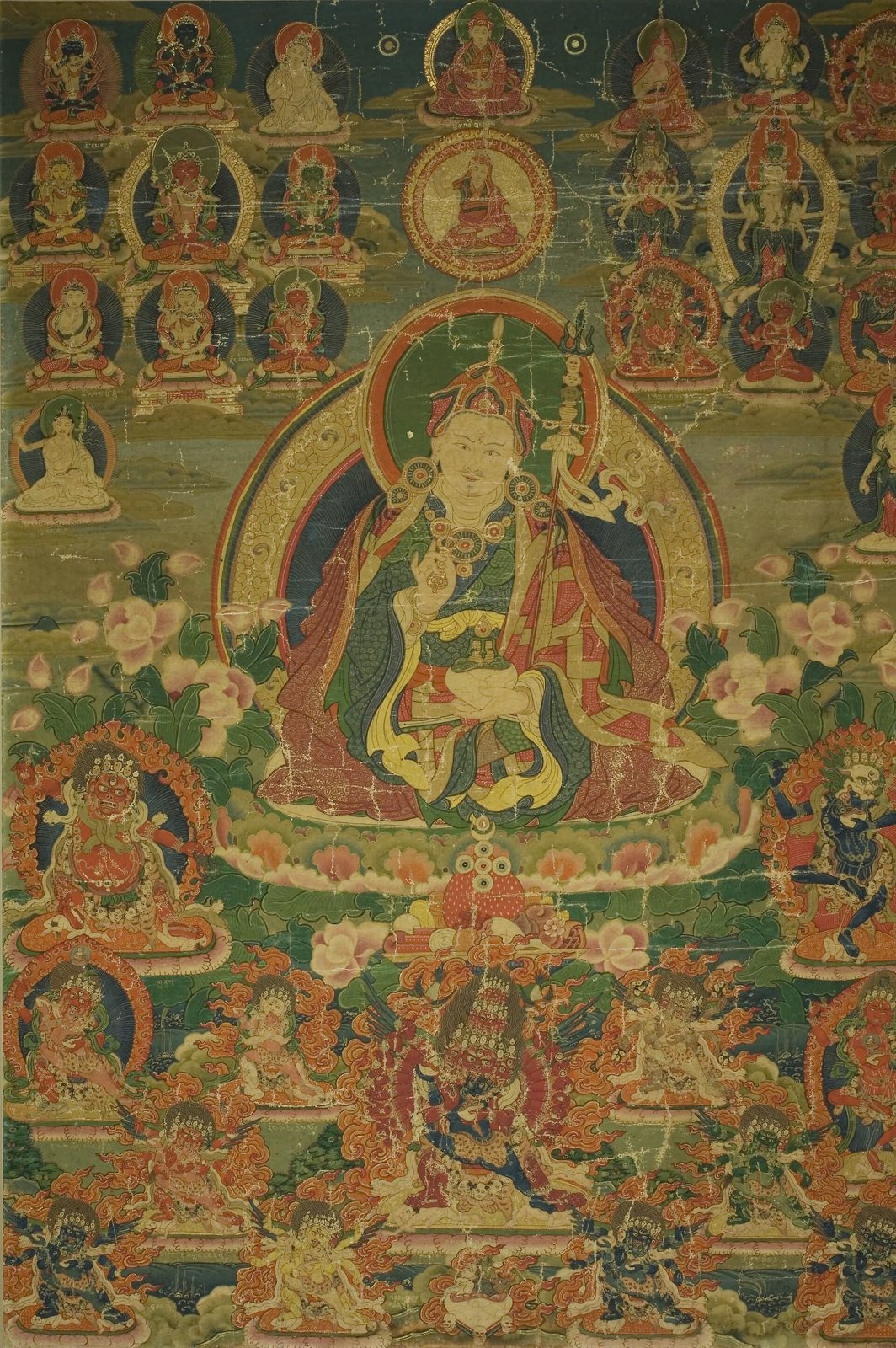
If you want to see skull imagery from Buddhist art in person, the works named above are in public collections: the Cleveland Museum of Art, the National Museum of Asian Art in Washington and the Rubin Museum of Himalayan Art. The Art Institute of Chicago holds an eighteenth century painted banner by an anonymous artist, *Painted Banner of Sage Guru Padmasambhava*_of_Sage_Guru_Padmasambhava_Seated_Holding_a_Thunderbolt_(Vajra)_and_Skull_Cup_(Kapala)_-_1970.486_-_Art_Institute_of_Chicago.jpg), made between 1701 and 1800, which shows the teacher holding a vajra and a skull cup. Check each museum's current galleries before a visit, since not every object in a collection is on view. If you want to reuse an image of a museum object, confirm the institution's own permission terms first.
A few manners are worth carrying with you. These are sacred images and ritual objects in a living religion. Look at them the way you would look at a cross or a reliquary: with curiosity, and with respect for the people for whom they still matter.
Skulls in Buddhist art quiz
Answer every question to check.
Questions about skulls in Buddhism
These are the questions people ask most often about skull imagery in Buddhist practice and art.
What is the significance of a skull in Buddhism?
A skull in Buddhism signifies impermanence, the instability of the body and the need to loosen attachment to it. In Vajrayana art it also belongs to the imagery of tantric deities and charnel grounds, where facing death becomes part of the path to awakening. The exact meaning depends on the tradition, the image and the ritual.
What is a Buddhist skull cup?
A Buddhist skull cup, called a *kapāla*, is a ritual vessel used in tantric Buddhist practice and shown in the hands of deities such as Vajravarahi and Vajrayogini. In art it ties the deity to the charnel ground and to the teaching on death and awakening. Wikimedia Commons hosts openly licensed photographs, including one of a skull cup from Pala Manor near Gyantse in Tibet, shared under CC BY 2.0.
What does a Tibetan skull crown mean?
A Tibetan skull crown marks a deity as a wrathful or protective form connected to the charnel ground, death and impermanence. It signals the power to overcome obstacles rather than any evil intent. The Rubin Museum's Panjarnatha Mahakala, painted about 1720, wears one along with a garland of severed heads.
What is charnel ground meditation?
Charnel ground meditation is the practice of contemplating death among the dead, or by calling a corpse to mind, to see impermanence clearly. DN 22 describes following a body through decay to bare bones, and later Vajrayana practitioners, including those of *gcod*, made the charnel ground a central setting for their practice.
What is Ikkyū's Skeletons?
*Ikkyū's Skeletons* (*Ikkyū Gaikotsu*) is a work associated with the Japanese Zen monk and poet Ikkyū Sōjun that uses a procession of skeletons to reflect on mortality and the instability of identity. Waseda University Library dates the work's establishment to 1457 and holds an illustrated edition printed in 1692.
Where to go next
The skull cup has the most to say about ritual, so the kapala skull cup story is a good next stop, followed by Citipati for the dancing skeletons. To set Buddhist imagery beside other traditions, our overview of skull symbolism gathers the many meanings skulls carry around the world, and what is memento mori shows how European art used the skull to think about the same unavoidable fact.
Terms in this story
Tap a term to see what it means.
Vajrayana. The form of Buddhism practiced in Tibet and the Himalaya, which uses tantric ritual, deity visualization and imagery such as skull crowns and skull cups.