

No. 004
Citipati: Tibet's Dancing Skeleton Lords of the Charnel Ground
The two skeletons dancing together in flames in Tibetan art are the Citipati (often spelled Chitipati), known formally as Shri Shmashana Adhipati, the "Glorious Lords of the Charnel Ground." Tibetan texts call them dur khrod bdag po yab yum, "Father and Mother, Lords of the Charnel Ground." They are a male and female pair of protector deities in Tibetan and Himalayan tantric Buddhism. Himalayan Art Resources connects them with the Secret Essence Wheel Tantra and the Chakrasamvara cycle, and describes their roles as protecting wealth, guarding against thieves and protecting the Naro Khechari practice of the deity Vajrayogini. Their skeleton bodies speak of impermanence, the Buddhist teaching that everything that lives will change and die.
They are protectors, then, not ghouls, and the grins on their skulls are part of the story.
Who the Citipati are
The name most people know, Citipati or Chitipati, is a common modern one. Jeff Watt of Himalayan Art Resources notes that "Chitipati" is widely used even though it does not appear in the root tantric texts. The fuller name, Shri Shmashana Adhipati, and the Tibetan dur khrod bdag po yab yum both say the same thing: these are the lords of the charnel ground, a husband and wife pair.
According to Himalayan Art Resources, the pair arise from the Secret Essence Wheel Tantra and belong to the Chakrasamvara cycle of tantric teachings. As protectors, they have specific jobs. They protect wealth, they guard against thieves, and they serve as protectors of Vajrayogini's Naro Khechari practice.
People who come to the Citipati through practice often ask how to relate to them. In the tradition Himalayan Art Resources describes, they belong to Vajrayogini's Naro Khechari practice as its protectors, so that practice is their home.
How to recognize them
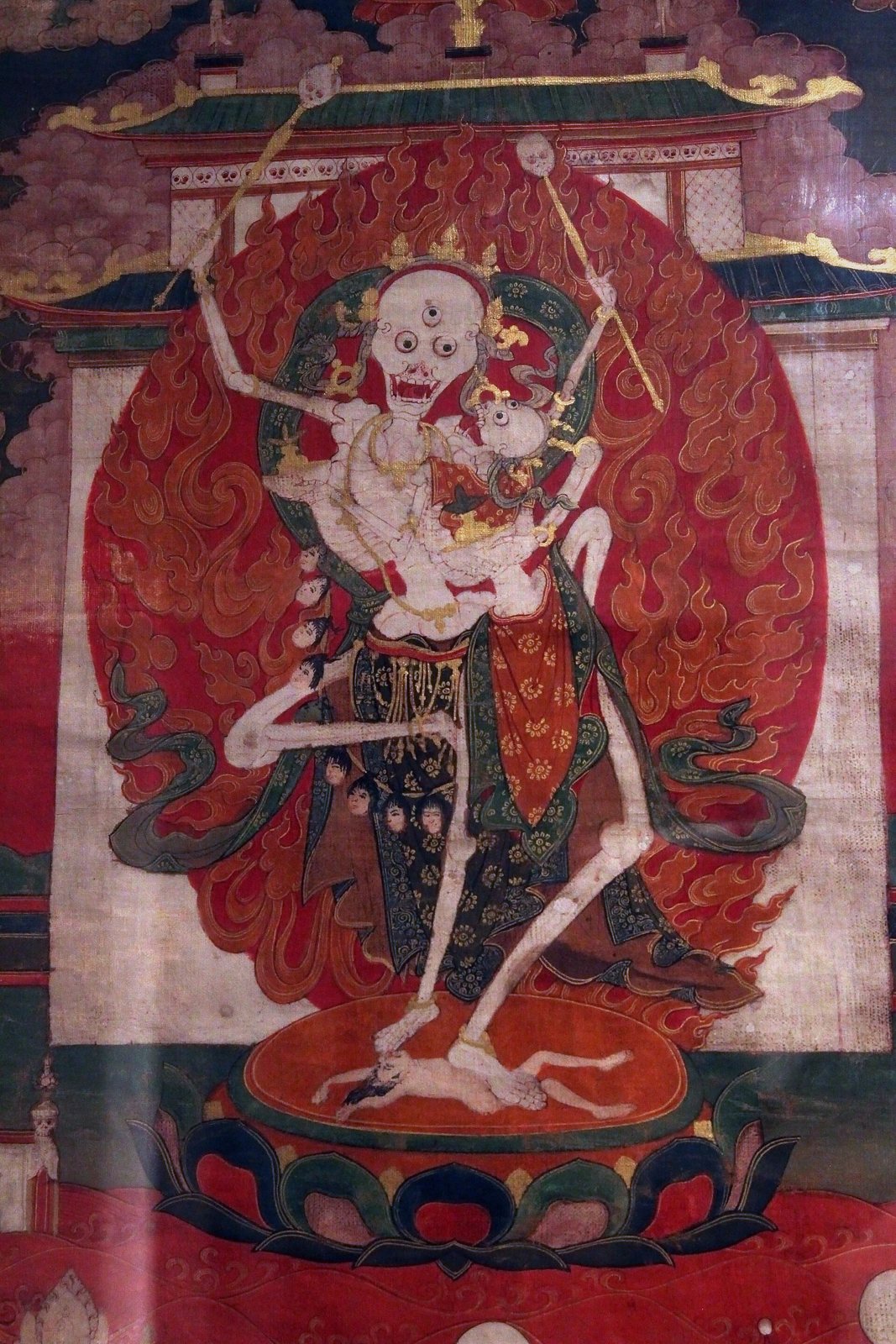
The Citipati are normally shown as two skeletons, one male and one female, dancing with their legs interlocked, surrounded by flames.
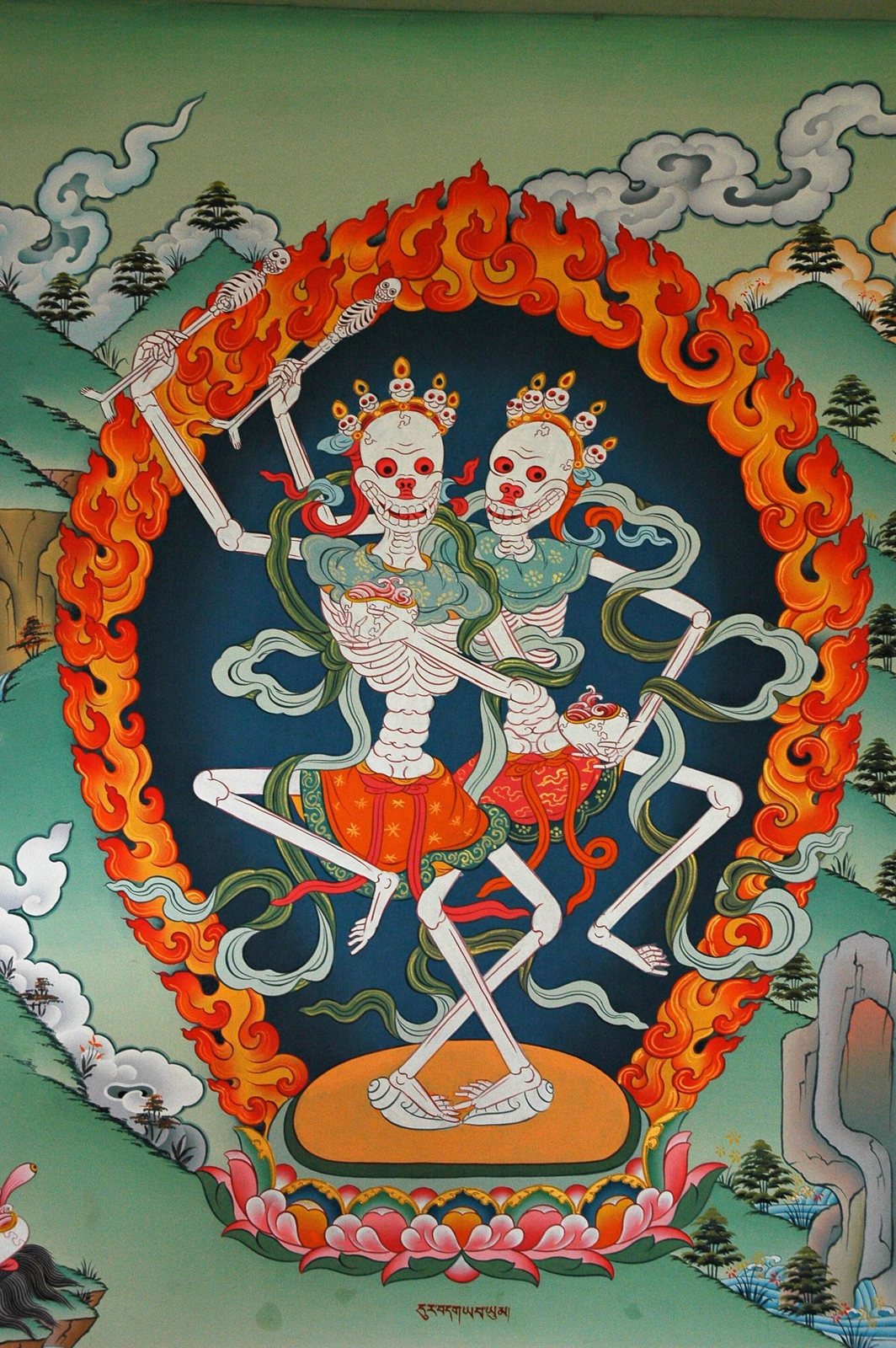
One of the earliest dated examples is a Tibetan painting in the Rubin Museum of Art, recorded by Himalayan Art Resources: *Chitipati/Shri Shmashana Adhipati*, Tibet, 1400 to 1499, ground mineral pigment and fine gold line on cotton, accession F1996.16.5. The museum record does not name the artist. In it, both skeletons have three round eyes and wide smiling mouths. They wear crowns of skulls, silk ornaments and red skirts, and they hold skull cups and bone staffs. The male stands on a conch shell and the female on a cowrie shell. Above them hangs a canopy made of ribs, limbs and intestines, and charnel-ground scenes fill the sides.
Once you know those details, the pair are easy to spot: two skeletons, not one; legs locked together in the dance; flames all around; skull crowns; and often a skull cup in hand.
Where to see the Citipati in museums
Museums hold the Citipati in paint, metal, bone and wood. The holding museums list them this way:
Tap or hover a row to highlight it.
| Object | Date | Medium | Museum and number |
|---|---|---|---|
| ObjectChitipati/Shri Shmashana Adhipati | Date1400 to 1499 | MediumGround mineral pigment and fine gold line on cotton | Museum and numberRubin Museum of Art, F1996.16.5 |
| ObjectPlaque from a Tantric Ritual Apron: Chitipati Dancing | Date16th century or later | MediumBone | Museum and numberMetropolitan Museum of Art, 1991.409.7 |
| ObjectOracle Mirror with Chitipati | Date16th to 17th century | MediumSilver inlaid with coral and turquoise | Museum and numberLos Angeles County Museum of Art, M.2017.180.1 |
| ObjectThe Buddhist deity Chitipati | DateApproximately 1800 | MediumBronze with gilding | Museum and numberAsian Art Museum, Avery Brundage Collection, B62B170 |
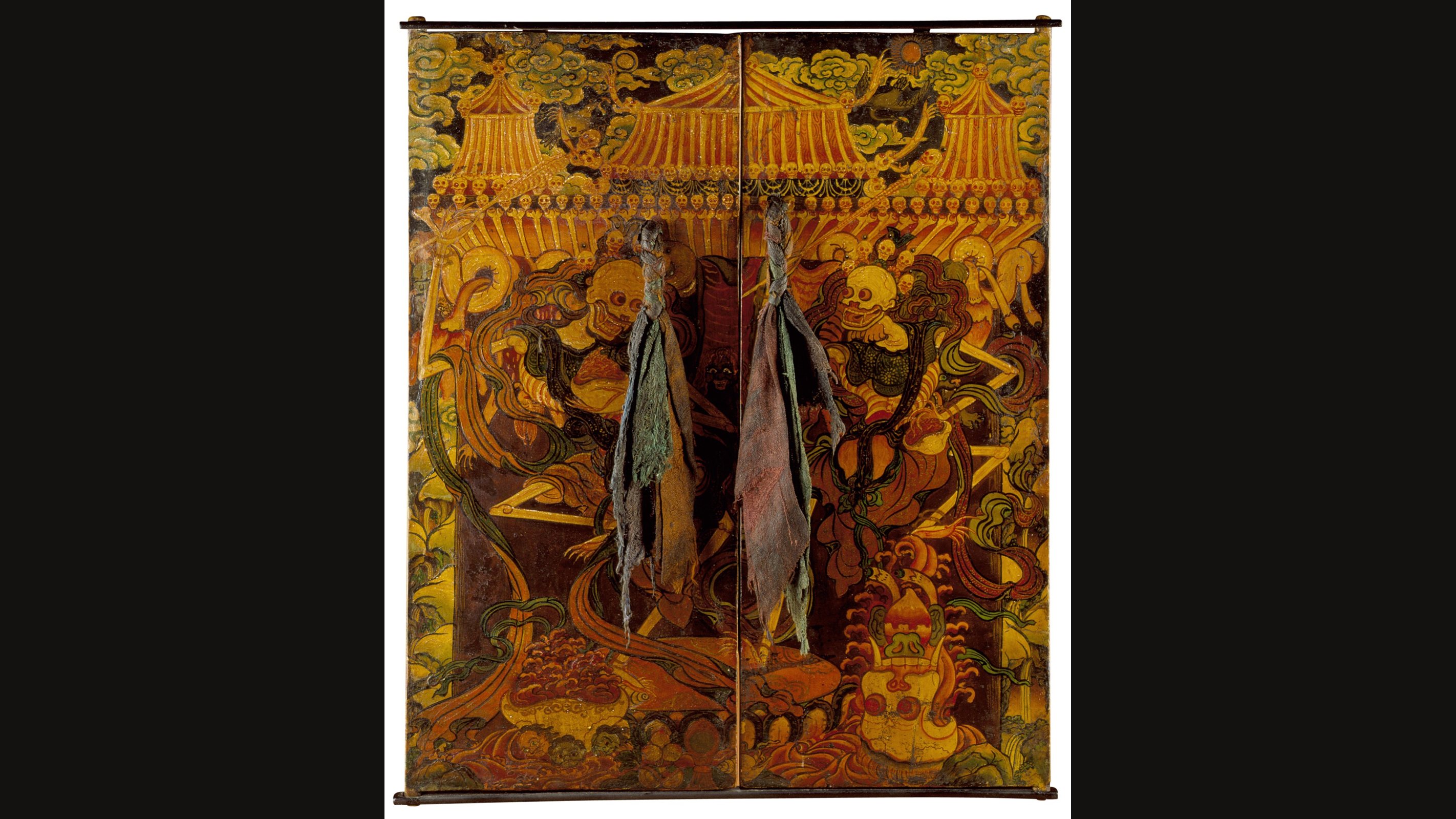
| ObjectCabinet with Chitipati | Date19th century | MediumWood, leather, pigments and gilding | Museum and numberWalters Art Museum, F.198 |
The Metropolitan Museum of Art's bone plaque is carved in bone and comes from a tantric ritual apron. The Asian Art Museum's gilded bronze is a sculpture of the deity from Tibet. LACMA's oracle mirror places the pair on a ritual object made of silver with coral and turquoise. The Walters Art Museum describes the dancing skeletons on its painted cabinet as male and female protectors associated with tantric Buddhist ritual and the protection of wealth. The Musée Guimet holds an eighteenth-century Tibetan Citipati painting, inventory MA 5224. None of these records names the artist.
Skeleton dancers in cham
If you saw dancing skeletons at a monastery festival rather than in a museum, you saw cham. The St Andrews Encyclopaedia of Theology describes cham as a ritual masked dance performed in monastery courtyards on particular festival days across the Northern Buddhist world. Its Tibetan origin story connects it with Padmasambhava's vajra dance at Samye, and individual programs include other episodes, such as the Black Hat dance.
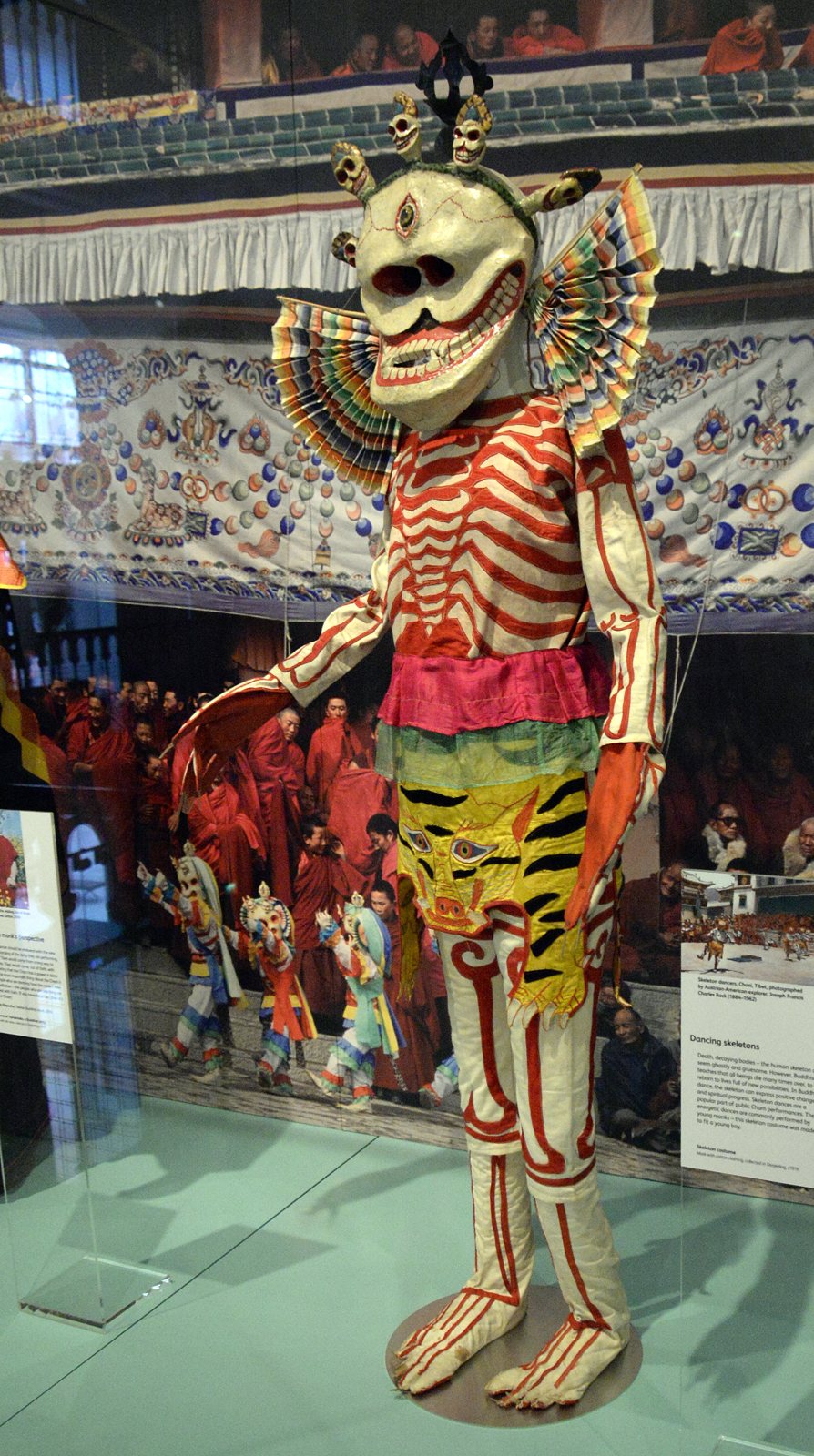
The skeleton dancers are called durdag, short for the Tibetan dur khrod bdag po, "Lords of the Cemetery." Two or four dancers may appear as male and female skeleton lords. They commonly enter first, mark out the boundary of the dance space and help move the crowd back. In some performances they carry or bring in the linga, a dough effigy that stands for obstacles or, on a deeper level, the ego.
Cham has no single standardized script, and performances vary between monasteries and lineages. A Spanish study by Francesc Massip and Lluís Kovács, published by the University of La Laguna, records dur dag, "the Dance of the Lords of the Cemeteries," with four skeleton dancers carrying the linga. Jeff Watt, writing in Tricycle, says the Sakya dance of Shmashana Adhipati developed about 250 years ago.
Are the Citipati and the durdag the same?
They are related, but they are not always the same figures. The Citipati, Shri Shmashana Adhipati, are a specific pair of protector deities with their own texts, roles and iconography. The durdag are skeleton dancers in cham who play the lords of the cemetery, and their part changes from one monastery's dance to another's.
Jeff Watt separates the Sakya Shmashana Adhipati dance from generic skeleton imagery, and Himalayan Art Resources draws the same line between the deity pair and the skeletons of cham. Skeletons also appear in the charnel-ground scenes around many Tibetan paintings. So, not every dancing skeleton in Himalayan art is the Citipati. The pair, the interlocked legs, the flames and the skull crowns are the clues that it is.
Why skeletons: impermanence and the charnel ground
A charnel ground is a place where human bodies are left exposed to decompose. In Buddhist traditions it is also a setting for meditation and for tantric practice, because there death and the body's impermanence are impossible to ignore.
Jeff Watt links Himalayan skeleton imagery to the Buddhist meditation on corpses in successive stages of decay, a contemplation in which the skeleton is the final stage. A body, however alive and dancing, becomes bones. The Citipati wear that fact as their whole form.
In tantric Buddhism, as Daniel A. Hirshberg explains in "Skull Imagery in the Yoginī Tantras" in the journal Pacific World, charnel grounds became important ritual settings, and skulls and bones could signify power over death and freedom from ordinary fear. Read that way, two skeletons dancing and smiling in the flames are not a threat. The imagery belongs to religious practice concerned with death, impermanence, protection and liberation.
The Citipati in art, dance and science
Tap or hover a step to follow the order.
Early Buddhist period
Contemplation of corpses in the charnel ground, a meditation on death, impermanence and fear
1400 to 1499
The Rubin Museum painting of Shri Shmashana Adhipati is made in Tibet
16th century or later
The Met's bone plaque shows Chitipati on a tantric ritual apron
16th to 17th century
LACMA's oracle mirror shows the Chitipati on a ritual object
Approximately 1800
The Asian Art Museum's gilded bronze Chitipati is made in Tibet
19th century
The Walters Art Museum's painted cabinet shows the dancing pair
About 250 years ago
The Sakya Shmashana Adhipati dance develops, per Jeff Watt
1993 to 1994
Citipati dinosaur fossils are found at Ukhaa Tolgod, Mongolia
The dinosaur named after them
If you searched "Citipati" and found a bird-like dinosaur sitting on a nest, you found their namesake. Citipati is also the name of an oviraptorid dinosaur from the Late Cretaceous of Mongolia, and the name refers to the Buddhist Chitipati imagery.
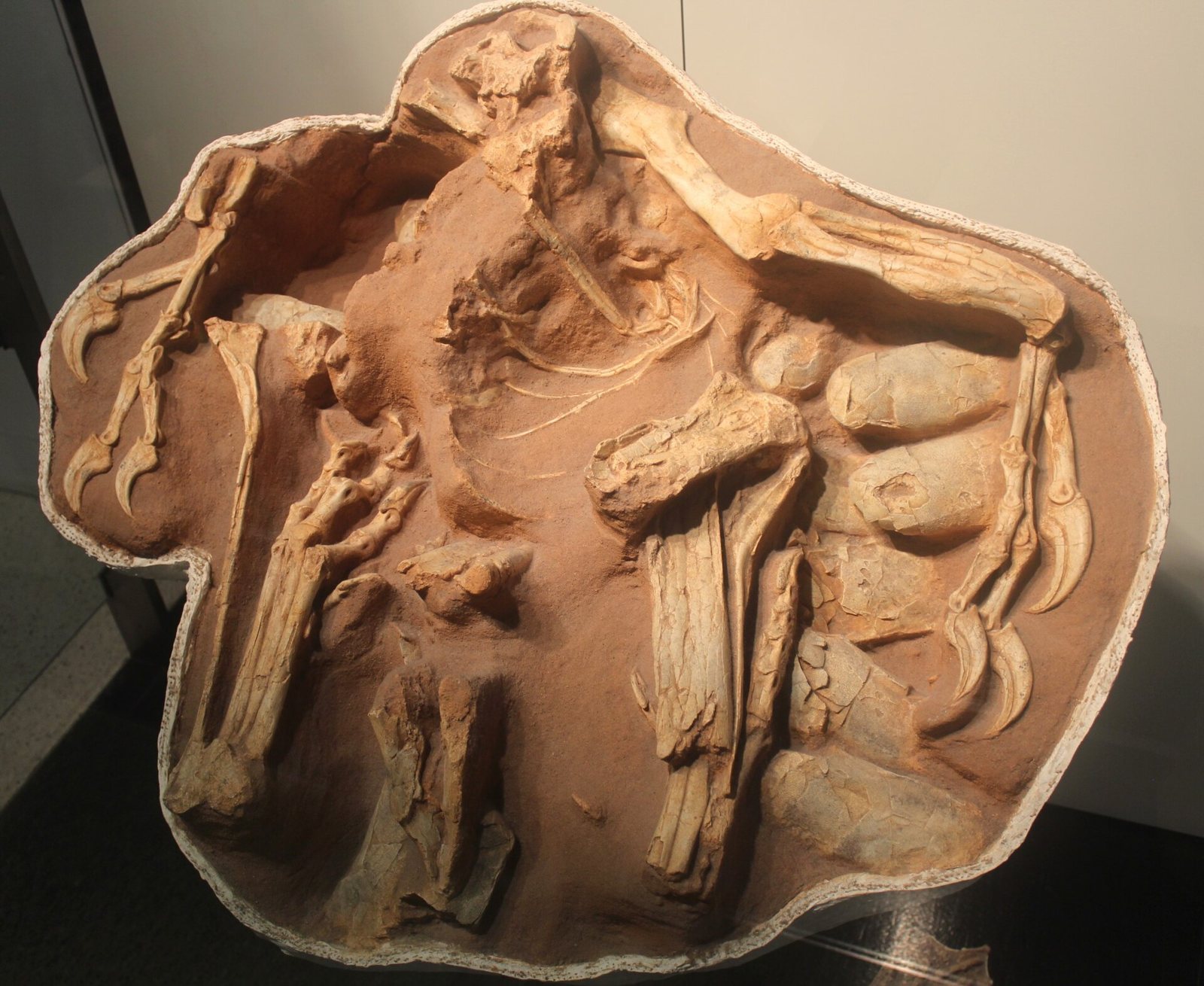
The American Museum of Natural History describes Citipati osmolskae as a bird-like dinosaur whose fossils show brooding behavior. Specimens turned up at Ukhaa Tolgod in 1993 and 1994, according to the museum's account of great fossil finds. A 1994 specimen preserved an adult sitting over a nest, and that find helped scientists reread the earlier Oviraptor fossil as a parent brooding its eggs rather than an egg thief, as the AMNH explains in Going Gobi.
Apart from the borrowed name, the dinosaur and the protectors have nothing to do with each other.
Questions people ask about the Citipati
Who is Citipati in Buddhism?
Citipati, also called Chitipati or Shri Shmashana Adhipati, is a paired protector figure in Tibetan and Himalayan tantric Buddhism: the male and female Lords of the Charnel Ground. Himalayan Art Resources associates them with protecting wealth, guarding against thieves and protecting Vajrayogini's Naro Khechari practice.
What do the dancing skeletons in Tibetan art mean?
Dancing skeletons in Tibetan art speak of impermanence and death, and the specific dancing pair are the protectors Shri Shmashana Adhipati. Skeletons also appear in charnel-ground scenes and cham dances, so the pair with interlocked legs and flames is the sign of the Citipati in particular.
What is a charnel ground?
A charnel ground is a place where human bodies are left exposed to decompose. In Buddhist traditions it is also a place for meditation and tantric practice, because it makes death and the body's impermanence directly visible.
Where can you see the Citipati in a museum?
You can see them in several collections, including the Rubin Museum of Art (a Tibetan painting from 1400 to 1499), the Metropolitan Museum of Art (a bone plaque from a ritual apron), LACMA (a silver oracle mirror), the Asian Art Museum (a gilded bronze from about 1800) and the Walters Art Museum (a painted nineteenth century cabinet). The Met, Asian Art Museum and Walters images are open access, so you can study them online.
Is the Citipati dinosaur named after the Buddhist deities?
Yes, the dinosaur Citipati osmolskae takes its name from the Buddhist Chitipati imagery. It is an oviraptorid from Late Cretaceous Mongolia, known from fossils that show an adult brooding a nest.
How much do you know about the Citipati?
Answer every question to check.
Where to go next
The Citipati hold skull cups, and the cups have a history of their own in the kapala skull cup. For skulls across Buddhist art more broadly, read skull symbolism in Buddhism. Europe has its own dancing dead, with a very different message, in the danse macabre, and the Western habit of keeping death in view is told in what is memento mori.
Terms in this story
Tap a term to see what it means.
Citipati. A common modern name, also spelled Chitipati, for the male and female skeleton protectors of Tibetan and Himalayan tantric Buddhism.