

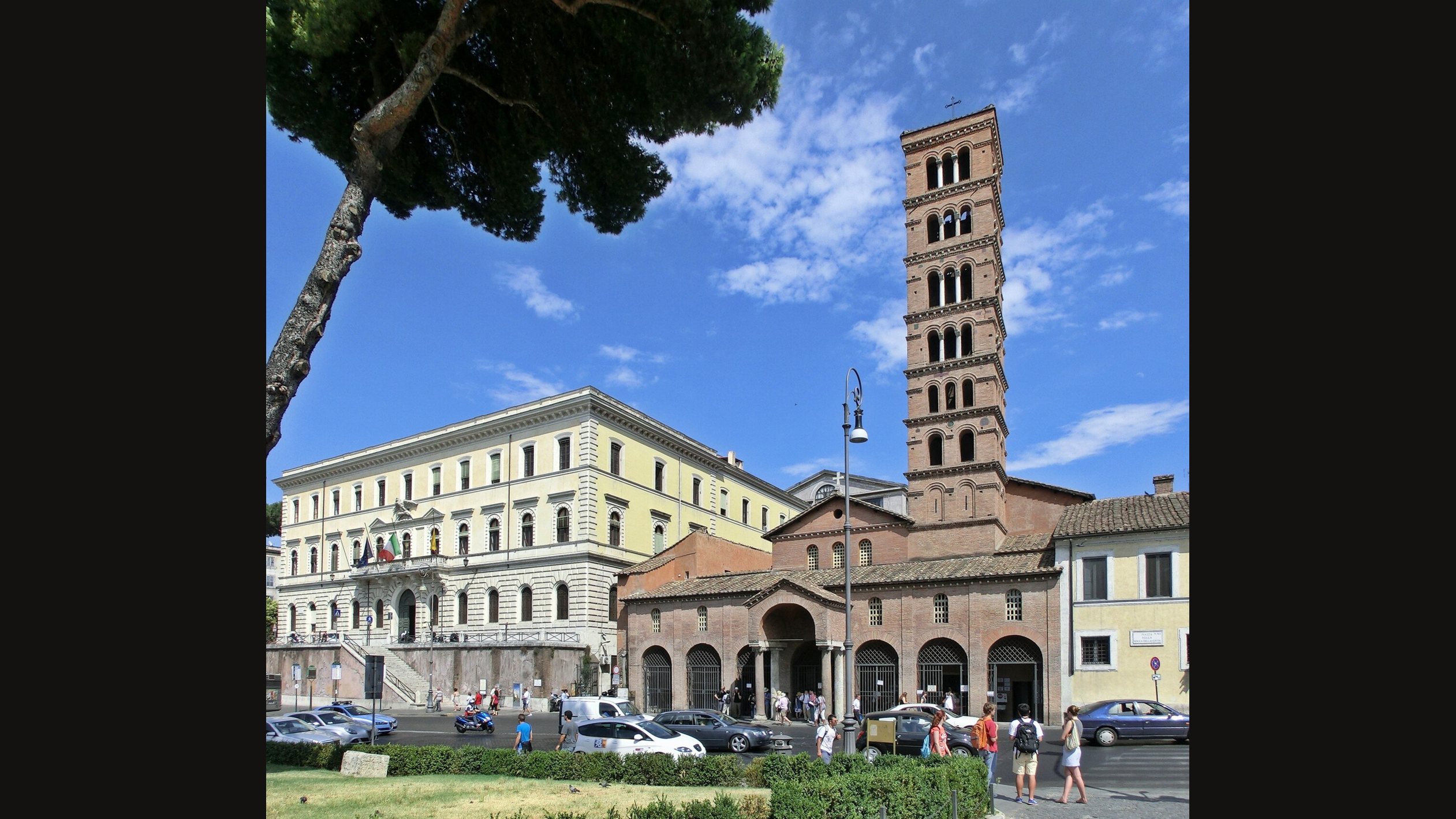
No. 010
Saint Valentine's Skull: Is It Really in Rome?
Yes, there is a skull in Rome venerated as Saint Valentine's. It sits, crowned with flowers, in the Basilica of Santa Maria in Cosmedin. According to accounts of its history, it was taken from the Catacombs of Saint Hippolytus in 1836 and later placed in the basilica. Whether it truly belonged to the martyr behind February 14 is uncertain, and Rome is not the only place that honors Valentine's remains. Whitefriar Street Church in Dublin and the Basilica of Saint Valentine in Terni, in central Italy, also keep relics venerated as his.
The fuller story takes in a third century martyr, a medieval poet, a 1969 change to the Catholic calendar and relics scattered across Europe.
The flower-crowned skull at Santa Maria in Cosmedin
Santa Maria in Cosmedin is a Roman basilica on Piazza Bocca della Verità. The skull is displayed with a crown of flowers and is traditionally identified as Saint Valentine's.
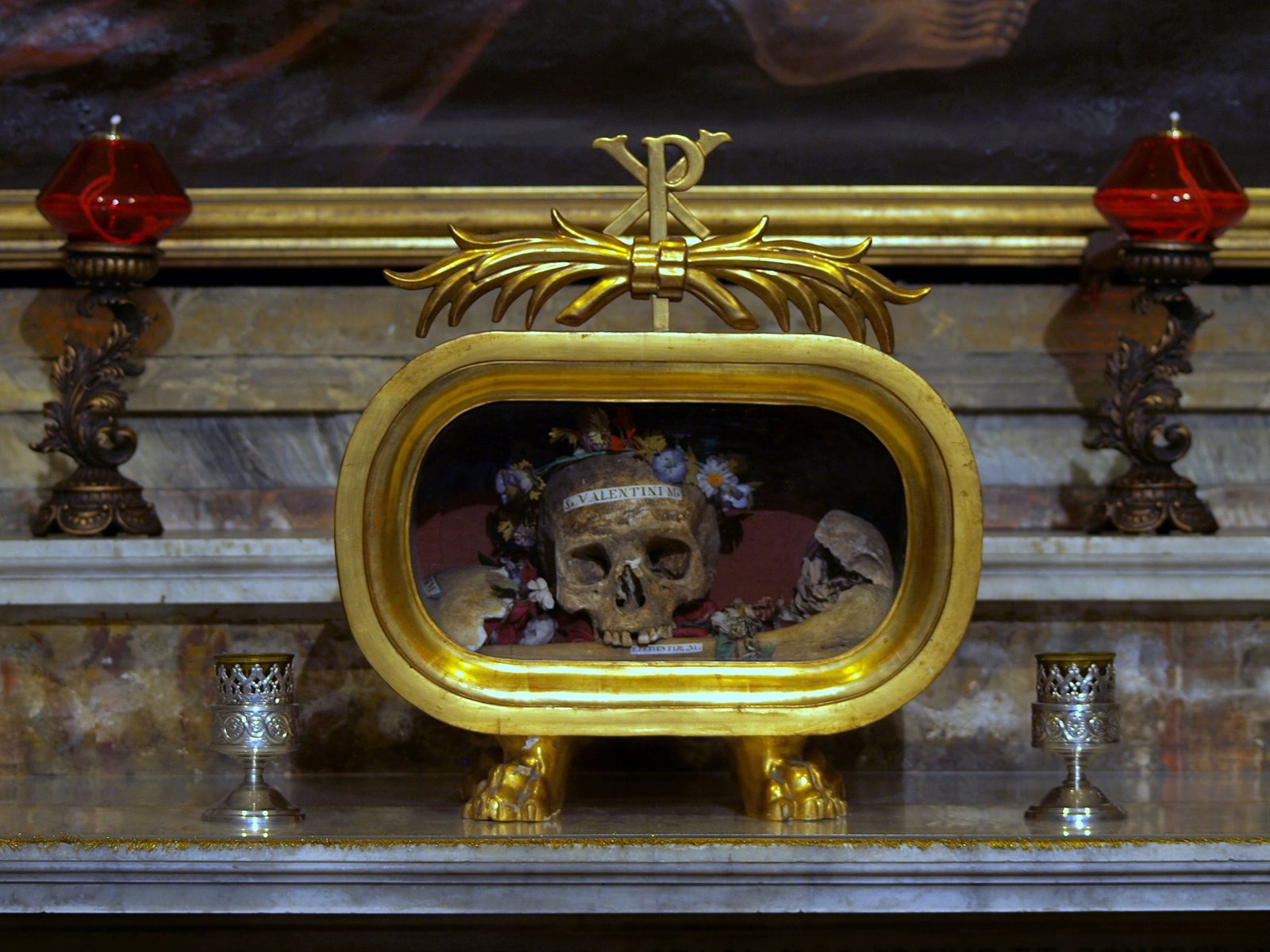
Its documented trail begins in the catacombs. The Cambridge Library Collection Blog and the Churches of Rome guide both trace it to 1836, when it was exhumed from the Catacombs of Saint Hippolytus near San Lorenzo fuori le Mura. From there it was later placed in Santa Maria in Cosmedin. Exactly when it entered the basilica, and who brought it, is less certain. The basilica itself is the best place to ask about its own record of the relic's history.
The chapel where the skull is kept is dedicated to Saint Giovanni Battista de' Rossi, an eighteenth century priest who had been a canon of Santa Maria in Cosmedin, according to Rerum Romanarum. He shares his name with another Giovanni Battista de Rossi, the nineteenth century archaeologist famous for his study of Rome's catacombs, as EWTN describes. The two are easy to confuse, and the archaeologist is not recorded as the person who moved the skull.
So, is the skull really Valentine's? The description the evidence supports is this: a skull venerated at Santa Maria in Cosmedin as Saint Valentine's, with a traditional identification rather than a scientific one. Other relics from the Roman catacombs have histories of their own, and our story on the catacomb saints follows others like it.
Who was Saint Valentine?
The Saint Valentine of February 14 is remembered as an early Christian martyr, and the historical record about him is thin and overlapping. It may even describe more than one man.
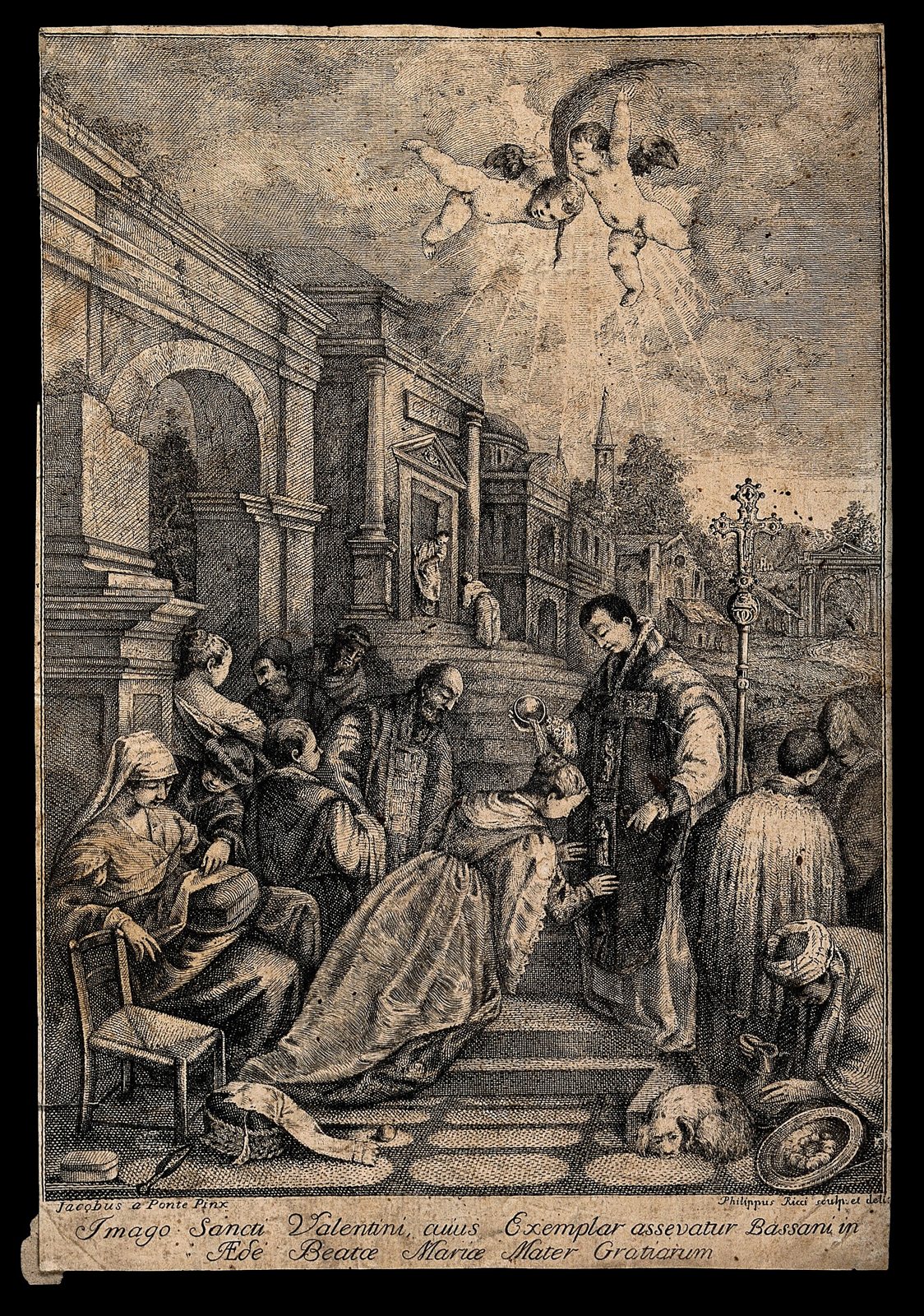
The Roman Martyrology, the Catholic Church's official list of saints, remembers two Valentines on February 14, as Vatican News sets out. One was a priest and martyr associated with the Via Flaminia, an ancient Roman road, who was killed by beheading under Claudius Caesar. The other is associated with Terni, where he was beaten, imprisoned and beheaded on the orders of the prefect Placidus.
Douglas McCarthy of Europeana sums up the possibilities: Valentine may have been a Roman priest, the bishop of Interamna (today's Terni) or another Christian martyr. Proposed dates for his death include 269, 270, 273 and 280. The historian Noel Lenski of Yale told the Associated Press that later traditions may have combined and expanded different Valentine stories.
Some of the best-loved details belong to that later growth. The stories of Valentine secretly marrying couples, healing his jailer's daughter and signing a note "from your Valentine" come from later tradition rather than the earliest accounts. The firm core is smaller: one or more Christian martyrs named Valentine, commemorated on February 14, with a Roman connection to the Via Flaminia and a separate tradition in Terni.
How a martyr became the saint of love
The February 14 commemoration is old. Europeana associates it with Pope Gelasius I in 496. The romance arrived much later, and a poet carried it in.
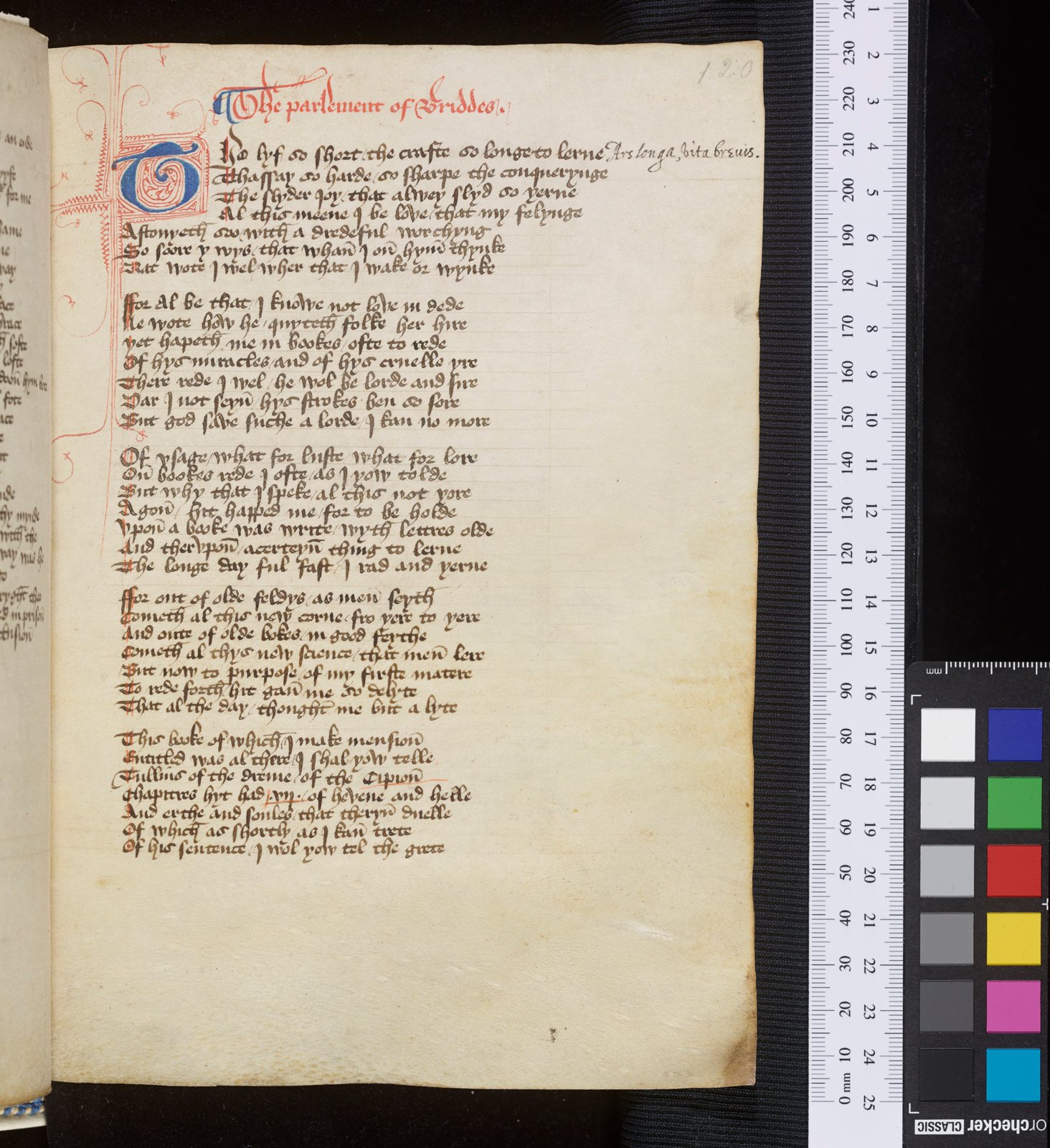
In 1375, Geoffrey Chaucer linked Saint Valentine's Day with birds choosing their mates in his poem the *Parlement of Foules*, according to Europeana. That image of spring pairing caught on, and the saint's day slowly became a day for lovers. There is a twist, though. Henry Kelly, a historian at UCLA, argues that the Valentine Chaucer had in mind may have been a different saint whose feast fell on May 3. The skull in Rome, in other words, ended up attached to a holiday that may have been built around someone else's feast day.
Saint Valentine through history
Tap or hover a step to follow the order.
Between 269 and 280
Proposed dates for the death of the martyr Valentine, according to Europeana
496
Pope Gelasius I is associated with the February 14 commemoration of Valentine
1375
Geoffrey Chaucer links Saint Valentine's Day with birds choosing mates in the Parlement of Foules
1605
The Diocese of Terni says a body identified as Valentine's is found near the altar of its ancient church
1836
A skull is exhumed from the Catacombs of Saint Hippolytus, later placed in Santa Maria in Cosmedin, and relics are sent from Rome to John Spratt in Dublin
February 14, 1969
Pope Paul VI promulgates the revised General Roman Calendar
January 1, 1970
The revised calendar takes effect
Why Saint Valentine was removed from the Catholic calendar
Saint Valentine's feast was removed from the Church's universal calendar in 1969 because so little is known about him, but he was not removed as a saint.
On February 14, 1969, Pope Paul VI promulgated the revised General Roman Calendar with the apostolic letter *Mysterii Paschalis*, and the new calendar took effect on January 1, 1970. The explanation usually quoted from the revised calendar reads:
"Though the memorial of Saint Valentine is ancient, it is left to particular calendars, since, apart from his name, nothing is known of Saint Valentine except that he was buried on the Via Flaminia on February 14."
The change moved his feast from the calendar the whole Church follows to particular calendars, the local and regional ones kept by dioceses and places with a special tie to him, such as Terni. His February 14 commemoration remained in the Roman Martyrology. The decision reflected how little is known of the details of his life. It was not a statement that Saint Valentine never existed, and churches that honor him have gone on doing so.
Where else are Saint Valentine's relics?
Rome's skull is one of several relics venerated as Valentine's. Each belongs to a particular church and its own tradition.
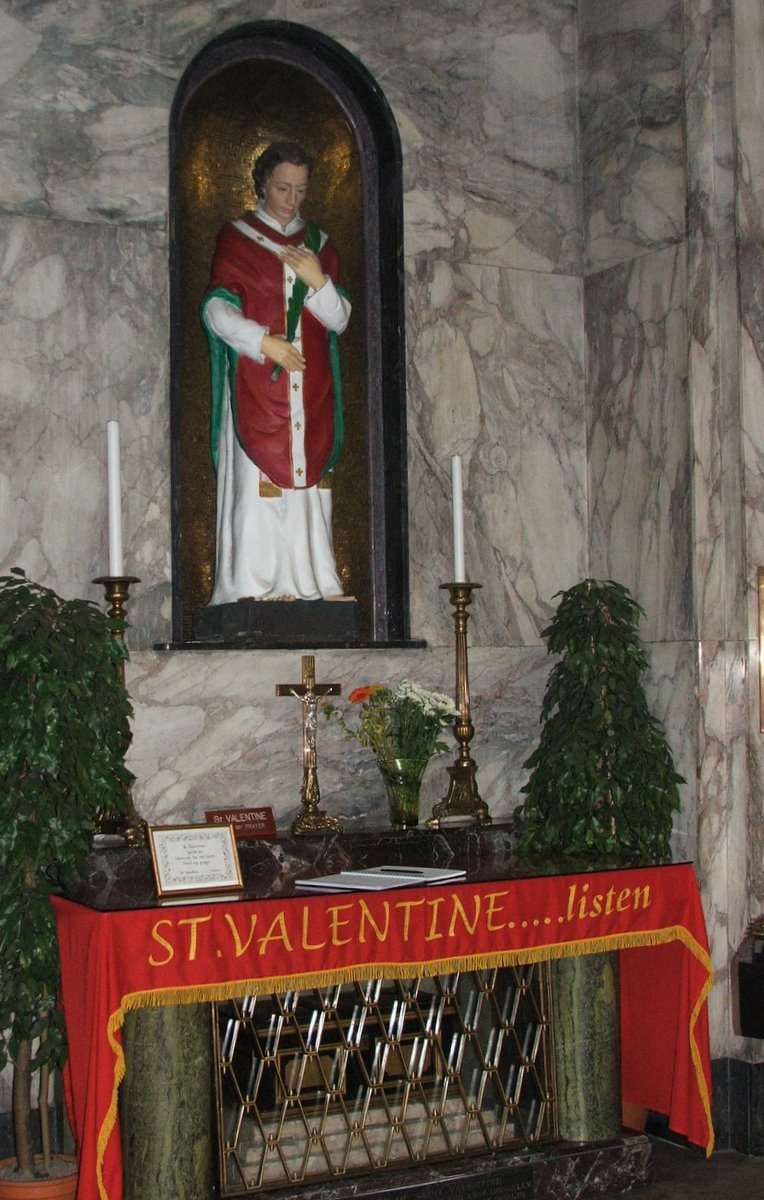
In Dublin, Whitefriar Street Church says it houses relics of Saint Valentine. Visit Dublin states that Pope Gregory XVI gave the relics to the church in 1836 and that they are specially displayed on February 14. A surviving letter dated January 29, 1836, described by Irish Heritage News, records remains removed from the cemetery of Saint Hippolytus on the Via Tiburtina, together with a small vessel tinged with blood, and entrusted to the Carmelite priest John Spratt. That is the same catacomb named in the history of the Rome skull, in the same year.
In Terni, the Diocese of Terni says that in 1605, after a papal permission for excavations, a body identified as Saint Valentine's was found near the altar of the ancient church. The relics it describes include part of the skull, the jaw with teeth, other teeth and ashes. The diocese treats the basilica as the saint's burial place, and it continues a local devotional tradition.
Other claims are reported further afield. National Geographic, which includes comments from the historian Lisa Bitel, and Europeana list a heart in Dublin, remains in San Antón Church in Madrid, a skeleton in Glasgow, a shoulder bone in Prague, and relics associated with places in France, Poland, Slovakia, England, Malta, Savona and Lesbos.
Tap or hover a row to highlight it.
| Place | What is kept there | What its keepers or guides say |
|---|---|---|
| PlaceSanta Maria in Cosmedin, Rome | What is kept thereA flower-crowned skull | What its keepers or guides sayTraditionally identified as Saint Valentine's; reported exhumed from the Catacombs of Saint Hippolytus in 1836 |
| PlaceWhitefriar Street Church, Dublin | What is kept thereRelics, with a small vessel tinged with blood | What its keepers or guides sayGiven by Pope Gregory XVI in 1836; specially displayed on February 14 |
| PlaceBasilica of Saint Valentine, Terni | What is kept therePart of the skull, the jaw with teeth, other teeth and ashes | What its keepers or guides sayFound near the altar of the ancient church in 1605; treated as his burial place |
| PlaceSan Antón Church, Madrid | What is kept thereRemains | What its keepers or guides sayReported by National Geographic and Europeana |
| PlaceGlasgow | What is kept thereA skeleton | What its keepers or guides sayReported by National Geographic and Europeana |
| PlacePrague | What is kept thereA shoulder bone | What its keepers or guides sayReported by National Geographic and Europeana |
These claims are devotional and institutional traditions. Together they do not add up to a settled identification of one complete body. Each church keeps and honors its relics within its own tradition of devotion.
Visiting the skull in Rome
Santa Maria in Cosmedin is a working church as well as a stop for visitors, so a visit to the skull is a visit to a place of worship. The basilica's official website lists these details:
- Address: Piazza Bocca della Verità 18, Rome.
- Opening hours: 9:30 a.m. to 5:50 p.m. every day.
- Closed on January 1.
- Sunday Divine Liturgy at 10:30 a.m.
The Churches of Rome guide says that on February 14 the skull is brought out and crowned with roses. That is a guide's account rather than a statement from the basilica. If you plan to see the relic, especially around Valentine's Day, confirm whether it is on view, any February 14 arrangements, service times and access rules directly with the basilica at +39 06 6787759 or rettore@cosmedin.org.
Saint Valentine's skull quiz
Answer every question to check.
Questions about Saint Valentine's skull
These short answers cover what people ask most about the skull and the saint.
Where is Saint Valentine's skull?
Saint Valentine's skull, as it is venerated, is displayed with a crown of flowers in the Basilica of Santa Maria in Cosmedin in Rome. Its identification is traditional, and other churches, including Whitefriar Street Church in Dublin and the Basilica of Saint Valentine in Terni, keep relics they also venerate as his.
Is Saint Valentine's skull real?
The skull in Rome is traditionally identified as Saint Valentine's, but its identity has not been established by scientific means. Accounts trace it to the Catacombs of Saint Hippolytus in 1836, and its path from there into the basilica is only partly recorded.
What is the real story behind Saint Valentine?
The real story behind Saint Valentine is that of one or more early Christian martyrs named Valentine, remembered on February 14, with a priest linked to the Via Flaminia in Rome and a bishop linked to Terni. The romantic side came much later, helped along by Chaucer's fourteenth century poetry, and tales of secret weddings belong to later tradition.
Why was St. Valentine removed from the Catholic calendar?
St. Valentine was removed from the universal General Roman Calendar in 1969 because so little was known of him beyond his name and his burial on the Via Flaminia. His memorial was left to particular calendars, and he remains in the Roman Martyrology for February 14.
Where are Saint Valentine's relics?
Saint Valentine's relics are claimed by several churches, chiefly Santa Maria in Cosmedin in Rome, Whitefriar Street Church in Dublin and the Basilica of Saint Valentine in Terni. Further claims include Madrid, Glasgow and Prague, as well as places in France, Poland, Slovakia, England, Malta, Savona and Lesbos.
Where to go next
The flower-crowned skull belongs to a long Catholic tradition of keeping and honoring saints' remains. Read about the jeweled catacomb saints for relics with a similar catacomb history, then skulls in Christianity for what the skull has meant in Christian art and devotion. If you are planning a Roman day among the bones, the Capuchin Crypt tells a very different story of remembrance.
Terms in this story
Tap a term to see what it means.
Relic. A part of a saint's body, or an object linked to a saint, kept and honored in Catholic devotion.