

No. 101
The Catacombs of Lima: Who Is Buried Beneath San Francisco and How to Visit
The catacombs of Lima are the crypts beneath the Church and Convent of San Francisco, in the historic centre of Peru's capital. They were burial spaces of colonial Lima. Franciscan friars were laid to rest there, and so were ordinary people of the city, men, women and children, until burials moved to Lima's new General Cemetery, which opened in 1808.
Nobody has an exact count of how many people rest there. The figure repeated most often is about 25,000, and one historian has estimated more than 100,000, so the fairest answer is thousands.
You visit them through the Museo Convento San Francisco y Catacumbas, at Jr. Áncash and Jr. Lampa on the Plazuela San Francisco. The museum lists guided tours of about an hour, with Spanish and English guides.
A Franciscan convent in the heart of old Lima
The story starts above ground. The Franciscans founded their convent on this site in 1546, and the monumental complex that stands there now was inaugurated in 1672, according to the museum record of Peru's Ministry of Culture. Beneath the church and convent, underground crypts served as burial spaces through the colonial period. Those crypts are what visitors now call the catacombs.
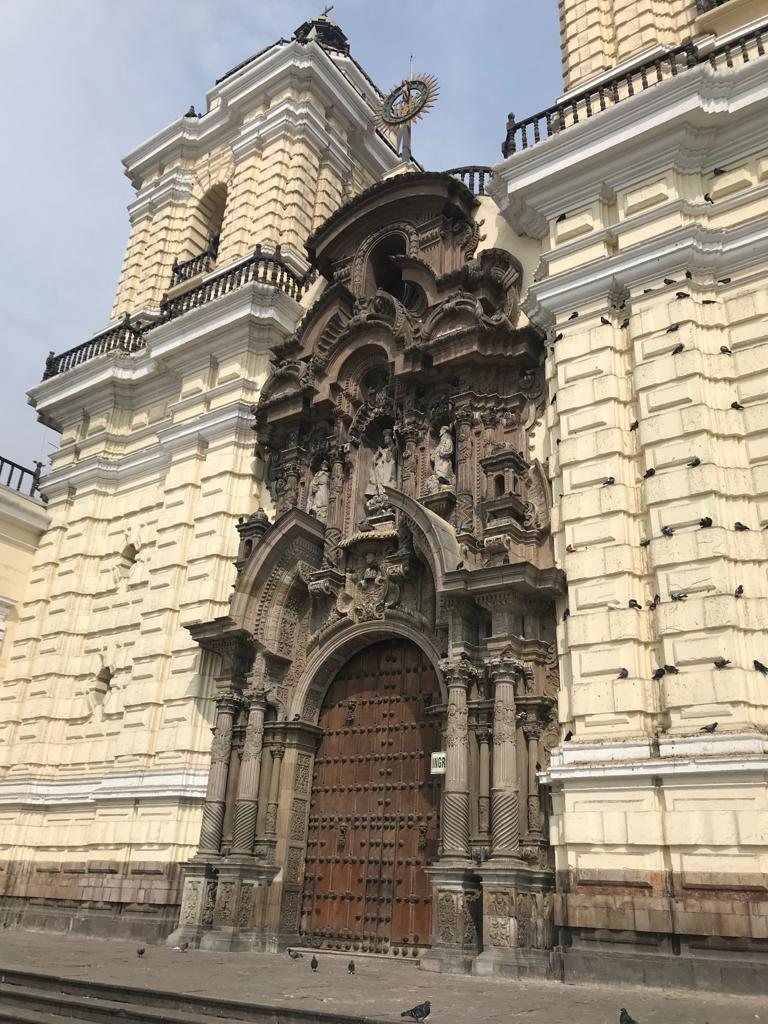
The complex also has a place on the World Heritage List. UNESCO first inscribed the Convent Ensemble of San Francisco de Lima in 1988, then extended the property and renamed it the Historic Centre of Lima in 1991. UNESCO calls San Francisco an outstanding example of a colonial convent ensemble in Latin America and lists the Historic Centre under its criterion (iv). The catacombs belong to that historic convent, and the listing covers the wider property; there is no separate World Heritage entry for the catacombs themselves.
Who rests in the crypts
Before 1808, Lima buried many of its dead inside churches and convents, and San Francisco was one of those places. The crypts held Franciscan friars alongside ordinary residents of the city, including men, women and children. Peru's Ministry of Culture describes the remains simply as those of Lima's former inhabitants.
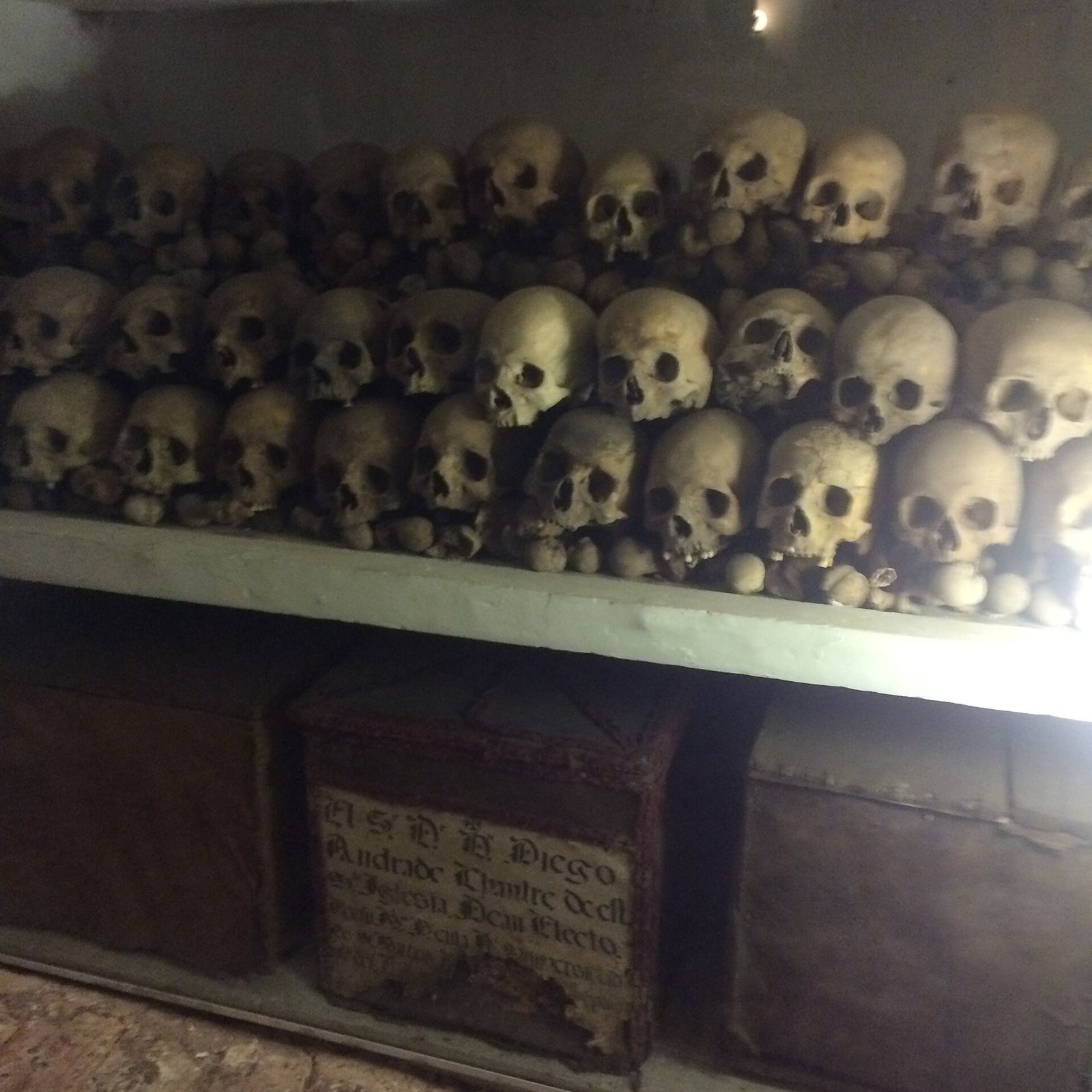
Most of them are not known by name. They are remembered together, as the people of colonial Lima who were buried beneath their church and convent. One name does come up: the newspaper El Peruano associates the Mexican Franciscan friar José Francisco de Guadalupe Mojica with the convent complex.
How many people were buried there
The honest answer is thousands, with the total uncertain. The number you will see most often is about 25,000, which El Peruano reports. That figure is an estimate of how many the crypts could hold, not a count of the bones in them.
Other specialists put it far higher. Historian and curator Cayetano Villavicencio has estimated more than 100,000 burials, as La República reported in 2024. Archaeologist Pieter Van Dalen has said that only about 30 to 40 percent of the wider underground area has been investigated, in reporting by Guillermo D. Olmo for BBC Mundo. With so much still unstudied, any single total would claim more than anyone knows.
Tap or hover a row to highlight it.
| Figure | What it describes | Who gives it |
|---|---|---|
| FigureAbout 25,000 | What it describesThe most repeated estimate, a measure of capacity rather than a count | Who gives itEl Peruano |
| FigureMore than 100,000 | What it describesAn estimate of total burials | Who gives itHistorian and curator Cayetano Villavicencio |
| Figure30 to 40 percent | What it describesThe share of the wider underground area investigated | Who gives itArchaeologist Pieter Van Dalen |
When the burials stopped
The turning point was a new cemetery. Lima's General Cemetery, known today as the Cementerio Presbítero Matías Maestro, opened in 1808 and changed where the city buried its dead. After it opened, burials in churches and convents were closed down over time.
Accounts differ on how quickly that happened at San Francisco. Historian David Pino, interviewed by El Comercio, says burials were ordered to move to the new cemetery in 1808, but that clandestine burials went on until the authorities sealed the crypts. The museum's own history page places the end of burials more loosely, around the 19th century and the period of independence.
Sealed, then opened to visitors
Once the crypts stopped receiving the dead, they were sealed or left neglected for a long time. Their return to view came in the 20th century, and here too there are two dates in circulation.
The chronology reported most widely puts preparation work in 1947, with excavation, cleaning and the installation of lighting, followed by a public opening in 1950. Peruvian broadcaster RPP and El Peruano both report the 1950 opening. The museum's current history gives a different institutional date, 1969, for the founding of the museum and the public opening of the catacombs. Both appear in print, and the museum's history is the place to read its own account.
The San Francisco convent and its catacombs
Tap or hover a step to follow the order.
1546
The Franciscan convent is founded on the site.
1672
The monumental complex is inaugurated.
1808
Lima's General Cemetery opens, and burials begin moving out of churches and convents.
1947
Restoration and access work, as commonly reported.
1950
Public opening, as commonly reported.
1988
UNESCO first inscribes the Convent Ensemble of San Francisco de Lima.
1991
UNESCO extends the property as the Historic Centre of Lima.
What you see underground
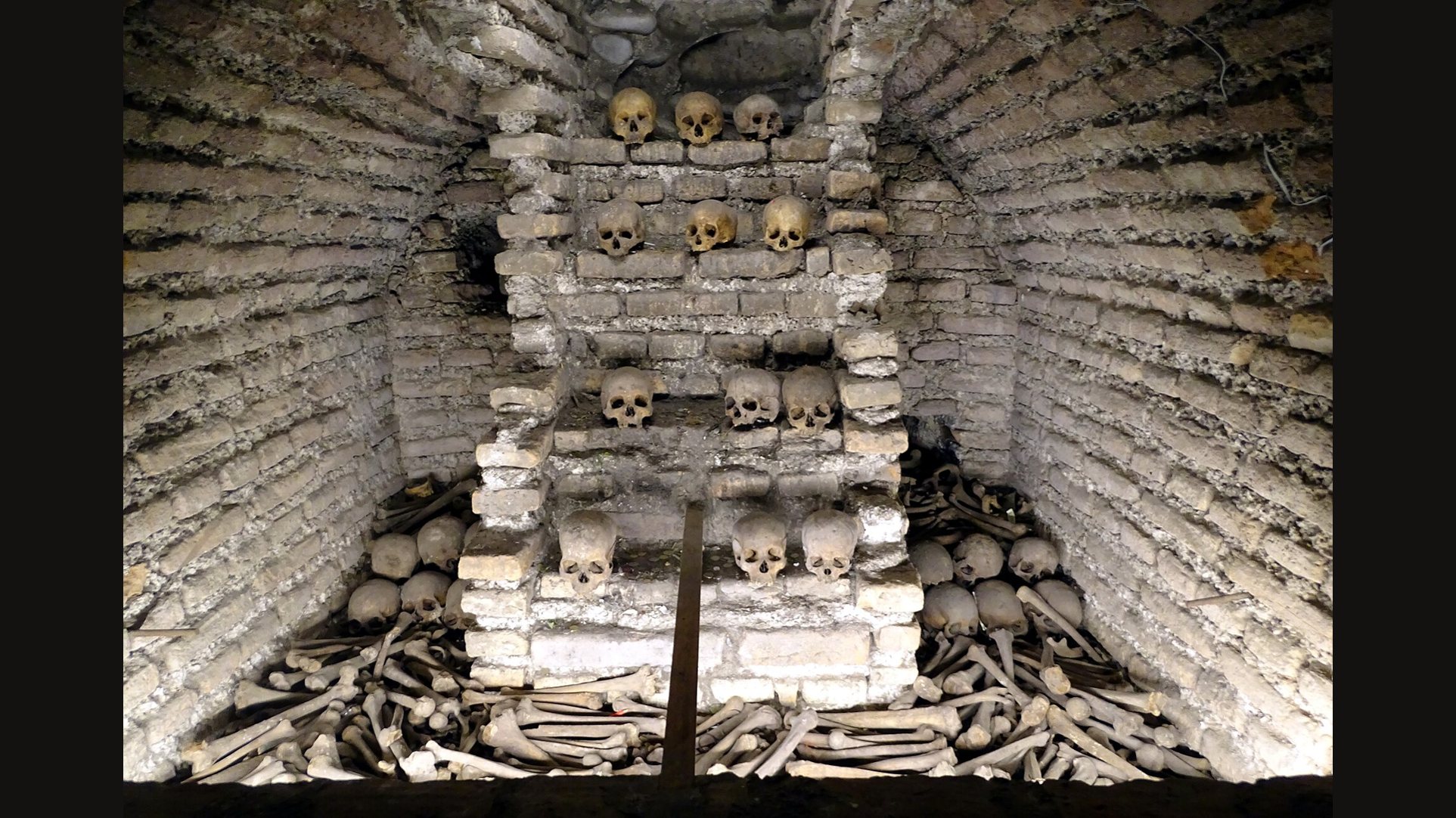
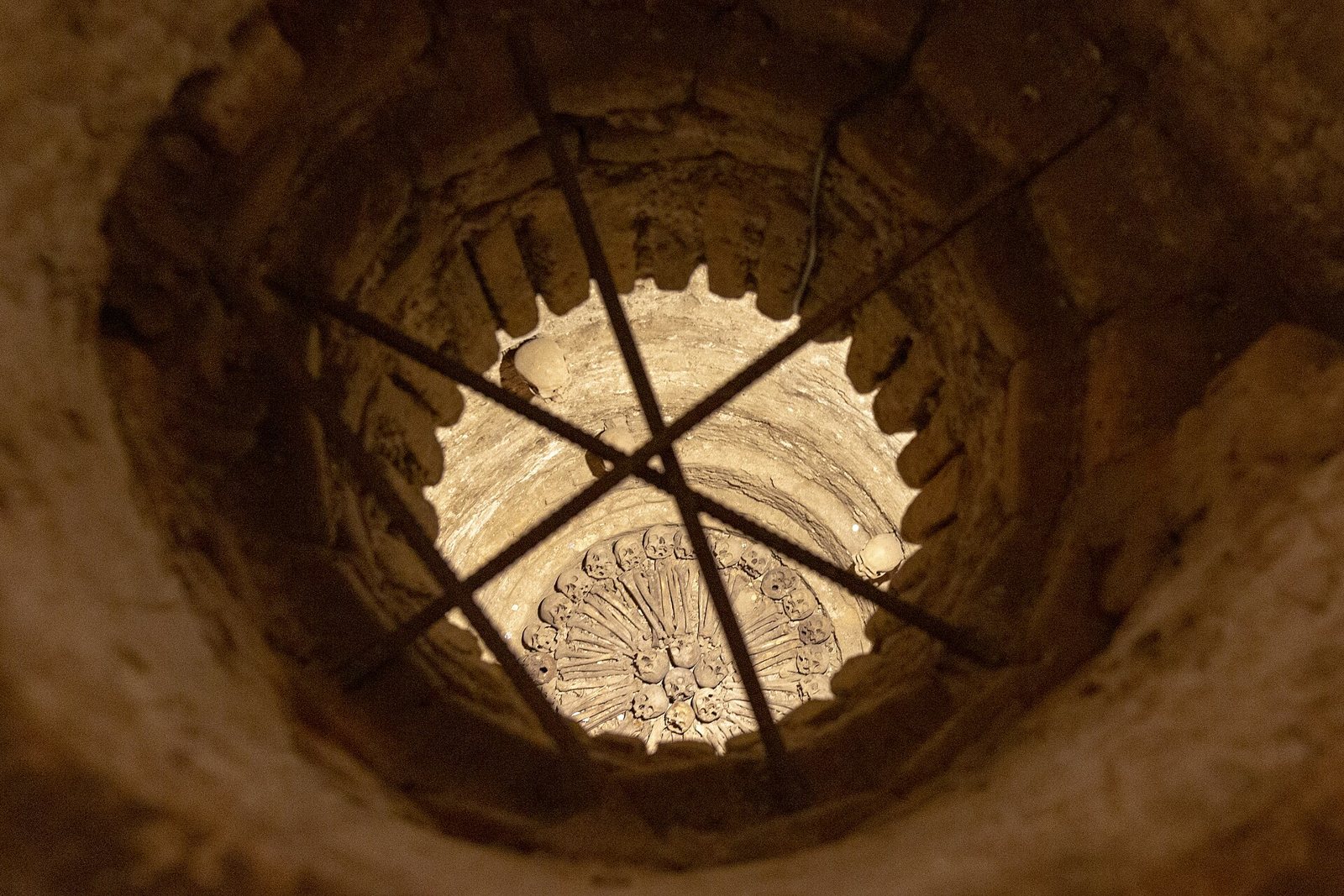
The visit takes you through underground passages, crypts and ossuary spaces, the areas where bones were gathered once burials were complete. In them, skulls and long bones lie in stacks and rows, and in some places they form geometric patterns. One of them, a round pit where bones are laid in circles, is the image that brings many readers here after seeing it online.
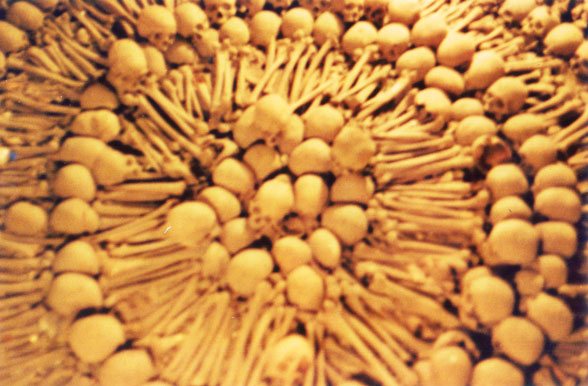
These are arrangements of human remains in the galleries open to visitors. What you are looking at is the people of colonial Lima, someone's ancestors, kept within the convent where they were buried. Lima is not the only place where bones were gathered and arranged inside a church; Rome's Capuchin Crypt and the Sedlec Ossuary in Czechia are two others, each with its own history.
Visiting the catacombs: hours, tours and booking
Getting in is simple: go to the Museo Convento San Francisco y Catacumbas, on the corner of Jr. Áncash and Jr. Lampa at the Plazuela San Francisco in central Lima, and join a guided visit. The catacombs are seen as part of that tour, and the ticketed visit includes the convent museum as well.
As of 22 October 2026, the museum's services page lists opening hours of 9:00 a.m. to 6:00 p.m., Monday to Sunday, holidays included. The museum's home page shows a later closing time of 9:00 p.m., so confirm the day's hours and the last entry with the museum before you set out. Tours run with Spanish and English guides and last about an hour.
Those daily hours also answer a question travelers often ask, whether the catacombs are still open to visitors: the museum lists visits every day of the week. Before you go, ask the museum about the current ticket price, the last tour of the day, any booking you might need and its rules on photography.
Before you visit the catacombs of Lima
Tap a card to bring it forward.
- Where: Museo Convento San Francisco y Catacumbas, Jr. Áncash and Jr. Lampa, Plazuela San Francisco, Lima.
- How: The museum describes the visit as guided.
- Language: Spanish and English guides are listed.
- Time: Allow about one hour for the tour.
- Ask first: Confirm the current fee, the last entry and the photography rules with the museum.
- Respect: The remains are people who were buried in Lima, so treat them as you would any grave.
How well do you know the catacombs of Lima?
Answer every question to check.
Questions about visiting the catacombs of Lima
A few practical questions come up again and again before a visit.
How much does it cost to enter the catacombs of Lima?
Ask the Museo Convento San Francisco y Catacumbas for the current fee before you go. Prices quoted on older travel pages are often out of date, and the museum's answer is the one that applies on the day you visit.
Can you take photos in the catacombs of Lima?
Ask the museum about its photography rule, and ask permission before photographing anywhere inside the convent or the catacombs. The bones on view belong to people buried in Lima, so a photo is something to ask about rather than assume.
Do you need to book a tour in advance?
Check booking and entry conditions with the museum before you arrive. Because every visit to the catacombs is guided, the museum can also tell you when the next tour in English or Spanish starts.
Are the catacombs in Lima worth it?
Yes, if colonial history, Franciscan buildings, archaeology or the respectful study of human remains interest you. The ticketed visit includes the convent museum too, and the whole complex is part of Lima's UNESCO World Heritage property.
Are the catacombs of Lima like the Paris Catacombs?
They share a name, but Lima's catacombs are crypts beneath a colonial convent, where the friars and families of the city were buried beneath the church. The Paris Catacombs have a history of their own, and the two visits are best read as separate stories.
More resting places of the dead
If Lima's crypts caught your attention, Rome has its own underground cemeteries, told in our story of the catacombs of Rome, and the wider world of bone chapels is mapped in ossuaries around the world. In France, the Douaumont ossuary keeps the unidentified dead of Verdun. The beliefs behind many of these places are told in skulls in Christianity and what memento mori means.
Traveling farther in Peru? The stories of the Lord of Sipán and the Chauchilla Cemetery are two more Peruvian accounts of how people cared for their dead.
Terms in this story
Tap a term to see what it means.
Catacombs. The name visitors use for the underground crypts beneath the Church and Convent of San Francisco in Lima, burial spaces of the colonial city.
---