

No. 198
The Catacombs of Rome: Who Is Buried There and How to Visit
The catacombs of Rome are underground cemeteries, long galleries cut into soft tuff along the roads outside the ancient city. According to the Pontifical Commission for Sacred Archaeology, Christian communities began them at the end of the 2nd and start of the 3rd century CE and kept burying their dead there into the 5th century.
Most of the people laid to rest in them were ordinary Christians, with clergy, martyrs and several popes among them. Rome's Jews had catacombs of their own, and some pagan Romans were buried underground too.
Today the Commission's directory lists seven catacombs open to the public: San Pancrazio, Priscilla, San Sebastiano, Domitilla, Sant'Agnese, San Callisto, and Saints Marcellinus and Peter. Visits are guided, and the details differ from site to site.
Cemeteries cut into the rock outside Rome
Burying the dead underground was not a Christian invention. Etruscans, Jews and Romans already did it. What the Christian communities of Rome added was scale: they turned underground burial into large shared cemeteries, gallery after gallery, where a whole community could rest together.
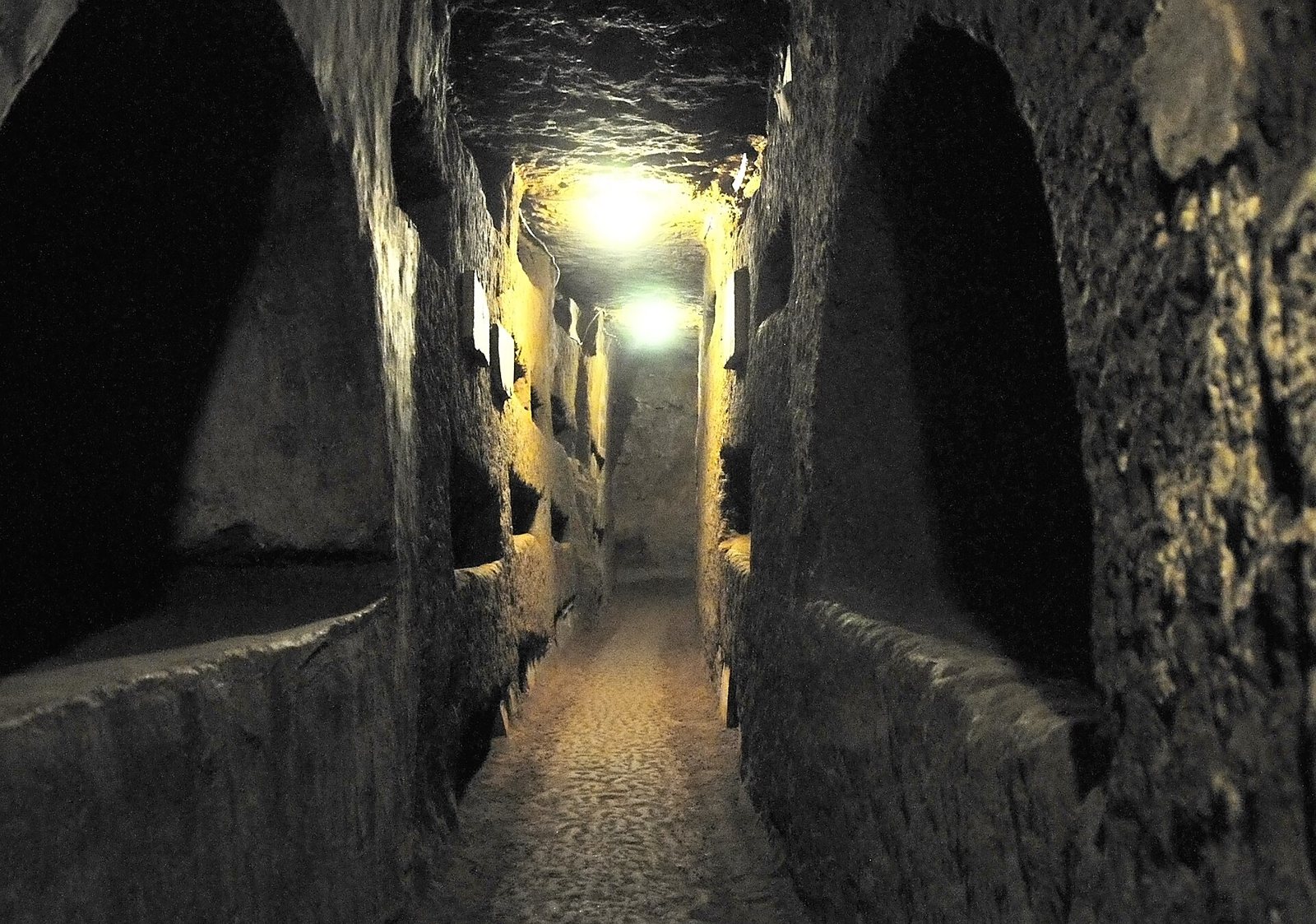
Their location had a legal reason and a practical one. Roman burial law placed cemeteries outside the city, and the roads leading out of Rome offered both the land and rock suited to digging. That is why the catacombs lie along roads such as the Via Appia Antica, the Via Salaria, the Via Nomentana and the Via Casilina, rather than under the city center.
They were cemeteries first and last. The Commission describes them as burial grounds, not generally secret churches or places where Christians lived in hiding.
Who was buried in the catacombs
Most burials were Christian: ordinary members of the community, along with clergy, martyrs and popes. Jewish Romans had separate catacomb cemeteries, among them those associated with Vigna Randanini and Villa Torlonia, according to Italia.it, Italy's official tourism site. Pagan burials also turn up in Rome's underground cemeteries, sometimes in earlier or shared areas.
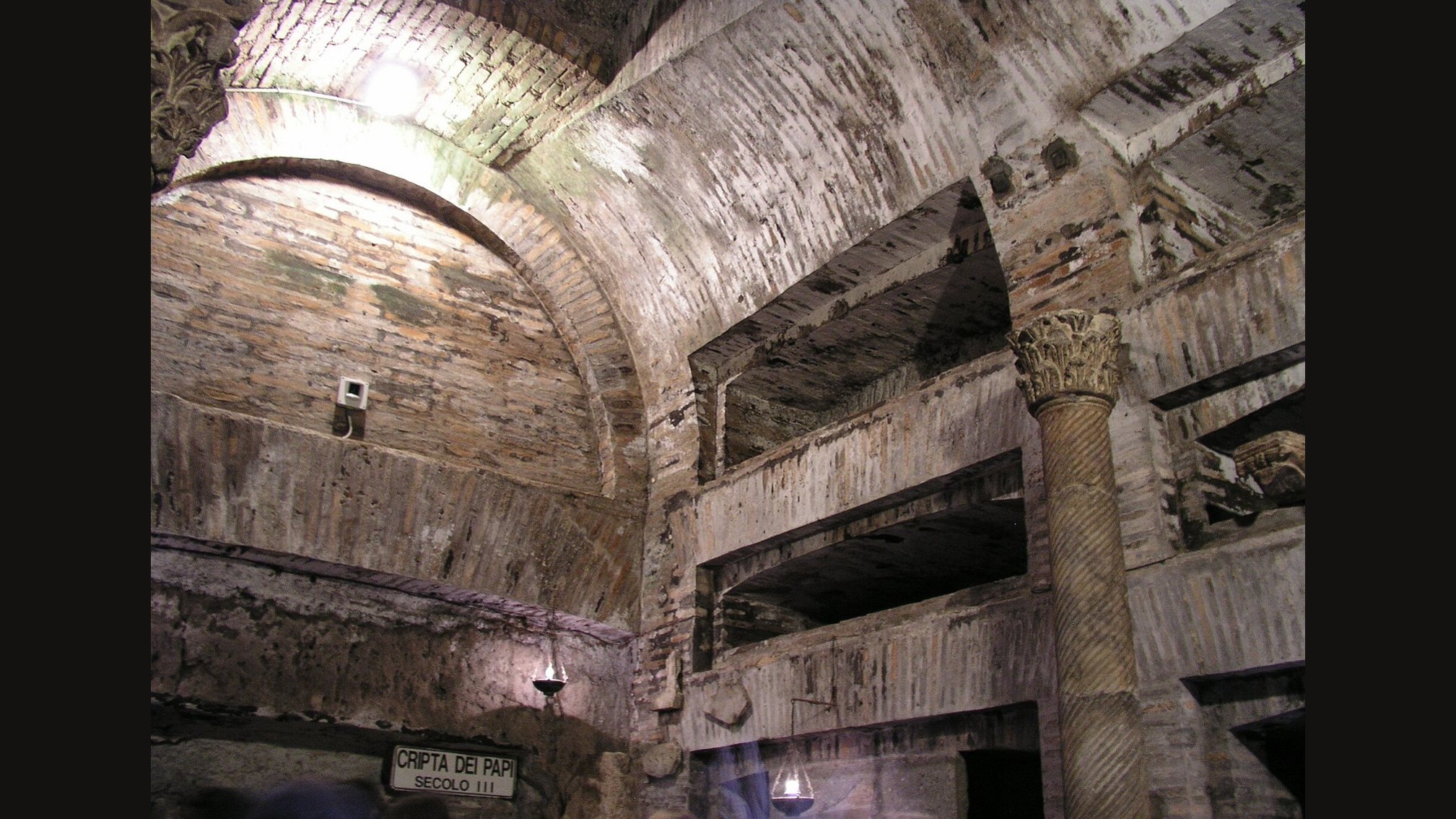
The best-known graves are in San Callisto. Its Crypt of the Popes became the burial place of several 3rd-century bishops of Rome. Italia.it's page on San Callisto puts it more precisely, describing the crypt as the burial place of nine pontiffs who succeeded Callixtus.
How many people lie in the catacombs altogether? Nobody has a precise count, and estimates vary with the area counted and the method used. Smithsonian, discussing the work of historian Paul Koudounaris, gives an estimate of 500,000 to 750,000 people buried across the Roman catacombs, mostly Christians but also some pagans and Jews. That is an estimate of burials over the centuries, not a count of bodies there today.
The fish, the shepherd and other paintings
The walls of the catacombs carry early Christian art: biblical scenes, portraits, banquet scenes and symbols. The fish stands for Christ through the Greek word *ichthys*, read as an acronym for "Jesus Christ, Son of God, Saviour." The Good Shepherd, a figure carrying a sheep, is one of the most repeated images; it borrowed a familiar ancient scene to show Christ. One Good Shepherd fresco in Priscilla is dated to about 225 CE by the World History Encyclopedia.
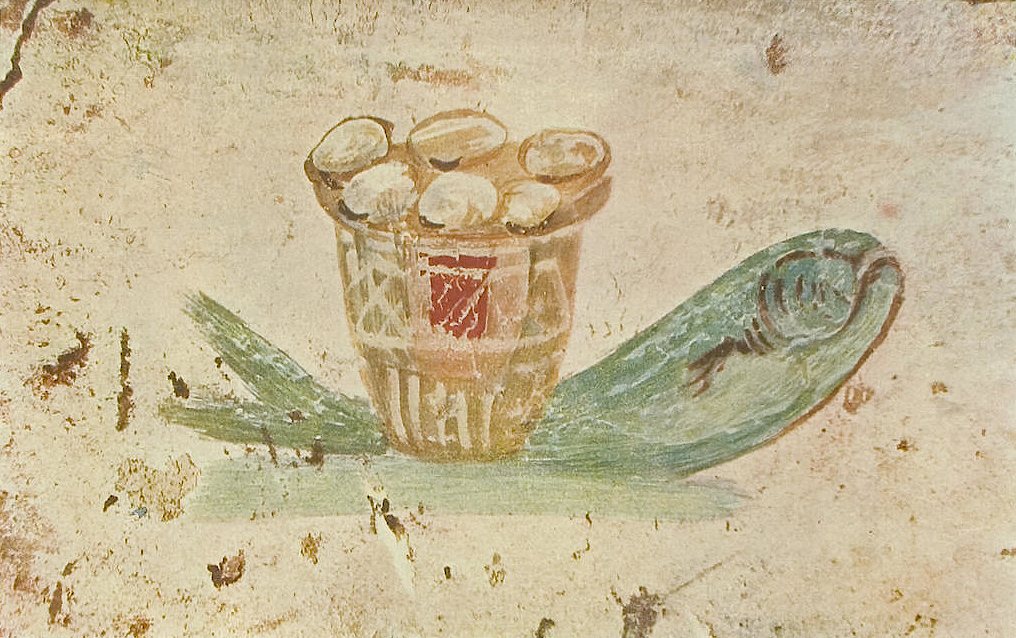
Other symbols recur from gallery to gallery. Doves stand for heavenly peace and anchors for firmness of faith. Jonah and Daniel among the lions appear again and again, along with praying figures known as *orantes*, vines and peacocks, scenes read in relation to resurrection and salvation.
Each open catacomb has its own highlights. Priscilla holds an early image of the Virgin Mary, according to the Pontifical Commission. Domitilla preserves extensive frescoes and an underground basilica. The official site of Saints Marcellinus and Peter describes its paintings as one of the richest surviving bodies of early Christian art, including banquet scenes.
Forgotten for centuries, then found again
Once burial in the catacombs ended, many of them became hard to enter. Barbarian incursions and the shift of pilgrimage to other places led to their abandonment, and the Pontifical Commission says they passed through a long period of oblivion.
They came back to light by accident. In 1578, a cemetery was uncovered on the Via Salaria, and Rome's underground burial places drew new attention. A young Maltese antiquarian named Antonio Bosio, born in 1575, took up the work. In 1593 he began surveying the catacombs systematically, and Treccani/), the Italian encyclopedia, records that he went into nearly all of them and copied their paintings. His book *Roma Sotterranea* ("Underground Rome") was published after his death, in 1632, and he became known as a pioneer of Christian archaeology.
The very word "catacomb" has a Roman address. It became associated with San Sebastiano's ancient place-name, *ad catacumbas*, meaning near or at the hollow, according to the catacomb's official site. In 1852 Pope Pius IX established the Commission for Sacred Archaeology, which still oversees the catacombs.
The catacombs of Rome through the centuries
Tap or hover a step to follow the order.
Late 2nd to early 3rd century CE
Christian communal catacombs emerge in Rome.
3rd century CE
The Crypt of the Popes develops in San Callisto.
4th to early 5th century CE
Church writers describe pilgrimage to martyrs' tombs in the catacombs.
1578
A cemetery uncovered on the Via Salaria renews interest in the catacombs.
1593
Antonio Bosio begins systematic study of the catacombs.
1632
Bosio's Roma Sotterranea is published after his death.
1852
Pope Pius IX establishes the Commission for Sacred Archaeology.
2014
Saints Marcellinus and Peter opens to the public after restoration and safety work.
What happened to the bones and relics
Will you see bones on a visit? Mostly, no. The catacombs are cemeteries, so human remains are part of their history, but the public routes are laid out around galleries, tomb niches, inscriptions, the built spaces underground and the paintings, not rows of exposed bones. Remains were also moved at different times, as the International Catacomb Society explains.
The moving happened in stages. Medieval popes transferred the remains of important martyrs to churches inside Rome, partly to protect them from invasion and desecration. From the late 16th to the 18th century, further bodies taken from newly opened catacombs were identified as "catacomb saints" and sent to churches, especially in central Europe.
Historians separate these two things: documented translations of known martyrs on one side, and later devotional identifications on the other. A skeleton found in a catacomb was not automatically a named martyr. The story of those jeweled skeletons, and the churches that received them, is told in our piece on the catacomb saints.
The catacombs open to visitors
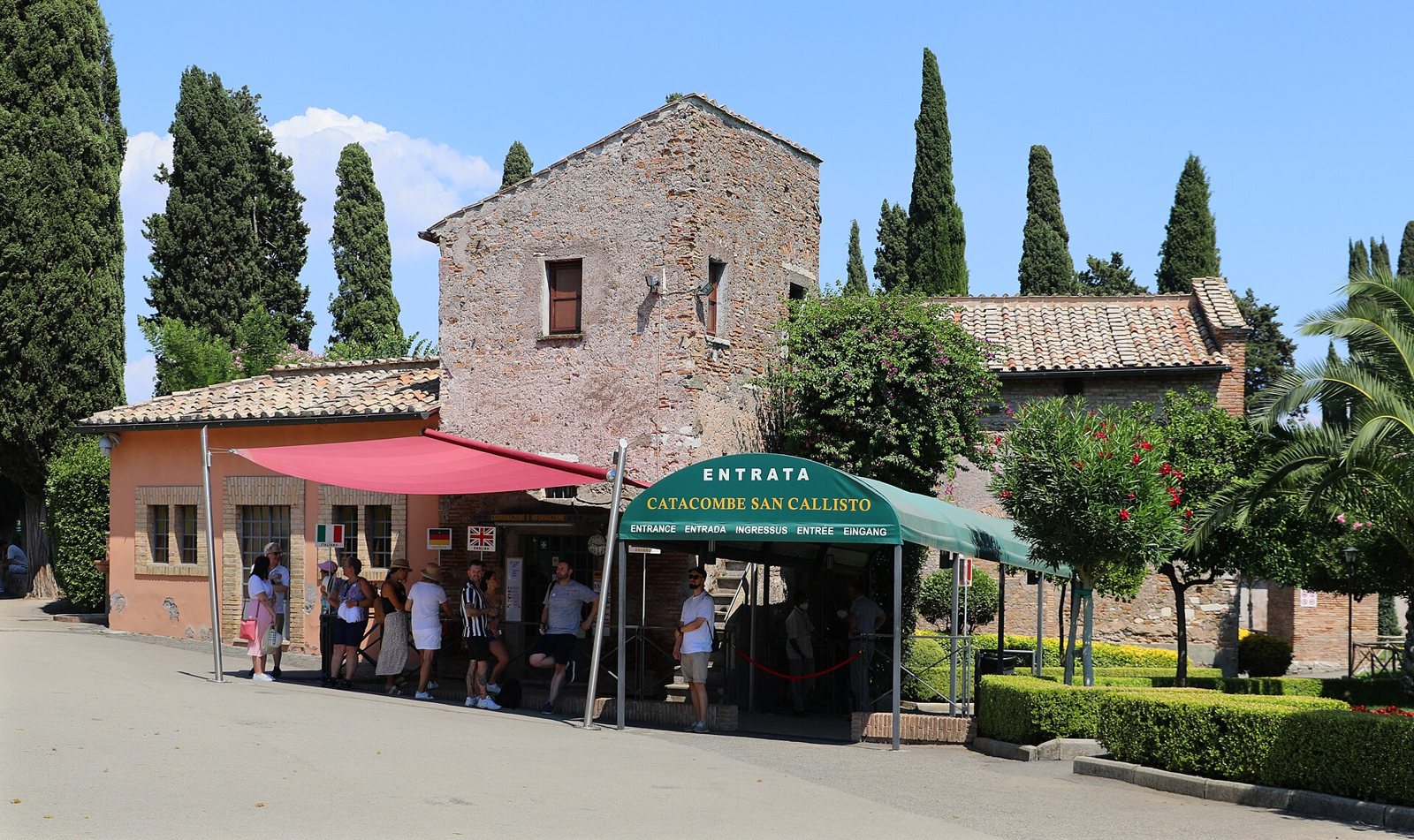
The Pontifical Commission's directory, as of 20 October 2026, lists seven catacombs open to the public. Older tourist summaries often name fewer, so check the official site of the one you plan to see. Two of them, San Callisto and San Sebastiano, sit close together on the Via Appia Antica.
Tap or hover a row to highlight it.
| Catacomb | Address |
|---|---|
| CatacombSan Pancrazio | AddressPiazza S. Pancrazio, 5/D |
| CatacombPriscilla | AddressVia Salaria, 430 |
| CatacombSan Sebastiano | AddressVia Appia Antica, 136 |
| CatacombDomitilla | AddressVia delle Sette Chiese, 282 |
| CatacombSant'Agnese | AddressVia Nomentana, 349 |
| CatacombSan Callisto | AddressVia Appia Antica, 110 |
| CatacombSaints Marcellinus and Peter | AddressVia Casilina, 641 |
The newest to open is Saints Marcellinus and Peter, which welcomed the public in 2014 after security and restoration work. Domitilla, according to its official site, contains the only surviving underground basilica among the catacombs open to visitors in Rome.
What a visit is like
Visits are guided. The sites set their own hours and prices. As of 20 October 2026, three of them list these details. At San Sebastiano, the guided tour is required, tours run in Italian, English, French, Spanish and German, and its regulations forbid photography and video. At Domitilla, the ticket includes a guided tour, and the last one starts 20 minutes before closing. At Priscilla, a guide accompanies every visit, which lasts about 45 minutes; groups of 10 or more must book ahead, and online tickets carry a €2 presale supplement.
Tap or hover a row to highlight it.
| Catacomb | Hours | Tickets | Guide |
|---|---|---|---|
| CatacombSan Sebastiano | HoursTuesday to Sunday, 9:15 to 17:15, last entrance 16:45; closed Mondays | Tickets€10 full, €7 reduced | GuideGuided tour required |
| CatacombDomitilla | HoursEvery day except Tuesday, 9:00 to 12:00 and 14:00 to 17:00 | Tickets€10 full, €7 reduced | GuideGuided tour included |
| CatacombPriscilla | HoursTuesday to Saturday, 9:30 to 13:00 and 14:00 to 17:00; Sunday, 11:30 to 13:00 and 14:00 to 17:00; closed Mondays | Tickets€2 presale supplement online | GuideGuided accompaniment required |
For San Callisto, Sant'Agnese, San Pancrazio and Saints Marcellinus and Peter, confirm current hours, fees and booking with each site's official visitor office before you travel. Hours and prices at all of them can change, so the official page on the day is the one to trust.
The other catacombs, the ones closed to the public, can be visited only by special arrangement. The Pontifical Commission's regulations require written permission at least 20 days in advance, an archaeological guide and a gravedigger designated by the Commission, and a group of no more than 15. Its 2013 regulations set fees of €100 for the gravedigger and €120 for the guide, with extra charges for visits longer than 75 minutes.
How well do you know the catacombs of Rome?
Answer every question to check.
Questions about the catacombs of Rome
Short answers to the practical questions about a visit, from what you will see to whether you need a guide.
Is it worth seeing the catacombs in Rome?
Yes, if early Christian archaeology, inscriptions and frescoes interest you. The standard visits are guided and show selected sections of much larger cemeteries, and they are not bone displays.
Which is the most famous catacomb of Rome?
San Callisto is often treated as the leading official cemetery of the early Church of Rome, because it holds the Crypt of the Popes and was run for the Church under Callixtus. San Sebastiano is famous too, since its place-name, *ad catacumbas*, gave the world the word "catacomb."
How many bodies are in the catacombs of Rome?
There is no single count. Published estimates of the total number of burials, such as the 500,000 to 750,000 Smithsonian gives, describe people buried over centuries, not bodies on view now.
Are there bones in the catacombs of Rome?
Human remains belong to the catacombs' history, but visitors mostly see empty tomb niches, inscriptions and paintings. Many remains were moved over the centuries, first to churches in Rome and later, as catacomb saints, to churches across central Europe.
Which catacomb should I visit?
Choose by what you want to see. San Callisto has the Crypt of the Popes, Priscilla an early image of the Virgin Mary and a Good Shepherd fresco, Domitilla an underground basilica, and Saints Marcellinus and Peter one of the richest sets of early Christian paintings; check each official site for that day's hours.
What is in the Catacombs of San Callisto?
Burial galleries, inscriptions, the graves of early Christians and the Crypt of the Popes, linked with several 3rd-century bishops of Rome. Public visits cover authorized sections with a guide.
Can you visit the catacombs without a guide?
No. The official rules at San Sebastiano, Domitilla and Priscilla require guided or staff-accompanied visits, and the closed catacombs need a Commission guide and gravedigger.
More stories of the dead and their resting places
Rome has other places where the dead are kept close. The Capuchin Crypt is a very different kind of burial site in the same city, and the Paris catacombs share the name but not the history. For the wider world of bone chapels, read about ossuaries around the world, and for the meanings Christians have given skulls and bones, skulls in Christianity.
The relics that left these galleries lead to more stories: the jeweled catacomb saints of central Europe and the saints whose skulls are kept as relics. And farther south in Italy, Naples has its own underground resting place in the Fontanelle Cemetery.
Terms in this story
Tap a term to see what it means.
Catacomb. An underground cemetery of galleries and tomb niches. The word became associated with San Sebastiano's ancient place-name, ad catacumbas.
---