

No. 012
Why Does Kali Wear a Garland of Heads? The Goddess and Her Mundamala
Kali is a major Hindu goddess of time, death, power, protection and liberation, and in Bengal her devotees call her Ma, the Mother. The garland of heads she wears is called the mundamala (*muṇḍamālā*), and it carries more than one meaning depending on the text and tradition you follow. In the battle story of the *Devi Mahatmya*, the heads belong to demonic enemies she has defeated. The British Museum presents them as a sign of her power to destroy the ego. In a Tantric reading set out by Sir John Woodroffe, the heads are the fifty or fifty-one letters of the Sanskrit alphabet, the sounds from which names and forms are made.
So, the short answer is that the garland is a sign of what Kali overcomes, and different teachers name that differently: enemies, the ego, mortality, time itself. The longer answer starts with who she is to the people who love her.
Who Kali is, and why devotees call her Mother
Kali's fierce appearance is the part most visitors notice first, but it is only half of how her devotees know her. In Shakta traditions, the branches of Hinduism centered on the Goddess, Kali can be understood as the Divine Mother and as a supreme form of the Goddess herself. A study in Cambridge University's *Religious Studies* journal follows how that relationship took shape in Bengal.
From the eighteenth century onward, Bengali devotional poetry increasingly presents her as Ma, a mother who cares for her children while keeping her fearsome form. The scholar Rachel Fell McDermott identifies the poet Ramprasad Sen as central to that change. His songs, as the Cambridge study notes, describe Kali as both caring and "stone-hearted," holding intimate devotion and terrifying power in the same breath. When a devotee says Ma Kali, the words are not decoration. They express dependence, closeness, appeal and surrender, the way a child speaks to a parent who is both loving and overwhelming.
For readers who want a full scholarly account, David Kinsley's *Hindu Goddesses*, published by the University of California Press, treats Kali at length alongside the other great goddesses of Hindu tradition.
The battle where Kali first appears
The story of Kali's appearance in battle comes from the *Devi Mahatmya*, a Sanskrit text in praise of the Goddess. Thomas B. Coburn's translation and study, *Encountering the Goddess*, presents the episode in chapter 7, and an English rendering of that chapter is also available online.
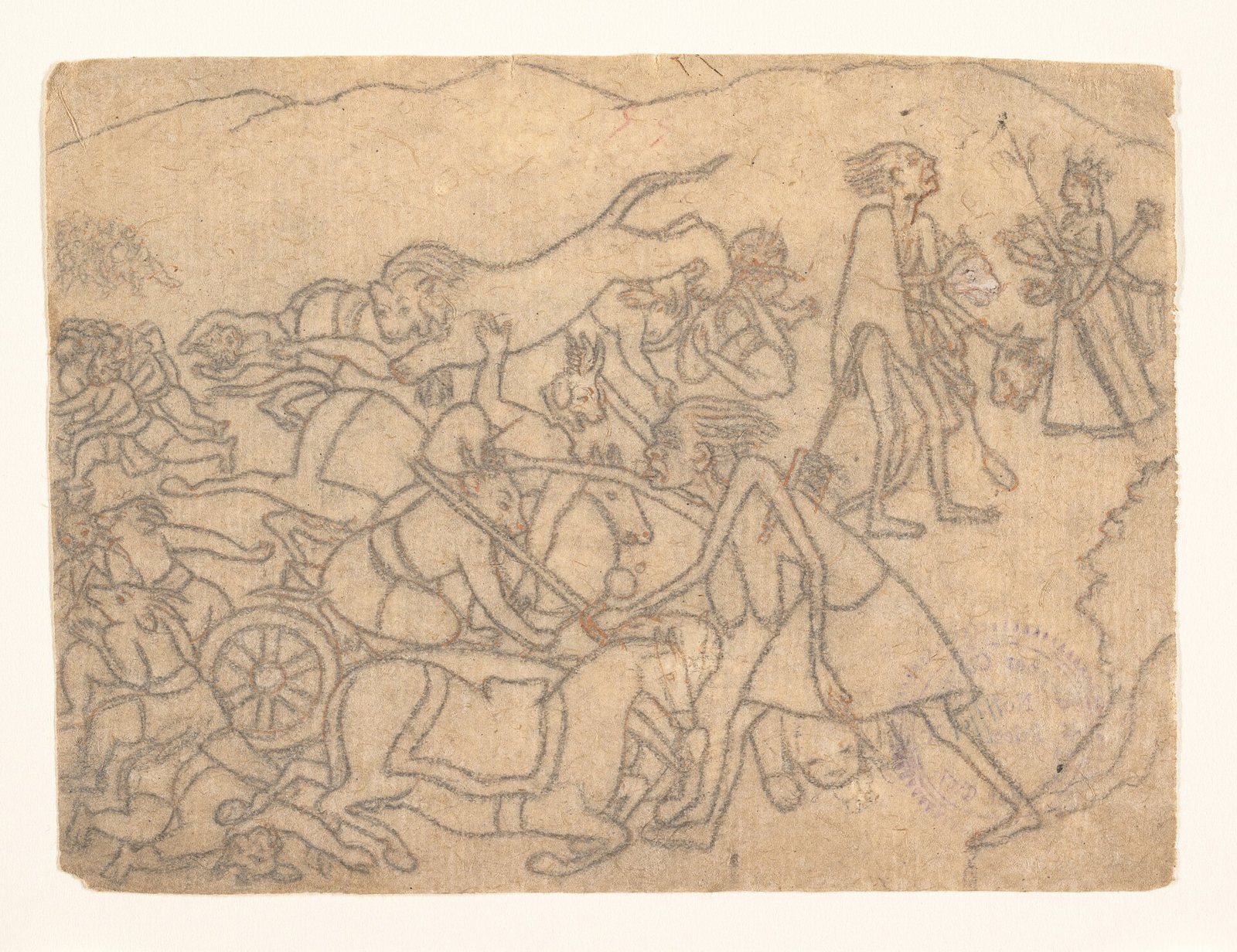
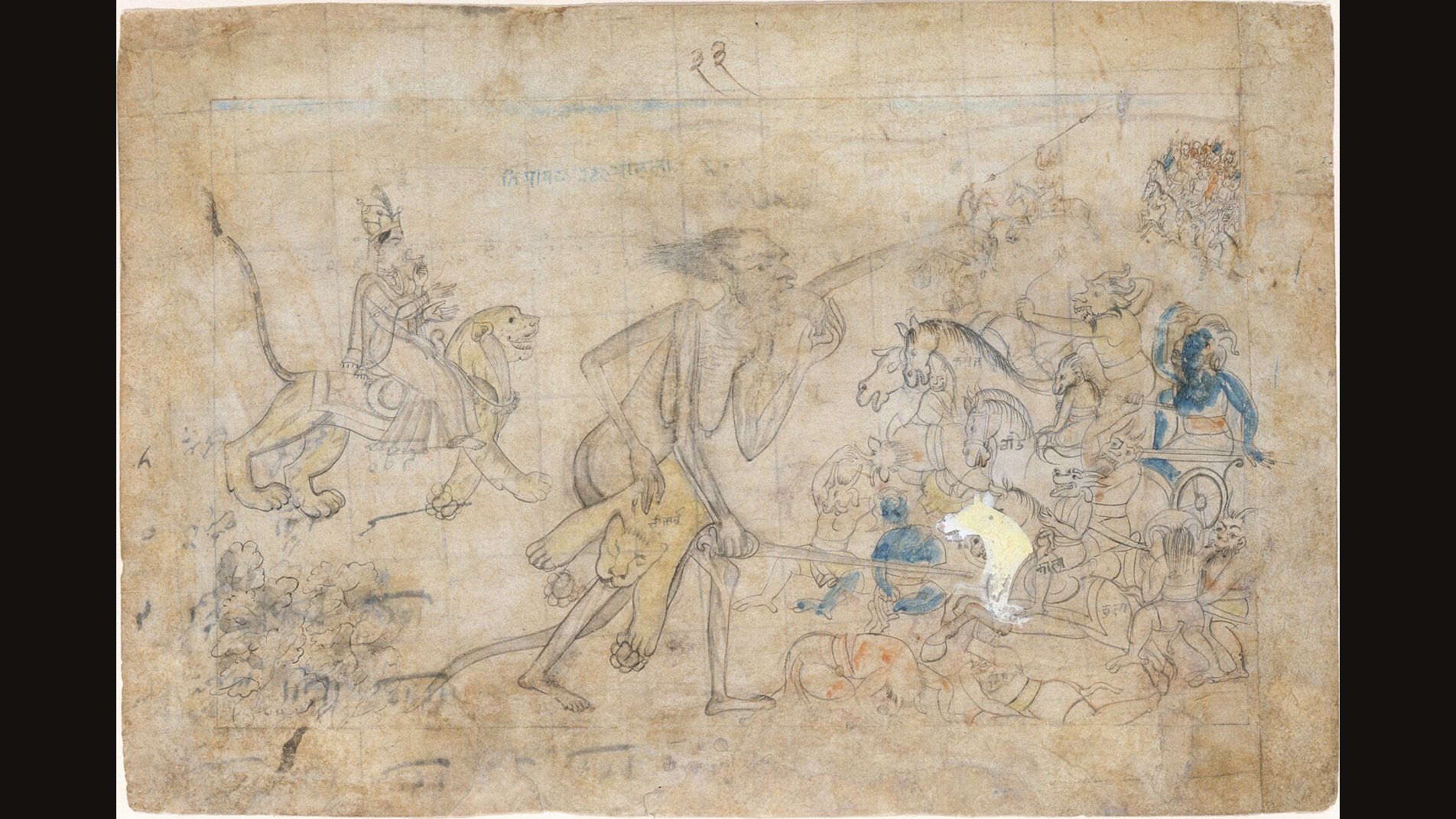
In the story, the goddess Ambika grows angry at two demon generals, Chanda and Munda. From her forehead springs Kali: dark, emaciated, armed with a sword and a staff topped with a skull, wearing a garland of human heads and a tiger skin. She tears into the demonic army, kills Chanda and Munda, and brings their heads to the goddess Chandika. Chandika then declares that Kali will be known as Chamunda, a name formed from the two generals she has slain, as the chapter 7 text records.
That is the garland's setting in the text: a battlefield, where divine power defeats forces that threaten the order of the world. The heads are the proof of victory, worn by the goddess who won it.
What the garland of heads means
The Sanskrit word *muṇḍamālā* simply means a garland of severed heads or skulls. What it stands for depends on the text, the lineage and the teacher, and several readings sit side by side rather than one replacing another.
The ego. The British Museum, in its introduction to feminine power, presents the heads as a symbol of Kali's power to destroy the ego. Each head is a limited, self-important identity that the goddess cuts away. The Birmingham Museum of Art gives a similar reading and also ties Kali to time, the force that ends every life and every form.
The letters of the alphabet. In Tantric interpretation, Sir John Woodroffe's *The Garland of Letters* identifies the heads with the fifty or fifty-one letters of the Sanskrit alphabet, called the *varṇamālā*, or "garland of letters." In this reading the necklace links Kali with sound, speech and mantra, with the creation of names and forms and with their dissolution. The goddess wears language itself.
Defeated enemies, mortality and time. Other interpretations connect the garland with the demonic forces she conquers in the *Devi Mahatmya*, with death and mortality, and with the end of a narrow, limited sense of self.
None of these is the single correct answer. Each belongs to a particular tradition, and a devotee, a temple priest and a museum label can all be right about the garland they are describing.
Heads or skulls: why the images differ
If you have seen several images of Kali, you may have noticed that the garland changes. Some show freshly severed heads, others show skulls, and others show stylized head-shaped ornaments that read almost like beads. The Birmingham Museum of Art and The Met both treat the garland as carrying layered meaning rather than one fixed message, and the Spanish government's heritage thesaurus has its own entry for the figure of Kali as an image type.
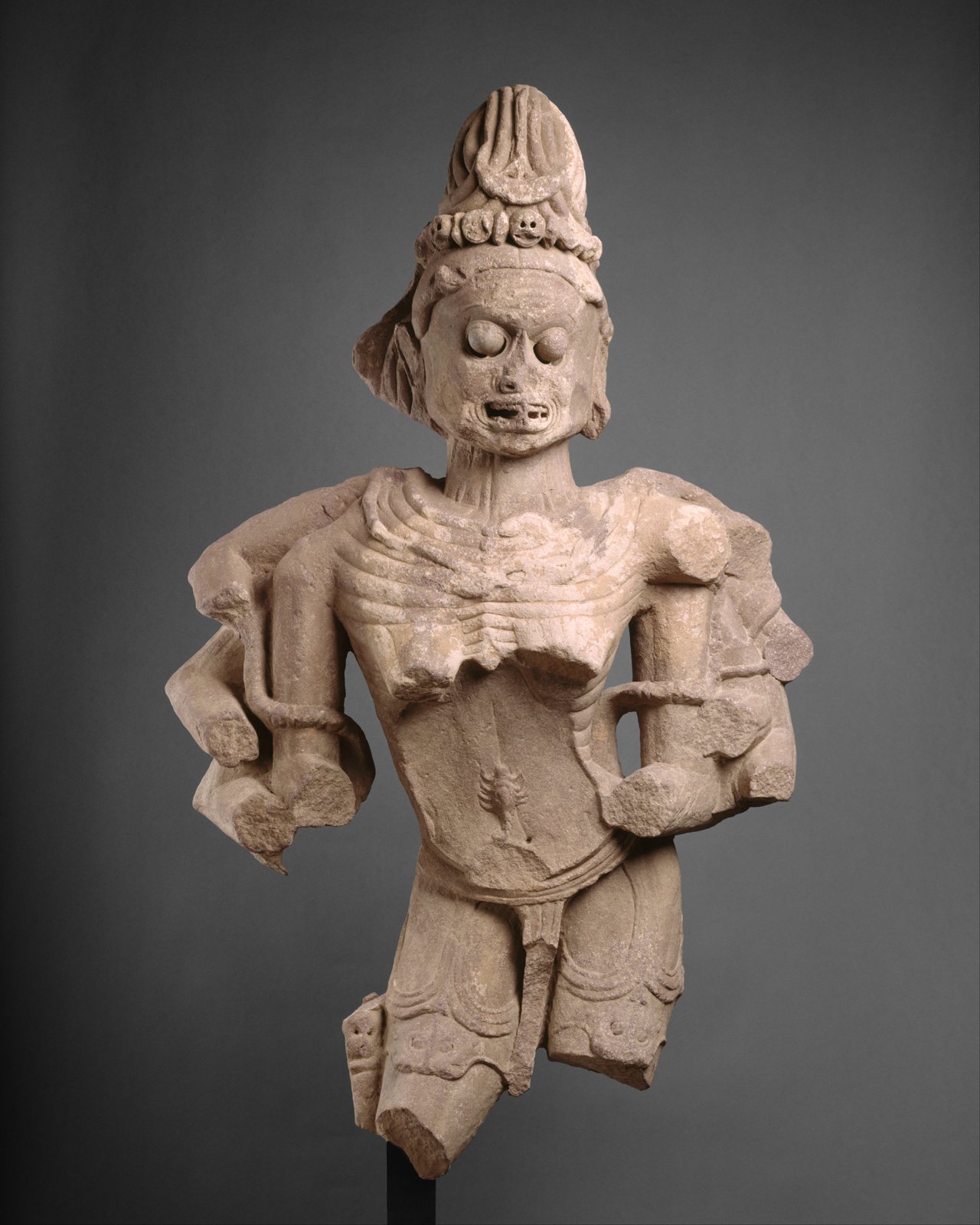
So, when you look at a particular painting, print or statue, the safest reading comes from that object: who made it, where and for whom. A Calcutta print and a sculpture from another region may wear the garland for different reasons.
The tongue, the skirt of arms and Shiva beneath her feet
The garland rarely appears alone. In the popular Bengali image that The Met discusses in *Seeing Kali Clearly*, Kali wears the garland of heads, a belt or skirt of detached arms, and unbound hair. She holds a sword and a severed head, and the god Shiva lies stretched out beneath her feet.
The arms in her skirt represent the physical power and actions of the beings she overcomes. The extended red tongue has more than one explanation. In the widely told story The Met describes, Shiva lies among the dead on the battlefield, Kali steps on him, recognizes her husband and stops her destructive dance; her tongue shows her astonishment. Standing on Shiva also expresses the relationship between Shakti, active divine power, and Shiva, whose still body comes to life through her presence. The British Museum's essay *Kali rises in the East* follows this same image through Bengal's Tantric and colonial history.
Reading the popular Bengali image of Kali
Tap a card to bring it forward.
- Garland of heads (mundamala): Defeated enemies, the destroyed ego or the letters of the Sanskrit alphabet, depending on the tradition
- Skirt of detached arms: The physical power and actions of the beings she overcomes
- Extended red tongue: In the widely told story, astonishment at stepping on Shiva
- Sword and severed head: Weapons and proof of her victory in battle
- Shiva beneath her feet: Shakti, active divine power, bringing the still Shiva to life
As with the garland, the exact symbolism shifts from image to image and tradition to tradition.
Kali in Calcutta prints at The Met
The Metropolitan Museum of Art holds two nineteenth-century prints of Kali made in Calcutta, now Kolkata, and both are in the public domain.
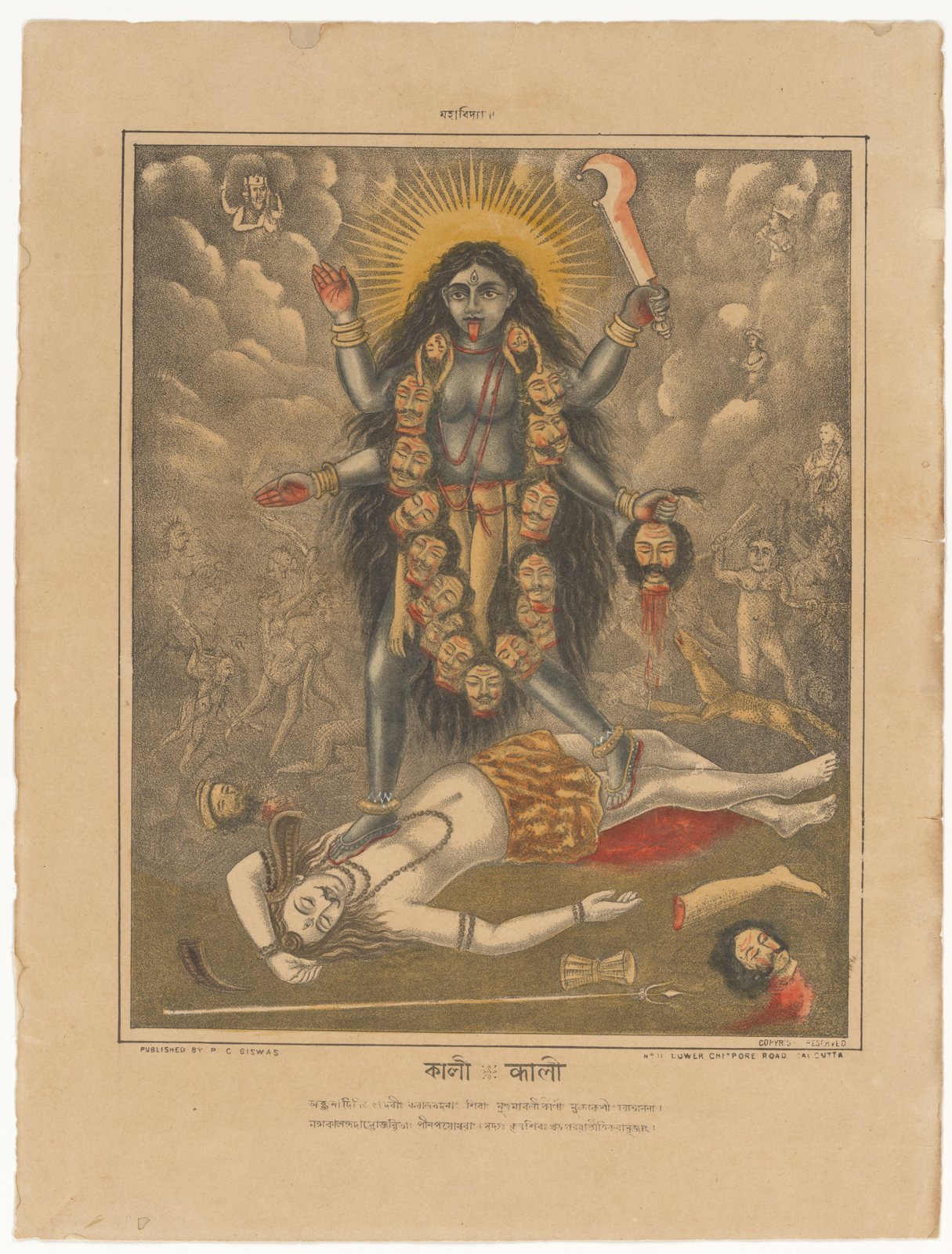
The first is *Goddess Kali*, by an artist not identified, made in Calcutta about 1880 to 1885. It is a lithograph printed in black with hand-coloring and watercolor, Met object 2021.195. It shows the garland of heads, the skirt of arms, the tongue, the sword and Shiva beneath her. The second, *Kali*, is a chromolithograph on paper made in Calcutta about 1885 to 1895, Met object 2013.3. Under The Met's Open Access policy, public-domain images like these may be downloaded, shared and reused without permission or fee, which makes them a good place to study the details up close.
Kali Puja and the temples of Kolkata
Kali is not only a figure in museums. In West Bengal she is honored on a festival night of her own. Kali Puja is held on the new moon night of the month of Kartika, usually in October or November. India's official tourism portal, Incredible India, describes the worship: images of Kali, prayers at midnight, devotional chants, gifts presented to the goddess, and the immersion of festival images afterward.
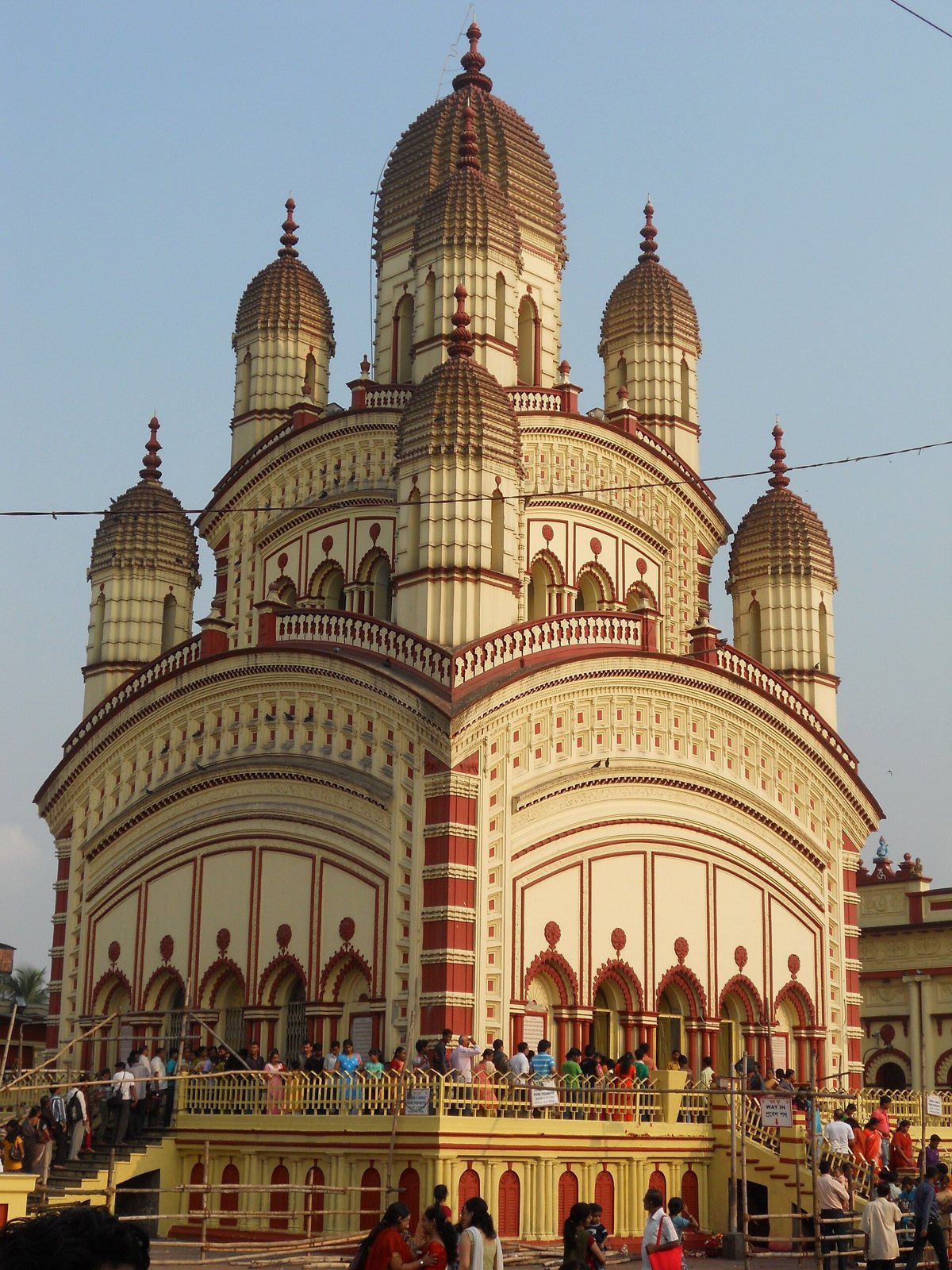
Two temples in Kolkata are especially tied to her. The Dakshineswar Kali Temple, on the eastern bank of the Bhagirathi River, was founded by Rani Rashmoni, who bought the land in 1847; the temple and its image were established in 1855. Its central deity is Bhavatarini, a form of Kali, and the temple is closely associated with the nineteenth-century devotee and mystic Sri Ramakrishna. The temple names Dipanwita Kali Puja as its principal annual festival and also keeps Phalaharini Kali Puja and Ratanti Kali Puja. Kalighat, also in Kolkata, is one of the city's major Kali temples and part of the sacred geography of Shakta worship in Bengal.
If you hope to attend, confirm current access, photography, dress and festival arrangements with the temple itself.
Kali in text, poetry and temple
Tap or hover a step to follow the order.
Devi Mahatmya, chapter 7
Kali springs from Ambika's forehead, kills Chanda and Munda and receives the name Chamunda
Eighteenth century
Bengali devotional poetry associated with Ramprasad Sen presents Kali as an intimate Mother
1847
Rani Rashmoni buys land for the Dakshineswar temple complex
1855
The Dakshineswar Kali Temple is founded and its image installed
Every October or November
Kali Puja is observed on the Kartika new moon
Questions people ask about Kali
These questions often follow a first look at her image.
Why does Kali wear a necklace of heads?
Kali wears a necklace of heads as a sign of what she overcomes, and the meaning depends on the tradition. In the *Devi Mahatmya* battle story the heads belong to defeated demonic forces; the British Museum reads them as the destruction of the ego; and in Woodroffe's Tantric reading they are the fifty or fifty-one letters of the Sanskrit alphabet, linking her with speech, mantra, creation and dissolution.
What does a skull necklace symbolize?
In Kali's iconography, a skull necklace can symbolize mortality, the destruction of ego, defeated demonic power, or the Sanskrit sounds from which names and forms are made. Some images show severed heads and others show skulls or stylized ornaments, so one meaning does not fit every depiction. Elsewhere in the world the skull carries other meanings again, which our guide to skull symbolism follows.
Is it okay to worship Kali?
Hindu communities answer this in different ways, and the answer belongs to the tradition you hope to follow. Many devotees worship her publicly and privately as Mother, protector and liberating divine power; some Tantric practices are traditionally learned through a guru or lineage, while bhakti, prayer, temple worship and devotional singing are approached more broadly. Anyone hoping to begin should learn from a qualified temple, teacher or community within that tradition.
Why does Kali stick out her tongue?
In the widely told story described by The Met, Kali's tongue shows astonishment: dancing on the battlefield, she steps on Shiva, recognizes him and stops. Other interpretations exist, and the meaning can differ from one image to the next.
What does Kali standing on Shiva mean?
It expresses the relationship between Shakti, active divine power, and Shiva, whose still body comes alive through her presence. In the popular story it is also the moment her destructive dance comes to an end.
Kali and her garland
Answer every question to check.
Where to go next
Kali is one of many figures around the world who hold death and renewal together. Our guide to gods of death sets her beside others from different cultures, and the story of the kapala skull cup follows another ritual object made from a skull. For the European habit of keeping death in view as a teacher rather than a terror, read what memento mori means.