

No. 013
Alas, Poor Yorick: What Happens in Hamlet's Skull Scene and What It Means
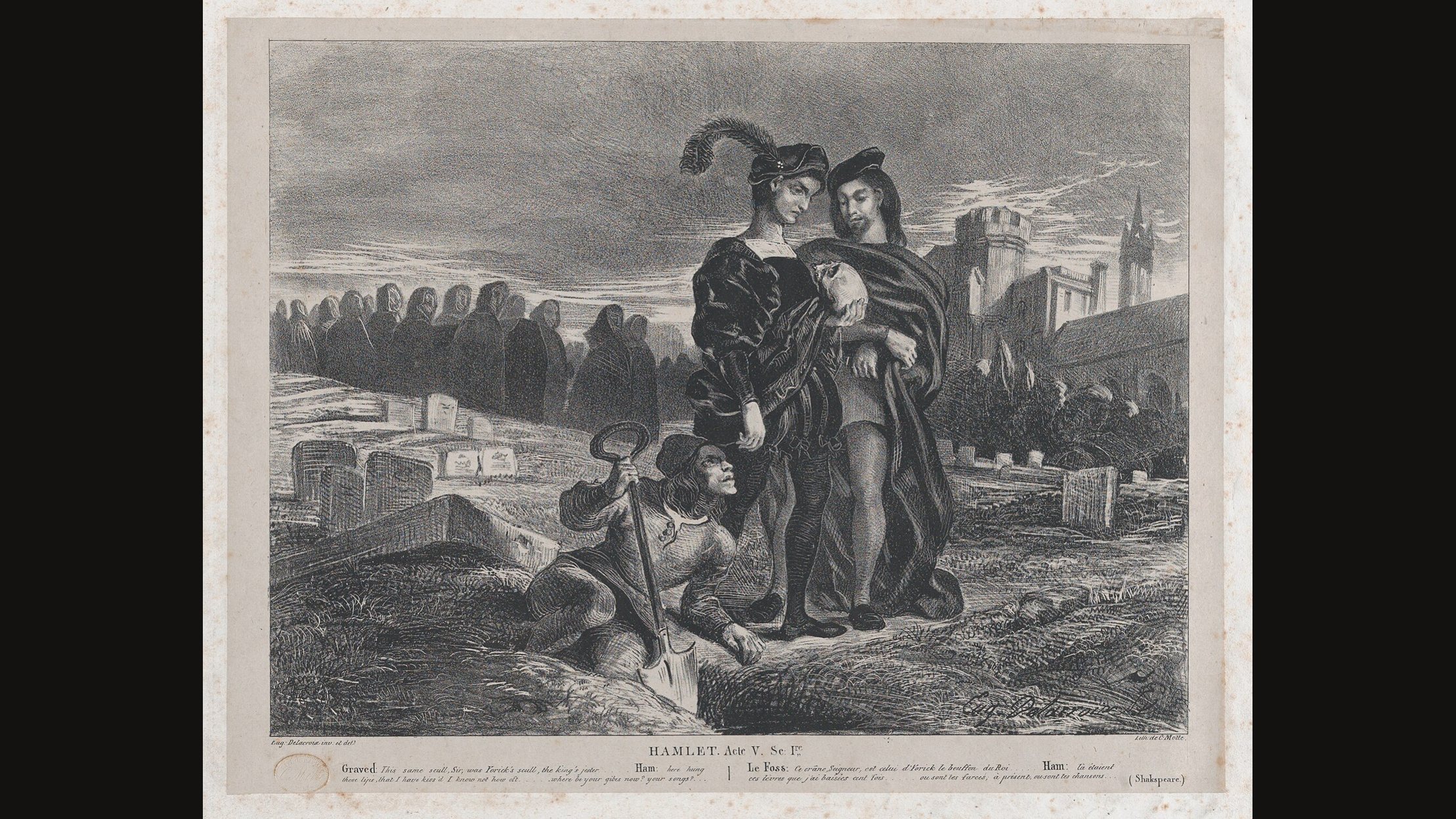
The man holding the skull is Prince Hamlet, in Act 5, Scene 1 of Shakespeare's *Hamlet*. A gravedigger, working in a churchyard, turns up a skull that has lain in the earth for twenty-three years and tells Hamlet whose it is: Yorick's, "the King's jester," the man who carried Hamlet on his back when he was a boy. Hamlet takes the skull and says, "Alas, poor Yorick! I knew him, Horatio" (Folger Shakespeare edition, Act 5, Scene 1, from line 190). He remembers Yorick's jokes and songs, then turns from one lost friend to a larger thought: that everyone, even Alexander the Great, ends as dust.
Many people remember the line as "Alas, poor Yorick, I knew him well." Shakespeare's Hamlet names his friend Horatio instead. The rest of the scene is just as interesting, and so is the real skull that once played Yorick on the English stage.
The graveyard scene, step by step
Act 5 opens in a churchyard. In the Folger Shakespeare edition, two gravediggers are digging a grave for Ophelia and arguing about whether she deserves a Christian burial after her suspected suicide. Their talk is quick, earthy and full of jokes, which is part of what makes the scene so memorable: death arrives with a shovel and a sense of humor.
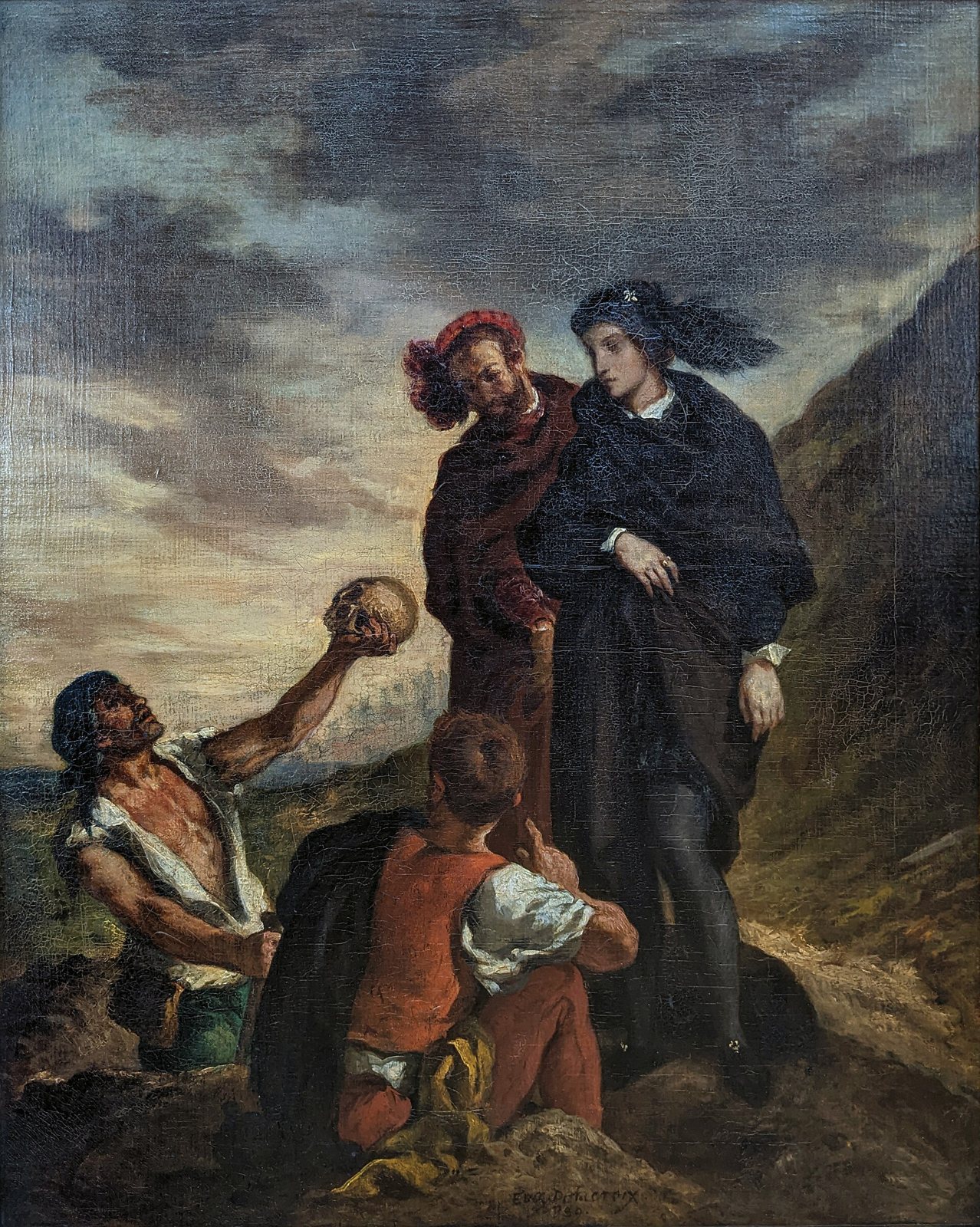
Hamlet returns with his friend Horatio and comes upon them. He jokes with the gravedigger and reflects on the skulls being dug up out of the old graves. Then the gravedigger picks up one particular skull. It has been in the earth twenty-three years, he says, and it belonged to Yorick, the King's jester.
Hamlet takes it in his hands, and the most famous moment in the play begins. After his speech over the skull, a funeral procession arrives, and Hamlet learns that the new grave is Ophelia's. Her brother Laertes leaps into the grave, Hamlet reveals himself, and the two men struggle there among the dead.
Who is in Hamlet's graveyard scene
Tap a card to bring it forward.
- Hamlet: The prince, who holds Yorick's skull and speaks over it
- Horatio: Hamlet's friend, the person Hamlet addresses in "I knew him, Horatio"
- The gravediggers: Two workers who debate Ophelia's burial and turn up the skulls
- Yorick: The King's jester, dead twenty-three years, present only as a skull
- Ophelia: The young woman whose grave is being dug
- Laertes: Ophelia's brother, who leaps into her grave when the funeral arrives
What Hamlet actually says
Here is the line as the Folger edition prints it, at Act 5, Scene 1, from line 190:
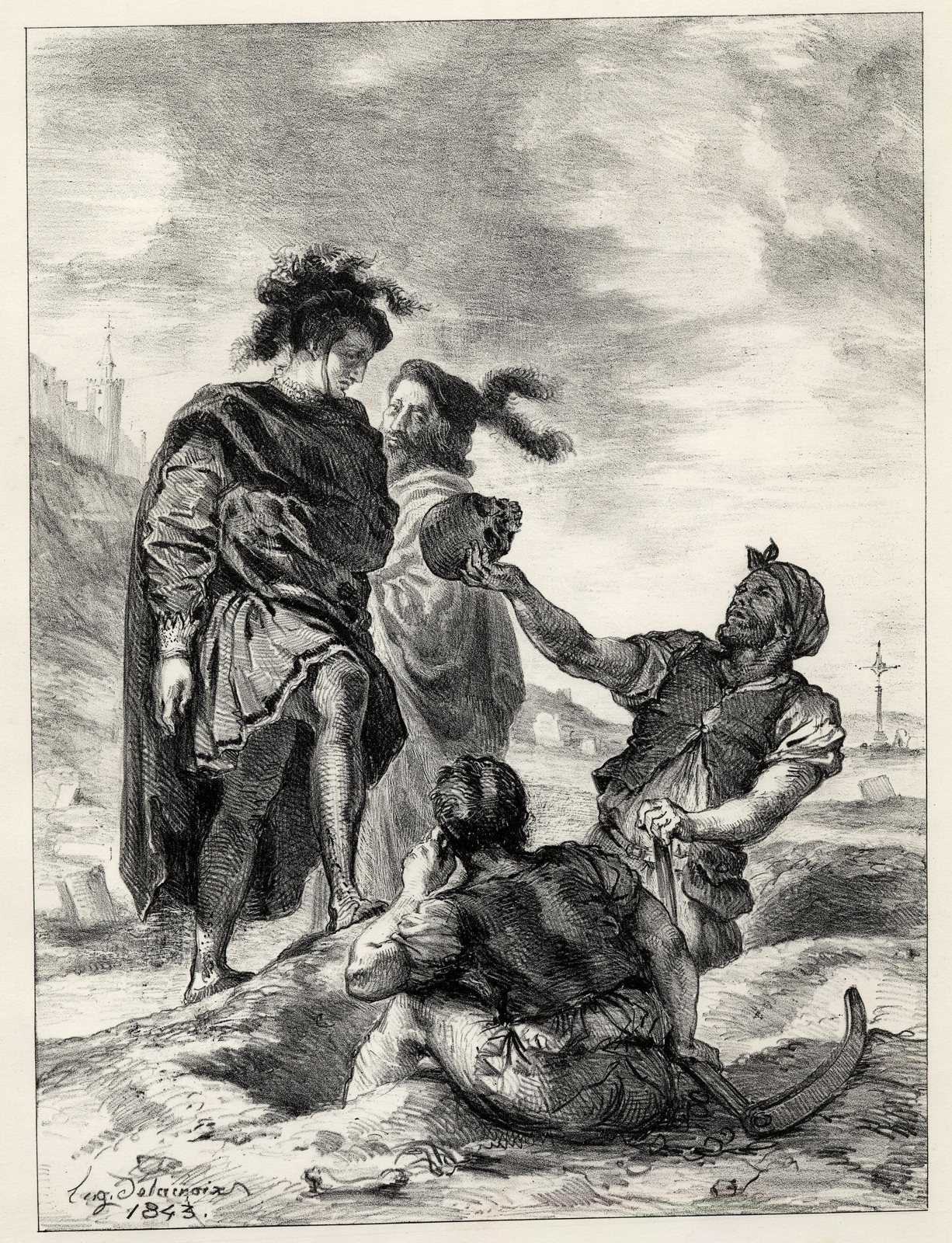
> "Alas, poor Yorick! I knew him, Horatio"
Hamlet goes straight on to describe the man the skull used to be, "a fellow of infinite jest, of most excellent fancy," and remembers that Yorick carried him on his back "a thousand times." The speech moves from fond memory to the hard fact of the bone in his hand. He asks where the jokes, the songs and the laughter have gone.
The popular version, "I knew him well," is how many people carry the line around, but the word "well" is not in Shakespeare's text. Hamlet is speaking to Horatio and telling him that he knew Yorick. For comparison, the 1604 Quarto 2 text, one of the earliest printed versions of the play, can be read through the Internet Shakespeare Editions.
Who Yorick was
Yorick never speaks in the play. He has been dead for twenty-three years by the time we meet him, and all that is left is his skull. Everything we know about him comes from Hamlet's memory: he was the King's jester, a court entertainer with "infinite jest," who played with the young prince and carried him on his back.
That is what gives the line its weight. Hamlet is not looking at a symbol; he is looking at someone he loved as a child, now unrecognizable. The jester's whole job was to make people laugh, and Hamlet's grief has a jester's edge to it. He speaks to the skull and asks it where its jokes have gone, which is about as Yorick a thing to do as anyone could manage.
From Yorick to Alexander: what the scene says about death
Hamlet does not stay with Yorick for long. Holding the skull, he asks Horatio:
> "Dost thou think Alexander looked o' this fashion i' th' earth?"
If Alexander the Great, the conqueror, ended up looking like this, then nobody escapes it. Hamlet follows Alexander's remains from burial to dust, to earth, to clay, and wonders whether that "noble dust" might end up plugging a beer barrel. He does the same for Julius Caesar, imagining the clay of the man who once frightened the world being used to patch a wall.
In the same scene, Hamlet does this with the skulls the gravedigger throws up, guessing that one might have been a politician, another a courtier, another a lawyer, and asking what became of their power, their papers and their property. In his essay "A Modern Perspective: Hamlet" for the Folger, Stephen Greenblatt describes how the skulls become anonymous and how "all human differences" collapse into the same material end. Yorick is the exception for a moment, because Hamlet remembers him, but even his skull ends up looking like everyone else's.
The scholar Julie Sanders, writing for Cambridge University Press about skulls on the early modern stage, points out that the skull is a real object in an actor's hand. It makes death physically present in the theater instead of leaving it as an idea. That is the scene's lesson in short: in the grave, rank, fame and ownership all wear away.
The real skull at the Royal Shakespeare Company
For one production, Yorick's skull was a real one. André Tchaikowsky, a Polish pianist and composer, died in 1982, and his will asked that his skull be offered to the Royal Shakespeare Company for use in the theater. According to The Guardian's report of 23 November 2008, it then sat in the company's props department for about twenty-five years.
It came close to the stage once before. Mark Rylance rehearsed with it for his 1989 Hamlet, but it was not used in performance. Then director Gregory Doran retrieved it, after the necessary official clearance, for his 2008 RSC production at Stratford-upon-Avon, and David Tennant held Tchaikowsky's skull as Yorick's. Jonathan Bate wrote about the skull and the production in The Guardian on 3 December 2008, and Doran later described receiving and preparing it in The Guardian on 18 April 2023.
The company first kept the skull's use quiet. Once the story became public, the publicity risked pulling the audience's attention away from the scene itself, and the RSC used a replica for some performances. It is a fitting story for this scene: a musician who wanted his own skull to keep working in the theater after his death, carrying on the exact thought Hamlet speaks over it.
Other ways the scene has been staged
The RSC's stage history of *Hamlet* runs from Richard Burbage, Thomas Betterton and Sarah Siddons to Laurence Olivier, Mark Rylance, Kenneth Branagh and David Tennant. It even records an early performance aboard the East India Company ship *The Dragon*, off Sierra Leone, in 1607.
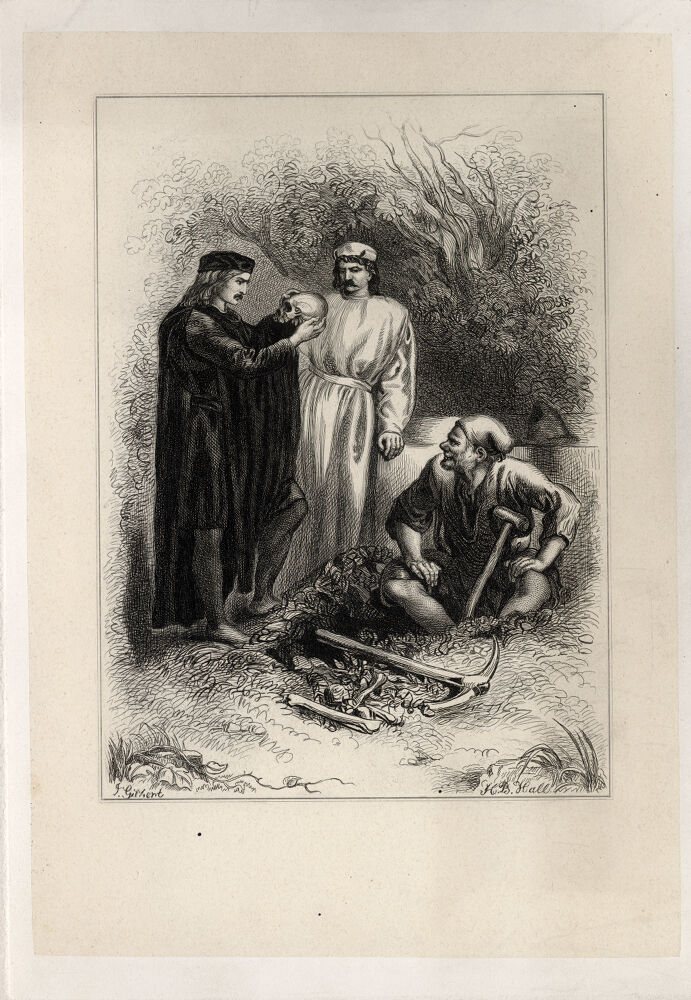
Directors have handled the skull in very different ways. Laurence Olivier touched the skull in his 1948 film. According to The Guardian, Thomas Ostermeier's 2008 Berlin production cut the gravedigger scene and represented Yorick with projected skull imagery, and Maxine Peake's 2014 Hamlet addressed a rolled-up sweater as Yorick. The scene still works, which says a lot about how strongly audiences already know what the skull stands for.
Yorick's skull on stage
Tap or hover a step to follow the order.
Early 1600s
Shakespeare's Hamlet enters the English stage repertory
1607
An early recorded performance aboard the East India Company ship The Dragon, off Sierra Leone
1982
André Tchaikowsky dies and leaves his skull to the Royal Shakespeare Company for theatrical use
1989
Mark Rylance rehearses with Tchaikowsky's skull, but it is not used in performance
2008
David Tennant uses the real skull in Gregory Doran's RSC production at Stratford-upon-Avon
2008
Thomas Ostermeier's Berlin production shows Yorick through projected skull imagery
2014
Maxine Peake's Hamlet addresses a rolled-up sweater as Yorick
How the pose became a symbol
A man looking into the eye sockets of a skull now means "Hamlet" almost anywhere, and it often means "thinking about death" even to people who have never read the play. Jeffery A. Triggs, in his essay "A Mirror for Mankind: The Pose of Hamlet with the Skull of Yorick," traces the pose as a recurring motif in poetry and art and connects it to vanitas imagery and the wider tradition of using a skull to show that life is short. You can see that tradition in our guide to vanitas paintings.
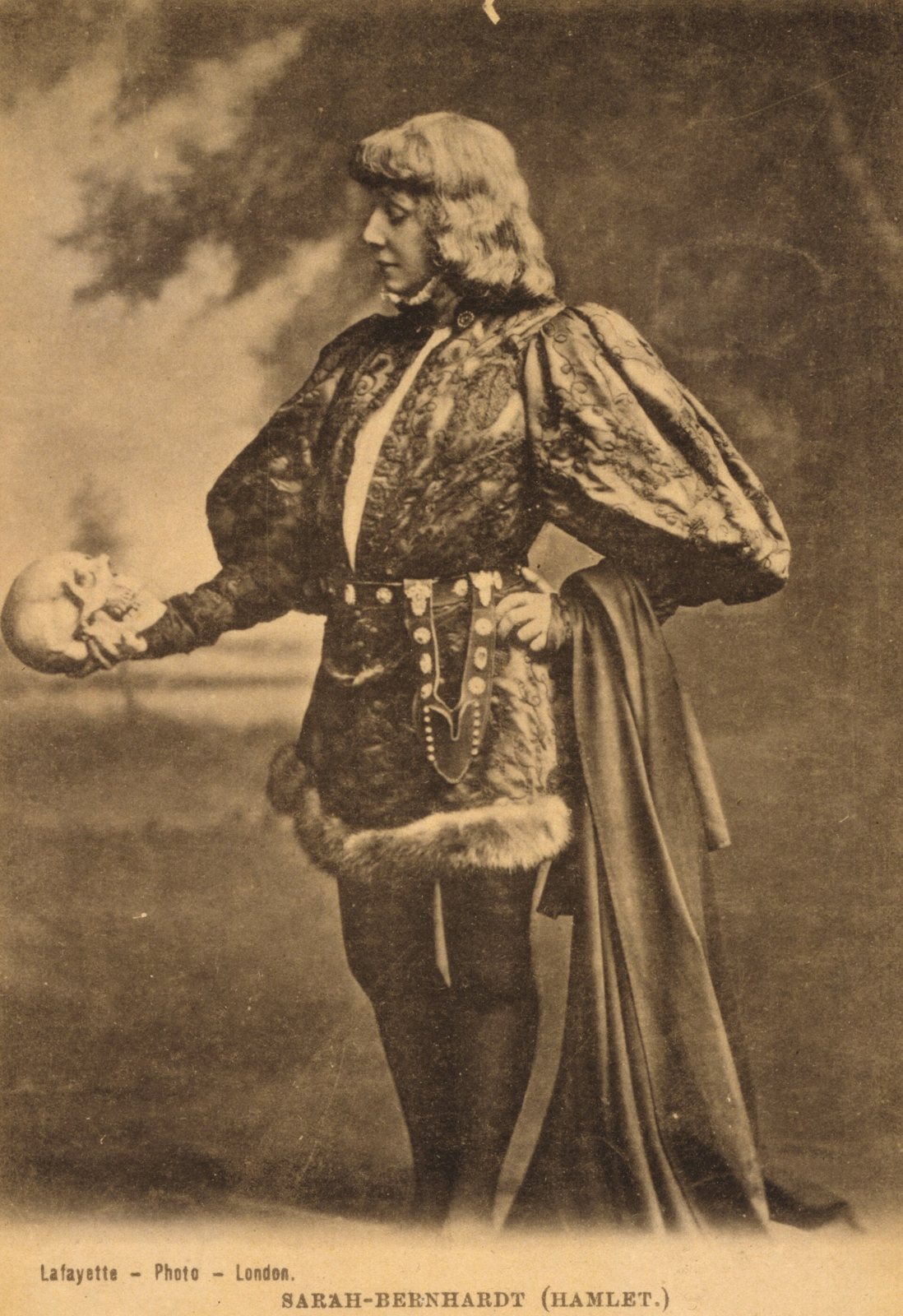
Photography helped spread it. Sarah Werner, in "Poor Yorick: The Photograph as Memento Mori," argues that performance photographs made the Yorick composition widespread and recognizable and linked it to older memento mori traditions. One actor, one skull and one steady gaze can stand for Hamlet, for Shakespeare and for mortality without a word of explanation. The Shakespeare Birthplace Trust even has a sculpture of Hamlet by Greg Wyatt at Shakespeare's New Place in Stratford-upon-Avon.
One detail is easy to blur. The skull scene is Act 5, Scene 1. The "To be, or not to be" speech comes much earlier, in Act 3, Scene 1, and Hamlet holds no skull while he delivers it. The two moments are easy to merge in memory, but they are separate scenes.
Alas, poor Yorick quiz
Answer every question to check.
Frequently asked questions
What is the meaning of "Alas, poor Yorick"?
"Alas, poor Yorick" is Hamlet's cry of grief on finding that a skull belongs to the jester who played with him as a child. It mixes memory, sorrow and shock at what death does to a body, and it opens his wider thought that even Alexander and Caesar end as dust.
Who said "Alas, poor Yorick, I knew him well"?
Hamlet says the line in Act 5, Scene 1 of Shakespeare's play, but his exact words are "Alas, poor Yorick! I knew him, Horatio." The word "well" was added in popular memory; in the text, Hamlet is speaking to his friend Horatio.
What does Hamlet say when he holds a skull?
He says, "Alas, poor Yorick! I knew him, Horatio," and calls Yorick "a fellow of infinite jest, of most excellent fancy." He goes on to recall Yorick carrying him "a thousand times" and asks whether Alexander the Great looked the same in the earth.
Who is Yorick in Hamlet?
Yorick is the late court jester of Denmark, "the King's jester," who died twenty-three years before the graveyard scene. He appears only as a skull, and everything known about him comes from Hamlet's childhood memories.
Was the skull David Tennant used real?
Yes, in Gregory Doran's 2008 RSC production David Tennant used the real skull of the pianist and composer André Tchaikowsky, who left it to the company for theatrical use. After the story became public, the company used a replica for some performances.
Where to go next
Yorick's skull belongs to a long line of skulls that ask the viewer to think about time. Follow it into vanitas paintings, the meaning of memento mori and some of the most famous skull art, or start broader with skull symbolism. If you are the kind of reader who already has a stack of plays by the bed, our Book Crew skull tee was made with you in mind.