No. 030
Calacas: What the Skeletons of Día de Muertos Are Called and What They Mean
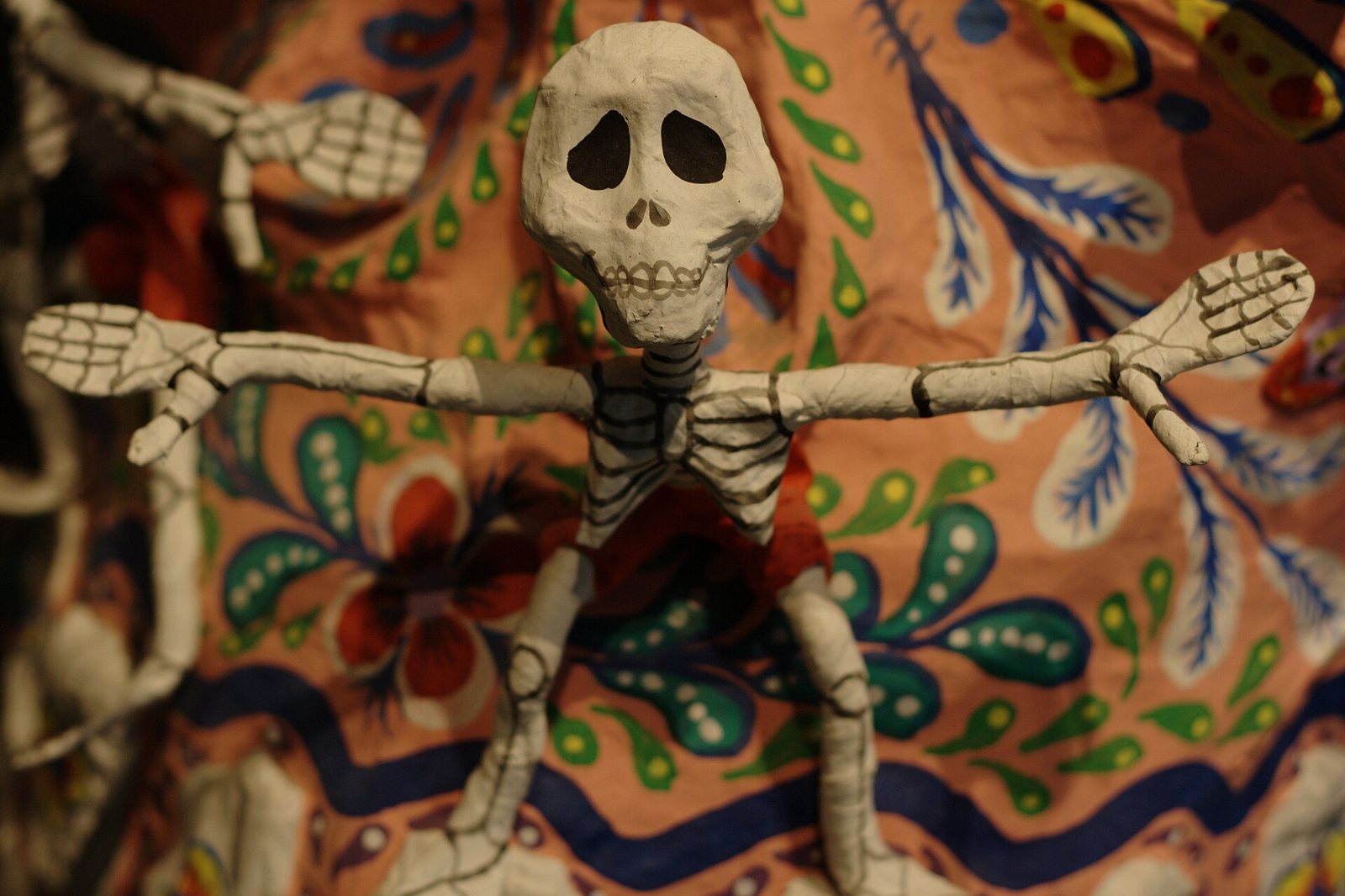
The cheerful skeleton figures of Día de Muertos are commonly called *calacas*. A *calavera* is a skull, though in Mexican Spanish the word can also mean a skeleton, a sugar skull or a satirical verse, and *La Catrina* is one particular well-dressed skeleton woman. These words overlap in everyday talk, so people mix them up all the time, but they are not interchangeable. The Diccionario del español de México, from El Colegio de México, defines *calaca* as a "calavera y esqueleto que simboliza la muerte," and the dictionary of the Asociación de Academias de la Lengua Española lists it too. What follows covers the names, what the skeletons stand for, who makes them and where to see them.
Four words for skeletons and skulls
Each word points to something slightly different, and the differences are easy to keep straight in a short list.
Tap or hover a row to highlight it.
| Word | Direct meaning | Typical Día de Muertos use |
|---|---|---|
| WordCalaca | Direct meaningA skeleton or allegorical figure of death | Typical Día de Muertos useFull-body skeleton figures, often colorful or humorous |
| WordCalavera | Direct meaningA skull, also a skeleton, a figure of death, a sugar skull or a satirical verse depending on context | Typical Día de Muertos useDecorative skulls, sugar skulls and literary calaveras |
| WordCalaverita | Direct meaningA little skull | Typical Día de Muertos useA small sugar skull, especially for an altar |
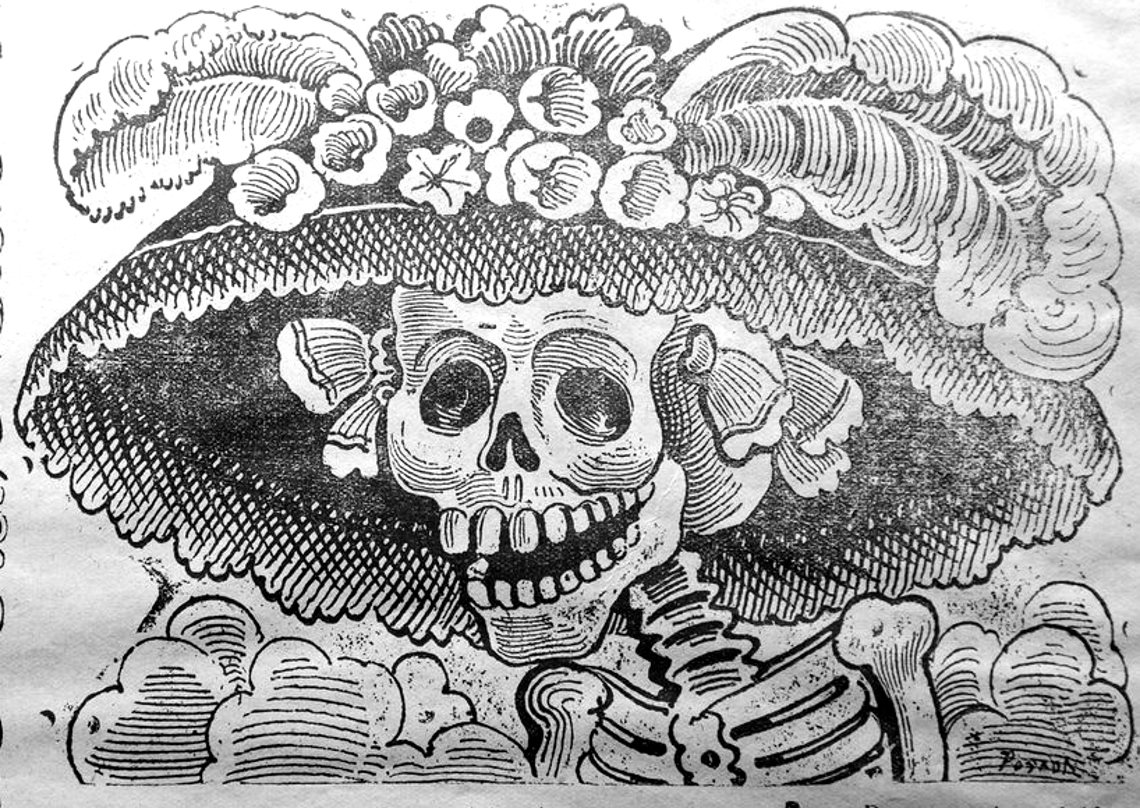
| WordLa Catrina | Direct meaningA named well-dressed female skeleton image derived from Posada's Calavera Garbancera | Typical Día de Muertos useA Posada-derived character associated with Día de Muertos |
*Calaca* usually means a skeleton shown as an animated person. *Calavera* more literally means a skull, and the same dictionary also records it as a human skeleton, a figure of death, a skull-shaped sweet made near Día de Muertos and the illustrated verses written in November. Small sugar skulls are often called *calaveritas* or *calaveras de azúcar*, and the Associated Press reported in 2025 on a Mexico City family that has made and sold them since the 1940s, noting that many buyers use them to decorate altars rather than eat them. *La Catrina* names a specific figure, not every decorated skull. So, if you are asking whether calacas and sugar skulls are the same thing, they are not: one is a skeleton figure and the other a candy skull.
What the skeletons stand for
On Día de Muertos, skeletons stand for the continuing bond between living families and their dead relatives, the temporary return of the dead, remembrance and the shared fact that everyone dies. UNESCO describes the Indigenous festivity dedicated to the dead as a yearly meeting between living families and deceased relatives, held from late October into early November, with flowers, candles, food and handmade objects placed on altars and graves. It was proclaimed in 2003 and inscribed on UNESCO's Representative List in 2008.
The humorous skeletons also make death familiar instead of distant. In Mexico City and other cities they turn up in satirical poems, newspaper cartoons, papier-mâché figures, toys and decorations showing everyday jobs. The meaning is not identical everywhere, though. The Huastec communities of Veracruz, Tamaulipas, San Luis Potosí, Puebla, Hidalgo, Querétaro and Guanajuato celebrate Xantolo, which UNESCO describes with its own characters, the *Huehues*, and its own masks, costumes, music and rituals.
Why the skeletons cook, dance and get married
Walk past a shop window in October and you may see calacas getting married, playing guitars, dancing, taking photographs or working on a laptop. The Burke Museum, in a collection record for a Mexican Día de Muertos figure, explains that calacas stand for death and point viewers toward mortality, while humorously showing what the dead enjoyed in life or might be doing in death. Its examples include weddings, dancing, music, photography, scuba diving and working on a cellphone. That is one museum's reading of Mexican calaca imagery, not a rule every family or community follows.
The Wereldmuseum Rotterdam adds a social angle, describing papier-mâché skeletons dressed as firefighters, musicians and other ordinary people that place death inside familiar scenes. In other words, a skeleton in a firefighter's coat is both a joke and a way of saying that death meets everybody in whatever job they have.
Where the lively skeleton came from
The cheerful skeleton as modern Mexicans know it grew out of nineteenth-century print culture. Manuel Manilla and José Guadalupe Posada developed popular skeleton imagery, and Posada used skeletons to comment on politics, class and everyday life. The Instituto Nacional de Antropología e Historia (INAH) notes that his broader skeleton prints adapted older European "dances of death" into scenes people in Porfirian Mexico would recognize.
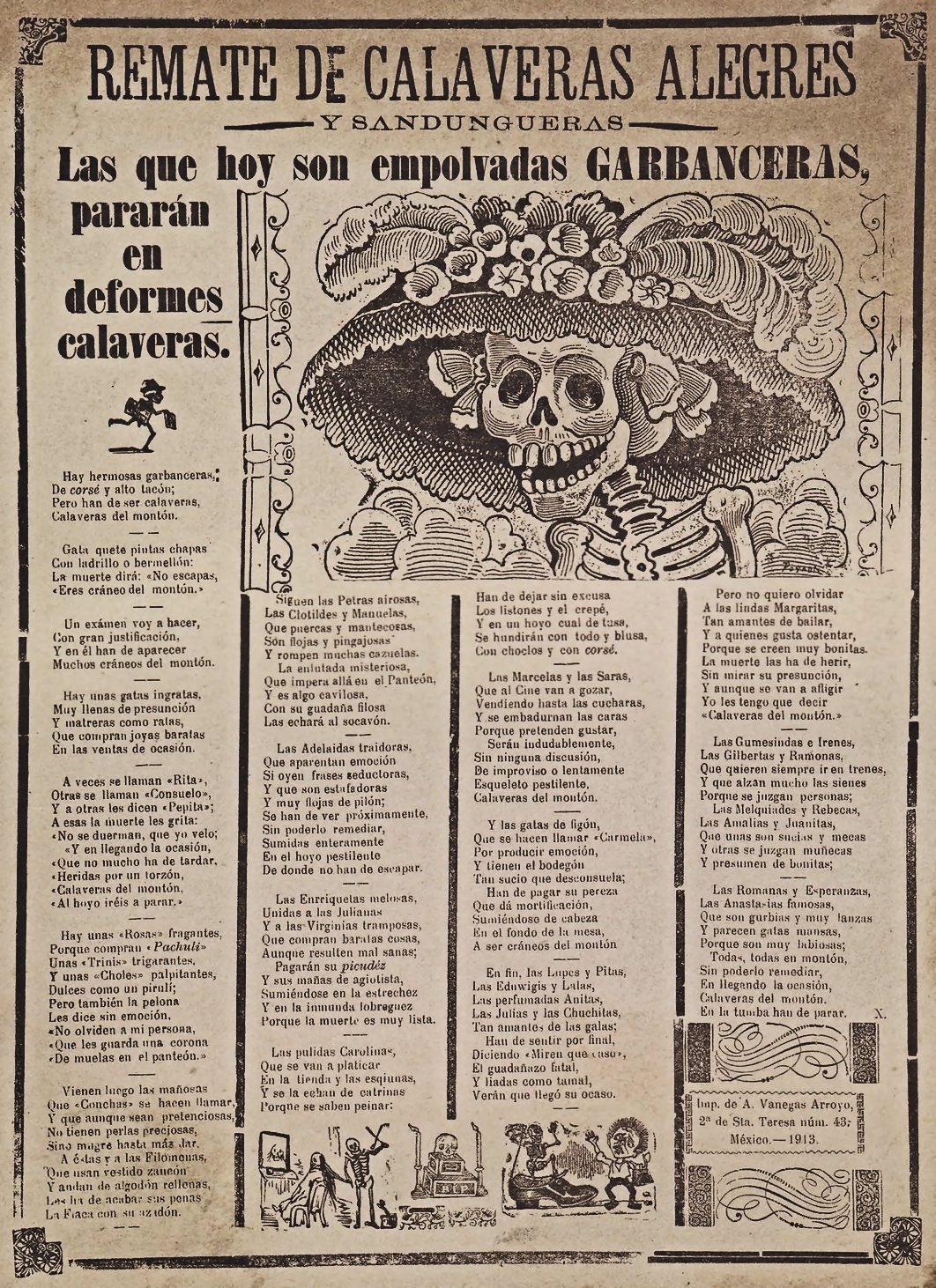
His *Calavera Garbancera*, a satire of people who rejected Indigenous identity while copying elite European fashion, was printed after his death, in 1913. Diego Rivera later gave a full-bodied version of the figure the name La Catrina in his 1947 mural *Sueño de una tarde dominical en la Alameda Central*. Later artisans and public celebrations widened the cast to musicians, workers, couples and dancers. The whole story of that figure has its own page, La Catrina, and the printmaker has one too, in José Guadalupe Posada.
Who makes calacas, and from what
Calacas are made in several materials and in several places, and each tradition has its own makers.
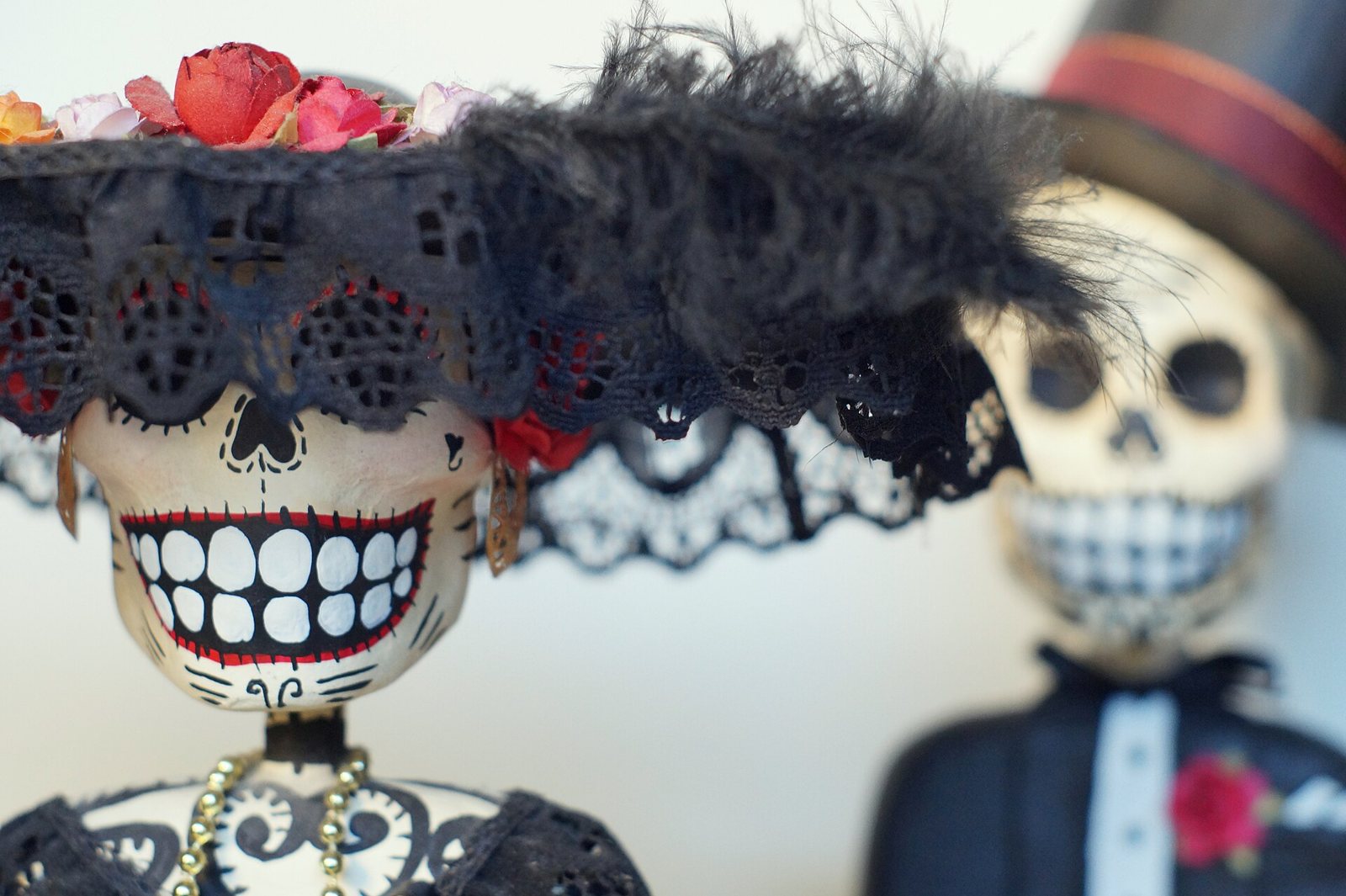
In Mexico City, the Secretaría de Cultura's survey of cartonería, the paper and cardboard modeling tradition, records cartoneros making cut-out and moving cardboard calaveras that danced when pulled by a thread. The Linares family is the best known name. Pedro Linares López, born in 1906 and died in 1992, is a major figure in Mexican cartonería and is associated with the creation of alebrijes, and his work also included calaveras, masks, Judas figures and toys. He received Mexico's Premio Nacional de Ciencias y Artes in Popular Arts and Traditions in 1991. His son Felipe and grandson Leonardo were recognized as Grandes Maestros del Arte Popular, and Leonardo Linares Vargas teaches cartonería and carries on the family workshop. Carmen Caballero Sevilla, another Mexico City cartonera, had her work collected by Diego Rivera and Frida Kahlo alongside Pedro Linares's.
In Xoxocotla, Morelos, Miriam Castañeda and Martín Ramírez made a series of 25 cardboard calaveras showing local customs, rituals and dances. In Puebla, the Paredes family of ceramic artists, including Daniel and María Fernanda Paredes, makes polychrome clay calaveras and skeletons showing everyday Mexican life. The Burke Museum also lists wood among the materials used for calacas, alongside papier-mâché and clay, without tying the wooden examples to a town or maker. The Linares work belongs to Mexico City cartonería and should not stand in for every regional calaca tradition.
Calacas from the nineteenth century to 2026
Tap or hover a step to follow the order.
Late nineteenth century
Manuel Manilla and José Guadalupe Posada develop popular skeleton imagery in print
1913
Posada's Calavera Garbancera printed after his death
1947
Rivera's mural Sueño de una tarde dominical en la Alameda Central names La Catrina
1991
Pedro Linares receives the Premio Nacional de Ciencias y Artes in Popular Arts and Traditions
1994
The National Museum of Mexican Art's Calaveras Pa' Todos exhibition, with the Linares family among the artists
2003 and 2008
UNESCO proclaims and then inscribes the Indigenous festivity dedicated to the dead
2019
Mexico City's Mega Desfile draws 807,000 attendees and a UN-UNESCO ofrenda is presented at the Palace of Fine Arts with Xochimilco artisans
2023
The Gran Desfile includes calaveras, catrinas and Mictlán floats
2026
Mexico City's official program lists a Great Day of the Dead Parade on October 31
Calacas on altars, in parades and in the street
Ofrendas vary by state, town and family. INAH lists common elements such as photographs, candles, food, water, cempasúchil, copal, papel picado, sugar calaveras and pan de muerto. Calacas may appear as decoration or as stand-ins for death, but they are not required on every altar.
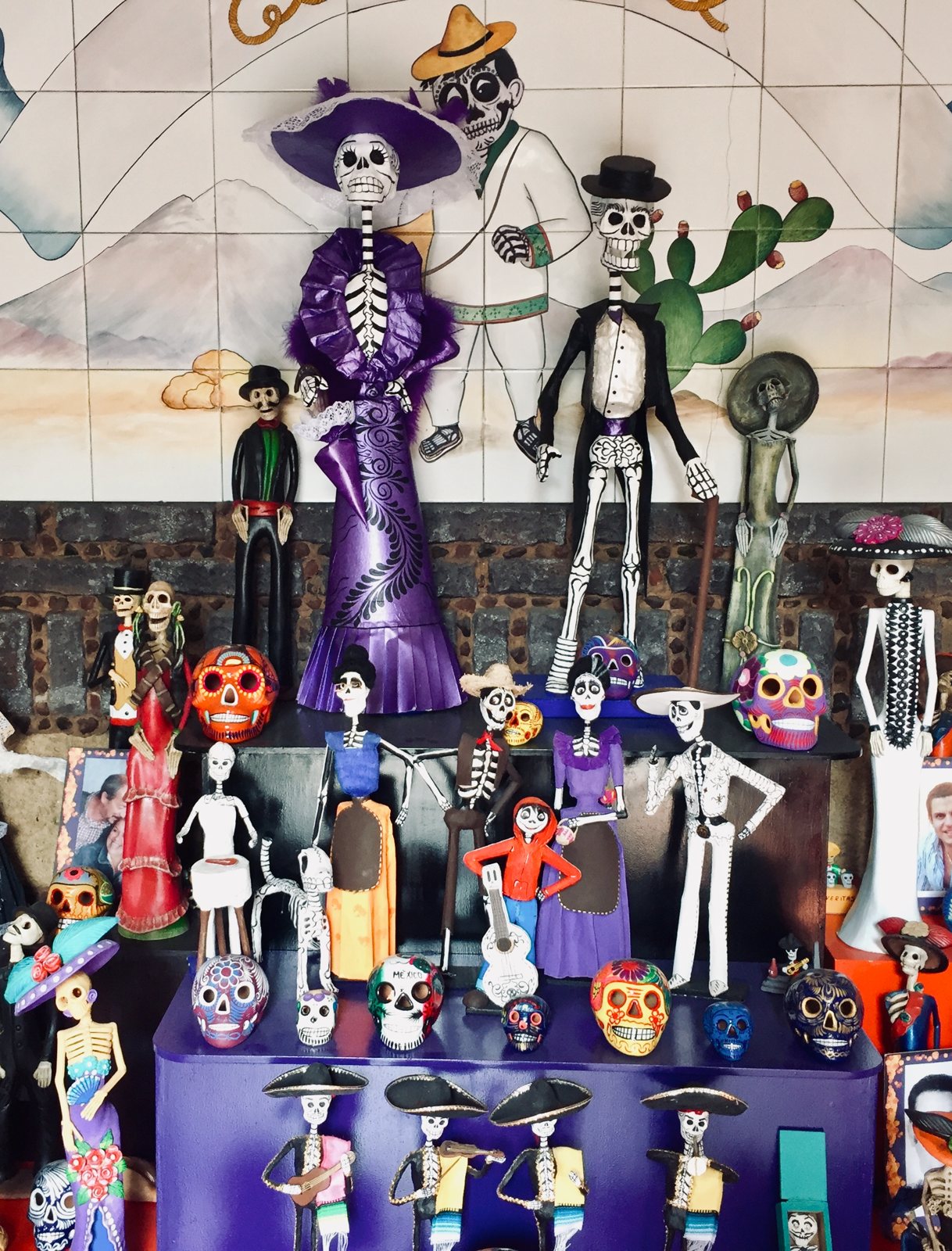
The big parade is a separate thing from a family ofrenda. Mexico City's 2019 Mega Desfile ran from the Estela de Luz to the Zócalo, and the city's cultural authority reported 807,000 attendees. The Wereldmuseum Rotterdam names the 2015 James Bond film *Spectre* as an influence on the modern Mexico City parade. In 2023, the Gran Desfile brought in groups and traditions from Milpa Alta, Tláhuac, Iztacalco, Michoacán, Puebla, Veracruz and other regions, with calaveras, catrinas, Mictlán-themed floats and musicians. Mexico City's official 2026 program lists a Great Day of the Dead Parade on October 31 from the Diana Cazadora to the Zócalo, so check the city's page for current details. That parade is a civic spectacle, and it sits apart from household altars and cemetery visits in other places. For the wider holiday, see the guide to Día de Muertos, and for the candy skulls, the story of sugar skulls.
Where to see calacas and what to ask if you buy one
Several museums keep or show real calaca work. The Museo de Arte Popular in Mexico City is a major institution for Mexican folk art and cartonería. The Museo Nacional de Culturas Populares holds Pedro Linares cartonería and has hosted exhibitions, workshops and sales involving the Linares family. The Museo Casa Estudio Diego Rivera y Frida Kahlo has about 500 Judas figures by Carmen Caballero Sevilla and Pedro Linares. In Chicago, the National Museum of Mexican Art holds Paula Linares's 1992 *Artesano de calaveras de azúcar* in polychrome cartonería with sequins, and the Ramírez-Castañeda family's calaca work from Xoxocotla has been shown at that museum, the Smithsonian and the GoggleWorks Center for the Arts. Check current exhibitions with each museum before you plan a visit.
If you want to buy a calaca, ask for the maker's name, region, material and workshop history. A museum record or direct contact with the artisan tells you far more than an unsigned marketplace listing.
Test your calaca knowledge
Answer every question to check.
Quick answers about the skeletons of Día de Muertos
What are the skeletons called in Day of the Dead?
The skeleton figures are commonly called calacas, a skull is a calavera, and the well-dressed female skeleton from Posada's work is La Catrina. In Mexican Spanish, *calaca* can mean death, a human skeleton or an allegorical skeleton figure, while *calavera* can mean a skull, a full skeleton, a sugar skull or a satirical verse. The words overlap but are not interchangeable.
What do skeletons represent on Day of the Dead?
They stand for the relationship between living families and their dead, the dead's temporary return, remembrance and the shared human condition of mortality. The humorous skeletons make death familiar. The meaning is not identical in every community, and Xantolo among the Huastec communities has its own characters, masks and music.
Why are skeletons so present in Mexican culture?
Mexican traditions about death combine Indigenous understandings of ancestors, agriculture and cyclical life with Catholic observances introduced during the Spanish colonial period, and they vary by community, region, town and family. UNESCO ties the remembrance to the annual maize cycle. Posada's satirical prints, later artisans, festivals, film, merchandise and diaspora celebrations then spread skeleton imagery beyond its local settings.
What are the decorative Mexican skulls called?
Decorative Mexican skulls are called calaveras, and small sugar skulls are commonly called calaveritas or calaveras de azúcar. Sugar skulls sit on Día de Muertos altars and may carry a person's name on the forehead. Full-body skeleton figures are more precisely calacas.
What is the difference between a calaca and a calavera?
A calaca is a skeleton, often an animated one, and a calavera is a skull that can also mean a skeleton, a sugar skull or a satirical verse. For that verse form, read about calaveras literarias.
Where to go next
Start with the story of La Catrina, the most famous skeleton of them all, then read the full guide to Día de Muertos. If you want to honor someone of your own, there is a guide to making an ofrenda, and the funny death verses have their own page in calaveras literarias. Skeletons at work are part of this tradition, and our Garage Crew skull tee puts an engraved skull gripping a wrench on a shirt for people who work on cars.