No. 034
Papel Picado: The Meaning and Making of Día de Muertos Cut-Paper Banners
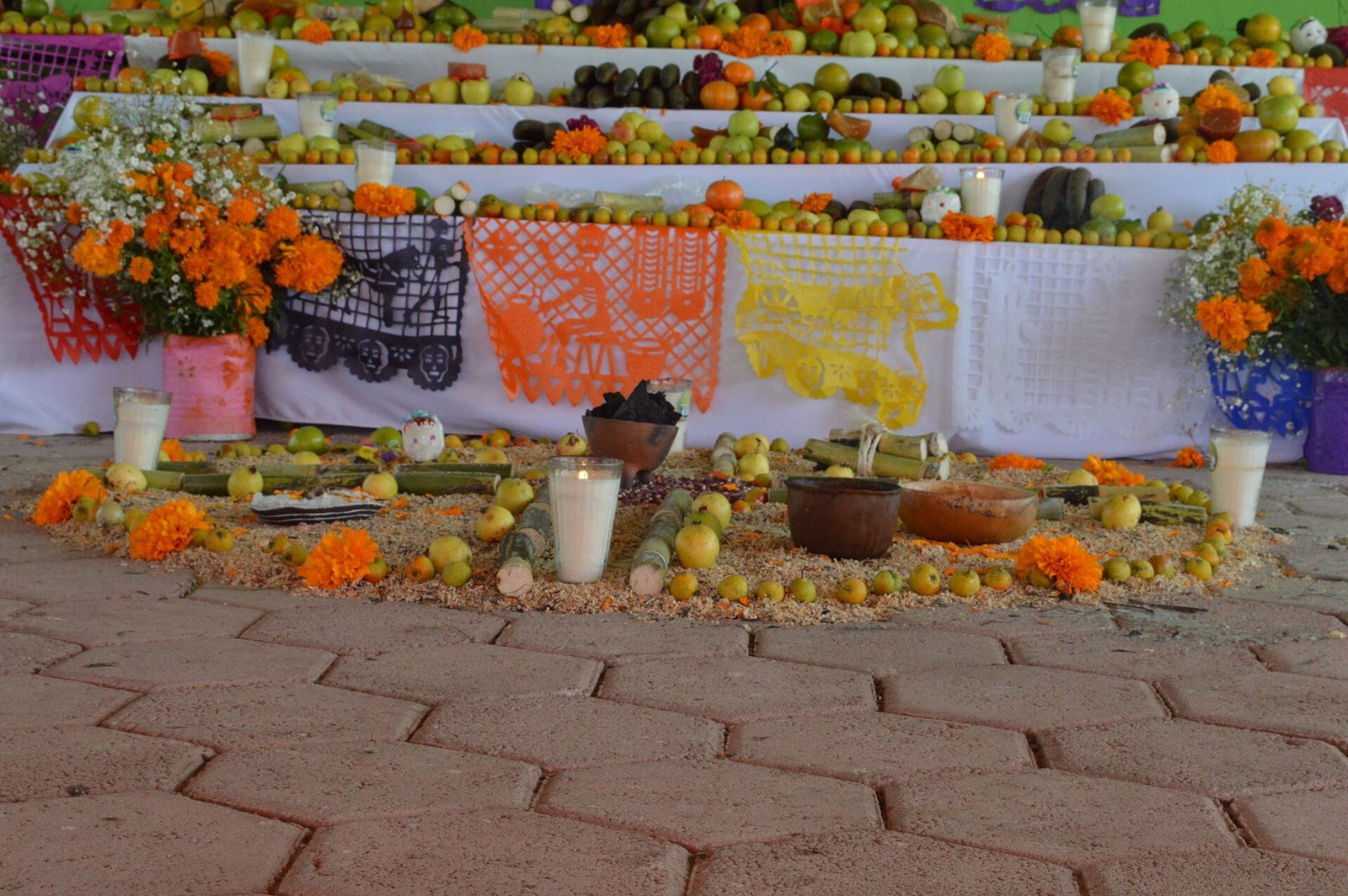
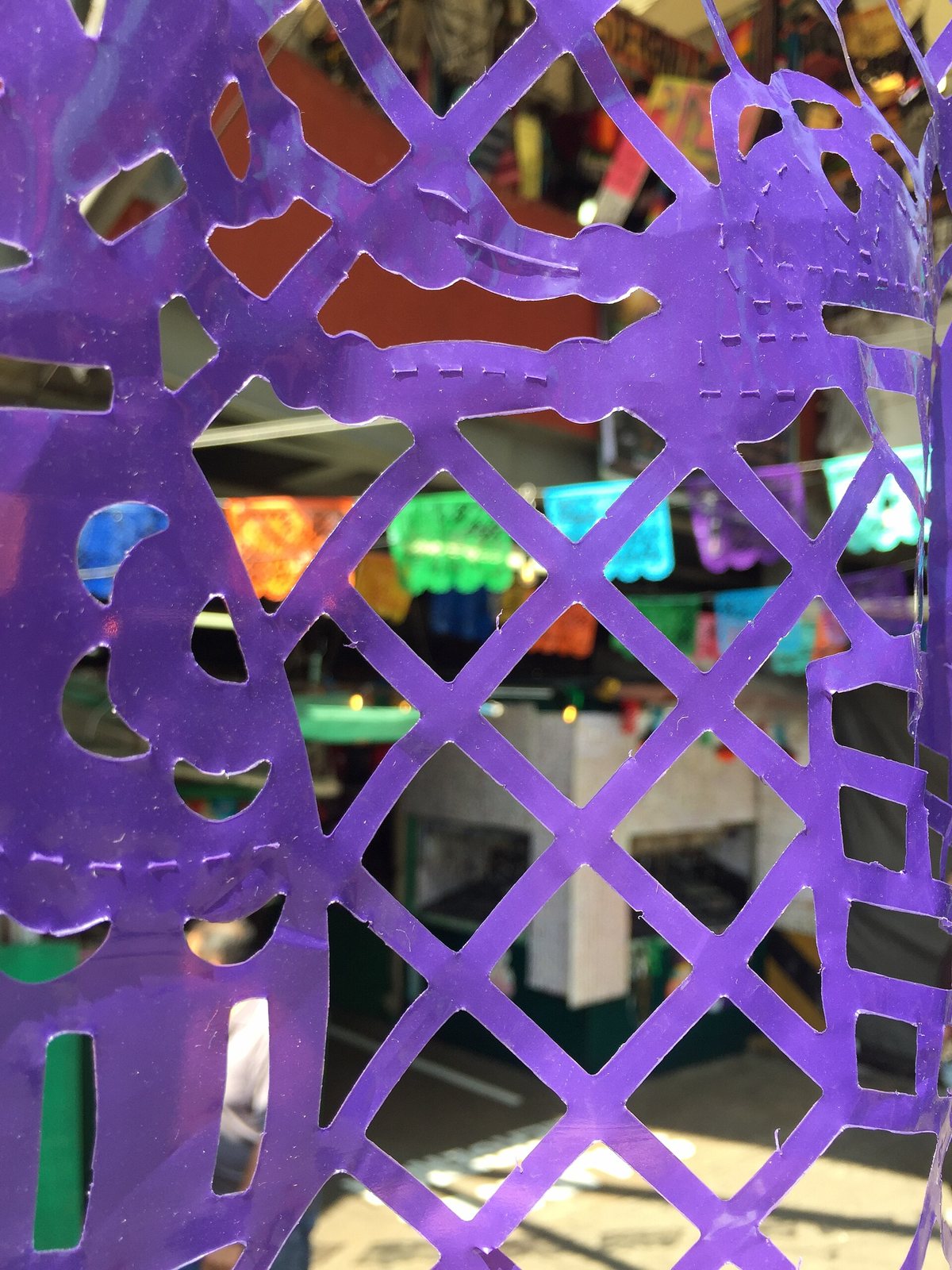
Papel picado is colored tissue paper cut into lacy openwork designs and strung together as banners. At Día de Muertos it hangs over ofrendas and across homes, cemeteries and streets, its cut-out skulls, skeletons and flowers fluttering above the altar. On many altars it is understood to represent air or wind, since the breeze passes right through the cuts, though what it means can differ from one community and family to the next. The name means "pecked" or "perforated" paper, and the best-documented home of the hand-cut craft is San Salvador Huixcolotla, a town in the Mexican state of Puebla, where artisans cut through tall stacks of sheets with steel chisels and a hammer.
What the name means
*Papel picado* translates literally as "pecked paper" or "perforated paper," the translation the Dallas Museum of Art gives. In everyday English, "cut-paper banner" or "tissue-paper decoration" describes it more clearly. The Diccionario del español de México defines it as cut tissue paper whose holes form designs or figures, and that is exactly the effect: the design is made of the paper that is taken away.
The phrase does not mean the same thing everywhere Spanish is spoken. In Cuba, *papel picado* can mean confetti. Some Spanish speakers also call the Mexican banners *papel cortado*, cut paper. When you hear the term around Día de Muertos, though, it means these banners.
Huixcolotla, Puebla: where the hand-cut craft took shape
The town most closely tied to papel picado is San Salvador Huixcolotla, in Puebla. Engineer Manuel Pérez Villegas, writing in the Mexican science magazine *Ciencia y Desarrollo* in 2003, dates the local development of the craft to the late nineteenth and early twentieth centuries. He names three men the community recognizes as its pioneers: Juan Hernández, Teodoro Vivanco and Antonio Flores. From Huixcolotla the work spread through Puebla and neighboring Tlaxcala, and by 1930, Pérez Villegas records, it had reached Mexico City.
Paper has a much longer history in Mexico, and that history is worth knowing as background. The Horniman Museum and Gardens in London points to the Otomí of San Pablito, Puebla, who made ceremonial paper from amate bark before the Spanish arrived, and to the colored *papel de China*, tissue paper that reached Mexico through the Manila-Acapulco trade from the sixteenth century on. Both belong to the story of Mexican paper, but neither proves that the modern tissue-paper craft of Huixcolotla began in pre-Hispanic times. The documented chisel-and-stack tradition is the one Pérez Villegas describes, rooted in that one Puebla town around the turn of the twentieth century.
Papel picado through the years
Tap or hover a step to follow the order.
Pre-Hispanic period
The Otomí of San Pablito, Puebla, make ceremonial paper from amate bark, part of the background of Mexican paper traditions.
Sixteenth century
Colored papel de China reaches Mexico through the Manila-Acapulco trade.
Late nineteenth to early twentieth century
The hand-cut craft develops in San Salvador Huixcolotla, Puebla.
1930
Pérez Villegas records the craft's spread to Mexico City.
1974
A Huixcolotla piece showing skeletons at a Day of the Dead celebration, later held by the Museo Franz Mayer, is made.
September 22, 1998
Handmade papel picado from San Salvador Huixcolotla is recognized as Cultural Heritage of the State of Puebla.
How papel picado is made
In the traditional Huixcolotla method, one design becomes dozens of identical sheets at a single go. The artisan draws a pattern, stacks many sheets of colored tissue paper on a work surface, places the template beneath or above the stack, and then strikes shaped steel chisels with a small hammer to punch each shape through every layer at once. Pérez Villegas describes a set of about 50 chisels in different sizes and forms: curved, flat, circular and zigzag. The Dallas Museum of Art says artisans can cut through up to 50 sheets at a time.
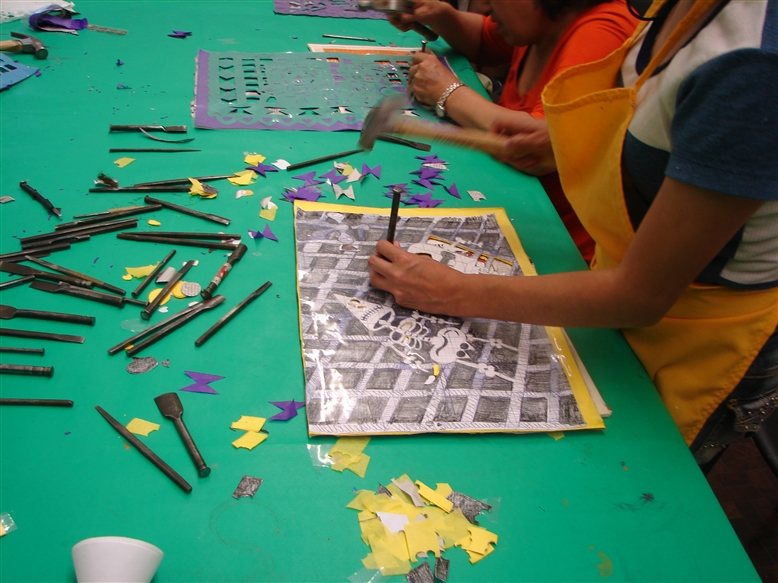
That is a long way from snipping a single banner with scissors, and a single pattern can produce a whole run of matching flags for a street or a cemetery. The Associated Press, reporting on Día de Muertos in 2023, described the artisan Yuriria Torres working with the same hammer and chisel.
Modern papel picado also comes in many other forms. Some is cut with scissors or knives, some is made from crepe paper, metallic paper or nylon, and some is cut by laser. When you buy a banner, it is worth asking which kind it is: artisan-cut, folded and cut by hand, stamped, die-cut or laser-cut. All of them decorate an altar, but only some carry the chisel work of Puebla's artisans.
The Museo Franz Mayer in Mexico City holds one example of the older craft: a piece made in 1974 in San Salvador Huixcolotla from tissue paper cut with a chisel, showing skeletons at a Day of the Dead celebration. The skeletons on today's banners have been part of the design for decades.
On the ofrenda and over the streets
During Día de Muertos, papel picado is hung over home ofrendas, in cemeteries, across streets and in public squares. A Puebla cultural inventory published by Mexico's Secretaría de Cultura describes Huixcolotla papel picado used for Todos los Santos and the Day of the Faithful Dead, decorating altars and the village streets.
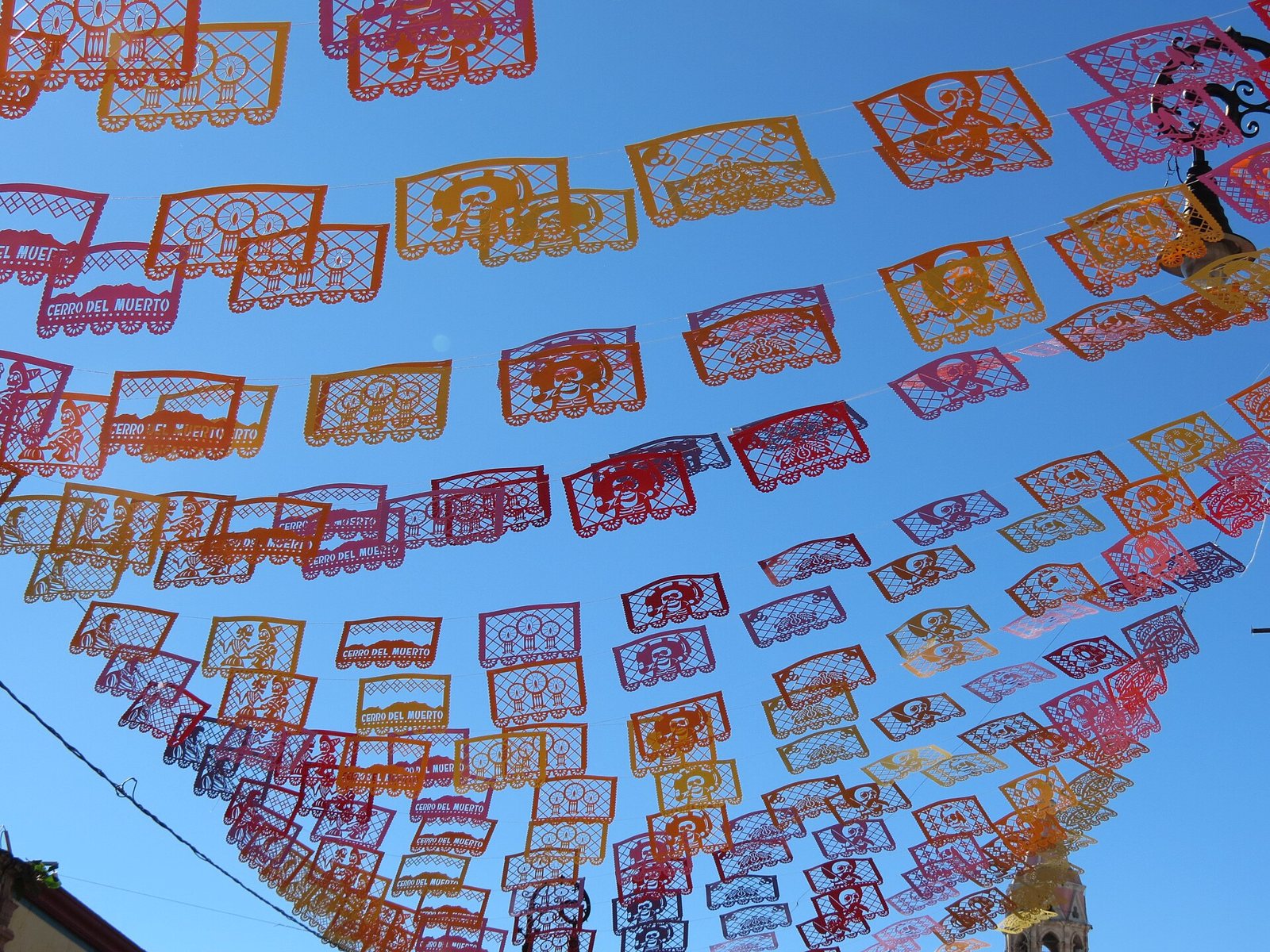
Its meaning on the altar is usually explained through its holes. Because air moves through the cut paper and sets it fluttering, papel picado is often read as representing the wind, the element of air among the other elements an ofrenda brings together. That reading is common in museum and teaching materials, and it belongs to particular local and educational traditions rather than being a single rule for all of Mexico. Some museum and news explanations go a step further and connect the paper's movement with the relationship between life and death. For many families it simply makes the altar festive and helps mark a time for remembering the people they have lost.
The designs follow the occasion. For Día de Muertos you will see calacas, skulls, skeletons, flowers, birds and religious symbols. The paper is also meant to be temporary. The Horniman Museum notes that papel picado is ephemeral by design and can dissolve in wind and rain; the old examples that survive in museums do so because they were kept indoors. A banner that fades and tears over the days of the celebration is doing exactly what it was made to do.
If you are building your own altar, the paper is one layer among many. Our guide on how to make an ofrenda shows how the pieces fit together, and the story of the cempasúchil marigold covers the orange flowers that often sit beneath the banners.
What the colors are said to mean
There is no single national color code for papel picado. Museum and educational sources do share some common associations, and you will hear them often, but they are interpretations that vary by town, family and altar tradition.
Tap or hover a row to highlight it.
| Color | Meaning often given |
|---|---|
| ColorPurple | Meaning often givenMourning or death |
| ColorBlack | Meaning often givenMourning or death |
| ColorOrange | Meaning often givenCempasúchil and the path or light for returning spirits |
| ColorYellow | Meaning often givenCempasúchil and the path or light for returning spirits |
| ColorWhite | Meaning often givenPurity or hope |
| ColorPink | Meaning often givenCelebration |
| ColorBlue | Meaning often givenWater, or people who died by drowning |
Those associations appear in explanations from the Wereldmuseum Leiden in the Netherlands, the Palm Springs Art Museum and a Día de los Muertos guide from the University of New Mexico. If you are choosing colors for your own altar, the meanings above are a starting point, and the people you are remembering are a better guide.
Not only for Día de Muertos
Papel picado decorates far more than the days of the dead. The Horniman Museum lists it at Christmas, Easter, Mexican Independence Day, weddings, baptisms, quinceañeras, carnivals and local saint's days. The designs change with the celebration: national colors for Independence Day, religious symbols for a saint's feast, flowers and birds for a wedding, scenes of everyday life for a town fair.
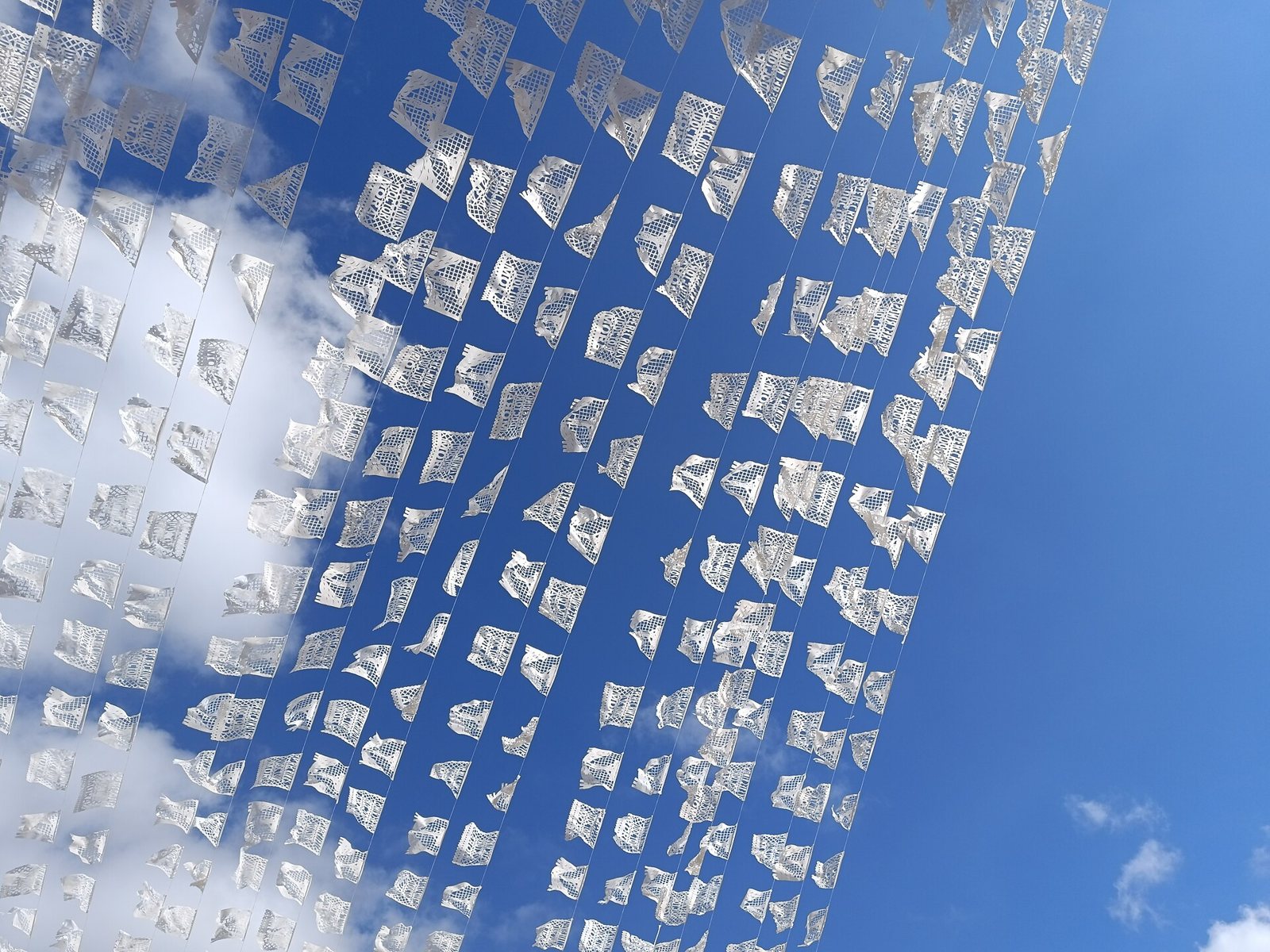
The craft has also traveled. It is now part of Día de Muertos celebrations in Mexican communities outside Mexico, including in the United States. Our guide to Day of the Dead celebrations in the USA looks at how the holiday is kept there. So, is papel picado only Mexican? The named craft tradition is Mexican, rooted in Huixcolotla, Puebla, and it is now carried and shared wherever Mexican communities celebrate.
Recognized as Puebla's heritage
On September 22, 1998, the government of Puebla recognized the handmade papel picado of San Salvador Huixcolotla as Cultural Heritage of the State of Puebla. Pérez Villegas recorded the designation in his 2003 article, and a 2025 Puebla government report repeats the date and the recognition.
That status belongs to the Huixcolotla handmade tradition specifically, not to every banner sold in Mexico. It is also separate from UNESCO's 2008 inscription of the Indigenous festivity dedicated to the dead, which recognizes the wider celebration rather than any one craft. Puebla artisans still bring their work to the season: a 2023 state notice records Huixcolotla artisans exhibiting papel picado for Día de Muertos.
Making a simple papel picado at home
You do not need chisels to make a banner for a home altar. A simple folded version works well, especially with children. You need tissue paper, a pencil, scissors, string, and glue or tape.
- Cut a strip of tissue paper and fold it several times.
- Draw simple geometric shapes near the folded edges.
- Cut through all the layers along your lines.
- Unfold the sheet slowly, since tissue paper tears easily.
- Fold the top edge over the string and glue or tape it in place, leaving a plain margin along the top so the piece does not rip where it hangs.
- Repeat in different colors and space the sheets along the string.
The result looks a lot like a paper snowflake, and it is a different technique from the Huixcolotla chisel method, where a pattern is punched through a whole stack. The Dallas Museum of Art offers a family activity with a printable template, and El Museo del Barrio and The Mexican Museum publish Día de Muertos activities that include paper cutting.
How much do you know about papel picado?
Answer every question to check.
Frequently asked questions
What does papel picado symbolize?
On Día de Muertos altars, papel picado is commonly read as representing air or wind, because the breeze moves through its cuts. It also makes the altar festive and helps mark a time for remembering the dead, and some museum and news explanations connect its movement with the relationship between life and death. The exact meaning varies by community, family and altar tradition.
What does papel picado translate to in English?
Papel picado literally means "pecked paper" or "perforated paper." In everyday English it is usually called a cut-paper banner or tissue-paper decoration, and the Diccionario del español de México defines it as cut tissue paper whose holes form designs.
Where did papel picado originate?
The hand-cut craft is best documented in San Salvador Huixcolotla, Puebla, where it developed in the late nineteenth and early twentieth centuries according to Manuel Pérez Villegas. It spread through Puebla and Tlaxcala and reached Mexico City by 1930.
What do the colors of papel picado mean?
The colors have no single fixed meaning, but museum and educational sources often link purple and black with mourning, orange and yellow with cempasúchil and the path of returning spirits, white with purity or hope, pink with celebration and blue with water. Families and towns use them in their own ways.
How do you make papel picado at home?
Fold tissue paper several times, draw simple shapes near the folds, cut through the layers, unfold carefully and attach each sheet to a string, leaving a margin at the top. This folded method is easier than the Huixcolotla chisel technique and is a good project for children.
Hang it where the wind can find it
Papel picado is one of the lightest things on an ofrenda and one of the first things people notice: a row of skulls and flowers moving above the photographs and candles. Whether you buy an artisan-cut banner from Puebla or fold your own at the kitchen table, it carries the same invitation to remember. For the rest of the celebration, start with our guide to Día de Muertos.
Terms in this story
Tap a term to see what it means.
Papel picado. Colored tissue paper cut into openwork designs and strung as banners, literally "pecked" or "perforated" paper.