

No. 033
Day of the Dead Masks: What They Mean and Where They Are Worn
A Day of the Dead mask can stand for many things: a calavera, La Catrina, an ancestor, an old person, an animal, a devil, death itself, or a character in a local masked dance. What a particular mask means depends on where it comes from and when it is worn. In Oaxaca, painted wooden masks have been worn by men going from house to house during the Days of the Dead. In the Huasteca, dancers in carved wooden masks perform la viejada, the dance of the old ones, during the celebration called Xantolo. The Catrina and skull masks sold for costumes come from a different line: the satirical skeleton drawn by the printmaker José Guadalupe Posada and the public celebrations that grew up around his image.
So, there is no single Day of the Dead mask. There are many masks, each tied to a town, a dance and an occasion, and the best way to understand one is to ask where it belongs.
Oaxaca: painted masks for house-to-house visits
The Oakland Museum of California describes a painted wooden mask from Oaxaca used during the Days of the Dead by men who went from house to house asking for food or money. Its Día de los Muertos curriculum places masks like this in some of the season's dances and in processions to the cemetery. In those settings, a mask is part of a performance that moves through the community, visiting households and walking toward the graves where families gather.
That is a specific practice in a specific state. Not every town in Oaxaca uses masks the same way, and not every Mexican state uses them at all for Día de Muertos.
Xantolo in the Huasteca: the dance of the old ones
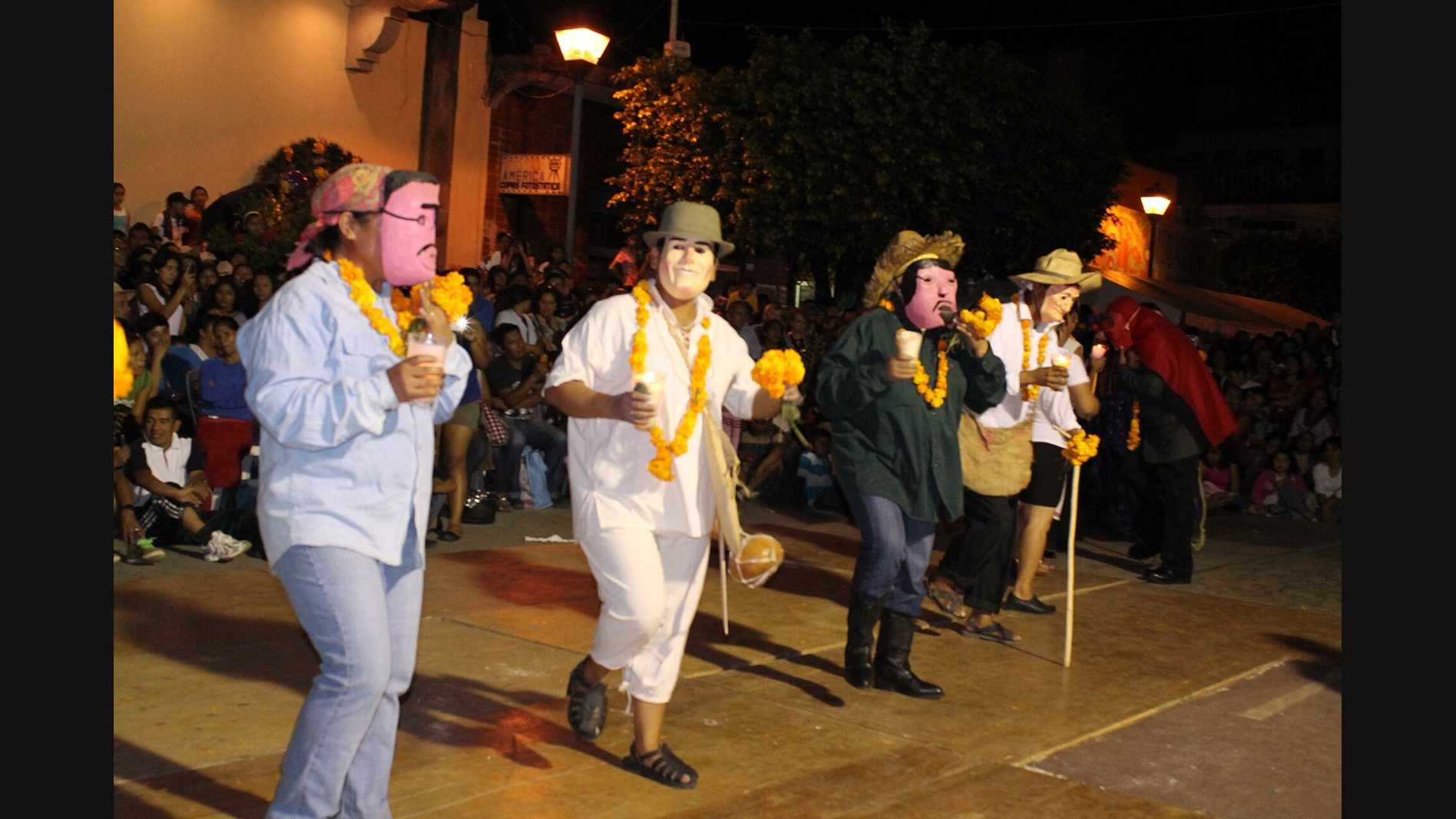
The most fully documented masked tradition of the season comes from the Huasteca, a region that crosses parts of Veracruz, Hidalgo, San Luis Potosí and Tamaulipas. There, the Days of the Dead are called Xantolo, and they include masked dances such as la viejada, also called the danza de los viejos. Dancers take on the roles of old people, animals, death, devils and other characters. INAH, Mexico's national institute of anthropology and history, describes the dancers as koles who wear wooden masks.
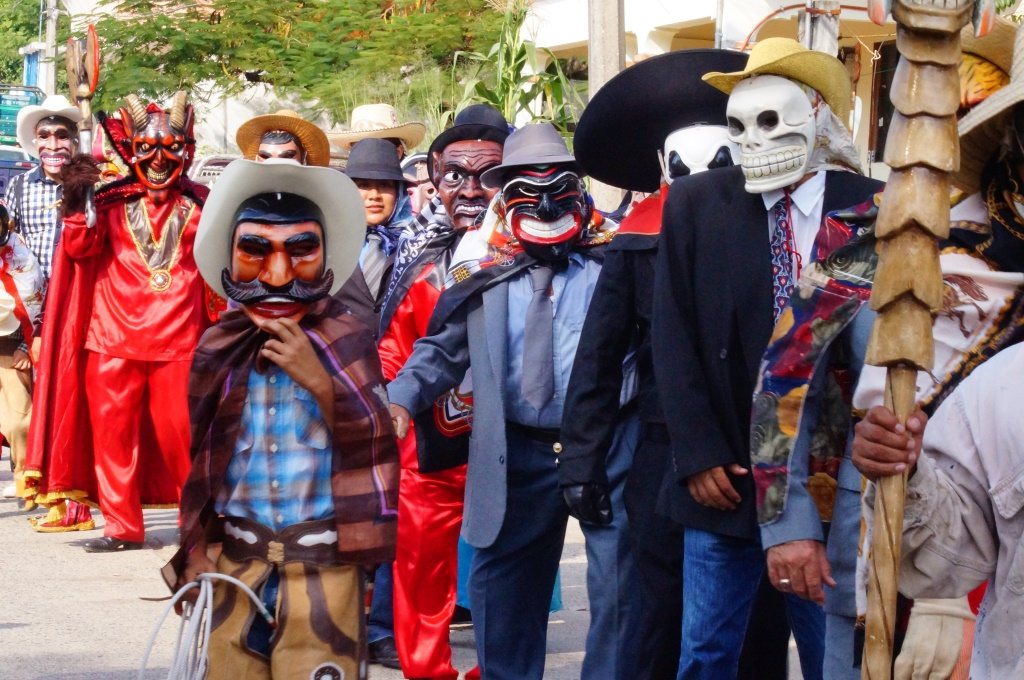
In Tempoal, Veracruz, a 2012 INAH publication on the danza de los viejos records the cast: the pregnant woman, the cowboy, the old man, the skeleton and the devil, among others. The masks there can be strikingly human or animal, and some honor people who have died or people the whole town would recognize, including public figures.
The masks are carved, and the wood matters. The same INAH publication lists cedar, orejón and pemuche as woods used in Tempoal, and singles out pemuche as especially valued because it is light, resists insects and is less likely to break.
Elsewhere in the Huasteca, a collection record at the University of Miami's Lowe Art Museum identifies a Comanche dance mask from San Vicente Tancuayalab, San Luis Potosí, used in Carnival and Day of the Dead dances. A photograph of Xantolo dancers taken in Xalapa, Veracruz, on October 29, 2016, records the dance there.
Wood, papier-mâché and cartonería
Mask materials change from place to place, and so does their purpose. Carved and painted wood runs through the dance traditions: the Tempoal masks, the Oaxaca mask in the Oakland Museum's curriculum, and a carved and painted wooden Day of the Dead mask made in Mexico in the 1980s that is now in the British Museum.
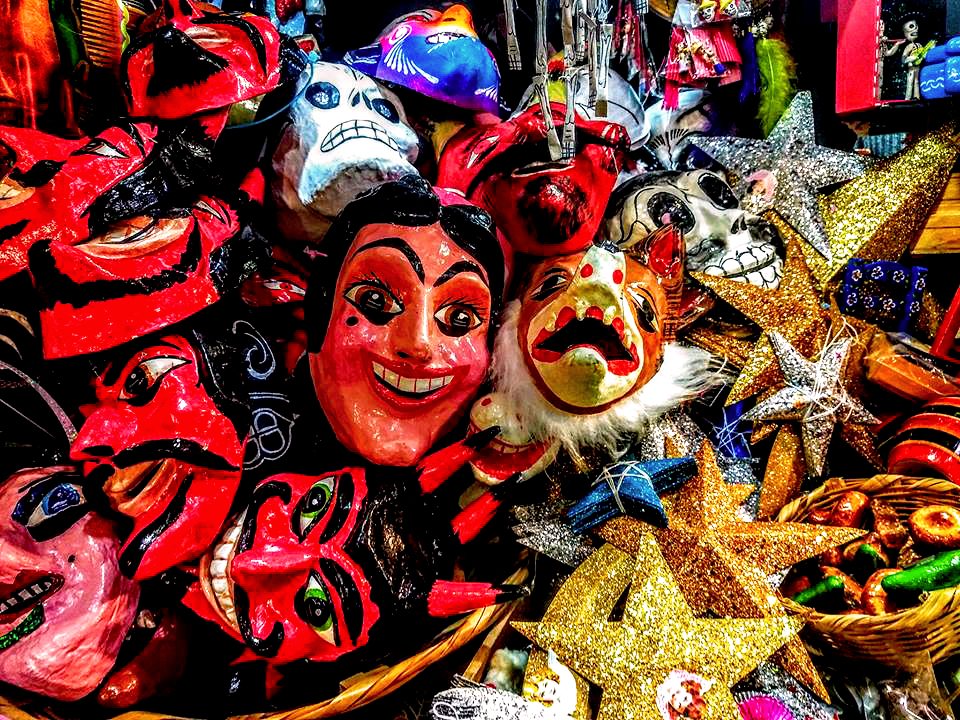
Paper is the other great material. Papier-mâché and cartonería, Mexico's paper-based craftwork, are central to calavera and Catrina objects. The Burke Museum records a Day of the Dead mask from Celaya, Guanajuato, made of paper and paint using papier-mâché, and notes that calacas and other skeleton figures are made from wood, papier-mâché and clay. The Mexican Museum lists papier-mâché, clay, wood, metal and cut paper among the materials used for calavera decorations.
The material on its own does not tell you what a mask means. A wooden mask can be a dance character in Veracruz or a decorative piece made for sale; a paper mask can be a festival costume or a child's craft project. To read a mask, you need its community, its maker, its dance and its occasion. Our story on calacas follows the skeleton figures made from many of the same materials.
Where Day of the Dead masks appear
Tap a card to bring it forward.
- Oaxaca: Painted wooden masks worn in some Days of the Dead dances, house-to-house visits and cemetery processions.
- Huasteca: Xantolo dances such as la viejada, with carved wooden masks and locally specific characters.
- Tempoal, Veracruz: Masks of old people, skeletons, devils, animals and recognizable local people, carved from cedar, orejón or pemuche.
- Celaya, Guanajuato: A papier-mâché Day of the Dead mask recorded by the Burke Museum.
- Mérida, Yucatán: Catrina costumes and parade imagery during Hanal Pixán events.
- United States: Masks, costumes and calavera imagery in Mexican American public celebrations, with major Chicano examples in East Los Angeles.
Catrina and calavera masks
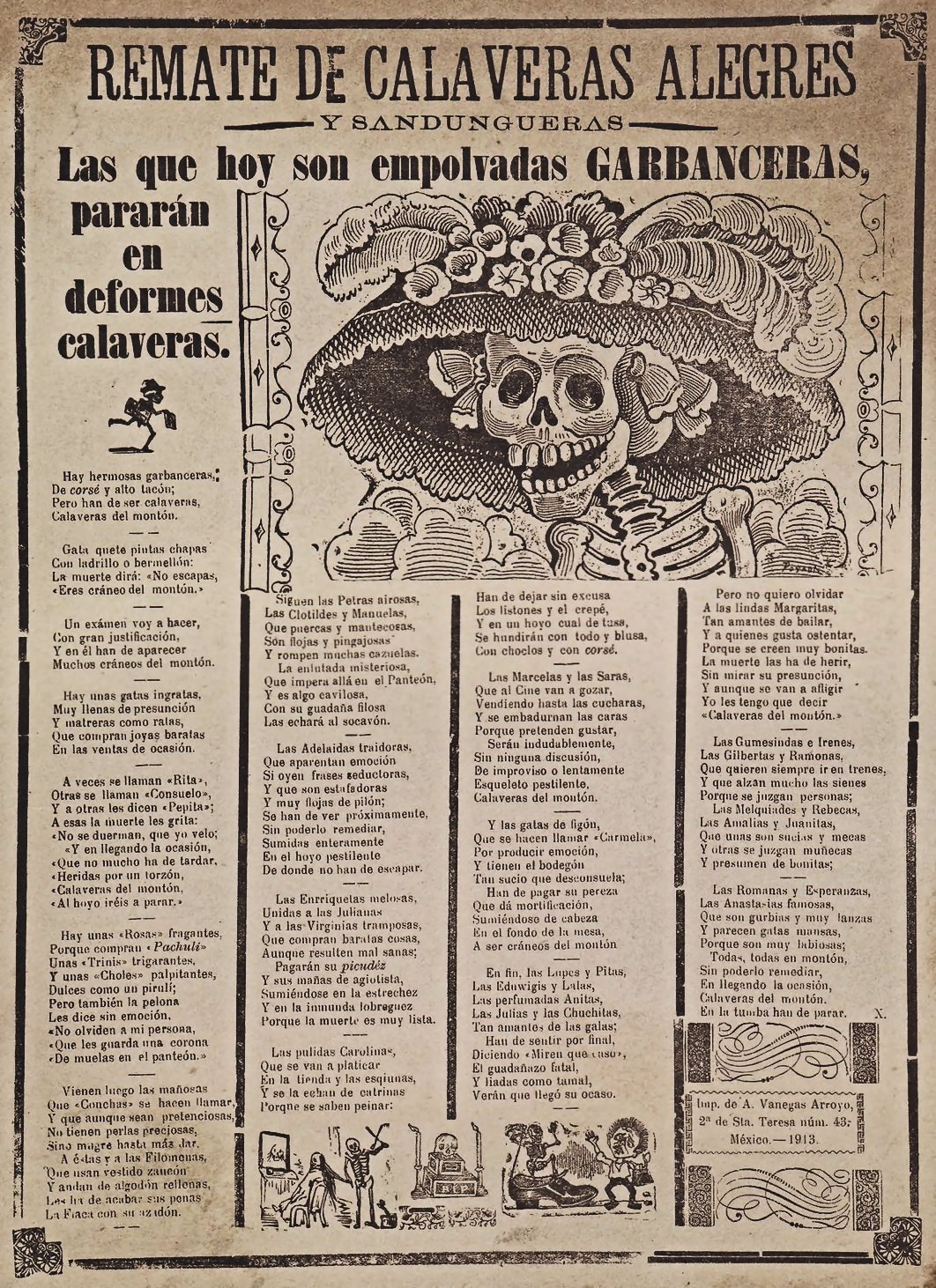
The skull masks you can buy online and the Catrina faces at festivals trace back to José Guadalupe Posada, the Mexican printmaker who drew satirical skeletons in the late nineteenth and early twentieth centuries. The Mexican Museum explains that the figure now called La Catrina was originally La Calavera Garbancera, a jab at people who turned away from their Mexican identity while chasing European bourgeois fashion. Posada's calaveras mocked politicians and every social class alike, with death as the destiny everyone shares, rich and poor. You can read more about the printmaker in our story on José Guadalupe Posada and about the figure herself in La Catrina.
Today, Catrina and calavera imagery shows up in masks, face painting, sculpture, posters, processions, altar decorations and plenty of things for sale. It can carry remembrance, a sense of mortality, social satire, beauty joined with death, cultural identity or simple festive performance, and which of those it carries depends on who is wearing it and where. In Mérida, Yucatán, the Days of the Dead are called Hanal Pixán, and the celebrations include a Catrina parade, the Paseo de las Catrinas; one photograph shows a Catrina there on November 2, 2024. Many people paint the face instead of wearing a mask, and our Catrina makeup story covers that look.
So, what is the difference between a Day of the Dead mask and a Catrina mask? A Catrina mask is one kind of Day of the Dead mask, based on Posada's skeleton lady. A store-bought Catrina mask for a costume is a modern commercial or personal object, which is a perfectly good thing to be. It is simply a different object from a carved Xantolo mask made for a particular dance in a particular town.
Masks and calaveras in the United States
Día de Muertos has a long history in the United States too. The Smithsonian American Art Museum traces observances by Mexican immigrants in the United States back to the 1890s, and dates a major modern revival to Chicano artists and activists. In 1973, Self Help Graphics & Art held a celebration in East Los Angeles that brought together ofrendas, parades, costumes and artworks. It helped build Mexican American cultural identity, and it commemorated people killed by gang violence.
Public celebrations in the United States now often include masks, costumes, face paint and calavera imagery in processions. The Mexican Museum's account of Chicano celebrations in San Francisco links respectful public presentation with attention to where the tradition comes from, and El Museo del Barrio offers calavera mask-making as an educational activity alongside discussion of the holiday's pre-Columbian roots and present-day community practice. For more on how the holiday is kept north of the border, see our guide to Day of the Dead celebrations in the USA.
Older masks in museum collections
Masks have mattered in Mexico for a very long time, though the oldest examples belong to their own stories rather than to Día de Muertos.
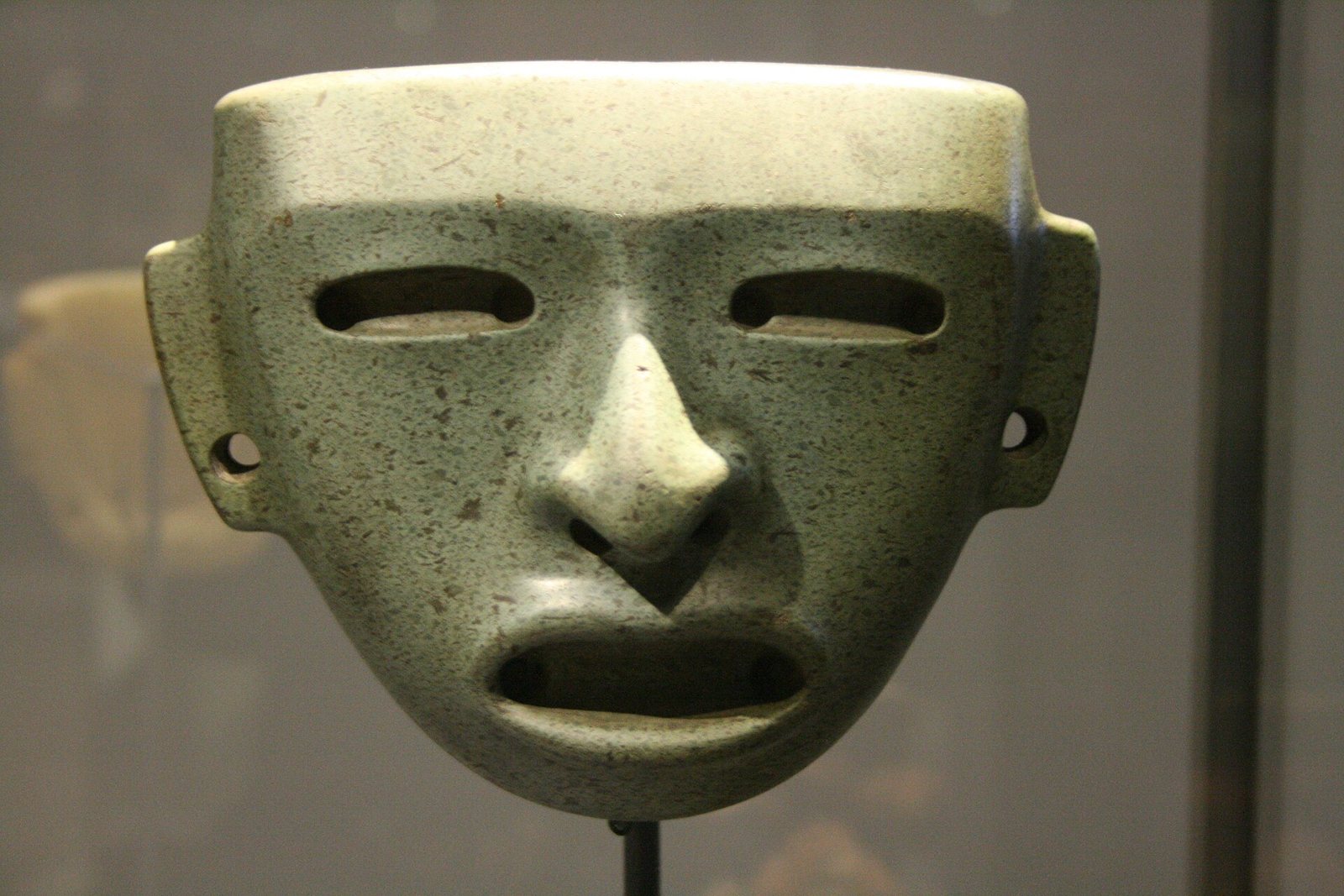
The Library of Congress holds a stone funerary mask from Teotihuacan, dated to about 200 to 500 CE, part of the Jay I. Kislak Collection, which the library makes available as public domain. Museo Amparo in Puebla holds a Nahua mask representing death, from the central Altiplano, dated to the Postclassic period, about 900 to 1521 CE. It is made of green stone, with incised teeth and features that resemble a skull, and its record describes its region, culture, period and techniques without identifying it as a Día de Muertos mask. The Brooklyn Museum holds Maya ceramic figures from Jaina Island wearing animal masks or headdresses, made as funerary objects and tied to high status, deities or the underworld.
In Sonora, Yoreme and Yoeme communities keep the pajko'ora mask tradition, documented by the National Museum of the American Indian. The mask can be worn over the face or at the back of the head, and its designs may represent the universe, stars, plants, animals, maize and the wisdom of elders. Its main occasions are village feast days and Holy Week, so it belongs to its own ceremonial dance rather than to Día de Muertos in general.
Together these objects show how important masked representation has been across many centuries and cultures in Mexico. They do not show that today's Day of the Dead masks descend from one ancient mask tradition, and each is best understood in its own time and place.
Masks in Mexico, from Teotihuacan to today
Tap or hover a step to follow the order.
About 200 to 500 CE
A stone funerary mask is made at Teotihuacan, now in the Library of Congress.
About 900 to 1521 CE
A Nahua green stone mask representing death is made in the central Altiplano, now at Museo Amparo.
Late nineteenth to early twentieth century
José Guadalupe Posada draws his satirical calaveras, including the figure later called La Catrina.
1890s onward
Mexican immigrants observe Día de Muertos in the United States.
1973
Self Help Graphics & Art holds its Día de Muertos celebration in East Los Angeles.
1980s
A carved and painted wooden Day of the Dead mask is made in Mexico, now in the British Museum.
2008
UNESCO inscribes the Indigenous festivity dedicated to the dead on its Representative List of the Intangible Cultural Heritage of Humanity.
How to wear a Day of the Dead mask with respect
Is it disrespectful to wear a Day of the Dead mask? It depends on the mask, the event and how you wear it, and the people hosting the celebration are the ones to ask. There is no single rule for every community, but these habits fit nearly any setting:
- Know where the mask comes from. Identify the community, dance or event connected with it before you wear it.
- Follow the hosts. Check the rules of the organization running a procession, cemetery visit, altar event or dance before you join in.
- Ask before you photograph. Dancers, artisans, altars and mourners deserve a request first.
- Stay out of ritual spaces unless invited. Do not enter a ritual space or touch an altar without permission.
- Call a costume a costume. A commercial Catrina mask is not an ancient sacred artifact, so do not present it as one.
- Skip the caricature. No fake accents, stereotyped clothing or Día de Muertos imagery used to mock Mexican people.
- Give credit. Name the maker, community, museum or photographer when you share an image.
- Ask about dance masks. If a mask belongs to a local dance, ask a cultural organizer or practitioner whether visitors may wear a similar one.
Día de Muertos practices differ by state, town, family, Indigenous community and diaspora, so what is welcome at a public parade in one city may be out of place at a family grave in a village.
Test your knowledge of Day of the Dead masks
Answer every question to check.
Frequently asked questions
What do Day of the Dead masks mean?
Day of the Dead masks can represent a calavera, La Catrina, an ancestor, an old person, an animal, a devil, death or a character in a local dance, and the meaning depends on the region, community and occasion. In Huasteca Xantolo, masks bring characters and even recognizable local people into la viejada; Catrina masks today often combine remembrance, mortality, satire, cultural identity and festive performance.
Where are Day of the Dead masks worn?
Day of the Dead masks are worn in specific places and events: in some Oaxaca dances, house-to-house visits and cemetery processions, in the Xantolo dances of the Huasteca in Veracruz, Hidalgo, San Luis Potosí and Tamaulipas, and in Catrina parades and public celebrations such as Mérida's during Hanal Pixán and Mexican American events in the United States.
How are Mexican Day of the Dead masks made?
Mexican Day of the Dead masks are made from carved and painted wood or from papier-mâché and cartonería, depending on the tradition. In Tempoal, Veracruz, dance masks are carved from cedar, orejón or pemuche, while the Burke Museum's mask from Celaya, Guanajuato, is paper and paint over a papier-mâché form.
Can non-Mexican people celebrate Day of the Dead?
Non-Mexican people can take part respectfully, and how depends on the family or community. Learn from Mexican and Mexican American cultural organizations, attend public educational events, accept invitations, and honor your own dead without claiming the tradition as your heritage. Ask before joining a private altar or ritual and follow local guidance.
Is a Catrina mask the same as a Day of the Dead mask?
A Catrina mask is one type of Day of the Dead mask, modeled on José Guadalupe Posada's skeleton lady. Other Day of the Dead masks, like the carved wooden masks of Xantolo, belong to particular dances and towns and carry their own characters and meanings.
Behind every mask, a place
A Catrina mask from a party store and a pemuche mask danced in Tempoal share a season, a skull or two and not much else, and both have a place in how people remember their dead today. If you are wearing one this year, knowing which tradition it comes from is the best way to wear it well. For the wider celebration, start with our guide to Día de Muertos.
Terms in this story
Tap a term to see what it means.
Xantolo. The name for the Days of the Dead in the Huasteca region of Veracruz, Hidalgo, San Luis Potosí and Tamaulipas, known for its masked dances.