

No. 031
Catrina Makeup: How to Paint the Look and Wear It Respectfully
A Catrina face starts with a pale or white skull base, dark eye sockets, a dark nose and a mouth line with tooth marks. After that comes the fun part: bright petal shapes around the eyes, dots, hearts, lace-like filigree and, often, flowers on top. Plan on 60 to 90 minutes for a detailed first try, use only products made for skin, and wear the face for remembrance at an event that welcomes it. That covers the plan. The rest of this page walks through each piece, from the history behind the face to the brush strokes to what Mexican and Mexican American makeup artists say about wearing it well.
Whose face you are painting
La Catrina began as a satirical print by the Mexican printmaker José Guadalupe Posada: a skeleton in an elaborate hat, called *La Calavera Garbancera*, drawn in the early 1900s. INAH reports that the image was first printed in October 1913, after Posada died on January 20 of that year, and that later prints carried titles such as *Remate de calaveras alegres y sandungueras* (1913) and *Calavera fifí* (1918). Diego Rivera gave her a full body and the name La Catrina in his 1947 mural *Sueño de una tarde dominical en la Alameda Central*. The whole story is in our guides to La Catrina and to José Guadalupe Posada.
The painted face echoes the exposed skull. The makeup itself is a later artistic and community tradition, visible in Día de Muertos celebrations in Mexico and in Mexican American communities in the United States. It is not an ancient custom, and it is not how every community marks the day. Día de Muertos practices vary by state, town, Indigenous community and family. UNESCO describes Indigenous communities in Mexico welcoming the temporary return of deceased relatives, with Indigenous practices and Catholic observances combined. For many people who wear Catrina makeup, the face stands for relatives who have died. The guide to Día de Muertos covers the holiday itself.
From Posada's print to the Catrina parade, early 1900s to 2025
Tap or hover a step to follow the order.
Early 1900s
Posada's satirical skeleton, La Calavera Garbancera.
October 1913
An early printing after Posada's death, per INAH.
1918
A reprint titled Calavera fifí.
1947
Rivera's mural Sueño de una tarde dominical en la Alameda Central presents the full-body Catrina.
2014
Mexico City's Catrina parade begins, per AP.
2025
The Mexico City parade includes more than 40 groups.
The parts of the look
Makeup artists teach a fairly steady set of pieces:
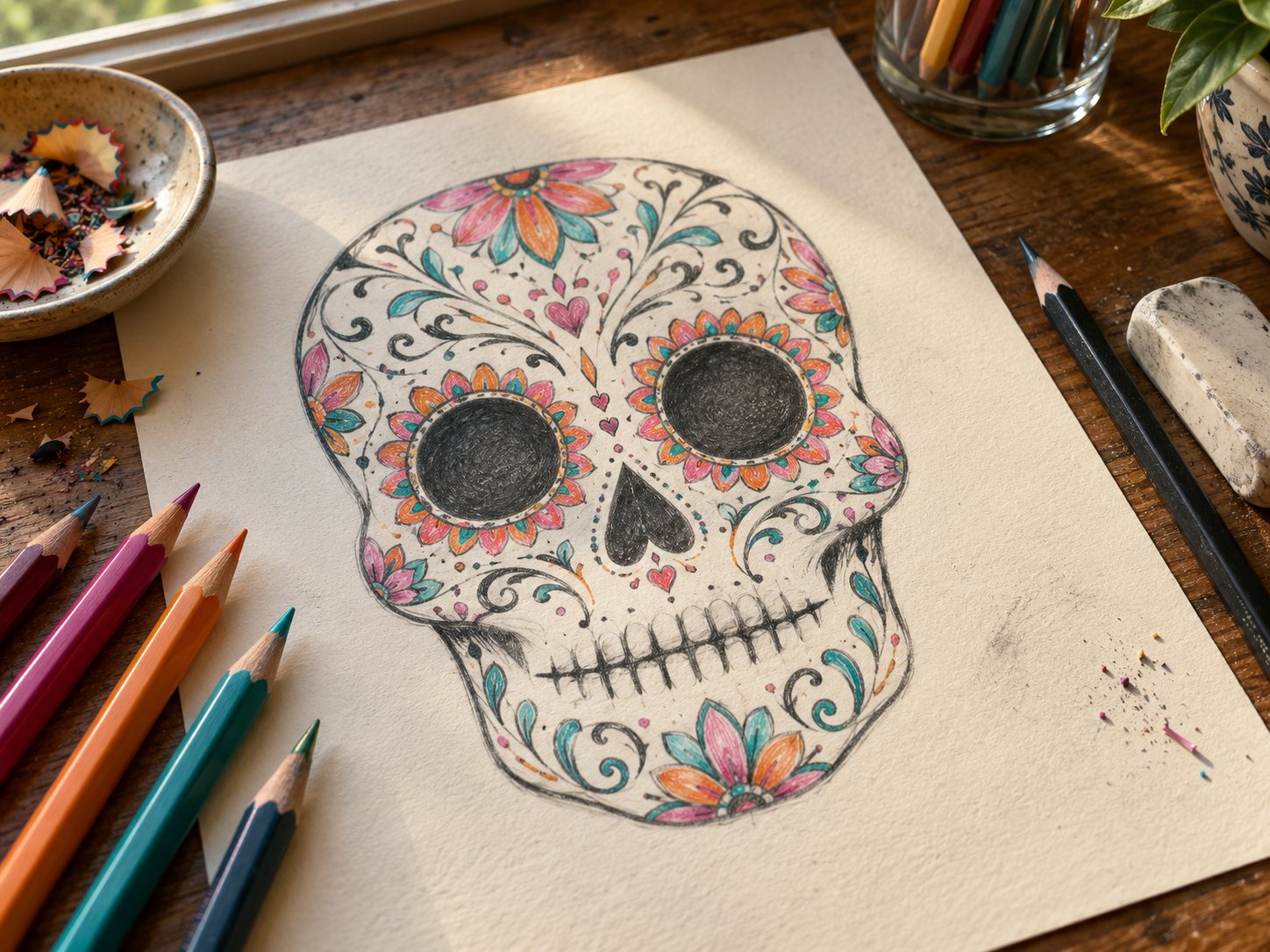
- A white or pale base over the face.
- Dark circular or oval eye sockets, often reaching up over the eyebrows.
- A black nose shaped like an upside-down heart, a diamond or a skull cavity.
- A horizontal mouth line with short vertical tooth marks.
- Decorative curves, dots, hearts and lace-like filigree.
- Bright colors around the eyes, often arranged like flower petals.
- Flowers, sequins, crystals or a floral headpiece.
- Optional bones on the neck and chest.
These are conventions of contemporary Catrina makeup, not rules that every town, family, artist or celebration shares. Makeup artist Judith Bautista says the design should be adapted to the wearer's features and calls it "not one size fits all," as she told *Allure*. Rosy McMichael describes the details as connected to family traditions. A UNAM report describes the contemporary style as colorful, festive and maximalist, tied to flowers, hats and sequins.
Sugar skull makeup is a close cousin, though not the same thing. A *calavera de azúcar* is a sweet, and Catrina makeup adapts the imagery of La Catrina, according to *Allure*. The word has its own page in what calavera means, and the candy is in the story of sugar skulls.
What to gather, and what is safe on skin
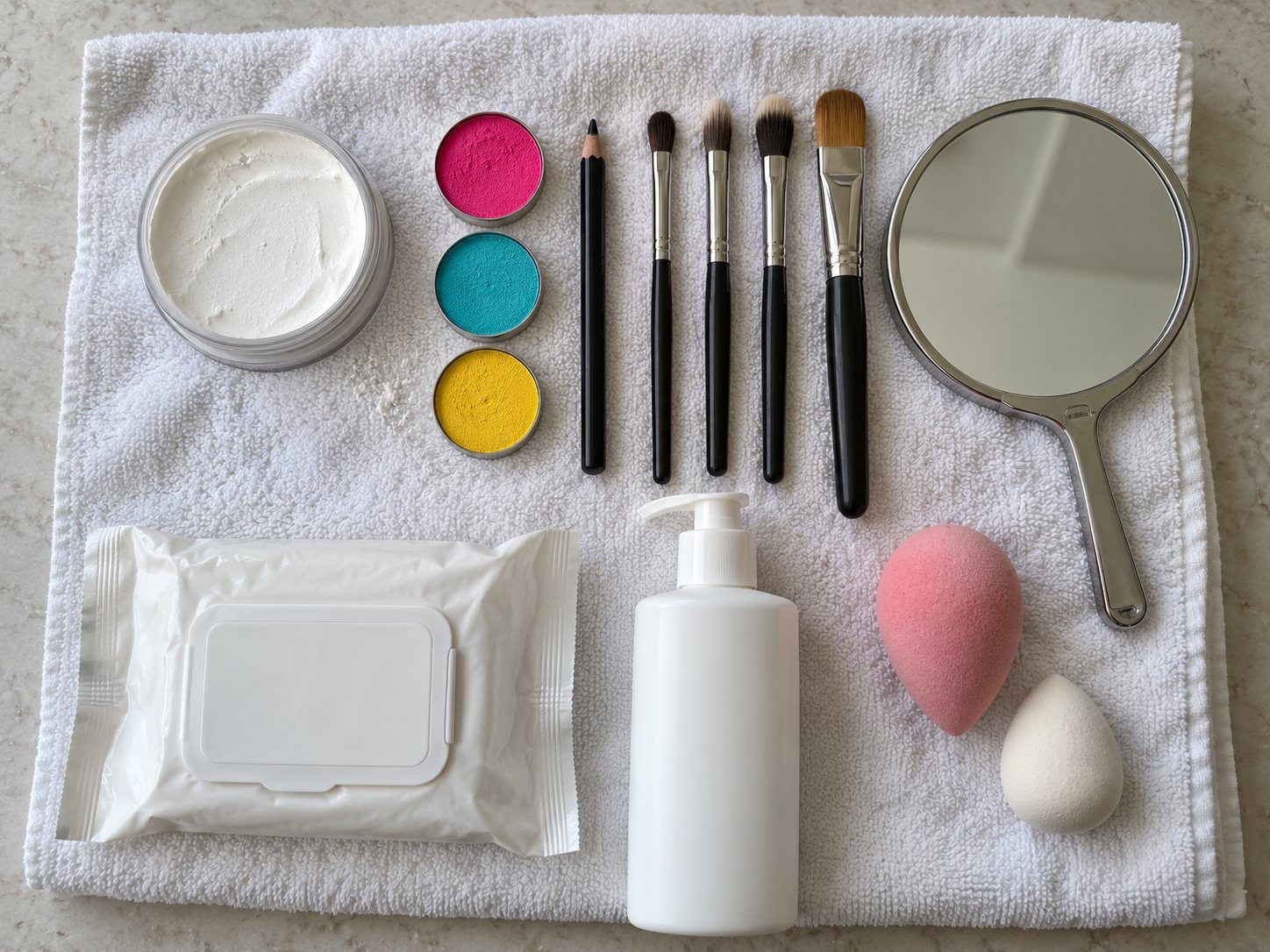
A basic kit is short: face-safe white makeup, black eyeliner or face paint, two or three face-safe bright colors, small round brushes, a flat brush, sponges, a mirror, wipes for corrections, clean water and a gentle cleanser. Add cosmetic-use adhesive and sequins if you want decoration, and flowers or a crown to finish.
What goes on your skin matters more than the artistry, and the U.S. Food and Drug Administration is clear on the basics:
- Use only products intended for skin. Craft paint and other materials not made for the face are out.
- Follow the label, especially any limit on use near the eyes.
- Check the ingredient list against the FDA's permitted color additives. A color allowed for hair or nails may not be allowed on facial skin or near the eyes.
- Test a new product on a small area of your arm 24 to 48 hours before the event, and stop if redness, swelling, rash, itching or other irritation appears.
- Do not sleep in face paint. Remove it as the label directs, with the cleanser, remover, soap or water it names, and go gently around the eyes.
- Skip decorative contact lenses unless an eye-care professional has fitted and prescribed them.
The FDA's novelty makeup guidance and its Halloween safety tips cover these points. No guidance can promise a product will be safe for every wearer. If you have known allergies or sensitive skin, be especially careful, and see a medical professional about a reaction that lasts or turns severe.
Before you paint
Tap a card to bring it forward.
- Use skin-safe products: Use face paint or cosmetics labeled for skin.
- Patch test: Test new makeup on the arm 24 to 48 hours ahead.
- Check color rules: Check color restrictions, especially around the eyes.
- Give it time: Plan 60 to 90 minutes for a detailed first face.
- Keep it festive: Keep the design festive and skip blood or horror effects.
- Know the event: Learn the event's local expectations before attending.
- Remove it gently: Remove the makeup gently and never sleep in it.
- Skip costume lenses: No decorative contact lenses without professional fitting.
Painting it, step by step
Here is the order most tutorials follow, with a mirror, good light and patience for drying time:

- Clean your face and lightly moisturize.
- Set out your colors, brushes, sponges, wipes and any decorations within reach.
- Outline the eye sockets and the nose with black eyeliner.
- Apply the white makeup over the rest of the face. Add more layers only after the earlier ones dry.
- Fill the eye sockets and the nose with black.
- Draw a curved mouth line and add vertical tooth marks.
- Add black ornamental curves, dots, hearts or filigree.
- Paint bright petal-like shapes around the eye sockets.
- Add colored accents elsewhere on the face.
- Attach sequins with cosmetic adhesive only, and keep decorations away from the eye itself.
- If you like, extend the design down the neck with bone lines.
- Finish with flowers, a floral crown or clothing that suits the event.
Timing varies. Mexican makeup artist Erika Ponce told Mexico News Daily in 2020 that a client's face took about 40 minutes and her own full face about 90. A simple face can take 45 minutes to an hour, and a detailed design by a professional often runs about two hours. For a detailed first attempt, allow at least 60 to 90 minutes. If you have a scheduled appearance, confirm the timing with your makeup artist or the organizer. These are practical estimates from working artists, not a Mexican cultural rule.
Wearing it well, in the words of people who wear it
Mexican and Mexican American voices do not agree on everything, and that is worth knowing before you go. A few of them, with the place or work each one speaks from:
- Judith Bautista, makeup artist. She told *Allure* she does not take offense when clients book Catrina makeup for Halloween. She uses the appointment to explain that the makeup represents Día de Muertos, a different holiday, and stresses that the purpose is honoring ancestors, not just looking attractive.
- Yasmin Maya. She said anyone can participate, but the practice is about honoring people who have died more than making Halloween makeup.
- Regina Merson, founder of Reina Rebelde. She welcomes participation "so long as the history is understood and the process is respected," and she objects to bloody or horror treatments, since La Catrina represents a dead relative rather than a comic-book monster.
- Denise Romero, Mexican American artist. She connects her designs to her grandmother, to Pátzcuaro and Michoacán, and to family colors, flowers and rebozos.
- Jocelyne Peña, blogger. She describes her Catrina practice as "paying homage to my family and their roots."
Online, the conversation is mixed too. A thread in r/AskLosAngeles includes people who welcome respectful participation and others who object to caricature, commercial treatment or invented "Aztec" styling. That shows different community voices, not a universal rule, and no single Mexican body sets one for outsiders. If you are unsure about a setting, ask the organizers or the community hosting the event.
The habits those voices point to are simple:
- Wear the makeup to a Día de Muertos event, cultural program, parade or gathering that welcomes it.
- Know the history well enough to explain that Catrina belongs to remembrance and celebration, not generic horror.
- Keep the design festive, colorful and personal, not bloody, grotesque or mocking.
- Tie details to remembrance, family, community or the event's theme.
- Follow local organizers' instructions at cemeteries, altars, religious observances and community ceremonies.
- Treat "Mexican," "Latino" and "Día de Muertos" as three different things.
- Do not assume that what works in one Mexican or Mexican American setting holds in the next. If you want to build an altar of your own, our guide to making an ofrenda is a good companion.
Catrina makeup quiz
Answer every question to check.
Where people wear the look
Catrina makeup has a stage in Mexico and in the United States. In Mexico City, La Catrina Fest MX listed a month of exhibitions, concerts, parties and a *Desfile de Catrinas y Catrines* beginning October 1, with registration advertised for 2025. The Associated Press reported that Mexico City's annual Catrina parade began in 2014, when makeup artist Jessica Esquivias gathered friends to celebrate Mexican icons, and that more than 40 groups took part in 2025, among them Exóticas, a collective of nearly 200 LGBTQ+ artists, stylists and designers.
In Tabasco, the municipality of Centro held its *Desfile de Catrinas y Catrines, Celebrando la Eternidad* on October 31, 2025, in Villahermosa's Zona Luz. The call for participants asked for creativity, respect for Mexican tradition and originality, and judged costume, adherence to Mexican tradition, makeup, characterization and public presentation.
Those events were held in 2025. Dates, eligibility, routes and fees change from year to year, and whether outsiders may take part depends on the organizer, so check the current page for any event you plan to attend. Our list of Day of the Dead celebrations in the USA is a place to start for events closer to home.
Quick answers about Catrina makeup
What is La Catrina, and what does she symbolize?
She is a Mexican skeleton figure now tied to Día de Muertos that began as a satirical print by José Guadalupe Posada around 1910 to 1913. In that original image the skeleton wears an elaborate hat and mocks people who rejected their social or Indigenous origins while copying European fashion. Over time she has come to stand for mortality, social equality, Mexican identity, remembrance and artistic reinterpretation.
What is the real history of La Catrina?
She began as *La Calavera Garbancera*, a print first issued in October 1913 after Posada's death, and Rivera gave her the name and a full body in his 1947 mural. Posada did not call her La Catrina. The makeup style grew much later through festivals, artists, schools, tourism, popular culture and Mexican and Mexican American communities.
Is it okay to wear Catrina makeup if you are not Mexican?
Several Mexican American makeup artists say yes, with conditions: treat it as taking part in a living tradition, not a spooky costume. Learn the history, avoid mocking Mexican people or Indigenous communities, and follow the expectations of the event or community you are joining. Views differ, so ask the organizers when the setting is unclear.
How long does Catrina makeup take, and what do you need?
A simple face takes about 45 minutes to an hour, and a detailed design often takes about two hours, so allow 60 to 90 minutes for a first detailed try. You need face-safe white and black makeup, a few bright colors, brushes and sponges, a mirror, remover and cleanser, plus optional cosmetic-use sequins and flowers. Test new products on your arm 24 to 48 hours ahead.
How is Catrina makeup different from sugar skull makeup, and how do I remove it safely?
The two overlap, but a *calavera de azúcar* is a sugar skull sweet, while Catrina makeup adapts the imagery of La Catrina. To remove it, follow the product label and its named cleanser or remover, go gently around the eyes, and never sleep in face paint.
Where to go next
If you would like the full story behind the face, read about La Catrina and the printmaker José Guadalupe Posada. The holiday around the makeup is in the guide to Día de Muertos, and for a bit of vocabulary on the skulls in all of it, see what calavera means.