

No. 129
Descartes' Skull: How the Philosopher's Head Ended Up in a Paris Museum
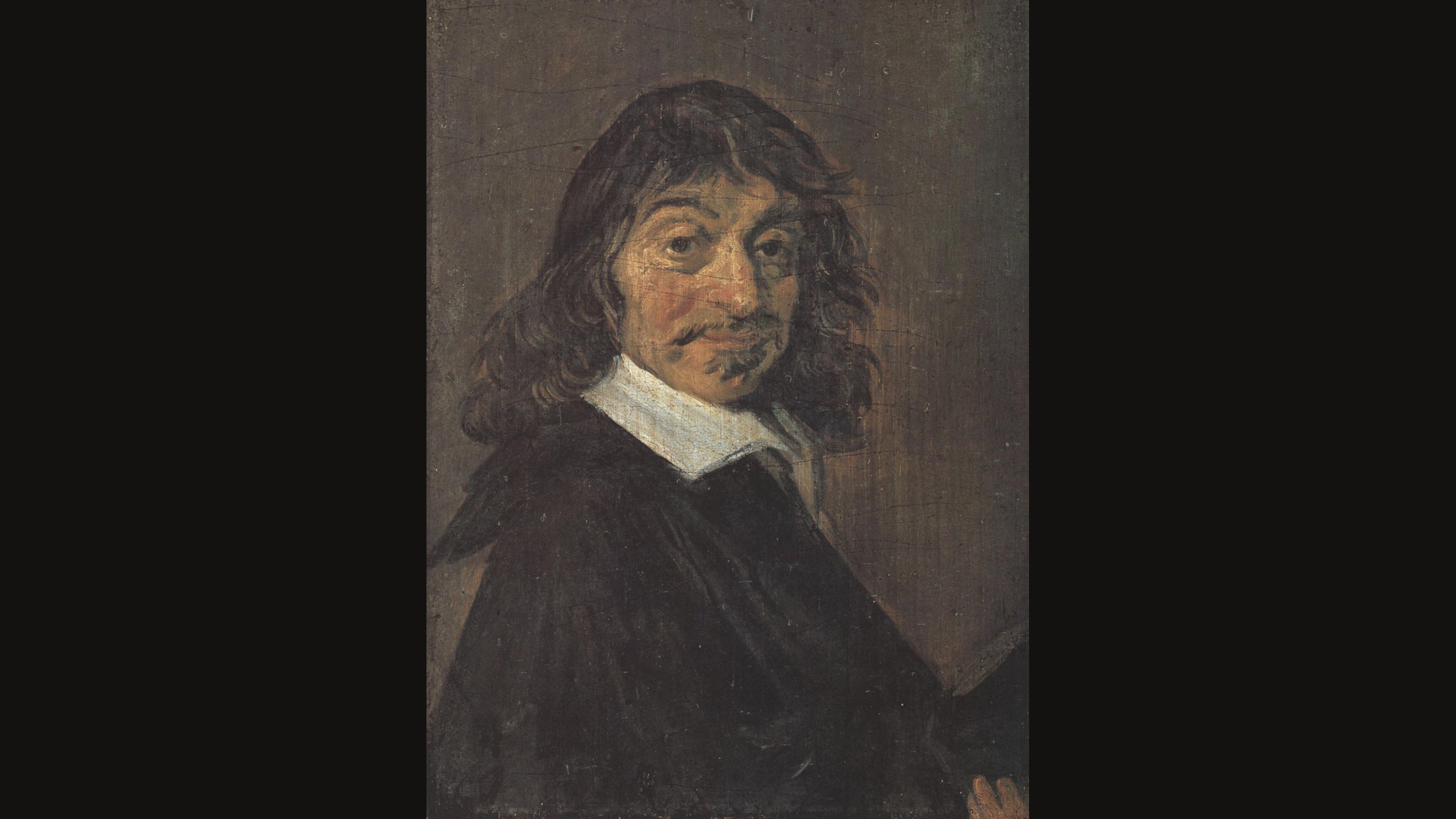
The skull attributed to the philosopher René Descartes is held in Paris by the Muséum national d'Histoire naturelle and associated with the Musée de l'Homme, where it is catalogued as inventory number MNHN-HA-19220 (Musée de l'Homme). The rest of the remains attributed to him lie across the city in the church of Saint-Germain-des-Prés, where they were reburied in 1819 without a skull. Head and body parted ways in Sweden, when his grave was opened so his bones could be sent to France. The skull stayed behind, passed through a string of Swedish owners who wrote their names on it, and only reached Paris in 1821. Whether the museum's skull is truly his is still debated.
It is one of the stranger afterlives in European history, and most of it can be followed through names, dates and the writing on the bone itself.
A death in Stockholm, 1650
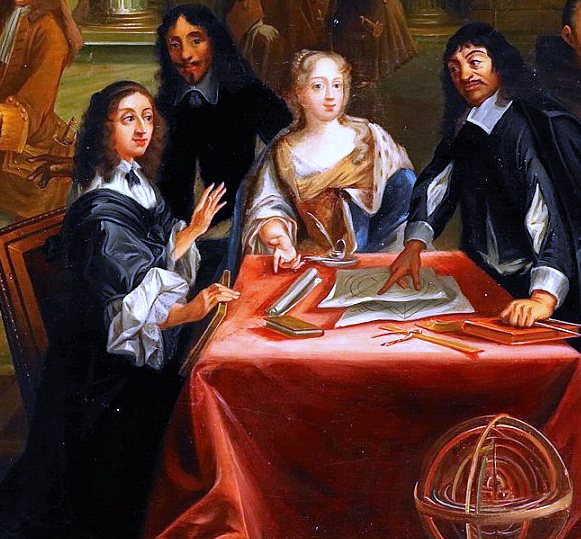
Descartes died in Stockholm on 11 February 1650. He had gone to Sweden after accepting Queen Christina's invitation to join her court (Stanford Encyclopedia of Philosophy). He was buried in Stockholm, a Frenchman in a Swedish grave, and there he stayed for the next sixteen years.
That might have been the end of it. Instead, his remains became something France wanted back, and the effort to bring them home is where the skull's separate story begins.
Dug up and sent to France
In his book *Descartes' Bones*, the historian Russell Shorto says the French ambassador Hugues de Terlon secretly unearthed Descartes' bones sixteen years after his death and had them carried to France in 1666 (Russell Shorto). The Musée de l'Homme's own account dates the exhumation to 1667, so you will see both years in print (Musée de l'Homme).
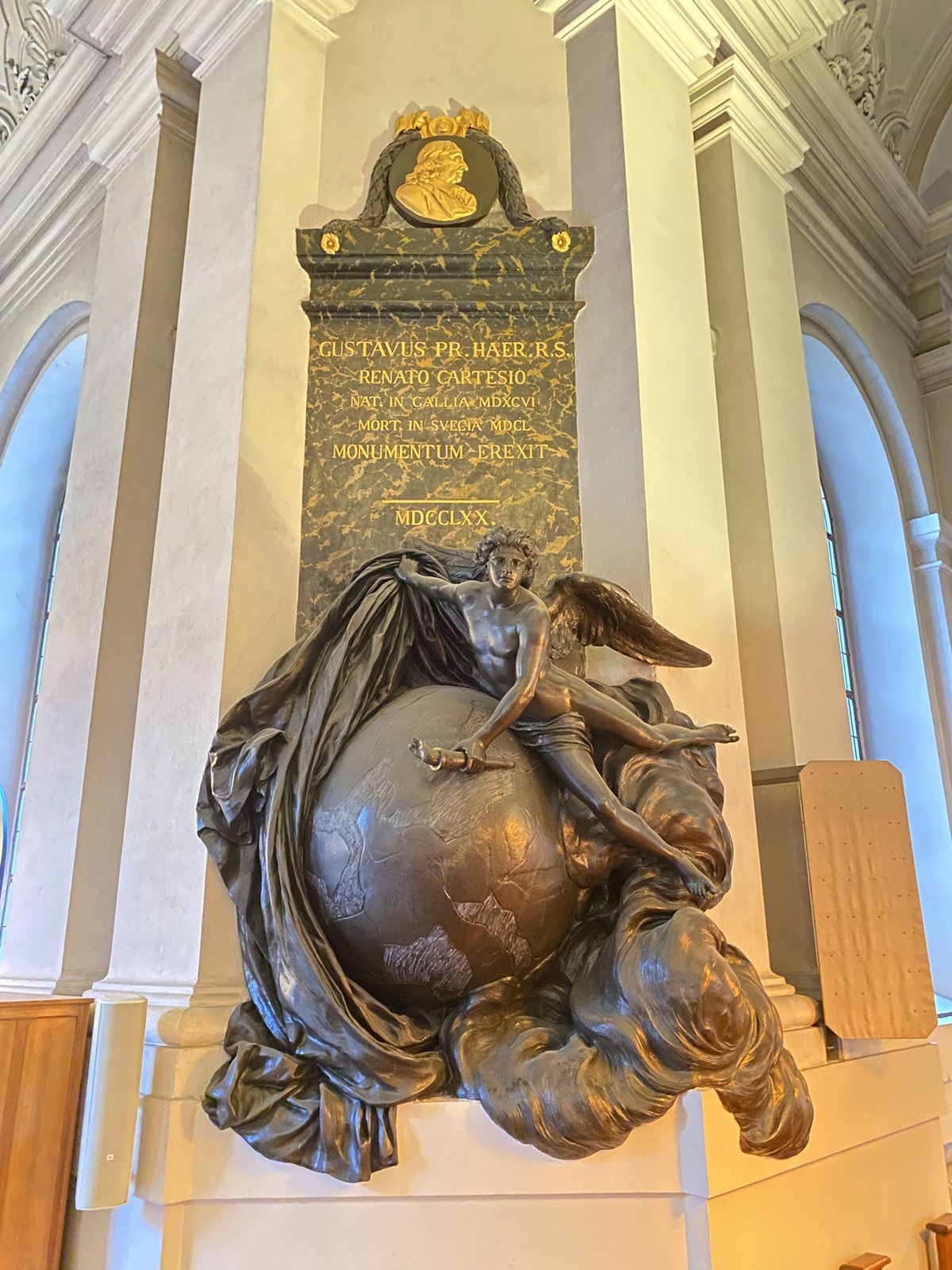
What the museum is clear about is the important part: when the remains were exhumed for the transfer to France, the skull was missing. The bones that crossed into France were a skeleton without its head.
The skull that stayed in Sweden, and the writing on it
The skull now in Paris carries its own account of where it went. An inscription on it attributes its removal to Is. Planström, the Swedish guard captain who supervised the exhumation. The inscription says the skull was taken when the body was about to be sent to France, and that it was then kept in Sweden (Musée de l'Homme).
That is what the inscription claims, not a proven fact. It is a record written on the object, and later scholars have weighed it alongside other accounts that do not settle the theft one way or the other (Wikisource, *Vie et œuvres de Descartes*).
The bone holds more than one line of text. It also bears a Latin verse and a series of names associated with its successive Swedish owners, among them J. Hägerflycht, Anders Anton von Stierneman, Olaus Celsius, Arckenholtz and J. Åhgren (Karsten and Ahlström). In effect, the skull became its own ownership register, handed from collector to collector over more than a century and a half, each keeper adding to the record.
The 1821 auction and the chemist who sent it to Paris
The skull's road back to France ran through a scientist. In 1821 the Swedish chemist Jöns Jacob Berzelius bought it at auction. He had heard that Descartes' remains had arrived in France without the skull, and he wanted the head returned to France as well. Berzelius delivered it to Georges Cuvier in Paris, and it entered the anthropological collections of the Muséum national d'Histoire naturelle (Musée de l'Homme).
Berzelius's own letter from 1821, describing the auction and the skull, is preserved in the appendix to *Vie et œuvres de Descartes*, a published account of the philosopher's life and works (Wikisource). Online, people sometimes ask who bought the skull at that auction. The buyer is well documented: Berzelius, who wanted it back in France.
The timing is the odd part. By the time the skull reached Paris, the rest of Descartes had already been laid to rest in a church two years earlier.
The rest of him, at Saint-Germain-des-Prés
Descartes' remains were reburied in 1819 at the church of Saint-Germain-des-Prés in Paris, between the tombs of two Benedictine scholars, Jean Mabillon and Bernard de Montfaucon. The skull was not among the remains placed there (Musée de l'Homme).
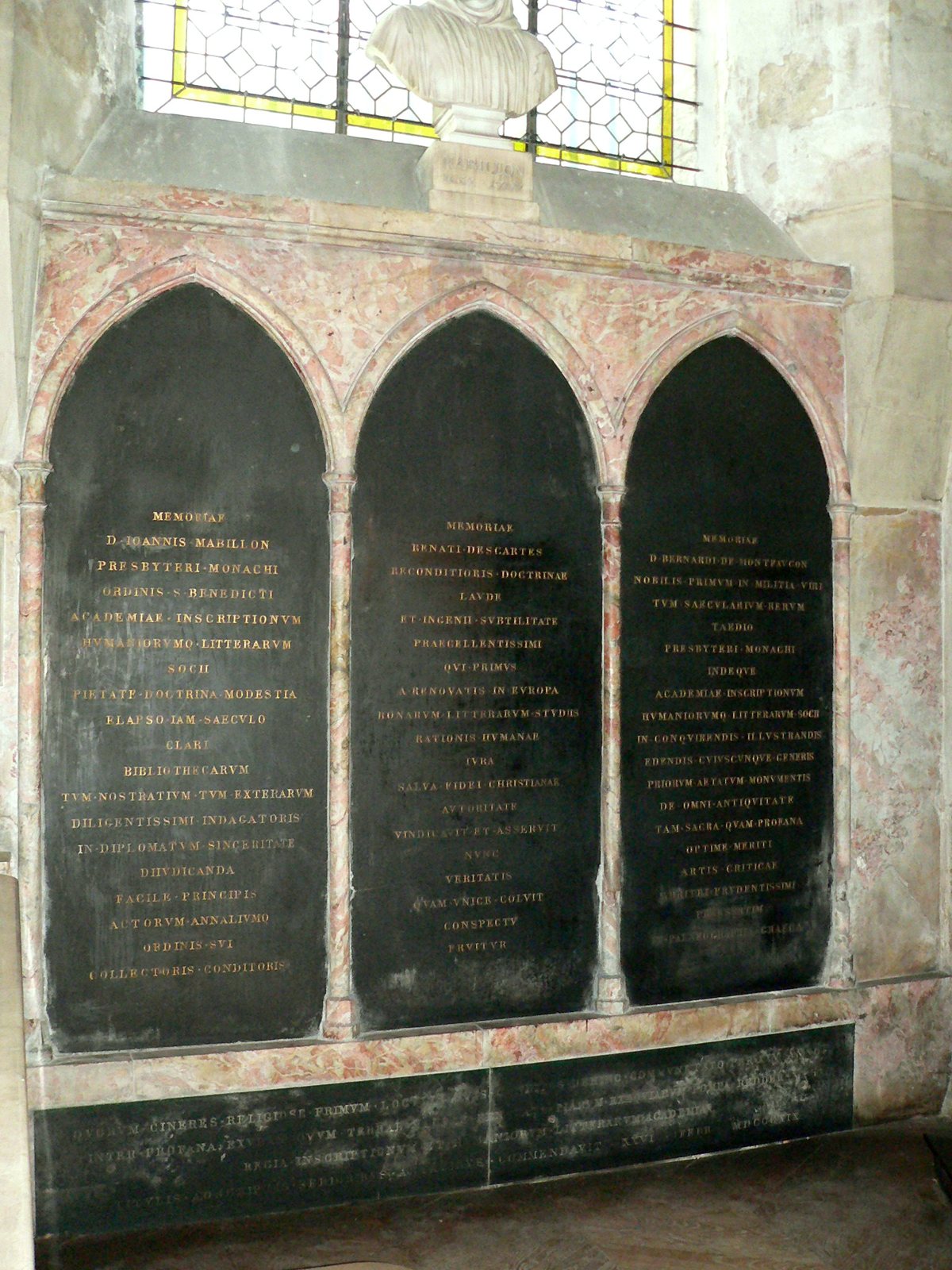
It is fair company for a philosopher: two learned monks on either side. Because the skull was separated so early, and because questions hang over both the Paris skull and the church remains, the bones at Saint-Germain-des-Prés are best described the way the careful accounts describe them, as remains attributed to Descartes (Russell Shorto).
Descartes' remains, from Stockholm to Paris
Tap or hover a step to follow the order.
11 February 1650
Descartes dies in Stockholm and is buried there.
1666
His remains are exhumed and taken from Sweden to France, according to Russell Shorto; the skull is missing.
1819
The remains attributed to Descartes are reburied at Saint-Germain-des-Prés in Paris.
1821
Jöns Jacob Berzelius buys the skull at auction and delivers it to Georges Cuvier in Paris.
2014
A CT examination attributed to Philippe Charlier identifies an osteoma in the right sinus.
2017
Researchers publish a CT-based study with a virtual endocast of the skull.
Is it really Descartes' skull?
The museum identifies the object as Descartes' skull, and it is catalogued as such (Muséum national d'Histoire naturelle). Not everyone agrees. The historian Per Karsten and the archaeologist Anders Ahlström argue that the Paris skull may be a forgery, and that a skull fragment kept at Lund University in Sweden may be the authentic piece (Karsten and Ahlström).
So, the question stands as a dispute with two sides. On one side is a museum object with an inscription, a chain of named owners and a documented arrival in Paris in 1821. On the other is a scholarly argument that the Paris skull may be a forgery, with a fragment in Lund as the possible real one. The identification remains open, and the debate has its own following in France, where forum threads still talk about "le débat autour du crâne de Descartes", the debate over Descartes' skull.
What modern science has done with the skull
The skull has also been studied with modern imaging. A 2014 CT examination attributed to Philippe Charlier, a French medical anthropologist and forensic expert, identified an osteoma, a benign bone tumour, in the right sinus. The scan also made later virtual modelling possible (The Bones of Descartes, summary).
In 2017, Philippe Charlier, Isabelle Huynh-Charlier, Philippe Froesch, Russell Shorto, Nadia Benmoussa and colleagues published "The brain of René Descartes (1650): A neuro-anatomical analysis". Using CT-based 3D technology, they built a virtual endocast of the cranial cavity and studied its shape, its measurements and its anatomical anomalies (PubMed). An endocast is a model of the inside of the skull. It is not Descartes' preserved brain; it is the shape of the space that once held it.
Facial images of Descartes attributed to Philippe Froesch are approximations based on the skull and on historical portraits. They give a sense of a face, not an exact reconstruction of his. Our story on facial reconstruction has more on how faces are estimated from skulls.
The museum record
For a famous object, the catalogue entry is short and precise.
Tap or hover a row to highlight it.
| Field | Record |
|---|---|
| FieldHolding institution | RecordMuséum national d'Histoire naturelle, associated with the Musée de l'Homme, Paris |
| FieldInventory number | RecordMNHN-HA-19220 |
| FieldMaterial | RecordBone |
| FieldHeight | RecordAbout 14 cm |
| FieldLength | RecordAbout 16 cm |
| FieldWidth | RecordAbout 18.05 cm |
| FieldArrived in Paris | Record1821, delivered by Jöns Jacob Berzelius to Georges Cuvier |
The Muséum keeps human remains in its osteological collection, with conditions on access (MNHN). If you hope to see the skull, check with the Musée de l'Homme before your visit whether it is on view, since a collection object is not always on display. The remains attributed to Descartes are at the church of Saint-Germain-des-Prés.
Descartes is in good, if scattered, company. The stories of Goya's skull, Haydn's skull, Schiller's skull and Shakespeare's skull all follow famous heads that took a different road from the rest of the body, and our piece on the Mütter Museum skulls looks at another museum that keeps skulls in its collection.
Questions people ask about Descartes' skull
These are the questions that come up most often.
Where is Descartes' skull?
The skull attributed to Descartes is in Paris, in the collections of the Muséum national d'Histoire naturelle, associated with the Musée de l'Homme. The rest of his attributed remains are at Saint-Germain-des-Prés, so head and body are in the same city but different buildings.
Which museum has Descartes' skull?
The Muséum national d'Histoire naturelle holds it, listed as MNHN-HA-19220, and it is associated with the Musée de l'Homme. Its authenticity is disputed, because Per Karsten and Anders Ahlström argue that a skull fragment at Lund University may be the real one.
Why was Descartes' skull separated from his body?
It was separated in Sweden when his remains were exhumed to be sent to France. According to the inscription on the skull, the guard captain Is. Planström took it at that moment and it stayed in Sweden, though the details of the theft remain contested.
What does the inscription on Descartes' skull say?
The inscription attributes the skull's removal to Is. Planström and says it was taken when the body was to be sent to France, then kept in Sweden. The bone also carries a Latin verse and the names of later Swedish owners, including Olaus Celsius and Anders Anton von Stierneman.
Who bought Descartes' skull at auction?
The Swedish chemist Jöns Jacob Berzelius bought it at auction in 1821. He wanted it returned to France and delivered it to Georges Cuvier in Paris; his letter about the purchase survives.
Is Descartes' skull real?
It is not settled. The museum identifies the skull as his, while the historian Per Karsten and the archaeologist Anders Ahlström argue it may be a forgery, so it is safest to call it the skull attributed to Descartes.
Where is Descartes buried?
The bones attributed to Descartes are buried at the church of Saint-Germain-des-Prés in Paris, where they were placed in 1819. They lie between the tombs of the Benedictine scholars Jean Mabillon and Bernard de Montfaucon, without the skull.
How well do you know the story of Descartes' skull?
Answer every question to check.
A philosopher in two places
Descartes died in 1650, and his remains have been on the move for much of the time since: a grave in Stockholm, a secret exhumation, a trip to France without the head, a skull passed from one Swedish owner to the next, an auction, a chemist's gift to Paris and a reburial among Benedictine scholars. Today the skull attributed to him sits in a museum collection and the rest of him rests in a church, both in the same city. Whether the museum's skull is truly his is still argued, which gives the story an ending that suits a philosopher: a question left open.
Terms in this story
Tap a term to see what it means.
Exhumation. The formal opening of a grave to remove the remains. Descartes' grave in Stockholm was opened so his remains could be taken to France.
---