

No. 124
Which Skull Is Schiller's? Goethe, the Vault and the DNA Test
Neither of the two skulls once honoured as Friedrich Schiller's is his. Weimar's mayor, Carl Leberecht Schwabe, chose one from a crowded burial vault in 1826, and the anatomist August von Froriep chose another from the same vault in 1911. In 2008 a DNA study run by the broadcaster MDR and the Klassik Stiftung Weimar, called "Der Friedrich-Schiller-Code", showed that neither skull belonged to the poet (Klassik Stiftung Weimar). Schiller's sarcophagus in the Fürstengruft, the ducal vault in Weimar, is now empty, and his real skull has never been identified.
So, the story you heard is true, and it is stranger than the short version. It runs through a night burial, a mayor sorting through the bones of a decayed vault, Goethe sitting with the skull he believed was his friend's and writing a poem to it, a second candidate a century later, and a laboratory result that sent both skulls back into the ranks of the unknown.
A night burial in a crowded vault
Friedrich Schiller died in Weimar on 9 May 1805. He was buried during the night of 11 to 12 May 1805 in the Kassengewölbe on the Jakobskirchhof, the churchyard of St. Jakob (Klassik Stiftung Weimar, Kassengewölbe). The Kassengewölbe was a shared vault for people of high standing who had no private family grave of their own.
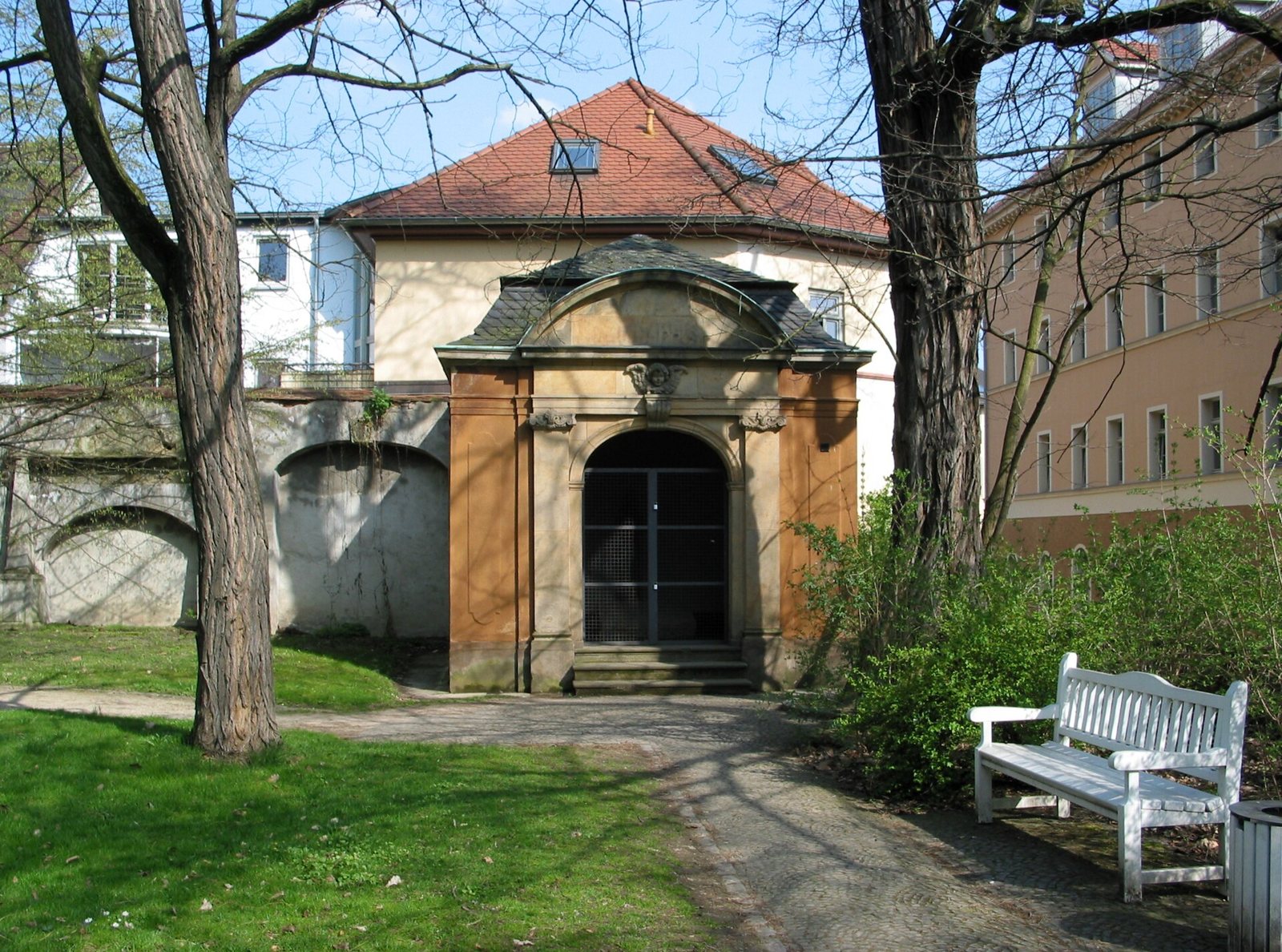
The vault held many coffins, stacked over the years. The Allgemeine Deutsche Biographie records the same burial place. By 1826, according to the Klassik Stiftung Weimar, the remains inside could no longer be securely identified.
Schwabe's search in 1826
In March 1826 the Kassengewölbe was due to be cleared, and Weimar's mayor, Carl Leberecht Schwabe, set out to recover Schiller's remains before that happened. What he met inside was hard going: decayed coffins and bones that had mixed together over two decades. The Klassik Stiftung Weimar says that 23 skulls were recovered in searches that ended on 20 March 1826 (Der Friedrich-Schiller-Code). Schwabe's own account of the burial and the search survives and can be read on Wikisource_und_die_Aufsuchung_seiner_Gebeine_(1826)).
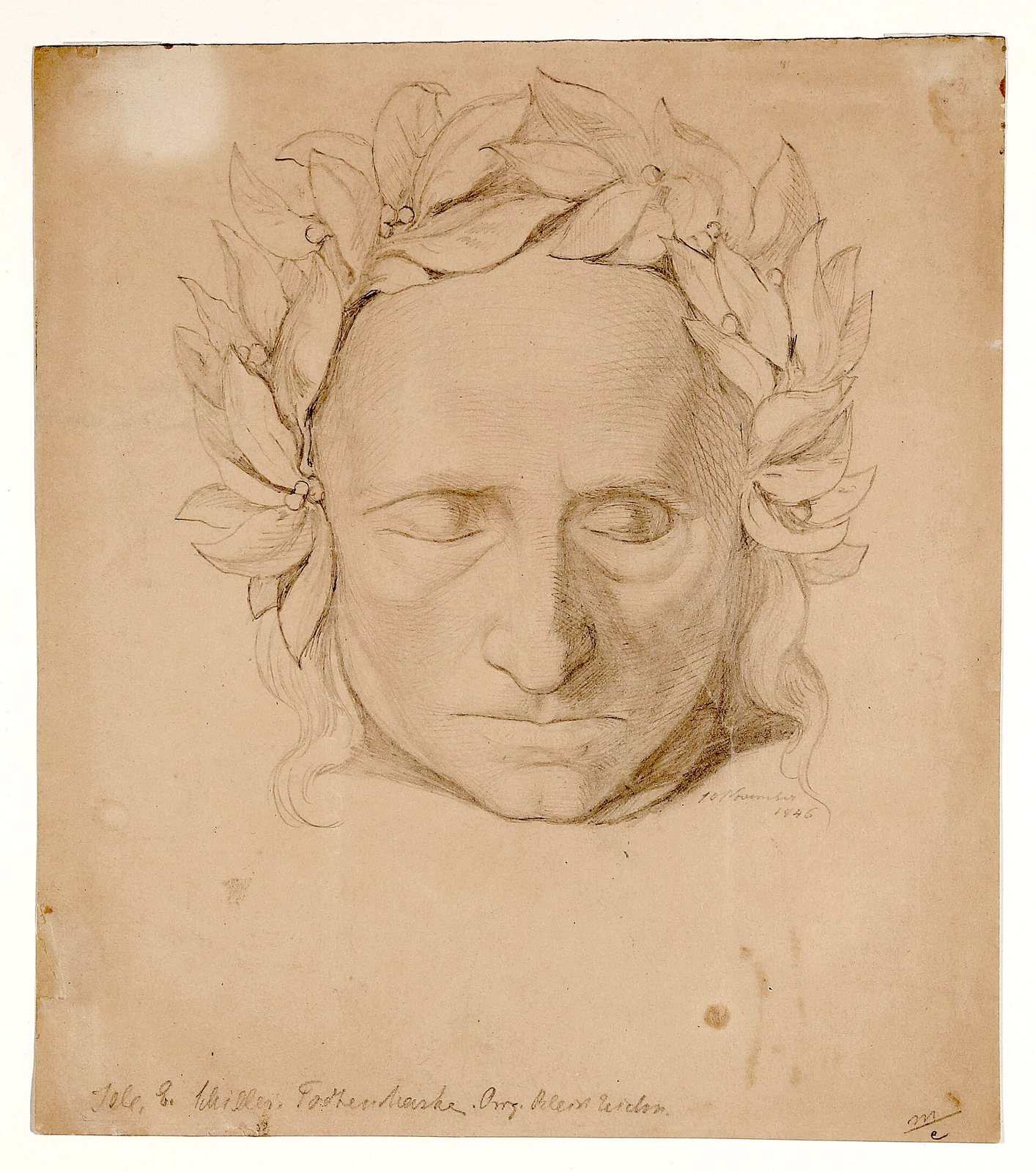
From those 23, Schwabe picked one large skull as Schiller's. He had no laboratory, so he did what he could: he compared the skulls with Schiller's death mask and listened to the recollections of people who had known the poet. A skeleton to go with the skull was assembled later that year, and in 1827 skull and skeleton were moved to the Fürstengruft.
People sometimes ask, in a German phrasing that turns up online, "Wer hat F. Schiller geklaut?", or who stole Schiller. The Klassik Stiftung Weimar's account describes no theft. The poet's remains were lost the slow way, among other people's coffins and bones in a shared vault, long before anyone went looking for them.
Goethe and the skull
This is the part of the story most people have heard. Johann Wolfgang von Goethe, Schiller's friend and fellow poet in Weimar, had the selected skull brought to his house in 1826. He kept it there for a time, contemplated it, and wrote the poem later known as "Bei Betrachtung von Schillers Schädel", which translates as "On Contemplating Schiller's Skull" (Klassik Stiftung Weimar). The poem dates from 1826, but its familiar title was given to it later, as an article in PMLA on Goethe's poem on Schiller's skull explains.
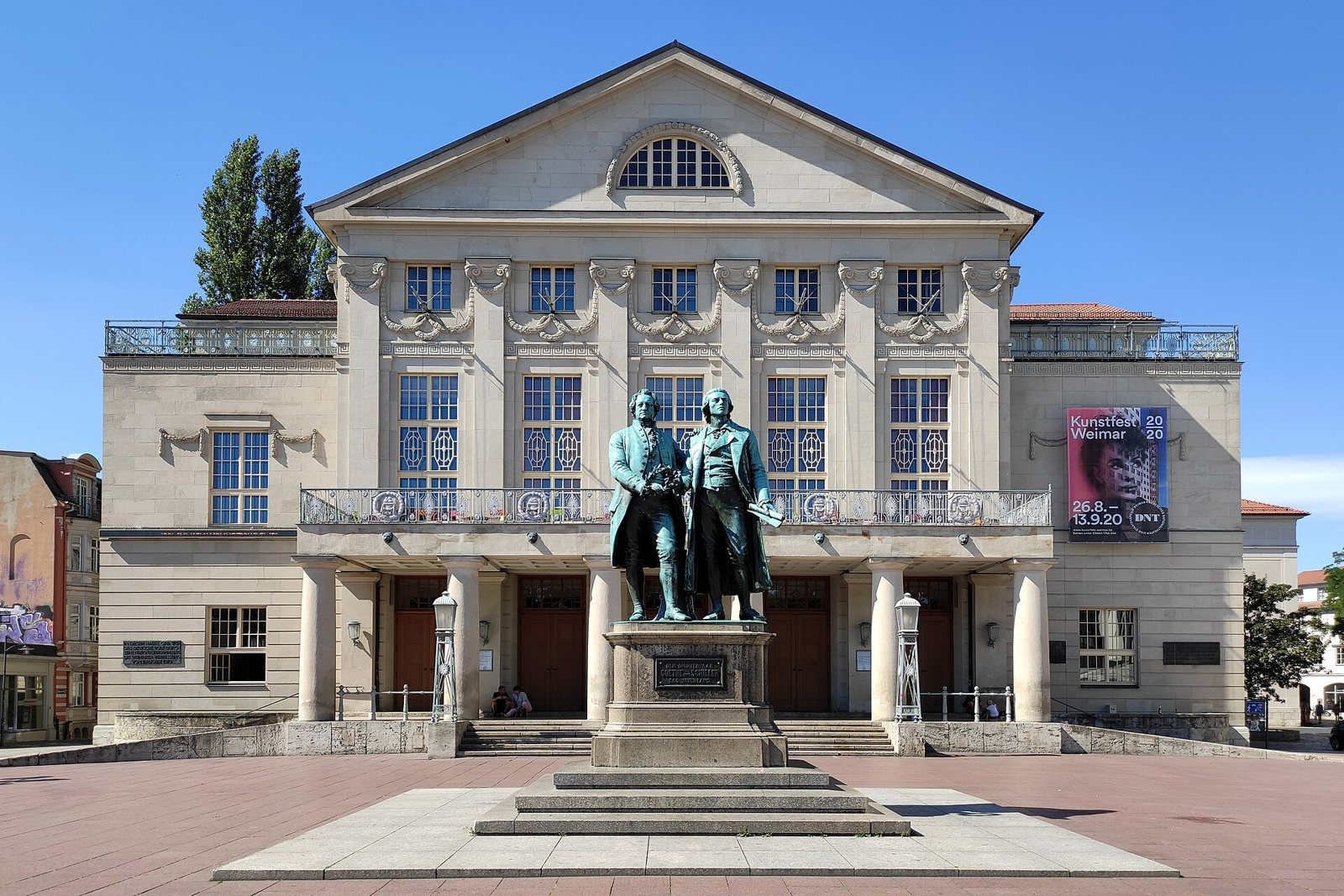
Goethe believed the skull was Schiller's. That belief is what gives the scene its weight: a poet alone with what he took to be the head of the friend he had lost, turning it into verse. A German forum question on Gutefrage asks readers whether they would keep a dead friend's skull at home, and the reason the question exists at all is this moment in Weimar. The Klassik Stiftung Weimar holds both a sculpture and a painting that show Goethe with the skull.
If the image of a poet holding a skull feels familiar, it should. Hamlet does the same thing in the graveyard scene, which we cover in Alas, poor Yorick, and the old habit of keeping a skull nearby to think about death has its own history in what memento mori means. For Goethe, though, the skull on his table was not a symbol but his friend. The sad turn is that, as the 2008 tests showed, it was someone else.
The Fürstengruft, where both poets were placed
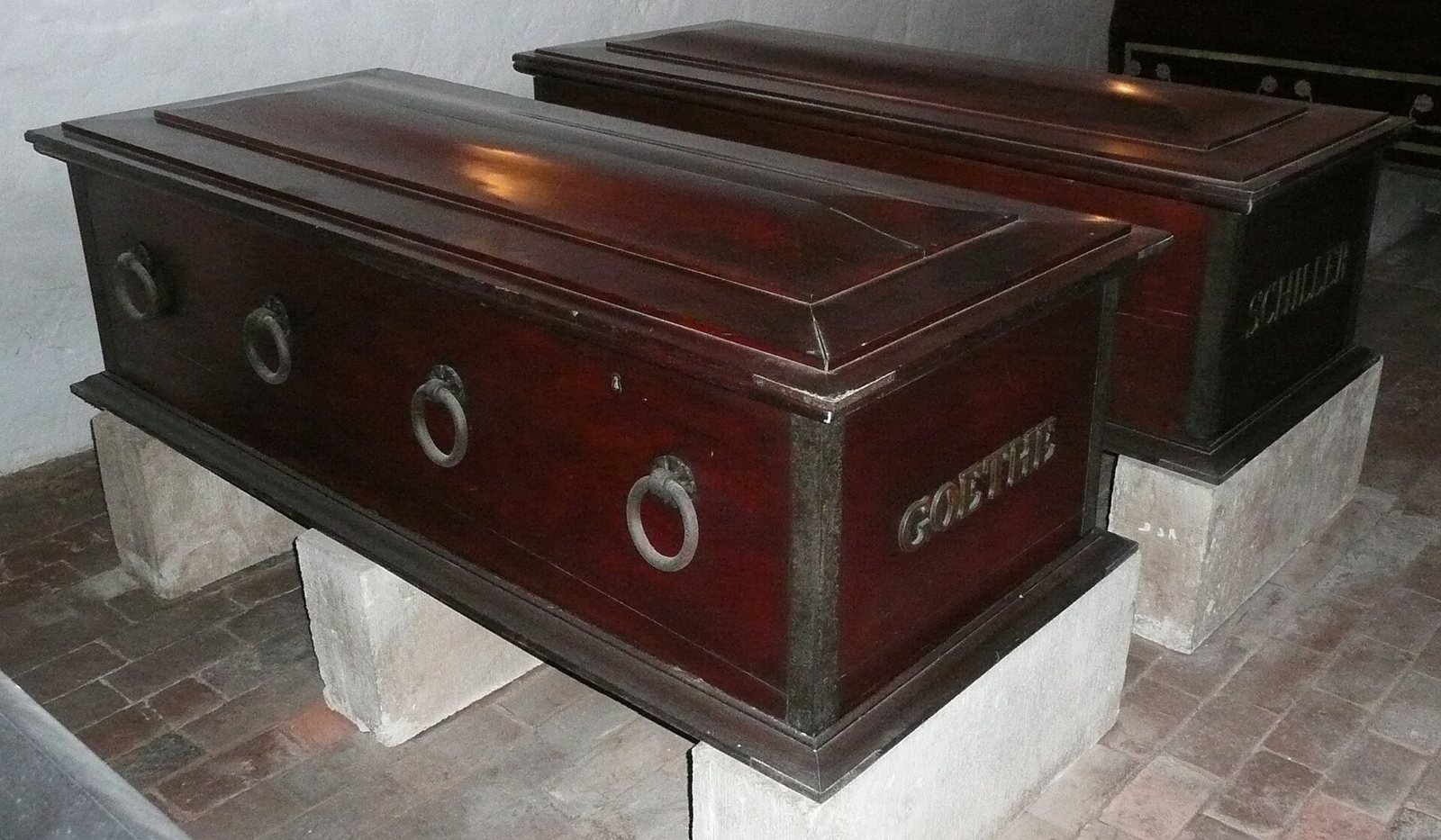
The Fürstengruft is a mausoleum on Weimar's Historischer Friedhof, the historic cemetery. It was built from 1823 to 1828 on the orders of Grand Duke Carl August (Klassik Stiftung Weimar, Fürstengruft). The remains believed to be Schiller's arrived in 1827, while the building was still going up. Goethe's sarcophagus stands there too, and the two poets rest beside members of the ducal family.
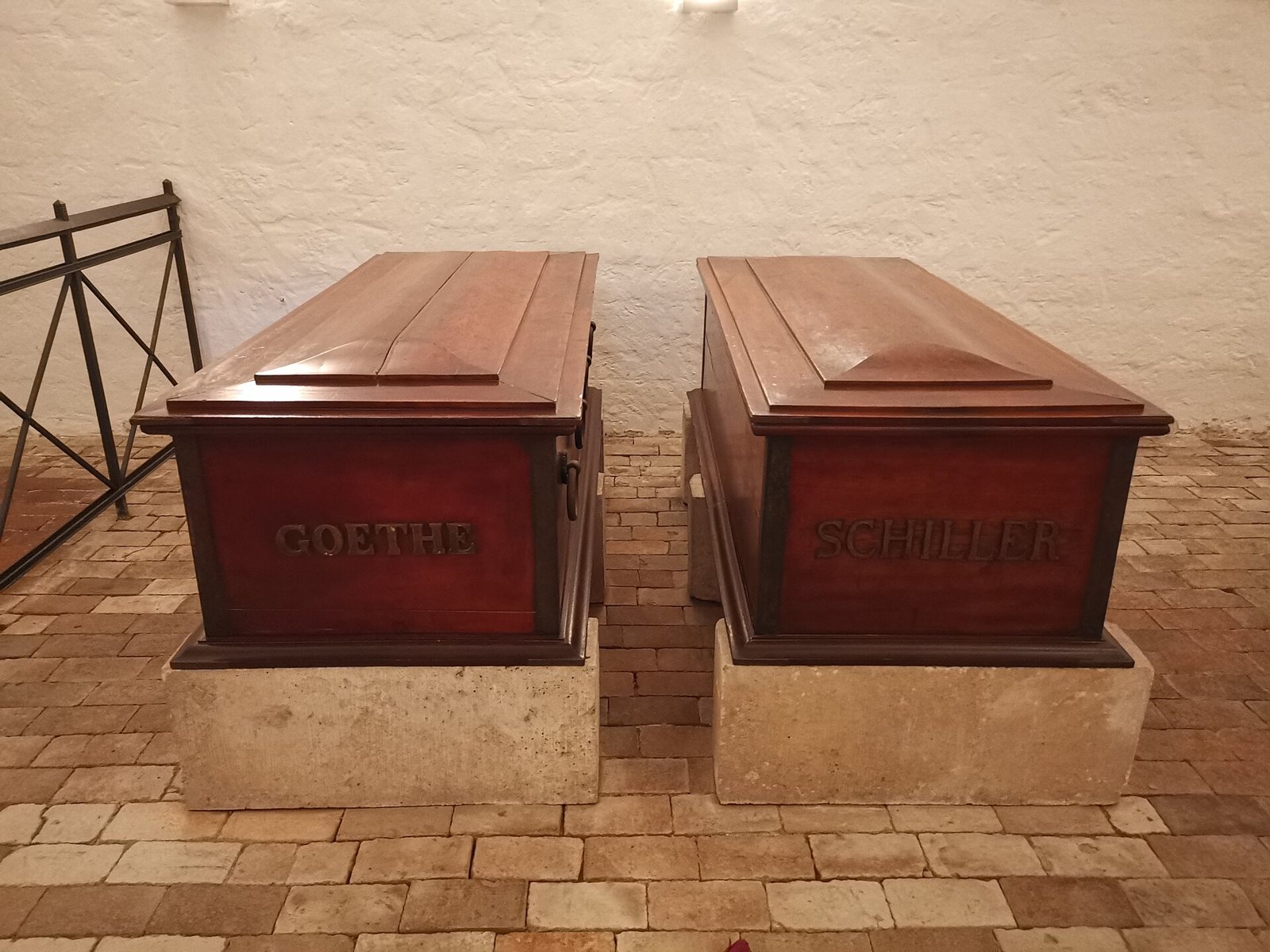
For about eighty years, that was the end of the story. Schiller, as far as anyone knew, rested next to his friend.
A second skull in 1911
Then, in 1911, the vault was opened again. August Friedrich von Froriep, director of the Anatomical Institute at the University of Tübingen, reopened the Kassengewölbe and between 28 August and 1 September 1911 excavated 63 skulls (Klassik Stiftung Weimar). He chose one of them as Schiller's after comparing it with death masks, casts and anatomical evidence. Froriep presented the skull publicly in 1912 and published his study in 1913 (Klassik Stiftung Weimar, August Friedrich von Froriep).
The remains attributed to this "Froriep skull" were placed in the Fürstengruft in 1913 or 1914; accounts give both years. For a time, Weimar had two competing "Schiller skulls" under one roof, each chosen by a serious man using the best comparison he had, and they could not both be right. As it turned out, neither was.
Tap or hover a row to highlight it.
| Detail | The Schwabe skull | The Froriep skull |
|---|---|---|
| DetailChosen by | The Schwabe skullCarl Leberecht Schwabe, mayor of Weimar | The Froriep skullAugust Friedrich von Froriep, anatomist, University of Tübingen |
| DetailYear chosen | The Schwabe skull1826 | The Froriep skull1911 |
| DetailSkulls in the search | The Schwabe skull23 | The Froriep skull63 |
| DetailHow it was chosen | The Schwabe skullCompared with the death mask and the memories of people who knew Schiller | The Froriep skullCompared with death masks, casts and anatomical evidence |
| DetailPlaced in the Fürstengruft | The Schwabe skull1827 | The Froriep skull1913 or 1914 |
| Detail2008 DNA result | The Schwabe skullNot Schiller | The Froriep skullNot Schiller |
The DNA test of 2008
The question was finally put to science in the project "Der Friedrich-Schiller-Code", run by MDR and the Klassik Stiftung Weimar. It combined comparative DNA analysis with historical, anthropological and other investigations. The DNA comparison used material attributed to Schiller and samples from close relatives (Klassik Stiftung Weimar).
In 2008 the project reported its result: neither the older Fürstengruft skull nor the Froriep skull belonged to Friedrich Schiller. The DNA findings also showed that the bones in the sarcophagus came from several different people. The skeleton assembled in 1826 had been put together from more than one person (Klassik Stiftung Weimar). The sarcophagus is now empty, and Schiller's actual remains have not been identified.
What makes the Schwabe skull so persuasive is how well it seemed to fit. In 2009 the Klassik Stiftung Weimar made a 3D print of the Schwabe skull set under Schiller's death mask, and it shows how closely the two appeared to match (Klassik Stiftung Weimar, 100 Schätze). The DNA had already ruled it out the year before. A face can seem to fit a skull and still belong to someone else, which is worth keeping in mind whenever you see a facial reconstruction. For Schiller's 250th birthday in 2009, the foundation also presented a publication and an exhibition with the pointed title "Schillers Schädel. Physiognomie einer fixen Idee", or "Schiller's skull: the physiognomy of a fixed idea".
Schiller's skull, from 1805 to 2008
Tap or hover a step to follow the order.
9 May 1805
Schiller dies in Weimar.
11 to 12 May 1805
He is buried at night in the Kassengewölbe on the Jakobskirchhof.
March 1826
Mayor Carl Leberecht Schwabe searches the vault and selects a skull.
1826
Goethe keeps the selected skull for a time and writes the poem later called "Bei Betrachtung von Schillers Schädel".
1827
Remains believed to be Schiller's are moved to the Fürstengruft.
1911
August von Froriep excavates the vault and selects a second skull.
1913 or 1914
The Froriep remains are placed in the Fürstengruft.
2008
DNA analysis concludes that neither skull belongs to Schiller.
Whose skulls were they, then?
Once neither skull was Schiller's, the natural question was whose they were. The Klassik Stiftung Weimar notes that the Froriep skull has been associated with Luise von Göchhausen, a court lady of the Duchess Anna Amalia (Klassik Stiftung Weimar, Kassengewölbe Mausoleum). Historians have attributed the older Schwabe skull to another person as well. These are attributions, not certainties. Either way, the people in the Kassengewölbe were real men and women of Weimar, someone's ancestors, and the story belongs to them too.
That is the "Schiller skull mystery" as it stands. The mystery is no longer which of the two skulls is his, because the answer is neither. The open question is where Schiller himself is, and nobody has an answer to that yet.
Visiting Weimar today
The Kassengewölbe you can see today is not the vault Schwabe climbed into. The present structure is a 1927 reconstruction built over the original foundations, and the old underground vault was filled in after the site lost its use (Klassik Stiftung Weimar).
The Fürstengruft is open to visitors, and Schiller's empty sarcophagus still stands there beside Goethe's. The Klassik Stiftung Weimar lists these details for 2026 on its opening hours and prices page and its visitor FAQ:
The Fürstengruft as the Klassik Stiftung Weimar lists it (2026)
Tap a card to bring it forward.
- Season: Summer season 21 March to 1 November 2026.
- Opening hours: Daily except Tuesdays, 10:00 to 18:00.
- Admission: 7 euros for adults, 5 euros reduced, 2 euros for pupils aged 16 to 20.
- Tickets: Sold on site; no advance reservation needed.
- Photography: Personal photos are allowed in public areas during opening hours, without flash, extra lighting or tripods. Online publication may need permission.
- Before you go: Hours and access change with the seasons, so look at the official schedule before travelling.
Weimar's city site also describes the Fürstengruft for visitors planning a trip.
Questions people ask about Schiller's skull
A few questions come up again and again, in English, German and Spanish. The short answers follow.
Which skull is Schiller's?
Neither of the two skulls once identified as Schiller's is his. The skull chosen by Carl Leberecht Schwabe in 1826 and the one chosen by August von Froriep in 1911 were both ruled out by the 2008 DNA study of MDR and the Klassik Stiftung Weimar. Schiller's real skull remains unidentified.
Did Goethe keep Schiller's skull?
Goethe kept the skull he believed was Schiller's at his house for a time in 1826. There he contemplated it and wrote "Bei Betrachtung von Schillers Schädel". DNA testing in 2008 showed that the skull was not Schiller's after all.
What happened to Schiller's skull?
Schiller's skull was lost among the mixed remains of the Kassengewölbe vault, where he was buried in 1805. Two men later picked skulls they believed were his, in 1826 and 1911, and both were placed in the Fürstengruft. The 2008 DNA study showed neither was his, so his true skull has still not been identified.
How did DNA show the skulls were not Schiller's?
The 2008 project "Der Friedrich-Schiller-Code" compared DNA from the skulls with material attributed to Schiller and with samples from his close relatives. It showed that neither skull matched, and that the bones in the sarcophagus came from several people. The Klassik Stiftung Weimar and MDR published the result.
Where is Schiller buried now?
Schiller's grave of record is the Fürstengruft in Weimar, where his sarcophagus stands beside Goethe's, but the sarcophagus is now empty. His actual remains have not been identified, and the original Kassengewölbe vault where he was first buried was later filled in.
How well do you know the story of Schiller's skull?
Answer every question to check.
An empty sarcophagus and a friendship
The facts fit in a few lines. Schiller was buried in a crowded vault in 1805, a mayor chose a skull in 1826, Goethe wrote a poem to it, an anatomist chose another in 1911, and DNA in 2008 said neither was his. What stays with people is less the science than the friendship: two poets placed side by side in the Fürstengruft, and one of them sitting with a skull, sure he was holding his friend. If you enjoy the stories of famous heads that went astray, Weimar has company, from Haydn's skull and Mozart's skull to Descartes's skull and Goya's skull.
Terms in this story
Tap a term to see what it means.
Kassengewölbe. The shared burial vault on the Jakobskirchhof in Weimar, used for people of high standing with no private family grave. Schiller was buried there in 1805; the structure seen today is a 1927 reconstruction.
---