

No. 184
Skeleton Hand Meaning: Tattoos, Art and Gestures
A skeleton hand most often stands for mortality, the old idea of memento mori, Latin for "remember that you must die," which runs deep in European art. What a particular skeleton hand means beyond that depends on what it is doing and who chose it. Holding a rose, cradling a heart, making a peace sign or folded in prayer, the same bones can say love, remembrance, faith or a private joke. There is no single meaning that fits every skeleton hand, and plenty of people choose one simply because they like how it looks.
That flexibility is the appeal. So, if you are planning a tattoo or wondering about the bony hands on a print or a Halloween display, the useful questions are where the image comes from, what the gesture adds, and what the person behind it meant.
Where the image comes from: death's reach in European art
Skeletons have pointed, beckoned and grabbed their way through European art for more than six centuries. The National Gallery, London connects memento mori skull imagery with the equalizing power of mortality in Northern European portraits and still lifes of the sixteenth and seventeenth centuries: whatever a sitter owned or achieved, death would come for them too. Our story on what memento mori means follows that idea in full.
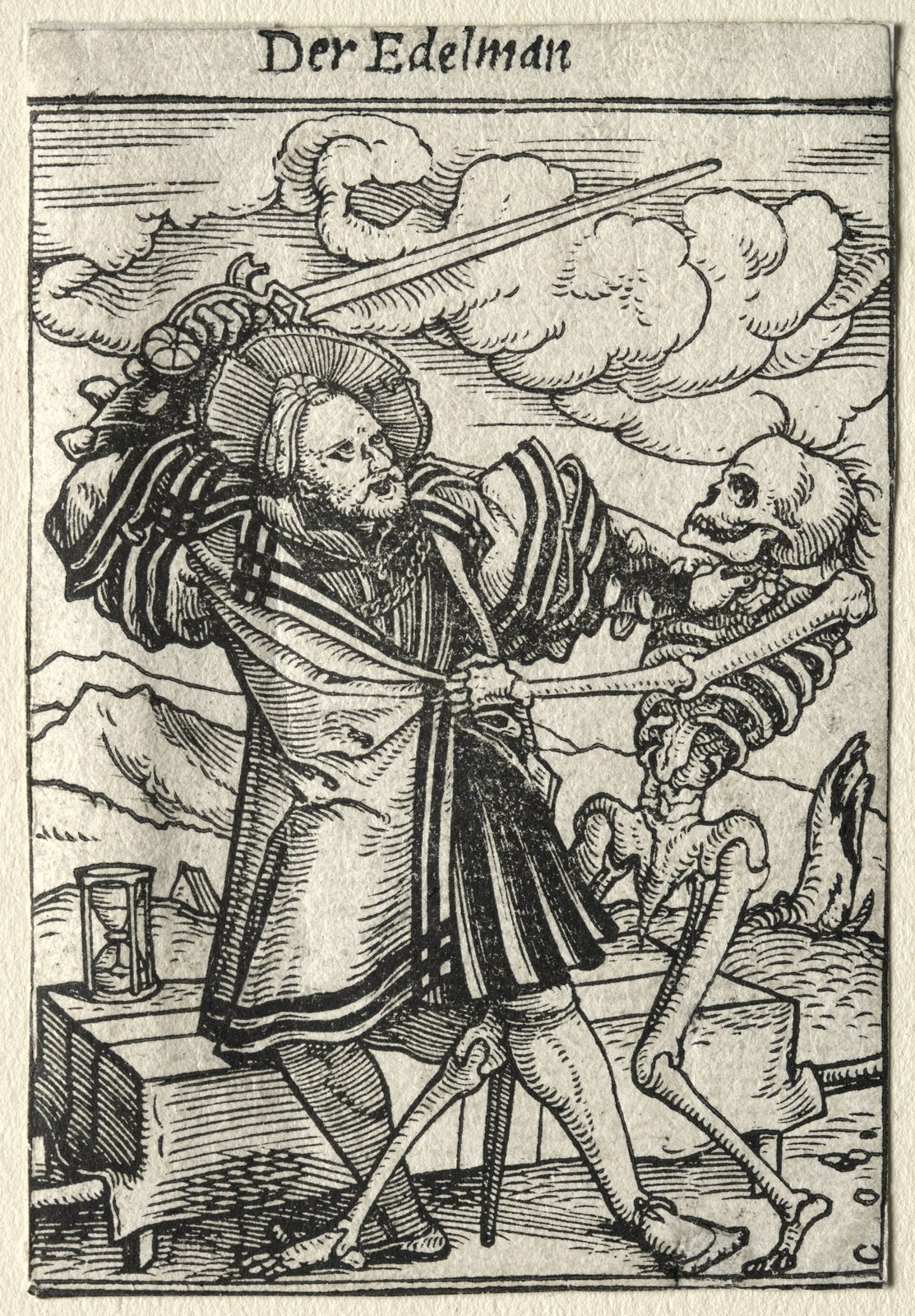
The Danse Macabre, or Dance of Death, gave the skeleton its most active hands. Medieval art historian Sophie Oosterwijk, writing in Oxford Bibliographies, describes it as an allegorical confrontation in which representatives of every social rank are summoned to die. Its earliest surviving literary version is Spanish, the *Dança general de la Muerte*, dated about 1390 to 1400. The earliest recorded visual version was a wall painting in Paris made in 1424 to 1425, now lost.
Print carried the dance further. In 1485 the French printer Guy Marchant published a printed *Danse Macabre* based on a Paris cemetery mural, with skeletons leading people from every social class toward death, and fourteen editions appeared before the end of the century, according to the RIT Cary Graphic Arts Collection. In those prints the skeletons' hands do the leading. Our Danse Macabre story tells that history at length.
Art and anatomy also met on the page. Cambridge University Library shows how skeleton imagery around the anatomist Vesalius blended scientific study with the memento mori tradition. These meanings belong to their setting: late-medieval and early modern Europe, and a Christian way of thinking about death. They do not travel automatically to every skeleton hand drawn since.
Skeleton hands through history
Tap or hover a step to follow the order.
1390 to 1400
The Spanish Dança general de la Muerte, the earliest surviving literary Danse Macabre
1424 to 1425
A Paris wall painting, the earliest recorded visual Danse Macabre, now lost
1485
Guy Marchant publishes a printed Danse Macabre in Paris
November 8, 1895
Wilhelm Conrad Röntgen identifies X-rays in Würzburg
December 22, 1895
Röntgen makes the radiograph of Anna Bertha Röntgen's hand
Skeleton figures in other traditions
Europe is not the only place where skeletons have hands with something to say. The Metropolitan Museum of Art holds a Tibetan skeleton dance costume of the kind worn in Tibetan Buddhist *cham* performances in the late nineteenth and early twentieth centuries. There the skeleton costumes and masks evoked impermanence, rebirth and the pursuit of enlightenment, a different set of ideas from the European Dance of Death. Our story on skull symbolism in Buddhism goes further into that tradition.
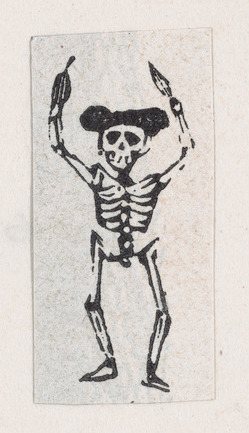
In Mexico, the printmaker José Guadalupe Posada filled his broadsides with busy, expressive skeletons. The Met's collection of his prints, made about 1880 to 1910, includes a skeleton running with a crowbar in his hand and a skeleton standing with his arms raised. His skeletons run, work and gesture with their hands much as living people do.
One skeleton, three settings
Tap a card to bring it forward.
- European memento mori: Mortality and the equalizing power of death, in sixteenth- and seventeenth-century art.
- Tibetan cham skeleton dance: Impermanence, rebirth and the pursuit of enlightenment.
- Modern tattoo: The meaning depends on the wearer, the gesture and the imagery around the hand.
The first X-ray was a hand
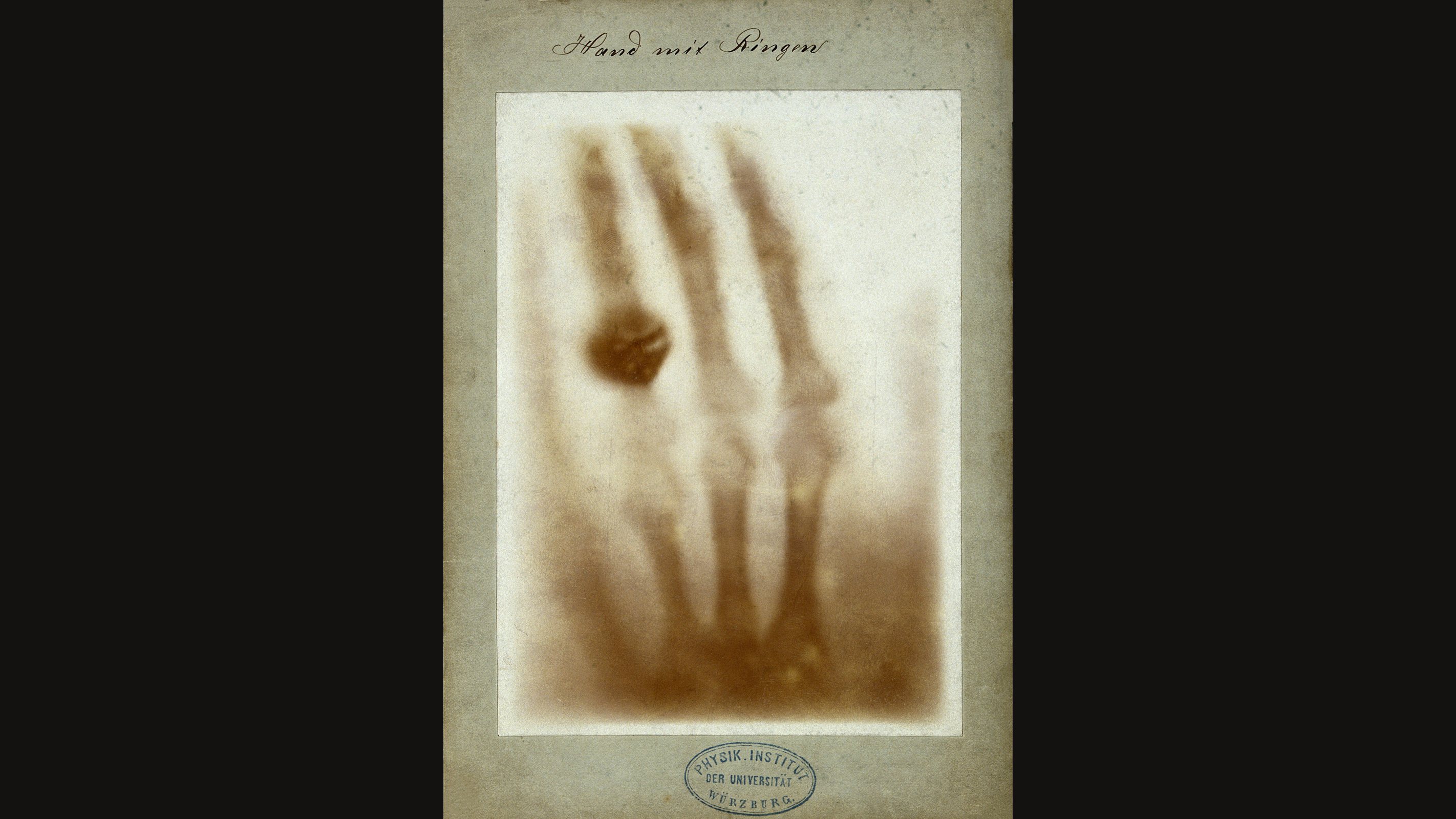
The most famous skeleton hand of the modern age belonged to a living woman. On November 8, 1895, the German physicist Wilhelm Conrad Röntgen identified X-rays while working in Würzburg. On December 22, 1895, he made a radiograph of the hand of his wife, Anna Bertha Ludwig Röntgen, and the image showed her bones and her ring.
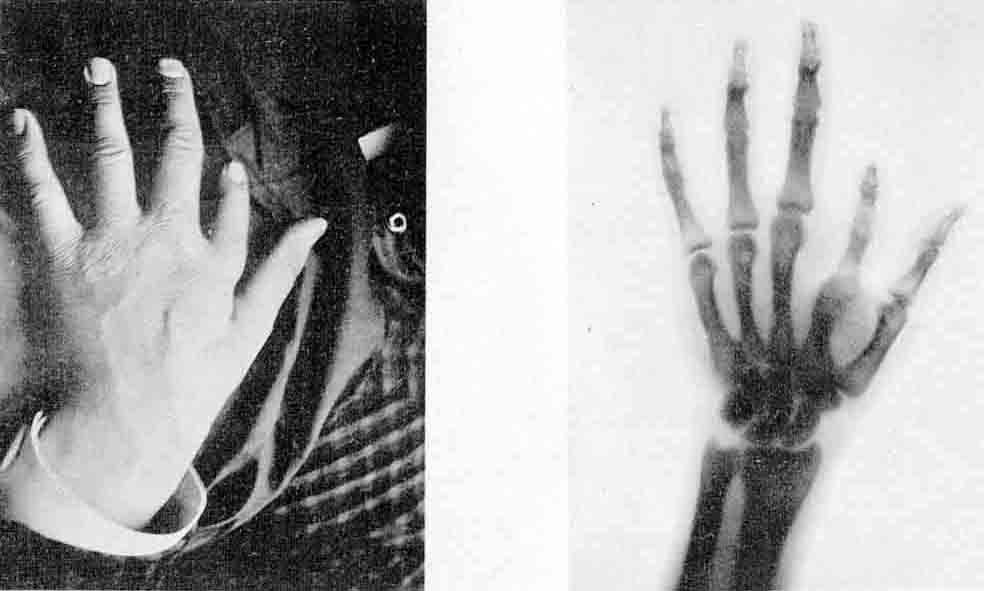
The National Museum of Health and Medicine records the story told at the time that she exclaimed, "I have seen my death!" The University of Zurich identifies Bertha's hand as the first known Röntgen image and notes that German speakers still call an X-ray image a *Röntgenbild*.
X-ray-style hand designs, with pale bones inside a soft outline of flesh, look a great deal like Bertha's radiograph. The resemblance is visual, though. Nothing traces a direct line from Röntgen's photograph to modern tattoos, so treat it as a striking parallel rather than an origin.
Twenty-seven bones in every hand
Each human hand has 27 bones. Eight carpal bones form the wrist, five metacarpals form the palm, and fourteen phalanges form the fingers and thumb. The count can change if the small sesamoid bones are counted separately, but 27 is the standard figure in the NCBI Bookshelf chapter on hand bones by Daniel G. Arias, Asa C. Black and Matthew A. Varacallo.
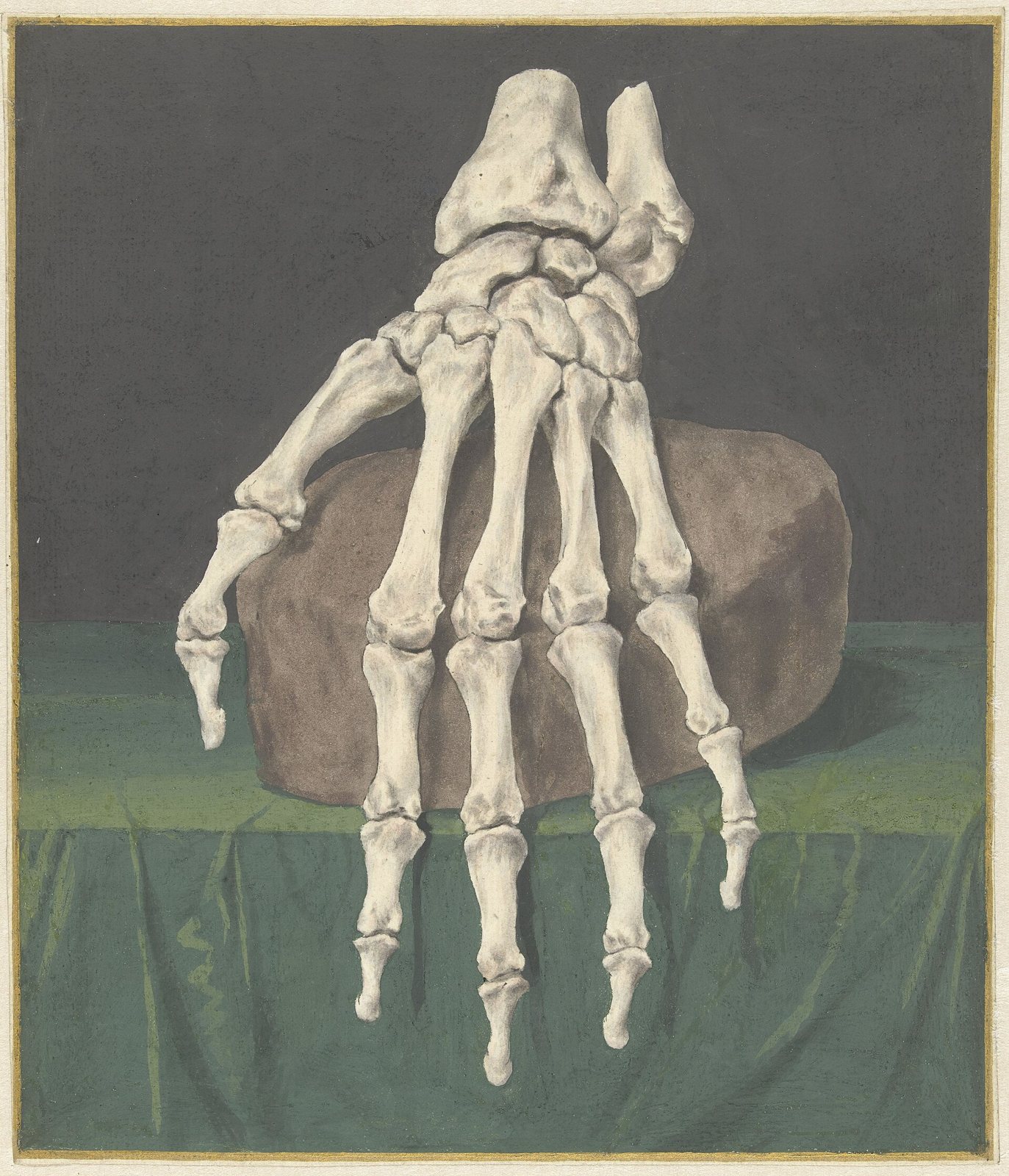
For anyone drawing or tattooing a skeleton hand, those three groups are the landmarks a viewer reads: the cluster of small bones at the wrist, the long bones of the palm and the chains of small bones in each finger. If you are curious how the hand fits into the whole body's count, our story on how many bones are in the human body has the rest.
Tap or hover a row to highlight it.
| Group | Number | Where |
|---|---|---|
| GroupCarpals | Number8 | WhereWrist |
| GroupMetacarpals | Number5 | WherePalm |
| GroupPhalanges | Number14 | WhereFingers and thumb |
| GroupTotal | Number27 | WhereOne hand |
What skeleton hand tattoos mean to the people who wear them
A skeleton hand tattoo carries no single fixed meaning. The motif may call up mortality or memento mori, but the object in the hand, the gesture, where it sits on the body and the wearer's own explanation decide what it means for that person. Some people choose it purely because they like the design, a point our story on skeleton tattoo meaning makes in a tattooer's own words.
Some common modern design readings come up again and again. They are readings, not rules:
- A skeleton hand holding a rose is often read as life and beauty set against death, a pairing our story on skull and roses meaning traces further.
- A hand holding a heart is often read as lasting love.
- Praying skeleton hands are often read as faith or reflection.
- The horns gesture is often read as a sign of rock or metal music.
- Linked pinkies are often read as loyalty or a promise.
The design is popular, too. A 2021 report from WNDX, based on Google Trends data, ranked skeleton hands fifth among tattoo designs in the United States that year.
If you are planning one, the ideas above are a starting point: a gesture, an object to hold, the X-ray look with its glowing outline, or a hand drawn bone by bone. The meaning that matters is the one you can explain. For the broader family of designs, our stories on skull tattoo meaning and memento mori tattoos are good companions.
Gestures: the heart and the peace sign
A skeleton hand keeps the shape of a living gesture while swapping flesh for bone, so the gesture brings its own meaning along. The hand-heart is widely used as a sign of affection. The V-sign can mean victory or peace, depending on where and how it is made.
The V-sign has a history of its own. Time reports that its widespread use in photographs in East Asia developed mainly from the late 1960s and was broadly accepted by the late 1980s, helped along by Japanese media culture, the fame of figure skater Janet Lynn after the 1972 Olympics, manga and advertising.
Artists use gestures with intent. Los Angeles artist Marcel "SEL" Blanco told FATHOM that the hand gestures in his artwork can express compassion, understanding, patience, self-control and making peace with anger. A skeleton hand making a heart or a peace sign puts that kind of living gesture together with an image of mortality, and the artist or the wearer is the best authority on what a specific piece means.
Does a skeleton hand tattoo mean anything in prison?
A skeleton hand on its own is not a documented universal prison or gang code. The U.S. National Gang Center says gang-related tattoos can show affiliation, rank, crimes, alliances or loyalty, and that their meanings vary by region. That variation is the point: no one should read prison history or gang membership into a skeleton hand without context.
If you want to know what a particular tattoo means, ask the person wearing it. When a specific identification is genuinely needed, a qualified local corrections or gang-symbol expert is the right person to ask. The same habit of reading a symbol in its setting applies to every skull image, from a tattoo to the skull and crossbones on a poison label.
More questions about skeleton hands
A few last answers for readers who want to go a step further.
What does a skeleton hand symbolize?
In the European memento mori and Danse Macabre traditions, a skeleton hand symbolizes mortality and the fact that death reaches people of every rank. In contemporary art and tattoos it can also stand for personal identity, remembrance, music culture, humor or simply a visual style.
Is the skeleton hand tattoo overused?
That is a matter of taste, not a fact anyone can settle. Its 2021 ranking shows the design was popular, which says nothing about whether your own version will look like anyone else's; the gesture, the object and the artist's hand make it yours.
Where can I see skeleton hands in historical art?
The Metropolitan Museum of Art holds *Memento Mori: a skeleton in a niche*, a print by Master I. A. M. of Zwolle made between 1465 and 1500, as well as José Guadalupe Posada's skeleton prints. The Wellcome Collection holds an image of the skeleton of a hand credited to Jan L'Admiraal.
Skeleton hand quiz
Answer every question to check.
A skeleton hand can be a medieval summons, a scientist's first glimpse inside a living body or a small promise inked on a wrist. Which one it is depends on the hand, and on the person who chose it.
Terms in this story
Tap a term to see what it means.
Memento mori. Latin for "remember that you must die." In European art, skull and skeleton images used to call that idea to mind.