
No. 136
Skeleton Costume History: Where Dressing as a Skeleton Came From
The skeleton costume has no single starting point. Its look goes back to the danse macabre of fifteenth- and sixteenth-century Europe, when artists showed Death as a skeleton walking among people of every rank. The costume you can buy in a box is much younger. It became popular in the twentieth-century United States, after ready-made Halloween costumes reached big stores in the 1930s and companies such as Collegeville and Ben Cooper started printing bones onto cheap suits.
Disney's dancing cartoon skeletons in 1929 and the cheap plastics of the postwar years helped the idea along. One early example still exists. A boxed Collegeville skeleton costume, marked Junior size and penciled at $2.98, sits in the collection of the Shiloh Museum of Ozark History in Arkansas.
This story follows the costume you put on. The yard skeletons, paper decorations and the twelve-foot giant on the lawn have their own history in why skeletons became a Halloween symbol.
Dressing as death before there were costume aisles
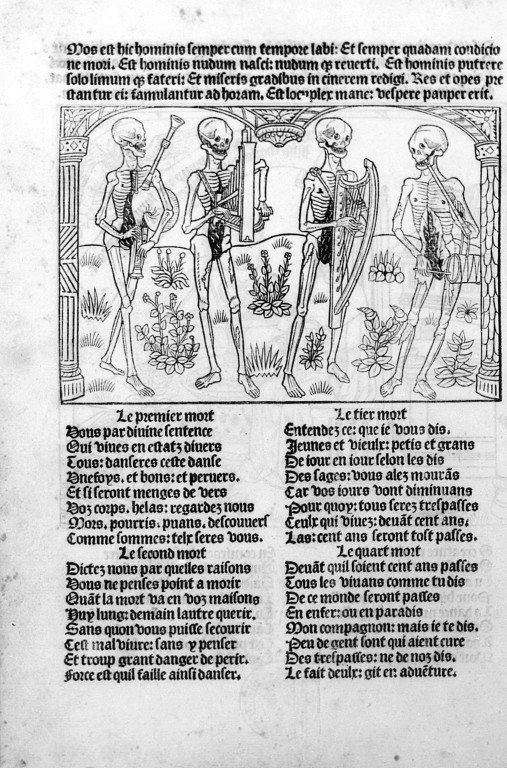
Long before anyone sold a skeleton suit, Europeans knew what Death looked like. The Ashmolean Museum describes the danse macabre, or Dance of Death, as a popular image in fifteenth- and sixteenth-century Europe, in which Death appears as a skeleton among people of different social ranks. Kings, merchants and peasants all got the same partner. That was art and religious imagery, painted, carved and printed, rather than a costume people wore on a set night. The full story of those processions of the dead is in our history of the danse macabre.
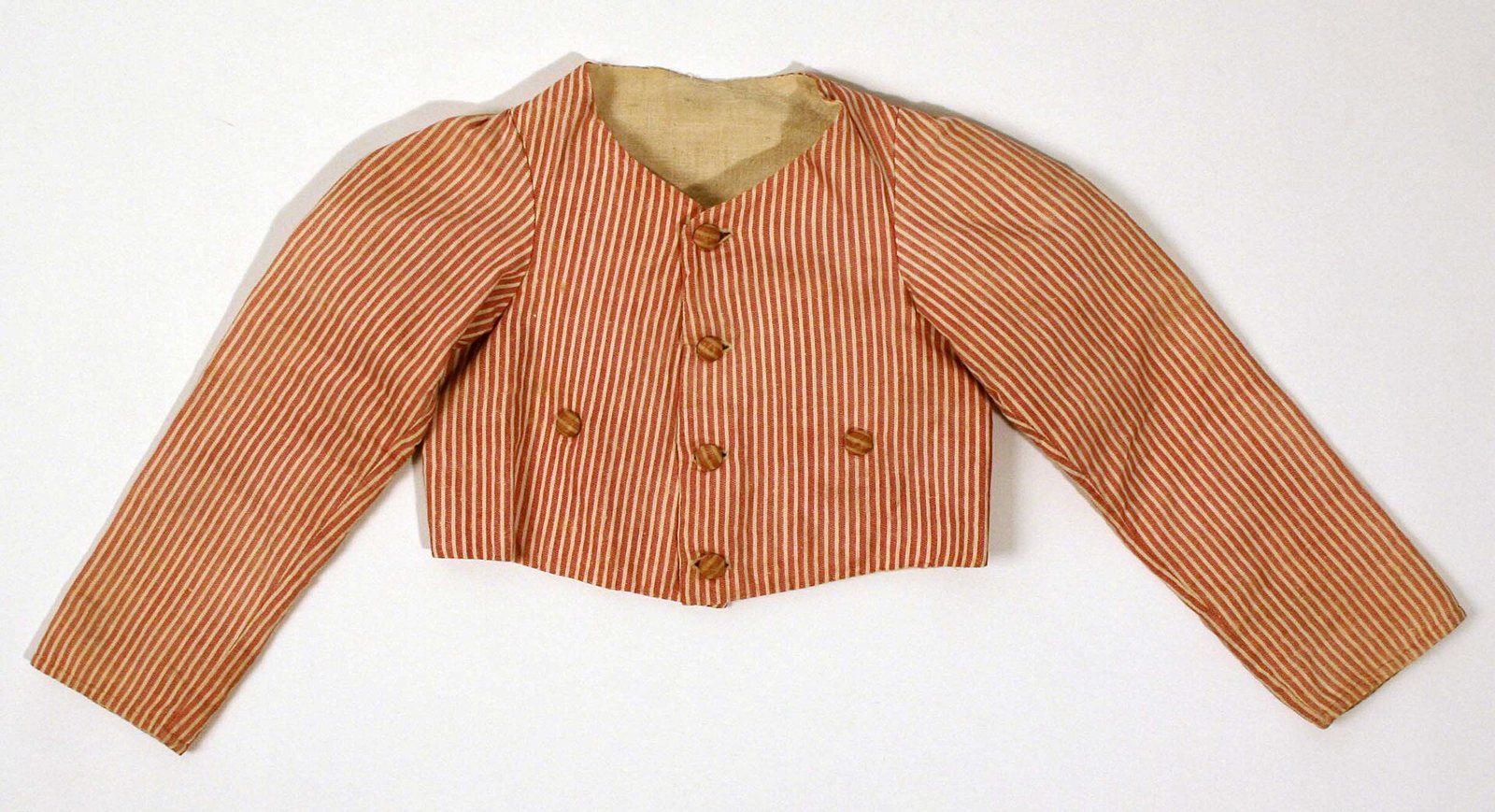
The words "skeleton suit" are older than the costume, too. The Metropolitan Museum of Art holds an American cotton garment titled Skeleton suit, dated about 1820. It is a historical piece of clothing, not something for Halloween, and it shows that the phrase meant something else before anyone thought of printing ribs on it.
Historian Daniel Compora of the University of Toledo and other scholars, as History.com reports, connect the modern skeleton to several threads at once: old European death imagery, Mexican calavera art, popular entertainment and the growing business of Halloween. The costume came out of all of them.
A separate line: calaveras and La Catrina
One of those threads has its own history and its own meaning. In Mexico, the printmaker José Guadalupe Posada drew skeleton figures, called calaveras, in the late nineteenth and early twentieth centuries. The Arlington Museum of Art explains that his calaveras satirized social privilege and political life, showing viewers that death reaches the powerful and the poor alike.
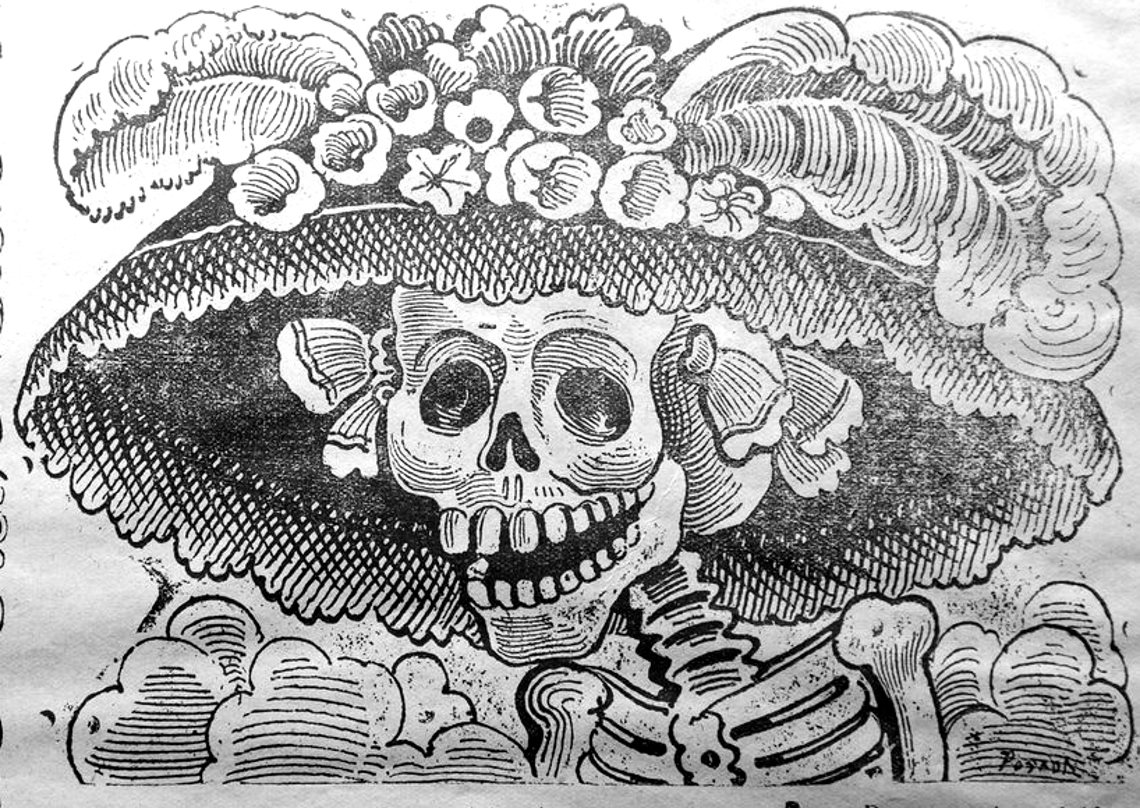
His best-known skeleton became La Calavera Catrina, tied to Día de Muertos through Posada's work and Diego Rivera's later painting of her. The Timothy S. Y. Lam Museum of Anthropology at Wake Forest University describes La Catrina as a skeletal woman who now appears in prints, sculpture, papier-mâché, sugar and costumed performance. Her story, from satire to celebration, is told in full in La Catrina, and the wider family of festive skeletons in calacas.
That history runs alongside the black-and-white Halloween skeleton suit rather than through it. Día de Muertos is a living tradition, and its practices differ from one community and place to another, so a Catrina look carries meaning that a store-bought skeleton suit does not. Our Día de Muertos story covers the celebration itself.
Costumes reach the store shelf in the 1930s
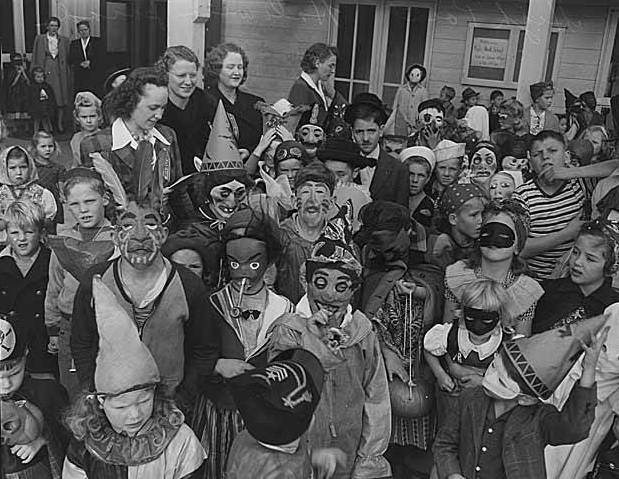
Halloween costuming became more common in the United States in the nineteenth and early twentieth centuries, but buying one off a shelf came later. Historic New England records that Sears and other large retailers sold ready-made children's costumes during that decade.
Plenty of families still made their own, because the Great Depression made store-bought costumes a luxury. After World War II, Historic New England notes, ready-made costumes became more affordable, and the boxed costume settled into the American Halloween routine. A skeleton was an easy design for that market: black fabric, white bones, done.
The Collegeville skeleton in a box
The best way to see an early store-bought skeleton is to look at a real one. The Shiloh Museum of Ozark History in Arkansas holds a boxed Collegeville skeleton costume that still has its original packaging. The box is marked Junior size, and someone penciled a price of $2.98 on it.
Collegeville's own story explains why its costumes were cheap. The museum identifies it as a Pennsylvania company that moved into inexpensive Halloween costumes in 1923, using fabric remnants left over from its flag-making business. So, a costume line grew out of the scraps of another product, which is about as thrifty as Halloween gets. The skeleton in that box is a small object, but it shows the whole shift from a homemade disguise to something a parent could pick off a shelf.
Ben Cooper and the boxed-costume years
Collegeville was not alone for long. Ben Cooper, Inc. was founded in Brooklyn in 1937 and became one of the major American Halloween costume makers, as the National Museum of American History and the Museum of Witchcraft and Magic both record. Its mass-produced costumes and masks became a familiar part of American Halloween, and a skeleton, with its simple printed bones, suited that kind of production well.
Popular culture was also giving skeletons a new personality. In 1929 Walt Disney released The Skeleton Dance, a cartoon in which skeletons dance in a graveyard at midnight. History.com describes it as major popular exposure for skeleton imagery. Death had become something that could dance, which is a better pitch for a children's costume than a medieval sermon.
Glow-in-the-dark bones
Then came plastic. History.com notes that postwar manufacturing made plastic skeleton decorations and cheap printed costumes widely available in the United States. Historian Katrina Gulliver, quoted there, describes the later spread of cheap, mass-produced skeleton decorations as part of a globalized Halloween retail trade.
Glow-in-the-dark materials joined that market during the twentieth century, and bones that shine after the lights go off are a natural fit for a skeleton suit. Who made the first glowing skeleton costume, and when, is not settled. What is clear is the direction: the skeleton suit became cheaper, brighter and easier to find with every decade.
How the skeleton costume came together
Tap or hover a step to follow the order.
Fifteenth and sixteenth centuries
Danse macabre imagery shows Death as a skeleton among people of different ranks, according to the Ashmolean Museum.
About 1820
The Metropolitan Museum of Art dates an American cotton garment titled Skeleton suit, a historical piece of clothing.
1923
Collegeville, a Pennsylvania flag maker, moves into inexpensive Halloween costumes made from fabric remnants.
1929
Walt Disney releases The Skeleton Dance.
1930s
Sears and other large retailers sell ready-made Halloween costumes for children.
1937
Ben Cooper, Inc. is founded in Brooklyn and becomes a major costume maker.
2025
The National Retail Federation estimates $4.3 billion in costume spending for adults, children and pets.
Skeletons for kids, pets and the whole family
The skeleton suit is now one choice in a very large costume market. The National Retail Federation's 2025 Halloween survey reported that 71 percent of people celebrating planned to buy a costume for themselves, a child or a pet, and it estimated $4.3 billion in costume spending. Pets are part of it: 23 percent planned to dress up an animal, with pumpkin, hot dog, bumblebee, ghost and superhero costumes among the leading pet choices.
Skeletons are a familiar costume category year after year. In the 2025 NRF rankings, a generic skeleton was not among the top five costumes for children, adults or pets, yet it stays on the racks as a steady classic. Matching skeleton outfits for a parent, a child and the dog are a common sight, and they work for the same reason the 1930s box did: everyone recognizes them at once.
The skeleton dinosaur costume is a modern mix of two ideas that each have their own following, the dinosaur suit and the skeleton. Rubie's developed inflatable dinosaur costumes in connection with the 2015 film Jurassic World, which made dinosaur suits highly visible. Put bones on a dinosaur and you get a costume that looks like a museum fossil out for the evening.
Painting the bones on your face
A costume often comes with a painted face, and the face has its own history. Plain black-and-white skull face paint belongs to Halloween's general use of skeleton imagery: dark sockets, a dark nose, teeth drawn across the lips. If you want to paint one, our step-by-step skeleton makeup story covers the kit, the steps and the skin safety.
Calavera and Catrina makeup is a different style. It draws on Mexican print culture, especially Posada's skeleton caricatures, and it is usually decorative, with flowers, color and detail. La Catrina was not originally a face-painting design at all; she was a print. Face painting may appear at present-day Día de Muertos events, but it is not one uniform practice across Mexico, and the look carries the meaning of a living tradition of remembrance. If that is the costume you want, read about Catrina makeup and the sugar skulls that share its colors first, so the look is tied to what it stands for.
Three skeleton looks and where each comes from
Tap a card to bring it forward.
- Skeleton face paint: A black-and-white skull face drawn from Halloween's general skeleton imagery.
- Calavera makeup: A decorative skull style that draws on Mexican print culture and José Guadalupe Posada's skeleton caricatures.
- Catrina makeup: A look based on La Catrina, Posada's skeleton lady later painted by Diego Rivera, tied to Día de Muertos and its remembrance of the dead.
What a skeleton costume stands for
What does a skeleton costume represent? It depends on where and when you wear it. On Halloween it usually stands for death, mortality or a playful supernatural figure, the bony neighbor who comes out once a year. In the danse macabre, the skeleton told viewers that death reaches people of every rank, so the costume carries a faint echo of that old leveling message.
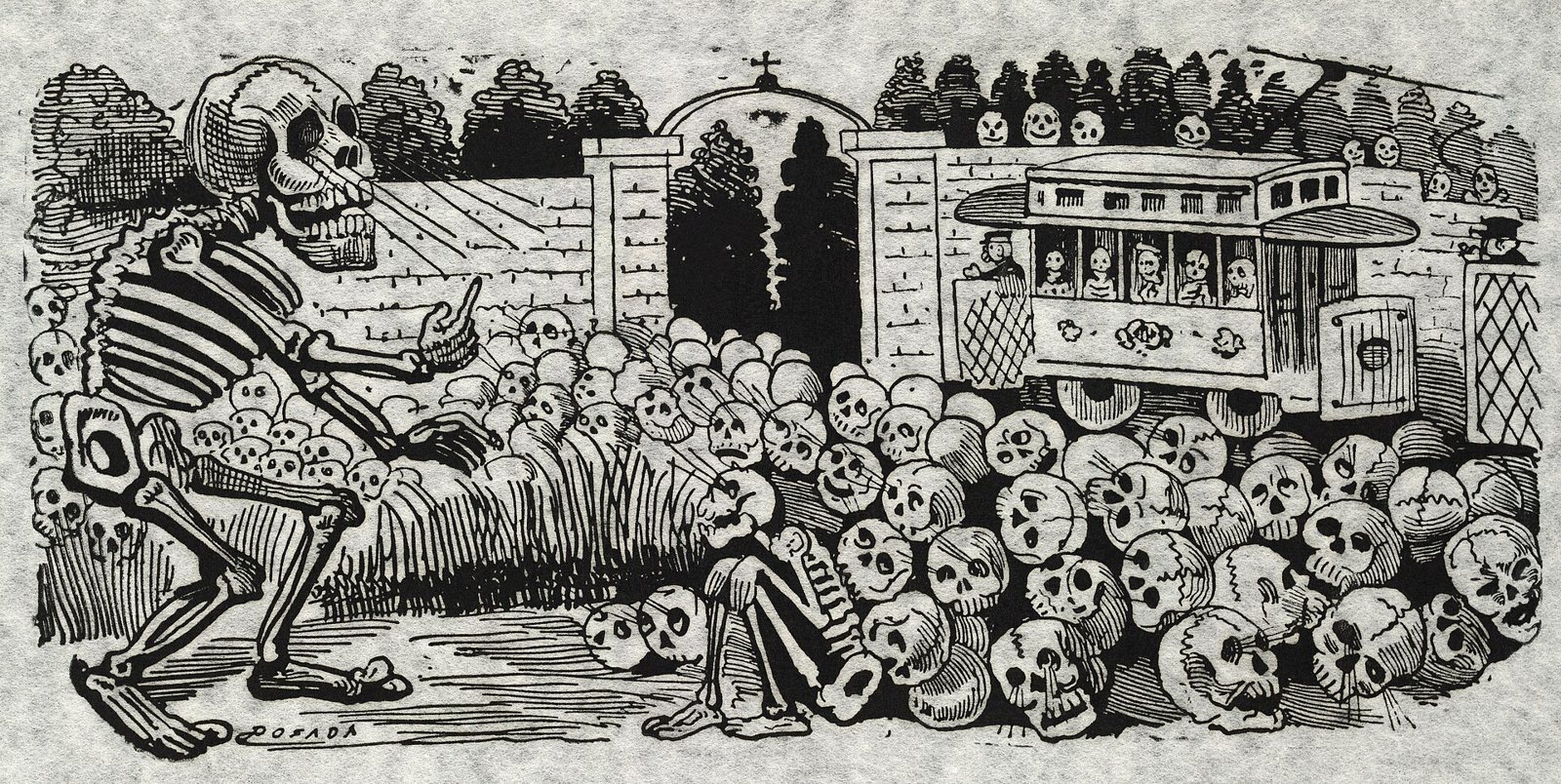
In Mexican calavera art, skeletons could carry satire and social criticism, and the idea that wealth protects nobody from death. A masked or painted face can shift that meaning again; our story on the history of the skull mask follows masks beside the costume. The suit itself is only cloth and printed bones. What it says comes from the person wearing it and the night they choose.
How well do you know the skeleton costume?
Answer every question to check.
Skeleton costume questions
These answers cover the questions people ask most about the costume's past.
When did skeleton costumes become popular?
Skeleton costumes became broadly popular in the twentieth-century United States, as ready-made costumes reached stores from the 1930s and Halloween grew into a commercial holiday. Disney's 1929 The Skeleton Dance gave skeletons wide popular exposure, and postwar plastics made skeleton costumes and decorations cheap and easy to find.
Why do people dress as skeletons for Halloween?
People dress as skeletons because the skeleton is the oldest and simplest image of death, and Halloween is a night built around the dead and the supernatural. The look is instantly recognizable, it works for any age, and since the danse macabre it has carried the idea that death treats everyone the same.
When were skeleton costumes invented?
No single person invented the skeleton costume. Boxed, store-bought skeleton costumes from makers such as Collegeville belong to the twentieth century, while the Met's "Skeleton suit" of about 1820 is an older garment that shares the name but was not a costume.
What is the difference between sugar skull makeup and skeleton makeup?
Skeleton makeup is a black-and-white skull face taken from Halloween's general skeleton imagery. Sugar skull or calavera makeup is a decorative style inspired by Día de Muertos and Mexican print art, with flowers and color, and it carries the meaning of a living tradition of remembrance.
What is the difference between a calavera and La Catrina?
Calavera is the Spanish word for a skull, and in Mexican art it names the skull and skeleton figures that Posada and others drew. La Catrina is one particular calavera, Posada's skeleton lady, who was later painted in a full gown by Diego Rivera and became a symbol of Día de Muertos.
Pick your bones
Whether you choose a printed suit, a painted face or a skeleton dinosaur, you are wearing something with a long line behind it: medieval Death among the living, Posada's satirical calaveras, a $2.98 box from Pennsylvania flag scraps and a cartoon that taught skeletons to dance. For the rest of the season's skeletons, read why skeletons became a Halloween symbol and the danse macabre, and if you are painting your face, start with skeleton makeup. There are plenty more skull and skeleton stories waiting at We Dig Skulls.
Terms in this story
Tap a term to see what it means.
Danse macabre. The Dance of Death, a popular image in fifteenth- and sixteenth-century Europe showing Death as a skeleton among people of every social rank.
---