

No. 118
Cézanne Skull Paintings: The Pyramid of Skulls, Why He Painted Them and Where They Are
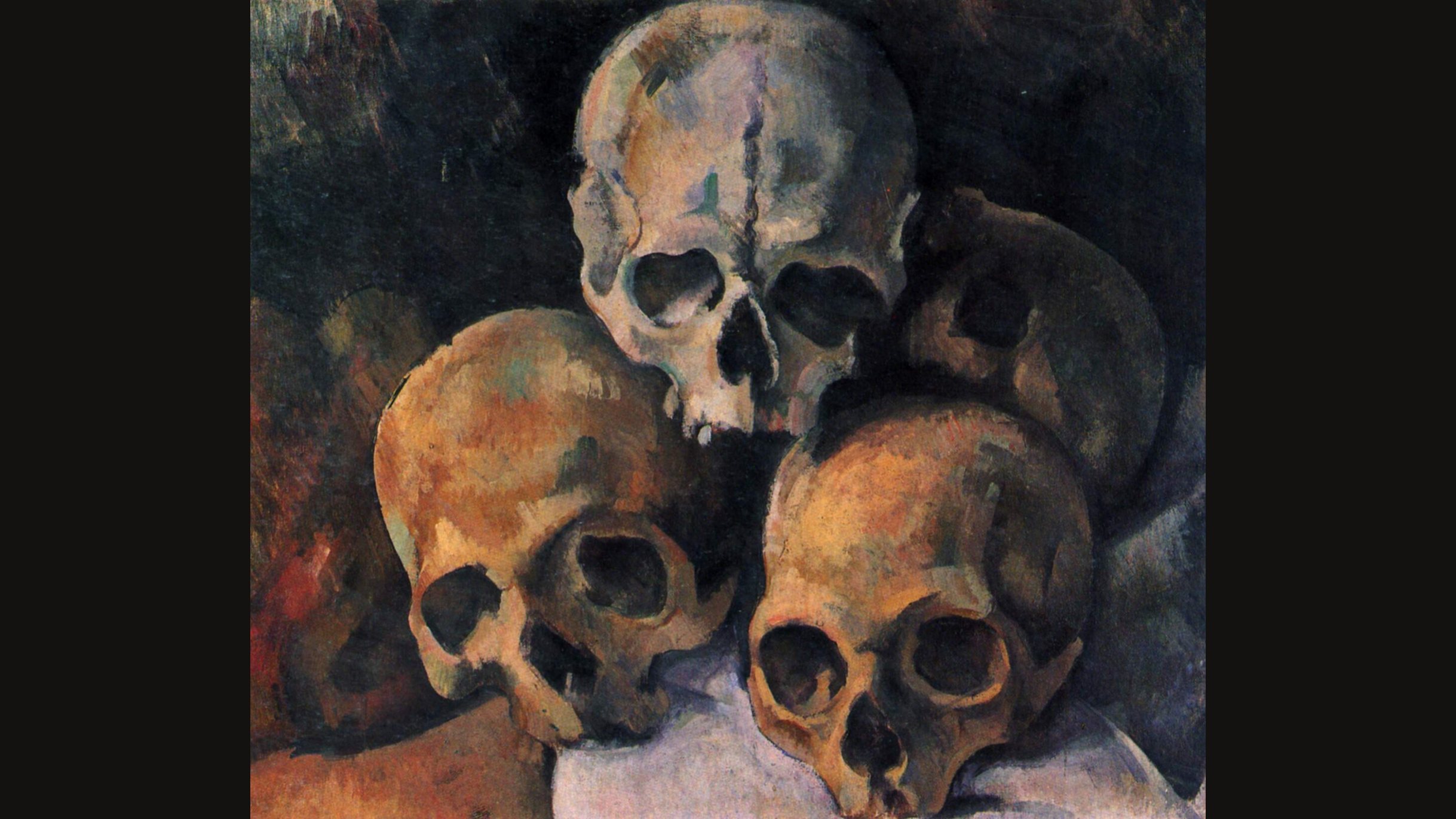
Paul Cézanne's *Pyramid of Skulls*, an oil painting about 39 by 46.5 cm dated 1898 to 1900 or around 1901, is recorded in a private collection in Switzerland, so it does not hang in a public museum (Cézanne catalogue raisonné). His other late skull paintings can be traced to the Detroit Institute of Arts and the Kunstmuseum Solothurn in Switzerland, and a related *Young Man and Skull* belongs to the Barnes Foundation in Philadelphia.
Why skulls? Museums give two reasons that work together. A skull is the oldest symbol of mortality in European still life, and it is also a solid, rounded form, well suited to a painter who cared about volume, color and structure.
The late skulls also came after his mother's death in 1897, the sale of the family estate in 1899 and worsening illness. Those years are part of the story, though no single cause is documented. Below, the paintings one by one, and where each one is now.
The Pyramid of Skulls
As its title says, the painting shows skulls stacked into a pyramid, on a canvas about 39 by 46.5 cm. The Cézanne catalogue raisonné lists it as FWN 874 and records it in a private collection in Switzerland. Catalogues date it either 1898 to 1900 or around 1901, so you will see both dates in print.
Because it belongs to a private owner, there is no gallery where you can count on seeing it. The easiest way for most people to look at it closely is the public-domain reproduction on Wikimedia Commons. If it is ever lent to an exhibition, the catalogue record and the exhibiting museum's listing are where that news will appear.
The other late skulls, and where each one is
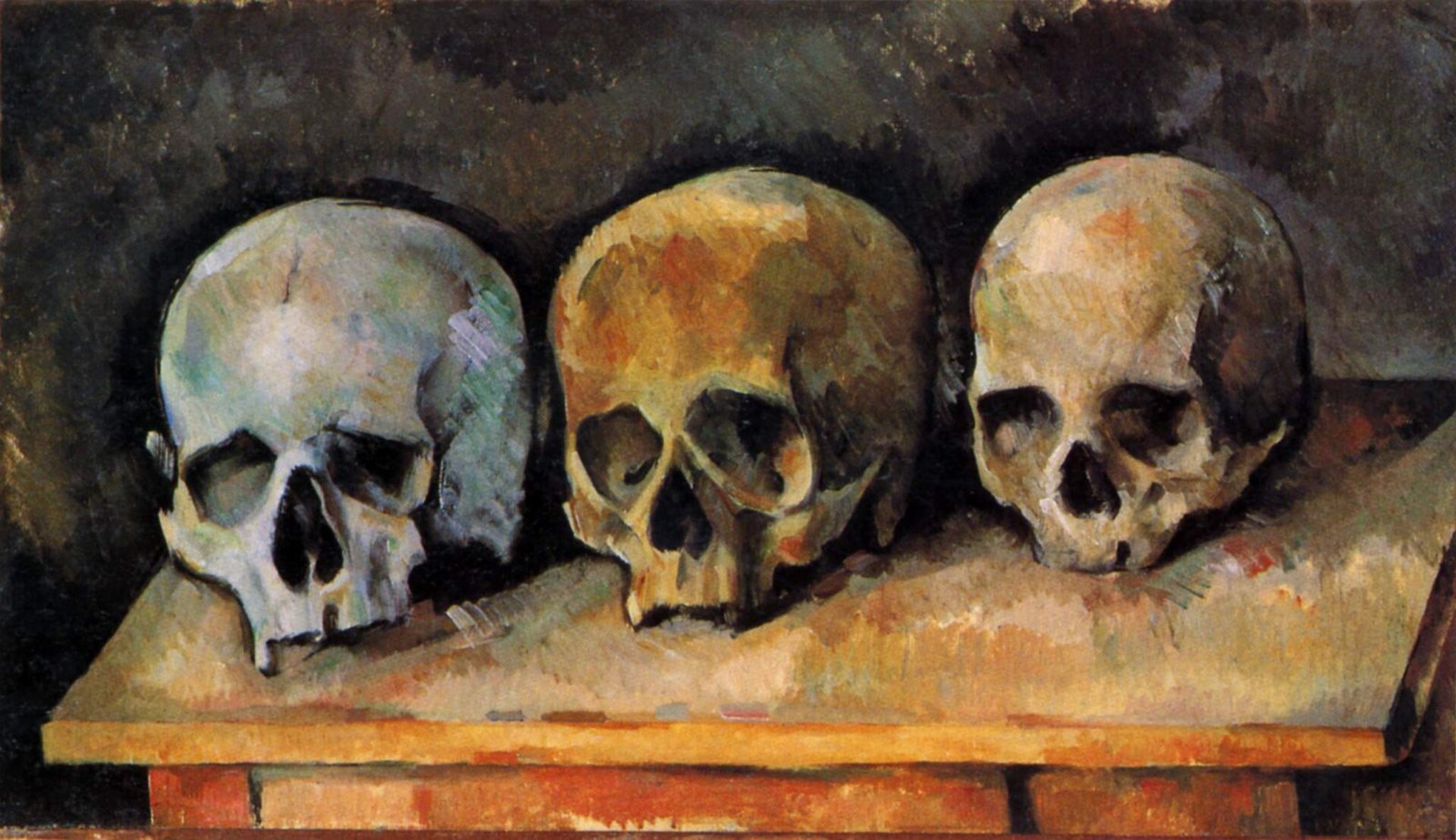
*Pyramid of Skulls* has close relatives. *The Three Skulls*, around 1898, is an oil on canvas at the Detroit Institute of Arts, accession 70.163. The museum classifies it as both a still life and a vanitas, and it is listed as not currently on view. The DIA's own reading is careful: Cézanne may have pursued skulls as formal shapes as much as symbols of death (Detroit Institute of Arts).
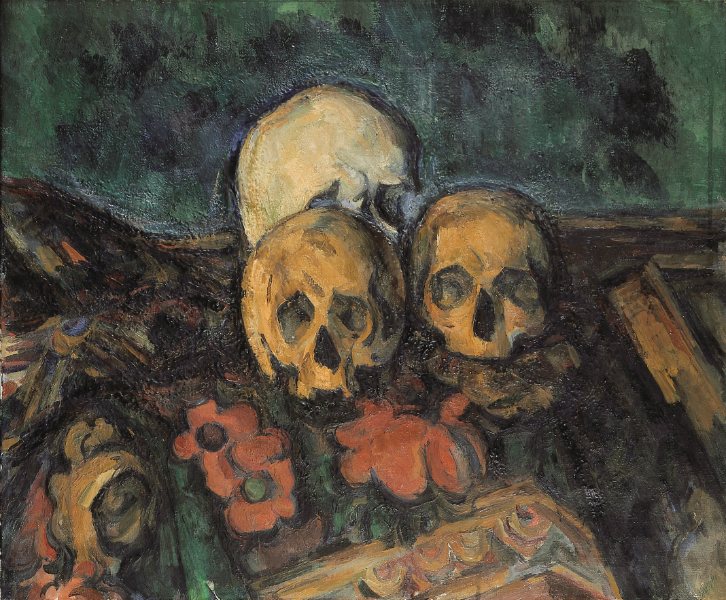
*Three Skulls on an Oriental Rug*, dated 1904 by the catalogue raisonné (FWN 875), sets three skulls on a richly patterned carpet. It belongs to the Kunstmuseum Solothurn in Switzerland, in the Dübi-Müller Foundation collection (Cézanne catalogue raisonné). The Barnes Foundation in Philadelphia holds *Young Man and Skull*, dated 1896 to 1898, a figure painting rather than a still life, and its online record marks the work public domain (Barnes Foundation/visually-similar)). The Getty adds that Cézanne made late skull still lifes between 1902 and 1906 in his studio at Les Lauves near Aix-en-Provence (Getty Research Institute). The Art Institute of Chicago has a *The Three Skulls* of its own, listed in our roundup of famous skull art. Three skulls turn up more than once in his late work, but in Cézanne the number carries no special code; our story on three skulls covers the motif more broadly.
Tap or hover a row to highlight it.
| Work | Date | Medium | Collection or location |
|---|---|---|---|
| WorkSkull and Candlestick | DateAround 1866 | MediumOil on canvas | Collection or locationPrivate collection, Zurich |
| WorkYoung Man and Skull | Date1896 to 1898 | MediumPainting | Collection or locationBarnes Foundation, Philadelphia |
| WorkThe Three Skulls | DateAround 1898 | MediumOil on canvas | Collection or locationDetroit Institute of Arts |
| WorkPyramid of Skulls | Date1898 to 1900 or around 1901 | MediumOil on canvas | Collection or locationPrivate collection, Switzerland |
| WorkThree Skulls on an Oriental Rug | Date1904 | MediumOil on canvas | Collection or locationKunstmuseum Solothurn, Switzerland |
Why skulls, so late in life
The late skulls belong to a hard stretch of Cézanne's life. His mother died on October 25, 1897. The family estate was sold in 1899. He suffered from worsening diabetes and lived in increasing isolation in Aix-en-Provence, according to the chronology in MoMA's *Cézanne: The Late Work* (Museum of Modern Art). It is natural to read a pile of skulls against those dates, and many viewers do.
The museums that hold or study the paintings are more measured. The Detroit Institute of Arts suggests Cézanne may have been interested in skulls primarily as form. The Getty describes them as traditional symbols of the briefness of human existence. Both can be true at once. A skull is a fine object to paint if you care about how a rounded mass sits in space, how light falls across a curved surface and how several similar shapes press against each other, and it also happens to be the most direct image of death a painter can choose.
Faith is the third possibility people raise. The skull-and-candle still life comes out of Christian vanitas imagery and the old image of a saint meditating over a skull, but the late skulls are not documented as devotional statements. Put plainly, Cézanne joined an old memento mori vocabulary to his lifelong interest in volume, color and structure, at a time when death was close to him.
Skulls long before old age
Cézanne did not come to skulls only at the end. *Skull and Candlestick*, around 1866, places a skull beside a candlestick, an open book, wilting flowers and an extinguished candle (Cézanne catalogue raisonné). It is recorded in a private collection in Zurich, as FWN 707. Every object on that table is a standard sign of passing time, which makes it his most openly symbolic skull painting.
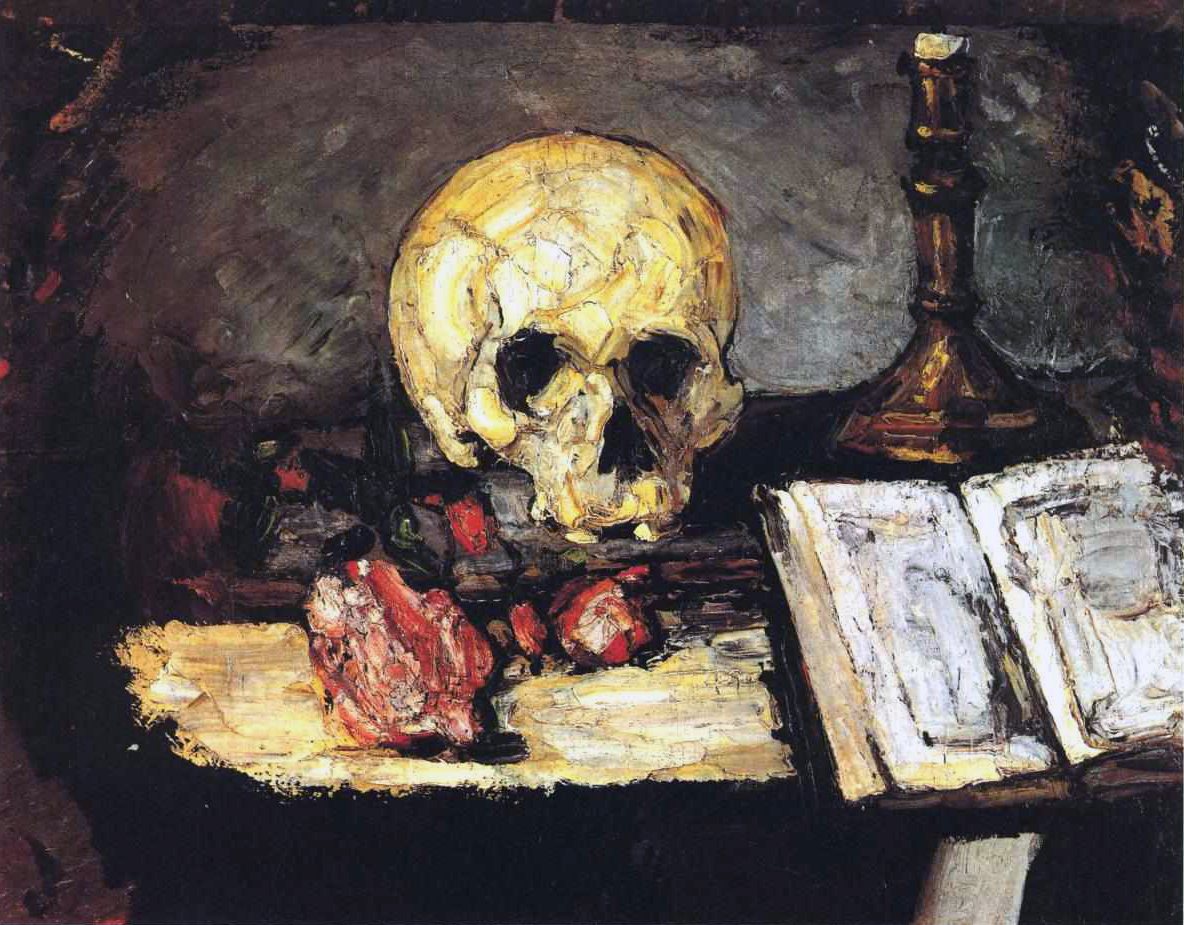
The Art Institute of Chicago's catalogue essay on *The Three Skulls* identifies *Skull and Candlestick* as Cézanne's first vanitas painting and ties it both to the memento mori tradition and to Christian images of saints contemplating skulls (Art Institute of Chicago). The Dutch still lifes behind that tradition, with their candles, bubbles and hourglasses, are the subject of our story on vanitas paintings.
There is a quieter work in between. The Detroit Institute of Arts holds *Skull and Book*, around 1885, a watercolor over black chalk. Its curators point out that skulls were common props in nineteenth-century artists' studios, and they again caution that Cézanne's interest may have been formal as well as symbolic (Detroit Institute of Arts). Seen together, the 1866 painting, the 1885 watercolor and the late canvases show the same object handled three ways: as an open symbol, as a study and finally as a subject he returned to again and again.
Cézanne and the skull, from 1866 to 1907
Tap or hover a step to follow the order.
Around 1866
Cézanne paints Skull and Candlestick, an early vanitas still life.
Around 1885
He makes the watercolor Skull and Book, now in Detroit.
October 25, 1897
His mother dies.
Around 1898
He paints The Three Skulls, now at the Detroit Institute of Arts.
1898 to 1900 or around 1901
He paints Pyramid of Skulls.
1899
The family estate is sold.
1902 to 1906
He works in his Les Lauves studio near Aix-en-Provence, where late skull still lifes continue.
1904
He paints Three Skulls on an Oriental Rug.
1907
A Cézanne memorial exhibition confirms his importance for emerging Cubism.
From Cézanne's studio to Picasso's
Cézanne's influence on Picasso was much wider than one subject. His still lifes showed how objects could be rebuilt through color, repeated planes, shifting viewpoints and simplified structure. MoMA's chronology says the 1907 Cézanne memorial exhibition confirmed his importance for emerging Cubism, especially for Georges Braque and Pablo Picasso (Museum of Modern Art).
Picasso kept skulls close, too. The Guggenheim describes skulls as traditional memento mori subjects that fascinated him throughout his life, and notes that during the German occupation of Paris he made skull still lifes that carry the tense atmosphere of the war (Guggenheim). The museum also connects Picasso's studio skulls with Cézanne's habit of keeping skulls among his studio objects.
That is a real line of descent, a way of treating the skull as both a mortality symbol and a built form, but it is a line between two painters, not between two particular paintings. No single Cézanne skull can be named as the direct model for a single Picasso.
Seeing Cézanne's skulls in person
Planning a visit takes a little care, because two of the best-known skull paintings are privately owned and the others are not always on the wall.
The Detroit Institute of Arts owns *The Three Skulls* of around 1898, currently listed as not on view. The Kunstmuseum Solothurn holds *Three Skulls on an Oriental Rug*; confirm with the museum that it is on display before you plan a trip around it. The Barnes Foundation in Philadelphia holds 69 works by Cézanne, including *Young Man and Skull*, though which works hang in which gallery can change. *Pyramid of Skulls* and *Skull and Candlestick* are in private collections in Switzerland, so watch exhibition listings for a loan.
There is one more place with a direct link to these paintings. Cézanne's studio at Les Lauves near Aix-en-Provence is open as a museum and preserves objects he painted in his still lifes, including skulls (Getty Research Institute). None of the paintings above lives there, but the skulls he looked at do. Whichever stop you choose, check the museum's collection page before you travel.
How well do you know Cézanne's skulls?
Answer every question to check.
Questions about Cézanne's skulls
Short answers to the questions that come up most.
Why did Cézanne paint skulls?
Cézanne painted skulls for more than one reason: they belong to the European vanitas tradition, and they gave him a solid, rounded form for studying volume, color and space. The late skull paintings followed personal losses and illness, yet no single cause is documented as the explanation.
Where is Cézanne's Pyramid of Skulls?
It is recorded in a private collection in Switzerland. It is not identified with any public museum, so a loan exhibition is the likeliest chance to see it.
When was Pyramid of Skulls painted?
It is dated 1898 to 1900 or around 1901, depending on the catalogue. Either way it falls in the years just after his mother's death in October 1897.
Where was Pyramid of Skulls made?
It was made in the years Cézanne was living and working in and around Aix-en-Provence. His Les Lauves studio there dates from 1902, slightly later than this painting.
How did Cézanne influence Picasso?
Cézanne showed Picasso how to rebuild objects through color, planes and changing viewpoints, and the 1907 memorial exhibition put that work in front of him and Braque as Cubism was emerging. The Guggenheim also links Picasso's studio skulls to Cézanne's.
More skulls in art
Cézanne's skulls sit between two other stories in this series: the skull Holbein hid in a portrait in 1533, told in The Ambassadors skull, and the bright, repeated skulls of 1976 in Andy Warhol's skull paintings. Around the time of Cézanne's *Skull and Book*, Van Gogh painted a skeleton with a cigarette. For the idea underneath them all, read what memento mori means, and for the skull's many other meanings, skull symbolism.
Terms in this story
Tap a term to see what it means.
Still life. A painting of arranged objects, such as skulls, books, candles or flowers, rather than people or scenery.
---