

No. 121
Mari Lwyd: The Welsh Horse Skull That Knocks at Christmas, and Where to See It
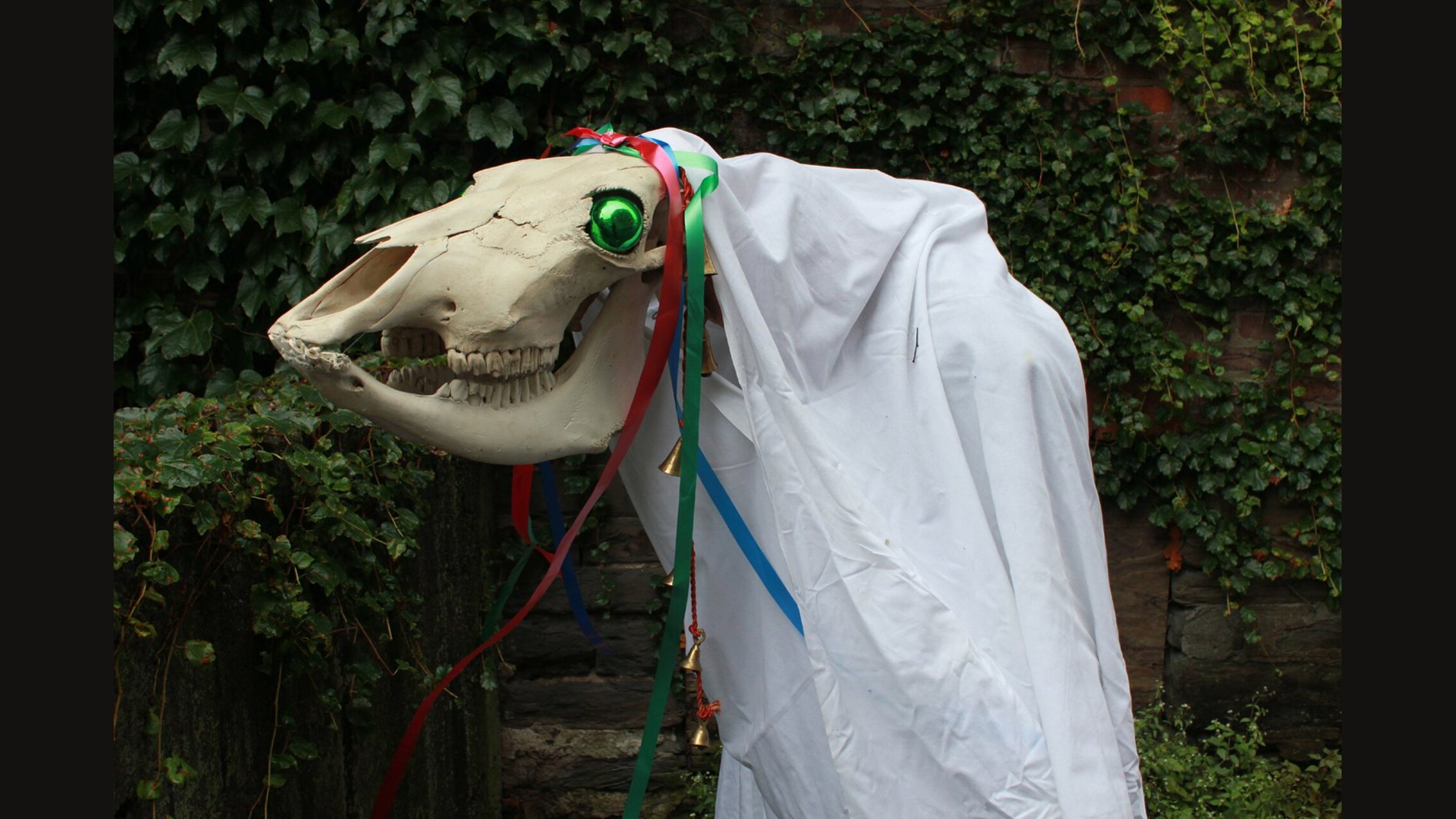
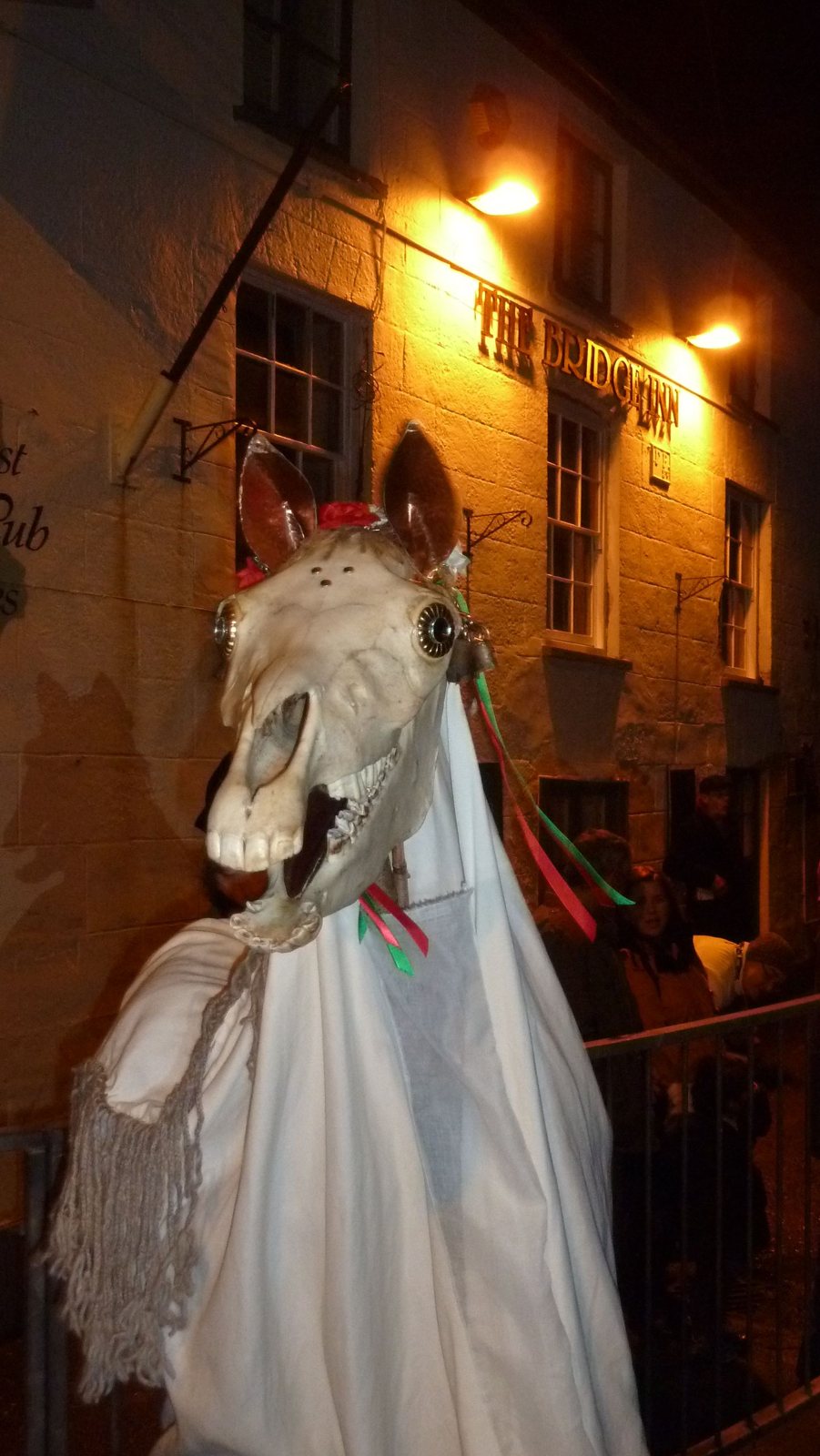
The horse skull on a pole, dressed in ribbons and a white sheet, is the Mari Lwyd, or Y Fari Lwyd, a Welsh winter wassailing custom. A person hidden under the sheet carries the decorated skull from house to house or pub to pub with a party of singers, and at each door they ask, in song, to be let in (Museum Wales). The traditional season runs from Christmas Day to Twelfth Night, and in some communities on into Hen Galan, the Welsh New Year, around 13 January. Historically it belonged above all to South Wales, especially Glamorgan, Monmouthshire and Carmarthenshire, and today you can still meet a Mari at events from Llangynwyd to Chepstow.
So, if a photo of a white-sheeted horse with ribbons and staring eyes stopped you mid-scroll, you have met a custom that is part song, part poetry contest and part house call, with a long and argued-over history behind it.
What the Mari looks like
Traditionally, the Mari's head is a real horse skull. Museum Wales describes a skull mounted on a pole, decorated with ribbons, rosettes and eyes, and covered with a white sheet, with the bearer hidden underneath (Museum Wales collection record). Not every Mari has a real skull, though. Historical and modern versions have also been made of wood, paper, cardboard and other substitutes, so the head you saw may be bone or may be a careful copy.
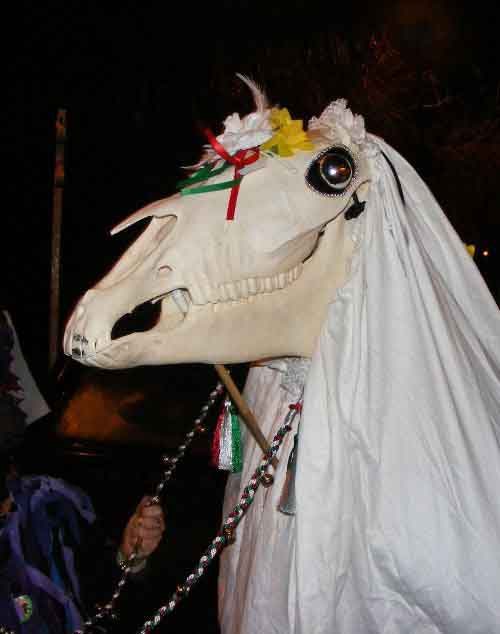
The National Museum of History at St Fagans, near Cardiff, keeps a Mari from Llangynwyd in Glamorgan dated to about 1900. It shows what a Mari looked like in the years when the custom was at its most popular: a skull, its trimmings, and the sheet that turns a person into a tall, pale horse at the door.
Knocking at the door: the pwnco
The heart of the visit is the pwnco, the rhyming exchange at the door. The Mari party asks in song to come in. The people inside refuse, tease or challenge them in verse, and the Mari party answers back. The contest goes on until one side runs out of verses or the household gives in and lets the Mari over the threshold (Museum Wales). St Fagans describes it as an improvised rhyme and verse contest that could last for an hour, which is a long time to stand outside on a Welsh winter night.
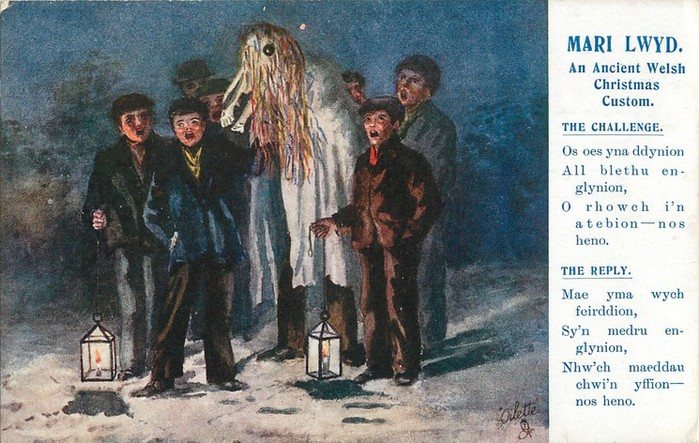
People today reach for modern comparisons. In one r/Wales thread, someone described it as a horse skull turning up at your door for a "rap battle". That is how a lot of people meet the custom now, and it is not far off the spirit of the thing: wit, quick replies and a crowd waiting to see who cracks first. Mari Lwyd performer Robert Evans has written about the pwnco and its verses in Gennad i Ganu: Pondering the Pwnco, and one modern verse he published begins "Wel, dyma ni'n dwad", roughly "Well, here we come calling", to ask permission to sing.
A song from Brynmenyn
Some of the old words survive because people remembered them. In October 1953, at Brynmenyn near Bridgend, a Mari Lwyd song was collected from William Morgan Rees, a railway worker born in 1883 who remembered performances near Bridgend until about 1933 (Museum Wales, The Mari Lwyd Song). Museum Wales gives the opening in English translation:
> Here we come > To ask may we have leave > To ask may we have leave > To ask may we have leave > To sing.
The repetition is the point. The singers are polite and stubborn at once, asking again and again until someone answers. The song goes on to ask leave to sing, to invite the people inside to compose englynion, the short, strict-metre verses of Welsh poetry, and to request generous slices of Christmas cake and drink from the barrel. A Mari, in other words, arrives hungry and thirsty and in a mood for poetry.
What does Mari Lwyd mean?
"Mari Lwyd" is commonly translated as "Grey Mare", but the meaning of the name is disputed. The Welsh folklorist Iorwerth C. Peate argued for a reading connected with "Holy Mary", while the folklorist E. C. Cawte favoured "Grey Mare" (Horniman Museum). Both readings have their supporters, and neither has settled the question.
You may also hear a Nativity tale about a pregnant mare turned out of the stable. It is a lovely story, but it is a later explanation for the custom rather than an established record of how it began. The same caution applies to the idea that the Mari is definitely a pagan or pre-Christian survival. That claim is popular, and some modern groups describe an ancient Celtic origin, but a pre-Christian origin remains unproven.
Two centuries of the Mari
The earliest written record of the Mari Lwyd is generally dated to 1800, in the Reverend J. Evans's A Tour Through Part of North Wales. Museum Wales gives an earlier account from 1798 (Museum Wales). Either way, the custom has been written about for more than two hundred years.
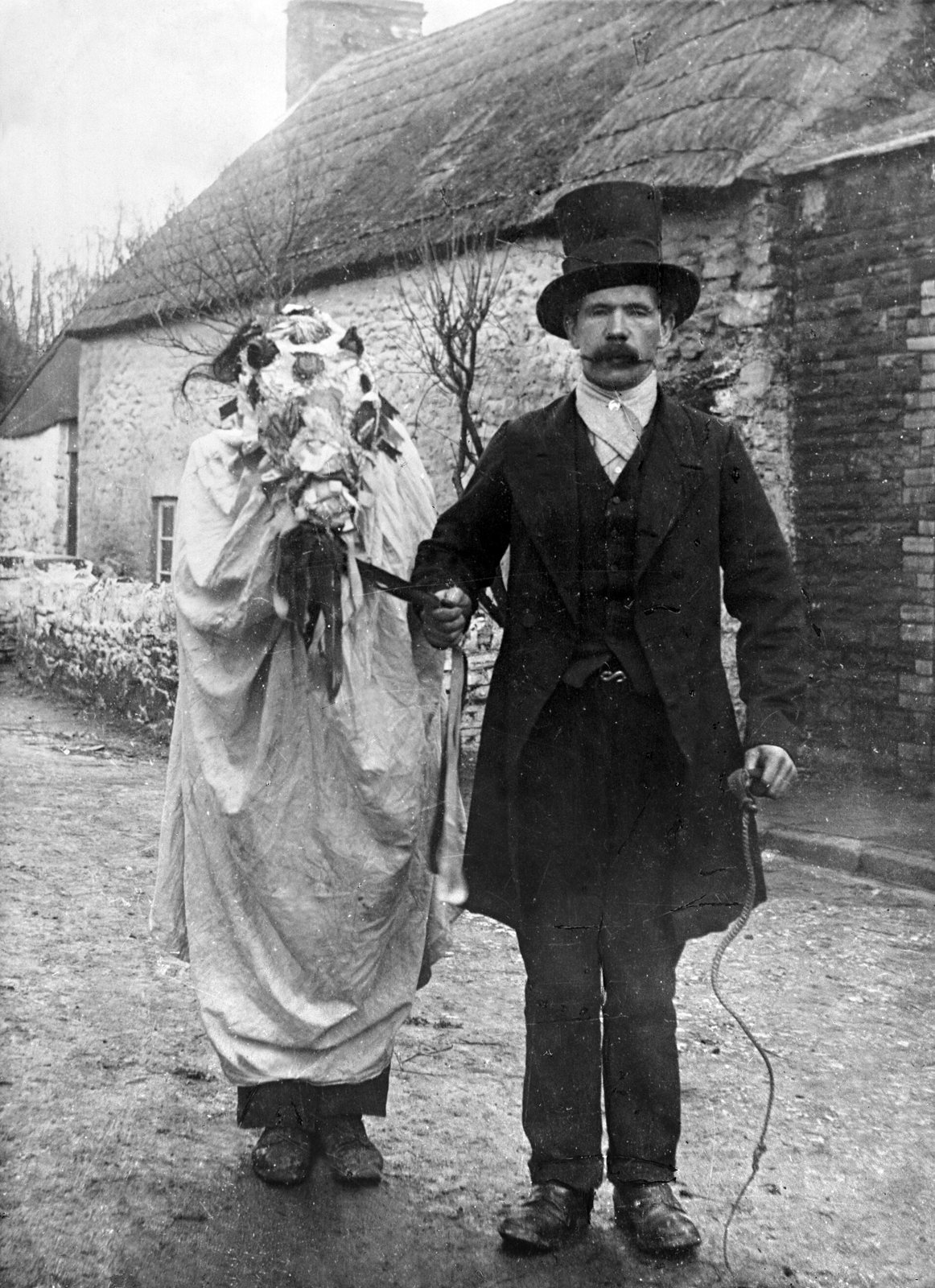
Museum Wales describes it as particularly popular between 1850 and 1920 in Glamorgan, Monmouthshire and Carmarthenshire. It was a custom of southern Wales rather than one practised the same way across the whole country. During the twentieth century it declined. Part of the reason was that fewer people took part in Welsh, and part was that Methodist and other Nonconformist communities criticised the drinking and disorder that came with some performances (Wales.com).
The folklorist Iorwerth Peate recorded the Mari in Cardiff, Bridgend, Llangynwyd, Neath and other parts of Glamorgan during the 1930s and 1940s. By the 1960s only a few processions remained. Later in the twentieth century, revivals took hold: the Llantrisant Folk Club, St Fagans itself, and a family tradition at Llangynwyd kept the Mari on the road (Mari Lwyd Cymru).
The Mari Lwyd through the years
Tap or hover a step to follow the order.
1798 or 1800
Earliest written record, depending on how the early account is dated.
1850 to 1920
The custom is especially popular in Glamorgan, Monmouthshire and Carmarthenshire.
1930s and 1940s
Iorwerth Peate records the Mari in Cardiff, Bridgend, Llangynwyd, Neath and elsewhere in Glamorgan.
October 1953
The Mari Lwyd song is collected from William Morgan Rees at Brynmenyn, near Bridgend.
1960s
Only a few processions remain; revivals at Llangynwyd, Llantrisant and St Fagans follow later in the century.
14 and 15 December 2024
St Fagans stages Mari Lwyd performances.
24 January 2026
The Chepstow Wassail and Mari Lwyd is held in Chepstow.
Where to see a Mari Lwyd today
The Mari is very much alive, and in more places than its old heartland. Here is where people take part, according to Wales.com, the organisers and Museum Wales (Wales.com):
Places where the Mari Lwyd still goes out
Tap a card to bring it forward.
- Llangynwyd, near Maesteg: A family tradition visits the Old House Inn on New Year's Day.
- Chepstow: The Chepstow Wassail and Mari Lwyd joins Welsh Mari customs with an English wassail on the border; it was held on 24 January 2026 at Chepstow High Street, the castle and the museum.
- St Fagans National Museum of History: Staged Mari Lwyd performances on 14 and 15 December 2024.
- Llantrisant: The Folk Club keeps up a revived tradition and still performs locally.
- Gellionnen Chapel, near Pontardawe: Listed among current Mari Lwyd places.
- Llansoy, Monmouthshire: Listed among current Mari Lwyd places.
- Dinas Mawddwy: Listed among current Mari Lwyd places.
- The London Welsh Centre: Listed among current Mari Lwyd places, in London.
- More towns: Modern events and processions in Holywell, Pembrokeshire, Cardiff, Bridgend, Neath and Caerphilly.
The Chepstow event is a good one to know about if you are curious about how customs meet at a border. Its organisers describe it as bringing Welsh Mari Lwyd performers together with an English wassailing ceremony (Chepstow Wassail Mari Lwyd), and the 2026 gathering was listed by Chepstow Town Council. St Fagans presented its December 2024 performances as part of its Christmas traditions programme.
Dates and formats vary from one community to the next. If you hope to see a Mari, confirm the current organiser's event details before you travel, since each group sets its own date and route.
Cousins across Britain
The Mari Lwyd belongs to a wider family of British "hooded animal" and hobby-horse customs, but each one is regional and has its own character (Horniman Museum).
The Mari Lwyd's relatives in Britain
Tap a card to bring it forward.
- Hoodening, Kent: A wooden horse head, usually carried under a cloth, with groups visiting houses and shops for payment.
- The Old Tup, Derbyshire and Yorkshire: A hobby horse with a goat's head, performed around Christmas in parts of both counties.
- Other English customs: The Old Horse, the Old Ball and the Broad of the Cotswolds.
The folklorist E. C. Cawte compared these traditions in his book Ritual Animal Disguise, published in 1978. He pointed to features they share: an animal figure, a hidden bearer, a seasonal procession, a request for food or payment, and a group of performers. He did not establish one ancient origin for all of them. With no late medieval records, and with customs that differ so much by region, scholars have considered links with the popularity of hobby horses in the sixteenth and seventeenth centuries (Folklife Quarterly).
So, the Mari Lwyd has relatives, but it is not the same as hoodening or the Old Tup. Its real skull, its white sheet and above all its Welsh-language pwnco at the door make it its own thing.
Questions people ask about the Mari Lwyd
These are the questions people ask most often about the Mari, in English and in Spanish, with short answers.
What is the Mari Lwyd?
The Mari Lwyd is a Welsh winter wassailing custom in which a decorated horse skull on a pole, under a white sheet, is carried from door to door in the Christmas season. Its party sings and trades verses with the people inside in a contest called the pwnco before being let in.
What does Mari Lwyd mean?
"Mari Lwyd" is usually translated as "Grey Mare", though the meaning is debated. Iorwerth C. Peate supported a "Holy Mary" reading, while E. C. Cawte favoured "Grey Mare". In Welsh the custom is also called Y Fari Lwyd.
Is the Mari Lwyd a real horse skull?
Traditionally, yes: the Mari is a real horse skull decorated with ribbons, rosettes and eyes. Some historical and modern Maris use wood, paper, cardboard or other materials instead. Museum Wales describes the St Fagans Mari from Llangynwyd, dated about 1900, as a real horse skull with its trimmings.
Is the Mari Lwyd pagan?
A pagan origin for the Mari Lwyd has not been established. The earliest written record dates from 1798 or 1800, and folklorists treat claims of a definite pre-Christian survival as unproven. The Nativity tale of a mare turned out of the stable is also a later explanation, not a record of how the custom started.
Where can I see a Mari Lwyd?
You can see a Mari Lwyd at community events in Wales and beyond, including Llangynwyd on New Year's Day, the Chepstow Wassail and Mari Lwyd (held on 24 January 2026), Llantrisant and the London Welsh Centre, with St Fagans staging performances in December 2024. Confirm the organiser's current date and route before travelling.
What is the pwnco?
The pwnco is the rhyming contest at the door between the Mari party and the people inside. Each side improvises verses until one runs out of replies, and St Fagans says it could last for an hour.
How well do you know the Mari Lwyd?
Answer every question to check.
A skull at the door, asking to sing
The Mari Lwyd is easy to love once you know what is going on under the sheet. It is a horse skull, yes, but it arrives with manners of a sort: it asks, over and over, to be allowed to sing, and it argues its way inside with poetry. If you enjoy the way one animal skull can carry a whole community's winter, you may also like our wider look at skull symbolism, the story behind the cow skull, and other seasonal customs in skeletons and Halloween.
Terms in this story
Tap a term to see what it means.
Mari Lwyd. A Welsh winter custom in which a decorated horse skull on a pole, under a white sheet, visits houses and pubs in the Christmas season. Also called Y Fari Lwyd.
---