

No. 005
What Is a Gashadokuro? The Legend of Japan's Giant Skeleton and How Old It Really Is
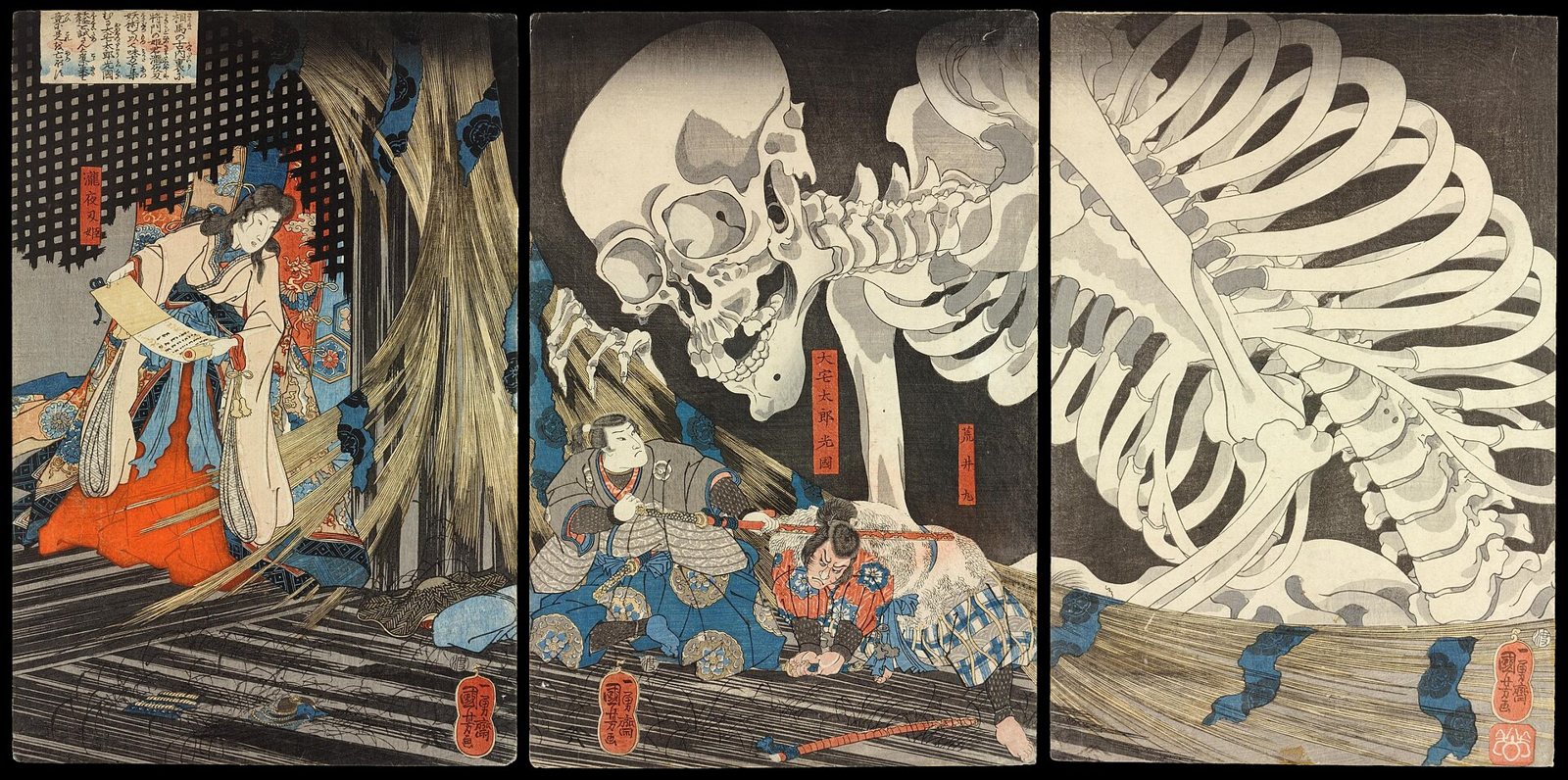
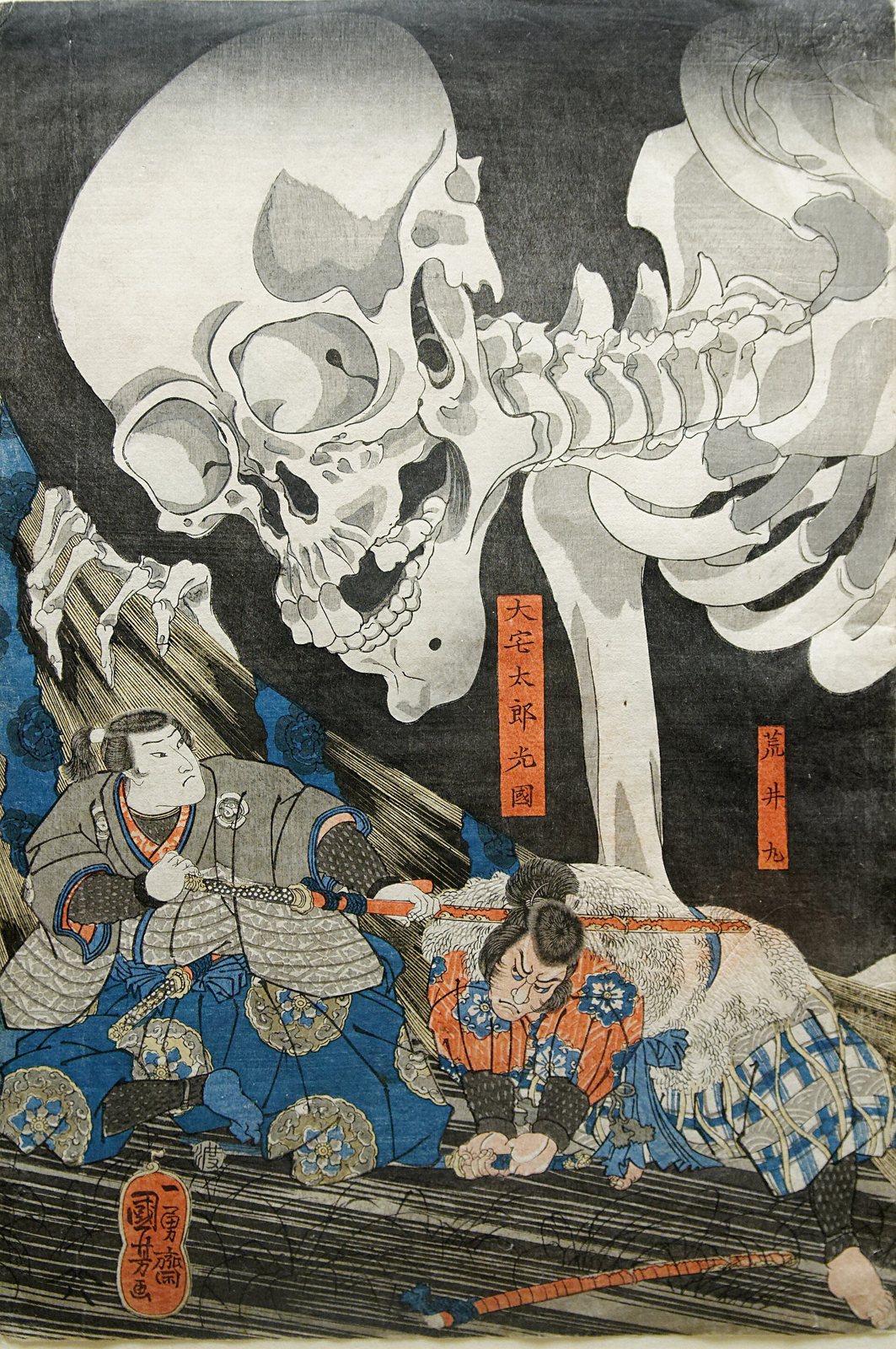
A gashadokuro (がしゃどくろ) is a Japanese yōkai, a supernatural creature of folklore, imagined as a gigantic skeleton that walks through open country at night. In later retellings its bones rattle as it moves and it grabs or attacks people who cross its path. As for its age, the name first appears in print in September 1966, in a Japanese magazine feature that scholar Ryūhei Hirota attributes to the writer Saitō Morihiro. The famous woodblock print of a giant skeleton looming over a ruined palace, by Utagawa Kuniyoshi, is about 120 years older. It shows a skeleton spectre summoned by a sorceress princess, and later books paired that image with the gashadokuro's name.
So, the giant skeleton you met in an anime or a game has two histories: a creature named in the 1960s, and a much older Japanese habit of drawing skeletons, sometimes to frighten, sometimes to teach and sometimes to make you laugh.
What the gashadokuro is and what it does
At its core, the gashadokuro is simple: a skeleton of enormous size, roaming dark fields and open country at night. That is the part the early descriptions support. Later retellings add the sound of rattling bones and attacks on people.
The name itself helps with the rattling. As YOKAI.JP explains, the opening of the name is commonly heard as sound-symbolic of rattling, and the first printed record wrote the whole name in hiragana as がしゃどくろ.
Popular accounts online go much further. You will read that the gashadokuro is assembled from the bones of people who died of famine or in battle, that it drinks blood, that it stands at some exact and alarming height, or that it has particular weaknesses. Those details belong to later layers of publishing and entertainment, added by different writers at different times, rather than to one old tradition. There is no fixed height in the early accounts, only "gigantic," which is plenty when the subject is a skeleton. If you like your skeletons merely very tall, the 12-foot skeleton of American front yards is a more manageable size.
Where the name comes from: a 1966 magazine and Shigeru Mizuki
The documented record starts in September 1966. That month, the Japanese girls' magazine *Bessatsu Shōjo Friend* (volume 2, number 9) ran an unsigned feature titled "A Guide to Japanese Yōkai Around You," on pages 111 to 126, and the gashadokuro was in it.
Ryūhei Hirota, in a 2021 study called "Yōkai in Postwar Japan" in the *Japanese Journal of Religious Studies*, attributes the creature to the writer Saitō Morihiro and notes that no historical record of it exists before the late 1960s. His study is about yōkai in postwar Japanese publishing, which is where the gashadokuro was born.
Two years later, in 1968, the manga artist Shigeru Mizuki included the gashadokuro in a collection of yōkai. Appearing in his collection helped the gashadokuro read as though it were an established traditional being. That is how a creature from 1966 came to feel ancient so quickly.
Kuniyoshi's giant skeleton
The image most people connect with the gashadokuro is older and has its own story. Utagawa Kuniyoshi made a triptych, a print spread across three sheets, usually dated about 1845 to 1846. Its full title is *Princess Takiyasha Calling up a Monstrous Skeleton Specter at the Old Palace in Soma*, and in English it is also known as *Takiyasha the Witch and the Skeleton Spectre*.
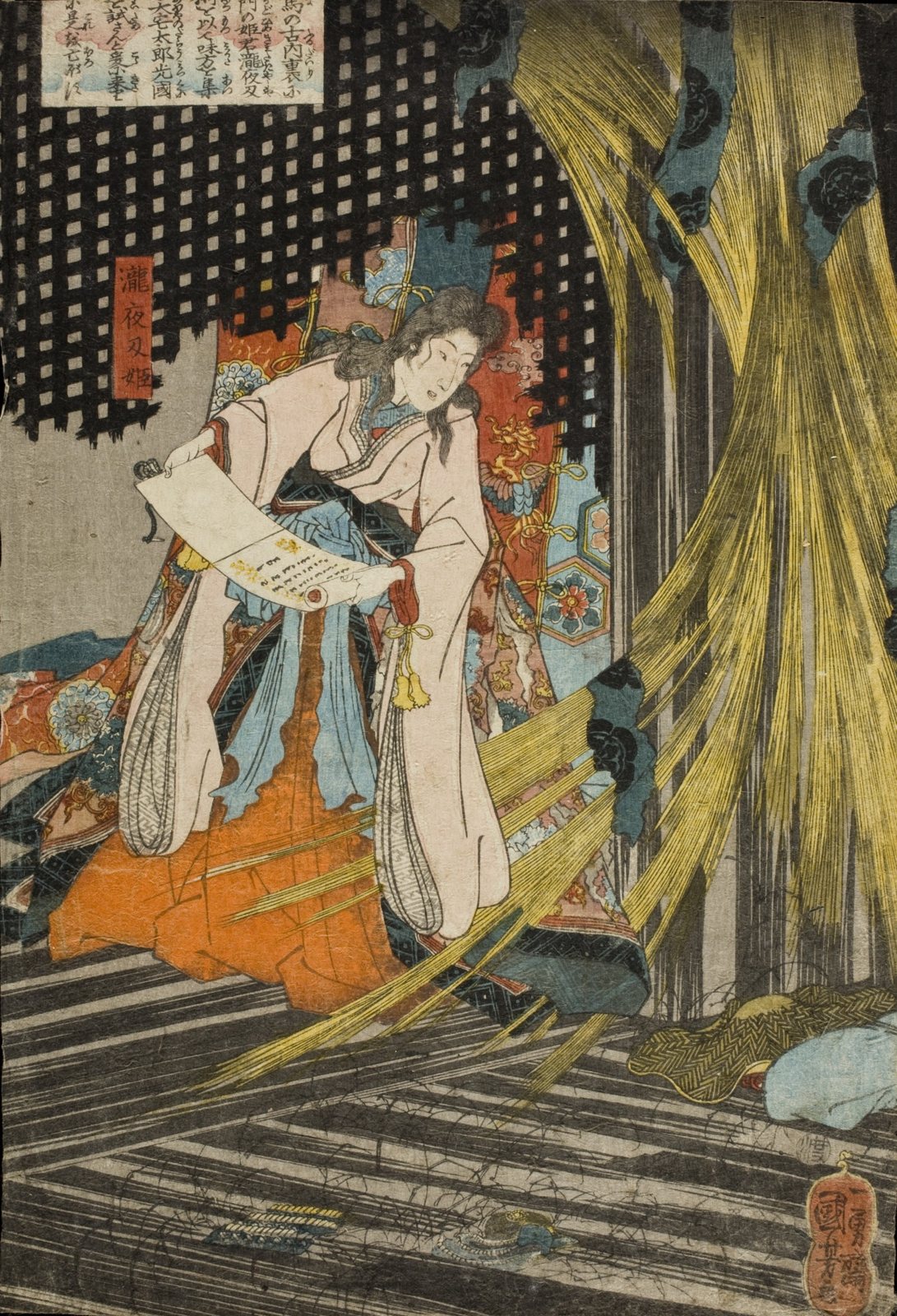
Princess Takiyasha is the daughter of the rebel Taira no Masakado, and in the print she uses sorcery at the ruined Sōma palace. Ōya Tarō Mitsukuni, a vassal of Minamoto no Yorinobu, comes to investigate the palace and faces what she has summoned. Kuniyoshi gives the scene its center: one enormous skeleton.
That skeleton is Kuniyoshi's invention as an artist. The Tokyo Fuji Art Museum, which holds the print, explains that the original literary work had several skeletons, and Kuniyoshi replaced them with one enormous one for dramatic effect. It worked. The British Museum holds another impression (accession number 1915,0823,0.915-916), and it is the image many people now connect with the gashadokuro.
Is the Kuniyoshi skeleton a gashadokuro? Not by name. The print shows a skeleton spectre called up by Princess Takiyasha, about 120 years before anyone wrote the word gashadokuro. The pairing came later, through postwar yōkai books and popular culture, which gave the new creature a ready-made face. For other famous works of skull and skeleton art, see famous skull art.
The print is also easy to enjoy at home. The Tokyo Fuji Art Museum offers its digital image under CC0, and Wikimedia Commons marks its reproduction of the British Museum copy with the Public Domain Mark.
Older skeletons in Japanese art and Buddhist teaching
Long before the gashadokuro, skeletons had serious work to do in Japan. Ikkyū Sōjun (1394 to 1481), a Zen monk and poet, is associated with *Ikkyū Gaikotsu*, or *Ikkyū's Skeletons*, an illustrated Buddhist text in which skeletons go about ordinary human life. The point is impermanence: underneath every person going about their day is a skeleton, and the self we hold on to does not last. Waseda University's library notes that the work was established in 1457 and holds a later edition printed in Osaka in 1692.
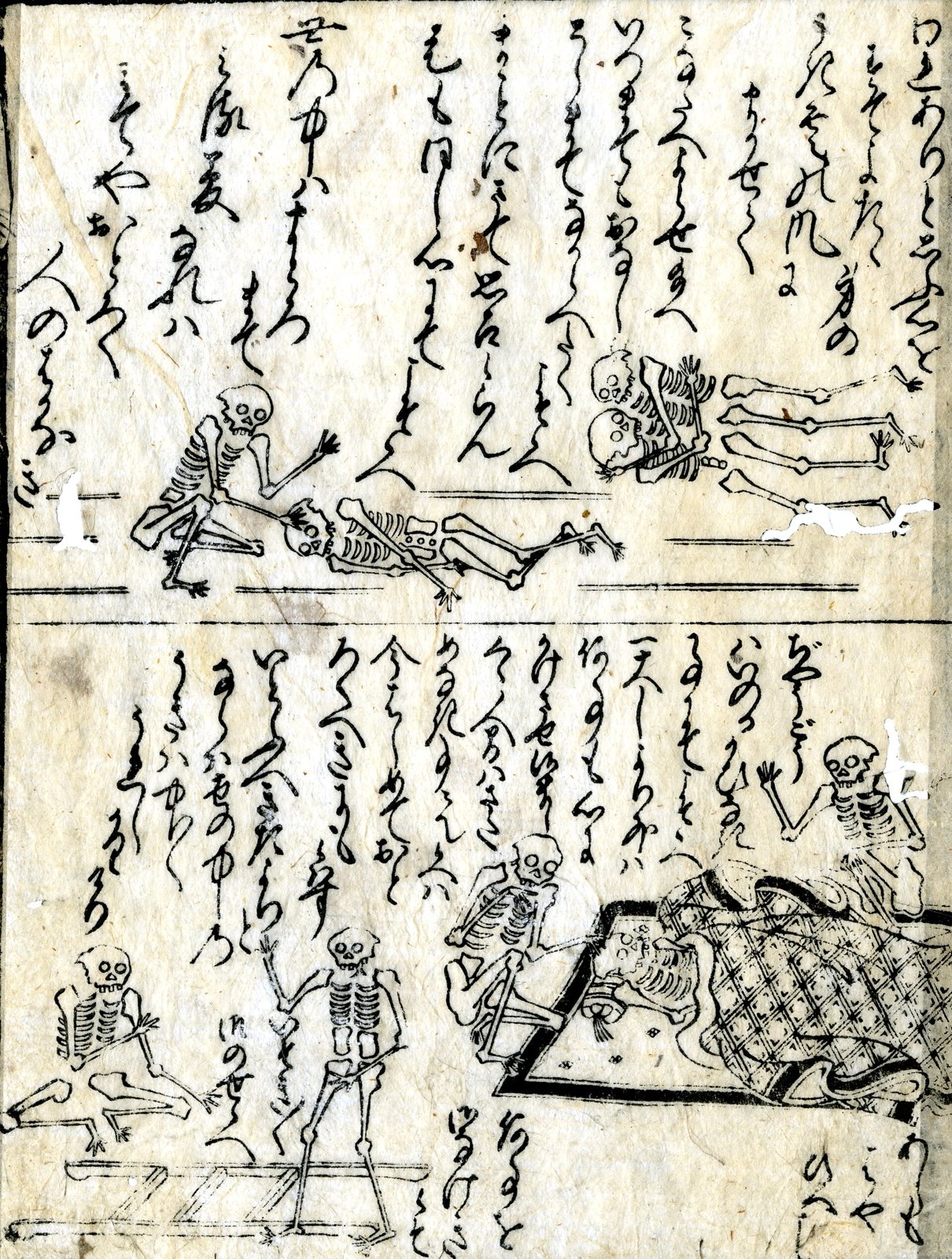
An English translation preserved by Ōtani University describes skeletons gathering in a dream, and a skeleton teaching that personal memories and worldly identity are only temporary. Readers who know the European idea of memento mori, the reminder that you too will die, will recognize the spirit of it, as will anyone who has seen the dancing skeletons of the danse macabre.
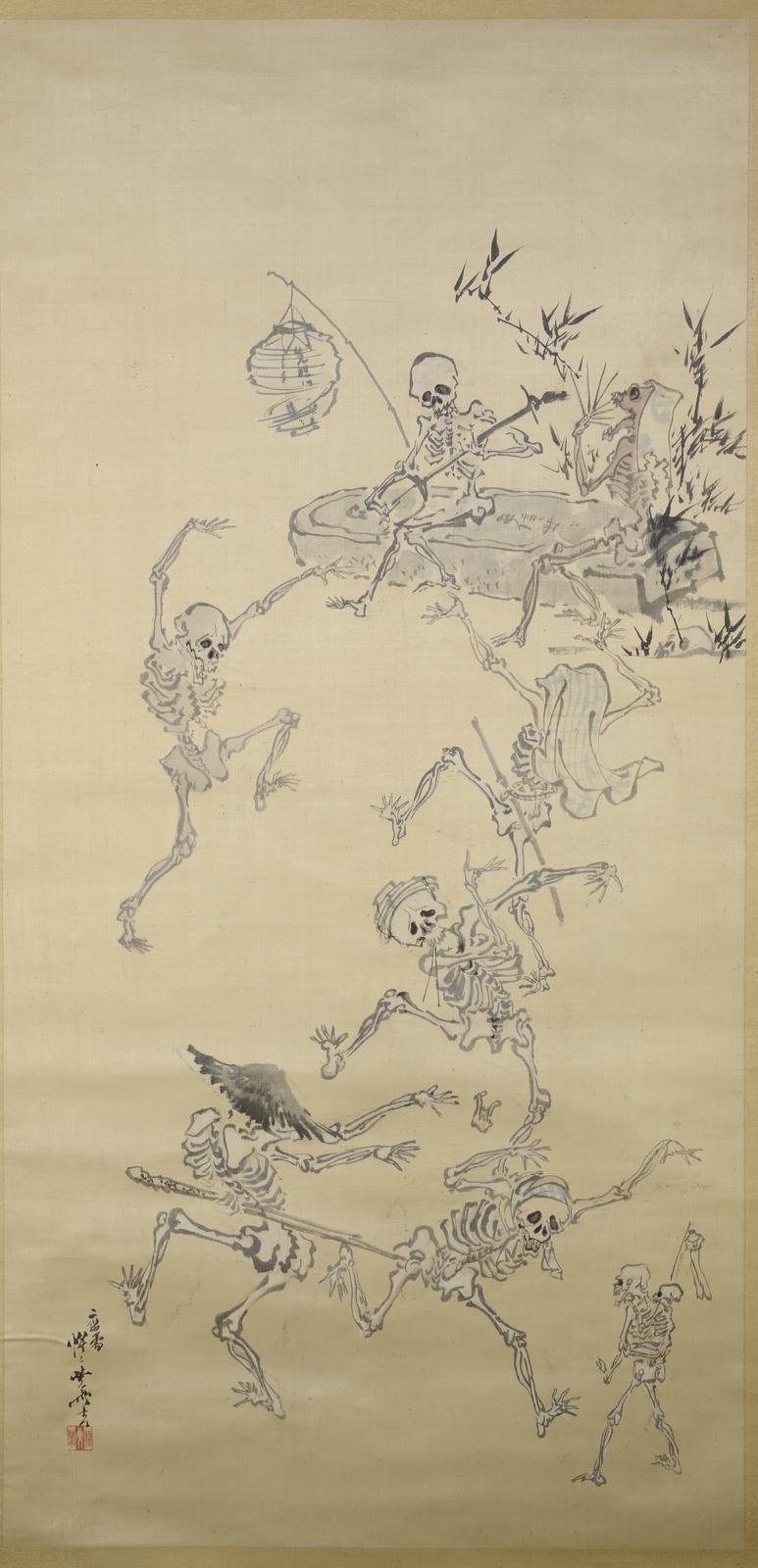
Four centuries later, Kawanabe Kyōsai gave Japan's skeletons a night out. In the Meiji period, Kyōsai drew and painted skeletons doing everything people do. The Ota Memorial Museum of Art's article on Kyōsai's skeletons describes skeletons in his *Kyōsai Manga* sumo wrestling, playing instruments, drinking, dancing, performing Kabuki scenes and holding banquets. They are comic and full of life, more party guests than monsters. One of his ink works, titled simply *Skeletons*, is held by the Itabashi Art Museum, according to Art Platform Japan.
Skeletons in Japanese art, and the gashadokuro
Tap or hover a step to follow the order.
1457
Ikkyū Gaikotsu, the illustrated Buddhist skeleton text associated with Ikkyū Sōjun, is established.
1692
A later edition of Ikkyū Gaikotsu is printed in Osaka.
About 1845 to 1846
Utagawa Kuniyoshi makes his triptych of Princess Takiyasha calling up a giant skeleton spectre.
September 1966
The gashadokuro appears in Bessatsu Shōjo Friend, in a feature attributed to Saitō Morihiro.
1968
Shigeru Mizuki includes the gashadokuro in a yōkai collection.
2025
Toei Animation and Toydium add a gashadokuro boss to the horror game NoroiKago: The Grudged Domain.
The gashadokuro in anime and games
Modern stories treat the gashadokuro as a giant enemy, an ally, a boss or a summoned being, depending on who is telling it. A few examples, each named as its publisher describes it:
In the manga and anime *Nura: Rise of the Yokai Clan*, published in English by VIZ, the gashadokuro is one of the named yōkai tied to the series' supernatural clans. Nintendo's listing for the Switch game *Haunted Dungeons: Hyakki Castle* includes the giant skeleton Gasha Dokuro among its Japanese yōkai. And in 2025, Toei Animation and Toydium announced a gashadokuro boss and a related stage for the PC horror game *NoroiKago: The Grudged Domain*, where the creature attacks from the center of the stage while a separate giant hand moves through the area.
Every one of these builds its own version, so the gashadokuro you fought in one game may not behave like the one in a manga. If you want to compare versions, name each by its title, publisher and release date, and you will see how much each adds.
A modern yōkai with old bones
None of this makes the gashadokuro less interesting. It is a real character of postwar Japanese yōkai culture, born in a 1966 magazine and carried forward by Shigeru Mizuki's 1968 collection and later by anime and games. It also stands on top of something genuinely old: centuries of Japanese artists and teachers using the skeleton to say something, whether that was Ikkyū's lesson about impermanence, Kuniyoshi's drama at the Sōma palace or Kyōsai's skeletons drinking at a banquet. For the wider story of why skulls and skeletons mean so much around the world, see skull symbolism.
How well do you know the gashadokuro?
Answer every question to check.
Common questions about the gashadokuro
What does a gashadokuro do?
In modern descriptions, a gashadokuro walks through dark fields at night, rattles as it moves and grabs or attacks people. The earliest core is simply a giant skeleton roaming open country. The idea that it is built from the bones of famine or war dead is a later addition to the story.
Are gashadokuro real or fake?
The gashadokuro is real as a character of modern Japanese folklore and fiction, but there is no evidence that a literal giant skeleton exists. The named creature first appears in postwar Japanese yōkai publishing in 1966, attributed to the writer Saitō Morihiro.
What is the deadliest yōkai?
There is no authoritative Japanese ranking of the deadliest yōkai. The gashadokuro is often portrayed as one of the most dangerous because of its enormous size and its attacks on people, but which yōkai counts as deadliest depends on the particular story, book, game or anime.
Where to go next
If the giant skeleton got you here, there is plenty more bone to follow. For more art built around skulls and skeletons, see famous skull art, and for the European tradition of skeletons as teachers, read about memento mori and the danse macabre. Death figures from other cultures appear in our story on gods of death.