

No. 088
Mrs. Ples: The Sterkfontein Skull, Her Age and Whether She Was Female
Mrs. Ples is the nickname of Sts 5, an almost complete cranium of *Australopithecus africanus*, an early human relative. Robert Broom and John T. Robinson of the Transvaal Museum found it on 18 April 1947 at Sterkfontein, in Gauteng, South Africa. She is usually described as about 2.1 to 2.8 million years old, though scientists still argue over the exact age of the cave layer she came from.
The name comes from Broom's first scientific label for the fossil, *Plesianthropus transvaalensis*, and from his belief that the skull belonged to an adult female. Later researchers have argued that "she" may have been a small male, and that question is still open. The original fossil is kept in Pretoria by the Ditsong National Museum of Natural History.
A skull out of the Sterkfontein rock in 1947
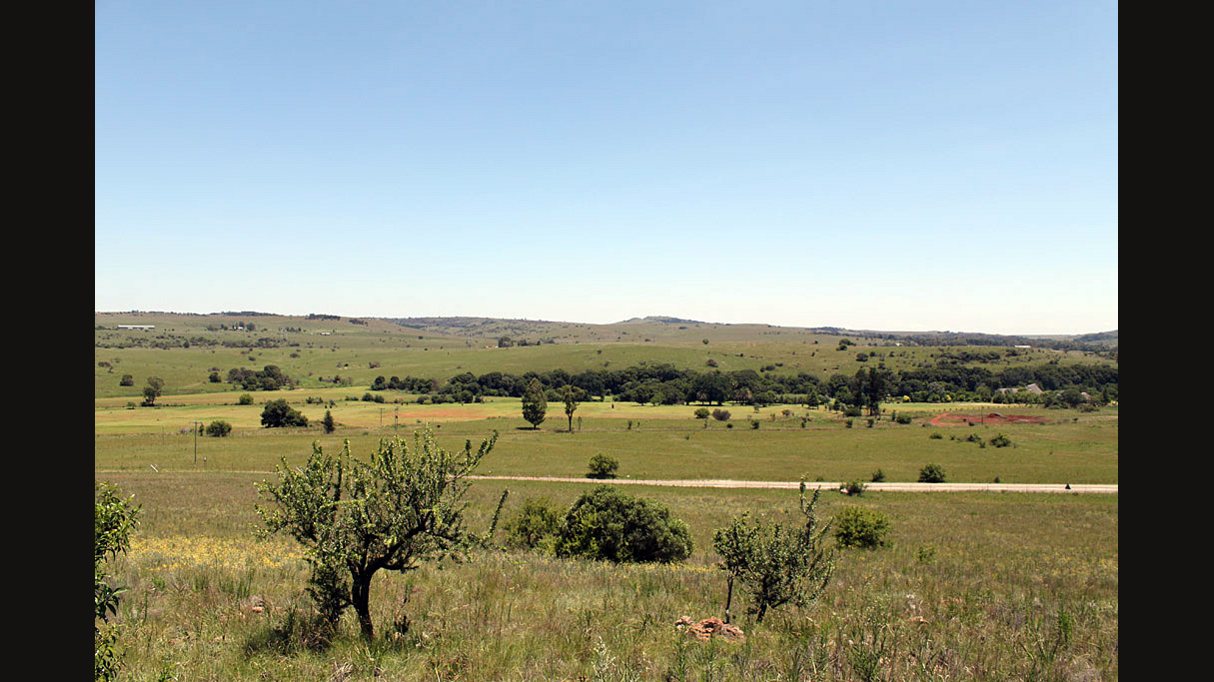
Sterkfontein is a cave site in Gauteng. On 18 April 1947, Robert Broom and John T. Robinson of the Transvaal Museum recovered an almost complete cranium from the breccia, the hard, cemented rubble that fills the old cave. It went into the catalogue as Sts 5. Broom and Robinson reported their Sterkfontein material in Nature that same year.
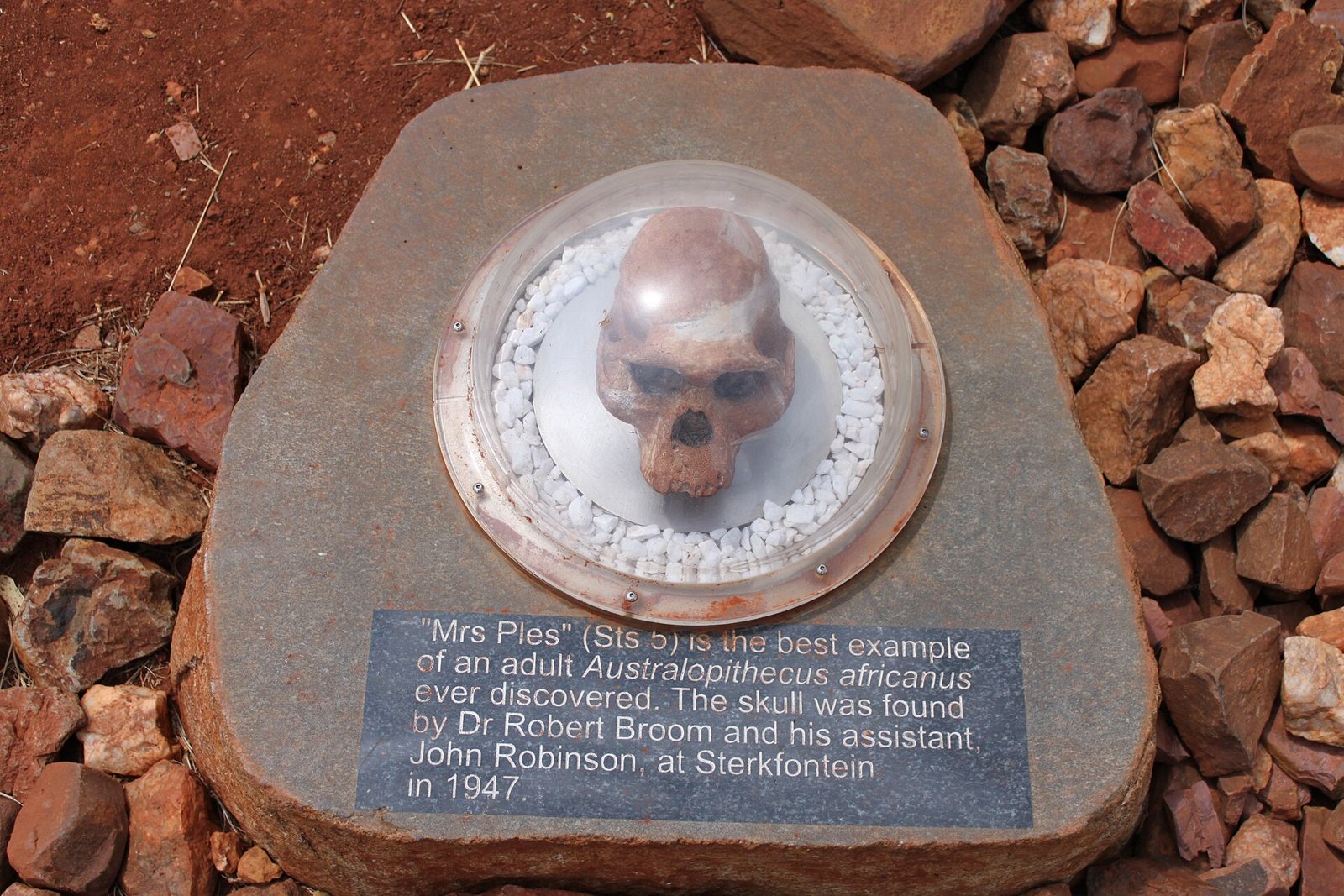
The extraction was not gentle. The skull broke into two pieces as it came out of the rock, reportedly after Broom used dynamite to expose it, according to the Smithsonian Human Origins Program. The break is part of the fossil's story.
Broom gave the skull a scientific name of its own: *Plesianthropus transvaalensis*, meaning "almost human of the Transvaal." He read it as an adult female. Shorten the genus name to "Ples," add "Mrs." for the female reading, and the nickname more or less writes itself. The genus name did not last, and the fossil is now placed in *Australopithecus africanus*, but the nickname stuck for good.
Broom was also one of the few scientists who had backed Raymond Dart's claims about an earlier South African fossil, a story told in full in our piece on the Taung Child.
What her face and small brain showed
Mrs. Ples mattered right away because she was a grown individual. The Taung Child, named by Dart in the 1920s, was a young child, and critics had argued that a juvenile could not show what the adults of its kind looked like.
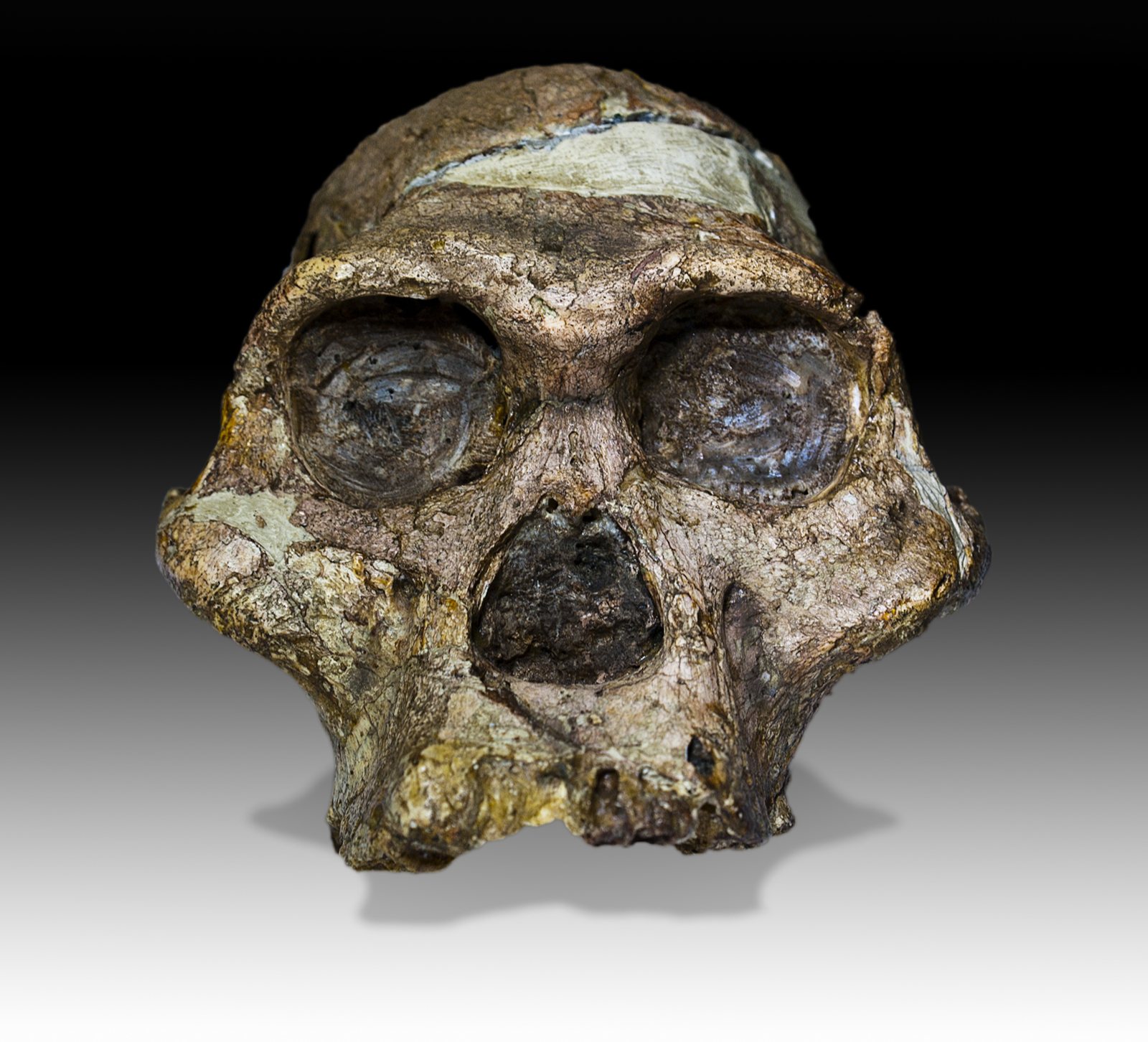
An adult cranium answered that. Sts 5 showed that a mature *Australopithecus africanus* still had a small brain and a strongly projecting face. The Smithsonian notes that this supported the reading of the Taung Child as an early human relative rather than a young chimpanzee. A complete adult face, with the jaw pushed forward under a small braincase, gave everyone something solid to compare against.
How old is Mrs. Ples?
The short answer is probably around 2.1 to 2.8 million years old, under the estimates most often used, with the age still argued. The Smithsonian's Sts 5 record gives 2.1 to 2.5 million years. Older accounts often placed her near 2.5 million years.
The uncertainty comes from the cave itself. Mrs. Ples came from a layer called Member 4, and different dating methods give Member 4 different ages. Wits University's 2024 explainer lays out the competing approaches. Here is how the main estimates compare.
Tap or hover a row to highlight it.
| Researchers | Method | Result |
|---|---|---|
| ResearchersSmithsonian Human Origins Program | MethodCatalogue age for Sts 5 | Result2.1 to 2.5 million years |
| ResearchersCommonly used range | MethodConventional range for Sterkfontein Member 4 | ResultAbout 2.1 to 2.8 million years |
| ResearchersHerries and colleagues | MethodPalaeomagnetism and uranium-lead dating | ResultAbout 2.01 to 2.05 million years |
| ResearchersFrost and colleagues | MethodFaunal biochronology, dating by the animal fossils in the layer | ResultAbout 2.0 to 2.6 million years for Member 4 |
| ResearchersThackeray and Dykes | MethodTooth-based biochronology | ResultAbout 1.8 to 3.5 million years, mean near 2.7 million |
| ResearchersGranger and colleagues, PNAS, 2022 | MethodCosmogenic nuclides | ResultAbout 3.4 to 3.7 million years for parts of Member 4, disputed by other researchers |
An estimate of about 2.15 million years has also been cited for Sts 5 specifically. The Granger study is the outlier that pushed parts of Member 4 much older, and other researchers have not accepted that result. Taken together, the fair summary is a fossil a little over two million years old, perhaps closer to two and a half, with a real debate about how to read the cave. For a general look at how scientists put ages on old bones, see our story on how old bones are dated.
Was Mrs. Ples male or female?
Nobody knows for sure, and scientists still disagree. The nickname reflects Broom's 1947 reading, not a settled fact. The question is sometimes put simply as "Señora o Señor Ples?", and scientists have been arguing both sides for more than forty years.
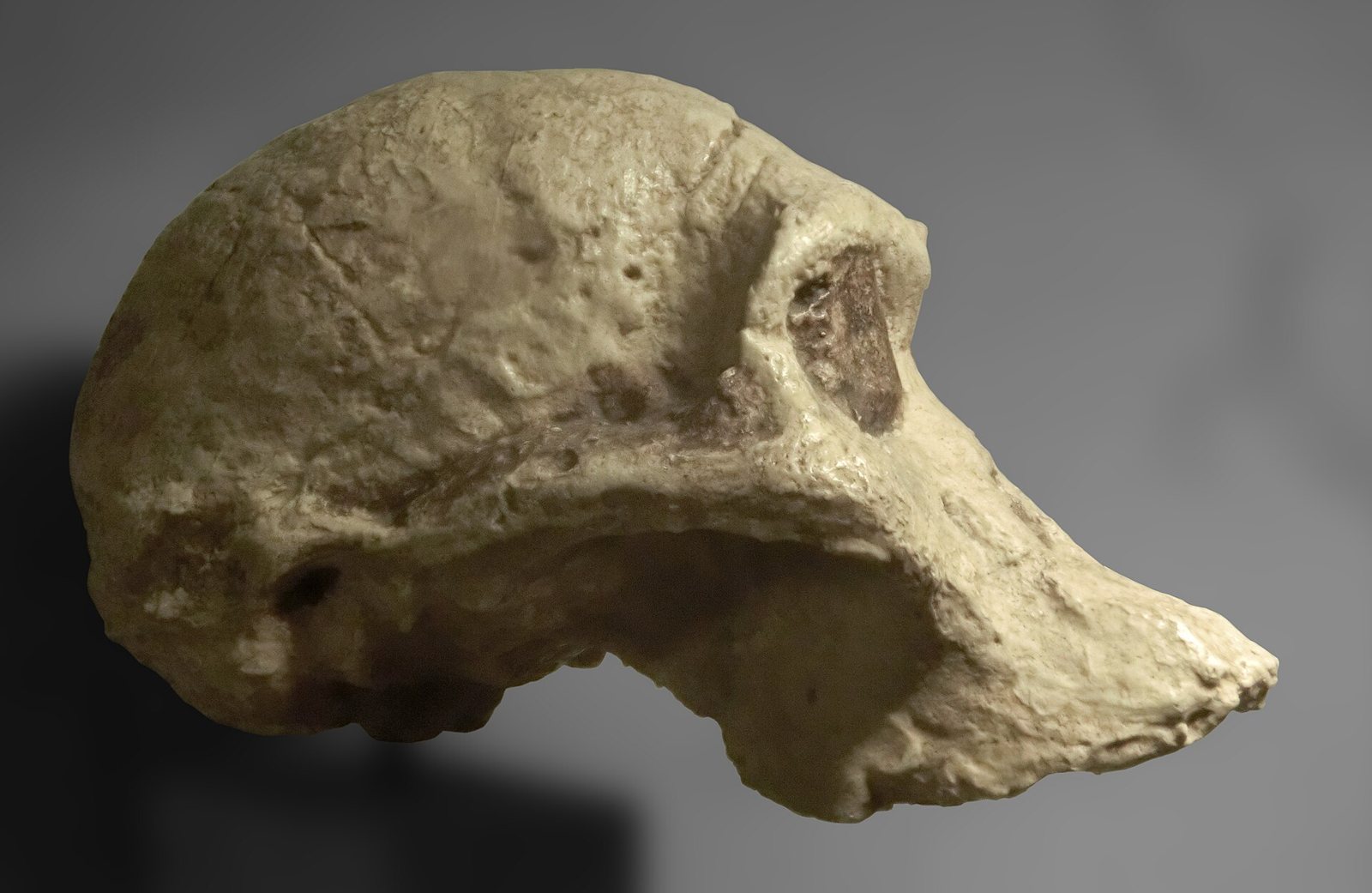
Broom judged Sts 5 to be an adult female because of its small canine sockets and its generally gracile, lightly built appearance. That view held for decades. Then the arguments began.
Mrs. or Mr. Ples? Who argued what
Tap a card to bring it forward.
- Robert Broom, 1947: Adult female, from the small canine sockets and lightly built skull.
- Yoel Rak, 1983: Male, citing the facial pillars associated with the canine roots.
- Thackeray and colleagues, 2002: An adolescent, using CT evidence.
- Bonmatí and colleagues, 2008: Fully grown, not an adolescent.
- Grine and colleagues, 2012: Defended the adult female reading.
- Villmoare and colleagues, 2013: A very old adult female.
- Gaokgatlhe Tawane and Francis Thackeray, 2018: The canine-socket measurements fit a small male better.
The most recent major argument came from Gaokgatlhe Tawane and Francis Thackeray in 2018. They measured the canine sockets and concluded that they are more consistent with a small male. The Ditsong Museums material and Thackeray's work lean toward male. Their reading has not ended the disagreement, though: Bonmatí and colleagues and Villmoare and colleagues had both made the case for a grown woman, and Sts 5 is still discussed as either a small male or an adult female.
A related puzzle involves a partial skeleton from the same site, Sts 14. A 2002 discussion asked whether Sts 14 could be the body that went with Mrs. Ples's head. Bonmatí and colleagues concluded in 2008 that Sts 5 and Sts 14 were not demonstrably the same individual. So, the skull still stands on its own.
Reading sex and age from a skull without the rest of the skeleton is hard even for much younger bones, as our story on what bones tell archaeologists explains. Whatever the answer turns out to be, Mrs. Ples was a real individual who lived and died at Sterkfontein, and the nickname is simply part of that individual's long life in science.
Mrs. Ples, the Taung Child and Little Foot
Three famous South African fossils get mentioned together, and it helps to know how they connect.
The Taung Child and Mrs. Ples belong to the same species, *Australopithecus africanus*. Raymond Dart described the Taung Child from Taung, South Africa, in the 1920s; it was a juvenile. Mrs. Ples, found at Sterkfontein in 1947, gave the species its classic adult face. Our Taung Child story covers that first find.
Little Foot is a different case. It is a much older and far more complete skeleton from the same Sterkfontein cave system, found by Ron Clarke and colleagues in the 1990s. It is generally treated as *Australopithecus prometheus*, although its classification has been debated, and a 2024 study gave it a biochronological age of about 3.6 million years. Same caves, then, but a different period and possibly a different species. For another well-known australopith from much farther north, read about Lucy.
Mrs. Ples and her neighbors
Tap or hover a step to follow the order.
1924
Raymond Dart describes the Taung Child, assigned to Australopithecus africanus.
18 April 1947
Robert Broom and John Robinson find Sts 5 at Sterkfontein.
1947
Broom first classifies Sts 5 as Plesianthropus transvaalensis.
1983
Yoel Rak argues that the skull is male.
1990s
Ron Clarke and colleagues find Little Foot at Sterkfontein.
2002
Thackeray and colleagues use CT evidence to argue for an adolescent.
2008
Bonmatí and colleagues conclude that Sts 5 was fully grown.
2018
Gaokgatlhe Tawane and Francis Thackeray argue for a small male.
1 April 2024
Wits University takes responsibility for Sterkfontein visitor operations.
Where is Mrs. Ples now?
The original Sts 5 fossil is curated by the Ditsong National Museum of Natural History in Pretoria, where it is associated with the museum's Broom Room. Public displays and visitor exhibitions may use casts rather than the original, so the skull you saw on a trip may well have been an exact replica.
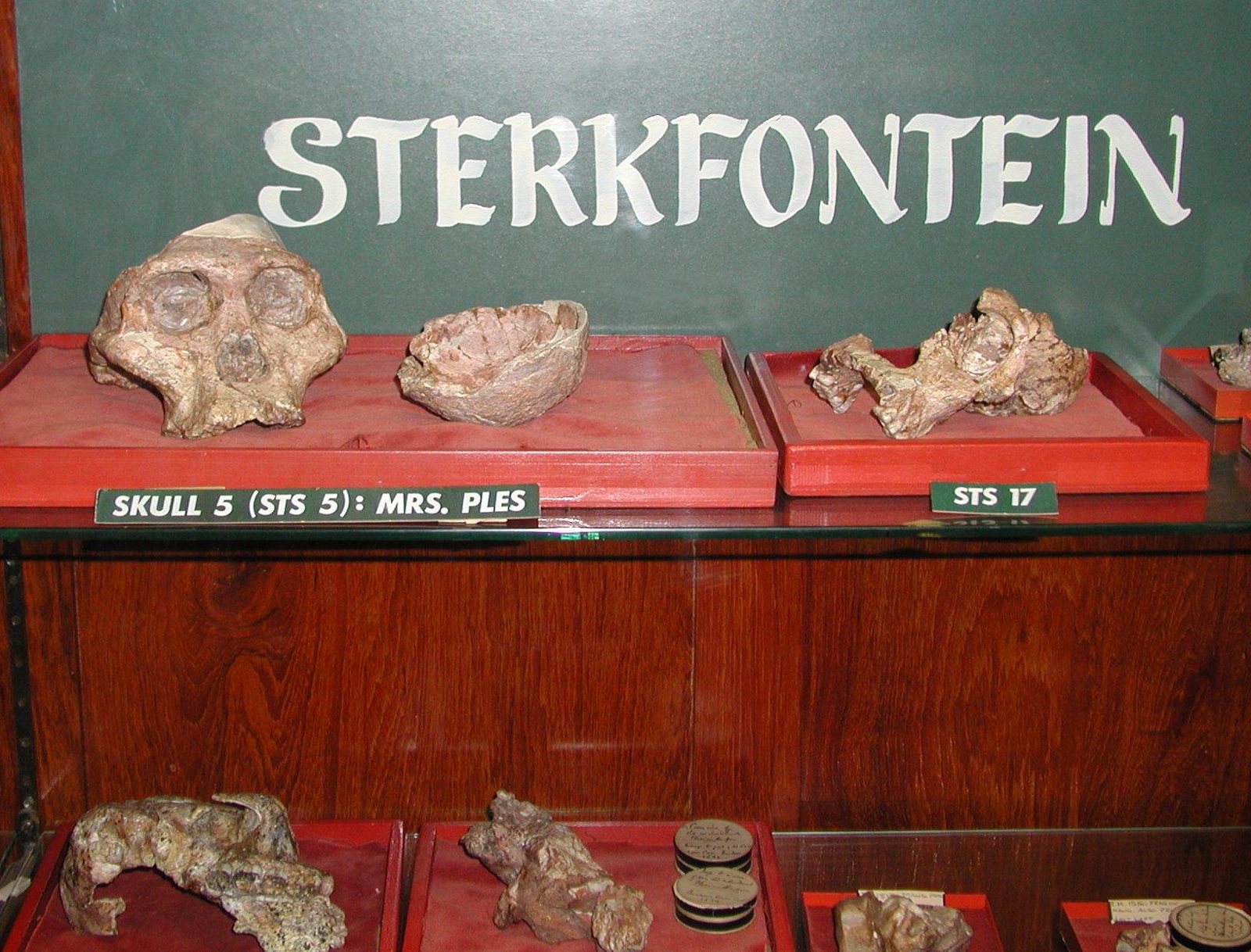
The place where she was found is a separate visit. Sterkfontein Caves lie about 40 kilometres northwest of Johannesburg in Gauteng, inside the Cradle of Humankind UNESCO World Heritage Site. Maropeng is the official visitor centre for the wider Cradle of Humankind. Since 1 April 2024, Wits University has run research and visitor operations at the Sterkfontein and Swartkrans Caves, according to Wits Sterkfontein Caves, and Wits announced the reopening of the Sterkfontein Caves in April 2025.
Before you travel, confirm opening hours, tickets and whether the original or a cast is on show with Ditsong, Wits Sterkfontein Caves or Maropeng.
How well do you know Mrs. Ples?
Answer every question to check.
Short answers about Mrs. Ples
A few smaller questions come up again and again.
Why is she called Mrs. Ples?
The name comes from Broom's original genus, *Plesianthropus*, shortened to "Ples," plus "Mrs." because he believed the skull was an adult female. The genus name was later dropped in favor of *Australopithecus africanus*, but the nickname stayed.
Who found Mrs. Ples?
Robert Broom and John T. Robinson of the Transvaal Museum found her at Sterkfontein on 18 April 1947. The pair reported their Sterkfontein material in Nature that year, with Broom reading the skull as an adult female.
What species is Mrs. Ples?
She is *Australopithecus africanus*, the same species as the Taung Child. Broom first placed her in a genus of his own, *Plesianthropus transvaalensis*, meaning "almost human of the Transvaal."
Is the skull on display the original?
Often it is a cast. The original Sts 5 is curated by the Ditsong National Museum of Natural History in Pretoria, and public exhibitions may use replicas, so ask the museum or site you plan to visit what is on show.
Mrs. Ples has been a South African icon for more than seventy years, and the questions about her age and sex keep her interesting rather than settled. If she made you curious about her relatives, the oldest human skull story lays out the wider family, and the Black Skull introduces the heavy-jawed *Paranthropus*, whose South African species Broom named in 1938. For another set of South African fossils cared for at Wits, see Homo naledi.
Terms in this story
Tap a term to see what it means.
Sts 5. The catalogue number of Mrs. Ples, the almost complete cranium found at Sterkfontein in 1947.
---