

No. 288
Hyena Skull: The Bone-Crushing Jaw and How It Compares With a Dog's
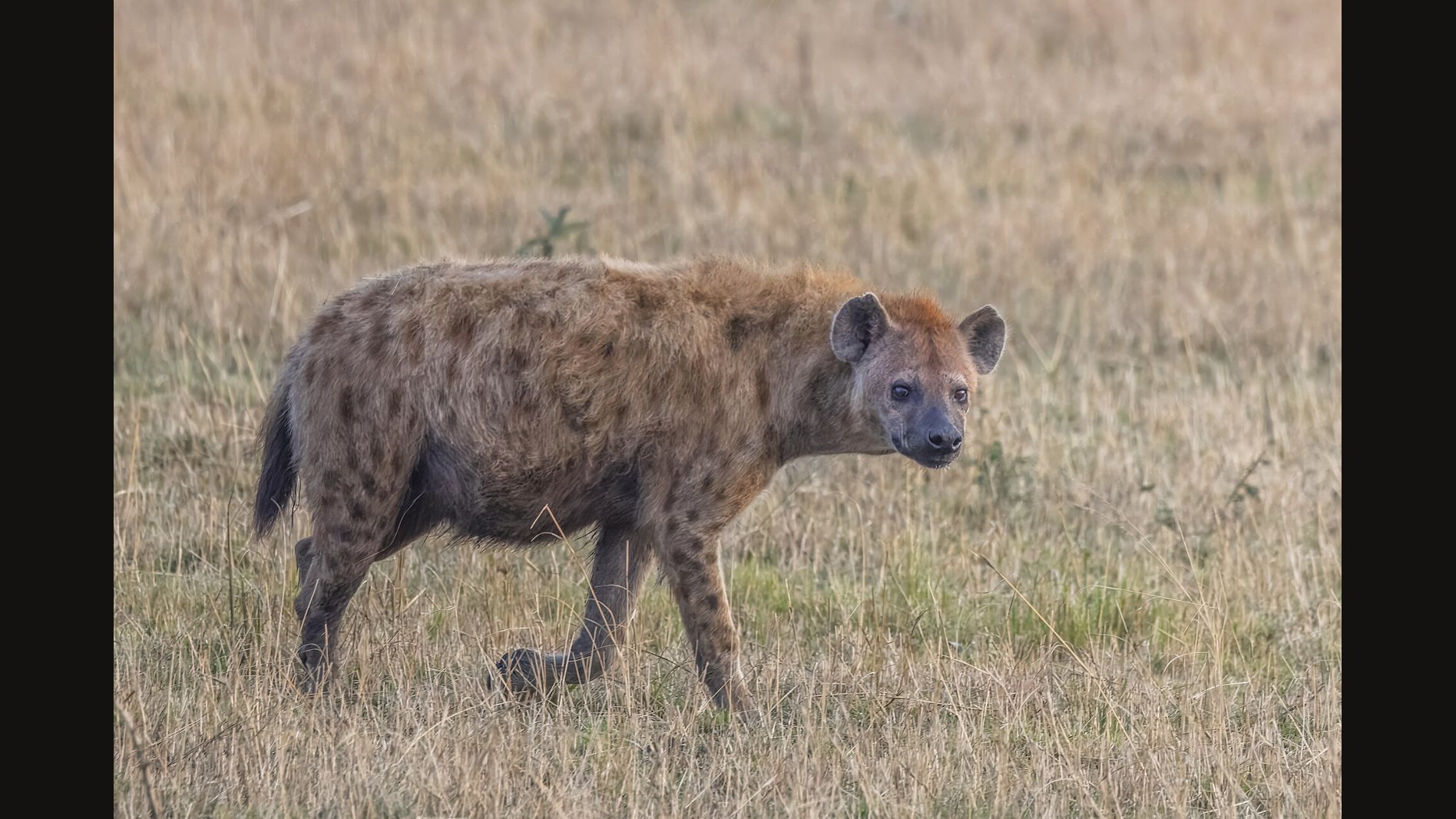
A spotted hyena, *Crocuta crocuta*, cracks bone with a skull built for the job. A long, high sagittal crest along the top and wide cheek arches give huge jaw-closing muscles room to attach, enlarged rear premolars do the actual cracking, and the tall, domed forehead helps spread the stress of each bite through the skull. Z. Jack Tseng, a paleontologist at the American Museum of Natural History, describes hyenas cracking the leg bones of large animals.
As for the dog question, a hyena is not a dog. Hyenas have their own family, Hyaenidae, on the cat-like branch of the meat-eating mammals, and the dog-like look evolved separately, a pattern scientists call convergent evolution.
Reading a spotted hyena skull
Hold a spotted hyena skull, or look closely at one behind museum glass, and the first thing you notice is the forehead. It rises in a tall dome above the eyes, more like a vaulted ceiling than the gentle slope of a dog's head. Behind it, a long, high ridge of bone runs down the middle of the skull. That is the sagittal crest, and it anchors the temporalis muscles, the big muscles that close the jaw.
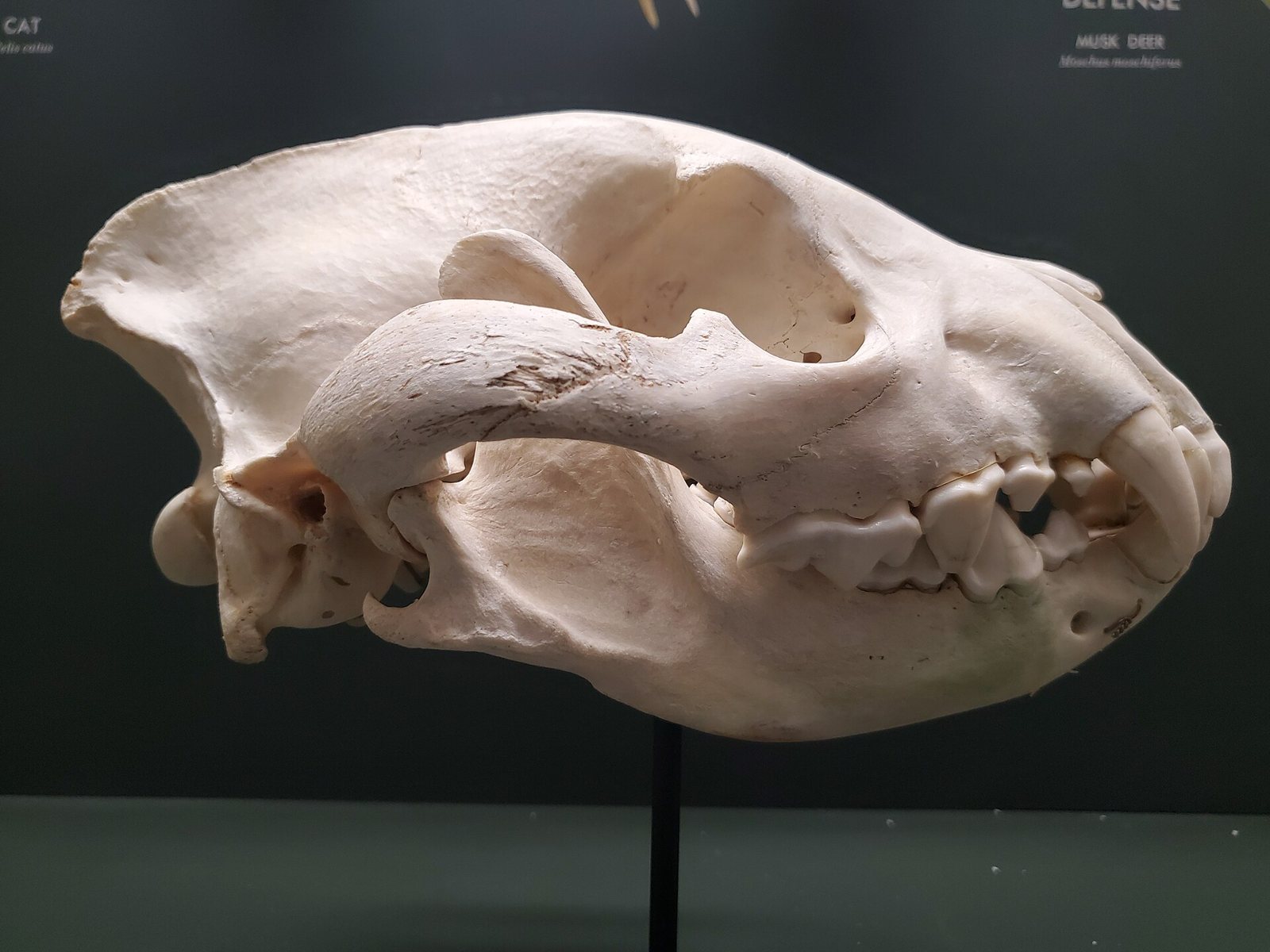
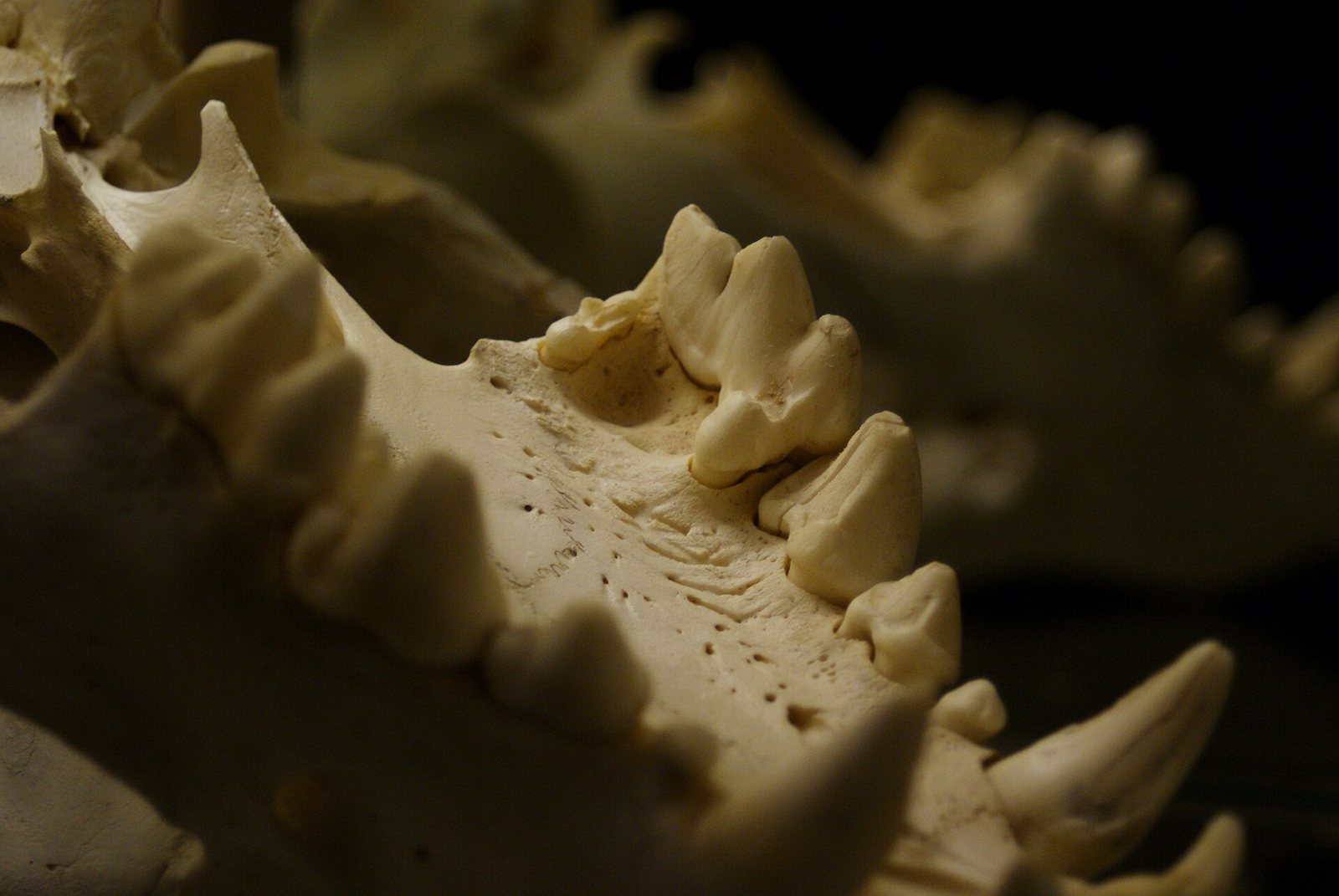
Look at the skull from above and the cheekbones, the zygomatic arches, swing wide, giving the jaw-closing muscles still more room to attach. Then turn the skull over. The cheek teeth are heavy, and the rear premolars are enlarged and specialized for cracking large bones. Compared with a typical dog skull, the hyena's is narrow and tall, with heavy surfaces for muscle and premolars built like little hammers.
The dome is not just for show. In a finite-element study, a computer method that tests how a structure handles force, Tanner and colleagues found that the air-filled sagittal crest and the domed front of the skull help dissipate stress during bone-cracking. Curtis and colleagues, writing on the frontal sinuses of carnivores, discuss the same stress-spreading role in hyena skulls. The forehead, in other words, is part of the shock absorber.
What to look for on a hyena skull
Tap a card to bring it forward.
- Domed forehead: A tall, vaulted front of the skull that helps spread bite stress.
- High sagittal crest: A long ridge along the top midline where the jaw-closing temporalis muscles attach.
- Wide cheek arches: Broad zygomatic arches that leave room for large jaw muscles.
- Heavy rear premolars: Enlarged cheek teeth specialized for cracking large bones.
- Shorter, deeper face: Compared with a dog, the face is shorter and the skull deeper through the braincase.
How strong is a hyena's bite?
Very strong, but the number you see depends on how it was measured and which teeth were doing the biting. There is no single figure that every study agrees on, because researchers use different methods and different bite positions. Any bite force worth quoting comes with its method attached.
The most direct approach is to let a hyena bite something that measures force. In a study published in the Journal of Zoology in 2000, Binder and Van Valkenburgh measured living captive spotted hyenas with a force transducer, a device that converts the squeeze of a bite into a reading. They also tested how well the animals fed by giving them sheep femurs for 15 minutes.
The other approach works from the skull itself. Wroe, McHenry and Thomason, in their 2005 paper "Bite club", estimated bite force from prepared skulls, using skull measurements and biomechanical models. Their estimate for the spotted hyena is 773 newtons at the canine teeth. Christiansen and Wroe's 2007 study also modeled bite force from skull and jaw-muscle anatomy and reported a higher estimate further back, at the carnassial region.
Those are estimates from models, not readings from a live animal, and the two kinds of number should not be swapped for each other. A canine estimate and a cheek-tooth estimate are not the same thing either. That is why big round figures online, quoted with no method or tooth position, are best left alone.
Tap or hover a row to highlight it.
| Animal | Scientific name | Skull or feeding detail | Bite-force figure and method |
|---|---|---|---|
| AnimalSpotted hyena | Scientific nameCrocuta crocuta | Skull or feeding detailHigh sagittal crest, domed forehead, heavy rear premolars | Bite-force figure and method773 N, estimated canine force from prepared-skull measurements and biomechanical modeling |
| AnimalStriped hyena | Scientific nameHyaena hyaena | Skull or feeding detailHigh sagittal crest, bone-processing skull | Bite-force figure and method545 N, estimated canine force from prepared-skull measurements and biomechanical modeling |
| AnimalAardwolf | Scientific nameProteles cristata | Skull or feeding detailSmaller skull, insect-specialist teeth | Bite-force figure and method151 N, estimated canine force from prepared-skull measurements and biomechanical modeling |
| AnimalGrey wolf | Scientific nameCanis lupus | Skull or feeding detailCaniform skull with a longer muzzle | Bite-force figure and method593 N, estimated canine force from prepared-skull measurements and biomechanical modeling |
| AnimalBrown bear | Scientific nameUrsus arctos | Skull or feeding detailBroad caniform skull, large jaw muscles | Bite-force figure and method751 N, estimated canine force from prepared-skull measurements and biomechanical modeling |
All five figures come from the same Wroe, McHenry and Thomason table, so they compare fairly with one another. They do not compare directly with a force-transducer reading from a living hyena.
Growing into the jaw
A hyena is not born with its famous bite. Binder and Van Valkenburgh followed nine young spotted hyenas from six months to two years old and found that weaned cubs are a long way from adult performance. Their bite strength kept rising well past that window, toward about five years of age.
The teeth mattered as the cubs grew. As the permanent teeth came in, the main bone-cracking zone moved back toward the rear premolars. The researchers note that this shift improved the jaw's mechanical advantage, so the same muscles could do more work on the bone. A young hyena with a sheep femur, then, is still learning a trade its skull has not finished building.
The four hyenas and their skulls
The hyena family, Hyaenidae, has four living members: the spotted hyena, *Crocuta crocuta*; the striped hyena, *Hyaena hyaena*; the brown hyena, *Parahyaena brunnea*; and the aardwolf, *Proteles cristata*. The Phoenix Zoo lists the same four.
A 2025 comparative study of their skulls found that the spotted, brown and striped hyenas share a long, high sagittal crest, a sharply defined nuchal crest across the back of the skull and prominent paracondylar processes, bony knobs near the base of the skull where muscles attach. These are the three bone-crackers. The study also found a difference at the base of the skull: the spotted hyena's basilar occipital region is more pyramid-shaped, while the other three have broader, cylindrical forms.
The aardwolf is the odd one out. Its skull is much smaller and more specialized. The sagittal crest is lower and splits into broad parietal crests, the temple area is strongly concave, and it lacks the deep masseteric fossa, a hollow for a big chewing muscle, that the three bone-crackers have. Its teeth suit a diet of insects rather than broken bones. In the Wroe estimates, the aardwolf's canine bite comes in at 151 newtons against the striped hyena's 545 and the spotted hyena's 773, which fits a hyena that eats insects rather than femurs.
Hyena skull vs dog skull
Hyenas belong to their own family, Hyaenidae, inside Feliformia, the cat-like branch of the carnivores. Dogs and wolves sit on the other branch, Caniformia, as the Getty Research Institute's classification shows. Andrew S. Flies at the University of Tasmania and the Phoenix Zoo both place hyenas closer to cats than to dogs. The dog-like body is what Z. Jack Tseng at AMNH calls convergent evolution: hyenas and dogs arrived at a similar shape, and some similar bone-processing tools, from different starting points.
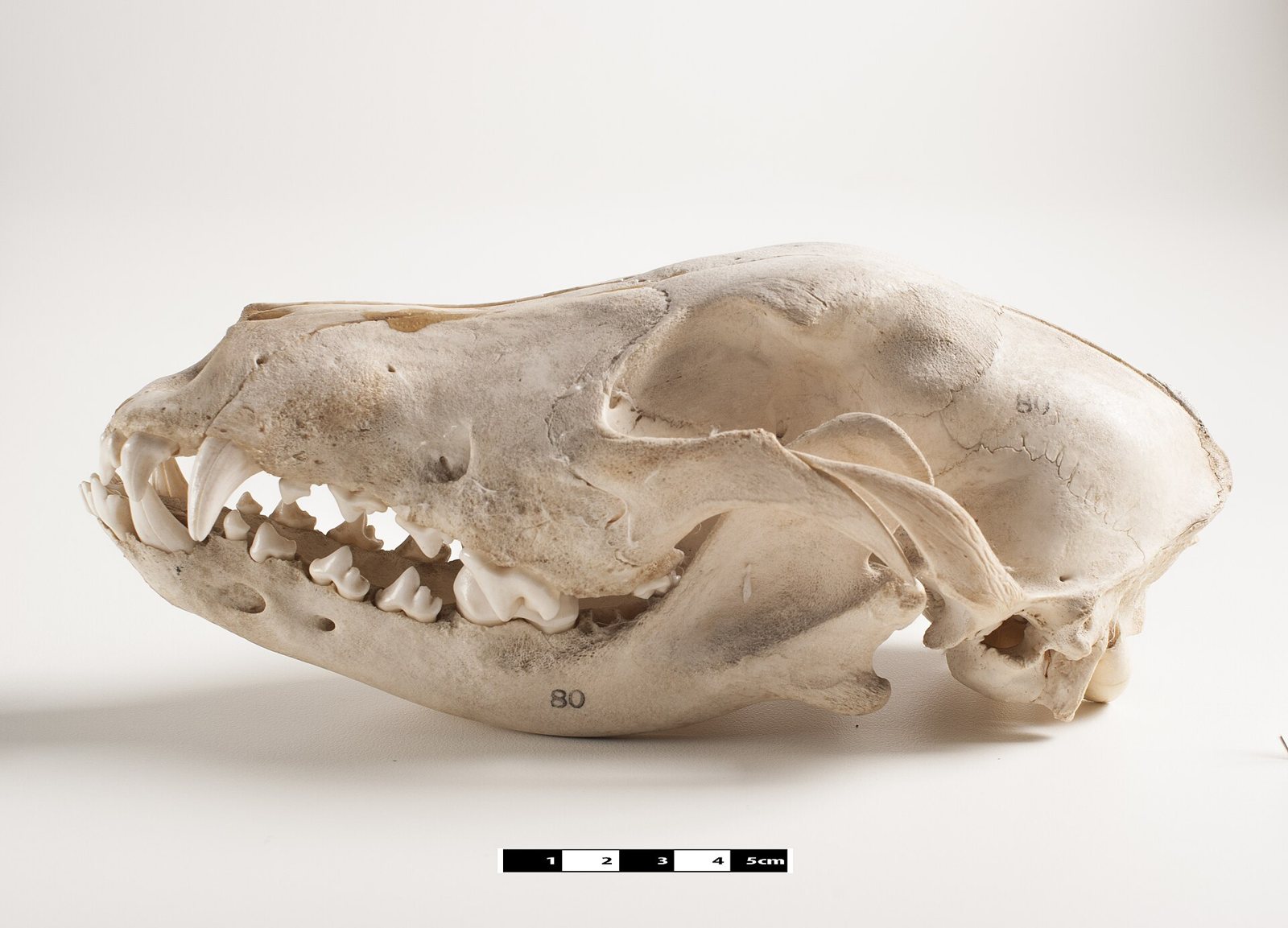
Side by side, the skulls tell them apart. A spotted hyena skull is generally shorter in the face, deeper through the braincase and heavier around the cheeks than a typical domestic dog's. Its sagittal crest and wide cheek arches give the jaw-closing muscles more room, and its premolars are thick bone-cracking teeth. A dog or wolf has a longer, more elongated skull and a different arrangement of cheek teeth.
The wolf makes a natural comparison, and our wolf skull guide covers that skull in its own right. Bears are caniform carnivores too, but with different skull proportions and feeding habits, and the bear skull story shows how different another heavy-jawed caniform can look. For the domestic side, dog skull identification covers the many shapes dogs come in, and the coyote skull and fox skull round out the wild dog family. If you want to see the cat side of the tree, the cat skull and mountain lion skull stories are the place to look.
In the Wroe estimates, the grey wolf, *Canis lupus*, comes in at 593 newtons at the canines and the brown bear, *Ursus arctos*, at 751, both below the spotted hyena's 773 by the same method.
Cave hyenas and their dens
Hyenas once denned in caves from Yorkshire to Belgium. The cave hyena, usually identified as *Crocuta crocuta spelaea*, was a Pleistocene relative of today's spotted hyena, and its dens have preserved the bones it left behind.
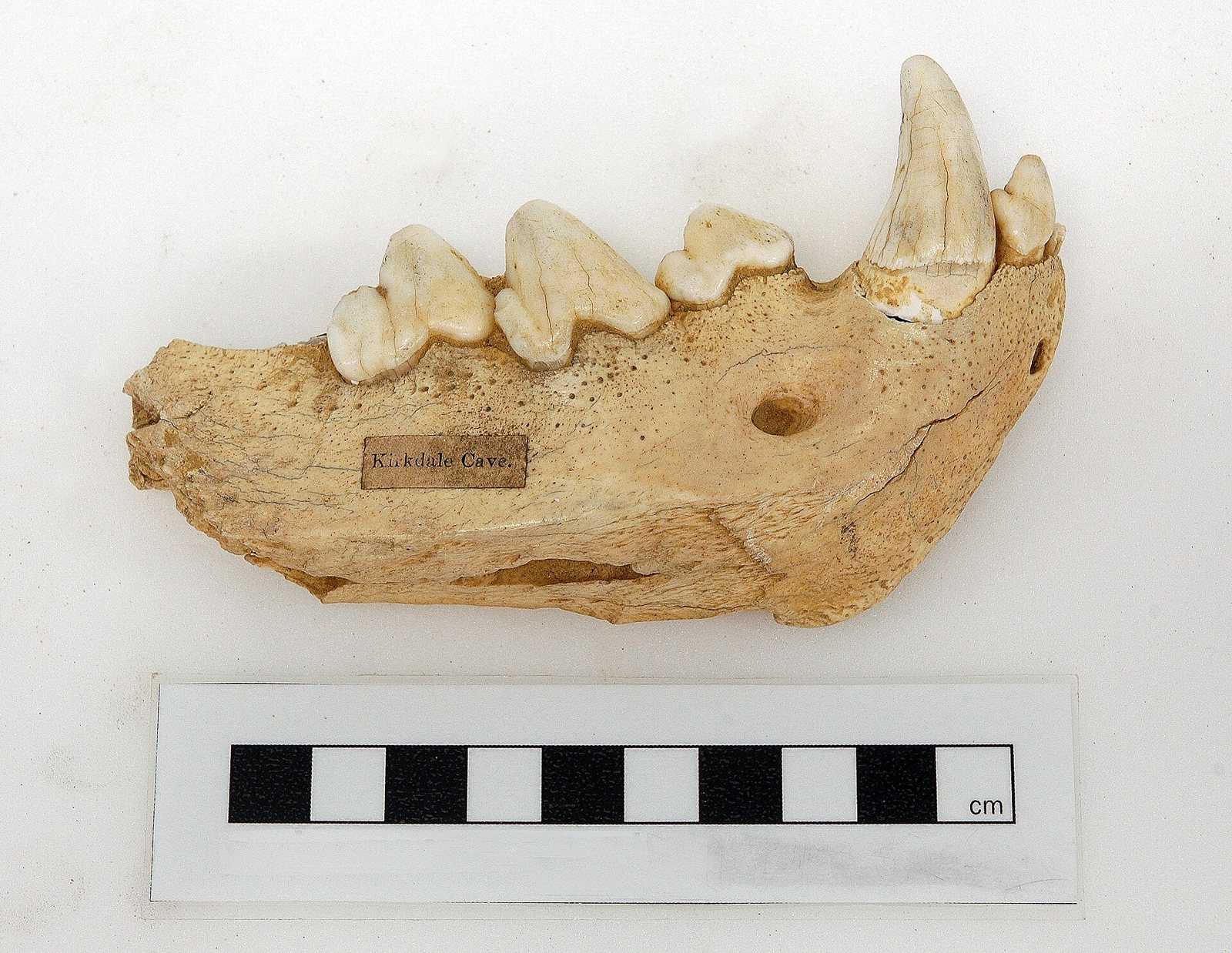
One of the most famous is Kirkdale Cave in Yorkshire, England. William Buckland studied it and, in 1822, published his argument that hyenas had used the cave as a den and dragged the remains of their prey inside. His evidence included gnawed bones and material he interpreted as fossilized hyena dung. Scarborough Museums and Galleries keeps the Kirkdale story, which helped establish the idea that a fossil cave could preserve an ancient predator's den rather than a random heap of bones. A few decades later, in 1876, H. Alleyne Nicholson published an illustration of a cave-hyena skull.
The cave hyena's story got a sadder chapter in 2022. At Marie-Jeanne Cave in southern Belgium, researchers from the Royal Belgian Institute of Natural Sciences and the University of Aberdeen reported more than 300 cave-hyena cub skeletons, dating to roughly 45,000 years ago. So many cubs in one place suggests the cave was used again and again as a birth den. The remains may record high death rates among the young, possibly including siblicide, cubs killing siblings, during times of food shortage.
Other Ice Age skulls make good company for this one, including the Smilodon skull and the mammoth skull.
Hyena skulls through the years
Tap or hover a step to follow the order.
1822
William Buckland publishes his reading of Kirkdale Cave in Yorkshire as a fossil hyena den.
1876
H. Alleyne Nicholson publishes an illustration of a cave-hyena skull.
2000
Binder and Van Valkenburgh measure bite force in captive spotted hyenas directly with a force transducer.
2005
Wroe, McHenry and Thomason publish bite-force estimates calculated from prepared skulls.
2008
Tanner and colleagues model how stress spreads through the spotted hyena skull during bone-cracking.
2022
The Royal Belgian Institute of Natural Sciences reports more than 300 cave-hyena cub skeletons from Marie-Jeanne Cave in Belgium.
Getting hold of a hyena skull
Hyena skulls do turn up in collections, and some people wonder how to get one. Take this as general information, not legal advice: the rules on owning, importing and selling wild animal parts change from country to country and from species to species. Before buying, importing or selling a hyena skull, ask the wildlife authority in your own country what applies. Our page on what to do with an animal skull is a good place to start with the questions to ask.
Hyena skull questions
A few more questions come up once people have seen that crest.
Can hyenas really crush bone?
Yes, spotted hyenas crack the leg bones of large animals, as AMNH paleontologist Z. Jack Tseng describes. Their enlarged rear premolars do the cracking, and young hyenas only reach full bone-cracking strength after several years, as their permanent teeth settle in.
Is a hyena a dog or a cat?
A hyena is neither a dog nor a cat. It belongs to its own family, Hyaenidae, on the cat-like branch of the carnivores, so it is more closely related to cats and their relatives than to dogs, even though it looks more like a dog.
Why does a hyena skull have a crest?
The crest gives the jaw-closing temporalis muscles a larger surface to grip. In the spotted hyena it is also air-filled, and modeling suggests it helps spread the stress of a bone-cracking bite across the skull. The gorilla grows a similar crest for its own jaw muscles, as the gorilla skull story explains.
What was a cave hyena?
The cave hyena was an Ice Age relative of the living spotted hyena, usually identified as *Crocuta crocuta spelaea*, from the Pleistocene. Its dens, such as Kirkdale Cave in England and Marie-Jeanne Cave in Belgium, preserved gnawed bones and, in Belgium, the skeletons of hundreds of cubs.
How can I tell if a skull is from a hyena?
Look for the tall domed forehead, the high sagittal crest, the wide cheek arches and the heavy rear premolars, on a skull that is shorter and deeper in the face than a dog's. If you are not sure the skull is even from a carnivore, our human vs animal skull guide is a good first check.
Hyena skull quiz
Answer every question to check.
A skull built around one job
The spotted hyena skull is a bone-cracking tool from front to back: a domed forehead to spread the stress, a tall crest and wide arches for the jaw muscles, and heavy premolars that take years to grow into. It looks like a dog's skull at a glance, but it comes from the cat side of the family tree, and its bite is best quoted with the method that measured it. For more heavy-jawed skulls, the wolf skull and bear skull make a good pair to read next.
Terms in this story
Tap a term to see what it means.
Crocuta crocuta. The scientific name of the spotted hyena, the best-known bone-cracking hyena.
---