

No. 286
Velociraptor Skull: How Big It Was and What It Really Looked Like
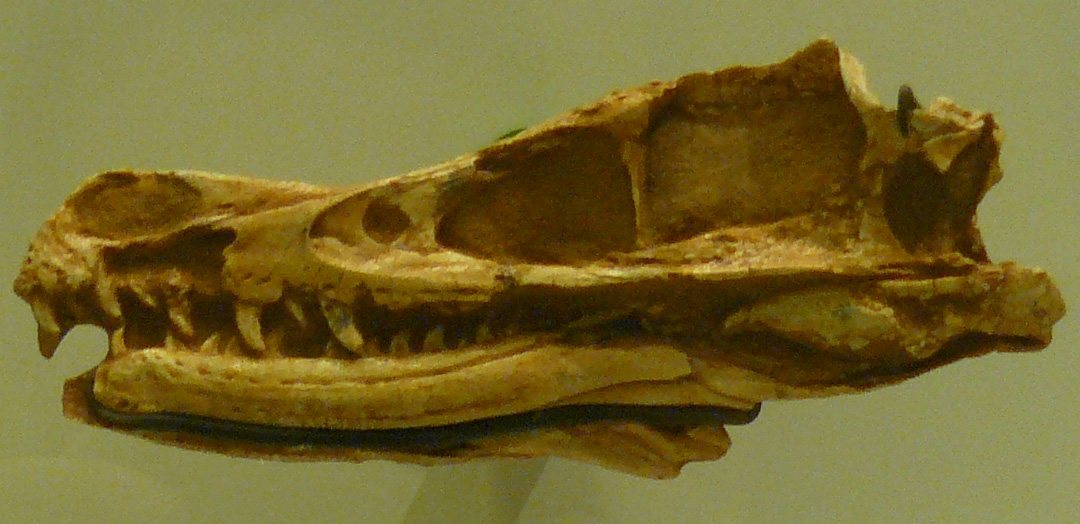
A real *Velociraptor mongoliensis* skull was small, narrow and lightly built, about 24 centimeters long, or roughly 9.5 inches, in the cast shown by the Australian Museum. Its long, low snout made up about 60 percent of that length, according to the skull description published by Barsbold and Osmólska in 1999, and its jaws held more than 60 jagged, serrated teeth (American Museum of Natural History).
The animal that owned that skull was a small, feathered predator from Mongolia and China. The raptors in *Jurassic Park* were modelled mainly on a bigger relative, as the Natural History Museum, London explains, which is why the real head would fit comfortably in your two hands.
The Velociraptor skull up close
Hold a cast of the skull and the first thing you notice is how long and low it is. Barsbold and Osmólska described the snout as long, narrow and shallow, taking up about 60 percent of the whole skull. Seen from the side, the profile rises slightly toward the back of the head. Near the tip sits a large oval nostril, and behind it runs a long, shallow antorbital fossa, a dip in the bone in front of the eye socket. The lower jaw curves gently outward along its lower edge rather than running straight (Barsbold and Osmólska, 1999).
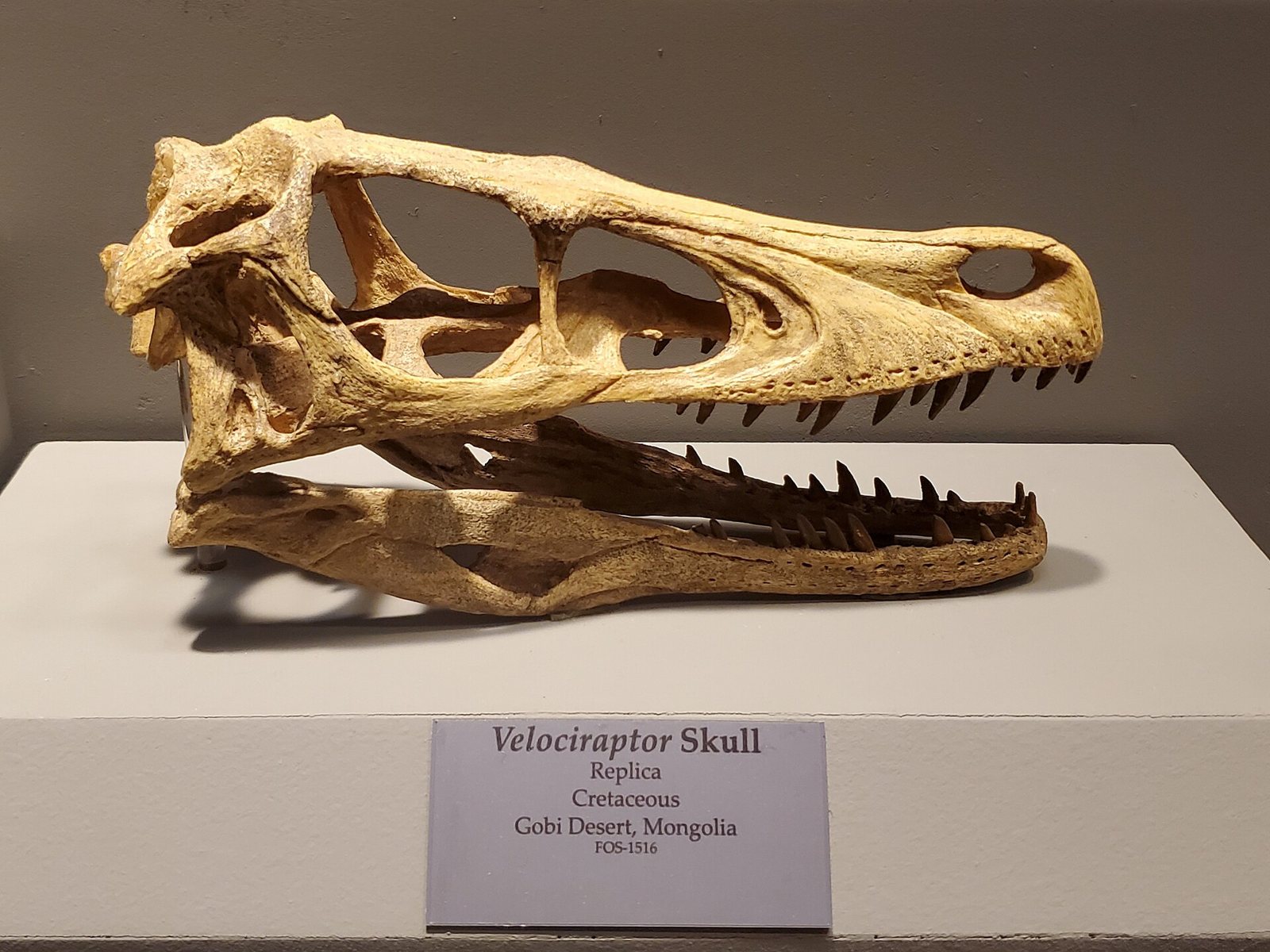
So, how narrow was it? Narrow enough that the snout looks more like a long wedge than a box. The skull was built light, not heavy, which suits a small hunter rather than a bone-crushing giant.
The teeth are the part that matches the film's reputation. The American Museum of Natural History (AMNH) counts more than 60 of them, jagged and dagger-like, with serrated edges suited to gripping and tearing meat (AMNH OLogy).
The very first skull named for the species is a real individual you can trace by number. It is catalogued as AMNH FR 6515, it is weathered on one side, and it comes from the Djadokhta Formation of Mongolia (AMNH specimen record).
Tap or hover a row to highlight it.
| Feature | Velociraptor mongoliensis |
|---|---|
| FeatureSkull length | Velociraptor mongoliensisAbout 24 cm (roughly 9.5 in) |
| FeatureSnout | Velociraptor mongoliensisLong, narrow and shallow; about 60% of skull length |
| FeatureTeeth | Velociraptor mongoliensisMore than 60 jagged, serrated teeth |
| FeatureFeathers | Velociraptor mongoliensisSix quill knobs documented on a forearm |
| FeatureGeological age | Velociraptor mongoliensisUpper Cretaceous, possibly lower to upper Campanian |
Named in 1924 from a skull out of the Gobi
The story of the skull begins in the Gobi Desert. The AMNH's Central Asiatic Expeditions worked there from 1922 to 1928 and recovered *Velociraptor* fossils along the way (AMNH). The museum places the first fossil find during its 1922 Gobi expedition, while its own expedition records document major fieldwork by Peter Kaisen and George Olsen in 1923 (AMNH 1923 expedition report). The holotype record names Peter Kaisen as the collector of the original skull and jaws (AMNH specimen record).
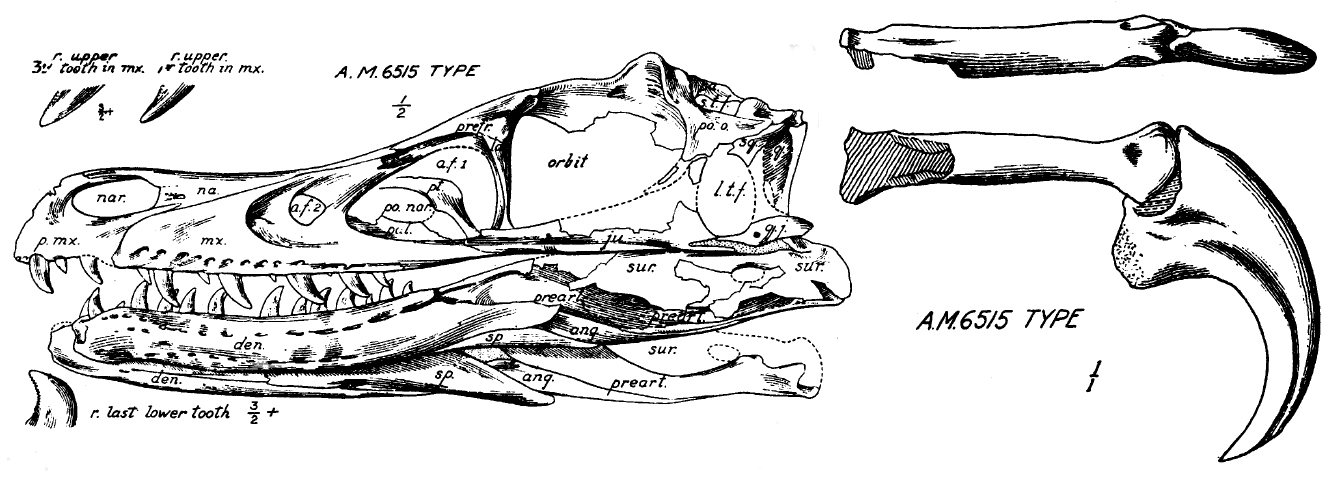
In 1924, Henry Fairfield Osborn formally named *Velociraptor mongoliensis*. He worked from a partial skull, jaws, a finger and foot material collected in Mongolia by the museum's expedition (AMNH OLogy). That skull became AMNH FR 6515, the reference specimen for the whole species.
The drawing that accompanied Osborn's paper survives too. The 1924 illustration of the type skull and jaws is now in the public domain, so the first published image of a *Velociraptor* skull is one anyone can look at and share.
The Fighting Dinosaurs fossil
The most famous *Velociraptor* fossil of all came almost fifty years later. In 1971, a Mongolian-Polish expedition working in the Djadokhta Formation of the Gobi Desert uncovered two animals locked together: a *Velociraptor mongoliensis* and a beaked *Protoceratops andrewsi* (AMNH Fighting Dinosaurs).
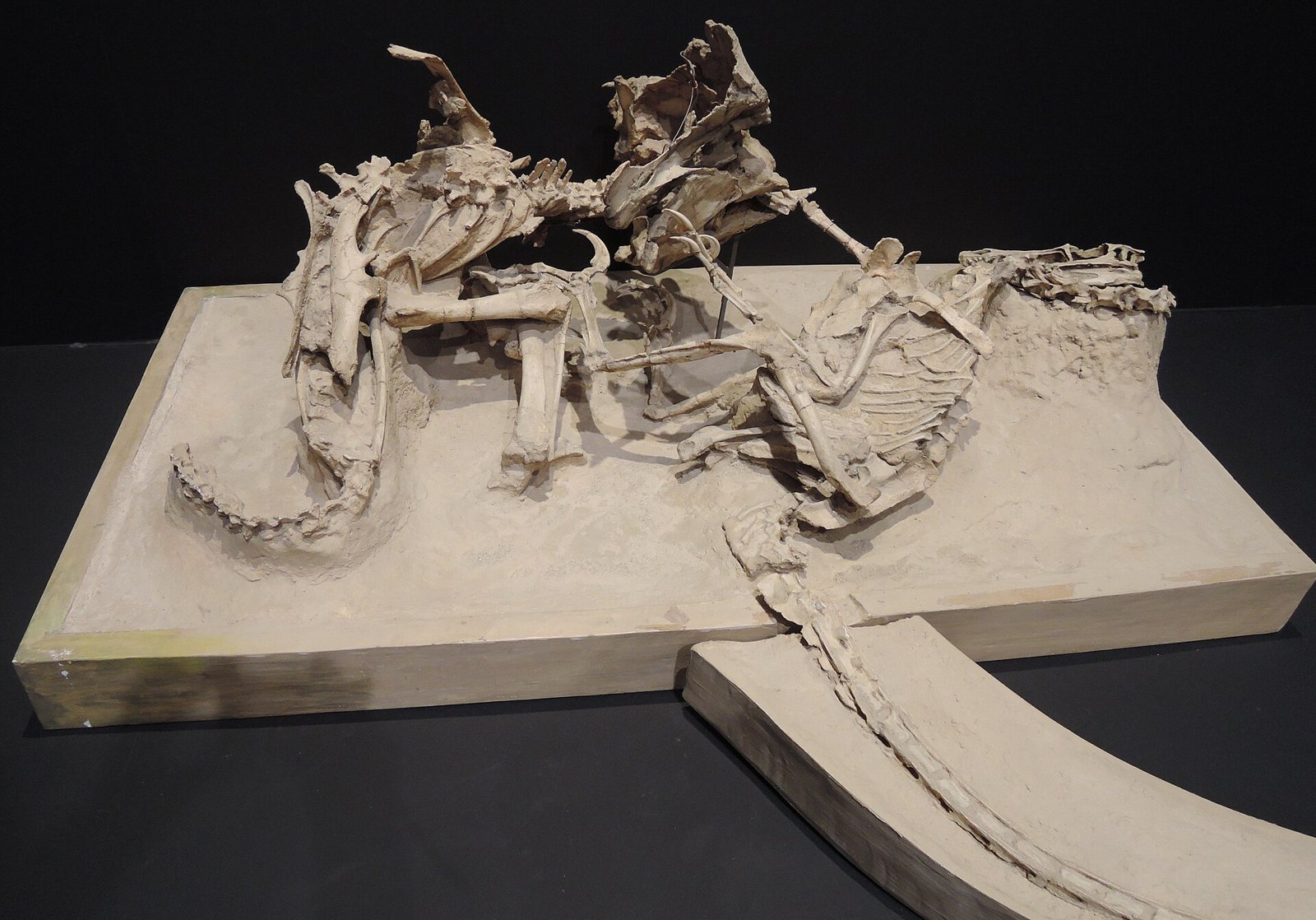
What the stone holds is very specific. The *Velociraptor*'s sickle claw is embedded in the *Protoceratops*' neck, and the *Protoceratops*' beak grips the *Velociraptor*'s arm. The AMNH dates the fossil to about 80 million years ago and describes it as a national treasure of Mongolia.
The original has travelled and come home. It was displayed in the United States in 2000 and returned to Mongolia in 2005, and casts of it have been shown internationally (AMNH specimen history). If you have seen the pair in a museum outside Mongolia, you were most likely looking at one of those casts.
Did Velociraptor have feathers?
Yes. The proof sits on a forearm. A *Velociraptor* fossil collected in Mongolia in 1998 preserves six quill knobs, small bumps on the bone where ligaments anchored large feathers. Alan Turner, Mark Norell and colleagues documented them in a 2007 paper in *Science*, and the AMNH reported the result under the plain headline that *Velociraptor* had feathers (AMNH, 2007).
Because quill knobs anchor large feathers, they show the animal carried substantial feathers along its forearms. Six small bumps on one bone answer the feather question with a plain yes.
What the bone cannot tell us is the color. The fossil evidence does not show the feathers' exact colors or the complete pattern of the body covering. So, any reconstruction you see with bold stripes or a bright crest is an artist's choice, made on top of the evidence rather than read from it.
What a real Velociraptor looked like
Put the skull back on a body and the whole animal comes into focus. The Australian Museum describes *Velociraptor mongoliensis* as a small, lightly built, feathered theropod, the group of mostly meat-eating dinosaurs that walked on two legs. It lived in what are now Mongolia and China. It had a long, low skull, serrated teeth, long legs, a stiff tail and a large sickle claw on each foot (Australian Museum; Natural History Museum, London).
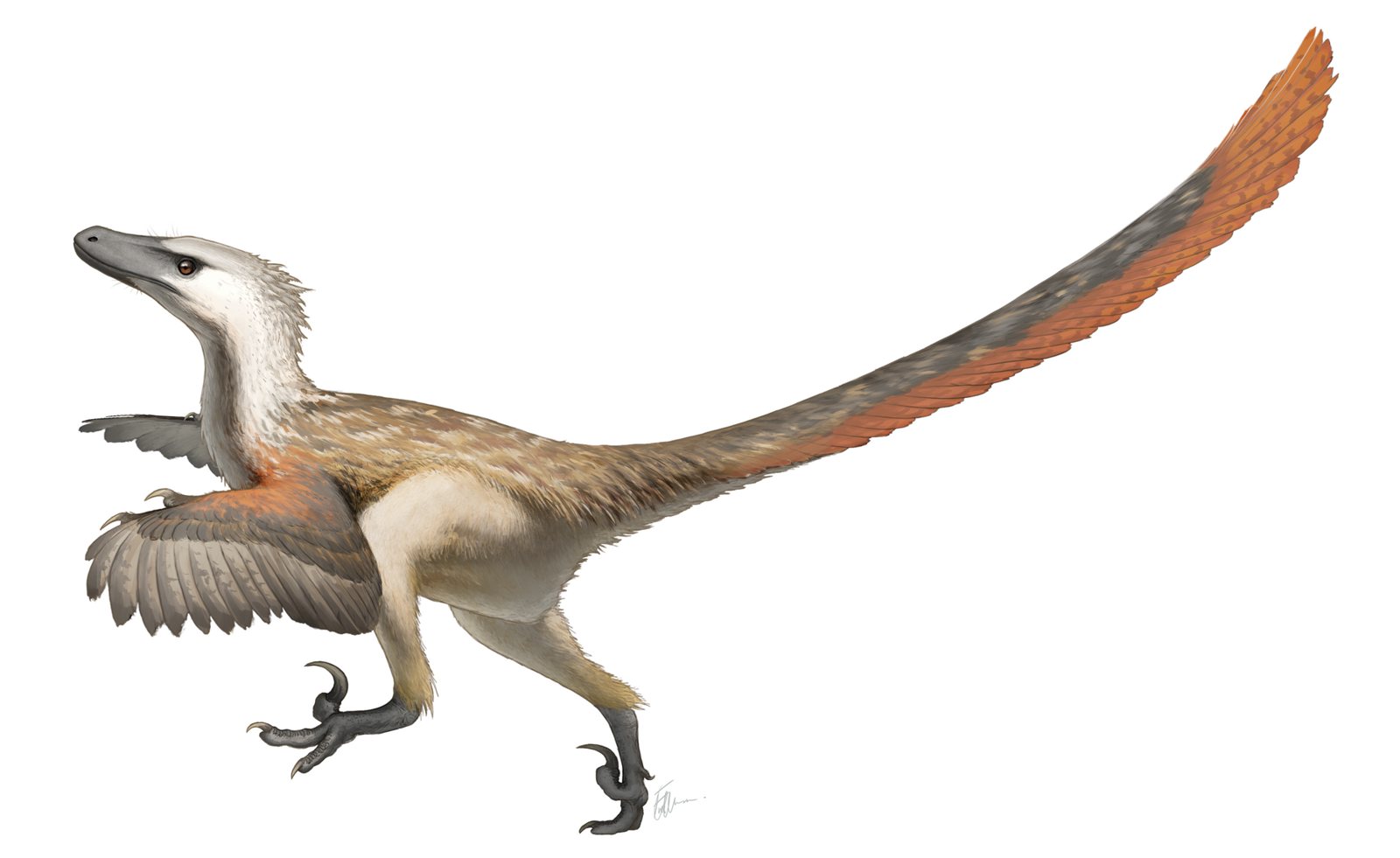
Add the feathered forearms from the 1998 fossil and you have the real animal: a small, quick-looking hunter with a long, low head, a stiff tail, a sickle claw on each foot and large feathers on its arms.
As for when it lived, Barsbold and Osmólska place their skull material in the Upper Cretaceous, possibly from the lower to the upper Campanian stage (Barsbold and Osmólska, 1999). The AMNH dates the Fighting Dinosaurs fossil to about 80 million years ago. That puts *Velociraptor* late in the age of dinosaurs, in the same broad stretch of time as the giant sea reptiles described in our mosasaur skull story.
How the Jurassic Park raptors differ
The raptors on screen are much larger than *Velociraptor mongoliensis*. The Natural History Museum, London says the novel and the films took their details mainly from *Deinonychus antirrhopus*, a larger North American relative, while keeping the name *Velociraptor* (Natural History Museum, London). The museum's Dino Directory gives *Deinonychus* a length of about 3.4 meters and places it in what is now the United States during the Early Cretaceous (Natural History Museum, Deinonychus).
So, the name on the film's animal is real, and the size belongs mostly to a cousin. The real *Velociraptor* lived on another continent and much later in the Cretaceous than *Deinonychus*.
There is a twist to the size story. *Utahraptor ostrommaysi*, a separate relative from Utah, was bigger still. Smithsonian Magazine reporting describes it as an animal of roughly 20 to 23 feet with a much larger claw than either *Deinonychus* or *Velociraptor* (Smithsonian Magazine). It was not the species shown in the films, but its find around the time of the first film helped show that some dromaeosaurs, the raptor family, really were large (Smithsonian Magazine, Utahraptor research).
Three raptors, three sizes
Tap a card to bring it forward.
- Velociraptor mongoliensis: Small and lightly built, with a skull about 24 cm long; lived in Mongolia and China in the Late Cretaceous.
- Deinonychus antirrhopus: About 3.4 meters long; lived in what is now the United States in the Early Cretaceous; the main model for the film raptors.
- Utahraptor ostrommaysi: Roughly 20 to 23 feet long, from Utah, with a much larger claw than the other two; not the species in the films.
Where to see a Velociraptor skull or cast
The skull that named the species, AMNH FR 6515, is kept in the research collection of the American Museum of Natural History in New York (AMNH specimen record). Visitors can still meet *Velociraptor* there: the museum's permanent Hall of Saurischian Dinosaurs includes a *Velociraptor* fossil display (AMNH Velociraptor exhibit; AMNH Saurischian Dinosaur Hall).
In Sydney, the Australian Museum displays a *Velociraptor mongoliensis* skull cast about 24 centimeters long, which it identifies as a Mongolian Late Cretaceous specimen (Australian Museum). A cast is an exact copy made from a mould of the real fossil, so it shows the true size and shape without putting the original at risk.
Gallery displays change from time to time, so confirm current access and opening details with the museum before you travel.
Velociraptor from the Gobi to today
Tap or hover a step to follow the order.
1922 to 1928
The AMNH Central Asiatic Expeditions work in the Gobi Desert and recover Velociraptor fossils.
1924
Henry Fairfield Osborn formally names Velociraptor mongoliensis.
1971
A Mongolian-Polish expedition uncovers the Fighting Dinosaurs fossil.
1998
A Velociraptor forearm with six quill knobs is collected in Mongolia.
2005
The original Fighting Dinosaurs fossil returns to Mongolia.
2007
Turner, Norell and colleagues report the quill knobs in Science.
How well do you know the Velociraptor skull?
Answer every question to check.
Frequently asked questions
A few more questions about the real animal, answered briefly.
What was a Velociraptor skull shaped like?
It was small, long, narrow and low, with a snout making up about 60 percent of its length. It had a large nostril opening, serrated teeth and a shallow lower jaw, as Barsbold and Osmólska describe it (1999).
What color were Velociraptor feathers?
Nobody can say from the fossils. The quill knobs prove the feathers were there, but the bone does not preserve their color or the full pattern of the body covering (AMNH).
Were the Jurassic Park raptors really Velociraptors?
They carry the name, but the Natural History Museum, London says their size and many details came mainly from *Deinonychus antirrhopus*. The real *Velociraptor mongoliensis* was much smaller and feathered.
Where was the first Velociraptor skull collected?
In the Djadokhta Formation of Mongolia, during the AMNH's Gobi expeditions of the 1920s. The holotype record names Peter Kaisen as the collector of the skull and jaws, now catalogued as AMNH FR 6515.
More fossil skulls to look at next
If the real *Velociraptor* turned out smaller than you expected, the next skulls will make up for it. SUE the T. rex skull is the giant meat eater many people expect raptors to resemble, and the Triceratops skull shows what a big plant eater's head looked like late in the Cretaceous. The Gobi has more to offer in the Citipati story, and for a predator from a much later age, the Smilodon skull shows how a saber-toothed cat used its teeth. Out at sea in the Late Cretaceous, the mosasaur skull carried a second row of teeth on the roof of its mouth.
Terms in this story
Tap a term to see what it means.
Velociraptor mongoliensis. The scientific name of the real Velociraptor, a small feathered dinosaur from Mongolia and China named by Henry Fairfield Osborn in 1924.
---