No. 027
Sugar Skull Tattoo Meaning: Remembrance, Día de Muertos and Wearing It With Respect
A sugar skull tattoo carries the meaning of the calavera de azúcar, the decorated sugar skull placed on a Día de Muertos ofrenda to stand for a loved one who has died. Families sometimes write that person's name across the skull's forehead. The meaning is remembrance, and it is a cheerful kind of remembrance: the dead are welcomed back with color, flowers and their favorite things. On skin, a sugar skull can also express Mexican or Mexican American identity or a personal thought about life and death. It reads most clearly as a memorial when it carries a name, a portrait, dates or flowers tied to a real person. Practice varies by region, town and family, so there is no single fixed version.
If you have one or are planning one, the rest of this story is about where the design comes from, what its parts are said to mean, and how people who grew up with the tradition talk about wearing it.
The calavera de azúcar on the ofrenda
Before it was ever a tattoo, the sugar skull was an altar object. The Mexican Museum describes calaveras de azúcar placed on family ofrendas during Día de Muertos to represent the dead, sometimes with names written on their foreheads. The Museum of Archaeology and Anthropology at the University of Cambridge records names being added to sugar skulls at Day of the Dead markets in Oaxaca, where the name identifies the person the skull stands for.
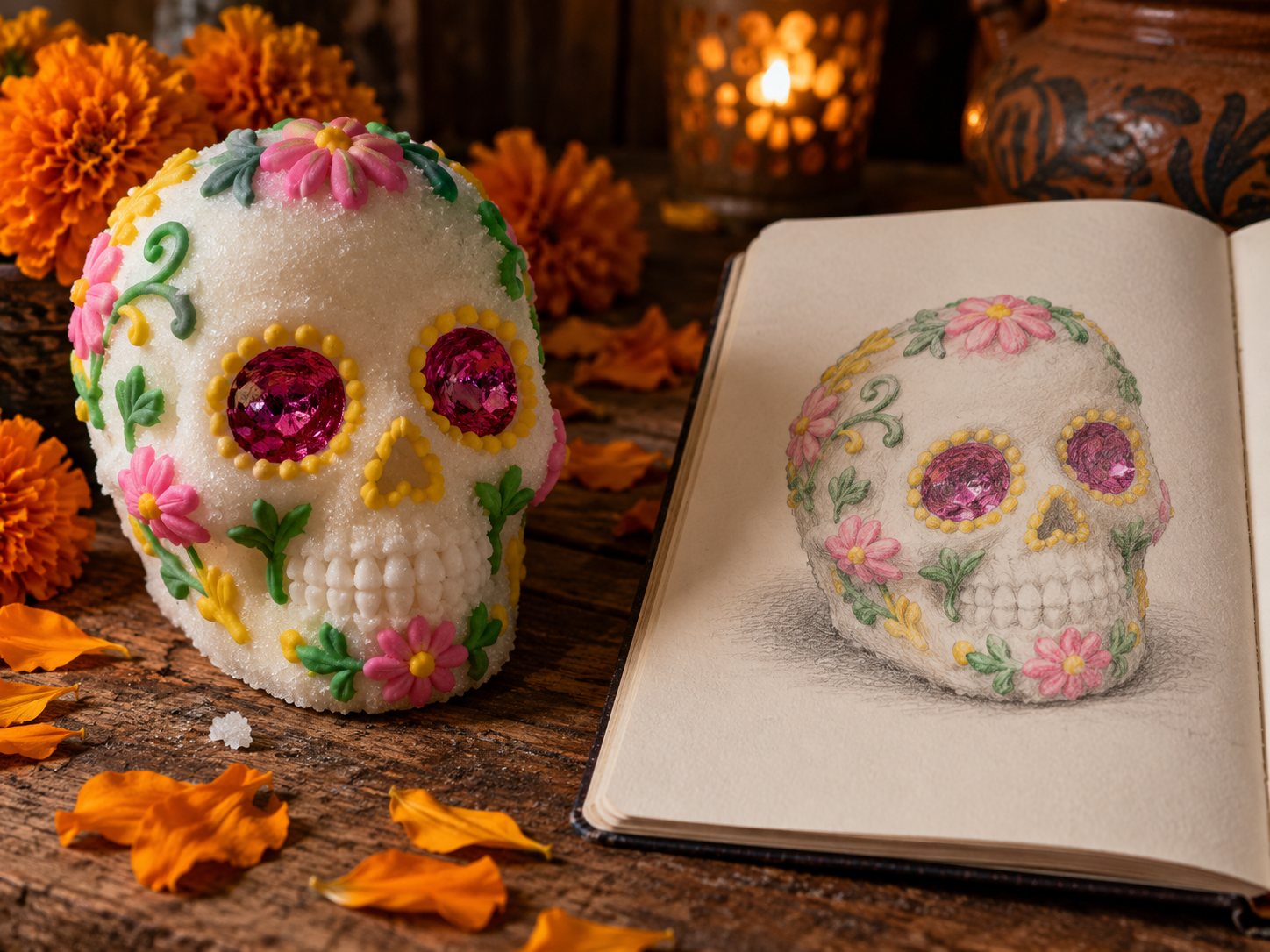
The tradition has a long paper trail. Cambridge also holds a sugar-paste calavera collected in Toluca in 1898 by Frederick Starr, decorated with black and red pigment and a dotted Latin cross. In Mexico City, the Chavarría family has been making sugar skulls for altars since about 1941, according to the Associated Press. Their skulls are molded and then painted by hand several days later.
Sugar skulls also differ from place to place. The same AP report describes regional versions made with sugar, chocolate, amaranth, almonds, peanuts, pumpkin seeds and honey. A sugar skull from one region can be made from quite different ingredients than one from another, and each belongs to the place that makes it. For more on the candy itself, read our story on sugar skulls, and for the altar they sit on, our guide to making an ofrenda.
From sugar skull to sugar skull tattoo
Tap or hover a step to follow the order.
1870
José Guadalupe Posada begins working in José Trinidad Pedroza's studio, the start of a career that produced satirical calavera prints
1898
Frederick Starr collects a sugar-paste calavera in Toluca, now catalogued at the University of Cambridge
About 1941
The Chavarría family begins making sugar skulls for altars in Mexico City
1968
Freddy Negrete is drawing black-and-gray Chicano imagery in Los Angeles juvenile detention
2015
The Día de Muertos parade in the film Spectre helps inspire a new annual parade in Mexico City
2017
Disney and Pixar's Coco brings Día de Muertos imagery to a much wider audience
How that meaning carries into a tattoo
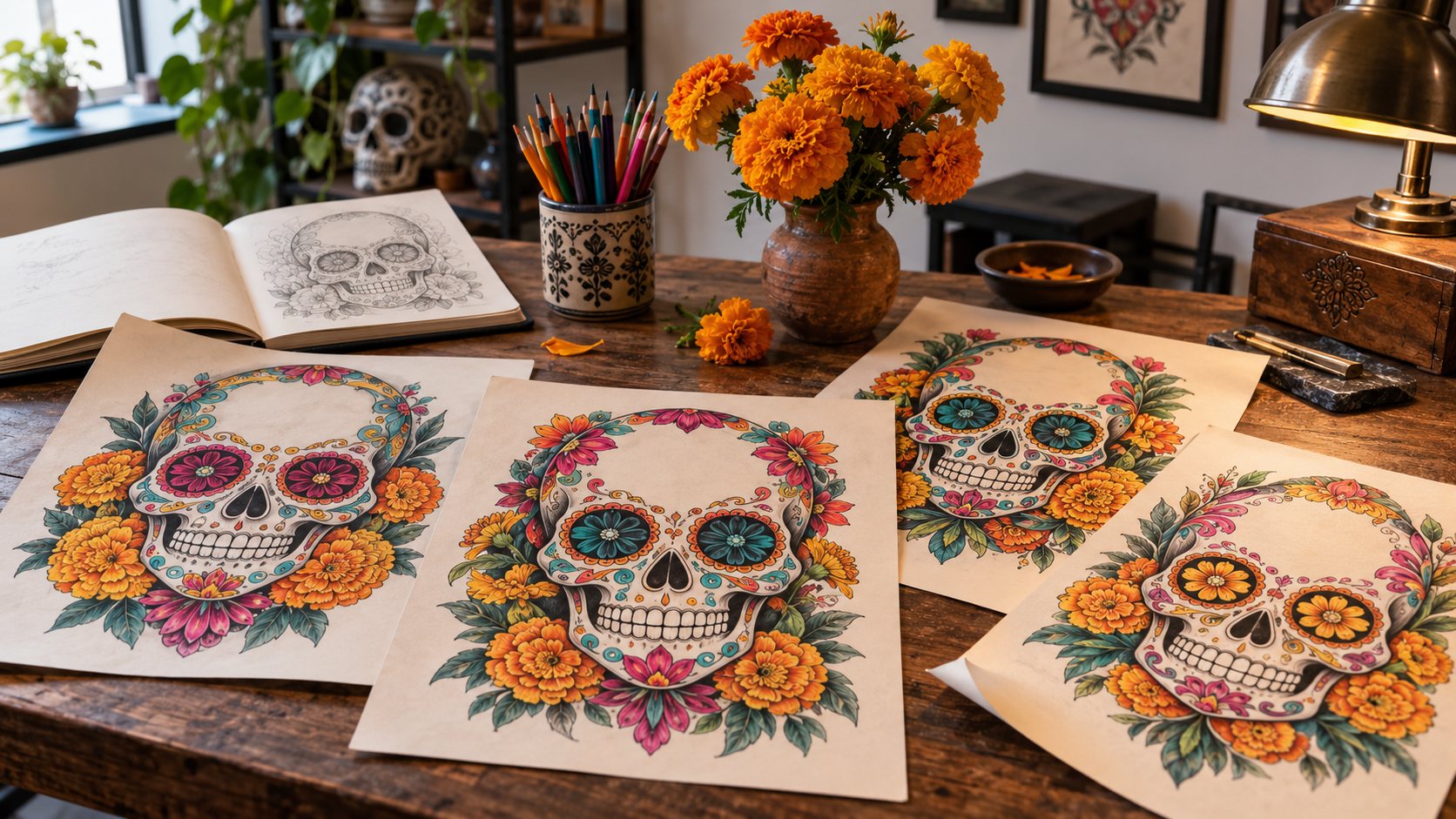
A tattoo carries the sugar skull's meaning most directly when it does what the altar skull does: it stands for someone. A name across the forehead, a portrait, dates, a favorite flower, a favorite food or an object that belonged to the person all tie the design back to the ofrenda's purpose. For someone honoring a grandparent, a parent or a friend, the tattoo can become a permanent version of the skull a family sets on the altar.
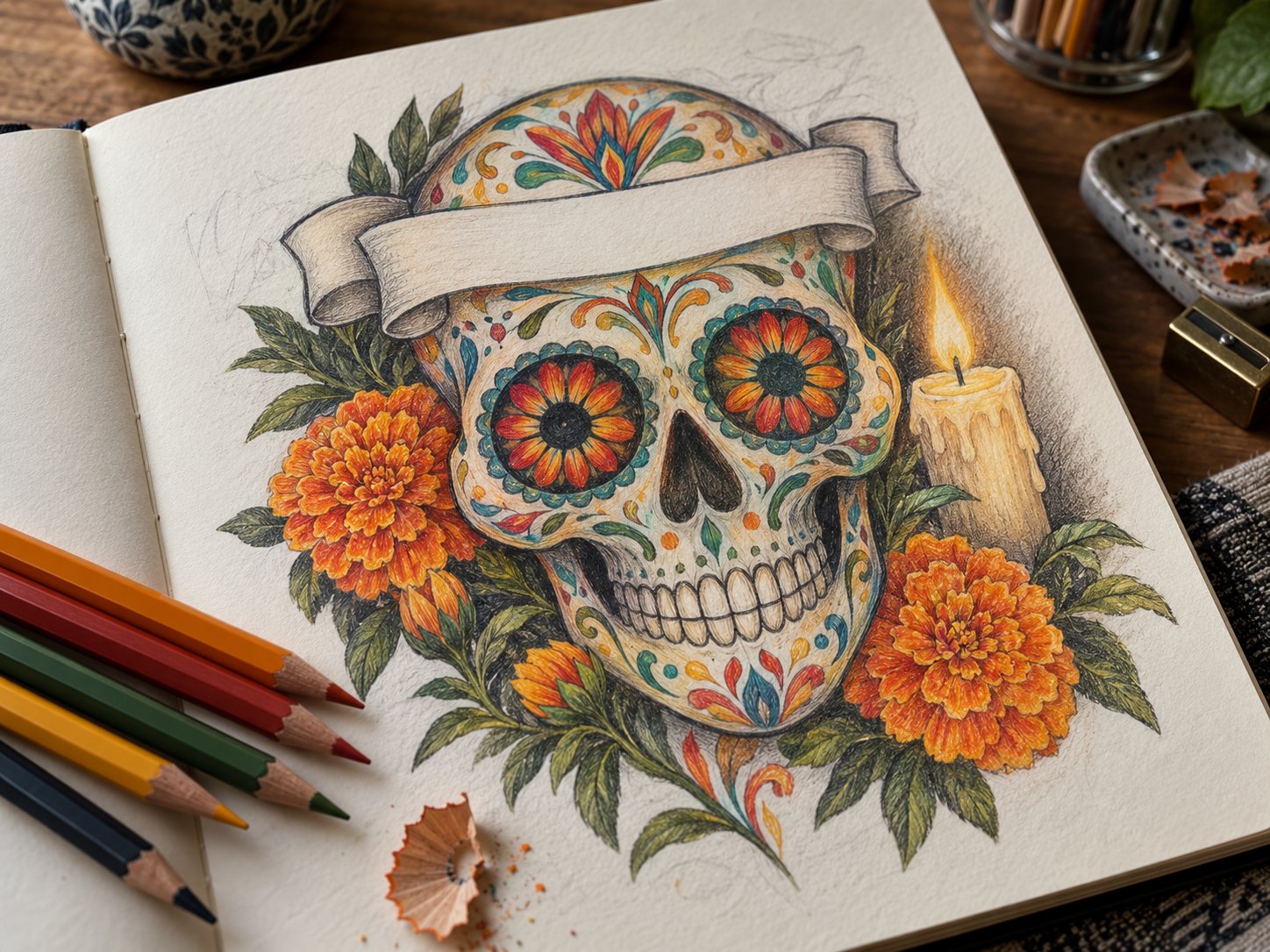
A sugar skull tattoo can also say something about who you are. It can express Mexican or Mexican American identity and family tradition. For others it is a reflection on life and death, decorated rather than grim. The interpretation depends on the wearer, the design, the community and the purpose, and the tradition itself differs across Mexico and across Mexican American communities in the United States. If you want the wider story of the holiday, start with our piece on Día de Muertos and the regional differences in Day of the Dead by region.
The elements, and what they are said to mean
Sugar skull tattoos borrow most of their details from the altar. This is how each one is usually read, and by whom.
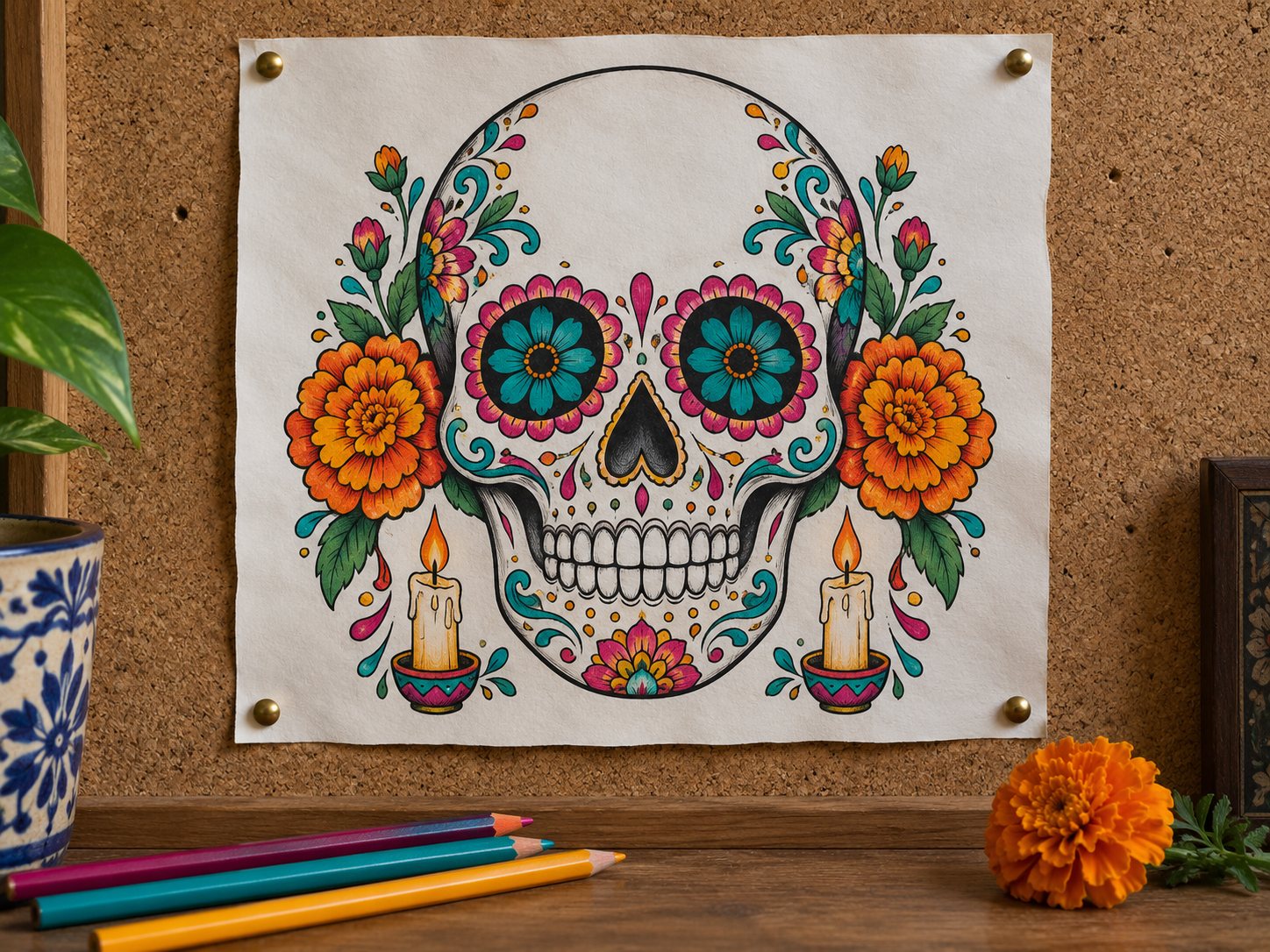
Sugar skull tattoo elements and their meanings
Tap a card to bring it forward.
- Marigolds (cempasúchil): An altar flower The Mexican Museum ties to death rituals and the path between the living and the dead
- A name on the forehead: Identifies the person the skull stands for, as on sugar skulls sold at Oaxaca markets
- Colors: Decorative choices that vary by artist, family, town and region
- Candles: The Mexican Museum says candles guide souls to the altar
- Photographs, favorite foods and drinks: Part of the wider ofrenda that remembers a specific person
- A Catrina portrait: Related to the sugar skull but a separate image, rooted in José Guadalupe Posada's satirical prints
Marigolds, or cempasúchil, are the flower most people recognize. The Mexican Museum describes them as an altar flower tied to death rituals and to the path between the living and the dead, within its own account of Día de Muertos altar practice.
The name on the forehead is the clearest memorial element you can put in a tattoo. On the sugar skulls Cambridge documented in Oaxaca, the name is what turns a decorated skull into a specific person.
Colors are where the design has the most freedom. Real sugar skulls are decorated with colored icing, flowers, foil and other materials, and the colors vary by artist, family, town and region. If a chart tells you each color carries one fixed meaning everywhere in Mexico, treat that as one person's reading rather than the tradition's. Choose colors that mean something to you or to the person you are honoring.
A Catrina portrait is a close cousin rather than a twin. The well-dressed skeleton lady began with José Guadalupe Posada, who started out in José Trinidad Pedroza's studio in 1870, according to the Cooper Hewitt, Smithsonian Design Museum, and went on to make satirical calavera prints. Mexico News Daily explains that his figure began as the satirical "Calavera Garbancera" and was later named and developed by Diego Rivera. A Catrina tattoo carries that history of satire and national imagery, which is a different story from a molded altar skull. You can read more in our pieces on La Catrina and José Guadalupe Posada.
How the sugar skull reached tattooing
There is no single first sugar skull tattoo on record. What is documented is the route through Mexican American and Chicano visual culture. PBS SoCal records Freddy Negrete developing black-and-gray tattoo imagery in Los Angeles juvenile detention in 1968, drawing on Chicano art, lowrider culture, saints and lettering. His work later connected with Good Time Charlie's shop in East Los Angeles, where thin-line black-and-gray tattooing entered professional practice. That Chicano tattoo lineage gave calaveras and other Mexican and Mexican American imagery a home in American tattooing.
Much wider popularity came later. The Día de Muertos parade in Mexico City seen in the 2015 film *Spectre* had not existed in that form before, and Mexico News Daily reports that the film helped inspire the parade that later became an annual event. Disney and Pixar's *Coco* followed in 2017. Tattoo publishing and commercial products spread the look further. These are modern chapters of the story, and they are part of why the design is everywhere now.
What Mexican and Mexican American voices say
People who love this design but are not Mexican or Mexican American often ask whether it is theirs to wear. People inside the culture answer that question in different ways, and the range is worth hearing in their own words.
Mexican American makeup artists Andrea Ortega Costigan and Mariana McGrath of Salt Spell Beauty welcome people from outside the culture who understand the memorial meaning. "It's not cultural appropriation if it's your own culture," they write, and they invite non-Mexican people to take part, as long as they understand what it means and remember their dead.
Cesáreo Moreno of the National Museum of Mexican Art spoke to the Associated Press about change in the tradition: "If people are looking to do something a little bit different, that is fine. But if people stop understanding what is at the heart of this tradition, that is what I am against."
Gabriela Solís, a Mexican American artist and cultural commentator, gave practical guidance in Mexico News Daily: avoid treating the imagery as a Halloween costume, especially next to pumpkins and other Halloween symbols, and do not enter churches or cemeteries with a painted face, because those are places of worship and mourning.
A Mexican American writer at Women Write About Comics, writing anonymously, takes a firmer line, describing sugar skulls as gifts set out for the dead and seeing use outside remembrance as especially problematic. And the Sacramento Bee has profiled Rob-O, a Mexican American sugar skull artist who uses the tradition to remember people and describes Día de Muertos as a positive outlet for grief.
These voices do not agree on everything. What they share is a concern about the image losing its tie to remembrance and becoming generic spooky decoration, a costume or a product with nothing behind it.
Wearing a sugar skull with respect
Respect here is mostly practical, and most of it happens before the needle touches skin.
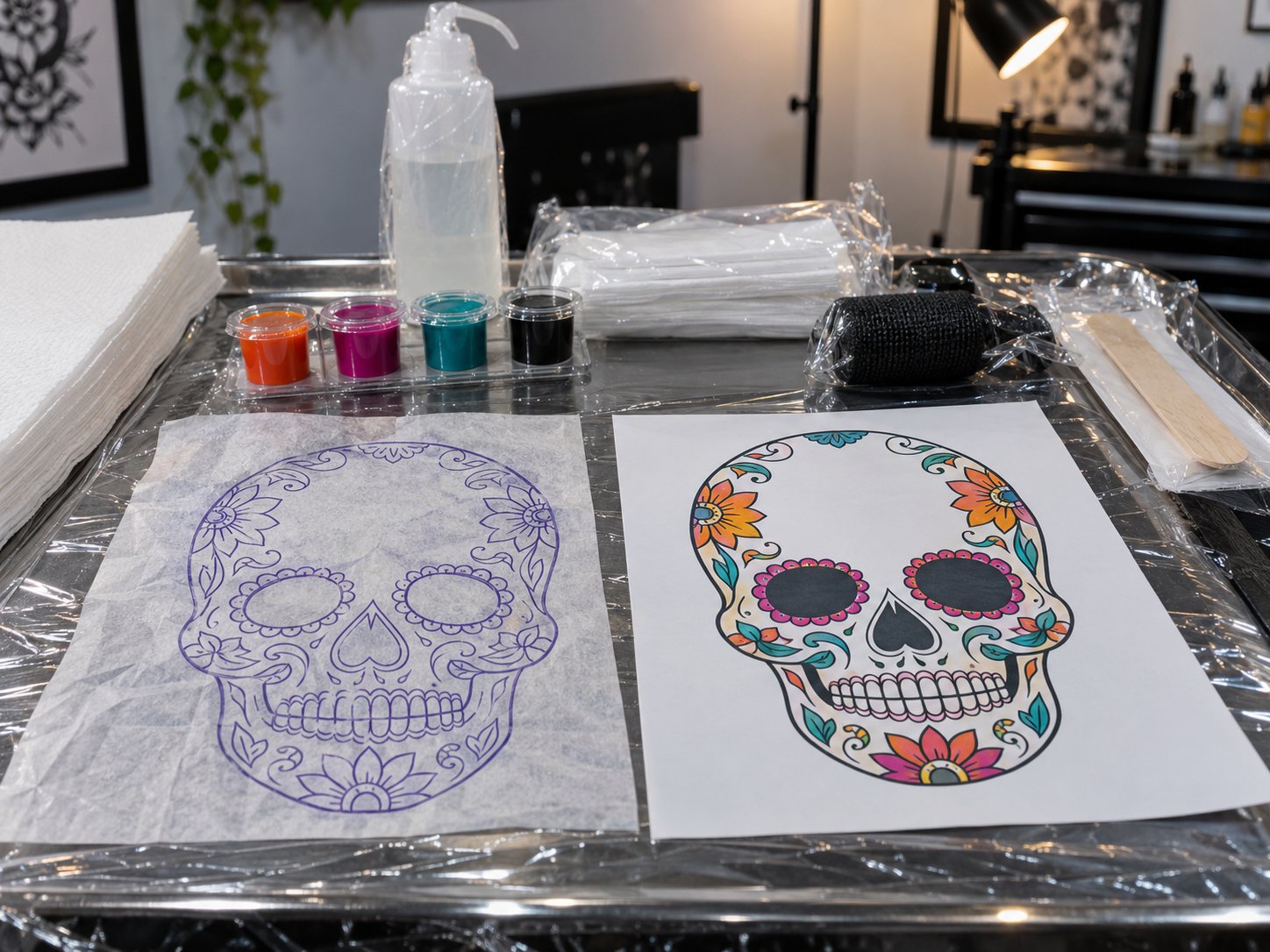
Start with the artist. Look for someone who understands the difference between a Día de Muertos calavera, a Catrina portrait and a generic skull, and talk through the design's cultural references before you book. Ask how they will handle the name, the flowers, a portrait and any other memorial details.
If the tattoo honors someone who has died, put them in it. A forehead name, dates, a portrait, a favorite flower or a favorite food connects the tattoo to the purpose of the ofrenda, and it gives you a story to tell when someone asks.
Learn the words that go with it: *calavera*, *calaverita de azúcar*, *ofrenda*, *cempasúchil*, *La Catrina* and *Día de Muertos*. Knowing them makes it easier to talk about the design and to credit where it comes from. And remember that one town's or one family's way of keeping the day is not the rule for all of Mexico.
If you take part in a public celebration, follow the host community's guidance, and treat churches, cemeteries and family altars as places of worship and remembrance rather than backdrops for photos. If you are planning face paint for the season, our Catrina makeup piece covers that side.
A respect checklist for a sugar skull tattoo
Tap a card to bring it forward.
- A clear purpose: The tattoo honors a specific person or carries a meaning you understand
- A real calavera: The design is recognizably a Día de Muertos calavera, not a generic skull
- A prepared artist: The name, flowers, portrait and other elements have been talked through before booking
- No Halloween stereotype: The tattoo and how you show it stay apart from Halloween costume use
- Respect in sacred places: Churches, cemeteries, family altars and local event guidance are respected
Quick answers about sugar skull tattoos
What is the cultural meaning of a sugar skull tattoo?
A sugar skull tattoo carries the meaning of the decorated calavera de azúcar used to remember a person who has died during Día de Muertos. It can also express Mexican or Mexican American identity, and a name or other memorial detail makes the link to remembrance clearest.
Is sugar skull face paint considered cultural appropriation?
There is no single answer, and Mexican and Mexican American voices differ. Makeup artists Andrea Ortega Costigan and Mariana McGrath welcome respectful participation by people who understand the memorial tradition, while other Mexican American writers object to Halloween-style or purely commercial use. Intent, conduct and whether the paint is about remembrance all matter.
What does a sugar skull tattoo mean for a woman?
A sugar skull tattoo has no separate meaning for women; a woman may wear one as a memorial, as an expression of Mexican or Mexican American identity, as a nod to La Catrina, or as a personal reflection on life and death. A female Catrina portrait brings in the history of Posada's satirical skeleton figures, but it does not fix any single trait such as beauty or strength.
Where to go next
The sugar skull is one thread in a much larger celebration. Read about Día de Muertos and how it differs by region, learn how families build an ofrenda, and meet La Catrina. If you are comparing designs, our piece on skull tattoo meaning covers the wider family of skull tattoos.