

No. 316
Chimpanzee Skull vs Human Skull: Brain Case, Face, Teeth and Brow
Set a chimpanzee skull beside a human skull and five differences jump out. The chimpanzee, *Pan troglodytes*, has a much smaller brain case, about 320 to 480 cc against an average of about 1,300 cc for modern humans, *Homo sapiens*. It has a heavy bony brow ridge, a face that pushes forward, large canine teeth with a gap beside them, and the opening for the spinal cord set farther toward the back. The human skull has a tall, rounded brain case, a near-vertical forehead, a flatter face, smaller teeth and a chin.
Animal Diversity Web, run by the University of Michigan Museum of Zoology, and the Smithsonian's Human Origins program both describe these features. They are average species differences, and individual skulls vary with sex and age. Read together, though, they make the two skulls easy to tell apart on a table. For a wider set of comparisons with other animals, see human vs animal skull.
The brain case
The brain case, or cranium, is the rounded part of the skull that holds the brain. Its size is measured as cranial capacity, or endocranial volume, the space inside, in cubic centimeters (cc).
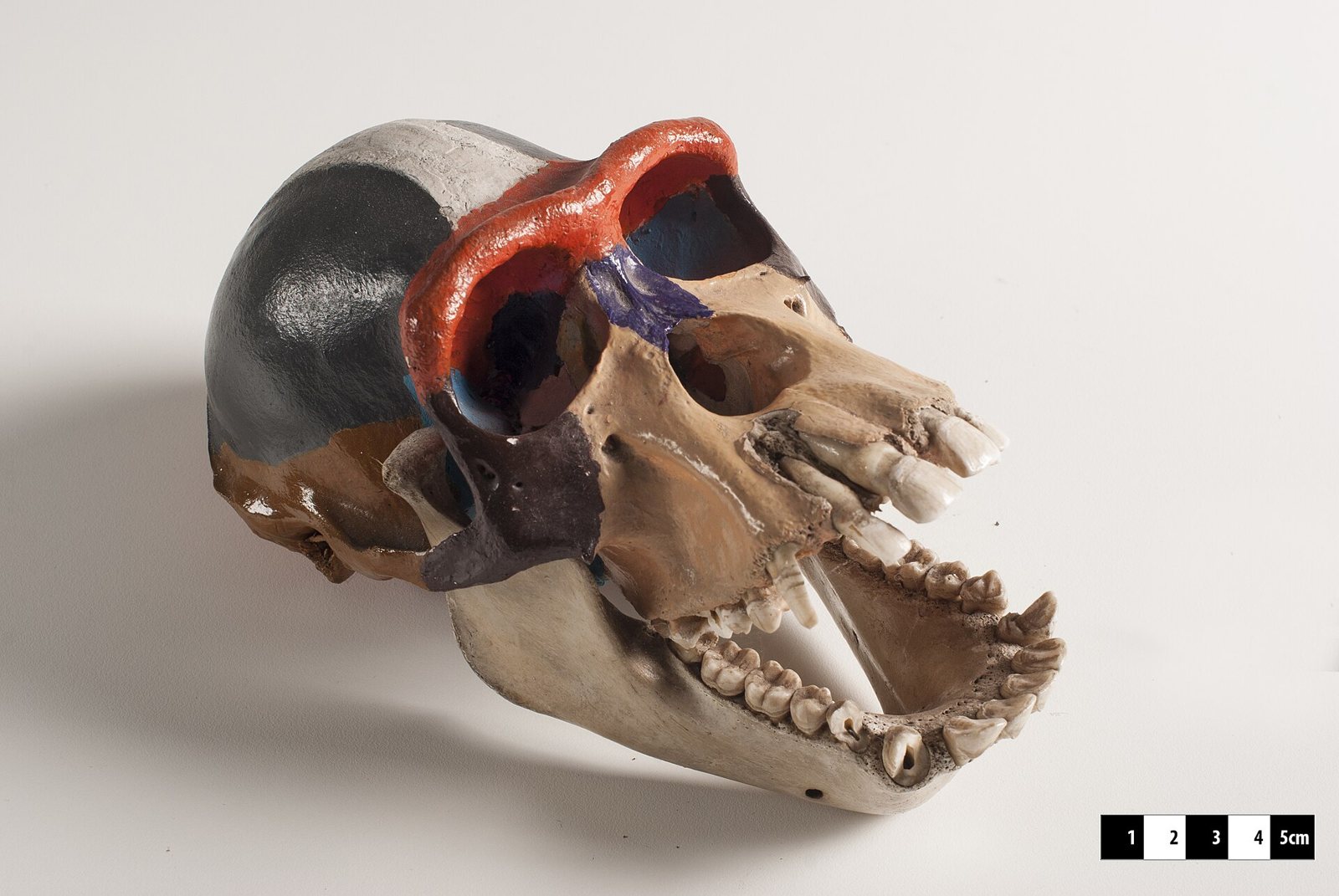
Animal Diversity Web gives the chimpanzee a cranial capacity of roughly 320 to 480 cc. A CT scan study of wild chimpanzees from Taï Forest National Park in Côte d'Ivoire, published on PubMed, measured 13 adults and reported an average endocranial volume of 378.7 cc, plus or minus 30.1 cc. Modern humans average about 1,300 cc, according to Smithsonian Human Origins, roughly three times as much.
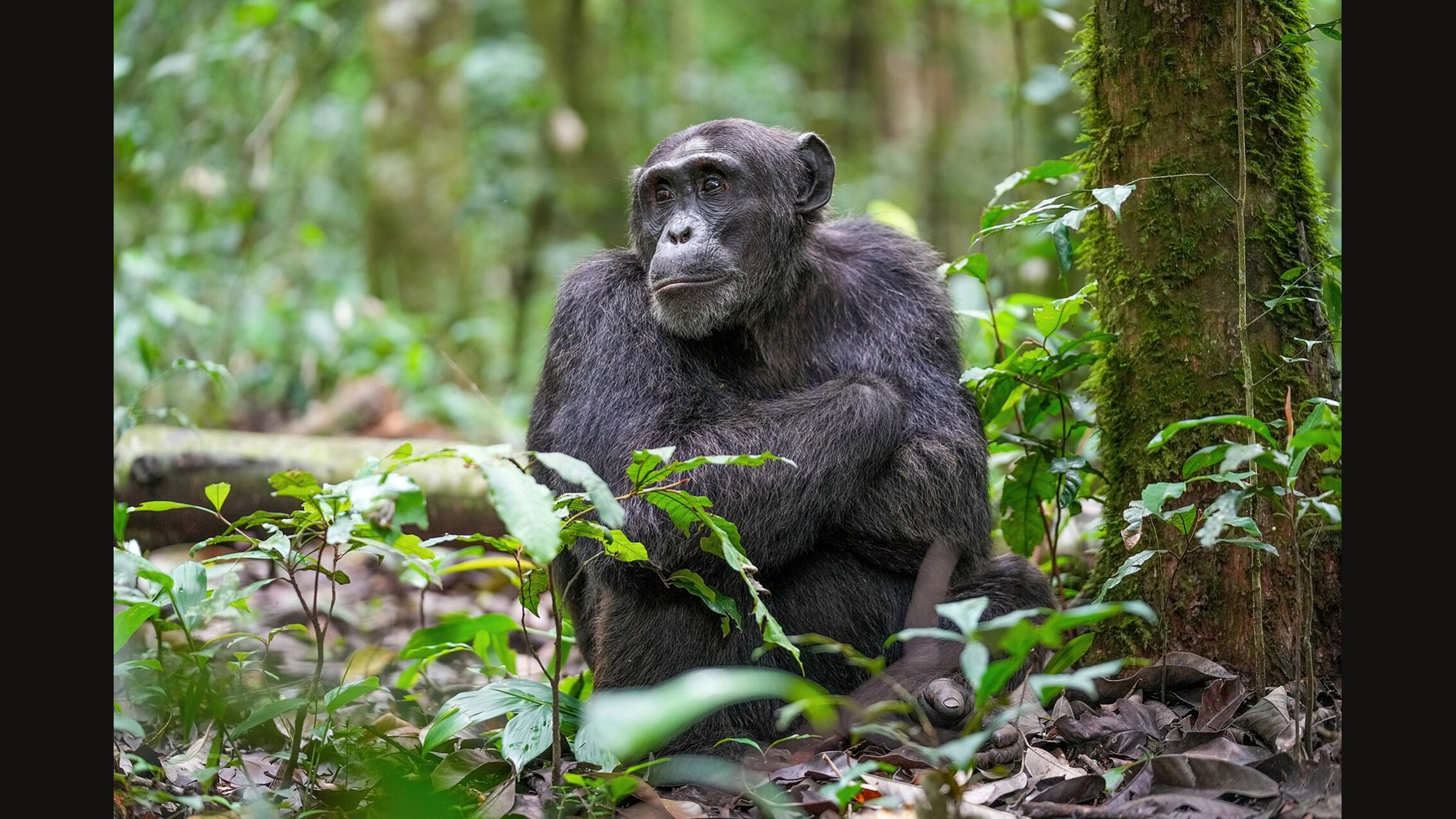
That difference is the first thing you see in profile. The Smithsonian describes the modern human skull as high vaulted and relatively thin walled, a tall dome that rises straight up from the forehead. The chimpanzee's brain case is smaller and lower, sitting behind a face that projects forward. For more on our own skull, read human skull facts.
The brow and the face
From the front, the chimpanzee's brow ridge is hard to miss. Animal Diversity Web calls it a prominent superorbital ridge, a thick shelf of bone running across the top of the eye sockets. Human brow ridges are much smaller.
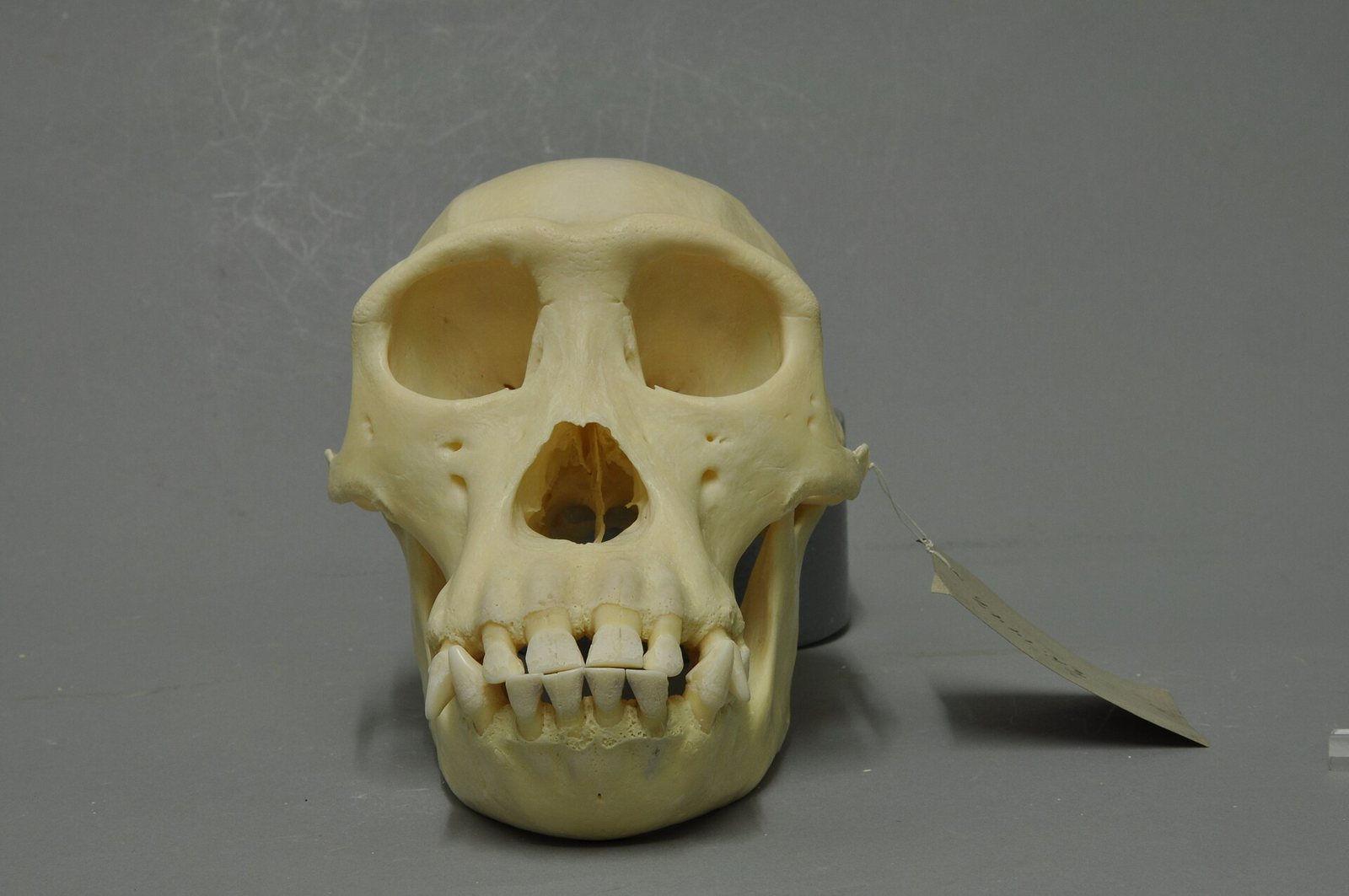
Below the brow, the chimpanzee face is prognathic, which means the face and jaws project forward. Animal Diversity Web describes it as slightly prognathic, and in side view the chimpanzee shows a longer, more projecting muzzle than a human. The Smithsonian describes modern humans as having a smaller face and jaw with little or no prognathism, a near-vertical forehead, and a chin on the mandible, the lower jaw. The chin is one of the simplest human clues there is, because a chimpanzee's lower jaw has none.
Two smaller details complete the top and back of the skull. A sagittal crest, a ridge of bone along the midline where jaw muscles attach, can occur in very large chimpanzees, but it is not typical. Chimpanzees also lack a nuchal crest, a ridge across the back of the skull. Adult males generally have larger skulls than females.
The teeth
Open the jaws and the canines tell the story. A chimpanzee has large canines and a visible diastema, a gap in the tooth row where the opposing canine fits. Its molars are large too. Seen from below, the upper teeth form a square dental arcade, meaning the row of teeth has a squarer outline than the rounded human one.
Humans keep the same broad kinds of primate teeth, incisors, canines, premolars and molars, but our canines are much smaller and there is no comparable gap beside them. Our dental arcade is more rounded, and our teeth are smaller overall. The Smithsonian's teaching page How to Read a Mammal Skull explains how tooth shape and arrangement reveal what a skull belonged to, and in this pairing they settle the question quickly.
Tap or hover a row to highlight it.
| Feature | Common chimpanzee, Pan troglodytes | Modern human, Homo sapiens |
|---|---|---|
| FeatureCranial capacity | Common chimpanzee, Pan troglodytesAbout 320 to 480 cc | Modern human, Homo sapiensAverage about 1,300 cc |
| FeatureFace | Common chimpanzee, Pan troglodytesSlightly prognathic, projecting forward | Modern human, Homo sapiensMuch flatter, little or no prognathism |
| FeatureBrow ridge | Common chimpanzee, Pan troglodytesProminent superorbital ridge | Modern human, Homo sapiensSmall or reduced |
| FeatureCanines | Common chimpanzee, Pan troglodytesLarge, with a prominent diastema | Modern human, Homo sapiensSmaller, with no comparable canine gap |
| FeatureForamen magnum | Common chimpanzee, Pan troglodytesFarther toward the rear | Modern human, Homo sapiensUnderneath and nearer the center |
| FeatureSkull outline | Common chimpanzee, Pan troglodytesLower braincase and projecting muzzle | Modern human, Homo sapiensHigher, rounded braincase and near-vertical forehead |
The view from underneath
Turn both skulls over and look for the foramen magnum, the large opening where the spinal cord leaves the skull. In a chimpanzee it sits farther toward the back. In a human it sits underneath the skull, nearer the center.
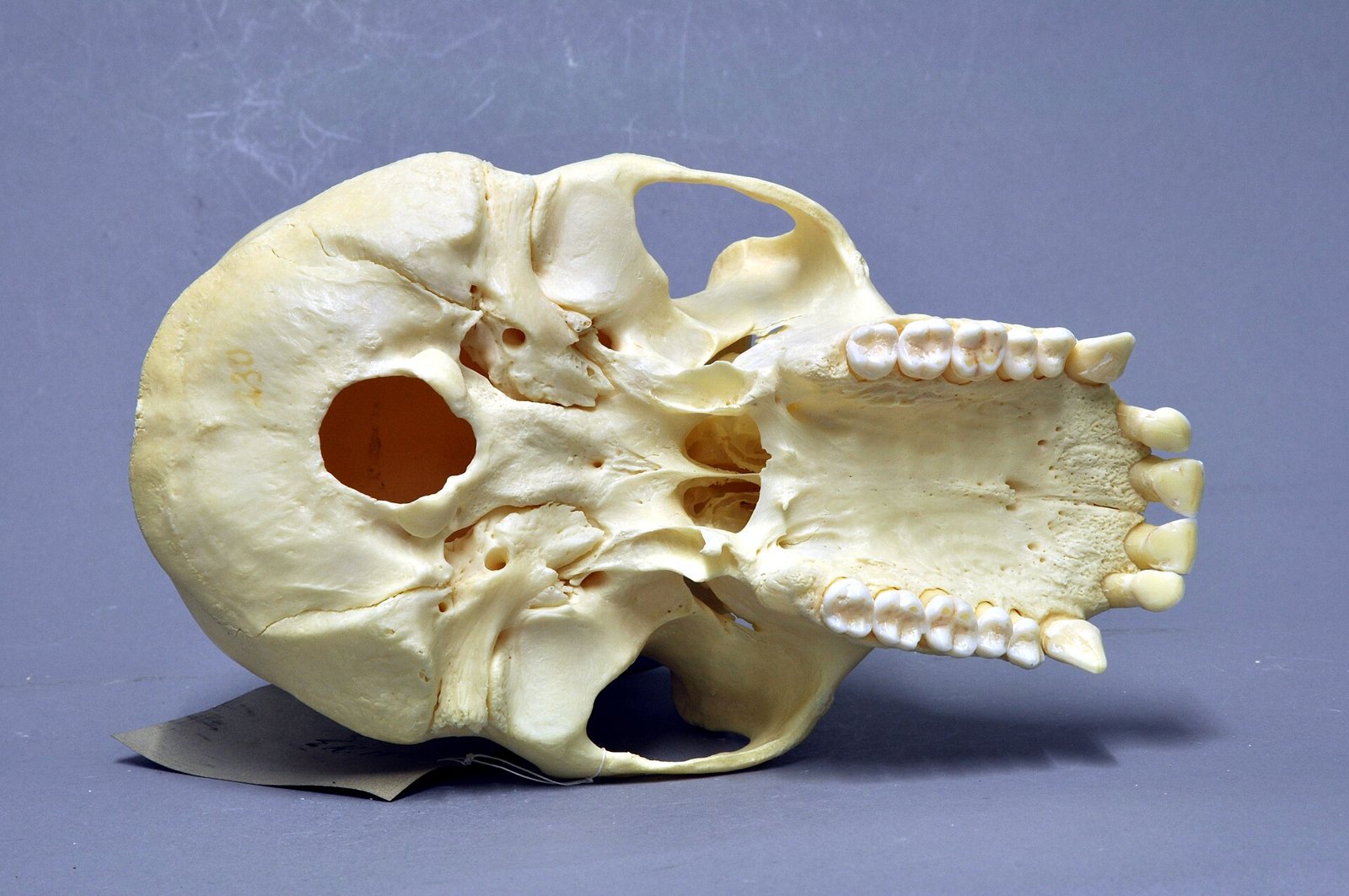
The Smithsonian's Walking Upright pages explain why that matters. A foramen magnum placed underneath fits a head balanced on top of an upright spine, which is how people walk. The Smithsonian sets early human skulls beside chimpanzee and modern human skulls on this point; for one famous early relative, read the story of Lucy.
These are average species differences. They help you understand a skull in a museum case, but they are not a substitute for examination by a qualified osteologist, a specialist in bones.
What to look at first
Tap a card to bring it forward.
- Brain case height: A tall, rounded dome points to a human; a low brain case behind the face points to a chimpanzee.
- Brow ridge: A thick shelf of bone over the eyes is a chimpanzee feature.
- Face: A face and jaws that push forward suggest a chimpanzee; a flat face suggests a human.
- Canines and gap: Large canines with a diastema beside them belong to the chimpanzee.
- Foramen magnum: Underneath and central in a human; farther back in a chimpanzee.
- Chin: A chin on the lower jaw is a human feature.
Is a chimp skull thicker than a human skull?
Not as a general rule, and the real answer is more interesting than a yes or no. Chimpanzee skull bone varies a great deal from one region of the skull to another. A study of the elastic properties of chimpanzee craniofacial cortical bone, the dense outer layer of bone in the skull and face, reported an overall average cortical thickness of about 1.7 mm, with large regional differences. Compared with human craniofacial bone, the chimpanzee bone tended to be less thick overall, although the chimpanzee's cranial vault, the roof of the brain case, was denser in the study's comparison.
Lynn E. Copes has measured cranial vault thickness across non-human primates, and with William H. Kimbel has compared it across primates more broadly. The common thread is that thickness depends on where you measure, the animal's sex, age and body size, and the method used. A big brow ridge does not turn the whole skull into a helmet, so thickness cannot be judged by appearance. For the human side of this question, read how strong is a human skull. Smaller primates follow other plans: a lemur skull has a toothcomb in the lower jaw, and a tarsier skull is dominated by two enormous eye sockets.
Chimpanzee, bonobo and gorilla
The common chimpanzee has a close relative in the bonobo, *Pan paniscus*. Both belong to the genus *Pan*, and telling their skulls apart takes the whole specimen: the teeth, the sex and age of the animal, careful measurements and a record of where it came from. For any individual skull, a university mammal collection or a qualified osteologist is the right place to confirm the species.
The western gorilla, *Gorilla gorilla*, is a different matter, far more heavily built than either. The Barcelona Natural History Museum's osteological atlas describes a prominent sagittal crest, large orbits, strong supraorbital ridges, a rounded face, marked forward projection of the lower jaw and prominent male canines. Next to that, a chimpanzee skull looks almost delicate. The gorilla skull story covers the gorilla in full, and for a primate with a very different face, a long dog-like muzzle, see the baboon skull.
Skulls in collections, and a comparison from 1863
Real comparisons start with skulls kept in museums. Harvard's Peabody Museum holds male and female chimpanzee crania collected in northern Liberia by George Harley in the early 1940s, which have been used in work on chimpanzee biology and human evolution. Harvard's Museum of Comparative Zoology holds bonobo skull specimens, such as this record. The University of São Paulo's Museum of Veterinary Anatomy has a chimpanzee skull photographed and shared openly.
The side-by-side view itself has a long history. In 1863, Thomas Henry Huxley's book *Evidence as to Man's Place in Nature* printed a comparison of human and ape skulls, a scan of which is shared by the Wellcome Collection. More than 160 years later, the brain case, brow, face and teeth are still where the comparison starts.
Keeping or owning a chimpanzee skull
This is general information, not legal advice, and rules differ by country and by state.
Chimpanzees, bonobos and gorillas are listed in Appendix I of CITES, the international agreement on trade in endangered wild animals and plants. A 2013 U.S. Fish and Wildlife Service Federal Register document states that international trade in chimpanzee specimens and parts requires permits and certificates, and the Fish and Wildlife Service's CITES pages explain how those permits work.
Before handling, keeping, transporting or importing any real skull, confirm the species, where it came from and the current permit requirements with the U.S. Fish and Wildlife Service or your national CITES authority, and check local wildlife and public-land rules too. Classrooms and museum displays mostly use casts. If there is any chance a skull you have come across is human, read found human bones first. For other skulls that turn up outdoors, see found an animal skull.
FAQ
Short answers on the chimpanzee skull's look, telling one apart, and young skulls.
What does a chimpanzee skull look like?
A chimpanzee skull has a low brain case, a heavy brow ridge over the eyes and a face that projects forward into a muzzle. The upper teeth sit in a square arcade with large canines and a gap beside them. A very large individual may show a sagittal crest along the top, though most do not.
How can you tell if a skull is a chimpanzee's?
Look for the combination: a small, low brain case, a strong brow ridge, a forward-projecting face, large canines with a diastema, no chin and a foramen magnum set toward the back. No single feature is enough on its own. A university mammal collection or a qualified osteologist can confirm the species of a real specimen.
Do baby chimp and human skulls look alike?
The differences in this story describe adult skulls, and a young skull is still growing into them, so it can be much harder to read. An infant skull of any primate is a job for a specialist. For how a human baby's skull is put together, see baby skull fontanelles.
Two skulls, side by side
A chimpanzee skull and a human skull share the same basic primate plan, and the differences sit in a handful of places: the height of the brain case, the brow, the face, the canines and the opening underneath. Once you know where to look, you can read them in any museum case.
Chimpanzee or human? Test yourself
Answer every question to check.
Terms in this story
Tap a term to see what it means.
Cranial capacity. The volume inside the brain case, measured in cubic centimeters. Chimpanzees have about 320 to 480 cc, modern humans about 1,300 cc on average.
---