

No. 329
The Toucan Skull and Its Huge, Light Beak
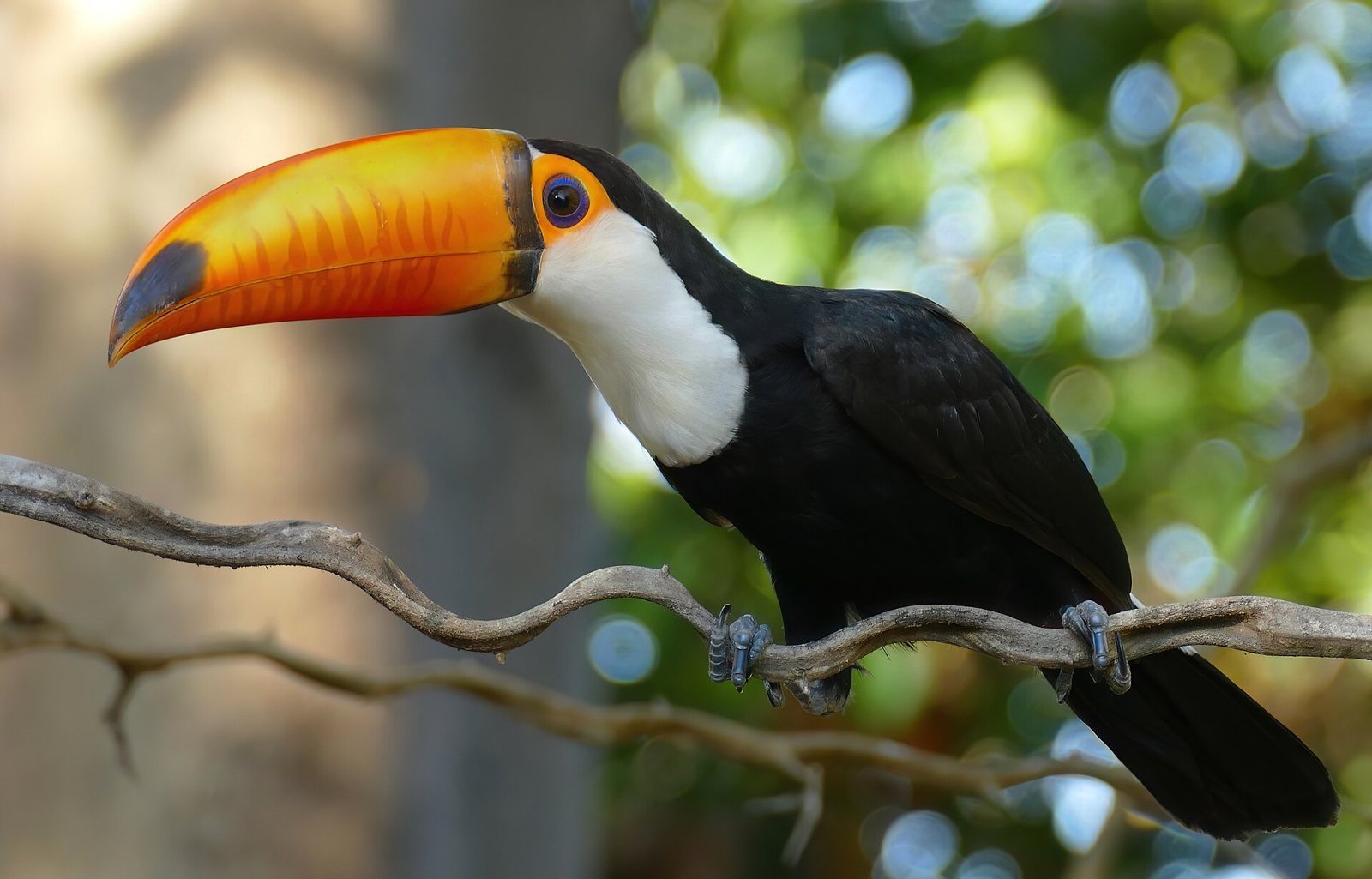
A toucan's huge beak is light because it is mostly engineering and air. The bill is a bony core inside a keratin sheath called the rhamphotheca, and the bone inside is a foam-like mesh of fine fibers and thin membranes with hollow spaces.
In the Toco toucan, *Ramphastos toco*, that build makes the bill about one-third of the bird's length but only about one-twentieth of its mass, according to a 2005 study by Yasuaki Seki, Matthew S. Schneider and Marc A. Meyers at UC San Diego.
The toucan uses it to reach and handle fruit, and, as Glenn J. Tattersall, Denis V. Andrade and Augusto S. Abe showed in *Science* in 2009, as an adjustable radiator that sheds body heat. Strip off the colorful sheath, and the skull underneath turns out to be surprisingly small and delicate.
The skull under the bill
A toucan skull includes the bony upper and lower jaws that hold up the bill. The bright outside that you see on a living bird is not bone. It is the rhamphotheca, a keratin sheath laid down in overlapping hexagonal tiles. Seki, Schneider and Meyers measured those tiles at about 50 micrometers wide and about 1 micrometer thick.
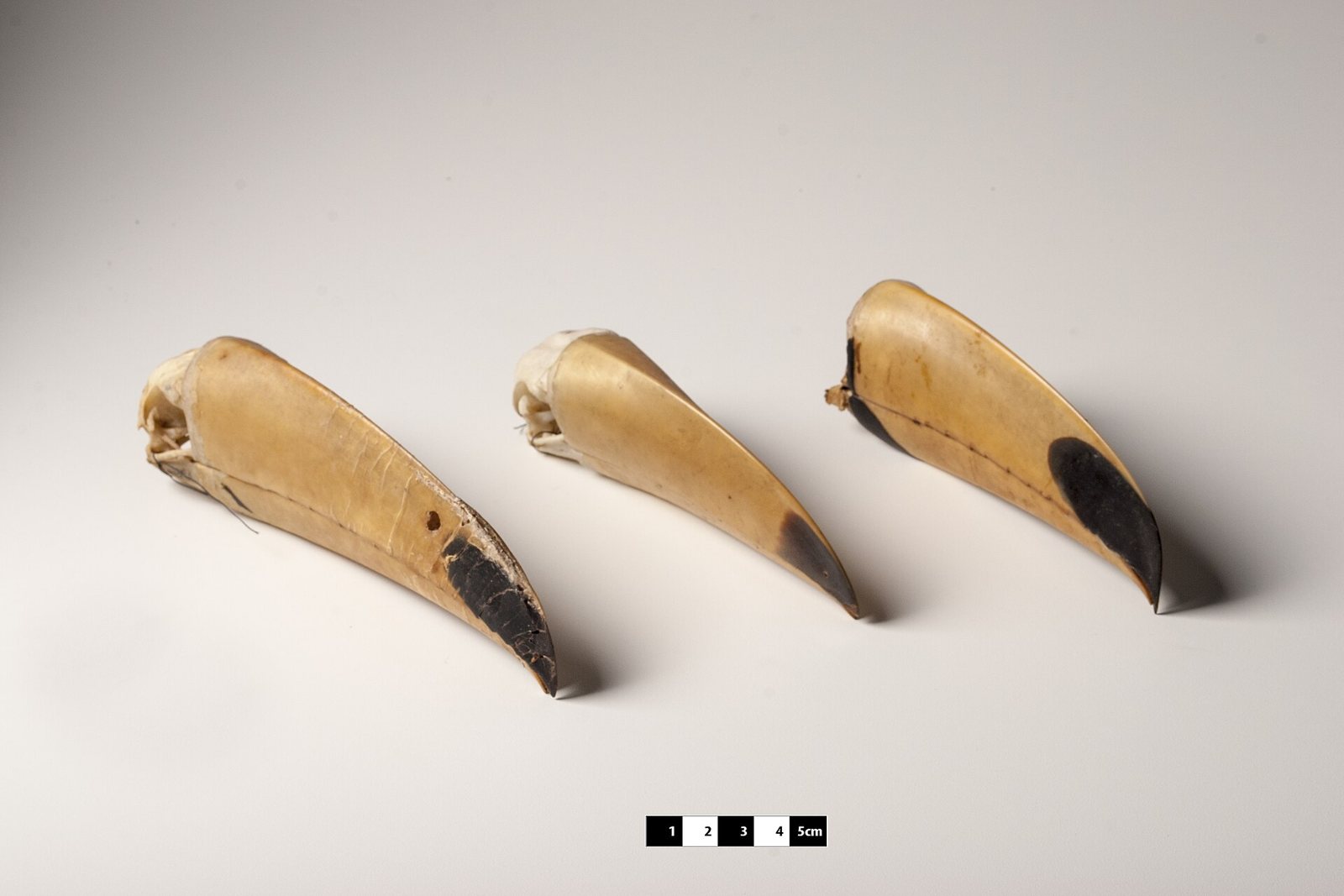
Take the sheath away and the skull looks like a different animal. What is left is a relatively small, lightweight bird skull with long upper and lower jaw bones, open nasal areas and thin bony supports where the big keratin bill once covered everything. It is a little like seeing a parade float without its decorations.
You can see this in prepared Toco toucan skulls from the Museum of Veterinary Anatomy at the University of São Paulo (FMVZ USP), photographed on 8 January 2016 and shared on Wikimedia Commons. North Carolina State University's *A Guided Tour of Avian Anatomy* also shows a *Ramphastos toco* skull.
Why the beak is so light
The beak works like a sandwich panel. Seki, Schneider and Meyers, at the University of California San Diego, published their structural study of the Toco toucan bill in *Acta Materialia* in 2005. They found a thin outer shell of keratin wrapped around a closed-cell foam, a mesh made of calcium-rich bony fibers stretched with thin, drum-like membranes.
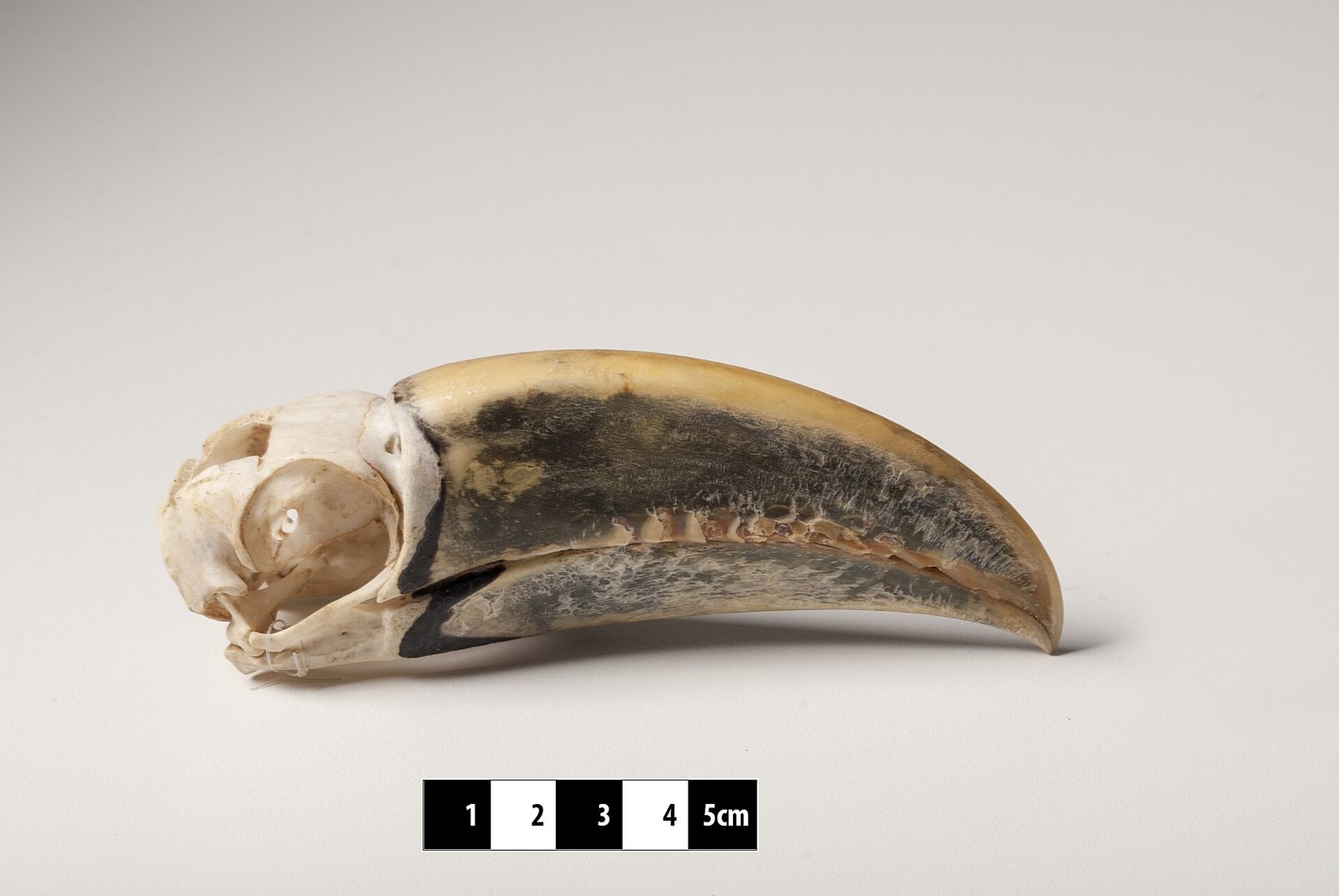
The bill also has hollow regions inside, placed where mechanical stress is low. The two layers split the job. The keratin shell gives a hard outer surface, and the foam inside braces it so it does not buckle, without adding much weight. The UC San Diego summary of the study describes the inner bill as a rigid foam of bony fibers and membranes.
The Museo Nacional de Costa Rica describes toucan bills the same way in plain terms: practically hollow inside, held up by thin bony bars. The San Diego Zoo also describes the bill as hollow and lightweight keratin supported by bony fibers. So, the answer to how a beak that big stays light is that very little of its volume is solid.
How heavy is a toucan's beak?
The figure to start with is the proportion. In the Toco toucan, the bill makes up about one-twentieth of the bird's total body mass. The Animal Diversity Web, run by the University of Michigan, puts adult Toco toucans at about 592 to 760 g.
Do the math and the bill comes out at roughly 30 to 38 g. That is an estimate from the proportion, not the weight of a bill set on a scale, so treat it as a ballpark figure. For a direct measurement, an ornithology collection is the place to ask. Either way, a bill that is a third of the bird's length and only about a twentieth of its weight is a neat trick for any animal to pull off.
What the beak is for
The bill does more than one job, and two of them are well supported.

The first is feeding. The Museo Nacional de Costa Rica and the Animal Diversity Web describe toucans using the bill to reach, grasp and handle fruit, including fruit out on branches and food inside tree cavities. The edge of the bill has a tooth-like shape that helps grip food.
The second is heat release. In 2009, Glenn J. Tattersall, Denis V. Andrade and Augusto S. Abe published a study in *Science* that used infrared imaging on adult Toco toucans. You can read an accessible copy of the paper. They found that the birds could change how much blood flowed through the bill, turning it into what they called a controllable vascular thermal radiator.
The numbers are striking. Heat loss through the bill usually made up about 30 to 60 percent of the bird's total heat loss. Across different conditions it ranged from about 5 percent to, briefly, as much as 100 percent. When toucans sleep, they tuck the bill under a wing, which cuts the heat lost from that well-supplied surface.
Both roles are real, and neither cancels the other. The 2009 study shows what the bill can do for body heat today; it did not settle why the toucan's bill grew so large in the first place.
Toco toucans, other toucans and aracaris
The Toco toucan is the largest toucan species, and the Animal Diversity Web credits it with the largest bill relative to body size of any bird. Adults average about 61 cm long.
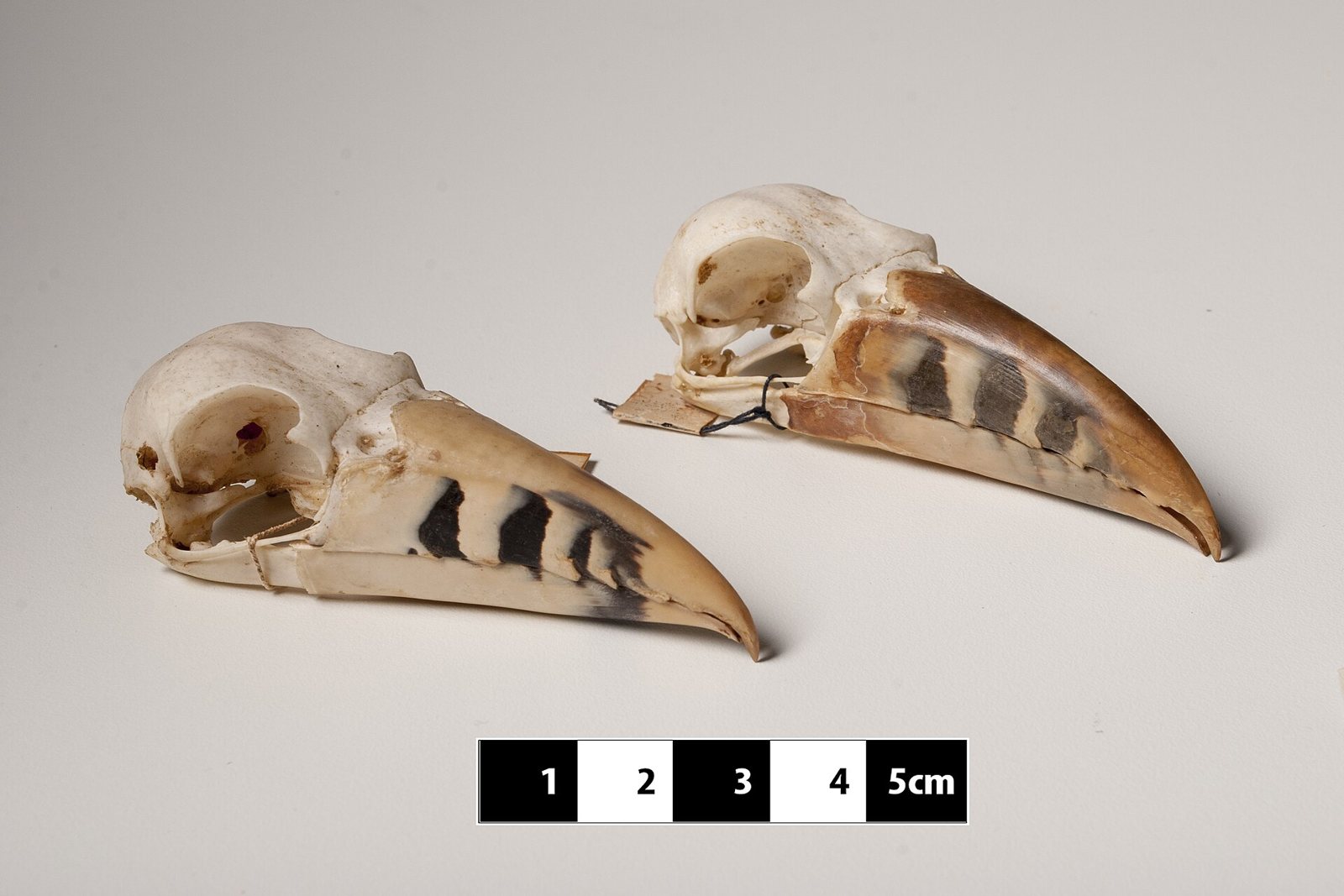
The family it belongs to, the ramphastids, comes in many sizes. The Museo Nacional de Costa Rica lists Costa Rican species ranging from about 30 to 56 cm. At the large end is the Chestnut-mandibled Toucan, *Ramphastos ambiguus*, at about 56 cm, and at the small end is the Emerald Toucanet, *Aulacorhynchus prasinus*, at about 30 cm.
Aracaris are smaller relatives with the same lightweight bill design. The Collared Aracari, *Pteroglossus torquatus*, averages about 41 cm and 230 g, and the Animal Diversity Web describes its bill as reinforced by a crisscross of bony rods. In general, aracaris have smaller, slimmer bodies and bills than the big *Ramphastos* toucans. The University of São Paulo's Museum of Veterinary Anatomy also holds a skull of the Green-billed Toucan, *Ramphastos dicolorus*.
Go back far enough and every one of these birds has a striking ancestry. A toucan is a living dinosaur: the American Museum of Natural History explains that birds were the only dinosaurs to survive the mass extinction about 65 million years ago, so the Toco toucan belongs to the surviving bird branch of the dinosaur family tree rather than to the prehistoric, non-bird dinosaurs.
Tap or hover a row to highlight it.
| Subject | Detail |
|---|---|
| SubjectToco toucan, *Ramphastos toco* | DetailAbout 61 cm long and 592 to 760 g; bill about one-third of body length and one-twentieth of body mass |
| SubjectCollared Aracari, *Pteroglossus torquatus* | DetailAbout 41 cm long and 230 g; bill reinforced by a crisscross of bony rods |
| SubjectCosta Rican ramphastids | DetailAbout 30 to 56 cm across the species listed by the Museo Nacional de Costa Rica |
| SubjectBill structure | DetailKeratin shell over a bony foam, with hollow regions inside |
| SubjectHeat exchange | DetailBill heat loss usually about 30 to 60 percent of total heat loss in adult Toco toucans |
How scientists opened up the toucan bill
Tap or hover a step to follow the order.
2005
Seki, Schneider and Meyers publish their structural and mechanical study of the Toco toucan bill.
2009
Tattersall, Andrade and Abe publish the thermal radiator study in Science.
2016
Prepared Toco toucan skulls at the University of São Paulo Museum of Veterinary Anatomy are photographed on 8 January.
2023
The Museo Nacional de Costa Rica's morphology page describes bill structure and the sizes of Costa Rican species.
Toucan skulls and the law
A toucan skull is a beautiful object, and it also comes with paperwork questions. This is general information, not legal advice, and the rules differ by country and by state.
Toucans are not native to the United States. The U.S. Fish and Wildlife Service explains that the Migratory Bird Treaty Act covers native migratory birds, so that law is not the one that governs toucans. International trade is a different matter. The Toco toucan sits in Appendix II of CITES, the Convention on International Trade in Endangered Species, with a listing date of 11 June 1992 in the CITES species list as published on 4 May 2023, and several other toucan species appear in Appendices II or III.
In practice, owning, importing or trading toucan parts may require permits. Before keeping or moving any toucan skull, confirm the species, where it came from and what is required with your wildlife authority and your country's CITES office. Do not assume a specimen may be kept or traded just because it was found or offered. Our story on what to do if you found an animal skull covers general first steps for any find.
Toucan beak questions
A few more questions come up once people see what is inside the bill.
Is a toucan's beak hollow?
Partly. A toucan's beak is largely foam-filled, with hollow regions inside, rather than an empty shell. The keratin outside covers a mesh of bony fibers and membranes that the UC San Diego team found in both the upper and lower bill.
Is a toucan's beak made of bone?
Both: the core of a toucan's beak is bone, and the outside is keratin. The bony part is the foam-like mesh attached to the jaws, and the keratin sheath, the rhamphotheca, gives the bill its hard, colorful surface.
Does a toucan bite hurt?
Yes, a toucan bite can hurt, especially if the bird grips or jabs with the serrated edge of its bill. The veterinary reference LafeberVet describes toucans and their relatives as able to cause painful injuries, so a toucan should never be handled by its bill. The bill is built more for reach, handling food, display and shedding heat than for crushing.
Do toucans feel pain in their beaks?
Yes, toucans can feel pain in the living tissue of the beak, under the outer keratin layer. That keratin is comparable to fingernail material, but the tissue beneath it carries blood vessels and nerves. A 2017 review of pain in birds by Jamie M. Douglas, David Sanchez-Migallon Guzman and Joanne R. Paul-Murphy concluded that birds have the nerve pathways to respond to pain and likely feel it in a way broadly like mammals; that evidence covers birds in general rather than toucans alone.
What is a toucan skull like without the beak sheath?
Without its keratin sheath, a toucan skull looks small and light next to the bill you remember, with long jaw bones and open nasal cavities. The bars, fibers and bony struts inside the bill are what give it strength once the sheath is gone, and prepared *Ramphastos toco* skulls at the University of São Paulo show them clearly.
Inside the toucan's beak
Answer every question to check.
More bird skulls
Once you have seen a toucan skull without its bill, other birds start to look different too. For what bird skulls have meant to people, read bird skull meaning, and for two very different builds, compare the crow skull and the owl skull. For another animal skull with a surprise in its teeth, try the camel skull, or look at a much smaller build in the frog skull.
Terms in this story
Tap a term to see what it means.
Rhamphotheca. The keratin sheath that covers a bird's bill; in toucans it is the colorful outer layer of the beak.
---