

No. 297
Owl Skull Identification: Why the Eye Sockets Are So Big
A small, light bird skull with no teeth, a short broad braincase, a sharply hooked beak and two enormous eye sockets facing forward is very likely an owl. Those sockets are the giveaway. An owl's eyes are long tubes fixed in place, and the British Trust for Ornithology says the two eyes together take up at least 70% of the skull's volume.
One practical point belongs right at the start. In the United States, owls are protected under the Migratory Bird Treaty Act, and the U.S. Fish and Wildlife Service says their bones and skulls may not be kept without a permit, even when the bird died naturally.
So, if you came across one on a trail, in a barn or beside an owl pellet, take photographs, leave it where it lies, and ask your state wildlife agency or a USFWS office what to do. The rest of the skull can still teach you a great deal from those photos.
How to identify an owl skull
Start with the simplest question: bird or mammal? A bird skull has a beak and no teeth. Western Illinois University's owl pellet material uses exactly that split, because it is the quickest way to sort a pile of small bones. If your skull has teeth, it belongs to a mammal, and the owl question is over.
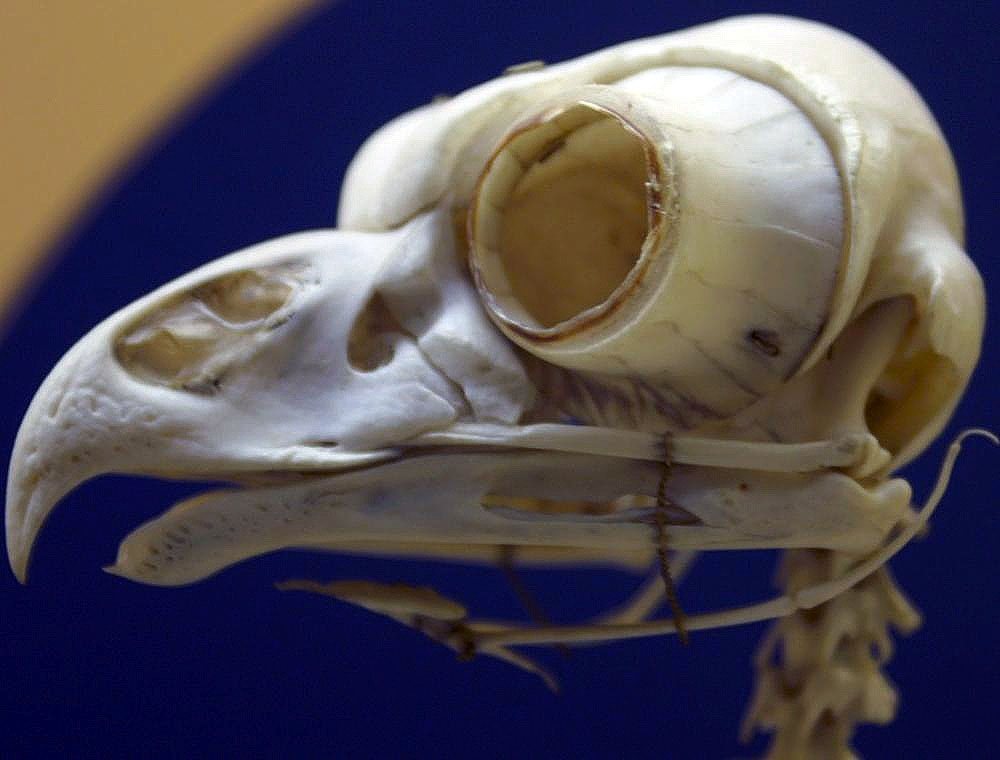
Next, look at the eye sockets, called orbits. In an owl they are huge, round and aimed forward rather than out to the sides. The Alabama Cooperative Extension System notes the forward-facing eyes that set owls apart from hawks, and in a cleaned skull that shows up as two wide openings that seem far too big for the rest of the head.
The braincase behind them is short and broad, so the whole skull looks compact. The beak is strongly hooked, but hawks, eagles and falcons have hooked beaks too, so treat the hook as a raptor clue and not as proof of an owl. It counts only when it comes with those oversized forward orbits.
Finally, peer inside each socket. Many birds have a scleral ring, a circle of small, overlapping bony plates that supports the eye, and a study of the avian eye, orbit and sclerotic ring describes how closely it fits the orbit. In a cleaned owl skull, that ring can survive as a delicate collar of bone sitting in the opening.
If you would like to compare your find with a known specimen, the Florida Museum of Natural History has a North American barn owl skull, *Tyto alba pratincola*, collected in Broward County, Florida, with a 3D model you can turn on screen.
Is it an owl skull? Five things to check
Tap a card to bring it forward.
- Beak and no teeth: A bird skull, not a mammal skull.
- Very large forward-facing orbits: The strongest single owl clue.
- A bony ring inside the orbit: The scleral ring, which supports the eye.
- A hooked beak: A raptor feature shared with hawks, so never use it alone.
- Ear openings at different heights: Present in some owl species and absent in others.
Why owls have such big eye sockets
An owl's eyes are not the round, rolling eyeballs you might expect. The British Trust for Ornithology explains that they are tubular, shaped more like short telescopes than marbles, and that they are held rigidly in place. They are built for seeing in low light, and they barely move at all.
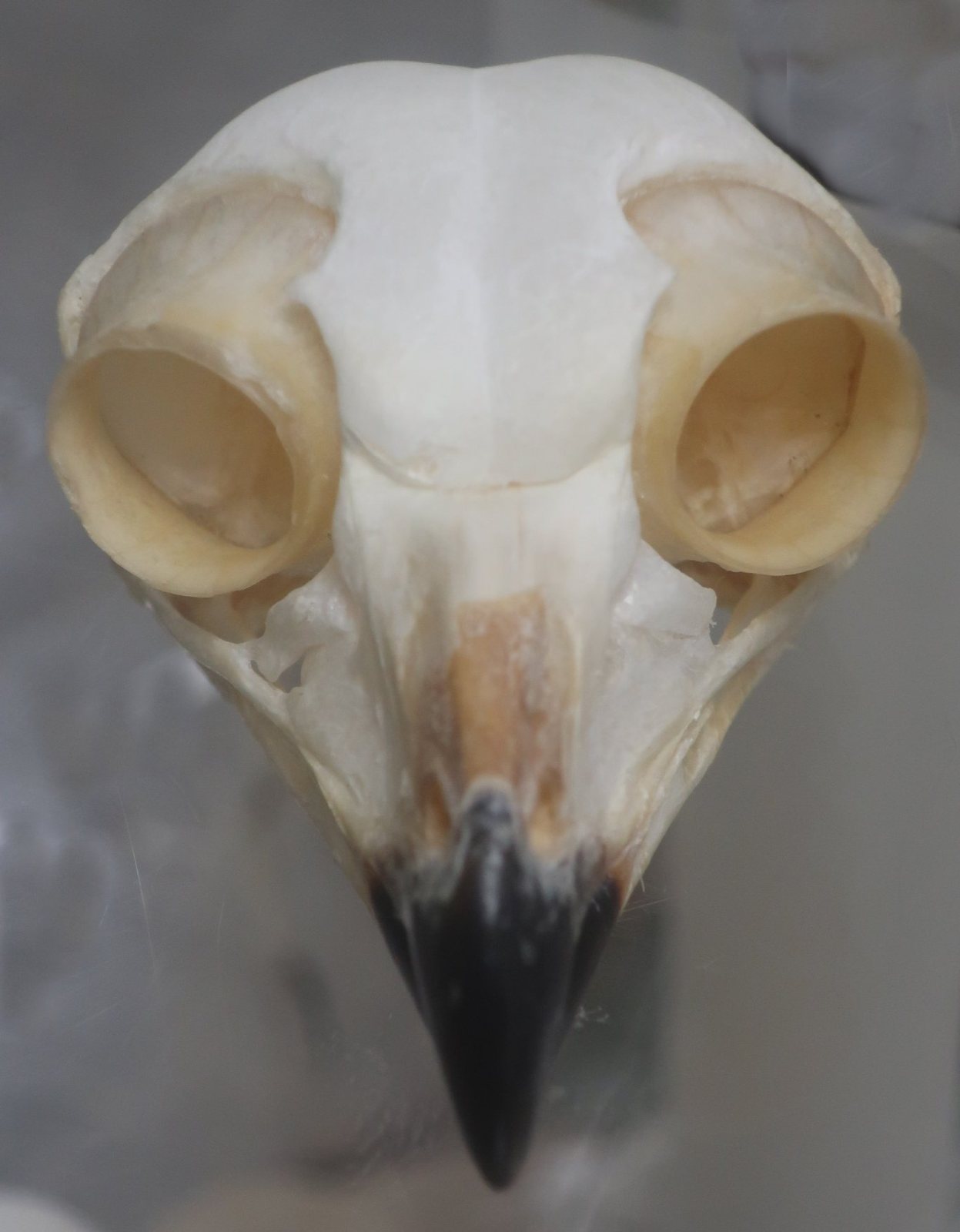
That has two results you can see. The first is the skull itself: eyes that big need room, so the orbits swell until, by the BTO's estimate, the two eyes fill at least 70% of the skull's volume. A skull you can hold in one palm ends up being mostly window.
The second result is the famous head turn. Because an owl cannot roll its eyes to follow something, it turns its whole head instead, which is why owls swivel so far around.
The scleral ring is part of the same design. Those small plates form a bony support for the eye inside its large orbit. When you spot a ring of tiny plates in a skull, you are looking at part of the frame that held that telescope.
The ears you can see in the bone
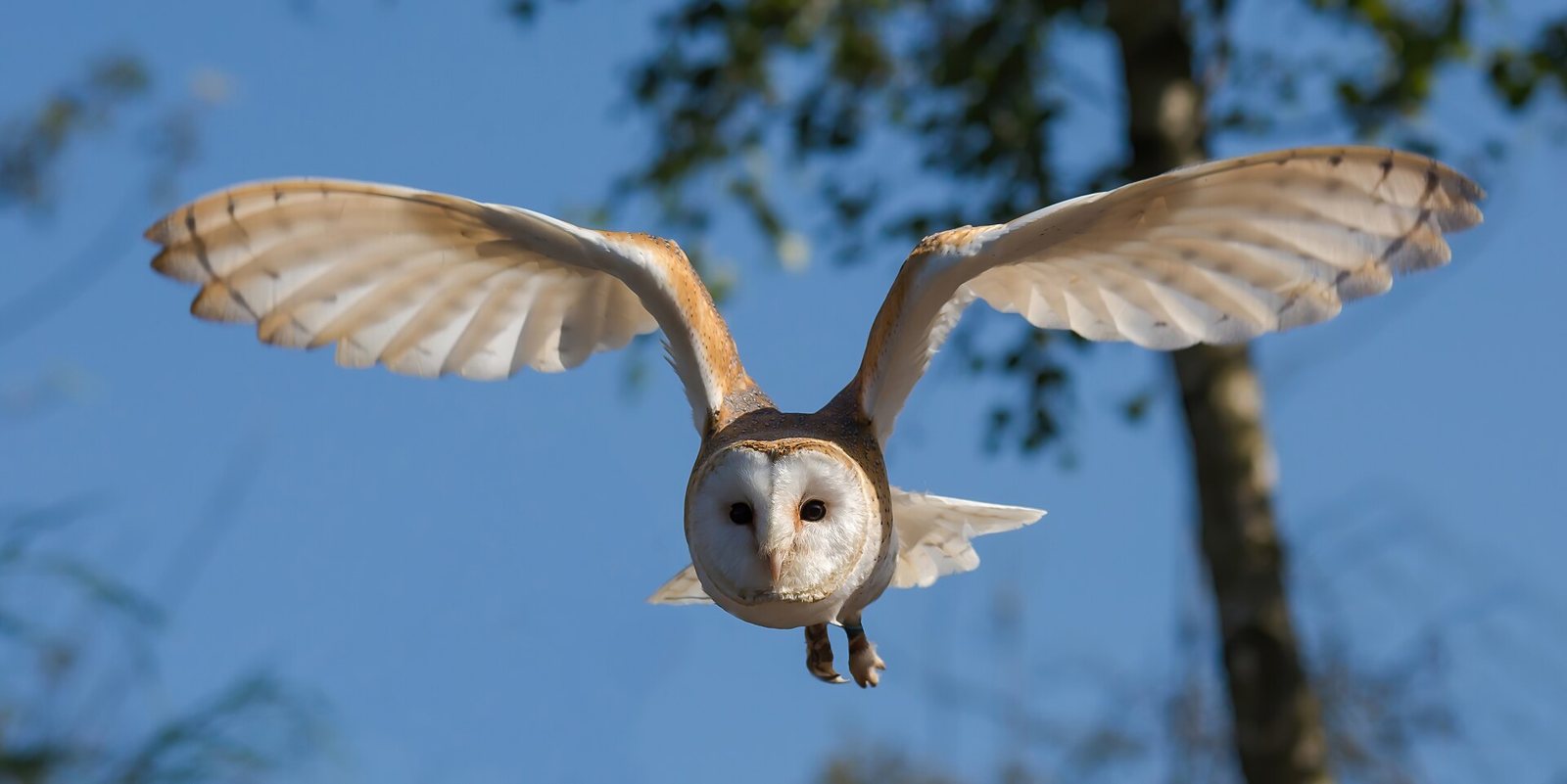
Owls hunt by ear as much as by eye, and some species carry the proof in their skulls. In the American barn owl, *Tyto furcata*, the outer ear openings sit at different heights on the two sides of the head. The heart-shaped feather disc of the face, the facial ruff, funnels sound toward them.
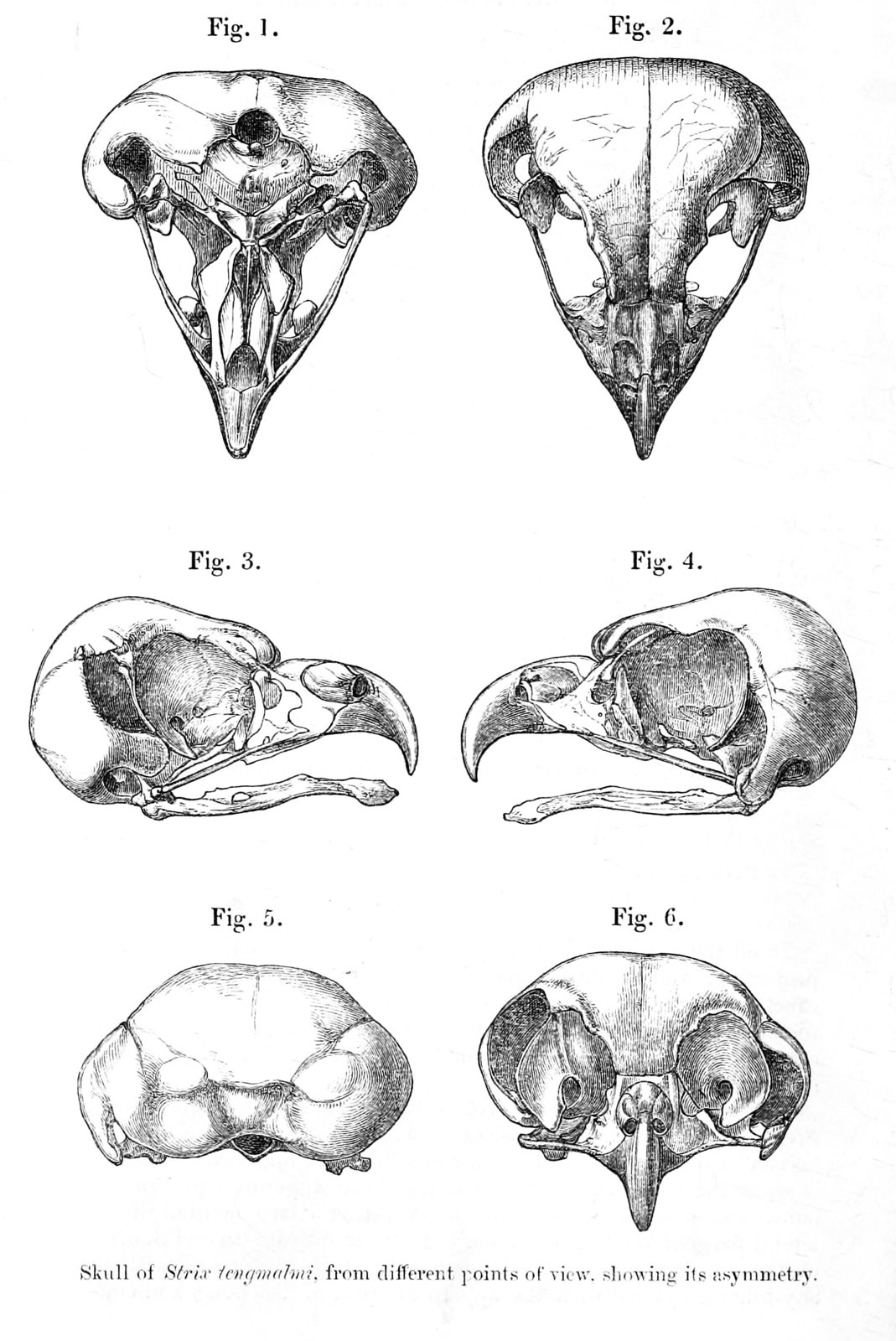
Because one opening is higher than the other, a sound from above or below reaches the two ears at slightly different loudness. A review in the Journal of Comparative Physiology A explains how barn owls use that difference to judge whether prey is above or below them, and credits Roger Payne's 1971 work with making the barn owl a major model for studying how animals locate sound.
Not every owl is built this way. In 1990, Volman and Konishi compared four species: burrowing owls and great horned owls, which have symmetrical ears, and barn owls and long-eared owls, which have asymmetrical ones. Their results showed barn owls using differences in loudness between the ears to place a sound up or down, and differences in timing to place it left or right.
For your skull, that means a lopsided ear region can be a helpful owl clue. A tidy, symmetrical one does not rule an owl out.
Barn owl or great horned owl?
These are two of North America's best-known owls, and size is the first hint. The barn owl, *Tyto alba*, has a smaller, more lightly built skull. The great horned owl, *Bubo virginianus*, has a noticeably heavier, sturdier one that matches a much bigger bird.
Museums keep reference specimens of both. Beside the Florida Museum barn owl, the Smithsonian has a male barn owl skull, *Tyto alba pratincola*, catalogued as USNM 610963, with a public-domain image record. The University of Alaska Museum of the North lends a hands-on bird kit to educators that includes great horned owls.
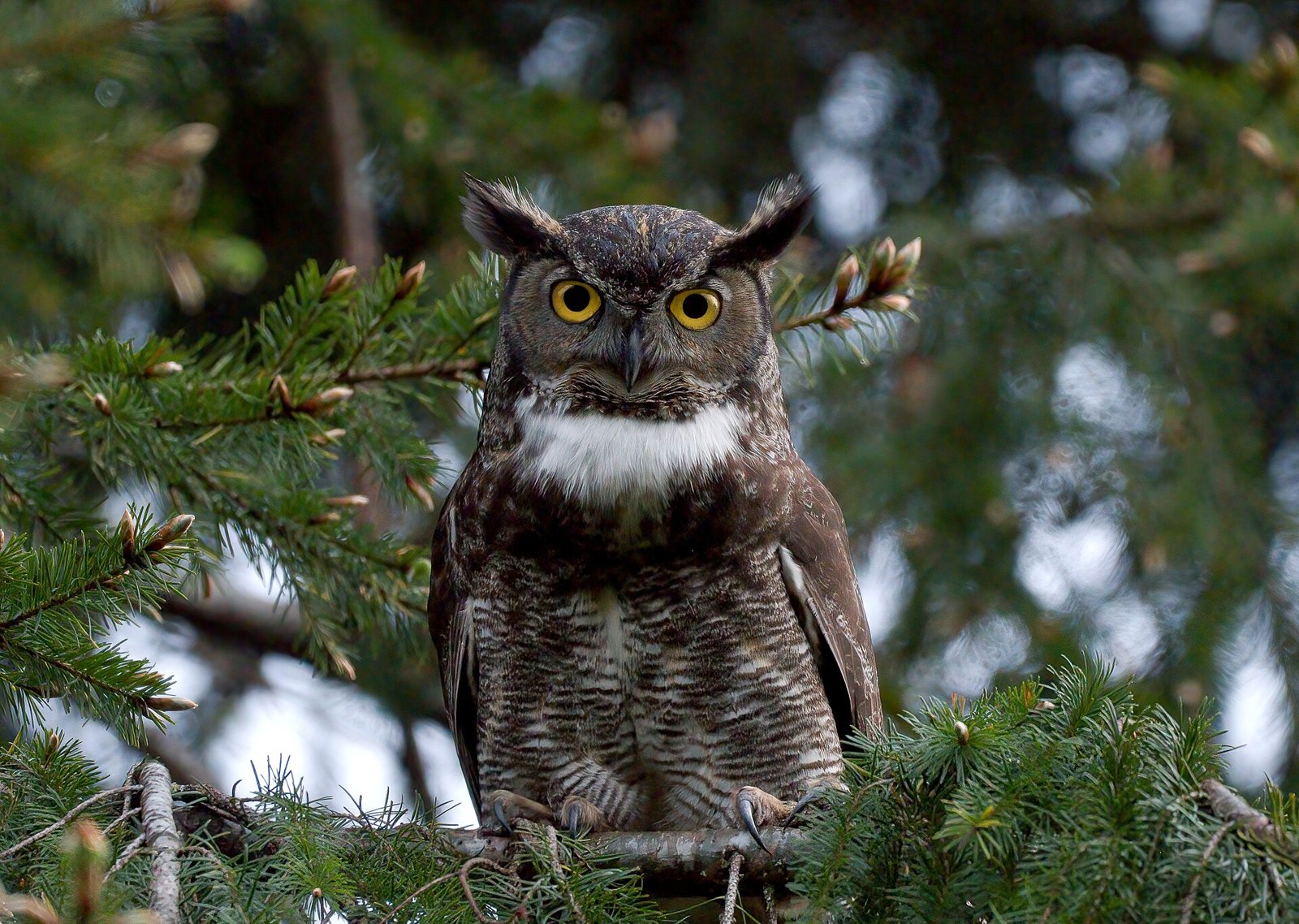
You may know the living birds by their faces. The Kentucky Department of Fish and Wildlife separates them by the barn owl's heart-shaped face with no ear tufts and the great horned owl's tufts and rounder face. Those are feather traits, though, and they disappear with the feathers. To name the species of a bare skull with confidence, compare it with a curated museum specimen or a regional bone key.
Tap or hover a row to highlight it.
| Trait | Barn owl | Great horned owl |
|---|---|---|
| TraitScientific name | Barn owl*Tyto alba* | Great horned owl*Bubo virginianus* |
| TraitSkull build | Barn owlSmaller and more lightly built | Great horned owlHeavier and sturdier |
| TraitFace of the living bird | Barn owlHeart-shaped, no ear tufts | Great horned owlRounder, with ear tufts |
| TraitEar openings | Barn owlAsymmetrical | Great horned owlSymmetrical |
Owl, hawk or crow?
All three have beaks and no teeth, so the beak alone will not settle it. Hawks share the hooked bill, but telling hawks apart from bone leans much more on measurements: the length and width of the skull, the shape of the nasal openings and the shape of the braincase.
That measured approach is how professionals work. Spain's Ministry for the Ecological Transition published a raptor bone guide, the *Guía de identificación de rapaces ibéricas por restos óseos*, which separates birds of prey, including the eagle owl, *Bubo bubo*, by skull length, width, nasal openings and the bony nasal process.
A crow, from the genus *Corvus*, is toothless too, but it normally lacks the owl's massive forward-facing orbits. The Cornell Lab of Ornithology explains how to tell crows from ravens by size and shape, though its notes describe the living birds rather than their skulls. If ravens are on your mind for other reasons, our story on the raven and skull as a pairing covers that side.
When the answer still is not clear, photograph the skull from above, from below and from both sides, with a ruler beside it. Send those photos to a natural history museum, a university ornithology collection or your state wildlife agency and ask for an identification. For bird skulls more broadly, our bird skull meaning story is a good companion read.
Found beside an owl pellet?
Owls cough up the parts of their prey they cannot digest as a compact pellet. The Vanderbilt University owl pellet bone chart shows how much survives inside: skulls, beaks, claws and teeth.
So, a skull lying near a pellet may well be the owl's dinner, not the owl. Go back to the first check. A tiny skull with teeth is a mammal, often a rodent, and our rat skull story can help with that. A tiny skull with a beak is a small bird. If you are ever unsure whether bones are animal or human, how to tell a human skull from an animal skull is the place to start.
Can you keep an owl skull?
This section is general information, not legal advice, and laws differ by country and by state. In the United States the answer for owls is clear: without a permit, you may not keep one.
The Migratory Bird Treaty Act of 1918 protects native migratory birds and their parts. The U.S. Fish and Wildlife Service explains that possessing feathers or other parts of native North American birds without a permit is prohibited, and that this includes birds that died naturally or were picked up dead. The agency's Feathers and the Law page names feathers, bones and whole specimens. Owls, the barn owl among them, are on the federal list of protected birds, which USFWS updated in 2023 (USFWS, as of October 2026).
Limited permits do exist, for set scientific, educational, public and cultural purposes. Without one, the kind move is simple: photograph the skull where it lies, leave it there, and contact your state wildlife agency or the nearest USFWS office. Our story on what to do after finding an animal skull walks through who to call for other species.
Owls, ears and the law: key dates
Tap or hover a step to follow the order.
1916
The United States and Great Britain, on behalf of Canada, sign a convention to protect migratory birds.
1918
The Migratory Bird Treaty Act becomes US law.
1936
The United States and Mexico sign their own migratory bird convention.
1971
Roger Payne publishes foundational work on how barn owls locate sound.
1990
Volman and Konishi compare sound location in four owl species.
2023
USFWS updates the federal list of protected birds.
Owl skull questions, answered
A few more questions come up once the main checks are done.
What does an owl skull look like?
An owl skull is light, broad and compact, with two huge forward-facing eye sockets and a curved, hooked beak. Some cleaned skulls still hold a ring of small bony plates in each socket, and in species such as the barn owl the two ear openings sit at different heights.
What is the ring of bone inside an owl's eye socket?
It is the scleral ring, a circle of small bony plates that supports the eye inside the orbit. It does not survive in every cleaned skull, so a skull without one can still be an owl.
Do all owls have lopsided ears?
No, only some species do. Barn owls and long-eared owls have asymmetrical ear openings, while burrowing owls and great horned owls have symmetrical ones, according to Volman and Konishi's 1990 comparison.
How can I find out which owl species my skull came from?
Compare it with a curated museum specimen or a regional bone key, because feather traits such as ear tufts are gone once only the skull is left. Clear photos from four angles beside a ruler give a museum or wildlife agency what it needs to help.
Owl skull quiz
Answer every question to check.
Where to go next
Owls and skulls also share a long history in art and symbolism, and our story on the owl and skull meaning picks up that thread. For the bones themselves, a museum's reference collection is the best next stop, and your photographs are the best thing to bring.
Terms in this story
Tap a term to see what it means.
Orbit. The bony eye socket of the skull. In owls the orbits are very large and face forward.
---